


In this guide
The Fender Jaguar is the guitar that failed twice and won anyway. Introduced in 1962 as Fender’s most expensive, most feature-laden flagship — bristling with chrome plates, switches, a string mute, and a 24-inch short scale Fender claimed was “faster, more comfortable” — the Jaguar was meant to lure players away from Gibson and crown the Fender lineup. Instead, it never matched the sales of the cheaper Stratocaster and Telecaster, found a brief home in surf music just as that wave was breaking, and was unceremoniously discontinued in 1975.
And then something extraordinary happened. Those forgotten, unwanted Jaguars sat cheap in pawn shops — and a generation of punk, grunge, and indie musicians who couldn’t afford a “real” Fender picked them up. Chief among them was Kurt Cobain, who slung a battered left-handed Jaguar during Nirvana’s world-changing rise and almost single-handedly transformed alternative rock from niche to global phenomenon. Johnny Marr, John Frusciante, Kevin Shields, Thurston Moore — the Jaguar became the offset weapon of the alternative generation. The guitar nobody wanted became a cult icon.
This guide covers the full Jaguar story: the ambitious 1962 origins, the short-scale design and its consequences, the famous strangle switch and elaborate controls, the specs, the players who immortalized it, tone recipes, the crucial Jaguar-versus-Jazzmaster question, and whether this short-scale offset belongs in your hands.
The Origins: Fender’s Feature-Laden Flagship
By 1962, Leo Fender had built an empire on three guitars: the Telecaster (1951), the Stratocaster (1954), and the Jazzmaster (1958). The Jaguar would be the fourth and final instrument in Fender’s original “big four” standard guitar lineup — and the only one born in the 1960s.
Fender designed the Jaguar to be its new top-of-the-line model, even more upscale and feature-rich than the Jazzmaster. It shared the Jazzmaster’s offset-waist body and floating tremolo, but Fender packed it with deluxe upgrades and innovations aimed at making it the most advanced electric guitar on the market. The company’s literature promised “faster, more comfortable” playing, and it was promoted heavily to the Southern California surf scene — even endorsed by Brian Wilson of the Beach Boys. The Jaguar’s eye-popping array of colors, chrome, and controls signaled that, in Fender’s view, a new sheriff was in town.
The Key Design Differences from the Jazzmaster
While the Jaguar borrowed the Jazzmaster’s silhouette, it differed in crucial ways. The most significant was the scale length: the Jaguar used a shorter 24-inch scale (versus the standard 25.5-inch Fender scale), deliberately closer to Gibson’s 24.75-inch scale, which Fender marketed as faster and more comfortable. It also had 22 frets rather than the usual 21.
The pickups were different too. Where the Jazzmaster used wide, mellow “soapbar” single-coils prone to picking up radio interference, the Jaguar used narrower, brighter single-coils — similar to Strat pickups but mounted in notched metal “claw” cradles that shielded the electronics from radio noise and focused the magnetic field. This gave the Jaguar a brighter, sharper, more cutting and percussive voice than the warmer Jazzmaster.
The Jaguar also featured an even more elaborate control system, a built-in string mute (a foam-and-metal mechanism that never really caught on with players), and the deluxe chrome hardware befitting a flagship.
The Controls: Switches, Circuits, and the Famous Strangle
The Jaguar is famous — or infamous — for having one of the most complex control layouts of any production guitar, and understanding it is key to appreciating the instrument.
The Dual Lead/Rhythm Circuit
Like the Jazzmaster, the Jaguar has two separate circuits selectable by a slider on the upper bout. The “rhythm” circuit engages the neck pickup only, with its own roll-knob volume and tone controls preset to a warmer voice. The “lead” circuit is where the Jaguar gets really interesting.
The Lead Circuit Switches
Rather than a conventional pickup selector, the Jaguar’s lead circuit uses three individual slide switches on the lower control plate: an on/off switch for the neck pickup, an on/off switch for the bridge pickup, and — most famously — a “strangle” switch. The strangle switch is a high-pass filter that adds a capacitor to the signal, cutting bass and producing a thinner, tighter, more cutting and trebly tone. This bass-cut switch is one of the Jaguar’s signature sonic features, giving it a sharp, percussive bite unavailable on most guitars.
This elaborate switching gives the Jaguar genuine tonal versatility — but it also bewilders newcomers. The trade-off for all that flexibility is complexity, and like the Jazzmaster, some players love the options while others find them fiddly.
From Surf Flop to Alternative Icon
The Jaguar’s commercial story mirrors the Jazzmaster’s, but its cultural rescue came from a slightly different, harder-edged direction.
The Surf Era and the Decline
Introduced as surf music was already cresting, the Jaguar was adopted by surf guitarists who loved its bright, twangy voice and floating tremolo — but the surf fad was running out of wave. The Jaguar never matched the sales of the Tele and Strat, and as musical tastes shifted toward louder, heavier rock in the late 1960s, the Jaguar fell out of favor. It was discontinued entirely in early 1975, having spent years as an almost-forgotten stepchild of the Fender family.
Punk and the Cheap-Guitar Revival
That neglect became the Jaguar’s salvation. Because they were unwanted, vintage Jaguars (and Jazzmasters) were cheap on the used market through the late 1970s and 1980s — and cheap, distinctive, and modifiable made them perfect for punk and post-punk musicians who didn’t have Stratocaster money. The Jaguar went from relic to icon as punk’s far-reaching effects rippled through the underground. Tom Verlaine of Television and Will Sergeant of Echo & the Bunnymen were among the post-punk players who saw the offset’s potential.
Kurt Cobain — The Jaguar’s Patron Saint
The single most important figure in the Jaguar’s revival is Kurt Cobain. A left-handed player, Cobain bought a heavily modified 1965 Jaguar at a pawn shop early in his career — exactly the kind of cheap, overlooked offset that was abundant at the time. He played it throughout Nirvana’s intense, meteoric early-1990s rise, and as Nirvana transformed alternative rock from a small niche into a worldwide cultural phenomenon, the battered Jaguar became one of the most recognizable guitars in the world.
Cobain’s Jaguar was loaded with aftermarket humbuckers (DiMarzio pickups), unusual electronics with three control knobs, and a Gibson-style bridge — a player’s modification, not a collector’s piece. Fender honored him in 2011 (the 20th anniversary of Nevermind) with the Kurt Cobain Jaguar, a meticulous recreation of that exact guitar, in both left- and right-handed versions. Cobain also co-designed the Jag-Stang, a Jaguar/Mustang hybrid Fender released in 1995. His influence on the Jaguar’s status cannot be overstated — for an entire generation, the Jaguar is grunge’s Excalibur.
The Indie and Alternative Roster
Cobain was the spearhead, but he was far from alone. Johnny Marr — the jangle architect of The Smiths, later of Modest Mouse and The Cribs — became so associated with the Jaguar that Fender produced a celebrated, player-friendly signature model based on his vintage ’65. John Frusciante of the Red Hot Chili Peppers used the Jaguar for his rhythmic, percussive single-note work. John Squire of The Stone Roses, Rowland S. Howard of The Birthday Party, Kevin Shields, Thurston Moore, Black Francis, Brian Molko, PJ Harvey, and many more wielded Jaguars. The guitar became a fixture of indie, grunge, shoegaze, and alternative rock — and despite this, vintage Jaguars still fetch considerably less than vintage Strats and Teles, keeping them attainable.
Fender Jaguar: Full Specifications
Body and Construction
The Jaguar features an alder body in the offset-waist shape shared with the Jazzmaster, typically finished in gloss. The offset design balances comfortably when seated. Sunburst is the classic finish, with custom colors like Lake Placid Blue and Fiesta Red — often with matching painted headstocks — highly prized. The Jaguar is notably festooned with chrome control plates, which contribute to its distinctive look but also add weight; some Jaguars are quite heavy guitars.
Neck and Fretboard: The Short Scale
The Jaguar’s defining feature is its 24-inch short scale length, the shortest in Fender’s main lineup and significantly shorter than the 25.5-inch Strat/Tele/Jazzmaster scale. This shorter scale reduces string tension, making strings feel slinkier and easier to bend, and creates a more compact, “faster” feel under the fretting hand. It also subtly affects the tone, adding a touch of warmth and a different attack. The neck is bolt-on maple with a rosewood fingerboard, 22 frets, and dot inlays on vintage models. Neck profiles are typically a comfortable ’60s “C” shape.
The short scale is the single biggest thing to try before buying — players accustomed to a full-scale Fender will immediately notice the looser tension, which some love and others find takes adjustment.
Pickups: The Shielded Single-Coils
The Jaguar’s pickups are narrower single-coils mounted in notched metal “claw” cradles. The metal shielding reduces hum and radio interference (a problem with the Jazzmaster’s open soapbars) and focuses the magnetic field, giving the Jaguar a brighter, sharper, more cutting and percussive voice. These pickups were designed specifically for the Jaguar — they are not Stratocaster transplants — and original vintage Jaguar pickups are highly valued by collectors. The bright, jangly higher-midrange of the Jaguar is perfect for chiming clean arpeggios and razor-sharp rhythm work.
The Floating Tremolo and Bridge
The Jaguar shares the Jazzmaster’s floating tremolo system — expressive, with a gentle, longer travel ideal for subtle wobbles and surf shimmer, plus a trem-lock feature. It also shares the same floating bridge and its associated quirks: the long length of string behind the bridge produces sympathetic resonance (and the characteristic chiming sound when you strum behind the bridge, an effect Sonic Youth exploited), but strings can pop out of saddle slots during aggressive play. Modern Jaguars and many players’ modifications use Mustang-style bridges or aftermarket offset bridges to solve this.
The Sound: What Makes a Jaguar Special
The Jaguar’s sonic signature is bright, sharp, cutting, and percussive — the most trebly and aggressive-sounding of Fender’s offset and single-coil guitars. Where the Jazzmaster is warm and full, the Jaguar is snappy and biting. The shielded claw pickups deliver clarity and articulation, the short scale adds a slightly looser, warmer attack underneath that brightness, and the strangle switch lets you go even thinner and sharper for a razor-edged tone.
Clean, the Jaguar jangles and chimes beautifully — that razor-like tone is perfect for chorus-soaked arpeggios (think The Smiths) and percussive, funky single-note riffs (think John Frusciante’s rhythmic playing sounding big and bright). With distortion and fuzz, the Jaguar’s brightness keeps it cutting and present, which is part of why it worked so well for grunge and indie — it stays articulate even in a wall of noise. The sympathetic resonance from the floating bridge and the behind-bridge string length adds textural complexity that experimental players have long exploited.
It’s a guitar with character and bite, ideally suited to players who want clarity, jangle, and an aggressive edge rather than warmth and smoothness.
Tone Recipes: Dialing In Classic Jaguar Sounds
Recipe 1: Kurt Cobain Grunge Tone
The Nirvana sound is about quiet-loud dynamics — clean, chorused jangle in verses exploding into thick, bright distortion in choruses. Cobain’s modded Jaguar had humbuckers, but the brightness shines through.
- Guitar: Jaguar (humbucker-modded or bridge pickup), volume at 10
- Distortion: A muscular distortion/fuzz (Cobain favored a Boss DS-1 and Big Muff-style fuzz) for the loud parts
- Chorus: A chorus pedal (Small Clone) for the clean verses — the signature “Come As You Are” sound
- Amp: Loud, clean-ish with headroom
- Gain (amp): 4–5
- Bass: 6, Mids: 5, Treble: 6
- Technique: Switch between clean chorus and full distortion for the quiet-loud dynamic
Recipe 2: Johnny Marr Jangle (The Smiths)
Marr’s intricate, chiming, layered jangle is the definitive clean Jaguar sound — bright, articulate, and shimmering.
- Guitar: Jaguar, both pickups on, strangle switch engaged for extra brightness
- Amp: Fender clean (Twin or similar) with headroom
- Gain: 2 (clean)
- Bass: 4, Mids: 5, Treble: 7
- Effects: Light reverb, subtle compression, occasional chorus; arpeggiated picking is the key
Recipe 3: John Frusciante Percussive Funk-Rock
Frusciante’s rhythmic, percussive single-note and chord work sounds big and bright through a Jaguar’s cutting voice.
- Guitar: Jaguar, bridge pickup, volume at 8–10
- Amp: Marshall or clean amp at edge of breakup
- Gain: 3–4
- Bass: 5, Mids: 6, Treble: 6
- Effects: Light overdrive for grit; the percussive right-hand attack is the real sound
Recipe 4: Surf Twang (1960s)
Classic surf is all bright twang, heavy spring reverb, and floating-trem wobble — and the Jaguar’s brightness is tailor-made for it.
- Guitar: Jaguar, bridge pickup, strangle switch optional for extra cut
- Amp: Fender amp with spring reverb (Twin/Deluxe)
- Gain: 2 (clean)
- Bass: 5, Mids: 5, Treble: 7
- Effects: Maximum spring reverb; use floating trem for surf wobble
Jaguar vs. Jazzmaster: The Offset Decision
The Jaguar and the Jazzmaster are the two pillars of Fender’s offset world, and choosing between them is the central question for any offset buyer. They share the body silhouette and floating tremolo but differ in fundamental ways.
Scale Length
This is the biggest difference. The Jaguar’s 24-inch short scale makes strings slinkier, easier to bend, and gives a more compact feel — great for fast playing and players who like lower tension. The Jazzmaster‘s full 25.5-inch scale provides standard Fender tension and a bigger, fuller sound. If you want a looser, faster feel, the Jaguar wins; if you want standard Fender tension, the Jazzmaster does.
Pickups and Tone
The Jaguar’s narrower, shielded claw pickups are brighter, sharper, and more percussive — the “lead” voice. The Jazzmaster’s wide soapbar pickups are warmer, fuller, and rounder — the “rhythm” voice. This is arguably the most important practical difference: the Jaguar bites and chimes, the Jazzmaster sings and growls.
Controls
Both have the dual lead/rhythm circuit, but the Jaguar’s lead circuit adds the individual pickup on/off switches and the famous strangle (bass-cut) switch, making it even more elaborate. The Jazzmaster’s lead circuit uses a simpler three-way selector.
Which Should You Choose?
Choose the Jaguar for a brighter, snappier, more cutting tone, a slinkier short-scale feel, and the strangle switch’s extra bite — ideal for jangle, surf, grunge, and indie. Choose the Jazzmaster for a warmer, fuller voice, standard Fender scale, and a tone that excels with fuzz and wall-of-sound textures. Both are offset icons; the choice comes down to scale feel and bright-versus-warm. On the vintage market, Jazzmasters tend to be slightly more in demand due to the preference for longer scale, but the Jaguar has a passionate, Cobain-inspired following all its own.
Best Years and Models to Buy: A Buyer’s Guide
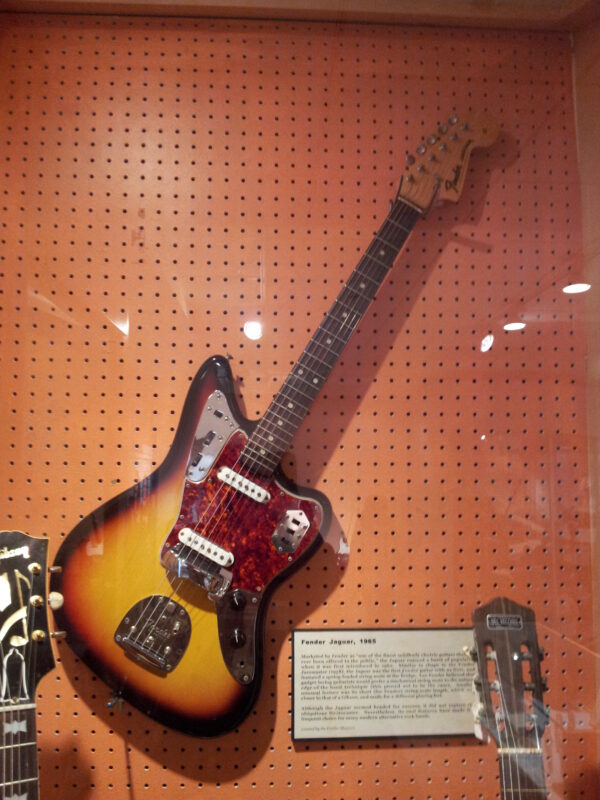
1962–1965 Pre-CBS Vintage — The Golden Era
1962, the first year of production, is the key vintage Jaguar year, but specs stayed consistent through the CBS takeover in 1965, so ’62–’65 examples tend to fetch similar prices. Early ’62 models have the desirable thicker “slab” rosewood fingerboard before the transition to a thinner, curved board. Original Jaguar pickups are critical to value — they were model-specific, not Strat transplants, and non-original pickups significantly reduce a vintage Jaguar’s worth. Pre-CBS Jaguars are prized, though still more affordable than comparable Strats and Teles.
1966–1975 — Later Vintage
Post-1965 CBS-era Jaguars (block inlays and binding arrived mid-1966) are more affordable vintage options with genuine character, right up until the model’s 1975 discontinuation.
Made in Japan Reissues
When Fender resumed Jaguar production, it did so first in Japan in the mid-1980s. These MIJ/CIJ Jaguars have a strong reputation — Japanese players had long embraced the surf-associated offsets — and are excellent value on the used market.
American Vintage and Modern USA Models
The first US-made Jaguar in nearly 25 years arrived in 1999 as the American Vintage ’62 reissue, acclaimed as the return of a classic. Modern American Original, American Professional, and 60th Anniversary models offer faithful vintage specs with modern refinements. The Ultra Luxe variant modernizes radically with humbuckers, a 25.5″ scale, and compound radius.
Player Series, Vintera, and Squier (Affordable Options)
Fender’s Mexico-made Player and Vintera Jaguars, and Squier’s Classic Vibe Jaguars, deliver the short-scale offset experience affordably. The Classic Player and HH models offer humbucker-loaded, modified versions (Tune-O-Matic bridge, 9.5″ radius) for under $1000 — more player-friendly and rock-oriented than the vintage spec.
Signature Models
The two key signature Jaguars both honor alternative icons. The Kurt Cobain Jaguar recreates Kurt’s modded humbucker Jag with the extra volume pot and three-way selector. The Johnny Marr Jaguar is a player-friendly masterpiece with Bare Knuckle pickups, a four-way selector (including series/parallel options), Mustang saddles, Staytrem stability mods, and dual upper switches — widely considered one of the best modern offset designs.
Living With a Jaguar: Practical Considerations
The Short Scale
The 24-inch scale is the first thing to adapt to. Strings feel slinkier and looser than on a full-scale Fender, which makes bending easier but can feel unusual at first, and may require slightly heavier strings to maintain feel and tuning. Some players use a heavier gauge (.011 or .012) to firm up the tension and reduce the floating-bridge quirks. Despite the shorter scale, there’s plenty of room for complex chords.
Weight
With all those chrome control plates and metal hardware, Jaguars can be on the heavier side. It feels good seated or standing, but be aware it’s not a featherweight guitar.
The Bridge and Tremolo
Like the Jazzmaster, the vintage Jaguar bridge can allow strings to slip during aggressive play. The fixes are the same: heavier strings, a Mustang bridge, or an aftermarket offset bridge (Mastery and others). The floating trem is expressive but built for subtlety, not divebombs. Modern and signature models often address these quirks out of the box.
The Control Learning Curve
The Jaguar’s array of switches is the most complex in Fender’s lineup. The simplest starting point: leave the rhythm/lead slider in “lead,” turn both pickup on/off switches on, and ignore the strangle switch until you want extra bite. Once comfortable, the controls offer genuine versatility.
Frequently Asked Questions
What is the “strangle switch” on a Fender Jaguar?
The strangle switch is the Jaguar’s famous bass-cut (high-pass filter) switch on the lead circuit. Engaging it adds a capacitor that rolls off the low frequencies, producing a thinner, tighter, brighter, and more cutting tone. It’s one of the Jaguar’s signature features, giving it a sharp, percussive bite that’s great for cutting through a mix and for surf and jangle tones. The nickname comes from how it “strangles” the bass out of the sound.
What’s the difference between a Jaguar and a Jazzmaster?
Both are offset Fenders with floating tremolos, but they differ in key ways. The Jaguar has a shorter 24″ scale (slinkier feel) and narrower, shielded “claw” pickups that are brighter and more percussive. The Jazzmaster has the full 25.5″ scale (standard tension) and wide soapbar pickups that are warmer and fuller. The Jaguar also adds individual pickup switches and the strangle switch. In short: Jaguar = brighter and slinkier; Jazzmaster = warmer and full-scale.
Why did Kurt Cobain play a Jaguar?
Kurt Cobain bought a heavily modified left-handed 1965 Jaguar at a pawn shop early in his career, when vintage offsets were cheap and overlooked. He valued it as an affordable, distinctive, modifiable instrument — his had aftermarket DiMarzio humbuckers and custom electronics. He played it throughout Nirvana’s rise, making it one of the most iconic grunge guitars. Fender released the Kurt Cobain Jaguar signature model in 2011 to honor him, and the guitar’s association with Cobain drove much of its modern popularity.
Is the short scale of the Jaguar good or bad?
It’s a matter of preference. The Jaguar’s 24″ short scale reduces string tension, making bends easier and giving a slinkier, more compact, “faster” feel that many players love — especially for fast passages. The downside is that players used to full-scale Fenders may find the looser tension unusual at first, and the floating bridge can be slightly more prone to quirks. Using heavier strings can firm up the feel. It’s neither good nor bad — just a distinctive characteristic to try before buying.
Is the Fender Jaguar good for metal?
The traditional single-coil Jaguar isn’t a classic metal guitar — its bright single-coils and floating bridge suit surf, punk, grunge, indie, and shoegaze better than modern metal. However, humbucker-equipped versions (like the Classic Player HH, Blacktop, or Kurt Cobain models with their DiMarzios) handle heavier music well, and the Jaguar’s cutting brightness keeps it articulate under distortion. For tight modern metal, a dedicated humbucker guitar is better, but the Jaguar excels at grunge-style heaviness.
Why are vintage Jaguars cheaper than Stratocasters?
Despite being Fender’s most expensive flagship when new in 1962, the Jaguar never matched the Strat and Tele in popularity, and was discontinued in 1975. For decades it was an overlooked “stepchild” of the Fender family, which kept vintage prices low — exactly why punk and grunge musicians could afford them. Even today, with their cult status, vintage Jaguars generally fetch considerably less than comparable vintage Strats and Teles, making them one of the better values in vintage Fender.
Are Jaguars hard to keep in tune?
Vintage-style Jaguars can have tuning quirks due to the floating bridge and tremolo, particularly strings slipping in the shallow saddle slots. The solutions are well-established: heavier string gauges, a Mustang or aftermarket offset bridge, and proper setup. The trem-lock feature helps maintain tuning if a string breaks. Modern and signature models (like the Johnny Marr, with its stability mods) largely solve these issues out of the box.
Final Verdict: Should You Buy a Fender Jaguar?
The Fender Jaguar is one of rock’s great comeback stories — Fender’s most ambitious flagship that flopped commercially, only to become a cult icon in the hands of punk, grunge, and indie musicians who saw beauty where the mainstream saw a forgotten relic. It carries the DNA of Kurt Cobain’s grunge revolution, Johnny Marr’s jangle, John Frusciante’s percussive funk-rock, and surf’s bright twang.
If you want a guitar with a bright, sharp, cutting voice, a slinky short-scale feel, the unique versatility of the strangle switch, and genuine alternative-rock credibility, the Jaguar delivers like nothing else. It’s especially suited to jangle, surf, grunge, indie, and shoegaze. The main considerations are the short-scale feel (try before you buy), the weight, and the learning curve of its complex controls — none of which are dealbreakers, and all of which are part of the Jaguar’s distinctive character.
If you prefer a warmer offset voice or standard Fender scale, the Jazzmaster is the natural alternative; if you want a more conventional Fender, a Stratocaster serves. But if you want the short-scale offset that grunge and indie made immortal — bright, biting, and brimming with character — the Jaguar is a guitar with a soul and a story. The flagship that failed became alternative rock’s enduring icon, and it’s never been more beloved than it is today.
Image credits
- 1965 Fender Jaguar, Museum of Making Music: photo by doryfour (Flickr), via Wikimedia Commons, CC BY-SA 2.0.
,_Museum_of_Making_Music.jpg)