Ani DiFranco’s Guitars & Gear: Percussion, Alternate Tunings and an Acoustic Sound Without Borders
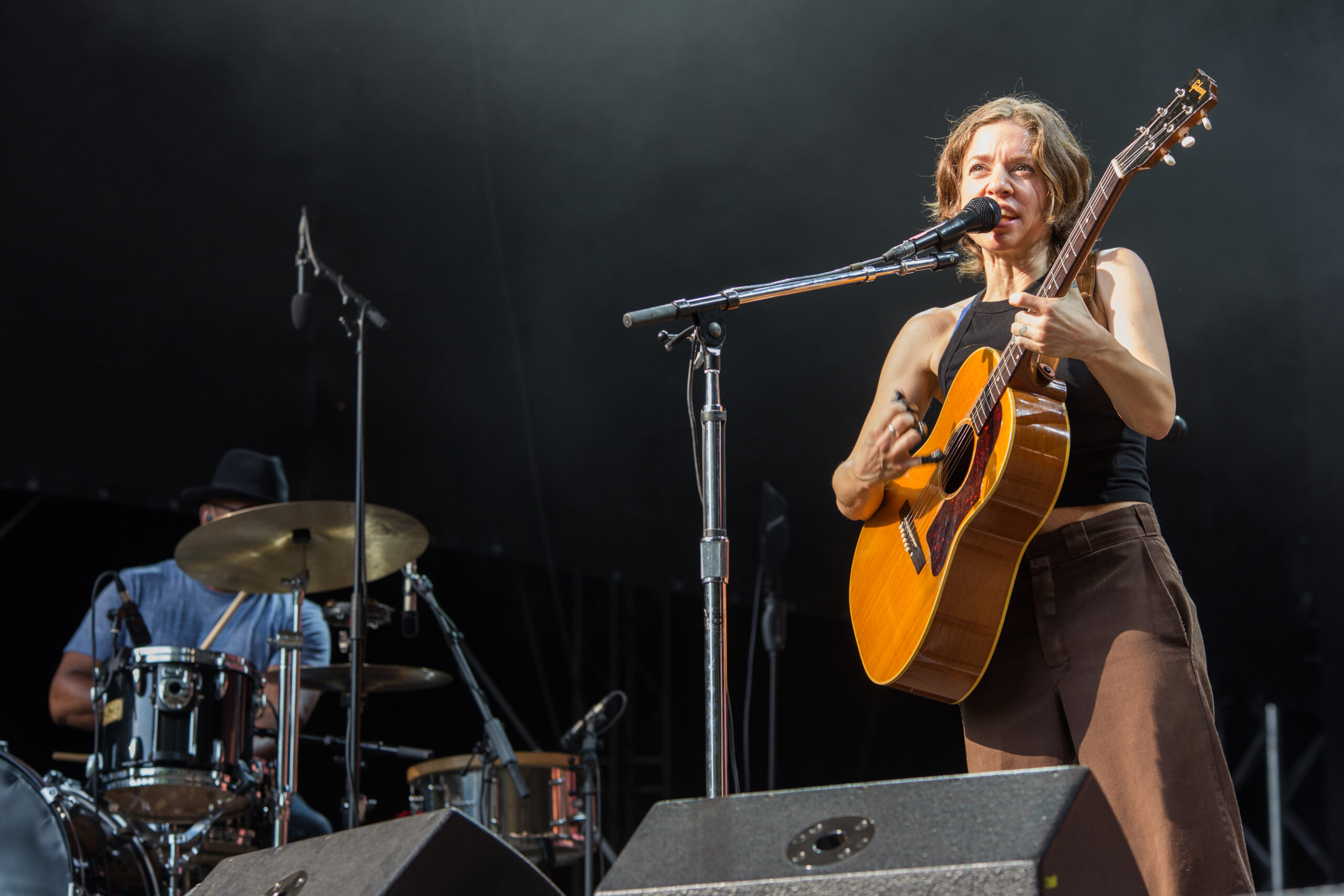
Ani DiFranco, Rudolstadt 2017. Photo: Carsten Stiller (Carstor).
Background
An acoustic guitar can supply the pulse, the low end and the interruptions that make a vocal phrase land. It can also become something whose acoustic origin is difficult to recognize. Ani DiFranco’s equipment history connects those possibilities: the guitar as a self-contained accompaniment, and the guitar as material a production can reshape. Understanding her rig therefore means asking more than which instrument sits in a rack. What job does that instrument do, and what happens to its sound after the strings move?
DiFranco founded Righteous Babe Records in 1990. Her official biography also identifies her 2019 memoir, No Walls and the Recurring Dream: useful anchors for a career in which authorship extends beyond writing songs to deciding how work reaches an audience.
In her 2005 Innerviews interview, she discussed different guitars as partners in the writing process. Knuckle Down, co-produced with Joe Henry, supplied another perspective on that process: a booked recording deadline concentrated her writing, while performing allowed songs to develop through their encounter with an audience. She also distinguished her conceptual leadership at Righteous Babe from Scot Fisher’s operational role.
Before those collaborations, Not a Pretty Girl arrived in 1995 with a deliberately pared-back conception. The official album account identifies Andy Stochansky’s drums and backing vocals alongside DiFranco’s guitar, bass and production. It is a useful starting point for an equipment history because it locates the rhythmic conception in the records, not merely in a later list of accessories.
Dilate followed in 1996, recorded across December 1995 and January 1996 at the Congress House in Austin. The official credits place acoustic, electric, steel and bass guitars among DiFranco’s instruments, alongside keyboards and percussion. “Adam and Eve” combines her acoustic and bass guitars with Stochansky’s drums; “Napoleon” supplies an electric-guitar counterpoint to the shorthand description of her as an acoustic performer.
Her official account of ¿Which Side Are You On? identifies a 2012 release co-produced with Mike Napolitano, with recording across 2010–11 at Studio in the Country, Brooklyn Bridge Studio and the Dugout. Adam Levy and Pete Seeger were among the guests; Seeger’s appearance on the title track followed a connection around his 2009 birthday celebration.
For Revolutionary Love, released in 2021, the official album notes describe songs developed on a pre-pandemic tour and a borrowed Brad Cook guitar that helped the writing. Principal recording took place at Overdub Lane in Durham, with Yan Westerlund on drums, Brevan Hampden on percussion and Phil Cook on keyboards. The basic recording happened over two days.
The official 2024 album account presents Unprecedented Sh!t as a largely remote collaboration with BJ Burton, with voice and guitar subjected to extensive processing. Its eleven tracks did not all originate at the same moment in her writing life.
Those three projects offer three different questions for a gear guide. How can a complicated acoustic part survive several simultaneous recording paths? How does a changed instrument prompt a different composition? And how much can a guitar sound be transformed while its rhythmic decisions remain important? The following guide treats these as connected questions, not competing schools of “real” and “processed” music. It follows documented equipment across specific periods rather than pretending every guitar and amplifier mentioned over decades belongs to one present-day stage setup.
The Rig: Ani DiFranco’s Guitars, Amps & Gear
Guitars
Alvarez-Yairi WY1
Premier Guitar’s 2017 inventory specifies WY1s with System 500 and Klark Teknik DN360 equalization.
Premier Guitar’s period inventories identify the WY1 as a Bob Weir signature model. Its current manufacturer specification includes a cedar top, rosewood body and a 25-inch scale, but the current electronics are not the historical System 500 equipment listed for DiFranco. The maker’s present catalogue describes today’s model, not a retroactive specification sheet for her guitars.
A WY1 is not a DiFranco signature model, and that distinction is useful rather than incidental. The model’s origin and the player’s application are separate histories. For this guide, the important connection is her sustained use of the instrument, including older onboard electronics; the manufacturer's specification is a reference for the product family. The setup that supported her writing belongs to the individual guitar and period.
Separate equalization also makes sense when several guitars must occupy one amplified arrangement. A similar output level does not guarantee a similar tonal balance. One instrument may put more energy into the region that masks a vocal; another may emphasize an attack that feels overly sharp through the PA. An instrument-specific correction addresses that difference before the player has to compensate with a completely different touch. It should not be confused with making every acoustic sound identical.
Cromwell G-4 Tenor
Acoustic Guitar’s November 2024 inventory identifies a Cromwell G4 tenor with a Fishman archtop pickup and the middle four strings of a six-string set. The same report names a one-off Alvarez YBM7C baritone with Matrix Infinity VT electronics.
The Cromwell offers a particularly concrete contrast with the WY1: four available strings rather than six. That changes which notes can be sustained together and the fingering routes between them. It does not prescribe a single genre or guarantee a higher register. In DiFranco’s ensemble context, the useful comparison is which harmonic information the guitar contributes while bass and drums supply other parts of the foundation.
The archtop-pickup reference also distinguishes this instrument from the undersaddle systems elsewhere in the inventory. The guitar’s physical construction, its strings and the way their vibration is converted into a signal all belong to the result. Calling both instruments “amplified acoustics” is accurate but leaves out precisely the differences a gear guide should explain.
Custom Alvarez Baritone
Premier Guitar’s January 2012 report, including technician Jason Kendall’s description and the accompanying inventory, specifies a custom Alvarez baritone: Masterworks mini-jumbo body, cedar/mahogany construction, ebony fingerboard, 25.5-inch scale, System 600, C-to-C tuning and .016–.070 strings. Its relationship to the later YBM7C is unverified.
Fishman describes the Matrix Infinity VT as an undersaddle pickup and active preamp system with soundhole volume and tone controls. Its tone adjustment combines a midrange reduction with increased bass and treble; a separate voicing option offers flat response or a bass-enhanced alternative. Those functions help explain the named system on the later baritone. They do not tell us which setting DiFranco used, and the VT should not be confused with Fishman’s separately named microphone-blending products.
Fishman offers wide, narrow and split-saddle versions of the system, with a 9-volt battery supply. Those installation formats are a practical reason not to treat the product name as a universal drop-in specification. Selecting the appropriate sensor depends on the instrument’s saddle arrangement; the 2024 artist report does not supply that installation detail.
An undersaddle sensor and a surface-mounted magnetic pickup do not take the same route from performance to electrical signal. The former operates at the saddle; the latter senses the strings magnetically. That distinction becomes relevant when comparing the reported baritone and Kay setups: a change in pickup technology is not simply a more expensive version of the same acoustic-microphone perspective.
Vintage Gibson and Epiphone Instruments
In 2017, DiFranco tentatively identified an early-1960s Gibson as an LG and associated older instruments with particular songs.
Her September 2024 Guitar World interview described a preference for vintage Gibsons of the 1950s and 1960s, loosely characterized as LG-1-type instruments, while Alvarez guitars remained in the picture. In that discussion, “Baby Roe” used tenor guitar and “New Bible” used ukulele.
The later sidebar prints Gibson LG-50, LG-3 and Epiphone Caballero FT-30 labels; exact identities and manufacture years remain incompletely reconciled.
What does survive the uncertainty is a more useful pattern than a collector’s checklist: small differences between instruments can become part of a composition’s identity. If a guitar encourages a particular spacing of notes, a particular attack or a comfortable physical gesture, changing the instrument may change the part even before any amplifier enters the picture. The relationship is not necessarily about rarity or monetary value. It can be about the familiar resistance and response around which a song was built.
The “GibsMart”
The 2017 studio favorite was the “GibsMart,” given to DiFranco by mentor Michael Meldrum: a Gibson rebuilt with a Martin top after damage.
Rubber-Bridge Kay and the Owl
Premier Guitar’s June 2021 feature describes the Brad Cook Kay loan and DiFranco’s subsequent commission of a counterpart from Reuben Cox at Old Style. Its equipment list includes rubber-bridge Kays, a DeArmond goldfoil pickup and a Carr Rambler house amplifier for Revolutionary Love. The article also places John Fahey among the music she heard growing up; John Fahey’s acoustic-guitar world offers a related route into instrumental storytelling.
By late 2024, the reported rubber-bridge Kay was baritone-tuned, with flatwounds and a Lollar surface-mount Gold Foil. A restored Owl carried Seymour Duncan Hot Rails. “Spinning Room” used rubber bridge; DiFranco connected its short decay with space between fingerpicked notes. These are dated reports, not a confirmed pickup-swap history for one Kay.
Attack and decay are separate parts of a note’s usefulness. An immediate transient can establish timing even when the following tone does not last very long. Conversely, a sustained chord can keep an accompaniment full while softening the distinction between successive gestures. For an arrangement built around carefully placed events, a shorter note may do more work than a longer one: it supplies an arrival and then leaves the next moment available.
Lollar’s current Surface Mount Gold Foil uses a fixed-height mounting arrangement; the manufacturer offers shims to accommodate different instrument geometries. Its product information describes a large oval magnet and recommends 250k controls. This is model-family context for the pickup named in the 2024 Kay report, not evidence that DiFranco’s guitar used those exact potentiometers or a particular shim configuration.
Seymour Duncan’s Hot Rails Strat design, by comparison, is a passive humbucker in a single-coil-sized format, with dual blades, a ceramic magnet and four-conductor wiring. The Owl report does not specify its exact Hot Rails variant, so the Strat product’s resistance values should not be transferred to that instrument. The meaningful family-level contrast is with the Gold Foil’s single-coil design, rather than an unsupported claim about DiFranco’s pickup output.
That puts the Kay and Owl in a different equipment conversation from an acoustic fitted only to reproduce its unamplified sound. Magnetic pickup architecture, the modified instrument and the amplified destination become part of the design. A guitar may begin with an acoustic body yet invite an electric-guitar approach to the signal. The important comparison is between the actual reported systems, not between an idealized “pure” acoustic and an assumed compromised one.
Other Documented Instruments
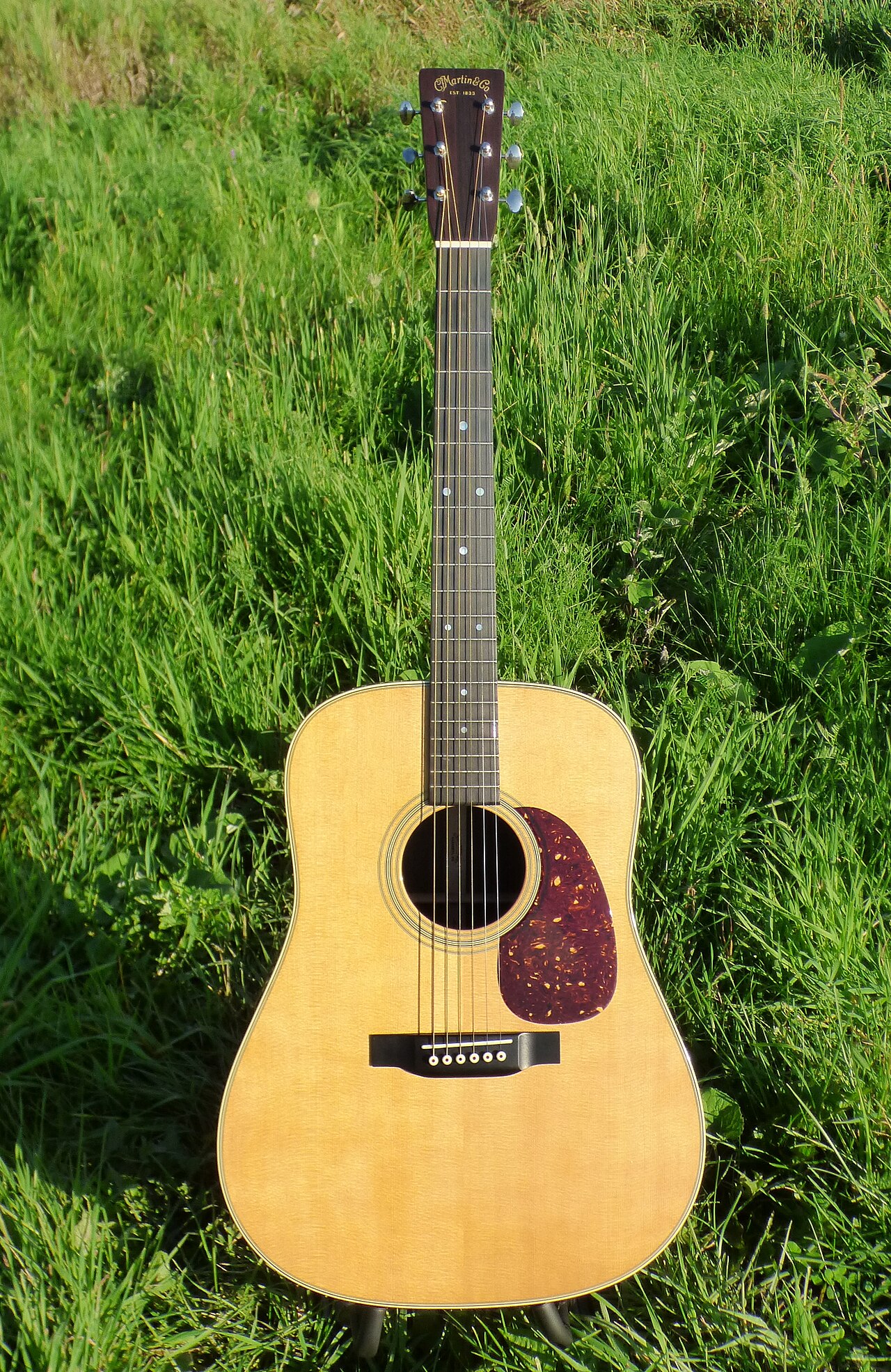
The 2012 feature names a Martin D-28 on “Mariachi” and “Unworry,” and a parlor instrument marked “Ted” for studio work. Its inventory also includes an Alvarez DY62C and an Epiphone Zenith tenor.

Complete Guitar List (Key Instruments)
These are dated key instruments, not an exhaustive collection or a verified current tour inventory.
| Instrument | Documented period | Role or useful distinction |
|---|---|---|
| Alvarez-Yairi WY1 | 2012/2017 | Recurring six-string; historical System 500 |
| Alvarez MSD1 | 2012/2017/2024 | Small-body alternative |
| Alvarez DY62C | 2012 | Listed six-string |
| Custom Alvarez baritone | 2012 | C-to-C setup; custom construction |
| Alvarez YBM7C | 2024 | Separately reported one-off baritone |
| Cromwell tenor, later identified as G-4 | 2017 inventory; 2021 caption; 2024 | Four strings; identification becomes more specific |
| Epiphone Zenith | 2012/2017 | Tenor alternative |
| Gibson LG-family instruments | 2017/2024 reports | “Piss Gibson” nickname belongs to 2017; later units not equated |
| “GibsMart” | 2017 | Rebuilt Gibson/Martin-top studio guitar |
| Epiphone Caballero FT-30 | 2024 | Reported vintage instrument |
| Kay rubber-bridge instruments | 2021/2024 | Distinct dated pickup descriptions |
| Restored Owl | 2024 | Hot Rails-equipped instrument |
| Martin D-28 | 2012 | Named song credits above |
| “Ted” parlor | 2012 | Studio use; maker unidentified |
The dates identify the reporting periods, not purchase or manufacture years. In particular, the two baritone entries and the two Kay-era descriptions remain separate rather than being collapsed into a fictitious single specification.
Amps
Magnatone Twilighter 260
In the 2012 Innerviews interview, DiFranco described recording an acoustic microphone, a direct feed, a clean/vibrato amplifier and a crunch amplifier, then overdubbing vocals. Her Magnatone Twilighter 260 is called a 1957 instrument there, while other published accounts place it in the 1960s. The exact year remains unsettled.
Pitch vibrato and amplitude tremolo are not interchangeable descriptions. The first moves pitch; the second moves level. That difference matters when a chord contains notes that already create complex beating or tension. Pitch movement can change the relationship the ear hears between those notes over time, whereas level modulation makes the whole event swell and retreat. Neither effect automatically creates the other, and the word “wobble” is too vague to tell a player which experiment to try.
A modulated amplifier also supplies a different component from an acoustic microphone. One presents the instrument’s unamplified event; the other can add an evolving electric layer. Blending those components allows clarity and movement to coexist instead of forcing one sound to do both jobs equally well. This explains the appeal of the architecture without assigning DiFranco undocumented speed, depth or microphone settings.
Rivera Sedona
That 2012 interview identifies a Rivera with a 15-inch speaker as the crunch source. It also describes an earlier oversized WY1 baritone experiment that disappointed her, followed by a more successful custom instrument, and reports 53 tunings at that point, organized with technician Jason Kendall.
A parallel crunch path need not become the whole guitar sound. Its most interesting contribution may be an edge that becomes noticeable when the playing grows forceful, while a cleaner path preserves the outline of the notes. Thinking in separate jobs helps here: one sound supplies the recognizable acoustic structure; another changes the density around it. Turning every source equally loud can obscure that division instead of strengthening it.
The Cabinet Configuration
The 2012 equipment list describes the Magnatone as a 2×12 combo and the Rivera Sedona with a 15-inch speaker. Those are documented combo configurations, not evidence of a separate wall of extension cabinets.
Speaker diameter is only one part of an amplified result. Enclosure, amplifier, placement and the signal being sent into the system also matter. A larger number printed on a speaker specification cannot determine whether an arrangement will have sufficient low end, and a second speaker cannot guarantee a wider recorded image. Those outcomes depend on how the system is used. For the reader, the configuration is useful historical information rather than a shortcut to a finished sound.
Studio Amplifiers
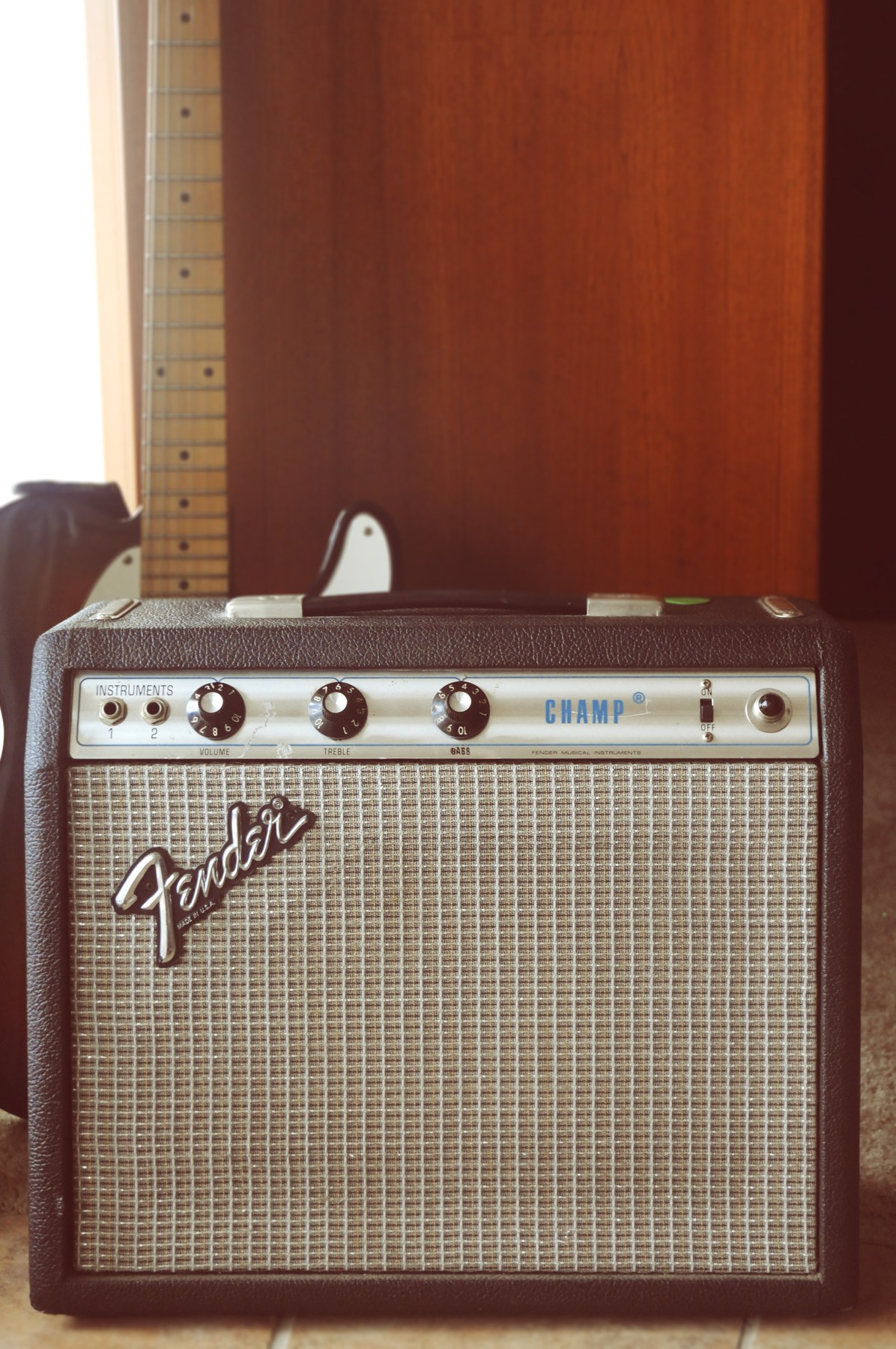
The 2017 report identifies studio Champ and live Rivera use; DiFranco sometimes omitted the recorded DI, keeping microphone and amplifiers.

Carr’s current Rambler information specifies a cathode-biased 5881/6L6 output stage, reverb, tremolo and selectable pentode/triode operation. Its page contains inconsistent power figures across different sections, so an exact rating is not resolved here. The manufacturer features supply context for the house amplifier named in the 2021 recording account; they do not identify the historical unit’s speaker. Premier Guitar’s 2021 inventory does explicitly report that its tremolo was engaged, without documenting the control settings.
The Rambler’s separate reverb, depth and speed controls show why naming an amp still leaves several possible sounds. A guitarist can use it without engaging those functions, or make the modulation central. The album-use evidence identifies the tool, not every choice made on its front panel. The same principle keeps the vintage Magnatone discussion useful: establish the relevant function, then distinguish it from undocumented settings.
Pedals
Complete Pedalboard (Documented)
The 2012 feature describes wah among the available colors, but does not establish a complete model-by-model pedalboard for the present day.
No comprehensive current board is verified in the sources used here. That is a direct answer rather than a missing shopping list. The documented setup already contains several ways to alter sound: the instrument, its tuning, instrument-specific equalization, amplifier coloration and recording treatment. Counting only floor pedals would overlook much of the actual decision-making. It would also encourage a misleading translation from “complex sound” to “many boxes,” when a complex arrangement can arise from the interaction of relatively few components.
Strings, Picks & Setup
The 2017 string list names D’Addario EJ16 (.012–.053), EJ17 (.013–.056) and EXP23 coated phosphor-bronze baritone strings (.016–.070).
That dated inventory gives a more practical answer than “heavy strings,” while stopping short of assigning one set to every instrument. The low-tuned baritone’s range is a different setup from either conventional acoustic set. String choice also interacts with the player’s attack: a forceful release can require a different compromise in action and feel from a gentle fingerpicked part. The published gauges are historical evidence, not a prescription to fit the heaviest set to an unrelated guitar.
Picks and nails are less completely documented in the evidence assembled for this guide than guitars and amplification. The playing discussion is grounded in fingerstyle testimony; it does not establish a never-uses-a-pick rule. No adhesive, nail-treatment or injury-management routine is needed to investigate the musical approach described below.


Playing Style & Tone Philosophy
The Pulse Is More Than Continuous Strumming
DiFranco told Guitar World in 2024 that her percussive fingerstyle grew through solo and bar performance. The discussion emphasizes dynamics and silence rather than an uninterrupted stream of strums. She also distinguished the low-register demands of solo work from the space needed when playing with a band.
That gives us a useful analytical starting point: a rhythm part is a distribution of events, not merely the repeated motion of a hand. A bass note, a clipped upper note and a pause can communicate a pattern without all three occurring on every beat. The ear receives information from the spacing as well as the attack. If the low note and chord always arrive together, they behave like one composite event. Separating their entrances can make one instrument suggest interacting parts.
On the official account of Not a Pretty Girl, the title track, “Shy” and “32 Flavors” belong to the same deliberately reduced recording conception. The presence of Stochansky alongside DiFranco is important: the record’s rhythmic identity is not evidence that one guitar was responsible for every percussive element.
For a reader comparing a solo performance with that album, a productive question is which rhythmic responsibilities move between guitar and drums. This avoids a familiar transcription trap: trying to force an entire recorded arrangement into the guitar part because the artist is strongly associated with that instrument. A solo adaptation may need a different distribution, not an imagined exact duplication.
Bass, Chord and Voice Have Different Jobs
For a singing guitarist, the accompaniment does not exist in isolation. The lowest note may establish direction while the upper strings supply color, but the voice still needs somewhere to enter. A technically impressive pattern can become less effective when every opening for a phrase is filled by another guitar gesture. This is an arrangement problem, not a judgment about how many notes a player should be allowed to use.
A low note under every chord can make harmonic direction explicit, but explicit is not always necessary when another player already supplies it. Removing a duplicated root can leave the character notes of a chord easier to hear. Conversely, in a solo passage a strategically placed low note can establish enough context for the upper part to become much freer. These are two arrangement tasks, which is why a tenor and a baritone can both be useful without offering interchangeable solutions.
Alternate Tunings Change the Route Through a Chord
The 2017 interview associates E–B–B–G–B–D with “Zizzing” and the earlier “Not a Pretty Girl.” That is one documented example, not a claim that a single alternate tuning explains her catalogue.
A tuning changes which pitches are available without fretting, but its importance extends beyond open strings. It reorganizes the distances a hand must travel between sounds. A progression that feels ordinary in one layout may demand a different gesture in another; a note that formerly required a finger may become available while that finger moves elsewhere. The physical route through the harmony changes, and that can change the rhythm of the part.
Repeated pitch classes can create another choice: the same harmonic identity may be available from more than one string, with a different physical position or tonal character. That lets an arranger think about continuity and interruption separately from simply finding a chord name. It does not mean that every repeated letter in a written tuning specifies the same octave. A complete practical setup needs the correct register and suitable strings, not just six note names copied from an article.
A Guitar Can Be the Beginning, Not the Final Timbre
The keyboard-like opening of “Spinning Room” was processed guitar, according to the 2024 interview. “The Knowing” likewise began with acoustic guitar that Burton transformed. The report does not identify a reproducible chain of plug-ins or settings.
For the guitarist, the interesting question is what remains useful after a sound changes category. The timing of the attack can survive a large change in spectral balance. The duration of a note can still decide whether a processed texture feels spacious or crowded. A small irregularity in articulation can remain expressive even when the source no longer resembles a conventional acoustic recording. The hand’s decisions are therefore not automatically erased by production.
The older parallel-amplifier approach and the later remote-production work offer two different degrees of separation between gesture and final sound. In one, recognizable acoustic and electric components can coexist. In the other, the source can become less identifiable. Neither method makes equipment irrelevant. It changes which equipment decision should come first: preserve a recognizable instrument, emphasize a component of its behavior, or let its performance drive a different sonic surface.
How to Sound Like Ani DiFranco
These are our practical starting points, not DiFranco’s published exercises, endorsed purchases or documented control settings. The objective is to explore the relationships that make her equipment history interesting: attack against space, register against arrangement, and a recognizable acoustic part against an altered second layer.
The Guitar
Start with a guitar you already know. Choose a short pattern containing one low note, one upper note and one compact chord. Keep the pitches unchanged for the first experiment. Play the low note with a firm beginning and let the chord arrive more softly; then reverse that balance. Record both versions. The question is not which is louder overall, but whether the accompaniment now implies a different center of gravity.
A four-string instrument, a low-register acoustic and a modified short-decay guitar are later branches of the experiment, not entry requirements. Each changes a different parameter. First establish which parameter your arrangement needs to change. If exploring unfamiliar tunings or gauges, have the setup assessed appropriately rather than assuming that historic specifications transfer to your instrument. Particularly, do not raise strings to unfamiliar pitches simply because a list of tuning letters lacks octave information.
The Amp
Build a clear foundation first. With an amplified acoustic, use a comfortable level and begin with a sound that allows the low pulse and upper articulation to remain distinct. Play the complete pattern before changing a control. An isolated chord can tempt you toward a pleasing sustained sound that becomes cumbersome when the actual rhythm starts.
If your existing equipment supports a separate colored path, add it quietly while leaving the cleaner foundation intact. Compare a short recording with and without that component at similar perceived loudness. A louder version often seems more exciting even when it is less articulate, so the comparison should not reward volume alone. Listen for the start and end of the low notes and the spaces before the upper notes.
A useful added layer should have a describable job. Perhaps it gives one accent a rougher edge or makes a sustained note move while the basic pattern stays clear. If its only contribution is that everything becomes larger and less distinct, reduce it before adding another effect. With a single simple amplifier, pursue the same priorities through touch and arrangement. Multiple recording channels are an option, not permission to postpone learning what the part needs.
The Essential Pedals
There is no verified universal Ani DiFranco pedal package to buy. If you already own equalization or modulation, use those functions selectively. Equalization can help a guitar occupy a useful region; it cannot rearrange a part whose low notes continually fight the bass. Modulation can add movement; it cannot replace the timing contrast between a sharply defined accent and a deliberate gap.
Try modulation on a held note first, then inside the entire pattern. Notice whether the effect changes your perception of the beat or merely the texture. A setting that is attractive on a sustained chord may interfere with a more articulated accompaniment. Keep the effect only if you can explain what improves in the full musical phrase. This is a more useful decision rule than matching an unverified knob position from a photograph.
Budget vs Authentic
The lowest-cost route is also a good diagnostic route: one existing guitar, a recording device and a short arrangement you can repeat. That setup tells you whether the idea works before a second signal path makes the result more complicated. A rare tenor, an old amplifier or a custom baritone may offer an inspiring response, but none automatically supplies the placement of notes around a vocal.
For the first purchase decision, distinguish three different needs: a new register, a new amplified pickup response or a new recording texture. A tenor addresses the first in a different way from a baritone. A pickup change concerns the second. An effect or amplifier may address the third without solving either of the others. Write down the missing function before comparing instruments; that keeps “authentic” from becoming shorthand for expensive but irrelevant.
For another perspective on the relationship between fingering and harmony, read Joni Mitchell’s guitars and alternate-tuning approach. For a contrasting route through song accompaniment and instrumental detail, explore Richard Thompson’s guitar and gear guide. Neither comparison means DiFranco uses the same setup or that their approaches are interchangeable.
Practice: Build a One-Guitar Rhythm Section
Build one complete phrase. Make a four-bar low-note pattern and add upper-string answers, with one planned point where the voices meet. Sing or hum a line over it. Record the result, then remove the upper attack that most obstructs a vocal entrance. Keep the pulse intact. This combines the rhythm and vocal-space questions into one musical task instead of treating speed or note count as the objective.
Change the arrangement, not everything at once. Add a bassist or a simple recorded bass line and remove selected low guitar notes. Keep the upper part recognizable. Then compare the full arrangement with your original solo version. The test is whether the guitar’s job has changed effectively; judging the isolated guitar track would miss the point of the tenor-versus-low-register distinction.
Make one production decision. Use the same recorded performance to compare a clean foundation with a small colored layer. Decide which moment benefits, and automate or perform that change only where it helps if your equipment permits. Keep the unprocessed version. This turns the parallel-path idea into an arrangement choice rather than an obligation to leave every component equally loud throughout the song.
Influence & Legacy
Independence Includes Changing the Recording Method
Educated Guess, released in January 2004, is a particularly concrete example of DiFranco taking control of the whole production. The official account credits her with all instruments and vocals as well as recording and mixing; Greg Calbi mastered it. Working in New Orleans and Buffalo, she used vintage reel-to-reel equipment and limited the recording to eight tracks. Environmental sounds, including rain and passing trains, were allowed into that setting.
Eight tracks impose a different kind of decision from an open-ended modern session. Even without claiming to know the individual tape assignments, the constraint makes it clear that adding a part has a cost in available recording space. A player producing a song must decide which performances carry several functions and which deserve a separate layer. That is a more concrete expression of self-direction than the assumption that independence simply means recording alone in a room.
For Reprieve in 2006, the official history names DiFranco and Todd Sickafoose as its two players. Recording began in her New Orleans studio in early 2005; Hurricane Katrina disrupted the process. After retrieving the recordings, she continued overdubs in Buffalo and later mixed back in New Orleans. Guitars coexist with keyboards and found sounds, and the account identifies an Omnichord among the available instruments. This was a different production situation from the touring ensemble or the eight-track solo project.
Those records help place the later Burton collaboration in a longer history. It was not necessary for every experiment to preserve the same combination of players, room or signal path. DiFranco could work alone, build a record around a small partnership or invite a producer to transform material remotely. The guitar remains central to the story without requiring every finished sound to advertise how it began.
What a Gear Guide Can Preserve
The strongest legacy argument here is not an unsupported list of artists supposedly influenced by her. It is the documented breadth of working methods available to a guitar-centered songwriter. A familiar acoustic, a borrowed guitar and a deliberately constrained recording setup are different kinds of resources. Some are repeatable commercial designs; others are relationships and circumstances that cannot be purchased as a signature package.
That makes the details worth getting right. The house amplifier should retain its studio role. A report from 2012 should not quietly become a claim about a current tour. Those distinctions let the reader see actual creative choices rather than a flattened list of brands. They also leave room for the next record to ask a different question.
FAQ
What acoustic guitars is Ani DiFranco known to have used?
Alvarez-Yairi WY1s, the smaller Alvarez MSD1, custom baritones, Cromwell and Epiphone tenors, Gibson-family instruments and modified Kays all appear in dated reports. The model-and-period table above separates those roles rather than presenting them as one current rack.
Is her Cromwell a six-string guitar?
No. The reported Cromwell G-4 is a four-string tenor, with a Fishman archtop pickup in the later inventory. Its exact use should be investigated song by song rather than assigning it a presumed universal tenor tuning.
Does she use one alternate tuning for everything?
No single tuning accounts for the documented approach. Different tunings and instrument roles recur across the history. Treat a published example as a route into that song’s harmonic layout, not as a universal master key or an instruction to retune an unsuitable string set.
Did DiFranco use the same Kay pickup in 2021 and 2024?
That is not established. The earlier account names DeArmond goldfoil equipment; the later account names a Lollar surface-mount Gold Foil. The two reports should remain dated descriptions, not a fabricated modification timeline for one instrument.
Which effects are necessary to start exploring her approach?
None is universally necessary. Begin with placement, dynamics and the length of notes. The documented sound-changing methods extend beyond pedals to instruments, equalization, amplifiers and studio processing, so a long pedal shopping list is not the most informative starting point.
Can one affordable guitar be enough?
Yes, for the musical experiments in this guide; no, as an exact substitute for every historical instrument. Start with the role you want to explore. A conventional six-string can test arrangement and dynamics, while a genuinely different register or pickup system may eventually require a different tool.
Image credits
- Top image: Ani DiFranco performing at Rudolstadt-Festival on 9 July 2017. Photo: Carsten Stiller (Carstor), Wikimedia Commons. Source notices: CC BY-SA 4.0 and CC BY 4.0. Original preserved; web version proportionally downscaled. No crop or other editorial alteration.
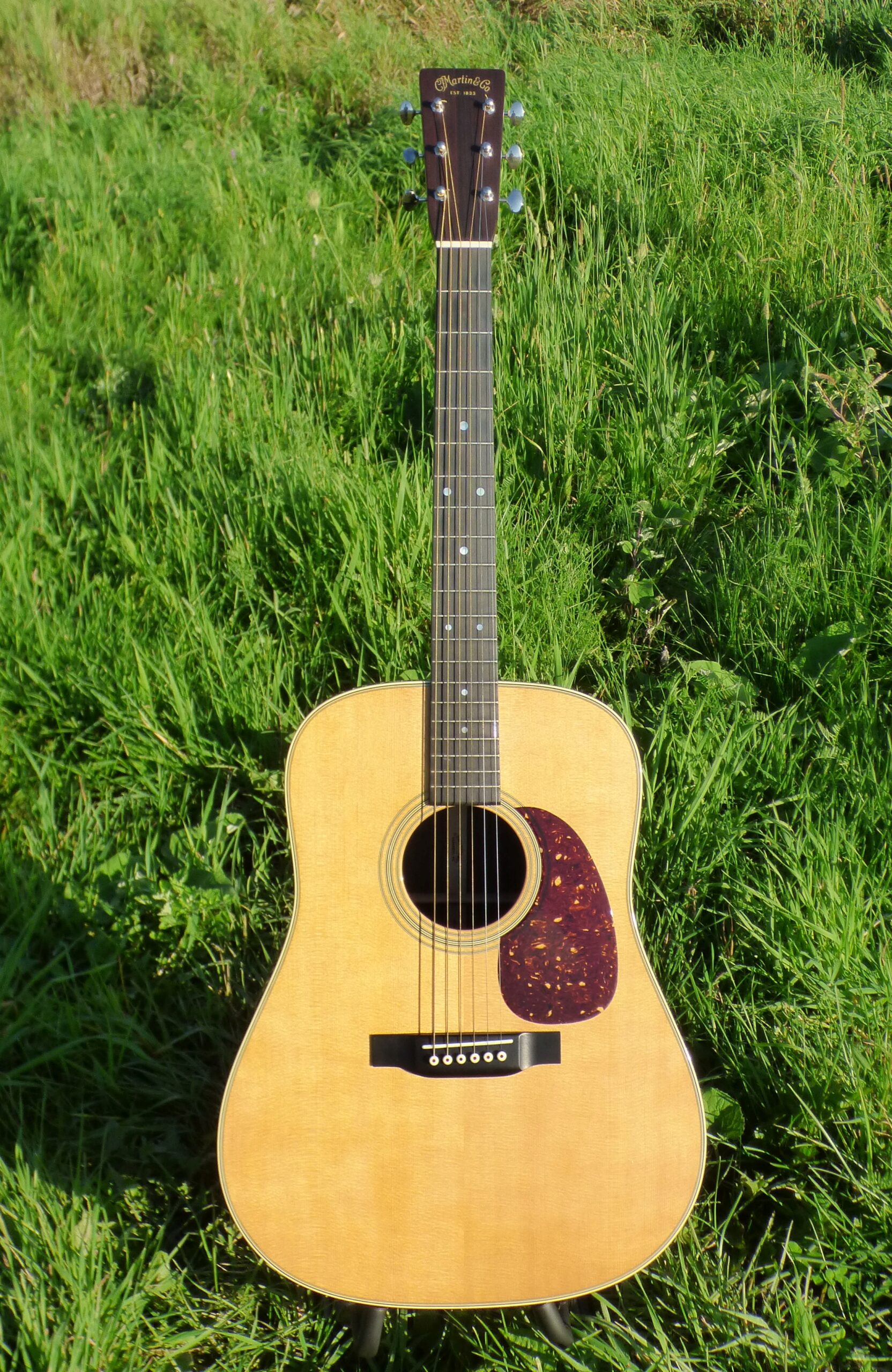
- A Martin D-28 acoustic guitar: Niranjan Arminius, Wikimedia Commons, CC BY-SA 4.0.
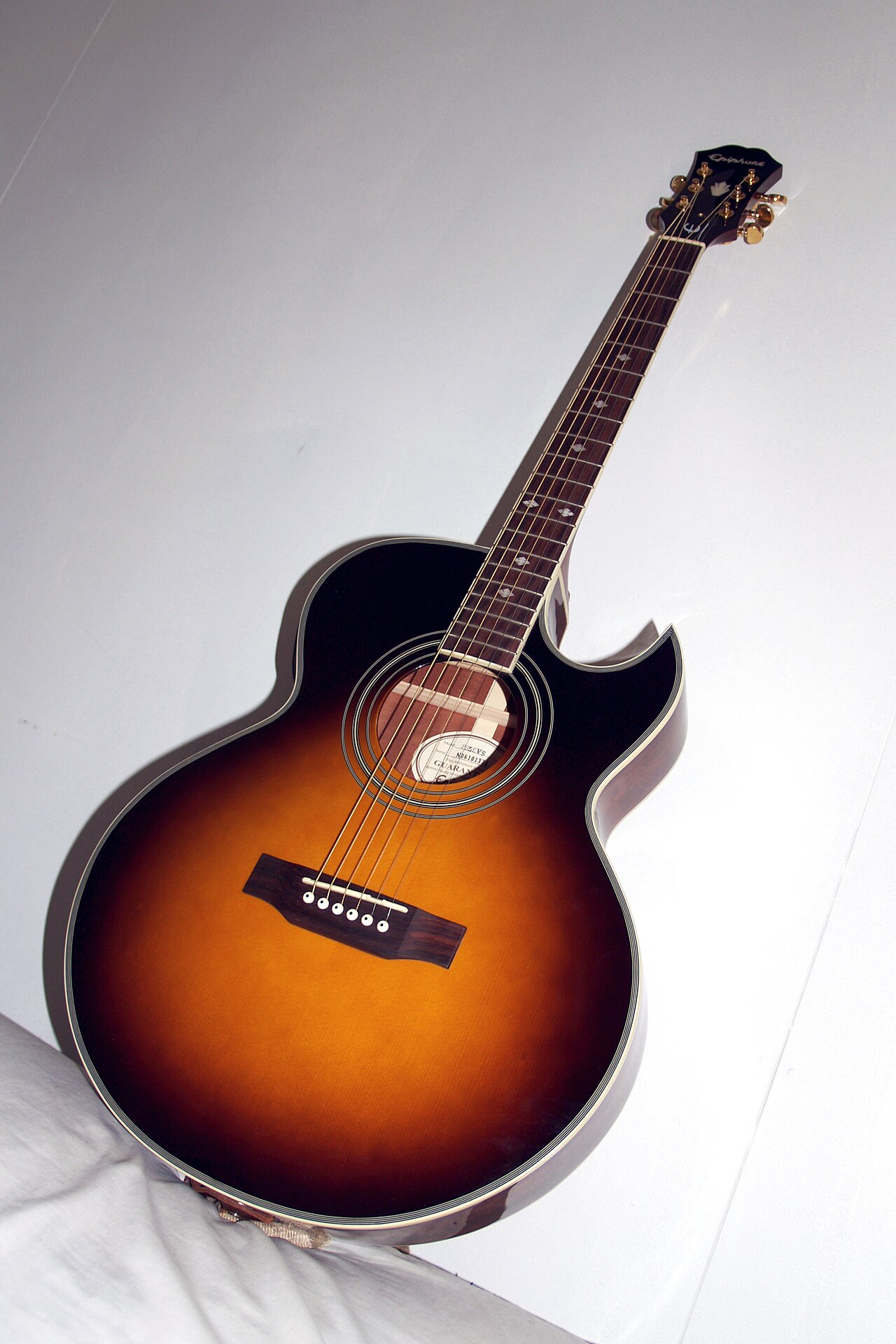
- An Epiphone PR-5E VS cutaway acoustic-electric guitar: Joshu∆ Byrd, Wikimedia Commons, CC BY 2.0.
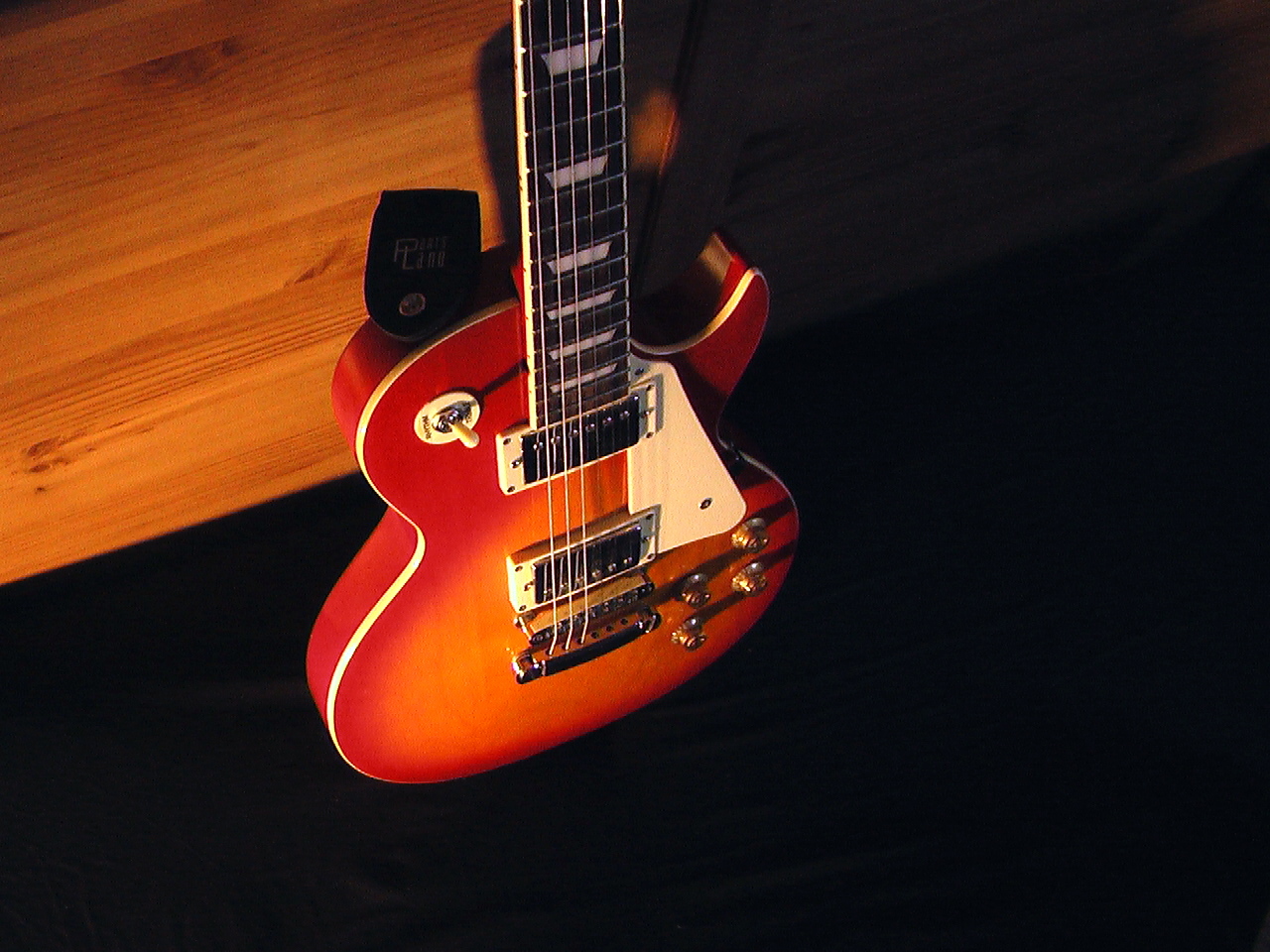
- A Gibson Les Paul with a sunburst finish: Delhovlyn, Wikimedia Commons, CC BY-SA 3.0.


