Mark Knopfler Guitars & Gear: The Complete Guide to Dire Straits’ Fingerstyle Master
Complete gear guide to Mark Knopfler — red 1961 Strat on Sultans of Swing, borrowed Vibrolux, Dan Armstrong compressor, volume pedal swell technique, no pick, and the most lyrical rock guitarist alive.
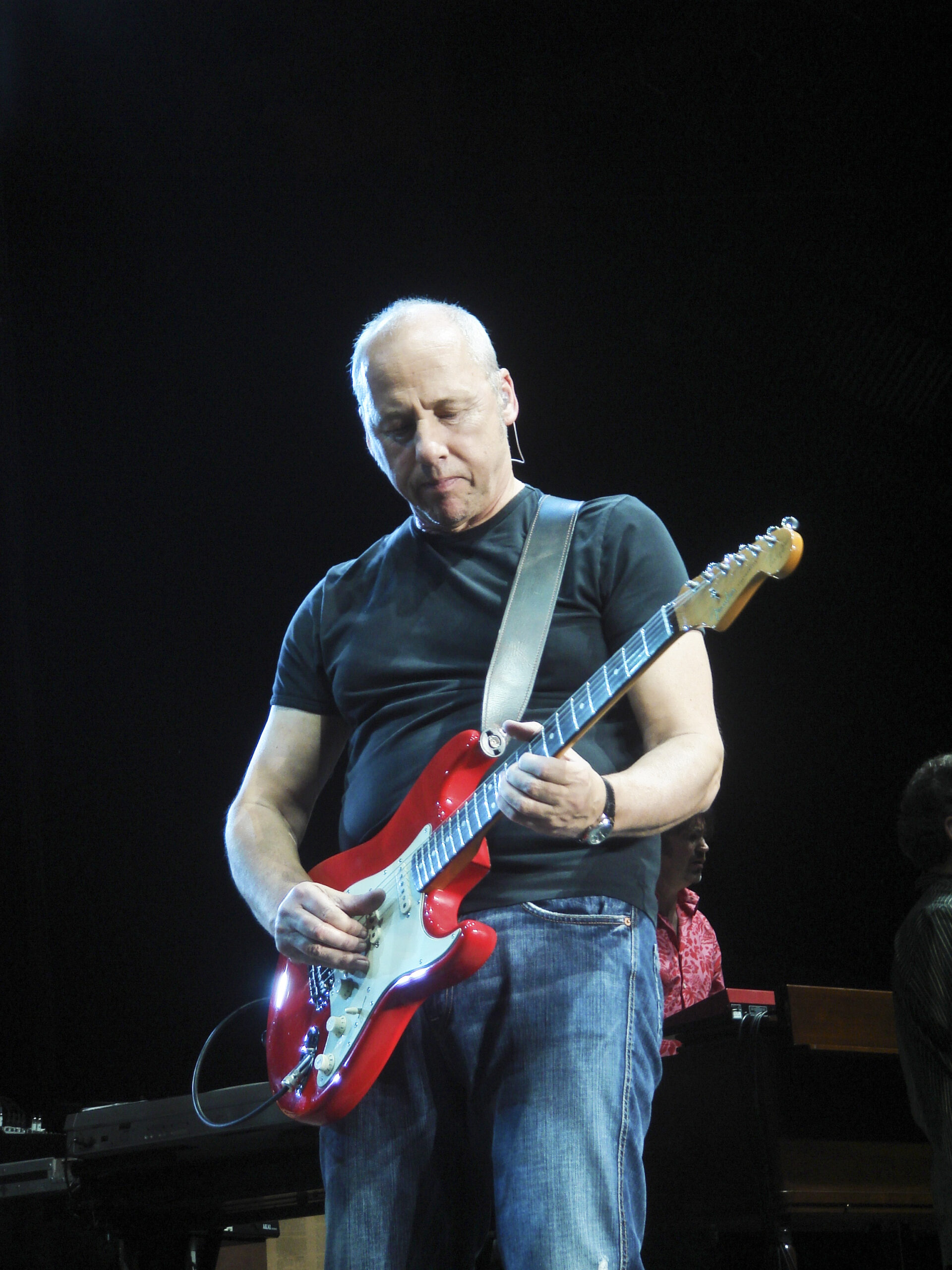
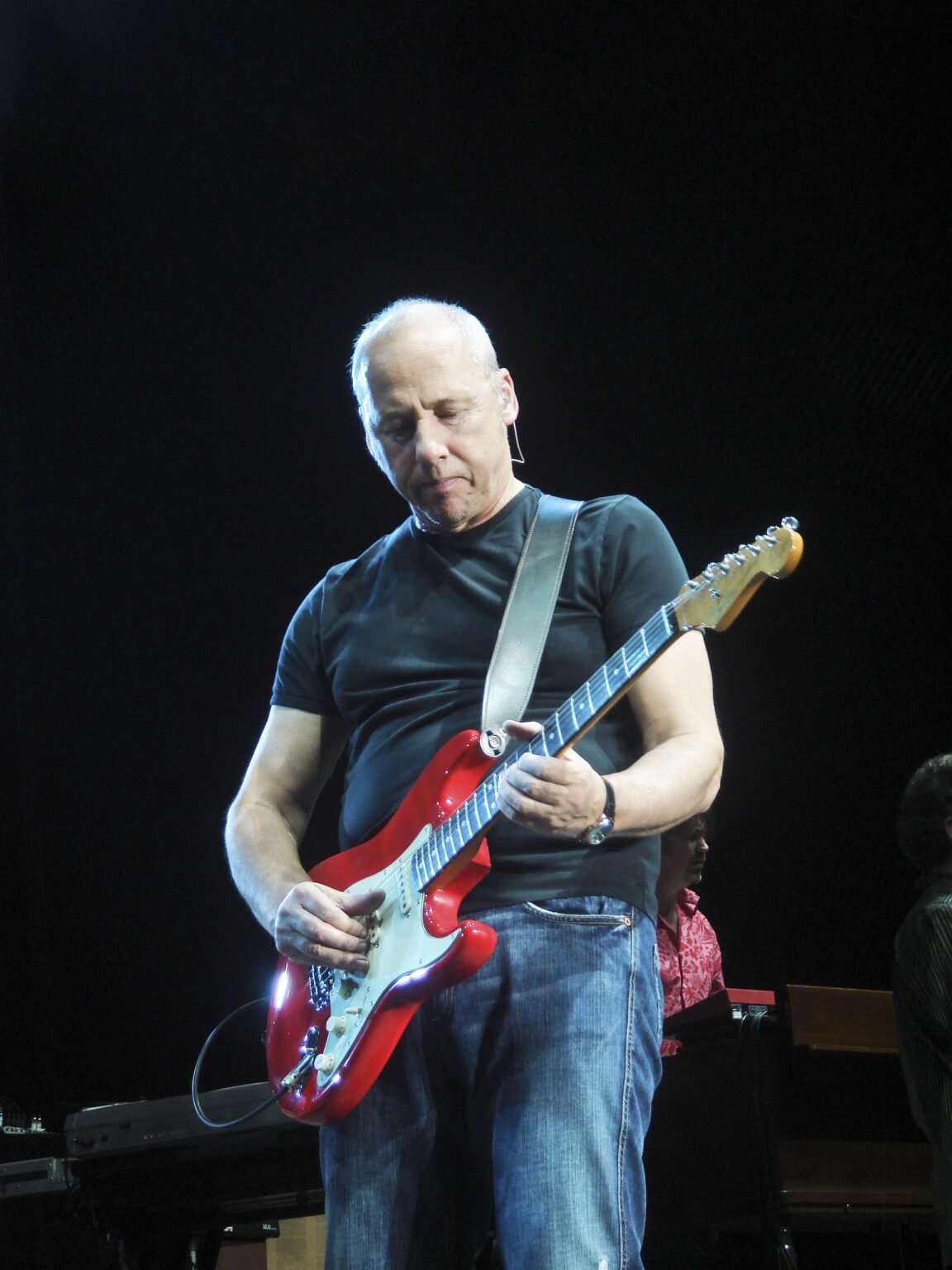
Christopher Bowley / Wikimedia Commons / CC BY 2.0
He started playing guitar with a pick. Then he stopped.
The Journey
In the early days — the pub band days, the Newcastle and London days — Mark Knopfler played his Gibson Les Paul Special with a pick. His friend Steve Phillips helped him strip it back to its original cherry finish. “It was everything to me,” he said. “I don’t know whether I slept with it, but it wasn’t far off.”
But by the time Dire Straits formed in 1977, he had switched to fingerstyle playing — using his thumb, index, and middle fingers directly on the strings rather than a plectrum. He has never explained this transition in simple terms, but the result was a guitar sound that was immediately, permanently distinctive: a specific attack that was simultaneously warmer and more percussive than any pick could produce, a tone that could sound like a banjo, a classical guitar, a jazz guitar, and a rock lead instrument all within a single performance.
The original version of “Sultans of Swing” was composed in open tuning on a National steel guitar. When Knopfler bought a 1961 Fender Stratocaster and played the song through a brown Fender Vibrolux that had originally belonged to Dire Straits bassist John Illsley, the song became what everyone knows. His fingers on the strings of the red Strat through the little Vibrolux amp — the most influential sound in British rock guitar of the late 1970s, produced with maximum simplicity.
No pick. A borrowed amplifier. A Strat bought secondhand, alder body bare wood, that he had refinished red. The Dan Armstrong Orange Squeezer compressor that contributed to the “Sultans” tone. A Morley volume pedal and a green MXR Analog Delay — three pedals running off batteries, no pedalboard, the entire Dire Straits live rig in 1978.
“The magician, not the wand, folks.” Someone who saw Dire Straits in a pub in 1977 remembers it that way. He’s not wrong.
Background: Glasgow, Newcastle, Journalism, and the Accidental Band
Mark Freuder Knopfler was born August 12, 1949, in Glasgow, Scotland, and raised in Blyth and later Newcastle, England. His father was an architect who had escaped from Hungary; his mother was English. He studied English at Leeds University and worked as a journalist for the Yorkshire Evening Post before becoming a guitar teacher in London — the specific combination of academic training, journalism experience, and musical development that produced one of rock’s most literary lyricists alongside its most distinctive guitar voice.
He co-founded Dire Straits in 1977 with his brother David Knopfler, bassist John Illsley, and drummer Pick Withers. The name was suggested by a friend — it described the financial position of the band at the time. Their first gig was on July 9, 1977, at a punk festival in Deptford. The anti-punk: four slightly older men playing clean, articulate, fingerstyle rock music at a moment when everything in British music was supposed to be loud, fast, and deliberately incompetent. They were booked to record a BBC session and the session producer passed a tape to the radio. John Peel played “Sultans of Swing” on his program. The record company came calling.
The debut album (1978), “Sultans of Swing” as a single, and the subsequent Communiqué, Making Movies, Love Over Gold, Brothers in Arms — the arc of Dire Straits’ commercial ascent through the early 1980s culminating with Brothers in Arms (1985) becoming the first album to sell more than a million copies on CD — established Knopfler as one of the most commercially successful and critically respected guitarists in rock history. He has sold over 120 million records worldwide. His solo career since Dire Straits dissolved has produced a further substantial catalog of recordings.
Tone note: He was a journalist and a guitar teacher before he was a rock musician. The specific combination is audible in everything he plays — the lyrical precision, the specific choice of each note rather than accumulation of notes, the storytelling approach to a guitar solo. “Sultans of Swing” is a piece of journalism: it tells a specific story about specific people in a specific place. The guitar solo at the end is not showing off technique; it is concluding the story. The journalist’s approach to narrative closure, applied to a guitar solo. This is the complete Knopfler musical philosophy.
The Rig: Mark Knopfler’s Guitars, Amps & Gear
Guitars: From Red Strat to National Resonator
1961 Fender Stratocaster (“The Red Strat”) — The Sultans Guitar
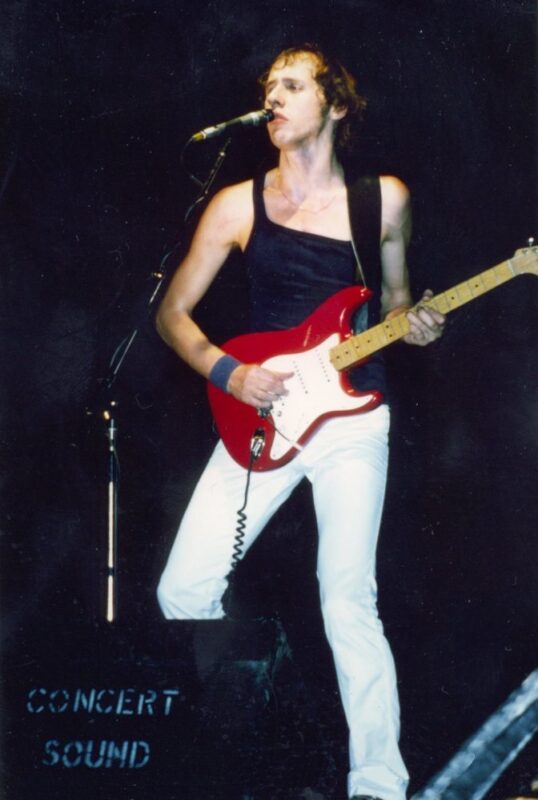
Mark Knopfler’s most iconic guitar — and arguably the most associated single instrument with his sound — is the 1961 Fender Stratocaster that he bought secondhand around 1977 in a stripped-back condition (the alder body bare wood). He had it refinished to a distinctive bright red — “Originally finished in sunburst, Knopfler had the guitar refinished to the distinctive bright red that would become synonymous with his early image.”
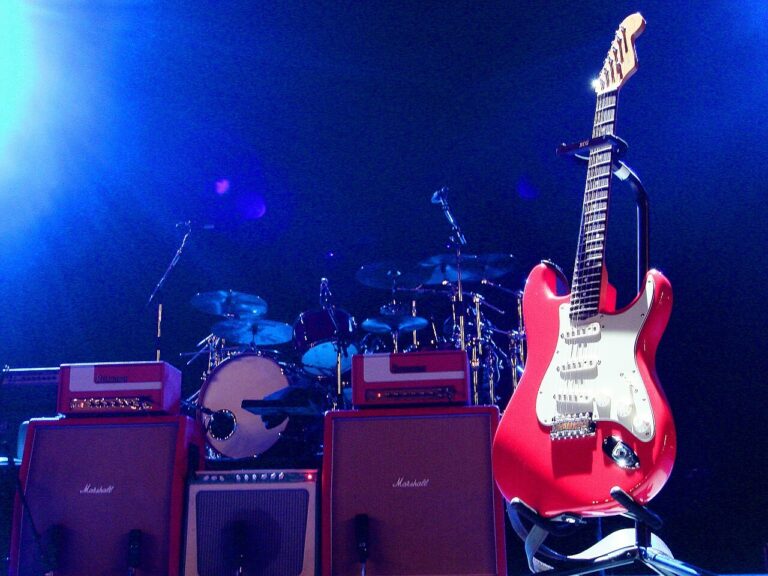
The red Strat was his primary guitar from 1977 until 1979 — used on the debut Dire Straits album (including “Sultans of Swing”), the Communiqué album, and all early live performances including the Rockpalast 1979 TV broadcast. He confirms in the Guitar Stories documentary that this guitar was used on the entirety of the debut album.
The guitar’s specifications reflect the 1961 vintage: rosewood fingerboard, three original single-coil pickups, the specific “quack” of the in-between pickup positions (bridge + middle) that is central to his rhythm tone. His specific pickup positions: he favors the bridge pickup alone for lead and the bridge + middle combination for the characteristic funky rhythm sound that defines “Sultans of Swing.”
He no longer owns this guitar — it was auctioned for charity. It is considered one of the most historically significant guitars from the late 1970s British rock scene.
Alongside the red 1961 Strat, Knopfler also used a maple-neck 1962 Stratocaster during the early Dire Straits period. This guitar — with a different character from the rosewood-neck ’61 — provided an alternative tonal option. The maple-neck Strat’s slightly brighter, more articulate sound contrasted with the rosewood neck’s warmer character.
When Mark began looking for a replacement for the ’62 Stratocaster in the early 1980s, the search led him to Schecter.
Schecter Dream Machine — The Making Movies and Love Over Gold Guitar
In the early 1980s, Knopfler acquired a Schecter Dream Machine from Rudy Music Stop in New York — a decision influenced by seeing a Schecter guitar owned by his girlfriend at the time. He bought several Schecter guitars simultaneously. The Dream Machine’s specific character:
- Body: Mahogany with birds-eye one-piece maple neck — a more premium construction than the standard Strat
- Finish: Metallic red
- Pickups: Initially equipped with three black Schecter F500T pickups; replaced after a few months with Seymour Duncans
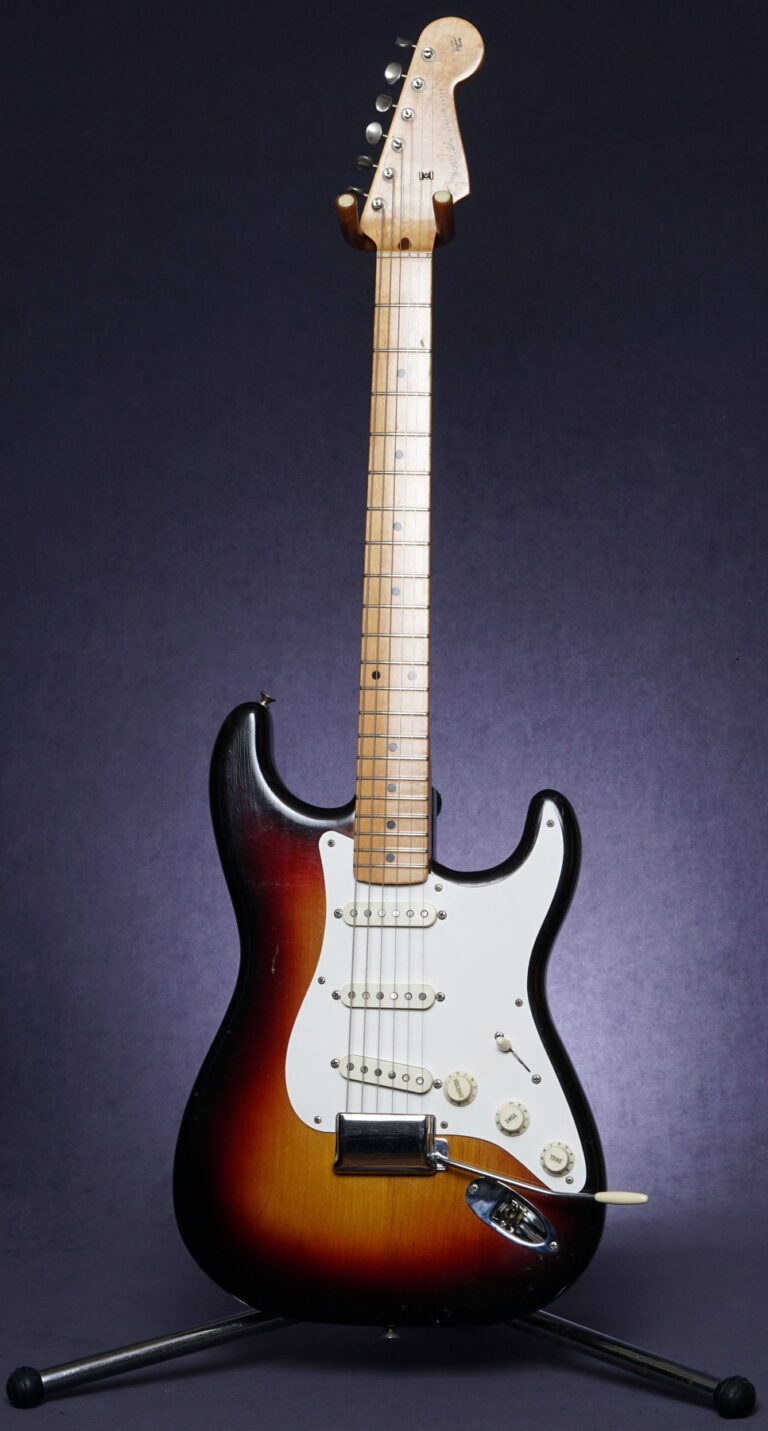
He used the Schecter from 1980 to 1987 — through Making Movies, Love Over Gold, and Brothers in Arms. On all early Dire Straits live recordings from this period, the Schecter is heard. His brother David Knopfler, who still owns the original Les Paul-style guitar from the early years, played rhythm on some of these instruments too.
Pensa-Suhr Custom — The Late Dire Straits Guitar
From 1987 onward, Knopfler used custom Pensa-Suhr guitars — instruments built by Argentinian businessman Rudy Pensa and master builder John Suhr. The guitar was first seen with him at the Nelson Mandela tribute concert in 1988. Suhr also introduced Knopfler to Jim Kelley amplifiers.
The Pensa-Suhr custom’s character: a Stratocaster-based design with improved construction tolerances and specific pickup configurations tailored to Knopfler’s requirements. One particularly forward-thinking Pensa-Suhr featured a Synclavier II synthesizer controller — Knopfler’s black Pensa “had a ton of knobs and was basically custom guitar made to control (when needed) a Synclavier II synth.” This controller appeared on “So Far Away” and in his film score work.
EMG active pickups appeared via early Pensa-Suhr guitars — the noiseless operation of active pickups reducing studio interference without changing the fundamental Strat-style tone character.
Gibson Les Pauls — The Money for Nothing Guitar
“Money for Nothing” — the signature Dire Straits song of the Brothers in Arms era — was recorded with a Gibson Les Paul. “Mark Knopfler played his 1958 Gibson Les Paul Standard on ‘Money for Nothing.'” This sunburst Les Paul with PAF humbuckers delivered the thick, sustained tone that defined the song’s iconic riff. The guitar ran through a Laney amplifier with slight overdrive for the recording — though most accounts focus on the Cry Baby wah’s half-open position as the defining tonal element.
Knopfler’s relationship with Les Pauls predates the “Money for Nothing” recording. He described his first meaningful guitar: a Gibson Les Paul Special that he and his friend Steve Phillips “painstakingly stripped and got it back to its original cherry finish — and it was everything to me.” This was his pub band guitar before Dire Straits. “That’s where Gibson started in my life, and that guitar will always have a special place in my heart.”
National Style O Resonator — The Romeo and Juliet Guitar
For “Romeo and Juliet” — one of his most beloved compositions — Knopfler plays a National Style O resonator guitar: the round-neck, metal-body resonator guitar that he got in Wales, borrowing money for it. “At 9:41 story of Mark’s National Style O starts. He got this resonator guitar in Wales, he borrowed the money for it.”
The National Style O’s specific character: the resonator cone amplifies the acoustic sound with a distinctive metallic, slightly nasal quality very different from a standard acoustic guitar. For “Romeo and Juliet” specifically, the resonator’s tone suits the delicate, vulnerable quality of the lyric and the fingerstyle approach perfectly.
He also played Danelectro guitars in a live performance context — specifically used for slide playing on songs like “Donegan’s Gone” and “Corned Beef City.”
Complete Guitar List (Key Instruments)
- Gibson Les Paul Special (stripped cherry finish) — Pub band primary; “everything to me”; where Gibson started for him
- 1961 Fender Stratocaster (“Red Strat,” rosewood neck) — Debut album; “Sultans of Swing”; auctioned for charity; no longer owned
- 1962 Fender Stratocaster (maple neck) — Early Dire Straits alternative
- Schecter Dream Machine (metallic red, mahogany/maple) — Making Movies, Love Over Gold, Brothers in Arms era (1980-1987)
- Pensa-Suhr Custom (various) — From 1987 onward; John Suhr-built; Synclavier controller version
- Gibson Les Paul Standard 1958 (sunburst, PAF) — “Money for Nothing” recording
- National Style O resonator — “Romeo and Juliet”; borrowed money for it in Wales
- Fender Mark Knopfler Signature Stratocaster — Production signature model
- Various vintage Gretsch 6120 — “I like those for just playing notes with a pick and holding the whammy bar” — occasionally plays with a pick on these
- Vintage 1960s Danelectro — Slide playing for specific songs
Amps: Vibrolux to Soldano to Kemper
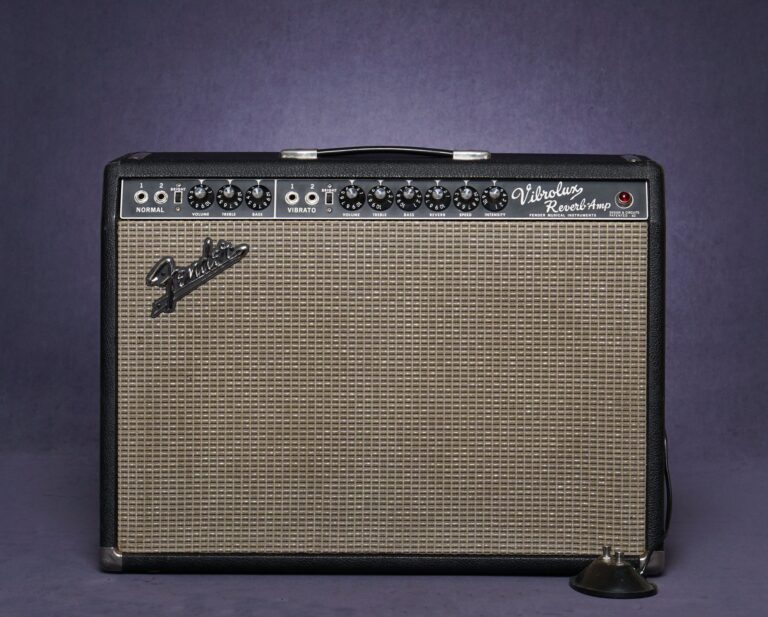
The brown Fender Vibrolux used on the debut album originally belonged to Dire Straits bassist John Illsley — Knopfler bought the Strat and hooked it up to Illsley’s amp for the first recordings and early live performances. The Vibrolux is a throwback to the brown-Tolex era of the early 1960s — 30 watts, two 6L6 tubes, tremolo effect, and an Oxford 12L6/M6 speaker. The combination of the 1961 Strat’s single-coil pickups and the Vibrolux’s warm, slightly compressed tube character produced the specific clean tone of “Sultans of Swing.”
This amplifier remains in Knopfler’s possession and is still used at his British Grove Studio. Its presence on the debut album is the most historically significant aspect of an otherwise unremarkable mid-wattage Fender combo.
Fender Twin Reverb and Roland Jazz Chorus — Early Live Amps
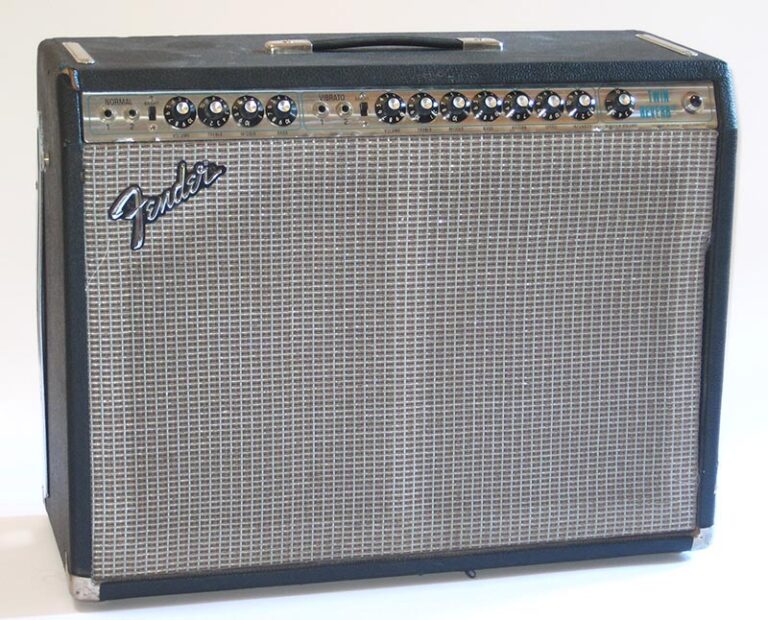
From summer 1978, the Fender Twin Reverb became Knopfler’s primary live amplifier — providing more headroom and more volume for larger venues than the Vibrolux. The Roland Jazz Chorus also appears as a documented recording amp for the debut, particularly for its distinctive chorus character that engineer Rhett Davies favored.
Music Man Amplifiers — The Making Movies Tour Amp
From September 1978 through the end of the Making Movies tour in 1981, Knopfler used Music Man amplifiers for all live performances. The Music Man (Leo Fender’s post-CBS amplifier design) provided the specific clean, warm, American-voiced tone that complemented his fingerstyle approach. These amps were also used on some studio recordings from this era.
Jim Kelley FACS — The Brothers in Arms Amp
For Brothers in Arms — the 1985 album that became the first to sell a million copies on CD — the amplifier was a Jim Kelley FACS. John Suhr introduced Knopfler to Jim Kelley amplifiers. “For the whole ‘Brothers in Arms’, Mark used the Jim Kelly FACS. According to John Suhr, the amp was also utilized in the ‘Money for Nothing’ intro.” The Jim Kelley FACS provided a specific clean, boutique-quality tone that suited the album’s refined production values.
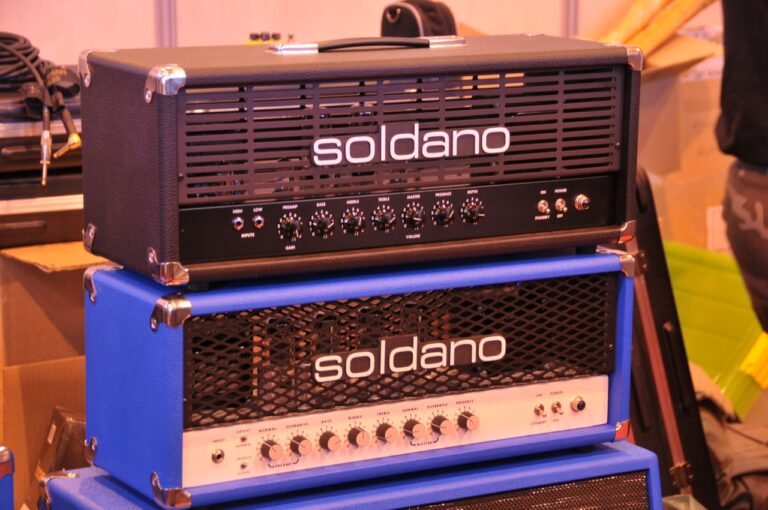
In the 1990s, the Soldano SLO-100 became Knopfler’s primary live amplifier. This high-gain 100-watt head — the same amplifier used by Eric Clapton (Knopfler’s use reportedly influenced Clapton to adopt it) — is known for its reliability and massive punch. Knopfler used it primarily on the clean channel rather than for high-gain tones, consistent with his overall approach.
Mesa/Boogie Mark IIB — Brief Period
Around 1982, Knopfler used a Mesa/Boogie Mark IIB — the same amplifier used by Prince and Carlos Santana in the same period. His use of the Mark IIB was brief; he returned to other amplifier choices before the Soldano became his primary.
Kemper Profiler — The Modern Solution
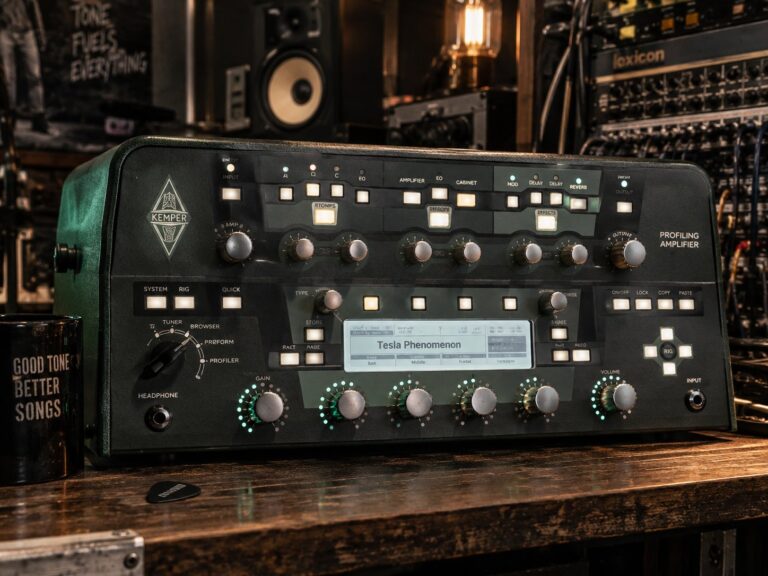
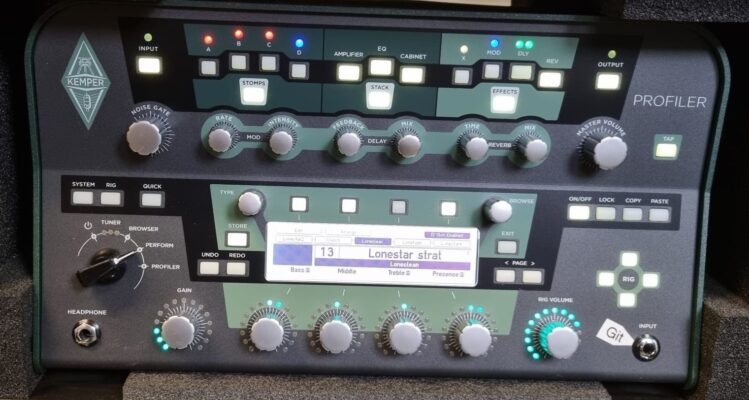
More recently, Knopfler has been using Kemper Profilers as his stage amplifiers — digital profiling technology that captures the response of physical amplifiers and plays them back through FRFR speakers. “Despite embracing digital profiling technology, Knopfler maintains a collection of physical amplifiers for recording and personal enjoyment. The Kemper serves as a practical touring solution rather than replacement for vintage equipment.” This pragmatic adoption of modern technology — by someone who built his reputation on vintage gear — reflects his commitment to consistent, reliable touring performance.
Pedals: The Volume Pedal as Primary Instrument
Mark Knopfler’s effects philosophy is one of the most distinctive in rock guitar: the volume pedal is his most important effect, used in ways “never intended” by its designers. His signal chain evolved from three pedals running off batteries in 1978 to Pete Cornish-built custom rack systems, but the guiding principle remained: enhance, don’t dominate.
Morley Volume Pedal — The Primary Effect
The Morley volume pedal was Knopfler’s primary effect from the earliest Dire Straits period through the Making Movies tour (1981). “In crafting his subtle guitar sound, Mark Knopfler relied on one of the most basic musical elements – volume. And the lack of it. He used it, however, in a way never intended.”
His specific approach: using the volume pedal’s swell — gradually opening the pedal from zero to full — to produce sustained, violin-like note entrances without the initial pick attack. The volume pedal’s swell eliminates the percussive transient of the fingerstyle attack and produces a singing, synthesizer-like quality on sustained notes. This technique — the volume swell — is the most distinctive single element of his expressive vocabulary.
He subsequently used Ernie Ball volume pedals for the same function.
Dan Armstrong Orange Squeezer — The Sultans Compressor
The Dan Armstrong Orange Squeezer compressor — a near-legendary compression pedal “that compresses the dynamics of music or individual notes without changing the attack of the note or adding any significant noise or distortion” — was used on the debut Dire Straits album and is frequently cited as an ingredient in the “Sultans of Swing” sound. The Orange Squeezer’s specific character: transparent compression that adds sustain without audibly squashing the signal, contributing to the specific “punchy clean” quality of the debut recordings.
Green MXR Analog Delay — The Early Live Echo
From 1978-1979, the only delay effect in the live rig was a green MXR Analog Delay — “used more for short slap-back echoes that made his guitar sound thick” rather than long repeating delays. The intro delay on “Down to the Waterline” (from the debut album) was actually a Space Echo from the mixing desk, not a guitar pedal. The MXR provided warm, analog character to specific live moments. “The old MXR delay used some now obsolete components that gave the pedal a really unique sound, extremely warm and fat, however with some noticable noise. A key element for the early Dire Straits live sound.”
Crowther Hotcake — The Primary Overdrive
The Crowther Hotcake overdrive — the same New Zealand-made pedal used by Jeff Beck and Nels Cline — is a consistent presence in Knopfler’s signal chain, used as a booster on the debut album and as his primary overdrive throughout his career. “In the first Dire Straits album, he uses a Hot Cake as booster and a Dan Armstrong Orange Squeezer as compressor.” The Hotcake’s warm, transparent overdrive character suits Knopfler’s preference for natural-sounding gain rather than artificial distortion.
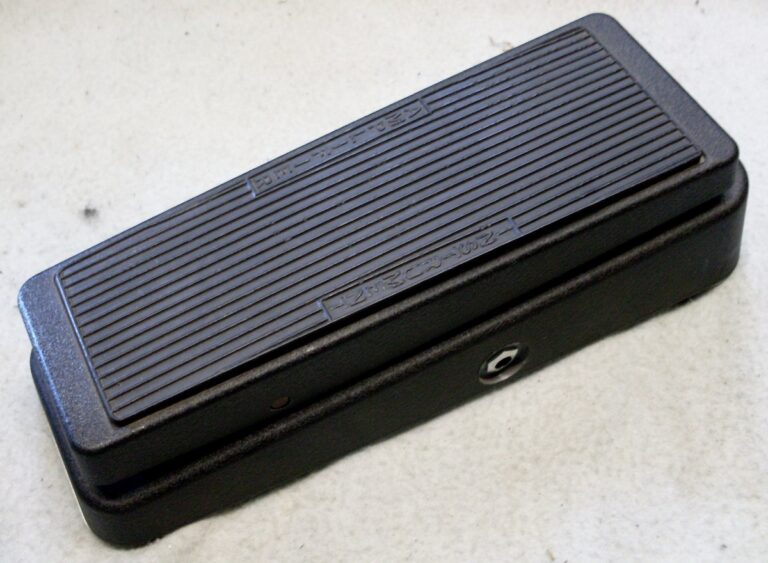
“In ‘Money For Nothing’, Mark uses a wah set almost wide open.” The half-cocked wah — set to a fixed position rather than swept — produces a specific mid-frequency resonance that is the characteristic tonal signature of the “Money for Nothing” guitar riff. The wah is not being swept; it is being used as a fixed tone filter, exactly as Carlos Santana uses it on “Samba Pa Ti.” The half-cocked wah’s resonant frequency, combined with the Les Paul’s humbucker warmth, produces the distinctive mid-forward character of the song.
Pete Cornish Custom Rack System — The 1980s Stage Rig
From 1980, Pete Cornish — who also built signal chain systems for Jimmy Page, Brian May, and David Gilmour — built Knopfler a custom rack system for stage use. “From 1980, he had Pete Cornish build him a custom rack and we can’t vouch to know exactly what’s in there.” The Cornish rack provided buffering, routing, and true bypass switching for the growing complexity of Knopfler’s signal chain during the Dire Straits’ peak commercial period.
Strings, Picks & The No-Pick Philosophy
No pick in later career: Mark Knopfler’s defining technique is fingerstyle playing with his thumb, index, and middle fingers directly on the strings. The thumb handles low strings; the fingers handle melody and lead; the combination produces a specific tonal quality — warmer pick attack, more control over individual string dynamics — that is impossible to replicate with a plectrum.
The exception: On certain guitars — specifically Gretsch 6120s — he sometimes plays with a pick while using the tremolo bar: “I like those for just playing notes with a pick and holding the whammy bar in my hand and getting the vibrato from my picking motion.” The specific combination of pick, Gretsch, and whammy bar produces a different tonal character from his standard fingerstyle Strat approach.
Strings: Various standard electric gauge strings — not specifically documented to a single brand across his career. His fingerstyle technique means string gauge and texture interact differently with his fingertips than with a pick; he has been observed using lighter gauges that allow the specific flexibility his technique requires.
The fingerstyle technique in detail: Knopfler’s right hand positions slightly differently from classical guitar fingerstyle — his thumb plays bass strings with a downward motion (similar to country thumbpicking), his index and middle fingers pluck melody strings with an upward motion, and the interaction between these motions produces the specific rhythmic and textural quality that makes his playing identifiable. The bridge pickup + middle pickup “quack” in between positions is particularly suited to his fingerstyle attack — the single-coil’s response to the softer fingertip attack produces a clarity and articulation that pick playing on the same guitar would make harder and more aggressive.
Playing Style & Tone Philosophy: The Lyrical Approach
Mark Knopfler’s guitar philosophy is the most literary in rock. He approaches the guitar the way he approaches song lyrics: what is the most precise, most economical, most emotionally resonant way to say what needs to be said? The answer is almost always fewer notes, placed with more precision, executed with more emotional commitment than the obvious approach would suggest.
The Volume Pedal as Voice
The volume swell technique — gradually opening the volume pedal from silence — is his most distinctive expressive tool. The specific effect: a sustained note that appears fully formed, without the initial attack transient, producing a violin or synthesizer-like sustained tone. This technique gives his slower passages a specific quality of appearing to emerge from the air rather than being struck into existence. “Romeo and Juliet,” “Brothers in Arms,” “Why Worry” — the most emotionally powerful passages in his catalog often feature this technique.
The Fingerstyle Rhythmic Approach
Knopfler’s rhythm guitar playing — specifically the bridge/middle pickup combination funk strumming of “Sultans of Swing” and similar songs — uses the fingerstyle right hand to produce a specific percussive, clucking quality. His fingernails hitting the strings from above produce a downstroke sound; his fingertips pulling strings upward produce an upstroke sound. The combination of nail-on-string percussiveness and finger-on-string warmth in a single rhythmic stroke is the specific Knopfler rhythm signature.
The Jazz and Country Synthesis
Knopfler’s playing draws from Chet Atkins’s country fingerpicking tradition, from the jazz guitar of Wes Montgomery (who also used his thumb as a pick on all strings), and from the Delta blues fingerpicking of players like Mississippi Fred McDowell. The specific synthesis — all these influences filtered through a rock and roll musical context — produced something that sounded like none of its sources while being recognizably descended from all of them.
How to Sound Like Mark Knopfler
The Guitar
Fender Stratocaster — vintage or the Mark Knopfler Signature model. Bridge/middle pickup combination essential for the rhythm tone; bridge alone for lead. Rosewood fingerboard for the characteristic warmth.
- Fender Mark Knopfler Signature Stratocaster — The direct approach; comfort-contoured ’57 body
- Any vintage Fender Stratocaster (1959-1965) — With original single-coil pickups
- Any Stratocaster in bridge/middle position — The in-between “quack” is essential for the rhythm tone
The Amp
Clean Fender amplifier — Vibrolux, Twin Reverb, or equivalent. No distortion from the amp.
| Control | Setting | Notes |
|---|---|---|
| Volume | Clean throughout | The amp provides clean headroom; the Hotcake provides drive when needed |
| Treble | 5–6 | Balanced; fingerstyle produces a warmer attack; no extra treble needed |
| Bass | 5–6 | Moderate; the Strat’s natural warmth provides sufficient low end |
| Reverb | Light spring | Subtle; the fingerstyle attack doesn’t need reverb to bloom |
The Essential Effects
- Volume pedal (Morley or Ernie Ball) — The most important effect; learn the swell technique for violin-like note entrances
- Dan Armstrong Orange Squeezer (or equivalent transparent compressor) — Subtle compression adding sustain without squashing
- Crowther Hotcake — Light overdrive when needed; warm, transparent
- MXR Analog Delay (or equivalent warm analog delay) — Short slap-back echo for live thickness
- Dunlop Cry Baby Wah (half-open, fixed position) — For “Money for Nothing” character; set and leave
The Essential Technique
Play without a pick. This is the non-negotiable element. The specific attack, warmth, and textural quality of Knopfler’s playing comes directly from his fingers on the strings. Develop the thumb-and-two-fingers approach: thumb for bass strings with a downward motion, index and middle fingers for treble strings with an upward pull. Practice the bridge/middle pickup combination Strat strumming until the “quack” sounds natural. Learn the volume swell: open the pedal from zero as you play a sustained note, letting the note appear without its attack.
Budget vs Authentic
Budget:
- Guitar: Fender Player Stratocaster; bridge/middle pickup position
- Amp: Fender Blues Junior or any clean tube combo
- Volume pedal: Ernie Ball VP Jr
- Compressor: Orange Squeezer clone or MXR Dyna Comp
- No pick
Authentic:
- Guitar: Vintage 1961 Fender Stratocaster (rosewood neck) or Fender Mark Knopfler Signature
- Amp: Fender Vibrolux (brown, original Illsley amp if available) or Soldano SLO-100 clean channel
- Effects: Dan Armstrong Orange Squeezer + Morley Volume Pedal + Green MXR Analog Delay + Crowther Hotcake
- No pick. Definitively no pick.
Influence & Legacy: The Lyrical Rock Guitarist
Mark Knopfler’s influence on guitar playing is the influence of the alternative approach — someone who demonstrated that clean tone, fingerstyle technique, lyrical economy, and musical intelligence were not just acceptable in rock guitar but capable of producing commercially dominant recordings. In an era when heavy distortion and technical shredding were becoming the dominant guitar aesthetics, Knopfler was selling out stadiums with a red Stratocaster, a borrowed Vibrolux amp, and no pick.
The documented connections:
- Eric Clapton — Clapton adopted the Soldano SLO-100 after observing Knopfler’s use of it; the two guitarists have collaborated and performed together, representing different peaks of the British guitar tradition (#9 in this series)
- The volume pedal technique — Knopfler’s specific use of the volume swell — using it “in a way never intended” — established the technique as a legitimate expressive tool in rock guitar rather than just a fader replacement
- Brothers in Arms — The first album to sell a million copies on CD; the guitar work on it (clean Stratocaster and Les Paul, Jim Kelley FACS amp, no excessive distortion) demonstrated that acoustic and clean electric approaches could dominate an era of increasingly heavy production
- The fingerstyle tradition in rock — Knopfler is the primary figure who established that rock guitar could be played fingerstyle without concession to technical expectation; subsequent fingerstyle rock guitarists acknowledge his influence
- Film scoring — Local Hero, The Princess Bride, The Last Valley, Cal — his film score work established a vocabulary of guitar-led cinematic music that draws equally on his country, Celtic, and rock influences
- The Notting Hillbillies — The country-acoustic side project where the Fender Vibrolux made its return; documenting Knopfler’s absorption of American roots traditions that run through all his work
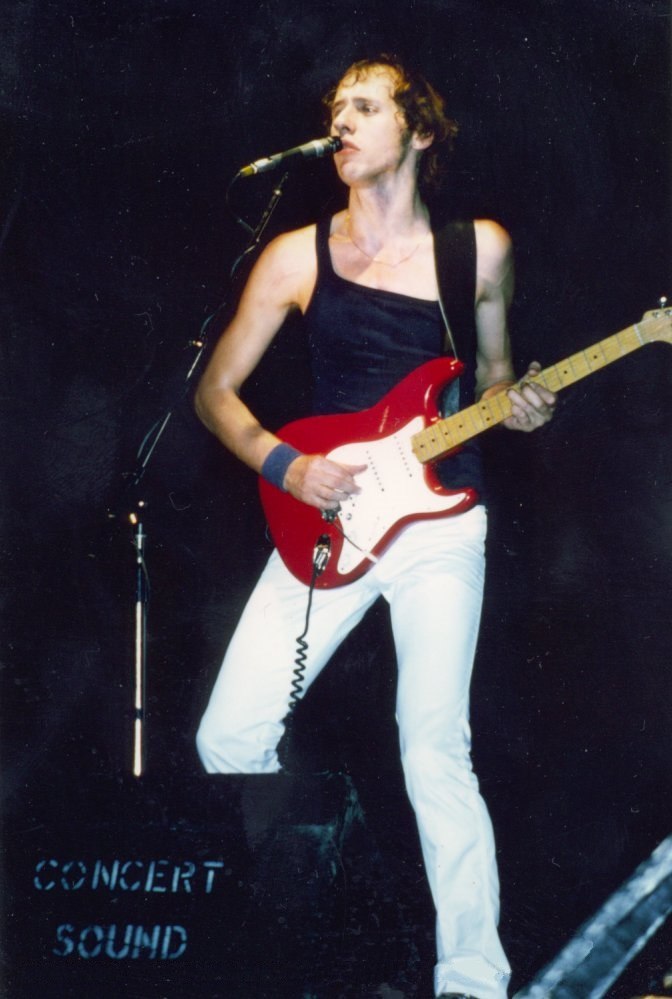
He started with a pick. He stopped. He borrowed the bassist’s Vibrolux. He played with three pedals running off batteries. He sold 120 million records. Rolling Stone ranked him the 27th greatest guitarist ever.
The red Strat was auctioned for charity. The Vibrolux is still in his studio. The volume swell is still his primary expressive tool. He never went back to the pick.
The magician, not the wand.
Tone note: The original “Sultans of Swing” was written in open tuning on a National steel guitar. When he played it on the red Strat through John Illsley’s Vibrolux, the song became what everyone knows. The steel guitar became a Fender. The open tuning became standard. The composition survived the translation because it was already complete — the tuning and the instrument were variables, not the song. This is the complete Knopfler composition philosophy: the song first, the gear in service of the song. The Strat and the Vibrolux happened to be what was available. They happened to be exactly right.
He borrowed the bassist’s amplifier. He had the Strat refinished red because the bare wood looked wrong. He played with his fingers because a pick didn’t feel right anymore. He put three pedals on the floor — the compressor, the volume, the delay — running off batteries. No pedalboard. No rack. No distortion. A 1961 Stratocaster and a borrowed Vibrolux and three pedals running off batteries in a pub in London in 1977.
“Sultans of Swing.” The red Strat. The no-pick technique. The volume swell. The Dan Armstrong Orange Squeezer. The National resonator for “Romeo and Juliet.” The Cry Baby set wide open for “Money for Nothing.”
The magician, not the wand. He was the magician.
For the guitarist whose own clean, lyrical Stratocaster approach in the blues tradition connects to the same fingerstyle sensibility from an American angle, check our complete guide to Stevie Ray Vaughan’s guitars and gear — though SRV used picks and .013 strings, the shared commitment to Stratocaster expressiveness over technical display connects them.
For the guitarist whose adoption of the Soldano SLO-100 was reportedly influenced by Knopfler, and whose own British guitar tradition represents a parallel peak from a blues direction — check our complete guide to Eric Clapton’s guitars and gear in this series.
For the guitarist who represents the volume-swell and clean-Stratocaster approach taken into progressive rock territory — don’t miss our complete guide to David Gilmour’s guitars and gear.
FAQ: Mark Knopfler Guitars & Gear
What guitar did Mark Knopfler use on “Sultans of Swing”?
A 1961 Fender Stratocaster that he bought secondhand around 1977 with the alder body bare wood — he had it refinished to a distinctive bright red that became synonymous with his early image. The guitar is confirmed by Knopfler himself in the Guitar Stories documentary as the guitar used on the entirety of the Dire Straits debut album, including “Sultans of Swing.” He used it through a brown Fender Vibrolux combo amplifier that originally belonged to bassist John Illsley. The red Strat was his primary guitar from 1977 until 1979. He no longer owns it — it was auctioned for charity. The original version of “Sultans of Swing” was composed in open tuning on a National steel guitar; the Stratocaster version became the one everyone knows.
Why does Mark Knopfler not use a pick?
He transitioned from pick playing to fingerstyle sometime before or during the formation of Dire Straits — he played the Gibson Les Paul Special with a pick in his early career but developed the fingerstyle approach (thumb and two fingers directly on the strings) that defines his entire guitar identity. He hasn’t explicitly explained the transition in simple terms. The result: a specific attack that is simultaneously warmer and more percussive than any pick can produce, allowing independent dynamics control for each string, and enabling the volume swell technique (smoothly opening a volume pedal from zero) that is his most distinctive expressive tool. The only documented exception: on Gretsch 6120 guitars, he sometimes plays with a pick while using the whammy bar — “I like those for just playing notes with a pick and holding the whammy bar in my hand.”
What is the “Money for Nothing” guitar tone?
The “Money for Nothing” riff was recorded with a Gibson Les Paul Standard (1958, sunburst, PAF humbuckers) through a Laney amplifier with slight overdrive. The defining tonal element is a Dunlop Cry Baby Wah pedal set in a fixed half-open position — not swept, but parked at a specific position to add a mid-frequency resonance to the riff. The half-cocked wah’s specific resonant frequency, combined with the Les Paul’s humbucker warmth, produces the characteristic mid-forward, nasal character of the guitar riff. The Brothers in Arms album was recorded through a Jim Kelley FACS amplifier — according to John Suhr, the Jim Kelley amp was used specifically on the “Money for Nothing” intro.
What compressor did Mark Knopfler use on the Dire Straits debut?
The Dan Armstrong Orange Squeezer — a legendary compression pedal that “compresses the dynamics of music or individual notes without changing the attack of the note or adding any significant noise or distortion.” The Orange Squeezer is specifically documented as an ingredient in the early Dire Straits / “Sultans of Swing” sound. Its specific character — transparent compression that adds sustain without audibly squashing the signal — contributes to the clean, punchy, present quality of the debut recordings. Knopfler also used a Crowther Hotcake overdrive as a booster on the debut album, alongside the Orange Squeezer compressor.
What is Mark Knopfler’s volume pedal technique?
Knopfler’s use of the volume pedal is described as using it “in a way never intended” by its designers. Rather than using it as a simple fader replacement, he uses it to create smooth swells — opening the pedal from zero as he plays a sustained note, allowing the note to appear fully formed without the initial percussive attack transient. This produces a violin or synthesizer-like quality on sustained notes: the note seems to emerge from the air rather than being struck. The technique is especially prominent on “Romeo and Juliet,” “Brothers in Arms,” and “Why Worry” — the most emotionally vulnerable passages in his catalog. He used the Morley Volume Pedal for this through the Making Movies tour (1981), then Ernie Ball volume pedals subsequently.
What amplifiers did Mark Knopfler use with Dire Straits?
The progression: Fender Vibrolux (borrowed from bassist John Illsley) for the debut album in 1978; Fender Twin Reverb from summer 1978 onward for live performances; Roland Jazz Chorus used in the debut album sessions; Music Man amplifiers for all live gigs from September 1978 through the Making Movies tour (1981); Mesa/Boogie Mark IIB briefly around 1982; Jim Kelley FACS for Brothers in Arms (1985), introduced by John Suhr; Soldano SLO-100 in the 1990s; Kemper Profiler for modern touring. The Fender Vibrolux borrowed from Illsley remains in Knopfler’s possession and is still used at his British Grove Studio.
How do I get Mark Knopfler’s “Sultans of Swing” guitar tone?
Fender Stratocaster in the bridge/middle pickup combination (the in-between “quack” position). Through a clean Fender combo amp (Vibrolux or Blues Junior equivalent). Dan Armstrong Orange Squeezer compressor or equivalent transparent compressor (low ratio, moderate threshold). Morley or Ernie Ball volume pedal for the swell technique. No pick — play fingerstyle with your thumb and index/middle fingers directly on the strings. The critical technique: practice the bridge/middle position fingerstyle strumming until the characteristic percussive quack appears naturally. Learn the volume swell technique: keep the pedal closed, play a sustained note, then smoothly open the pedal to let the note appear without its attack. The amp should stay clean throughout — no overdrive on “Sultans.”
Image credits
- Top image: Christopher Bowley / Wikimedia Commons / CC BY 2.0
- Mark Knopfler: photo by Klaus Hiltscher, via Wikimedia Commons, CC BY-SA 2.0.
- Fender Vibrolux Reverb: Tonereport, Wikimedia Commons, CC BY-SA 4.0.
- Fender Twin Reverb: Micahmedia, Wikimedia Commons, CC BY 3.0.
- Dunlop Cry Baby: Roadside Guitars, Flickr, CC BY-SA 2.0.
- Fender Mark Knopfler signature Stratocaster: Christopher Bowley, Wikimedia Commons, CC BY 2.0.
- Mark Knopfler live: Christopher Bowley, Wikimedia Commons, CC BY 2.0.
- Mark Knopfler live: Klaus Hiltscher, Wikimedia Commons, CC BY-SA 2.0.
- Fender Stratocaster: Lightburst, Wikimedia Commons, CC BY-SA 4.0.
- Soldano SLO-100: fvancini, Wikimedia Commons, CC BY 2.0.
- Kemper Profiler: Vonvon, Wikimedia Commons, CC0.