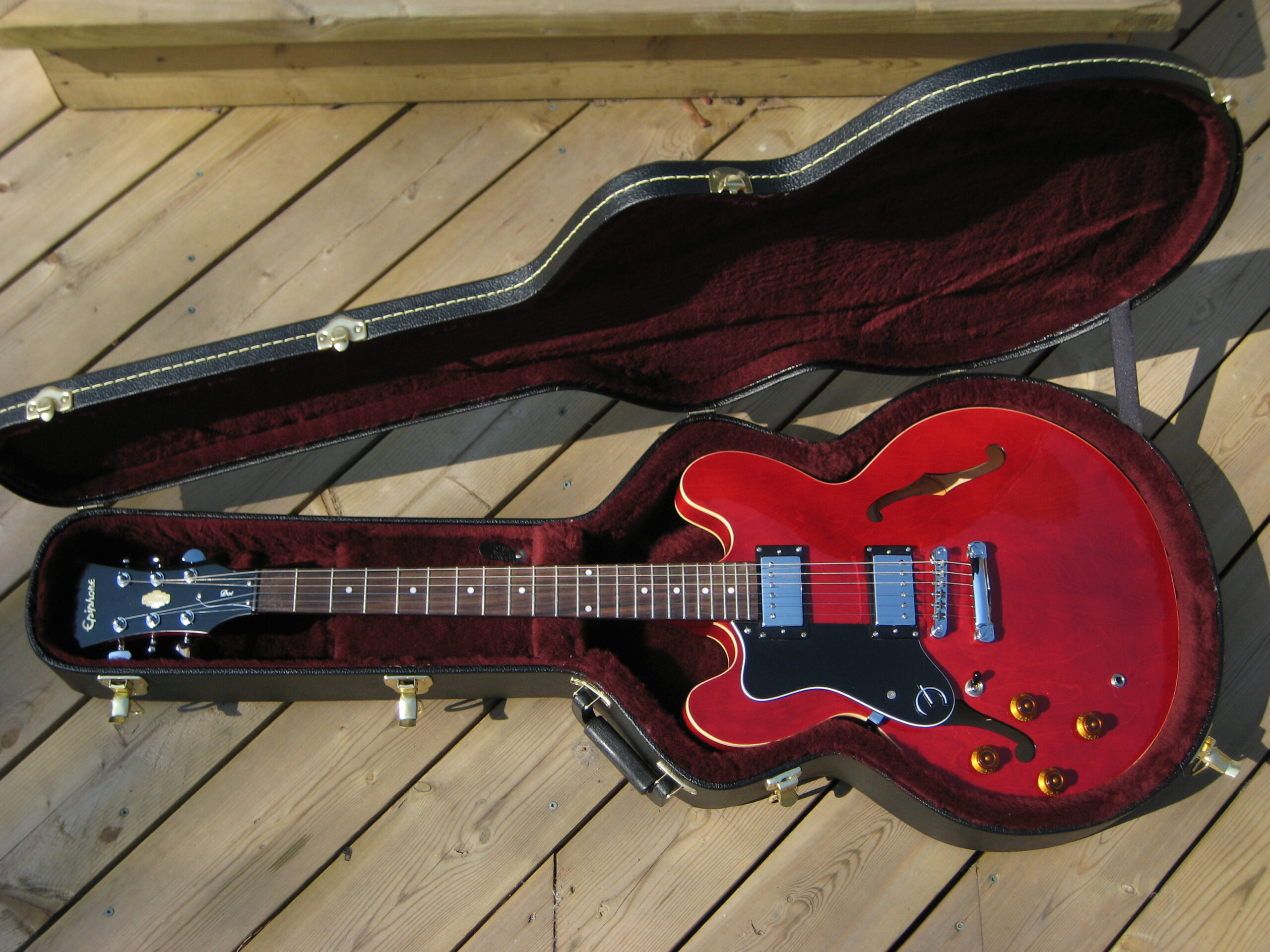
Epiphone Dot: The Beginner’s Semi-Hollow That Josh Homme Turned Into a Stoner Rock Weapon
Left-handed Epiphone Dot in its open case, photographed 28 March 2009. Photo: Gary J. Wood. CC BY-SA 2.0 (https://creativecommons.org/licenses/by-sa/2.0/). Full source frame resized for web; no cropping or retouching. Web version: CC BY-SA 2.0. Source: https://www.flickr.com/photos/garyjwood/3395149814/
The Epiphone Dot is tagged a beginner jazz-blues guitar, but Josh Homme used one on QOTSA's heaviest record. History, specs, and buying guide inside.
Every gear list needs a guitar that everyone agrees on for the wrong reasons. The Epiphone Dot has been called a “beginner semi-hollow,” a “budget ES-335,” and a “great first jazz box” so many times that most players have stopped actually listening to it. Which is a shame, because somewhere between the beginner reviews and the jazz-blues typecasting, Josh Homme plugged one in during the darkest, heaviest era of Queens of the Stone Age and proved the Dot was never as limited as its reputation suggested.
Introduced in 1997 as Epiphone’s affordable answer to Gibson’s own ES-335, the Dot sits at the high end of entry-level pricing and was built specifically to make the semi-hollow format accessible to players who couldn’t stretch to a Gibson. That accessibility has, ironically, worked against its reputation ever since — cheap enough to be a first guitar, therefore assumed to be a guitar you outgrow. The players who’ve actually spent time with one tend to disagree.

An Affordable Answer With Its Own Identity
The Dot takes its name from its fretboard markers — simple dot inlays, in contrast to the more elaborate block inlays found on fancier Epiphone archtops like the Casino or Sheraton. That’s a deliberate simplification, not a corner cut: Epiphone built the guitar to strip away ornamentation while keeping the core semi-hollow formula intact. Two hollow “wings” with f-holes sit on either side of a solid center block, keeping the guitar far less prone to feedback than a fully hollow archtop — the same structural trick Gibson’s original ES-335 pioneered in 1958, just executed at a fraction of the price.
From Korea to Qingdao
Manufacturing has shifted over the Dot’s near-three-decade run. Early production ran through Korea before moving to Epiphone’s Qingdao, China facility in 2002, where current models are still built. The neck material also changed over time — mahogany from the start, but Epiphone briefly used maple before returning to mahogany construction in 2008, a detail collectors of specific-year Dots track closely. A stripped-back sibling, the Dot Studio, ditches the pickguard and f-hole binding for a laminated mahogany body, single volume and tone control, and uncovered pickups — a genuinely different, lower-cost variant worth knowing about if you’re shopping the family rather than the flagship.
Why the Dot Outlasted Its Launch-Era Competition
1997 was a crowded year for budget semi-hollow guitars chasing the ES-335 formula, and most of that era’s competition has long since been discontinued or reworked beyond recognition. The Dot’s staying power comes down to a simple decision Epiphone made early on: rather than chasing a specific vintage year’s spec sheet, they built a guitar that could absorb incremental upgrades — better pickups, better hardware, better fret work — without needing a full redesign every few years. That’s why a current-production Dot and a mid-2000s Dot share a name and a silhouette but represent genuinely different build-quality tiers. It’s also why the model has survived Epiphone’s broader “Inspired by Gibson” rebrand largely intact, just with updated electronics options layered on top of the same core recipe.
Full Specifications
Why the “Beginner Guitar” Label Undersells It
The Dot’s pickups are the crux of the misunderstanding. The Alnico Classic and Alnico Classic Plus set is Epiphone’s import version of Gibson’s own 490R/498T pairing — not a watered-down substitute, but a licensed recreation of a genuinely respected pickup configuration, one that’s come standard on many of Epiphone’s most serious solidbody and hollowbody models over the years. Players who’ve measured them report DC output in the 8.6k range with real Alnico V magnets — numbers that sit comfortably in classic PAF territory, not budget-humbucker territory.
What actually limits the Dot isn’t the electronics — it’s genre expectation. Reviews consistently describe it as well-suited to jazz, blues, and classic rock, but note it lacks the raw output for heavy metal without help from pedals or amp gain. That’s a real limitation for players chasing extreme high-gain tones straight from the guitar. It’s also exactly the ceiling Josh Homme decided to test.
Famous Players: Beyond the Blues Box Reputation
Josh Homme’s Ebony Dot
Josh Homme of Queens of the Stone Age used an ebony-finished Epiphone Dot around the Lullabies to Paralyze era of the band — one of QOTSA’s darkest, densest records, built on detuned riffs and claustrophobic production. It’s about as far from the Dot’s “cozy jazz box” reputation as a guitar assignment gets, and that’s precisely what makes it worth knowing. Homme didn’t need the Dot to sound polite; he needed it to sit inside a mix built from layered, downtuned guitars, and a semi-hollow’s natural resonance and sustain gave those riffs a different texture than a solidbody alone would have. It’s a reminder that “semi-hollow” doesn’t automatically mean “safe,” and that a guitar built for beginners can still end up in genuinely heavy hands. Find his full rig breakdown at GuitarGangsters’ Josh Homme gear guide.
Joe Bonamassa and the Blues Mainstream
On the other end of the genre spectrum sits the guitar’s more expected home turf: blues-rock. Joe Bonamassa, one of the most visible modern blues-rock guitarists working today, has his own signature ES-335 model and remains closely associated with the format the Dot descends from, and countless working blues and roots players have used a Dot specifically because it delivers ES-335-adjacent tone without ES-335 money on the table. Find his gear profile at GuitarGangsters’ Joe Bonamassa page.
The Working Player’s Guitar
Beyond named signature players, the Dot’s real reputation has been built by decades of working musicians who bought one specifically because it let them access ES-335 tone at gig-budget prices. Reviewers and forum communities alike consistently describe it as the guitar that convinces skeptics semi-hollow tone doesn’t require four-figure spending — a fantastic instrument that lets guitarists experience an ES-335-style guitar without spending four figures, which is exactly the role it’s played on countless stages that never made it into a magazine feature. Session players and touring backline techs alike tend to name the Dot as a guitar they’d happily hand to a working musician sight-unseen — not because it’s flashy, but because it’s dependable, consistent between units, and rarely the reason a gig goes wrong.
That reliability matters more than it sounds. A semi-hollow guitar has more moving parts to go out of spec than a solidbody — a loose f-hole brace, a shifting center block, a neck joint under different stress than a flat-top design — and the Dot’s decades-long track record of holding up under regular gigging use is arguably a bigger endorsement than any single celebrity association. It’s the guitar equivalent of a well-reviewed daily driver: unglamorous in conversation, completely dependable in practice.
Tone Recipes
Classic Blues-Jazz, the Expected Territory
Neck pickup, tone rolled back to around 5, volume near max. Run into a Fender Deluxe Reverb-style amp with light breakup for warm, rounded chord work and articulate single-note lines.
Homme-Style Heavy Riffing
Bridge pickup, both volume and tone wide open, pushed into a mid-gain overdrive like an Ibanez TS9 Tube Screamer to tighten the low end before hitting a higher-gain amp channel. The semi-hollow body adds sustain and harmonic complexity a solidbody won’t give you at the same settings — useful for filling out downtuned riffs without needing extreme gain.
Clean Indie/Alt-Rock Rhythm
Middle pickup position, tone around 6 to 7, straight into a clean Fender Twin Reverb-style platform. The Dot’s semi-hollow airiness gives strummed chords a natural chime that a solidbody like a Fender Telecaster can approximate but not quite replicate.
How It Compares
Vs. the Epiphone Riviera
Both are budget-friendly semi-hollows built on the ES body shape, but they solve tone very differently. The Riviera uses mini-humbuckers and a Frequensator tailpiece for a brighter, single-coil-adjacent voice; the Dot uses full-size Alnico Classic humbuckers for a rounder, more traditional humbucker tone closer to a stock 335. Players chasing vintage top-end clarity should look at the Riviera; players wanting a warmer, more conventional semi-hollow voice should stick with the Dot. Read the full breakdown at GuitarGangsters’ Epiphone Riviera feature.
Vs. the Epiphone Sheraton-II Pro
The Sheraton-II Pro sits a tier above the Dot with coil-tappable ProBucker humbuckers, gold hardware, and a fancier block-and-triangle inlay scheme — genuine upgrades if the budget allows. But the extra flexibility and cosmetics come at a real price jump, and the Dot’s simpler, fixed-humbucker setup remains the more direct, no-fuss route into semi-hollow tone. See the comparison at GuitarGangsters’ Epiphone Sheraton-II Pro feature.
Vs. a Solidbody Les Paul
The tonal gap is bigger than the price gap suggests. A Gibson Les Paul Standard delivers thicker sustain and a more compressed, singing lead tone; the Dot answers with more air, more openness in the low mids, and a natural resonance that makes clean and lightly-driven tones feel more three-dimensional. Players who record a lot of rhythm parts often find the semi-hollow sits better in a mix without extra EQ work.
Vs. the Gibson ES-335
The comparison the Dot invites by name, but rarely wins on paper — and doesn’t need to. The original ES-335 concept traces back to 1957, when Gibson’s engineering staff began developing a thinline archtop with a solid center block, using premium tonewoods, hand-graduated tops, and USA-made hardware throughout. The Dot borrows the structural blueprint but substitutes laminated construction and import electronics at every turn, and the tonal gap is real: a genuine ES-335 offers more nuanced dynamics, richer harmonic complexity, and generally superior sustain. What the Dot offers instead is the same fundamental voice — semi-hollow warmth, reduced feedback versus a full archtop, that unmistakable “quack” in the middle pickup position — at roughly a tenth of the price of a USA-built Gibson. For players who want to know if they actually like semi-hollow guitars before committing serious money, the Dot is the correct first purchase, full stop.
Buying Guide
The standard Dot remains one of the most cost-effective ways into genuine semi-hollow tone, starting around $479 for the core spec with Alnico Classic and Alnico Classic Plus pickups. Epiphone’s current “Inspired by Gibson” branded version of the same body shape pushes closer to $599 and typically steps up to Alnico Classic PRO pickups with coil-tapping for added versatility — worth the upcharge if you want the option to thin the tone out toward single-coil territory without buying a second guitar. Budget-conscious buyers should also look at the Dot Studio variant, which strips cosmetics further to hit an even lower price point while keeping the same core semi-hollow construction.
Buying used comes with one specific caution: build quality has genuinely improved over the Dot’s lifetime, and a 1990s-era Dot plays and sounds like a meaningfully different instrument than a current production model — factor that into any used listing rather than assuming all Dots are created equal. Check current listings at Reverb’s Epiphone Dot marketplace.
Practical Ownership Notes
Semi-hollow construction like the Dot’s makes it noticeably lighter on the shoulder than an equivalent solidbody, which matters over a long gig or practice session. The stock Alnico Classic pickups handle moderate gain well but will need pedal or amp assistance for anything approaching high-gain metal tones — plan your pedalboard accordingly rather than expecting the guitar alone to deliver aggressive output. Some players report inconsistent finish quality around the f-holes and neck heel on certain units compared to competing brands, so a careful in-person inspection or a reputable dealer’s return policy is worth prioritizing when buying new. If you do want to chase a hotter or more vintage-specific tone, many owners upgrade to aftermarket sets like Seymour Duncan ’59s without issue, since the Dot’s cavity and mounting hardware follow standard humbucker dimensions.
Feedback management deserves a specific mention. Semi-hollow bodies are far more feedback-resistant than fully hollow archtops, but they’re not immune, especially at high stage volumes with gain-heavy pedals engaged. Standing too close to a loud monitor or amp cabinet with the volume rolled up can still trigger uncontrolled resonance through the f-holes — a quick step back or a slight amp angle adjustment usually solves it. String changes are straightforward given the standard Tune-O-Matic and stopbar setup, with no unusual tension quirks to account for the way a Frequensator-equipped guitar requires. And because the Dot has stayed in continuous production for nearly thirty years, replacement parts, pickguards, and hardware are widely available and cross-compatible across most production years, making long-term upkeep considerably easier than it is for shorter-lived or discontinued models.
FAQ
Is the Epiphone Dot only good for jazz and blues?
That’s its most common association, but not its ceiling. Josh Homme used one on one of Queens of the Stone Age’s heaviest records, proving the semi-hollow format can handle far more aggressive material than its reputation suggests, especially with some pedal assistance.
What’s the difference between the Epiphone Dot and the Inspired by Gibson Dot ES-335?
The current “Inspired by Gibson” branded version typically steps up to Alnico Classic PRO pickups with coil-tapping capability, at a modest price increase over the standard Dot’s fixed-humbucker Alnico Classic and Classic Plus set.
Is the Epiphone Dot really a good beginner guitar?
Yes, but don’t let that undersell it — its build quality and pickup set have improved significantly over its near-thirty-year production run, and plenty of working professionals still use one rather than “graduating” to something more expensive.
Should I buy a vintage 1990s Dot or a new one?
New, in most cases. Reported build quality has improved considerably since the Dot’s 1997 introduction, and a modern unit will generally outperform an older example at a similar price point.
Image credits
- Josh Homme: Bill Ebbesen, Wikimedia Commons, CC BY 3.0.
- Top image: Left-handed Epiphone Dot in its open case, photographed 28 March 2009. Photo: Gary J. Wood. Source photograph · CC BY-SA 2.0. Full source frame resized for web; no cropping or retouching. Web version: CC BY-SA 2.0.
Latest News
Related

On This Day
Monday 9 November
From this week: