PRS Silver Sky: The Guitar John Mayer Built to Replace the One Fender Wouldn’t
Reference illustration of the model, not a photograph of the player’s equipment.
How John Mayer left Fender to build the PRS Silver Sky with Paul Reed Smith, plus specs, tone recipes, and the Fender legal fight now surrounding it.
The PRS Silver Sky isn’t a guitar John Mayer happened to play well; it’s a guitar that exists specifically because he wanted one that didn’t yet exist, built with his direct involvement from the headstock shape down to the wiring inside the tone pots. The interesting story here is how a Grammy-winning guitarist walked away from the most famous electric guitar brand in the world to build its closest rival.
The Fender Fallout
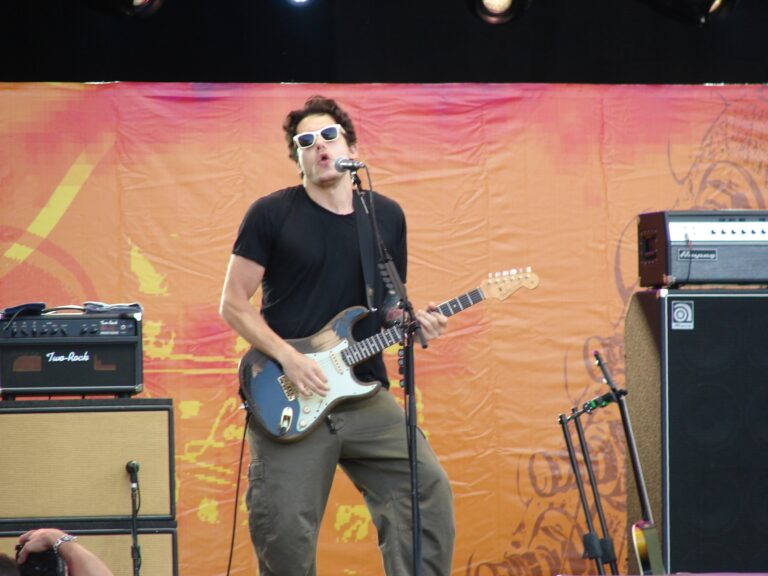
Mayer spent years as one of Fender’s most visible modern ambassadors, with his own signature Stratocaster released in 2005. But by the early 2010s he’d developed specific ideas about how an S-style guitar could be refined — ideas he says didn’t find much traction inside Fender. “I tried to do something like this with Fender, but I couldn’t create enough enthusiasm within the company for my vision,” Mayer told Guitar World around the Silver Sky’s release. He ended the Fender partnership in 2014 and went looking for a manufacturer willing to build to his specifications rather than simply put his name on an existing product.
He found it, awkwardly, through a cold call. According to an account from session guitarist Tim Pierce, PRS’s team initially hung up on Mayer when he first phoned about developing a guitar together, assuming it was a prank before he proved his identity. It wasn’t an obvious pairing — PRS had built its reputation on figured maple tops, birds-in-flight inlays, and a very un-Fender aesthetic — but Mayer valued something specific about the company: direct access to Paul Reed Smith himself. “At PRS I get to call the guy whose name is on the guitar, and we get to build stuff together,” he later said.
Two Prototypes, Two Years, One Guitar
The Mayer/PRS partnership didn’t start with the Silver Sky. In 2016, PRS released the Private Stock Super Eagle, an exotic, limited-run hollowbody built for Mayer’s work with Dead & Company, followed by the Super Eagle II in 2017 and a signature J-MOD 100 amplifier the same year. Both Super Eagle models were gorgeous and expensive — around $11,000 at the time — and neither was remotely accessible to a working guitarist. Mayer wanted something else: an instrument built on his own point of view but priced and produced for the mass market.
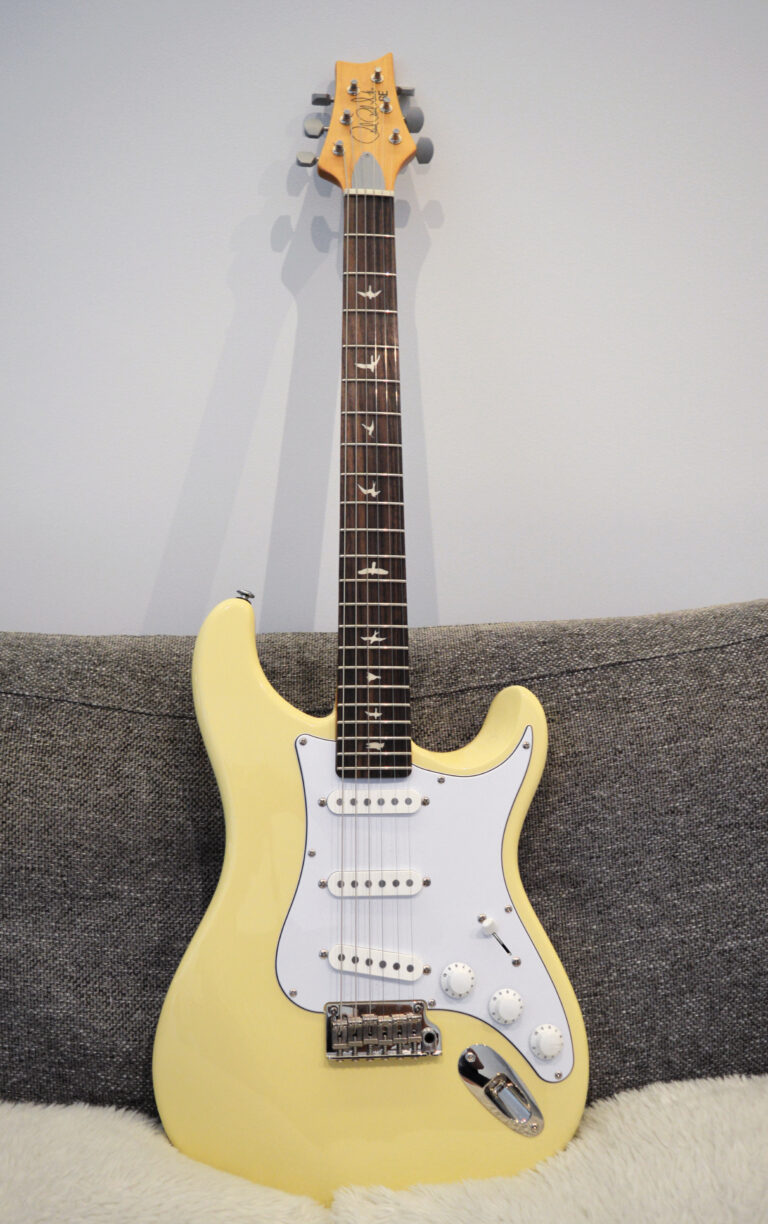
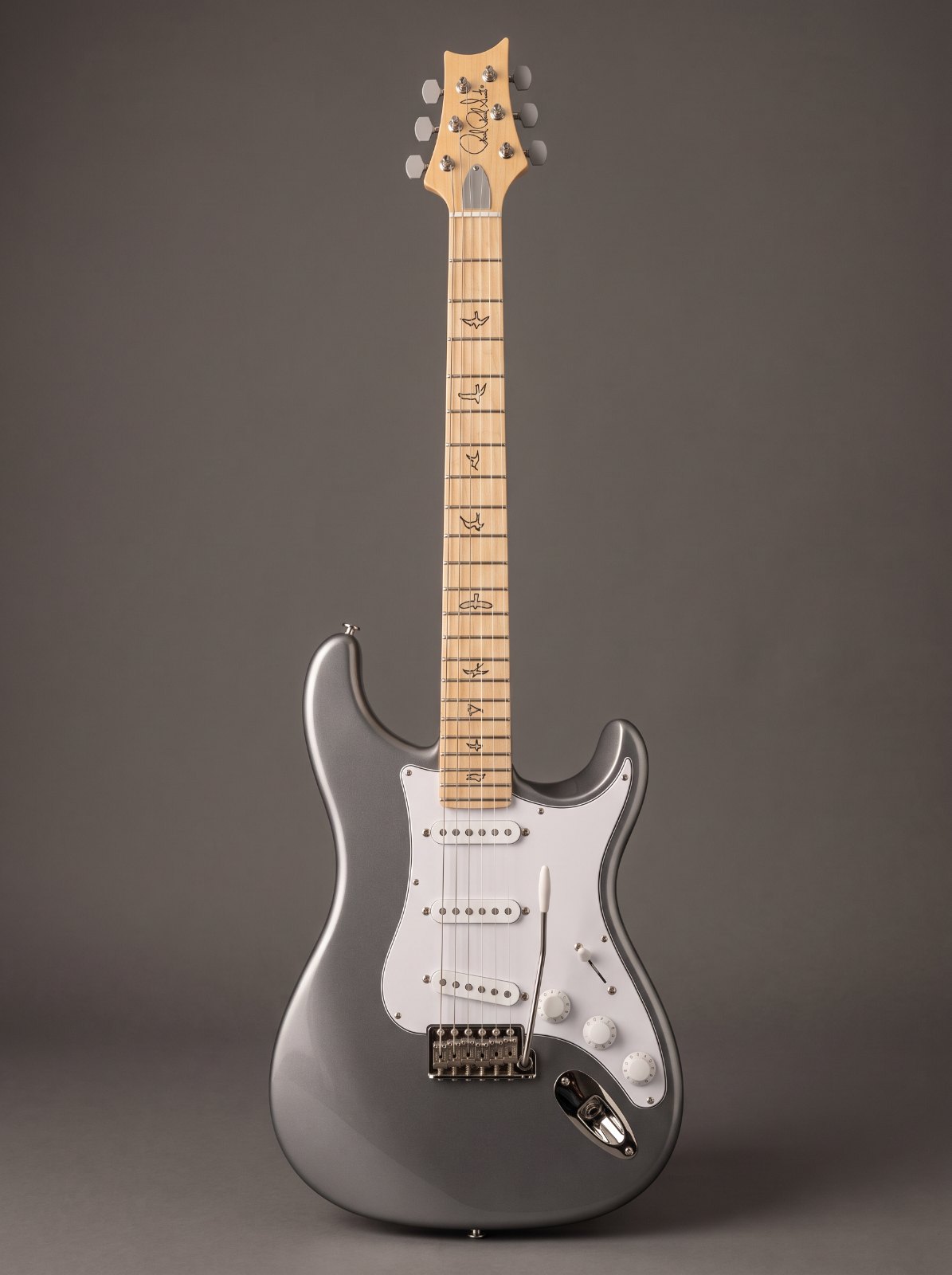
That became a roughly two-year development process, described by PRS as combining Mayer and Smith’s favorite elements of 1963 and 1964 Stratocasters with fully reworked modern details. The headstock alone reportedly went through 25 redraws, eventually landing on an inverted version of PRS’s own silhouette — inverted specifically to keep a consistent length of string behind the nut for tuning stability, and to suit Mayer’s playing feel. The pickups, tremolo, neck carve, and even the fretboard radius were each independently re-examined rather than borrowed from an existing PRS model. Guitar Player later noted that 2010’s DC3 — an earlier, lesser-known PRS single-coil design — represented an evolutionary step toward the much more Fender-adjacent instrument the Silver Sky would become.
Why “Silver Sky”?
Notably, Mayer chose not to put his own name on the front of the headstock or market the guitar as a conventional signature model. He picked the name “Silver Sky” instead — by his own account possibly a half-remembered fragment of a song lyric — because it sounded appropriately mysterious and fit naturally with PRS’s long-running bird-and-sky naming language. When the guitar launched via a 40-minute Instagram Live stream in March 2018, it reportedly generated almost a year’s worth of traffic to PRS’s website in 45 minutes, crashing the server and instantly becoming one of the most talked-about instruments in recent guitar history — for better and for worse, given the immediate backlash from players who saw it as an expensive Strat with the wrong headstock.
PRS Silver Sky — Full Specifications
Anatomy of the Tone
The 635JM pickups are the heart of the Silver Sky’s identity. Mayer’s goal was to replicate the character of the single-coils in his own 1964 Stratocaster while smoothing out the harsh “quack” that occurs in a Strat’s second and fourth switch positions — the classic in-between, funk-friendly tones — without eliminating the effect that makes those positions musically useful in the first place. The result, according to PRS, is a pickup voice that stays “round and full” with a top end that never tips into ice-pick territory, achieved partly through the reverse-wound, reverse-polarity middle pickup that cancels hum in those in-between switch positions.
The tremolo system matters more here than on a typical S-style guitar. PRS ships the Silver Sky’s Gen III steel tremolo set up flush to the body for downward-only pitch travel by default — a deliberate choice, since keeping the bridge plate in constant contact with the body increases the guitar’s acoustic resonance and improves the signal-to-noise ratio of the single-coil pickups. Players who prefer a floating vibrato setup can still configure it that way, at the cost of a small amount of that added resonance.
The 7.25″ fretboard radius on the Core model was one of the guitar’s most debated specs at launch — a notably curved, vintage-style radius that some reviewers worried would cause fret-out on aggressive bends, though in practice PRS’s fret-leveling process largely avoids the issue. Early prototypes reportedly used flatter 8.5″ and 8.25″ radii before Mayer settled on the more vintage-curved 7.25″ for the production Core model — while the SE version, aimed at a broader range of playing styles, ships with the flatter 8.5″ radius instead.
The Elephant in the Room: Fender’s Cease-and-Desist
As of this writing, the Silver Sky is at the center of the biggest legal story in the guitar industry. In March 2025, a German court issued a default judgment against a Chinese seller of unlicensed Stratocaster copies, a ruling Fender has since characterized as establishing the Stratocaster body as a protected work of “original creative expression” under German and EU copyright law. Fender began sending cease-and-desist letters to guitar builders in spring 2026, starting with the small California builder LsL Instruments. In late May 2026, the Wall Street Journal confirmed that PRS had also received one — specifically over the Silver Sky.
PRS’s public response has been brief but pointed: the company said it “disagrees with Fender’s assessment” and declined to elaborate further. Fender, for its part, has stated it isn’t targeting all double-cutaway or “two-horned” guitar bodies, only what it considers close copies of the Stratocaster’s specific design — though neither Fender nor its law firm has publicly defined exactly which visual elements cross that line. Commentators have noted that the Silver Sky’s body has distinct proportions from a real Stratocaster (a deeper lower-bout scoop, a longer upper horn, a different neck-joint angle), which under Fender’s own stated criteria would seem to put it outside the “close copy” category — making its inclusion on the cease-and-desist list one of the more contested and closely watched developments in the whole dispute.
Fender set an extended response deadline of June 8, 2026 for the builders it contacted; that date has now passed without a lawsuit being filed against PRS, and both companies remain in a standoff rather than active litigation. Fender’s leadership has publicly stated it is not seeking inventory destruction and is open to settlement discussions, while PRS’s language — “disagrees,” not “is reviewing” — reads as a company preparing to contest the claim rather than quietly comply. Given the Silver Sky’s commercial scale (it has outsold the Stratocaster itself on Reverb’s platform in multiple recent years) and PRS’s resources relative to smaller builders like LsL, this case is widely expected to become the test that defines how far Fender’s campaign can actually reach. Readers should treat this as a developing story rather than a settled outcome.
Famous Players: John Mayer, Almost Exclusively
Unlike most entries in this series, there isn’t a supporting cast to sort through — the Silver Sky is Mayer’s guitar in a way few production instruments belong to any single player, on the road with his solo band, his blues trio, and Dead & Company alike. What’s worth noting is how much of Mayer’s own guitar identity is bound up in an instrument he no longer plays exclusively; he has since also worked with other builders on custom T-style instruments, a reminder that even the guy whose name isn’t on the headstock keeps experimenting. Beyond Mayer’s own use, the Silver Sky and SE Silver Sky have become a common sight in session and worship-music circles, valued less for celebrity association than for consistency — a guitar that plays the same way out of the box as it did in the demo video, which was precisely the problem Mayer set out to solve when he left Fender in the first place.
Tone Recipes
Blues-trio drive: Bridge pickup, a transparent overdrive (a Tube Screamer-style pedal works well here) pushing a clean-to-edge-of-breakup tube amp — the 635JM bridge pickup’s controlled top end keeps aggressive picking from turning brittle.
Spacious clean (Dead & Co-inspired): Neck or middle pickup, light compression, modulation and delay stacked for width rather than gain — leaning on the guitar’s clarity rather than its bite.
In-between funk/pop rhythm: Position 2 or 4 on the 5-way switch, clean amp, light chorus — this is the “quack” Mayer specifically preserved rather than engineered out, useful for rhythm parts that need to cut through a dense mix without dominating it.
Ballad warmth: Neck pickup, tone knob rolled back slightly, clean-to-lightly-driven amp — the reverse-wound middle pickup keeps things quiet even with the tone rolled off.
How It Compares
Against a Fender Stratocaster, the comparison is unavoidable and, as of 2026, legally contested — but the practical differences are real: PRS’s locking tuners and tighter tolerances aim at day-to-day reliability, the 635JM pickups are voiced to reduce single-coil hum without abandoning the character that makes a Strat sound like a Strat, and the body contours and neck joint are measurably different from a vintage-spec Fender, even if the overall silhouette invites the comparison.
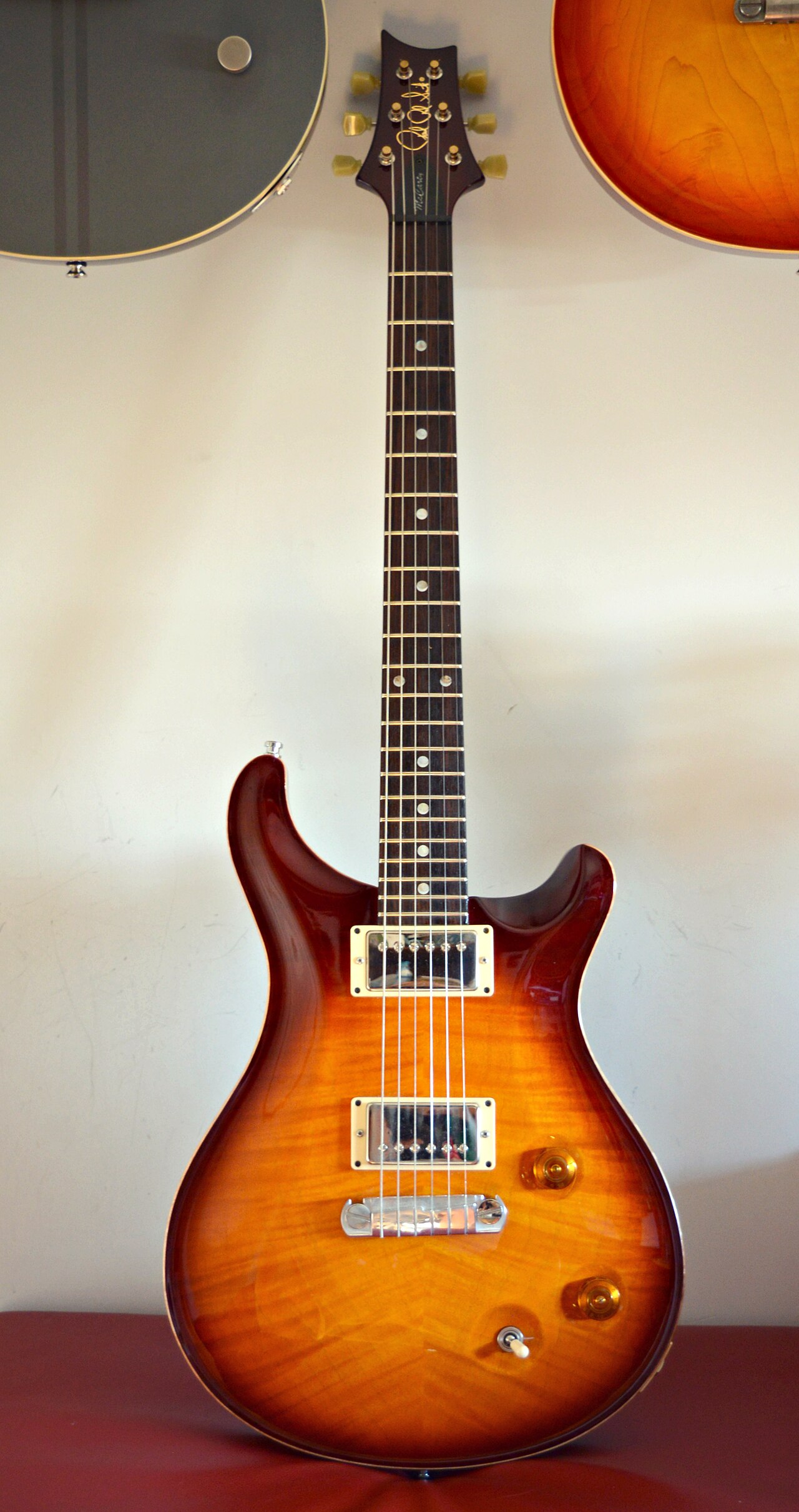
Against PRS’s own McCarty 594, the Silver Sky sits at the opposite end of PRS’s own catalog — humbuckers and a shorter, vintage-Gibson-adjacent scale length on the 594 versus three single-coils and a full 25.5″ Fender-standard scale on the Silver Sky. Players choosing between the two are really choosing between two different tonal vocabularies, not two versions of the same idea.
Against a Telecaster, the difference is more about voicing than construction — the Silver Sky’s three-pickup, tremolo-equipped layout offers more tonal range and pitch-bending expression, while the Tele’s simpler two-pickup format remains the sharper, more direct choice for country and roots-rock rhythm work.
Buying Guide
The Core USA Silver Sky is the guitar Mayer and Smith actually designed together, and it’s worth the jump for players who will notice the difference in fret-leveling, tuning stability under heavy tremolo use, and the alder body’s resonance. The SE Silver Sky, built in Indonesia with a poplar body and a flatter 8.5″ fretboard radius, trades some of that vintage-curve feel for broader playability and a price roughly a third of the Core model — and has been Reverb’s best-selling electric guitar model in multiple recent years, a genuinely remarkable feat for a guitar under $1,000. Buyers choosing between maple and rosewood fretboards on the Core model should know the neck shape itself changes slightly between the two: the maple option keeps Mayer’s original 635JM carve, while the rosewood option is subtly rounded in the shoulders. Limited-edition color runs — Nebula, Lunar Ice, and the 2026 Wild Blue release limited to 1,000 pieces — command a premium and tend to sell out quickly.
Practical Ownership Notes
The 7.25″ fretboard radius on the Core model is the single most polarizing spec on the guitar — vintage-curved and comfortable for chord work and classic-rock bends, but worth testing before buying if you’re coming from a flatter modern radius and do a lot of extreme high-fret bending. The tremolo’s default downward-only setup is a deliberate design choice for tone and resonance, not a limitation; players wanting a floating setup can rework it, with a small tradeoff in acoustic loudness. At 7.4 lbs, the Silver Sky is comfortably lighter than most vintage Stratocasters, a small but real difference over a long set.
FAQ
Is the PRS Silver Sky basically a Fender Stratocaster with a different headstock?
No, though the resemblance is deliberate and has been legally contested by Fender as of 2026. The Silver Sky has different body proportions, a reworked pickup design, PRS’s own tremolo and tuning hardware, and construction details developed independently over roughly two years, even though it clearly draws on Stratocaster DNA.
Why doesn’t the Silver Sky have John Mayer’s name on it?
Mayer deliberately avoided marketing it as a conventional signature model, choosing the name “Silver Sky” instead and keeping his name off the front of the headstock.
What’s the difference between the Core Silver Sky and the SE Silver Sky?
The Core USA model uses an alder body, a 7.25″ fretboard radius, a bone nut, and locking tuners; the SE uses a poplar body, an 8.5″ radius, a synthetic bone nut, and non-locking tuners, at roughly a third of the price.
Is Fender suing PRS over the Silver Sky?
As of this writing, Fender has sent PRS a cease-and-desist letter, not a lawsuit. PRS has stated it disagrees with Fender’s position; no court case has been filed between the two companies, and the situation remains unresolved.
Does the cease-and-desist affect whether I can still buy a Silver Sky?
No — as of this writing, the Silver Sky and SE Silver Sky remain in full production and available for purchase. A cease-and-desist letter is a legal warning, not a sales ban.
Image credits
- A PRS McCarty guitar standing upright: Freebird, Wikimedia Commons, CC BY-SA 2.0.
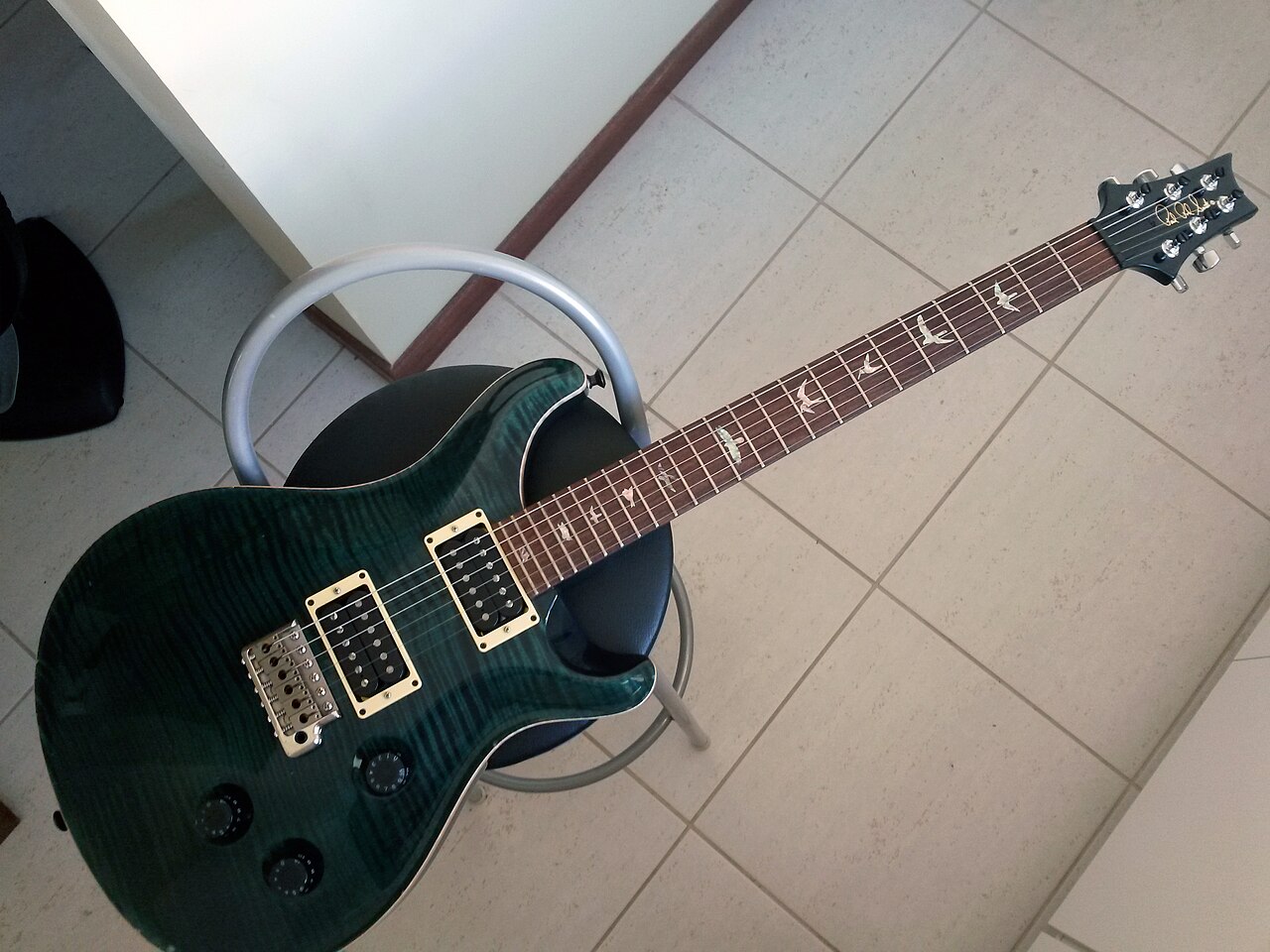
- A PRS Custom 24 in teal black, 2004, seen from above: Rachmaninoff, Wikimedia Commons, CC BY-SA 4.0.
- Top image: GuitarGangsters AI-generated reference illustration, not a photograph.
Latest News
Related
On This Day
Monday 9 November
From this week: