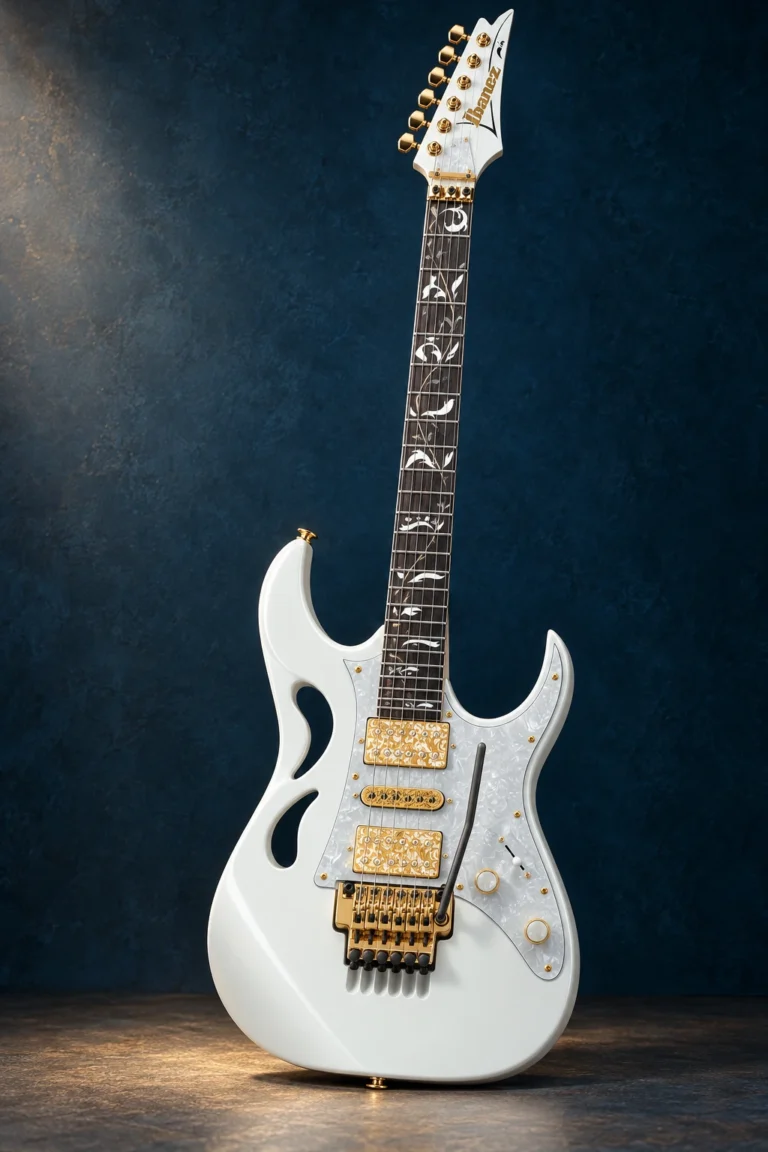
Ibanez RG8570Z J.Custom: One Tier Above the Prestige
Ibanez's J.Custom line sits above Prestige and outside the signature roster entirely. The RG8570Z is the RG family's quiet, unbranded flagship.
Last time out we covered the RG652AHMFX Prestige and called it the unsigned shred machine — a Japan-built RG that nobody famous claims as their own. The RG8570Z takes that same idea and pushes it a full tier higher. This is Ibanez’s J.Custom line: above Prestige, outside the entire signature-model universe, and built in numbers so small that most of the world never got to buy one new.
What “J.Custom” Actually Means
Ibanez runs three broad tiers of Japanese-made instruments. Prestige is the tier most players encounter — the RG652AHMFX from our last article lives here, alongside hundreds of other RG, S, and AZ models built at the FujiGen plant to a consistent, high standard. Above that sits J.Custom: a smaller, slower production line originally intended almost entirely for the Japanese domestic market, using premium tonewoods, hand-selected tops, and finishing techniques that don’t appear anywhere else in the catalog.
The Non-Signature Flagship
What makes J.Custom unusual is what it isn’t. It isn’t a signature series — there’s no artist’s name on the truss rod cover, no personally specified pickup voicing, no story about a player’s exact stage rig. It’s Ibanez building its best possible version of its own standard shapes, for players who want the ceiling of Japanese craftsmanship without buying into anyone else’s specification.
From USA Custom to J.Custom
The tier didn’t start in Japan at all. Between 1989 and 1995, Ibanez ran a “USA Custom” shop out of North Hollywood, California, building small runs of exotic-wood and custom-graphic instruments for the American market under sub-lines with names like UCEW (USA Custom Exotic Wood) and UCMD (USA Custom Metal Design). When that shop wound down, Ibanez moved the same idea back to Japan and rebranded it J.Custom in 1996 — the “J” standing for Japan and drawing a clean line under the American chapter. From the start, J.Custom instruments were built by FujiGen’s most experienced luthiers and, in some cases, by the Sugi Musical Instruments workshop, in numbers small enough that individual models were sometimes the work of a single named craftsperson rather than a production line.
There’s a genuinely surprising twist buried in the naming history here: “Prestige,” the tier most players now think of as sitting just below J.Custom, actually started life as an export label for J.Custom guitars. When Ibanez introduced certain J.Custom RG models to the European market in 1997, they were rebadged “Prestige” for that market specifically — the same guitar, different sticker. Over the following years Prestige split off into its own distinct, larger-volume tier, with real-wood tops eventually reserved exclusively for J.Custom, but the hierarchy players take for granted today — Prestige below J.Custom — only settled into that shape gradually. J.Custom, in other words, isn’t an add-on to Prestige. Prestige is arguably the offshoot.
A Decade Mostly Confined to Japan
The RG8570Z arrived in 2009, built by FujiGen as part of the J.Custom range and, for its first several years, sold almost exclusively within Japan — the fate of most J.Custom instruments, which Ibanez has historically treated as a domestic showcase line rather than an export product. That changed gradually: Europe got access starting in 2016, and by 2018 the RG8570Z reached most markets worldwide, China being the one notable exception. It’s one of the more widely available J.Customs specifically because of that expansion, which is a large part of why there’s enough English-language community discussion and dealer history to write about it at all — most of its J.Custom siblings never got that reach.
Anatomy of the RG8570Z
Body and Top
The body is African mahogany capped with a 4mm AAA flamed maple top, bound in cream. Ibanez names its J.Custom finishes after gemstones and minerals rather than the more generic color names used on Prestige models — Almandite Garnet, Black Onyx, Bright Brown Rutile, Chrysocolla, Brownish Sphalerite, Royal Blue Sapphire — a small branding flourish that reinforces the sense that these are meant to feel like jewelry-grade instruments rather than mass-production guitars. A 2018 Rhodonite Pink finish was released as a Japan-exclusive spot model through retailer Ishibashi before later appearing in European markets too.
Neck and Fingerboard
The RG8570Z uses Ibanez’s J.Custom Super Wizard neck, a thin, fast bolt-on profile built from five laminated pieces. At launch that meant maple and walnut; in late 2017 Ibanez switched the recipe to maple and wenge, a change that also came with three new finish options. Titanium reinforcing rods were added to the neck starting in 2010, a year after the model’s introduction, for extra rigidity under the tension of the double-locking tremolo. The fingerboard itself has varied by year and market — original-spec instruments used a bound rosewood board with flamed maple binding, while many later production runs, including several Sweetwater-exclusive colorways, shipped with a bound Macassar ebony board instead. Either way, all versions carry the same eye-catching Tree of Life vine inlay running the length of the neck, and the fret ends receive Ibanez’s dedicated J.Custom fret edge treatment — a finishing step even more refined than the Prestige fret-end treatment we flagged as inconsistent on the maple-board RG652AHMFX in our last article. On J.Custom, that inconsistency doesn’t happen; every board gets the full treatment regardless of wood.
Electronics and Hardware
Pickups are a DiMarzio HSH trio: an Air Norton at the neck and a Tone Zone at the bridge, the same pairing used on the RG652AHMFX, but here they flank a DiMarzio True Velvet single coil in the middle position rather than sitting alone. That middle pickup opens up cleaner, more articulate tones the two-humbucker Prestige can’t quite reach — a genuine functional upgrade rather than just an extra knob to turn. The bridge is an Edge Zero double-locking tremolo with a removable ZPS (Zero Point System) tuning stabilizer, a lower-profile design with a stud-lock function built specifically for tuning stability during aggressive dive-bombs. Controls are simplified to a single volume, a single tone, and the five-way switch, mounted as recessed “Easy Access” knobs that sit flush enough to avoid catching a pick mid-solo. Gotoh supplies the locking tuning machines and strap-lock pins, finished in Cosmo black to match the rest of the hardware.
The RG8570 Family Tree
The RG8570 name has a longer history than the Z-suffixed model this article covers. An original RG8570 — also known internally as the JCRG-80 — ran from 2001 to 2004 as a Japan-only J.Custom, pairing a flame maple top on a plain mahogany body with a maple and bubinga neck, a rosewood board with mother-of-pearl dot markers, an Edge Pro tremolo, and the same DiMarzio Air Norton/Tone Zone/True Velvet trio that would carry through to later models. A maple-board sibling, the RG8570M, and simpler variants without the middle pickup (the RG8520) or with an ebony board and violet chrome hardware (the RG8670) rounded out that first generation.
The RG8570Z profiled here arrived in 2009 as a direct replacement for the RG8470Z, with the middle pickup addition as the headline change. Around it, Ibanez ran several dealer- and market-specific spin-offs typical of the J.Custom line’s small-batch culture: the SRG8570Z was a spot-model variant built for Shimamura Gakki, one of several Japanese retail chains for which Ibanez has long produced short-run J.Custom exclusives under different lettered prefixes. The RG8570ZXX pushed further upmarket still with a curly maple top and gold hardware in place of the standard cosmo black. A fixed-bridge sibling, the RG8571, dropped the Edge Zero for players who wanted the tonewood and finish without a locking trem to maintain. Left-handed demand was served in two separate windows — an RG8570ZL production run from 2015 to 2017, and a second one from 2019 to 2022 — rather than as a continuously available option, another small reminder of how limited J.Custom volumes really are.
When the RG8570Z was discontinued after 2022, Ibanez didn’t retire the shape — it replaced the Edge Zero with a Lo-Pro Edge tremolo and relaunched it in 2023 simply as the RG8570, dropping the Z. That successor has continued to evolve in small ways since; as of 2026 the fingerboard on markets outside Japan changed to rosewood, while the Japanese-market version retained the Macassar ebony board, yet another example of the geographic finish variation that runs through this model’s entire history.
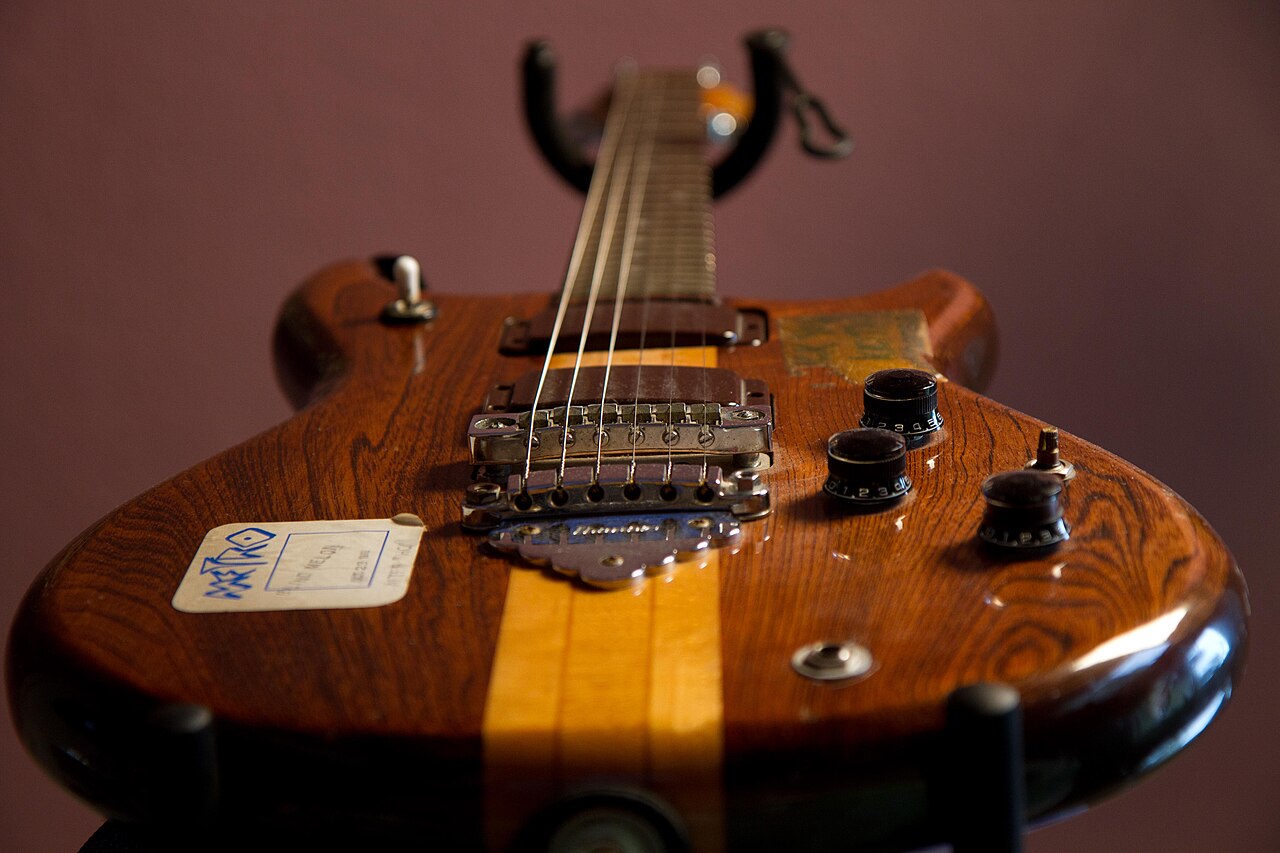
Famous Players: Built By Ibanez, Chosen By No One In Particular
What does check out is more interesting than a shred-icon name-drop. Ibanez’s own promotional video library — cataloged on the Ibanez Wiki’s video archive — includes an official demo titled “Ibanez j.custom RG8570Z Electric Guitar featuring ichika.” That’s Ichika Nito, the Japanese guitarist known for ambient, tapping-heavy fingerstyle work and a huge YouTube following built on the same wave of internet-native guitar virtuosity that made Tim Henson a household name in guitar circles. Ichika turns up across several other Ibanez J.Custom demo videos too, suggesting an ongoing relationship with the company’s demo program rather than a one-off shoot — but this particular RG8570Z video is a direct, company-sourced confirmation rather than an inference. You can read more about his rig on his own page, Ichika Nito.
A second, differently-shaped connection comes from Andrew O’Connor, guitarist for the American deathcore band Lorna Shore — a band that went from underground extremity to viral mainstream attention on the strength of a scream heard around the internet, and has since toured arenas and festivals worldwide. O’Connor’s primary brand relationship today is with Solar Guitars, whose Evertune-equipped models he credits for touring stability. But his own Instagram post, captioned simply “Gear Gear Gear,” documents an Ibanez RG8570Z sitting in his collection as a backup to his main six-string — a smaller, more honest kind of endorsement than a full signature deal, and one that fits the J.Custom line’s identity as a guitar chosen on its own merits rather than issued as sponsor gear.
The Lorna Shore connection is worth a beat of context for anyone outside deathcore’s usual audience. The band spent over a decade as a respected but relatively underground act before new vocalist Will Ramos’s guttural range on the 2021 single “To the Hellfire” spread across social media well beyond metal’s usual channels, pulling in listeners who had never heard the genre before and landing the song on Spotify’s Viral Chart. That moment turned Lorna Shore into festival headliners within a couple of years, and O’Connor’s guitar work has been part of every tour and release since — which makes his quiet Instagram nod to an Ibanez J.Custom sitting in his case a small footnote to a considerably larger story.
Tone Recipes
Ambient Tapping and Fusion Leads
With the True Velvet engaged alone or blended with the Air Norton in positions 2 or 4, the RG8570Z opens up a glassy, articulate voice well suited to two-hand tapping and legato runs in the Ichika mold — bright enough to let fast picking and tapped harmonics ring clearly, without the harshness a hotter single coil can introduce. Keep gain moderate and lean on the guitar’s volume knob for dynamics rather than a pedal.
Deathcore and Extended Rhythm
Bridge position, Tone Zone alone, gain pushed hard: this is the O’Connor-adjacent setting, built for palm-muted breakdowns and low-string chugging. The mahogany body and maple top combination keeps the low end tight rather than woolly, which matters when a riff is built around rapid alternate picking on the low strings.
Classic Shred Leads
Neck position, Air Norton, tone rolled to around 7: a warm, singing lead tone that avoids sounding muddy even with sustain-heavy vibrato. Push the Tone Zone in for a hotter, more aggressive solo voice when a section calls for more bite than the Air Norton offers alone.
How It Stacks Up
Against the RG652AHMFX Prestige we covered previously, the difference is genuinely structural rather than cosmetic — the flamed maple top, three-pickup HSH layout, Macassar ebony or rosewood board options, and full fret-edge treatment on every unit put real distance between the two tiers, not just a price gap. Against the RG550 Genesis Collection that opened this run of Ibanez articles, the RG8570Z represents the opposite end of the RG family’s ambition: where the RG550 deliberately recreates a stripped-down 1987 blueprint, the J.Custom pushes the same silhouette toward the most expensive materials and construction Ibanez is willing to put into a non-signature guitar.
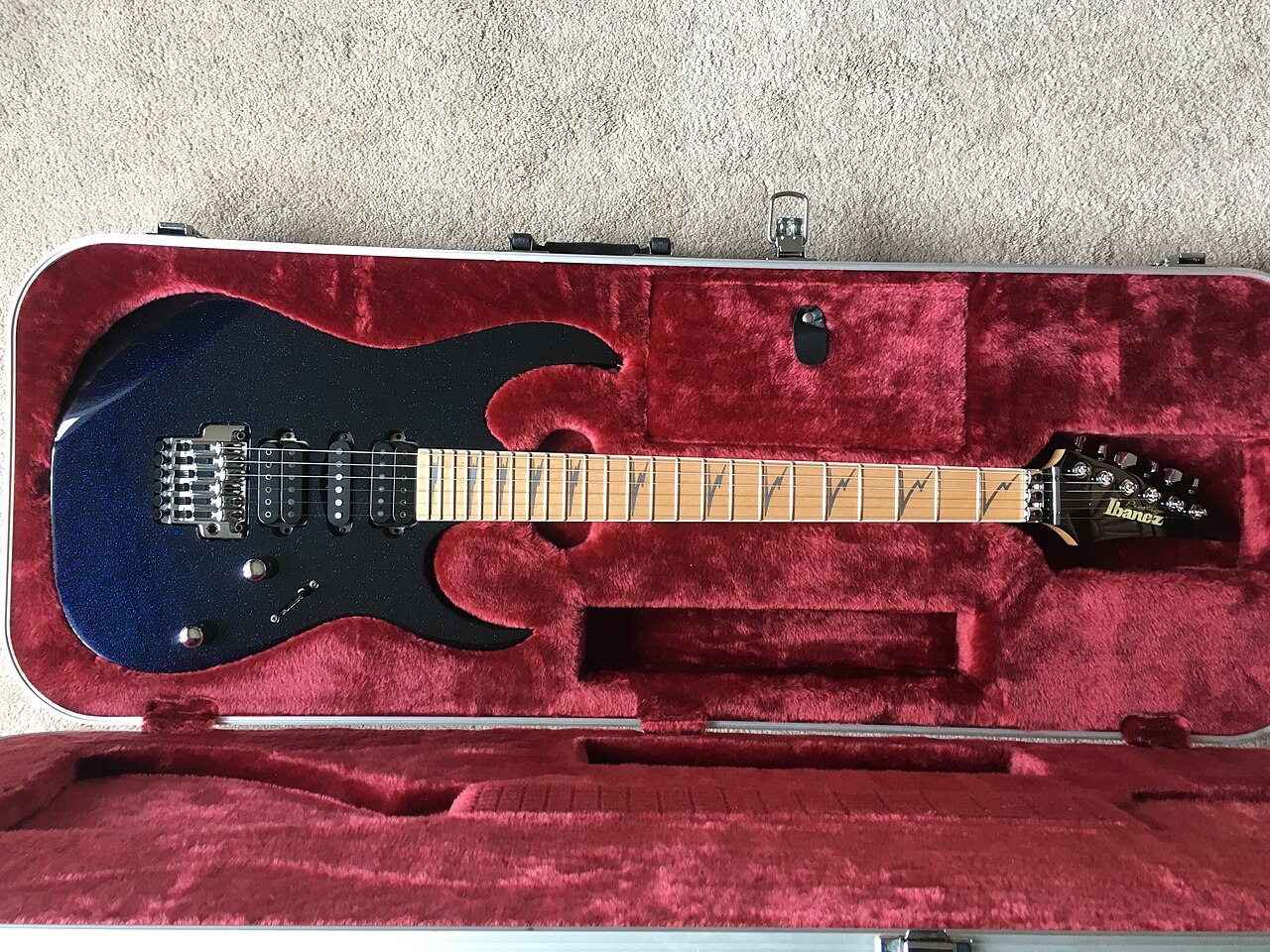
Outside Ibanez, the closer comparison is another brand’s non-signature flagship: the Gibson Les Paul Custom, sometimes nicknamed the “Black Beauty,” which occupies a similar space in Gibson’s catalog — the most opulent version of a standard shape, built for players who want the best materials available without an artist’s name attached. Set-neck mahogany versus bolt-on maple/wenge, and a completely different genre home, but the underlying logic of “flagship without a face” is the same in both cases.
Buying Guide
The RG8570Z was discontinued after 2022, replaced for 2023 by the visually similar RG8570, which swaps the Edge Zero for a Lo-Pro Edge tremolo and otherwise keeps most of the same spec sheet. That makes the RG8570Z itself a used-and-NOS-only proposition today. New-old-stock and lightly used examples have circulated in the $3,000–$3,700 range depending on finish and condition, with some dealer-exclusive colorways commanding a premium simply because they were never widely stocked outside Japan or a single retailer’s exclusive run.
Two spec details are worth checking before buying secondhand. First, the neck wood: pre-2017 units use maple and walnut, while 2017-onward production switched to maple and wenge, a change some players report as a slightly stiffer, brighter-feeling neck — not better or worse, but different enough to matter if you’ve played one era and are shopping for the other. Second, the fingerboard: rosewood and Macassar ebony both exist across the model’s run depending on year and market, and the two woods have a genuinely different look and a subtly different top-end response, so it’s worth confirming which one a specific listing has rather than assuming.
It’s also worth watching for dealer-exclusive spot models bearing a different lettered prefix on an otherwise near-identical spec sheet — an SRG8570Z, for instance, was built specifically for the Japanese retailer Shimamura Gakki rather than as a general-market release, and instruments like it can turn up on the used market labeled inconsistently by sellers who aren’t familiar with Ibanez’s dealer-exclusive naming conventions. None of this makes the guitar itself any different in practice, but it does affect how confidently you can compare one listing’s price against another’s.
Living With a J.Custom
Owner discussions consistently rate build consistency as the RG8570Z’s strongest asset — one longtime collector on SevenString.org, on his 26th J.Custom purchase, described the fit and finish as dependably excellent even when a particular top’s figuring turned out less dramatic than hoped. That’s a recurring caveat worth passing along honestly: several owners note that the most spectacular flamed-maple tops tend to get reserved for the Japanese domestic market, so an export-market RG8570Z can occasionally arrive with a more modest top than photos of other units suggest. The Edge Zero tremolo draws mixed opinions — most owners appreciate the ZPS stabilizer’s contribution to tuning stability during heavy dive-bomb use, though a few find the added hardware and springs make routine tuning changes slightly fussier than a standard double-locking trem. The recessed volume pot is occasionally described as less gradual in its taper than players expect, a minor quirk rather than a dealbreaker. At roughly 7.2 pounds, it’s comfortably lighter than most mahogany-bodied guitars of similar size, thanks in part to the FujiGen plant’s careful weight-relief practices on J.Custom builds.
FAQ
What does “J.Custom” mean on an Ibanez guitar?
It’s Ibanez’s highest standard-production tier, built in Japan by FujiGen with premium tonewoods and finishing techniques above even the Prestige line, and produced in smaller numbers. It sits apart from, rather than above, Ibanez’s signature-artist models.
Is the RG8570Z still in production?
No. It was discontinued after 2022 and replaced for 2023 by the RG8570, which uses a Lo-Pro Edge tremolo instead of the Edge Zero but keeps most of the rest of the spec sheet intact.
Why does the neck wood differ between examples?
Ibanez changed the neck lamination from maple/walnut to maple/wenge in late 2017. Both eras exist on the used market, and the change affects feel more than it affects fundamental build quality.
Does the RG8570Z have three pickups?
Yes — an HSH configuration with DiMarzio Air Norton and Tone Zone humbuckers flanking a DiMarzio True Velvet single coil in the middle, giving it more tonal range than the two-humbucker Prestige RG652AHMFX.
Was the RG8570Z ever a signature model?
No. Despite frequently being lumped in with Ibanez’s shred-icon signature artists in casual gear discussion, it’s a standard-production J.Custom model with no artist attribution — part of what makes it distinct from guitars like the JEM or JS series.
Image credits
- A black Ibanez Prestige guitar in a red-lined case: Ron Ruiz, Wikimedia Commons, CC BY-SA 4.0.
- An Ibanez Musician MC200DS guitar seen from below: Joshin Yamada, Wikimedia Commons, CC BY 2.0.
Latest News
Related

On This Day
Monday 9 November
From this week: