Ibanez PS10: The Guitar Paul Stanley Designed to Outlast a Decade of Trends
From a 1977 Japan tour to a hand-cut mirror-glass stage guitar, the Ibanez PS10 is Paul Stanley's design, start to finish. Full history and specs.
The PS10 belongs to one guitarist, full stop: Paul Stanley, co-founder, rhythm guitarist, and lead vocalist of KISS, and one of the very few 1970s rock stars who treated a signature guitar collaboration less like an endorsement deal and more like an actual design project.
From Gibson Kid to Ibanez Icon
Stanley didn’t start out as an Ibanez guy. Through most of KISS’s explosive rise in the mid-1970s, his arsenal leaned on Gibson: an L6-S Midnight Special, a Flying V, a Firebird, an Explorer, even an EDS-1275 double-neck. He’d grown up idolizing exactly the players you’d expect from that gear list — seeing Humble Pie, Led Zeppelin, the Yardbirds, and Derek and the Dominos most weekends as a teenager, most of it played on Gibsons. But by the late ’70s, Stanley had reached a conclusion that was unusual for a rock star of his stature at the time: he thought the Japanese manufacturers, Ibanez specifically, were quietly outbuilding Gibson’s own factory output during a rough patch in Gibson’s history.
“I Was Looking for a Guitar I Would Love”
When KISS toured Japan in 1977, the band was met with the kind of reception that led them to record Alive II at Tokyo’s Budokan Hall, and it was around this trip that Ibanez approached Stanley about collaborating on a signature guitar. What happened next set the PS10 apart from most 1970s signature deals, which were often little more than a name stamped on an existing catalog model. Stanley threw himself into the design work directly, shaping decisions down to the fret inlays and binding. He’s been direct about how personal the result felt: asked decades later about the connection between the PS10 and his old Gibsons, Stanley explained that when you close your eyes and play it, the PS10 is basically built on templates that came from some of his old Gibson guitars — high praise from someone who’d just spent years walking away from that brand.
The PS10 first appeared in the 1978 Ibanez catalog and retailed for about $695, remaining Stanley’s main guitar through 1981. Stanley himself has drawn a sharper line between the PS10 and the standard Iceman than most players realize — in his own words, describing the relationship as closer to a Chevy and a Rolls Royce than two versions of the same car, with construction, frets, inlays, wiring, the sustain-block tailpiece, and the half-bone/half-brass nut all part of what he brought to a shape that had started life as a fairly obscure catalog model nobody wanted.
The Cracked Mirror Guitar
The single most famous PS10 variant didn’t come from a marketing meeting — it came from a British glam-rock frontman’s hat. Stanley had seen Slade’s Noddy Holder wearing a top hat covered in circular mirrors that threw beams of light across the venue whenever a spotlight hit it, and he wanted the same effect built into a guitar. He assigned the task to Ibanez USA rep Jeff Hasselberger, who went through several failed attempts at literally shattering a mirror before switching to hand-cutting individual pieces of mirrored glass and arranging them across a PS10-shaped maple blank, angling each piece between 5 and 15 degrees to scatter light exactly the way Stanley wanted. The edges were sanded smooth enough not to shred Stanley’s picking hand, and the “Cracked Mirror” guitar debuted later in 1979 as the visual centerpiece of KISS’s live show — a guitar that, by Stanley’s own account decades later, has absorbed enough sweat and stage wear across hundreds of shows that he’s joked it holds enough of his DNA to clone him.
A Guitar That Left and Came Back — Twice
The original PS10 run ended in the early 1980s as Stanley moved through a run of other brands. The Hamer Standard Custom debuted on the Return of KISS tour, one of several custom-built Hamer pieces Stanley commissioned — his originals came finished in distinctive colors and later reappeared refinished in a tiger-stripe paint job during the Creatures of the Night tour, complete with the same split pearl-and-abalone inlay design carried over from the PS10 and a sustain-block bridge in place of a standard tune-o-matic. From there he moved to B.C. Rich, including a Warlock finished in the same cracked-mirror treatment as his Ibanez, used mainly through the Animalize era of 1984–85, before eventually landing with Steinberger. It’s a genuinely restless run of guitars for a player whose stage persona rarely changed — Stanley clearly enjoyed chasing new shapes and finishes even while keeping his core rhythm-guitar approach constant underneath.
Ibanez brought the design back briefly for KISS’s 20th anniversary in 1992–93 as the IC1000BK, a run of roughly 511 units worldwide, followed by further Japan- and Korea-built reissues (the PS10II, PS10LTD, and PS10CL) through the mid-to-late 1990s before Stanley moved on again, this time to a long-running Washburn signature partnership.
Stanley returned to the Iceman shape as his primary guitar during KISS’s 1995 reunion tour, then set it aside again for Washburn before coming back to Ibanez for good starting in 2015, this time as an active collaborator on the brand’s design and development rather than simply an endorsee picking colors from a swatch book. The modern PS10, introduced in mid-2015 and built in Japan by FujiGen, is the guitar that resulted — and it’s the version most players today can actually buy new, unlike the increasingly expensive and scarce late-’70s originals.
The Modern PS10: Full Specifications
The current PS10 isn’t a note-for-note recreation of the 1978 original, and it’s worth knowing what actually changed. The vintage PS10 ran a pair of V-2 humbuckers rather than the Seymour Duncan units found on the modern version, and early production used simpler hardware throughout — the Seymour Duncan ’59/Custom 5 pairing, the Prestige fret edge treatment, and several of the refined hardware touches are additions from the 2015 relaunch rather than features of the guitar Stanley toured with in 1978. The shape, the sustain-block bridge concept, and the half bone/half brass nut, on the other hand, carry straight through from Stanley’s original design brief — the parts of the guitar he was most personally invested in getting right the first time are the parts Ibanez left alone.
What Paul Stanley Actually Plays Today
KISS wrapped their farewell “End of the Road” touring in 2023, and the gear breakdown from that final run is about as clear a picture as exists of what Stanley actually relies on when the lights come up. His main guitars were a rotation of Ibanez PS10s in Black, Gold, Cracked Mirror, and Rhinestone finishes, alongside a Gibson Custom Shop “Custom” V modified by tech Billy Rowe, with Ibanez PS60 models kept on hand as backups. Each V was customized to Stanley’s own specifications — body contour, neck profile, frets, hardware, finish, and a custom tailpiece — because, per his tech, Stanley has never wanted to play the same thing everyone else plays and prototyped his own take on Gibson’s classic shape rather than accepting one off the rack.
The amp side of the rig is almost defiantly simple for an arena headliner. Stanley runs custom Engl heads loosely based on the Ritchie Blackmore model but re-tubed with EL84s instead of the stock 5881s, through a pair of Marshall 4×12 cabinets loaded with Celestion Vintage 30 speakers. According to his longtime tech, the band experimented with modular effects and overdrives over the years but kept coming back to plugging straight into the amp on a single channel, using the guitar’s own volume knob to clean up the gain when needed — an old-school approach that Stanley’s tech has singled out as one of his favorite things about how Stanley approaches the instrument.
The Wider Paul Stanley Family Tree
The PS10 sits at the top of a tiered lineup that’s grown substantially since the 2015 relaunch, all built on the same Iceman-derived body shape but split across price points and finishes.
The Standard Tiers
Below the Japan-built PS10, Ibanez offers the PS120 (mahogany body with maple top, built to a lower price point) and the PS60 and PS40 as further budget-tier entries — the same guitars Stanley’s own crew keeps around as stage backups. A short-scale PSM10 miKro version exists too, aimed at younger or smaller-handed players who still want the shape without an adult-scale neck.
The Cracked Mirror Lineage
Stanley’s most famous custom guitar has become its own recurring limited-edition sub-series rather than a one-off relic. The PS1CM, introduced in 2015 with a silver mirror top and silver hardware, was followed by the purple-topped PS2CM in 2017, a gold-topped PS4CM in 2020, and a black acrylic-mirrored PS3CM in 2023 built to mark the PS10’s 45th anniversary. Each piece of mirrored acrylic on the PS3CM was cut to match its corresponding piece on Stanley’s actual original Cracked Mirror guitar and mounted at the same angle — a level of replica accuracy that treats Stanley’s 1979 stage prop less like a novelty finish and more like a piece of instrument history worth preserving precisely.
Stanley’s Role in KISS’s Sound
Understanding the PS10 means understanding what Stanley actually does on stage, which is a different job than the one most signature-guitar stories are built around. He’s never positioned himself as KISS’s lead player — that role belonged to Ace Frehley in the band’s classic lineup and later to Tommy Thayer — and Stanley has said directly that he was never chasing flashy solo status, drawing more inspiration from rhythm-focused players like Keith Richards and Pete Townshend than from any guitar hero’s lead lines. His real contribution runs through KISS’s songwriting: he co-wrote and sang stadium staples like “Love Gun,” “Black Diamond,” and “I Was Made for Lovin’ You,” and he’s described the band’s founding mission in terms of melody and chorus writing pulled from Brill Building pop songwriting traditions filtered through Led Zeppelin-style guitar weight, rather than pure headbanging aggression.
That context matters for understanding why the PS10 is built the way it is. A guitar designed by and for a rhythm-and-vocals frontman prioritizes different things than one built for a touring lead player — comfortable chord-hand positioning, a bridge that adds low-end density and sustain to full-band power chords, and a neck profile that doesn’t sacrifice rhythm comfort chasing upper-fret shred access nobody was asking this guitar to deliver. The PS10 isn’t a lead player’s tool wearing a rock star’s name; it’s a genuinely rhythm-guitarist-shaped instrument, designed by one of the most recognizable rhythm guitarists in arena rock history.
Tone Recipes
Classic KISS Rhythm
Both humbuckers combined, amp pushed into edge-of-breakup rather than heavy saturation, tone control left mostly open. This is the closest setting to Stanley’s own reported approach — a single amp channel, guitar volume doing most of the gain-shaping work rather than a pedalboard.
Neck Pickup Cleans
Neck ’59 model alone, volume rolled back slightly, amp on its cleanest setting. Useful for the more melodic, verse-driven passages in KISS’s catalog where Stanley’s rhythm work sits further back in the mix.
Bridge Pickup Power Chords
Bridge Custom 5 alone, amp gain pushed further than the combined setting, minimal EQ scooping. The Custom 5 was voiced as a higher-output companion to the ’59, and it’s the pickup doing most of the work on the band’s more aggressive material.
How the PS10 Compares
Against the standard, non-signature Ibanez Iceman IC520 covered elsewhere in this project, the PS10 shares the same underlying body silhouette but very little else — Seymour Duncan pickups instead of DiMarzio, an ebony board instead of jatoba or rosewood, a Gibraltar sustain-block bridge instead of a Tight-Tune setup, and a price tag that reflects genuine Japanese Prestige-tier construction rather than a Chinese-built budget guitar. It’s a useful pairing precisely because both guitars trace back to the same 1970s shape but land at opposite ends of what that shape can cost. Against Stanley’s own Gibson V — the guitar he still keeps in rotation as a genuine alternative rather than a backup of convenience — the PS10 offers more sustain and low-end presence thanks to its embedded sustain block, while the V trades some of that density for a lighter overall feel.
Buying Guide
- Vintage (1978–1981) originals are genuine collector’s items. Early PS10 prototypes have sold at auction for thousands of dollars, and even standard production examples from the original run command a real premium over the modern reissue.
- The 1992–93 IC1000BK anniversary run is scarce. With roughly 511 units built worldwide, tracking one down and verifying authenticity takes more patience than shopping the current catalog.
- Cracked Mirror editions are limited runs, not standard stock. The PS1CM through PS3CM were each produced in finite numbers tied to specific anniversaries — buy when you see one you want rather than assuming it’ll still be available later.
- Don’t assume “PS” means Prestige tier. The PS10 is Japan-built and priced accordingly, but the PS120/PS60/PS40 family shares the shape at a fraction of the cost with different woods and hardware — a legitimate way into the silhouette without the full signature-model price.
- Check pickups carefully on any guitar sold as an “original” PS10. Genuine late-’70s units carry V-2 humbuckers, not the Seymour Duncan ’59/Custom 5 pairing found on every guitar built since the 2015 relaunch — a quick way to catch a mismatched or later-modified instrument being sold as fully original.
Practical Ownership Notes
Like every Iceman-shaped guitar, the PS10’s body mass sits forward relative to the headstock, so the same neck-dive tendency that shows up on the standard IC520 applies here too — a wide, grippy strap makes a real difference during standing play. The embedded sustain block in the Gibraltar bridge is a genuine tonal feature rather than pure branding: players moving from a standard tune-o-matic setup consistently report more low-end density and longer note decay, which suits the thick rhythm-guitar role Stanley’s own playing occupies in KISS’s arrangements. Because the guitar was designed by a rhythm player rather than a lead virtuoso, the neck profile and control layout favor comfortable chord-hand positioning over extreme upper-fret access — a deliberate design choice that lines up with how Stanley has always described his own playing priorities.
Frequently Asked Questions
Is the Ibanez PS10 the same guitar as the standard Iceman?
They share the same underlying body silhouette, but Stanley has described the relationship as more like two entirely different cars than two versions of the same guitar — different pickups, fingerboard, bridge, tailpiece, and nut construction throughout.
What’s the difference between the PS10 and the Cracked Mirror models?
The Cracked Mirror guitars (PS1CM through PS4CM) are limited-edition variants that replicate Stanley’s actual 1979 custom mirror-top stage guitar, each released in a different mirror color and tied to specific anniversaries rather than being part of the standard, ongoing catalog.
Does Paul Stanley still play the PS10 live?
Yes — gear breakdowns from KISS’s 2023 farewell touring confirmed the PS10, in several finishes, as his main touring guitar alongside a customized Gibson V and PS60 backups.
Why did Paul Stanley switch from Gibson to Ibanez in the first place?
Stanley has said he felt Japanese manufacturers like Ibanez were producing higher and more consistent quality than Gibson during a difficult period in Gibson’s own manufacturing history in the mid-to-late 1970s, and Ibanez’s willingness to let him design his own signature guitar from the ground up sealed the deal.
What happened to Paul Stanley’s original Cracked Mirror guitar?
Stanley has kept his actual 1979 stage guitar as a personal artifact rather than retiring it to a museum — a related mirror-top piece from the same era is held in the Victoria & Albert Museum’s collection in London, but Stanley’s own touring instrument remains part of his private collection and continues to inform the modern Cracked Mirror reissue line.
Did Paul Stanley ever play anything other than Ibanez and Gibson?
Yes — his career includes stretches with Hamer, B.C. Rich, and a long-running Washburn signature partnership between his two periods with Ibanez, alongside earlier one-off appearances with brands like Ampeg and Epiphone in KISS’s earliest years.
– Guitars > Electric Guitars > Signature Models
– Guitar Styles > Flying V, Explorer & Radical Shapes (nearest match for the Iceman-derived asymmetrical body)
Image credits
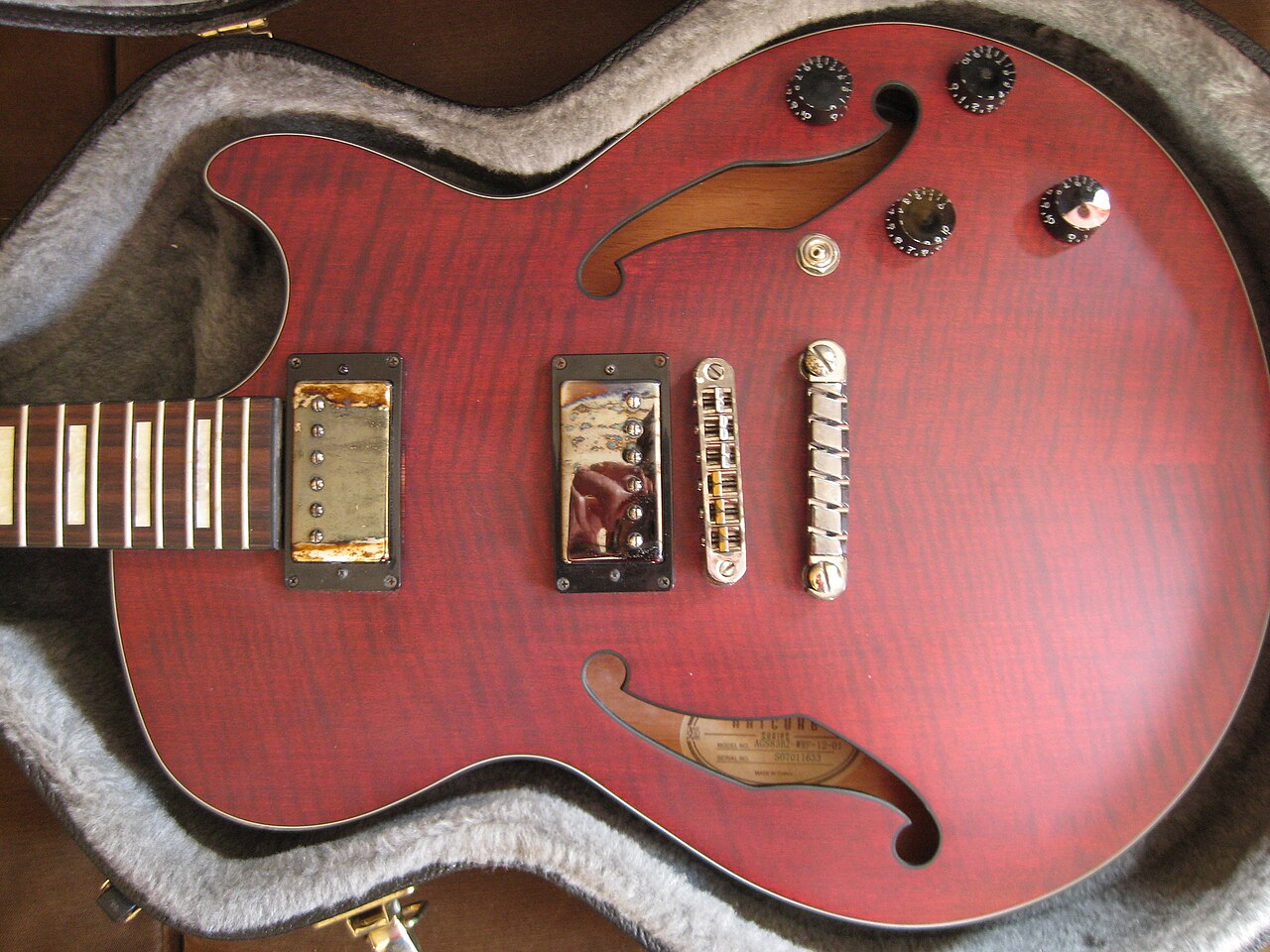
- An Ibanez Artcore semihollow electric guitar in its case: Scott Cranfill from Lexington, Kentucky, United States, Wikimedia Commons, CC BY 2.0.
- An Ibanez AEB5E acoustic bass headstock against a mountain view: Niranjan Arminius, Wikimedia Commons, Public domain.
Latest News
Related
On This Day
Monday 9 November
From this week: