Four Pounds of German Engineering: The Hughes & Kettner TubeMeister Deluxe 20
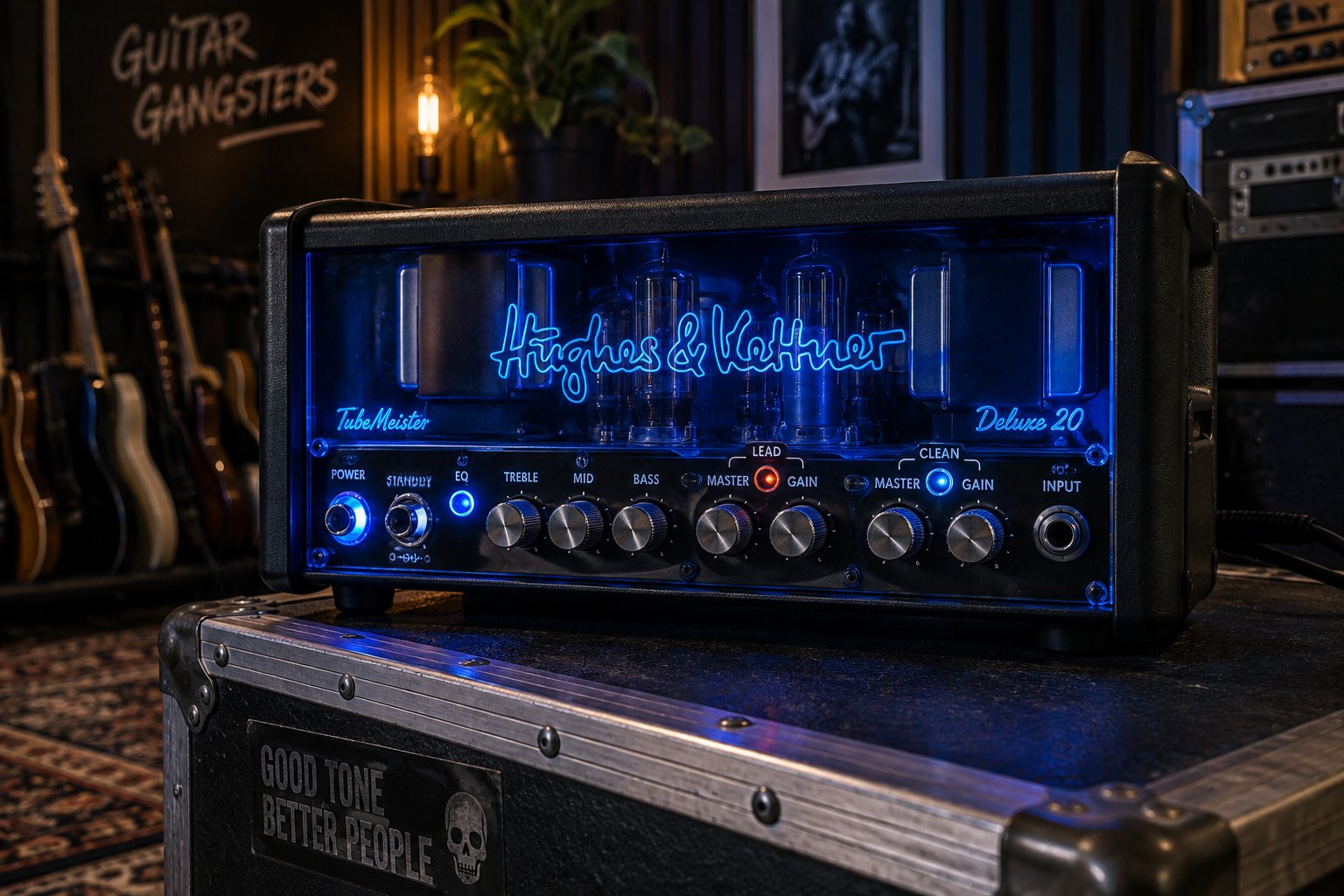
Hughes & Kettner TubeMeister Deluxe 20 Head. AI-generated reference illustration, not a photograph.
The TubeMeister Deluxe 20 packs German EL84 tube tone, four power levels, built-in cab-sim DI, and Silent Recording into a 4.4-pound lunchbox head.
There is a certain breed of guitarist who has solved a problem the industry spent decades pretending didn’t exist. The problem is this: a tube amp that sounds correct — that breathes and sags and blooms the way a tube amp should — also weighs forty pounds, wants a large cabinet, and will wake up everyone on your street when you push it to the place where it sounds best. For thirty years the industry’s solution was “use less gain” or “buy a different amp.” Then the lunchbox happened, and everything changed.
The Hughes & Kettner TubeMeister Deluxe 20 is not the first lunchbox head and it is not the most feature-loaded one in the current market. What it is, consistently, is one of the most intelligently designed — a head that treats Silent Recording not as a marketing footnote but as a first-class output mode, that auto-biases its power tubes so you can swap them without a technician, and that fits in a gigbag side pocket while still running real EL84 tubes in a push-pull output stage. The German engineering that built the Triamp and the TubeMeister 36 is in there. The form factor is just different.
This is the complete guide to the TubeMeister Deluxe 20 — how it works, what it sounds like at every wattage, what H&K’s famous artists actually play (and why none of them are on this specific model), and whether this amp belongs in your rig.
Hughes & Kettner: German Engineering Since 1984
Hughes & Kettner was founded in 1984 in Langenfeld, a town in the North Rhine-Westphalia region of Germany southwest of Düsseldorf. The company entered a market dominated by British and American designs — Marshall, Fender, Vox — and chose to compete not by copying those blueprints but by building amplifiers that were technically more sophisticated than anything the existing players were doing. Where British and American amp makers celebrated simplicity and tradition, H&K celebrated circuits.
The results were polarising in the way that genuinely innovative products always are. H&K’s early work in switching amplifier topologies, their investment in clean-switching relay systems instead of manual channel potentiometers, and their willingness to pair tube preamp stages with digital reverb circuits before that was considered respectable — all of it attracted the players who wanted more from an amplifier and repelled the purists who wanted less. H&K never really cared which camp they were in. The company kept building.
Over the following decades they moved their headquarters to St. Wendel in Saarland and built a range that stretched from entry-level practice combos to the Triamp MkIII, a three-channel tube flagship that remains one of the most fully-featured channel-switching heads ever made. Along the way they became known for three things above all others: the Red Box direct output (a cab-simulated DI that allowed tube amps to feed a PA directly, introduced decades before such things were fashionable), the TSC or Tube Safety Control system (an automatic biasing circuit that lets players swap power tubes without a technician), and a persistent commitment to innovation that kept H&K relevant when other German competitors faded.
The TubeMeister series, launched around 2011, applied H&K’s industrial seriousness to a new format: the pedalboard-friendly lunchbox head. The TubeMeister 18 was followed by the TubeMeister Deluxe revision, which upgraded the Red Box output, refined the power-scaling circuitry, and added features that the original line had treated as secondary. The TubeMeister Deluxe 20 is the result.
TSC and Red Box AE: The Two Innovations That Matter
Every amp in the TubeMeister Deluxe line carries two pieces of technology that distinguish it from competitors at the same price point. Both are worth understanding before looking at the specs table, because they change how you actually use the amp.
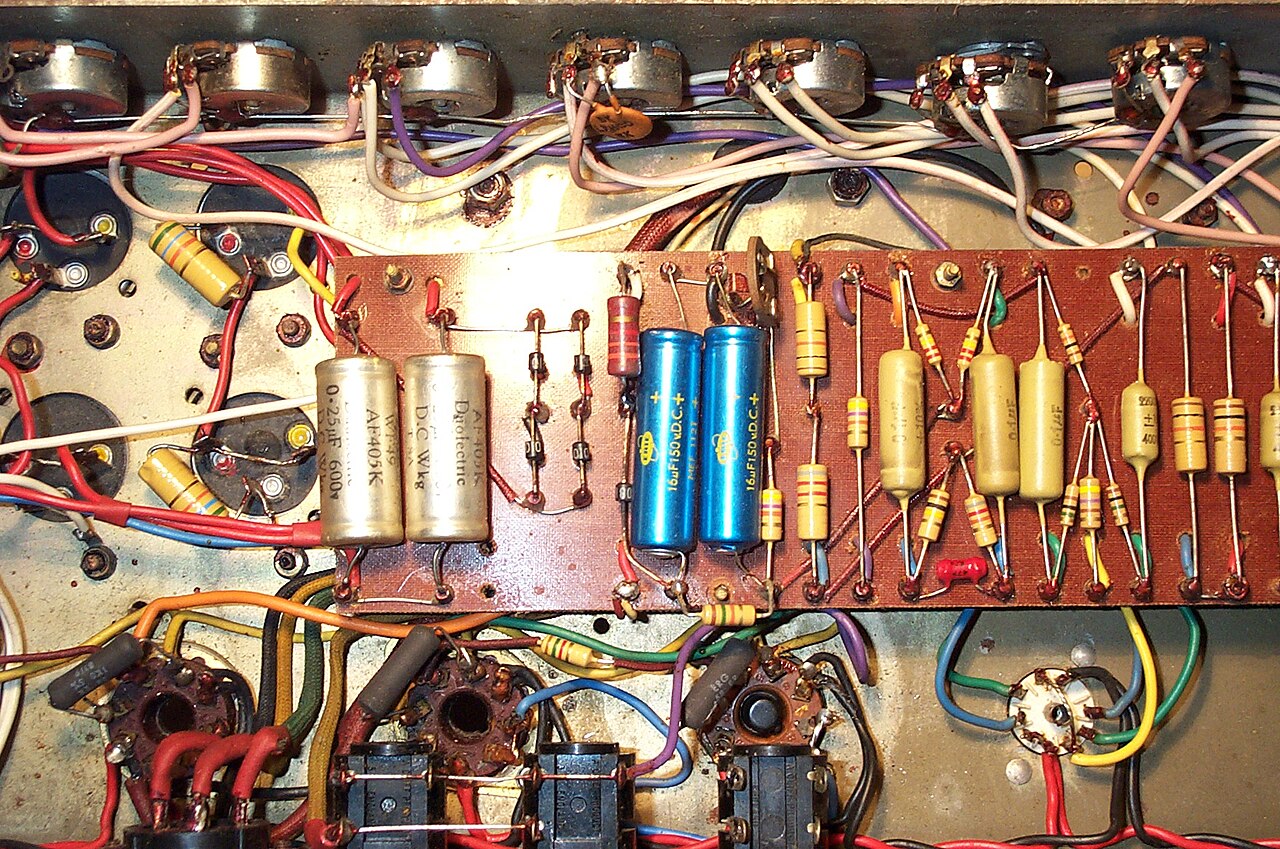
TSC — Tube Safety Control — is H&K’s automatic biasing system. In a conventional tube power amplifier, the bias point of the output tubes must be set manually by a technician with a multimeter, a bias pot, and the correct procedure for the specific tubes installed. Do it wrong and you run the tubes cold (thin tone, premature wear) or hot (saturated tone, much faster wear, possible failure). This is not especially difficult if you know what you’re doing, but it is a barrier for players who want to retube without a service call, and it locks you into whatever tube brand your technician prefers. TSC removes that entirely. The circuit measures the operating point of whatever tubes are installed and biases them correctly — automatically, in real time. You can swap a matched pair of EL84s from any manufacturer, power the amp on, and the TSC has it dialled within seconds. You can also run the amp with a failing or mismatched tube and TSC will compensate within its range rather than letting the output stage run into an unsafe operating condition.
Red Box AE — Active Extension — is H&K’s current generation of speaker-simulation direct output. Every TubeMeister Deluxe has an XLR output on the rear panel that carries a processed version of the amp’s signal: the power section running into a reactive load simulation, then through a cabinet impulse that models a miked 4×12, then out of a balanced XLR at line level, ready to go directly into a mixing console, audio interface, or PA system. The “AE” designation indicates the current active version, which H&K upgraded from earlier passive Red Box designs for improved frequency response and lower noise floor. At 0W — Silent Recording mode — the speaker outputs are switched off and the amp runs entirely through the Red Box AE. The tube stages are all still active. The EL84s are still working. You are still listening to a tube amplifier. It just isn’t waking anyone up.
TubeMeister Deluxe 20 Specifications
EL84: Understanding the Power Section’s Character
The choice of EL84 output tubes is not incidental. It defines what the TubeMeister Deluxe 20 is and is not, and understanding EL84 behaviour is the fastest route to understanding what this amp can and cannot do.
EL84s are British tubes — developed by Mullard in the UK in the early 1950s, popularised by Vox in their AC15 and AC30 series, and subsequently adopted by a wide range of British manufacturers who wanted a tube that was compact, efficient, and capable of considerable harmonic richness at moderate power levels. Their characteristic sound comes from the way they generate third-order harmonics as they approach saturation: where an EL34 or a 6L6 tends to compress and smooth out as it clips, an EL84 gets brighter, tighter, and more overtone-rich. The top end stays present and even emphasised. The midrange gets forward. The breakup is faster and more immediate than a 6L6 and slightly less creamy than an EL34.
In the TubeMeister Deluxe 20’s push-pull configuration, two EL84s deliver a sound that sits between a tweed Fender (warm, harmonically complex breakup) and a Vox (bright, chimey, forward midrange) without fully belonging to either tradition. The clean channel, with its simplified Bass and Treble controls, benefits from the EL84’s natural warmth at low volume settings and begins to develop that forward harmonic character as the Master Volume climbs. The Lead channel adds a full three-band EQ and a Gain control that can get the preamp section working hard long before the power stage follows, which means you have independent control over preamp saturation and overall output level — the key to making a 20W amp sound like anything from a bedroom noodler to a studio workhorse at unity gain.
The four power levels engage this character differently. At 20W you get the full EL84 push-pull response, with genuine sag and dynamic feel when you dig in. At 5W the power section runs less current and the EL84s break up slightly earlier, with more compression and less clean headroom on the Lead channel — useful for getting power amp saturation at manageable volume. At 1W you are genuinely practice-level quiet, the kind of volume you can play in a flat at midnight without anyone complaining, with a sound that remains recognisably tubey because the EL84s are still active and still passing a signal even if they are not working especially hard. At 0W the speaker output closes off entirely and the Red Box AE handles everything.
Famous Players: H&K’s Roster and Why This Amp Isn’t On It
Hughes & Kettner have a genuine and long-documented artist roster, and two names from it have been associated with the brand long enough that they belong to any honest account of H&K’s legacy. Rudolf Schenker and Matthias Jabs, the guitar pairing of the Scorpions, have maintained a relationship with Hughes & Kettner that goes back decades. Schenker’s collaboration with H&K produced the Puretone head, a single-channel pure tube design built to his specifications for stadium-level live use. Jabs has similarly been associated with the brand in the context of H&K’s flagship channel-switching products. Both players need large-format, high-headroom, rack-compatible rigs for the scale of show the Scorpions play. Neither of them plays a TubeMeister Deluxe 20.
This is not a critique of the amp. It is a structural fact about how artist endorsements work in the amplifier world. Major touring artists who sign with amp companies use those companies’ flagship models — the ones that deliver the highest headroom, the most channel flexibility, and the loudest output — because that is what large stages require. A 20W lunchbox head is not designed for the Scorpions’ main stage. It is designed for the player who needs the quality of H&K engineering without the size and weight penalty of the Triamp MKIII, and who records in a home studio where Silent Recording mode is not an optional extra but the entire point.
H&K’s brand-level roster has included players from across the rock and metal spectrum at various points in the company’s history. The TubeMeister Deluxe 20 occupies the same ecosystem as those artists’ preferred flagships, draws on the same engineering philosophy, and delivers a recognisably H&K character in a format none of those players would ever bring onstage. The absence of a celebrity user is the honest truth, and it tells you something useful about who this amp is actually for.
Tone Recipes
1. Clean Jangle Platform
The TubeMeister Deluxe 20’s clean channel at moderate Master Volume levels is a genuinely effective pedal platform — warm enough to fatten single-coil pickups, defined enough to let a drive pedal’s character come through clearly. Set power to 20W. Clean channel: Volume 4, Bass 5, Treble 5. Master Volume 4. Noise Gate off. Run a transparent overdrive (something based on the Klon or the Timmy circuit) in front at low gain for edge-of-breakup single-note work, or a compressor for Nashville-style fingerpicking. The EL84s at moderate Master Volume stay clean but develop that chimey upper-register warmth that makes them useful under a clean-channel drive. Run the Red Box AE simultaneously to capture the tone to your interface — this is exactly what that output is for.
2. Blues Crunch at 5W
Switch to 5W. Lead channel: Gain 5, Volume 6, Bass 5, Middle 6, Treble 4. Master Volume 5. At 5W, the EL84s break up more easily in the power stage and the combination of moderate preamp gain and a working output section generates a compressed, harmonic-rich blues tone that responds well to pick attack. Back off the guitar’s volume for a cleaner, tighter rhythm tone. Dig in with a heavy pick attack and the amp opens up into a natural, slightly compressed crunch. This setting benefits from a small 1×12 cabinet — the TubeMeister Deluxe 20 is frequently paired with compact H&K cabinets but works equally well with any quality 8Ω or 16Ω speaker load.
3. Medium-Gain Rock
Stay at 20W. Lead channel: Gain 6–7, Volume 5, Bass 5, Middle 5–6, Treble 6. Master Volume 4. A humbucker-equipped guitar in the bridge position gives you a focused, punchy rhythm tone with enough gain for classic rock single-note lines without losing the note definition that separates EL84-based amps from the more compressed EL34 alternatives. The noise gate becomes useful at this gain level — switch it on to eliminate the hum between phrases. This setting sits well in a band mix because the EL84s keep the midrange forward rather than scooped: you will be heard without needing to boost 1kHz on the PA.
4. High-Gain Lead — Silent Recording
Power to 0W (Silent Recording). Lead channel: Gain 8–9, Volume 6, Bass 5, Middle 7, Treble 5. Master Volume 6. The Red Box AE output runs into your audio interface. The cab simulation models a miked 4×12, which sounds counterintuitive for an EL84 amp that naturally wants a 2×12 or 1×12 — but the Red Box AE’s processing is voiced to complement the amp’s character rather than change it, and at high gain the result is a direct signal with more body than a raw line-level recording. Add a noise gate plugin on the input channel to manage the additional gain-stage noise. This is the workflow for which the TubeMeister Deluxe 20 was explicitly designed.
5. Edge-of-Breakup Pedal Platform at 1W
Power to 1W. Clean channel: Volume 8, Bass 6, Treble 5. Master Volume 7. A fuzz pedal — germanium Fuzz Face style — into the input. At 1W the amp’s clean headroom is reduced enough that the interaction between a fuzz and a slightly working output stage produces the same kind of compressed, mid-forward saturation that studio players used to get from cranking a small combo in a recorded isolation booth. Nobody is doing that at three in the morning. At 1W, you can. Add a spring reverb pedal in the FX loop for depth. This is a studio sound in an apartment.
Comparisons
TubeMeister Deluxe 20 vs. Friedman Runt 20
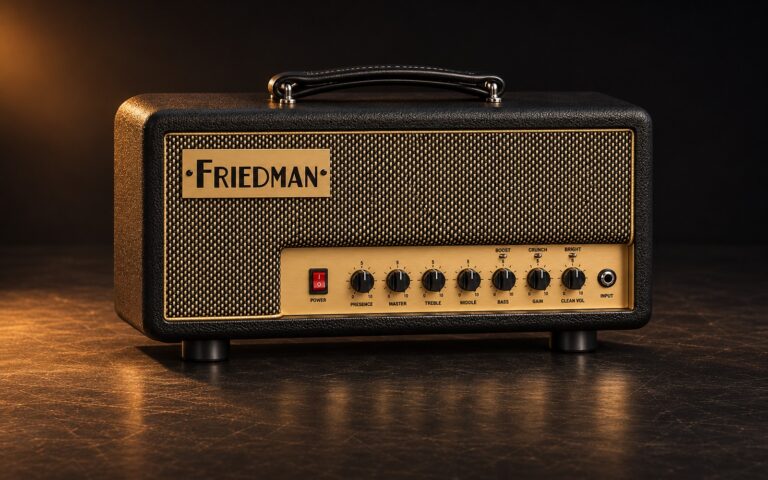
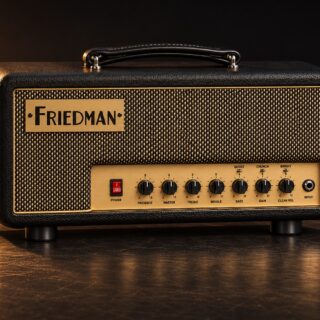
The Friedman Runt 20 operates in the same wattage class but belongs to a different tonal tradition entirely. The Runt 20 uses EL84 tubes in a class A topology and is voiced in the Friedman house style — a tight, articulate high-gain character with a scooped midrange that prioritises metal and hard rock applications. The TubeMeister Deluxe 20 runs its EL84s in push-pull and has a more balanced EQ response with the midrange left more present by default. The Runt 20 has no built-in load box or DI output; you need an external reactive load solution to run it in Silent Recording mode. The TubeMeister Deluxe 20’s Red Box AE is native to the chassis. The Friedman costs roughly $1,600 new; the H&K sits around $900–$1,000. They are not the same kind of tool, even in the same format and wattage.
TubeMeister Deluxe 20 vs. Revv D20
The Revv D20 is the most directly competitive product in the “low-wattage lunchbox with built-in direct output” category. Both amps use 20W output sections with built-in load and cabinet simulation — but the D20 uses 6V6 tubes where the TubeMeister Deluxe 20 uses EL84s, a difference that produces meaningfully different characters. The Revv is warmer and more American-voiced; the H&K is brighter and more British. The Revv D20 integrates Two Notes Torpedo technology with full MIDI control and 128 loadable cabinet impulses; the TubeMeister Deluxe 20’s Red Box AE is a fixed simulation without software expansion. The Revv MK2 costs around $1,349; the H&K is considerably cheaper. The D20 is more powerful as a direct recording tool; the TubeMeister Deluxe 20 is simpler, lighter, and easier to operate without a computer. Both are valid. Neither replaces the other.
TubeMeister Deluxe 20 vs. Marshall DSL20HR
The Marshall DSL20HR is the natural brand-loyalty alternative for players coming from a Marshall background. It uses EL34 tubes — the traditional British power section — and has four modes across two channels rather than the TubeMeister’s simpler two. The DSL20HR also has a switchable power attenuator, digital reverb, and footswitchable clean/crunch and ultra gain modes, making it a more flexible rock-and-metal tool out of the box. What it does not have is a built-in cab-sim DI output — the TubeMeister Deluxe 20’s Red Box AE remains a genuine differentiator — and the DSL’s EL34 character is distinctly different from the TubeMeister’s EL84 brightness and compression. Players who want a British character and aren’t bothered by running a separate DI box should audition the DSL20HR; players who want the full direct-to-interface workflow without additional hardware have a clear reason to stay with the H&K.
TubeMeister Deluxe 20 vs. Blackstar HT-20R MkII
Blackstar’s HT-20R MkII is another EL84-based competitor in the 20W class, and the comparison is closer than the Friedman or Marshall alternatives because the tube choice produces a similar family of tones. The HT-20R MkII adds digital reverb and Blackstar’s ISF (Infinite Shape Feature) — a single-knob EQ control that sweeps between American and British frequency responses — making it somewhat more flexible on the tone-shaping side. It does not have TSC; tube swapping requires the same conventional biasing procedure as any other amp. The Blackstar also lacks a built-in load box, though it has a cab-emulated output via its Emulated Output jack. The H&K’s TSC and the more developed Red Box AE simulation are genuine advantages for players who tune their rig frequently and record regularly.
TubeMeister Deluxe 20 vs. Fender Blues Junior IV
The Fender Blues Junior IV is the classic entry point for the “affordable combo with real tubes” conversation. At roughly $599 new, it costs significantly less than the TubeMeister Deluxe 20, uses EL84 tubes in a 15W configuration, and sounds great for what it is: a low-gain, warm, Fender-voiced platform with a spring reverb and minimal controls. What it doesn’t do is give you any useful Silent Recording option, four power levels, a balanced cab-simulated XLR output, or auto-biasing. The Blues Junior is a combo for home practice and small venue gigs. The TubeMeister Deluxe 20 is a head for players who need to shift between home studio, bedroom practice, and live performance in the same unit without buying additional hardware. They solve adjacent problems, not the same one.
Buying Guide
New TubeMeister Deluxe 20 units have been available at consistent pricing in the $899–$999 range through authorised H&K dealers. Hughes & Kettner is a German company with professional distribution in most markets, so warranty service is typically available. Check that your unit comes with the original power cable and footswitch jack documentation if you intend to use the FSM-432 MKIII footswitch (not included, sold separately) — the footswitch unlocks channel switching and power level switching from the floor, which is how the amp is best used in a live context.
Used TubeMeister Deluxe 20 units appear frequently in the $450–$650 range, reflecting the reality that lunchbox heads are commonly purchased by players who discover they need either more wattage or a different tonal character, then move on. The TSC system means you can buy a used example and retube it yourself on the cheap — a matched pair of EL84s from JJ or Electro-Harmonix costs under $30 and drops straight in without a technician. The power transformers in H&K amps are generally well-rated for their application; failures are uncommon. The most common used-market issue is a faulty FX loop caused by accumulated impedance on the send/return jacks — clean those contacts before writing off the loop entirely. Check that the Red Box AE output is functioning by running the XLR directly into an interface and verifying you get signal at all four power levels including 0W.
Ownership Notes
The TubeMeister Deluxe 20 is designed for the FX loop to run at either instrument level or line level, switched via a rear-panel toggle. Line level is the correct setting for rack effects processors and studio-grade effects units. Instrument level is correct for most standard guitar pedals. Getting this wrong produces either a signal that is too loud and harsh (wrong way) or too quiet and muddy (other wrong way) — set it correctly once and leave it.

The TSC circuit biases the EL84s within seconds of power-on. This means you can retube the amp with minimal disruption to a session: swap tubes, power on, wait for the TSC LED to stabilise, play. The amp can also detect tube failure and reduce its output gracefully rather than dumping an unprotected signal into the output transformer — you will notice the sound changing before anything breaks, which gives you time to swap tubes rather than a repair bill.
Silent Recording mode runs the amp into a built-in reactive load rather than a fixed resistive load. This matters because a resistive load (the kind used in many simple load boxes) presents a constant impedance to the output transformer, which does not match the variable impedance of a real speaker. The result is a power section that doesn’t quite behave like it does into a cabinet — the sag and compression are subtly different. H&K’s reactive load design in the TubeMeister Deluxe 20 is not the most sophisticated available compared to dedicated external load boxes at significantly higher cost, but it is substantially better than nothing and it is meaningfully more realistic than a simple resistive alternative. For home recording purposes it is entirely sufficient.
Pairing the amp with a quality 1×12 cabinet loaded with a Celestion Vintage 30 or a WGS Veteran 30 will take the tone in a more British, forward-midrange direction. A Celestion G12H-30 or Jensen P12N will push it toward a warmer, American-inflected character. The EL84 power section responds clearly to speaker choice; it is worth experimenting with different speaker loads if you have access to them before settling on a cabinet.
Frequently Asked Questions
Can I use the TubeMeister Deluxe 20 without a speaker cabinet?
Yes. Set the power switch to 0W (Silent Recording) and the internal load circuit absorbs the amp’s output, routing everything through the Red Box AE XLR output. You get full tube signal path — preamp and power section both active — without needing a connected cabinet. This is the intended use case for home recording and late-night practice.
Do I need to bias the EL84 tubes after replacement?
No. The TSC (Tube Safety Control) system biases the power tubes automatically on startup. You can swap to any matched pair of EL84-type tubes from any manufacturer, power the amp on, and TSC handles the rest. There is no bias pot to adjust and no multimeter required. This is one of the TubeMeister Deluxe line’s most practically useful features.
What is the difference between the original TubeMeister 18 and the Deluxe 20?
The original TubeMeister 18 produced 18W and featured an earlier version of the Red Box DI output. The TubeMeister Deluxe 20 produces 20W (a minor difference in practice), upgrades the direct output to the Red Box AE (Active Extension) with improved frequency response and noise floor, refines the power-scaling circuit, and adds the 0W Silent Recording mode as a distinct position on the power selector. The Deluxe versions also updated the cosmetic design. The core EL84-based architecture is shared across both generations.
Is the FX loop in front of or behind the power attenuator?
The FX loop on the TubeMeister Deluxe 20 is positioned in the signal chain after the preamp and before the power stage. This means it operates at preamp level, and its position relative to the power-scaling circuit means that effects placed in the loop are subject to the same power-section compression and character changes that come with switching between 20W, 5W, 1W, and Silent modes. For most applications this is the desirable behaviour — your reverb and delay feel like part of the amp rather than bolted on after it.
What footswitch does the TubeMeister Deluxe 20 use?
The compatible footswitch is the Hughes & Kettner FSM-432 MKIII, sold separately. It connects via a dedicated multi-pin jack on the rear panel and provides floor-based switching of channels and power levels. The TubeMeister Deluxe 20 can be operated entirely from the front panel if no footswitch is connected; the footswitch adds live-performance convenience without being mandatory for the amp to function correctly.
Does the Red Box AE output work at all power levels, including 0W?
Yes. The Red Box AE is active at all four power settings. At 0W (Silent Recording) it is the only output carrying signal — the speaker jacks are disconnected by the internal load circuit. At 20W, 5W, and 1W it operates simultaneously with whatever speaker cabinet is connected, allowing you to split the signal between a cabinet and a mixing console or audio interface in a live or studio context.
What speakers does the Red Box AE emulate?
H&K voices the Red Box AE to simulate a miked Hughes & Kettner 4×12 cabinet. The simulation is fixed — unlike some competitors (the Revv D20’s Two Notes integration, for example) there is no software to expand the library or adjust mic placement. For most recording applications the fixed simulation is entirely workable; players who need access to multiple cabinet characters will need to run the amp’s XLR output through an external IR loader in addition, or use dedicated software like Two Notes Torpedo or a plugin equivalent.
Is the TubeMeister Deluxe 20 loud enough for a rehearsal or small gig?
At 20W through an efficient 1×12 or 2×12 cabinet the TubeMeister Deluxe 20 is louder than it looks and sufficient for rehearsal with a moderate drummer and for small-to-medium venue gigs where PA support is available. It is not a large-venue amp on its own — a 100W head into a 4×12 produces physically different air movement. For anything above 300-capacity venues, run the Red Box AE direct to the FOH board and use the amp as a stage monitor through a small cabinet. This is the workflow many players in the lunchbox-head world have adopted regardless of brand.
Image credits
- A guitarist playing on stage in front of an amp: Bex.Walton, Wikimedia Commons, CC BY 2.0.
- A band on a lit stage in front of a crowd: Dhagely, Wikimedia Commons, CC BY-SA 4.0.
- Inside a tube guitar amplifier: germanium from Eichwalde, Germany, Wikimedia Commons, CC BY 2.0.
- Top image: GuitarGangsters AI-generated reference illustration, not a photograph.
Latest News
Related
On This Day
Monday 9 November
From this week: