The Armored Lunchbox: How the Vox Night Train NT15H Brought Trainwreck DNA to the Working Guitarist
The Vox Night Train NT15H packs Trainwreck-inspired EL84 tone into a 17-pound armored lunchbox. History, specs, and verified player guide.
Ken Fischer built his Trainwreck amps one at a time in a New Jersey garage, refused to sell to dealers, and died in 2006 having produced fewer than 70 instruments. By the time the last one left his bench, a used Liverpool or Express had crossed $30,000 at auction. What Fischer understood — and what the whole amplifier world spent the 1990s slowly absorbing — is that a great amp doesn’t need reverb, tremolo, multiple channels, or a master volume. It needs a preamp circuit that breathes, an output stage that compresses with personality, and absolutely nothing standing between those two stages and the speaker. Everything else is furniture.
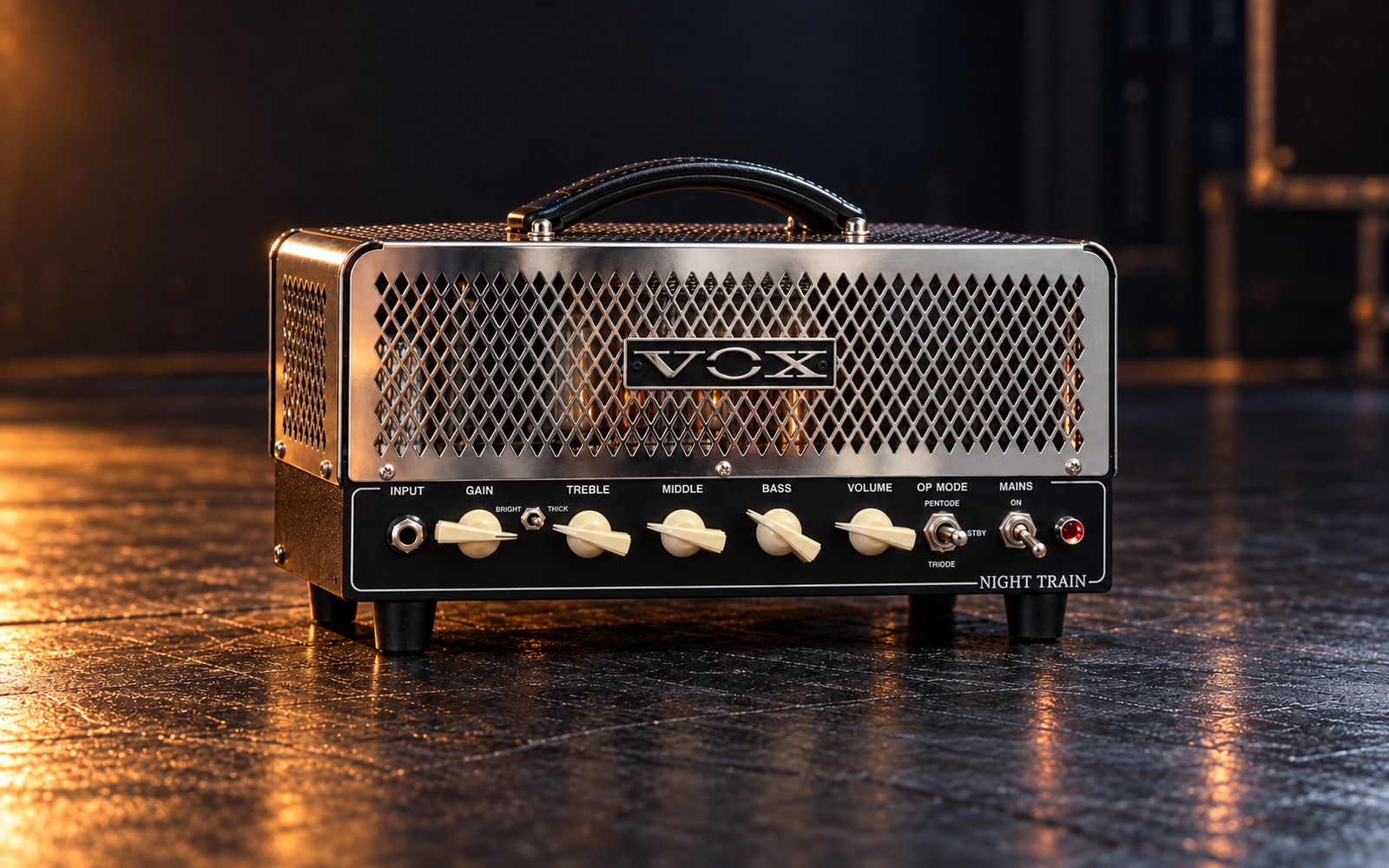
The Vox Night Train NT15H, introduced in 2009 at $700, is not a Trainwreck. It never claimed to be. But when Vox R&D director Dave Clarke sat down with boutique amp builder Tony Bruno to design a new low-wattage head, Fischer’s philosophy was the explicit starting point. The result: an all-metal “armored lunchbox” housing two EL84s, two 12AX7s, a Bright/Thick voicing switch borrowed conceptually from Fischer’s topology, and nothing else. No reverb. No loop. No channel switching. Seventeen pounds. Built for a carry case.
The Night Train became one of the most talked-about small-head launches of the late 2000s — not because it was cheap (it wasn’t particularly), but because it was honest. This is the story of what it is, who actually plays one, and whether it still makes sense in 2026.
History: From Trainwreck to Lunchbox
The lineage matters. Ken Fischer’s Trainwreck Express and Liverpool were push-pull EL84 designs with a preamp that ran unusually hot and a total absence of the features — reverb tanks, effects loops, switchable channels — that Fischer believed degraded tone. His amps were ferociously dynamic and harmonically complex at the edge of breakup, capable of the kind of long-decay sustain you normally associate with far more expensive circuits. They were also, by the time Fischer passed away in December 2006, all but unobtainable.
Tony Bruno had been working in Fischer’s tradition for years, building hand-wired single-channel heads under his own name from components he personally sourced and tested. Every Bruno amp was played with a live band before it left the shop. When Vox approached Bruno to collaborate on the Night Train, the brief was essentially Trainwreck-inspired simplicity in a mass-producible, portable form. The Night Train’s preamp draws on the circuit concepts Fischer explored. The power section owes more to the AC15’s output stage, with component-level tweaks to give the Night Train a voice distinct from its British siblings. The result is neither a Trainwreck replica nor a miniature AC15: it’s something between the two, with its own tonal personality.
The chassis itself deserves mention. Where nearly every tube head of its wattage class comes in a wood cabinet with tolex, the NT15H uses a two-piece all-metal enclosure: the lower section houses the PCB and components, and a chromed, ventilated upper shell surrounds the transformers and tubes. The result weighs 17 pounds and fits in the padded carry bag Vox included with every unit. Vox’s 2009 catalogue called it an “armored lunchbox,” and the name stuck.
Premier Guitar’s Jordan Wagner reviewed the NT15H in July 2009, rating it 5/5, calling it “really hard to beat if you’re in the market for a low-wattage amplifier” and noting “the best sounding small-wattage clean tone that I’ve heard so far.” His only substantive criticisms were the absence of an effects loop and the fact that the Bright/Thick voicing switch wasn’t footswitchable.
Vox updated the platform around 2012–2013 with the Night Train G2 — NT15H-G2 head and NT15C1-G2 combo — which addressed both criticisms. The G2 added onboard spring reverb, footswitchable Bright/Girth dual channels, and retained the Thick switch on the Bright channel. The NT2H Lil’ Night Train (2 watts, single EL84) arrived later for bedroom players and recording. The original NT15H is the one that defined the platform and the one covered here.
Specifications
A note on the mode switch: the three-position standby/triode/pentode selector is not a simple standby switch. In Triode mode the output stage runs at approximately half power and the EL84s compress differently — the harmonic character shifts, upper-order content softens, and the amp feels slightly spongy compared to Pentode. Pentode is louder and more immediate. Standby is the middle position. Get familiar with which position you left it in before powering off.
The Bright/Thick switch is the personality lever. In Bright mode the full three-band EQ is active — this is the chimey, detailed clean side, the one that rewards a Telecaster or Stratocaster. In Thick mode the tone controls are bypassed entirely, preamp gain increases, and the amp shifts into a darker, heavier voice. Premier Guitar’s review describes it as sounding “like a channel switch” — an accurate observation, because the tonal change is that pronounced. The name “Thick” undersells it: at volume, Thick mode into a 4×12 produces what the review called “a Slash-esque bark” that bears little relationship to the clean Bright mode character.
Famous Players: What the Roster Actually Shows
The artist list for the NT15H names Brian May, The Edge, George Harrison, Tom Petty, and Rory Gallagher. This is a recycled Vox brand roster.
George Harrison died in November 2001. The NT15H was introduced in 2009. That is an eight-year calendar impossibility. Harrison used AC30s — specifically the early-1960s JMI-era combos he helped make famous with the Beatles — throughout his career. He never touched a Night Train.
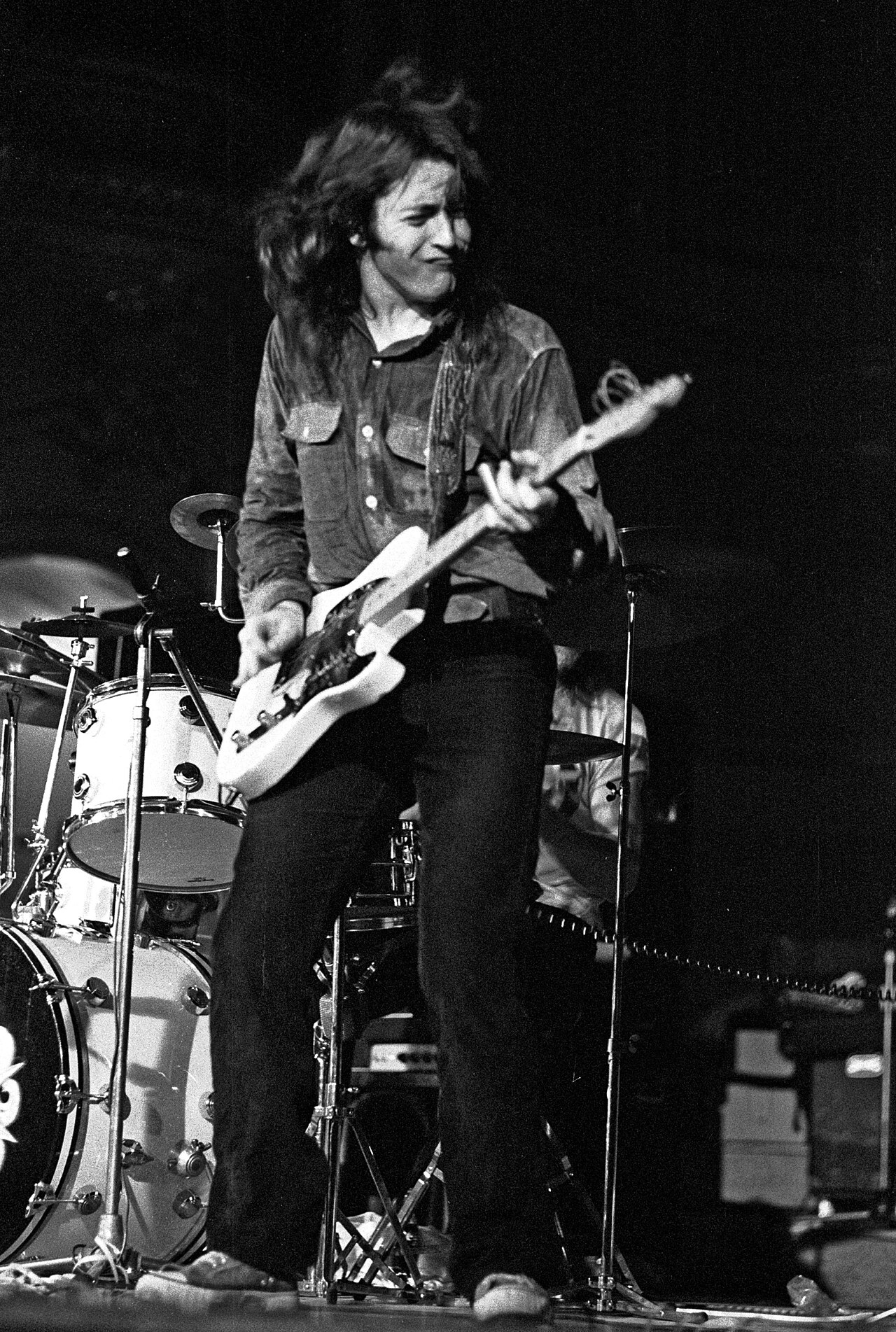
Rory Gallagher died in June 1995. The NT15H was introduced in 2009. That is a fourteen-year calendar impossibility. Gallagher’s amp history runs from Vox AC30s in the 1960s to a rotating cast of Marshalls, Fender Bassmans, and Boogie Marks — none of which are Night Trains, none of which could be.
Brian May has used AC30s — Normal channel, paired with a Dallas Rangemaster treble booster — his entire career. His signature Vox product is the MV50-BM NuTube minihead, not the Night Train. No primary source places May in front of a NT15H.
The Edge plays AC30TBs with extensive delay rigs. Vox AC30s are the foundation of his clean tone across every U2 album since the 1980s. No Rig Rundown, no interview, no confirmed setlist photo places a Night Train in his setup.

Tom Petty (d. October 2017) used vintage AC30 combos — the “old brown AC30” he referred to in interviews. The NT15H launched in 2009, giving a technical eight-year window, but no primary source — no Rig Rundown, no confirmed stage photo, no interview — connects Petty to a Night Train specifically. The recurring appearance of these five names across the entire Vox range is a brand-level association pattern, not per-SKU documentation.
The Equipboard listing for the VOX Night Train 15W shows five pro artists. Three are named: Brendon Urie (Panic! at the Disco), with video evidence confirming the amp in use; Brendan Benson (The Raconteurs, solo career), listed with his Raconteurs connection; and Ty Tabor (King’s X lead guitarist), sourced to Guitar Player magazine. These three are genuinely plausible Night Train users. The amp’s chimey-to-crunchy range suits Urie’s theatrical pop-rock production values and Tabor’s harmonically rich King’s X tone. Benson, who co-wrote and co-produced extensively with Jack White as The Raconteurs, is exactly the kind of studio-conscious player who would reach for a 15-watt head that can be cranked at low volumes.
The honest summary: the Night Train has a respectable but modest verified artist profile. It is a working player’s amp that rewards studio use and small-room live work. It is not a stage-filling rig anchor, and the players who actually own one tend not to be the ones on arena tours.
How It Sounds: The EL84 Push-Pull Character
The NT15H runs its EL84s in push-pull configuration — unlike the AC4C1-12’s single-ended Class A — which means the power section cancels even-order harmonics at lower drive levels and delivers a firmer, more defined low end before compression sets in. At 15 watts the Night Train has genuine clean headroom. You can push the master volume past noon with a Telecaster before the power stage starts to breathe, which makes it giggable in small venues alongside a restrained drummer. At 7.5 watts in Triode mode you’re trading headroom for a softer, rounder saturation character — ideal for recording at volumes that won’t rattle the adjacent apartment.
The preamp is where the Trainwreck influence shows up most clearly. Fischer’s circuits were famous for their articulation and dynamics: how they tracked your pick attack, how they opened up when you backed off the guitar’s volume knob, how they added harmonic complexity rather than just gain. The Night Train’s preamp does this in a more affordable, mass-produced way. It doesn’t equal a real Trainwreck — nothing does — but the responsiveness to picking dynamics is genuine and distinct from standard British voiced heads in the same wattage class.
Single-coil pickups get the most out of it. The review’s Telecaster bridge pickup assessment — “stayed twangy and detailed at almost all levels” — holds up across dozens of user accounts. Humbuckers can push the amp into feedback territory at higher gains; keeping the guitar’s volume knob at 7 or 8 rather than 10 solves most of this. The Night Train responds to guitar volume control as well as any amp at its price point.
The frequency window sits roughly in the 200Hz–6kHz range with the upper-midrange presence that characterizes the EL84 topology. There’s limited content below 150Hz — you won’t feel this through the floor. In a live mix that’s a feature: the Night Train lives in the guitar’s natural frequency band without fighting the bass or kick drum. High-pass the amp mic at 120Hz and let the bass own everything below.
Tone Recipes and Settings
Recipe 1: Jangle Clean (Bright Mode, Telecaster)
Mode: Pentode. Bright. Gain at 8 o’clock (just off minimum). Treble at 2 o’clock. Middle at noon. Bass at 10 o’clock. Volume at noon or beyond. Pair with a Fender Telecaster bridge pickup or Rickenbacker 360/12. The result is a clean that has enough high-end sparkle to cut a dense arrangement without sounding brittle. Roll your guitar’s tone knob to 7 to warm the top end for rhythm parts, back to 10 for leads.
Recipe 2: Classic-Rock Crunch (Bright Mode, Les Paul)
Mode: Pentode. Bright. Gain at 11 o’clock. Treble at 1 o’clock. Middle at 11 o’clock. Bass at noon. Volume at 1 o’clock or higher. With a Les Paul or Epiphone Casino, this gives you the edge-of-breakup crunch that works for open-chord rock rhythm. Use your guitar’s volume knob between 6 and 8 for a cleaner rhythm track; push it to 10 for lead lines.
Recipe 3: Thick Mode Bark (High Gain, Humbucker)
Mode: Pentode. Thick. Gain at 2 o’clock. Volume at 2 o’clock. Into a 2×12 or 4×12 cabinet, this is the “Slash-esque bark” PG described. The tone controls are bypassed — what you hear is the preamp and power stage working together with no EQ filtering. Back off the guitar volume to 7 for a tighter, less compressed sound; dime it for sustained lead lines. Keep a noise gate in the signal chain if hum becomes an issue at high gain.
Recipe 4: Studio Recording (Triode Mode, Any Guitar)
Mode: Triode (7.5W). Bright. Gain at noon. Volume cranked to 3 o’clock. Mic the speaker off-axis about 2 inches from the cone. At Triode volumes you can push the output stage into the sweet compression zone without destroying your neighbors or your microphone’s capsule. Add Electro-Harmonix Deluxe Memory Man in the signal chain for slapback or medium-length echo — since the Night Train has no effects loop, pedals go in the front input, so keep drive pedals between the guitar and the amp and time-based effects with moderate mix settings.
Recipe 5: Fuzz Tone (Bright Mode, Big Muff)
Mode: Pentode. Bright. Gain at 9 o’clock (mostly clean). Volume at 1 o’clock. Run an Electro-Harmonix Big Muff Pi into a fairly clean front end and let the fuzz circuit do the heavy lifting. The Night Train’s chimey Bright mode cleans up enough to let the Big Muff’s own character dominate rather than stacking with preamp saturation. This was a common studio approach: a small clean head + a sustain pedal gives more control over the fuzz character than a cranked amp.
Comparisons: Where the Night Train Sits
The most natural comparison is the Vox AC15C1. Both are 15-watt EL84 heads/combos, both are British-voiced. The AC15C1 has a spring reverb, a Normal and Top Boost channel with treble cut, and a Celestion G12M Greenback in the combo version. The Night Train has no reverb and no loop, but the Trainwreck-inspired preamp gives it a more complex harmonic character in the clean-to-edge-of-breakup region. The AC15’s Normal channel produces a darker, warmer clean; the Night Train’s Bright mode is more present and detailed. Choose the Night Train if you want preamp responsiveness and plan to run reverb and delay as pedals. Choose the AC15 if you want an amp-in-a-box that covers clean, crunch, and reverb without a pedalboard.
Against the Vox AC10C1, the Night Train has more power and a distinctly different circuit character. The AC10C1 runs its EL84s in push-pull but with a Top Boost active EQ and a digital reverb. The Night Train’s Bright/Thick switching and Trainwreck-inspired preamp give it a different breakup quality. The AC10C1’s closed-back cabinet lends more low-end punch for recording; the Night Train (typically run with the V112NT open-back cab) sounds more open and spatial.
The Fender Blues Junior is the closest American-voiced competitor in the same wattage and price bracket. The Blues Junior uses EL84s too (unusual for a Fender), but its Fat switch, onboard spring reverb, and traditional Fender voicing produce a warmer, darker character with more pronounced midrange compression. The Night Train is more articulate in its clean tones; the Blues Junior is warmer and more forgiving in its overdrive range. Budget Blues Junior buyers tend to be country and blues players; Night Train buyers tend to be indie, alternative, and studio players who want dynamic responsiveness above all else.
If you’re considering the Vox AC30C2, the decision is primarily about volume and headroom. The AC30 runs two pairs of EL84s for 30 watts and stays clean to much higher volume. The Night Train’s 15 watts runs out of headroom considerably sooner, which means it distorts more easily but is harder to keep clean in loud environments. For small stages and studios, the Night Train’s portability wins. For medium rooms and anything involving a loud kit, the AC30 is the correct tool.
The Vox AC4HW1 Hand-Wired is a legitimate comparison point for the boutique-leaning buyer. The AC4HW1 is point-to-point turret-board construction with a single EL84 in single-ended Class A — more compressed, more harmonically saturated at lower volumes, and with the Celestion G12M Greenback already in its cabinet. The Night Train’s push-pull circuit is cleaner, more defined, and responds differently to pedals. The AC4HW1 is better for blues-inflected studio work at bedroom volumes; the Night Train is better for live small-room work and for players who need that extra 10 watts of clean headroom.
The Night Train G2: What Changed and Whether It Matters
The Night Train G2 (NT15H-G2 head, NT15C1-G2 combo, introduced c. 2012–2013) addressed every criticism of the original. It replaced the single Bright/Thick channel with footswitchable Bright and Girth channels, added onboard reverb, and retained the Thick switch on the Bright channel. The power output and EL84 configuration remained identical.
Whether this makes the G2 strictly better is a question of priorities. The G2 gave working players the reverb and footswitching flexibility they’d asked for. But several reviewers noted that the G2’s dual-channel design produced slightly different breakup characteristics from the original, and some players felt the original’s simplicity was its virtue rather than its flaw. Both are now on the used market; the original NT15H tends to be priced slightly below the G2 for equivalent condition. Either one is a legitimate purchase; the G2 is the one to choose if you need reverb in the amp itself.
Buying Guide
The NT15H is a discontinued product. Used examples on Reverb in 2026 run from approximately $250 to $350 for clean working condition, with higher prices for mint examples with the original carry bag. The G2 runs $50–100 higher for comparable condition. Neither represents significant risk as a used purchase: the circuit is simple, the components are standard, and the failure modes are typical tube-amp wear — power tube bias drift, preamp tube microphonics, capacitor age. Buy from a seller who has powered it up and describes the tube condition; budget $40–60 for a fresh set of EL84s and 12AX7s if the amp hasn’t been retubed recently.
The companion V112NT cabinet (open-back, 12″ Celestion Greenback 16Ω, 30W rated) appears on the used market for $80–130 and pairs well with the head. The Night Train’s 15 watts into an open-back Greenback is the configuration the amp was designed around. If you want more low-end punch or plan to mic the amp for recording, a closed-back 1×12 with a Celestion Vintage 30 or Celestion G12-65 is an effective alternative.
The single most important used-market check: confirm which position the Bright/Thick switch clicks into cleanly and that the three-way mode switch makes solid contact in all three positions. Both are mechanical switches with no redundancy; worn contacts cause intermittent volume drops or dead Triode mode. A functioning example will click firmly into each position with no crackling. If you hear crackling, budget for a tech visit to clean or replace the switch.
Ownership Notes
The all-metal enclosure is robust but transfers heat more readily than a wood cabinet. The tubes get genuinely warm during extended play — this is normal for any EL84 amp in push-pull but worth noting if you’re transporting the amp immediately after a set. Let it cool before zipping it back into the carry bag. The chrome tube cage (upper enclosure shell) provides good mechanical protection but minimal thermal insulation.
No effects loop means your signal chain runs entirely in front of the amp. Time-based effects — reverb, delay, chorus — placed before the preamp will sound different than they would in an effects loop. Most reverb pedals (including spring-tank emulators like the Electro-Harmonix Holy Grail or the Source Audio Ventris) work in front of the Night Train without issue, but the decay will interact with any preamp saturation. Set your reverb mix conservatively in Thick mode or the result can blur into mush. Delay pedals in front of a cranked preamp will also produce cascading saturation on repeats — which can be a creative choice or a problem depending on the music.
The push-pull output stage is notably quiet in Bright mode at low gain — less hiss than many PCB-constructed tube amps at this price. In Thick mode at high gain, single-coil guitars can pick up hum from nearby fluorescent lights or power supplies. A quality noise gate (Boss NS-2, MXR Smart Gate) handles this without killing sustain.
Bias is fixed; the NT15H is not a user-biasable amp. When replacing EL84s, use a matched pair and have a tech verify bias if you’re hearing tonal imbalance between strings. Mismatched EL84s in a fixed-bias push-pull design degrade the null point and increase second-harmonic content — which some players like and some don’t, but it’s not what the circuit was designed to do.
Frequently Asked Questions
Is the Vox Night Train NT15H the same as the Night Train G2?
No. The original NT15H (2009) is a single-channel design with a Bright/Thick switch, no reverb, and no footswitching. The Night Train G2 (c. 2012–2013) added a second Girth channel that is footswitchable alongside the Bright channel, plus onboard reverb. The power output and EL84 configuration are the same in both generations. The G2 also runs with slightly different breakup characteristics due to the reworked channel architecture.
Does the Night Train have an effects loop?
No — and this was the most common complaint about the original NT15H. All effects go in front of the amp’s input. The Night Train G2 also lacks an effects loop, which remained a criticism. If an effects loop is essential to your workflow, look at the Vox AC15CH (15-watt head) or AC30CH (30-watt head with attenuator), both of which include one.
What’s the difference between Bright and Thick mode?
In Bright mode, the three-band EQ (Treble, Middle, Bass) is active. The amp is chimey and detailed, with preamp gain determined by the Gain knob. In Thick mode, the tone control circuit is bypassed entirely and the preamp gain increases — the amp gets louder, darker, and significantly more aggressive. The tonal shift is dramatic enough that Premier Guitar’s reviewer called it “like a channel switch.”
What speakers work with the Night Train?
The companion V112NT uses a Celestion Greenback (12″, 16Ω, 30W), which Vox voiced the amp against. The Night Train has both 8Ω and 16Ω outputs, so it can drive most standard guitar cabinets. A closed-back 1×12 with a Celestion Vintage 30 (16Ω) produces more low-end punch and suits Thick-mode crunch playing. A 2×12 or 4×12 with Vintage 30s gives more air movement and works well for live use. Avoid mixing impedances — use the 16Ω output with a 16Ω load, or the 8Ω output with an 8Ω load.
How loud is 15 watts into an open-back 1×12?
Loud enough for small venues with a moderate drummer. A 15-watt push-pull EL84 amp is approximately half the perceived volume of a 30-watt amp — not half as loud as the wattage ratio suggests, because the decibel scale is logarithmic. In Pentode mode at volume this is a genuine rehearsal and small-room gig amp. In Triode mode at lower volume it’s a recording head. It will not keep up with a loud drummer in an untreated room without a microphone.
Can I use the Night Train with a 4×12 cabinet?
Yes. Premier Guitar’s reviewer connected it to a Bogner 4×12 with Celestion Vintage 30s and found it “really showcase[d] how multidimensional the overdrive tones are.” A 4×12 moves more air and controls the low-end response better than an open-back 1×12. The Night Train’s 15 watts doesn’t push a 4×12 hard, but the speaker mass improves bass definition noticeably. Match the impedance — most 4×12 cabs can be wired for 4Ω, 8Ω, or 16Ω; use the 8Ω tap on the Night Train if your cab is wired for 8Ω.
Why do George Harrison and Rory Gallagher appear on Night Train gear lists?
They shouldn’t. George Harrison died in November 2001; Rory Gallagher died in June 1995. The Vox Night Train NT15H was introduced in 2009 — eight and fourteen years after their deaths, respectively. Both are legitimate Vox players historically (Harrison’s early AC30 use is well-documented; Gallagher’s early career also involved AC30s), but their names appear on Night Train listings because Vox’s brand association with British tone has allowed the same roster to be recycled across every Vox product regardless of timeline. Check the calendar before accepting any artist claim about an amp introduced after 2000.
What’s the best tube replacement for the Night Train?
The stock tubes are serviceable; a matched pair of JJ EL84s or Tung-Sol EL84s from a reputable dealer is the most common upgrade. Tung-Sol tubes tend to produce a slightly brighter top end; JJs run a little warmer. For the 12AX7 preamp positions, a Tung-Sol 12AX7 in V1 (the first preamp position, which has the most influence on tone) with the stock tube in V2 is a low-cost way to improve gain structure. Have the amp biased by a tech after any output tube change in a fixed-bias design.
Image credits
- Top image: GuitarGangsters AI-generated reference illustration, not a photograph.
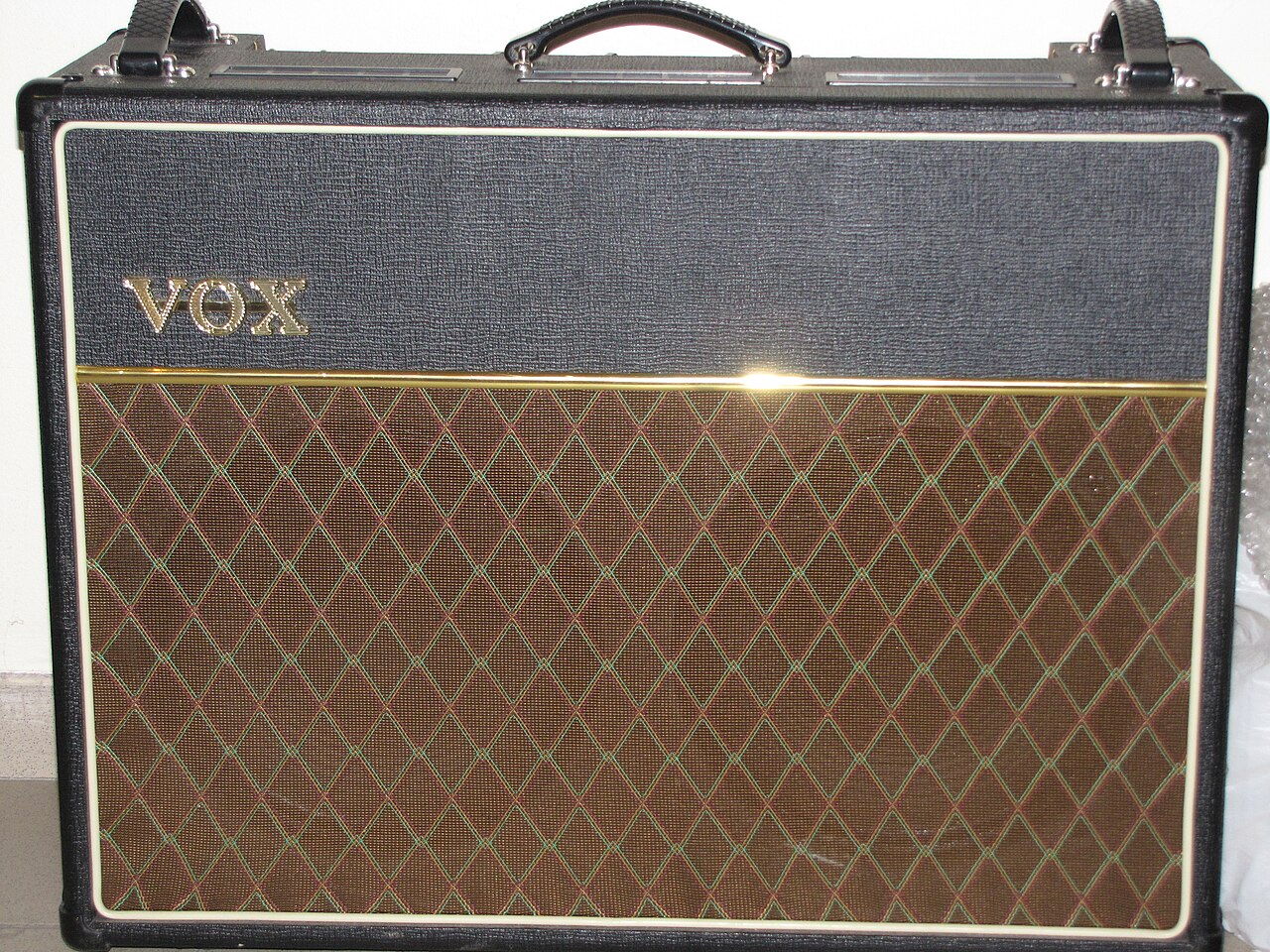
- A Vox AC30 CC2 amplifier: massygo from Ghent, Belgium, Wikimedia Commons, CC BY 2.0.
- The Edge: iinchicore, Wikimedia Commons, CC BY-SA 4.0.
- Rory Gallagher: Heinrich Klaffs, Wikimedia Commons, CC BY-SA 2.0.
Latest News
Related
On This Day
Monday 9 November
From this week: