The Amp That Fits in Your Jacket Pocket — Positive Grid Spark GO Reviewed
Everything you need to know about the Positive Grid Spark GO — the world's most portable smart amp. Specs, tone recipes, comparisons and buying guide.
There is a very specific guitar-player problem that has existed since the dawn of practice amps: the moment you’re away from your amp is the moment the riff shows up. In a hotel room with a rental guitar and no gear. In your in-laws’ spare bedroom. On a tour bus. On a long-haul flight where the idea for the bridge section arrives at 35,000 feet. Every guitarist has lost a musical idea to the tyranny of circumstance, and every solution — headphone amps, mini amps, battery-powered practice combos — has involved some compromise that made you reach for your phone and hum the idea into a voice memo instead of actually playing it.
The Positive Grid Spark GO is Positive Grid’s answer to that problem, taken to its logical extreme. Announced in March 2023 as the smallest member of the Spark smart-amp family, it packs the entire BIAS tone engine, the full Spark app ecosystem, Bluetooth streaming, a built-in rechargeable battery, 33 amp models, 43 effects, and a USB recording interface into a body that is, without exaggeration, smaller than most smartphones. You can clip it to a guitar strap. You can carry it in a jacket pocket. You can balance it on a hotel nightstand between a glass of water and a travel-sized toothpaste, and it will still be capable of generating a noise complaint from the room above.
Whether that is enough depends entirely on what you need it to do — and this guide will tell you exactly what it does, what it doesn’t, and how it fits into the wider landscape of portable tone.
How Positive Grid Got Here: From JamUp to a Pocket-Sized Spark
Positive Grid was founded in 2011, headquartered in San Diego with engineering operations in Taipei, Taiwan. Their earliest product was JamUp, a mobile amp modeling app for iOS that was, at the time, among the most convincing guitar-amp simulations available on any mobile device. The company followed it in 2014 with BIAS Amp — a desktop and iOS amp designer that let you swap virtual components inside a modeled amplifier: change the preamp tube type, the output transformer, the rectifier, the cabinet. BIAS Amp became one of the reference standards for professional amp simulation software.
Hardware arrived in 2016 with the BIAS Head and BIAS Rack, guitar amplifiers that ran the BIAS engine in dedicated hardware form. But the product that changed Positive Grid’s trajectory entirely was the Spark 40, launched via crowdfunding in 2019. The Spark 40 generated 25,000 pre-orders before it shipped and sold 100,000 units in its first year — numbers that made it one of the fastest-selling practice amps ever made. It did this not because it was the most powerful or the most tonally sophisticated practice amp on the market, but because it was the first practice amp that felt genuinely designed around how modern guitarists actually practice: with a phone, with streaming music, with YouTube, with a need to learn chord changes quickly and improvise over backing tracks without setting up a studio rig.
The Spark Mini followed in 2022, shrinking the Spark concept to a 10W battery-powered stereo portable. The Spark GO arrived in March 2023 as the smallest possible expression of that same idea — and at $129 street price, the most affordable entry point into the Spark ecosystem.
Specifications
Design and Controls: A Camera That Plays Guitar
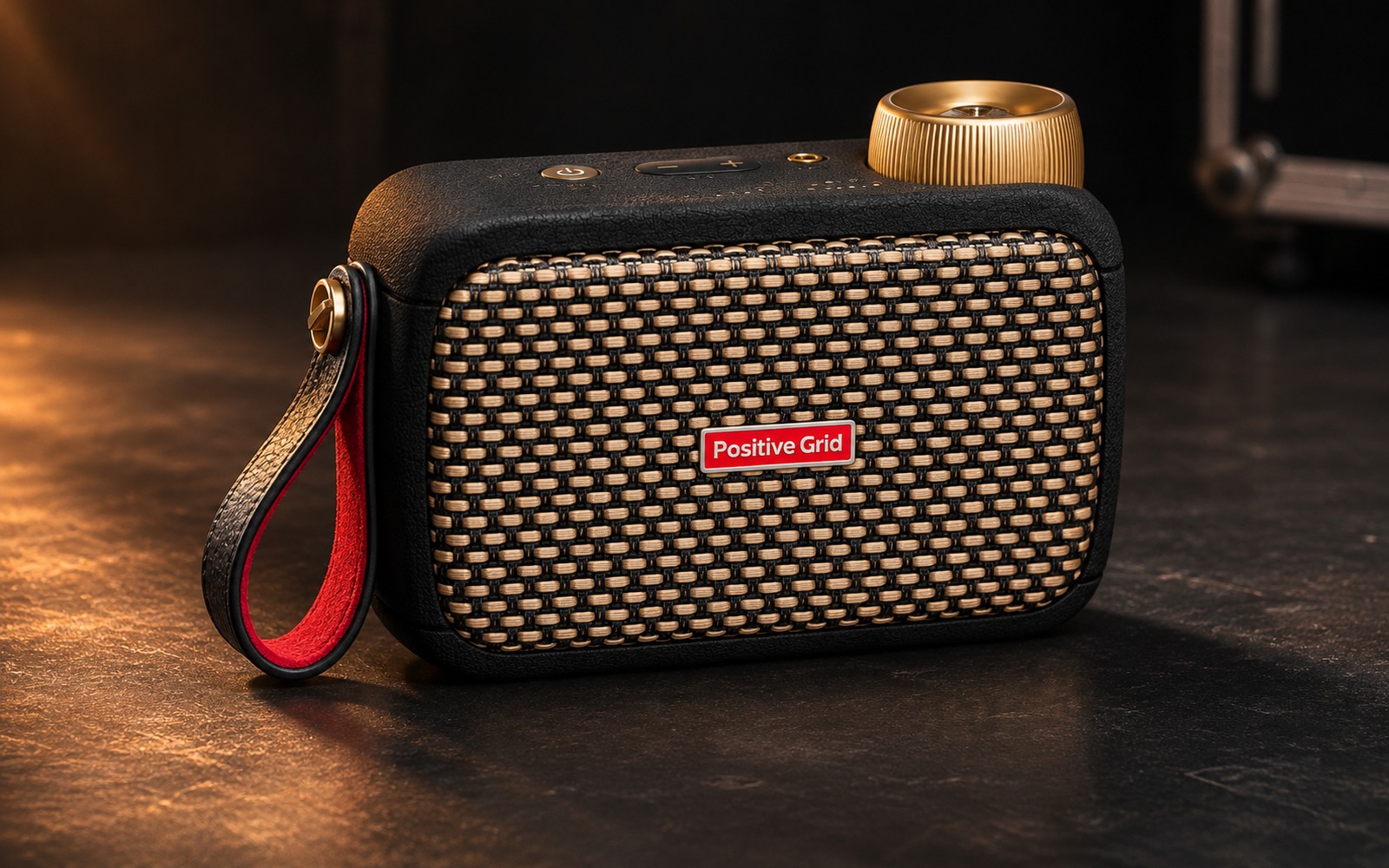
The first thing reviewers note when they unbox a Spark GO is that it looks more like a point-and-shoot digital camera than a guitar amplifier. The dimensions back this up. At 4.92″ wide and 3.34″ tall, it is physically smaller than many recent flagship smartphones and considerably lighter than any guitar amp you’ve ever owned. The carry handle sits on top, the grille cloth faces forward, and the whole thing has the reassuring density of quality consumer electronics rather than the hollow plasticity of toy amps at this price range.
Positive Grid’s black-and-gold aesthetic carries over from the Spark Mini and Spark 40: textured rubber sleeve, gold metallic hardware, woven speaker grille (with an all-black grille included in the box as an alternative finish). The rubber sleeve doubles as both grip and anti-slip, holding the GO in place on any flat surface without traditional amp feet. Two rubber straps — red and black — let you hang it from a guitar strap or carry it from your wrist. A pair of carry configurations and a carry handle mean there are four ways to hold this amp before you’ve even reached for a cable.
Controls are deliberately minimal. On top: the preset selector button (four red LEDs indicate which of the four hardware presets is active — Rhythm, Lead, Solo, Custom), separate music volume +/- buttons for Bluetooth-streamed audio, and the power/Bluetooth pairing button. The guitar input lives in the centre of a large, knurled gold volume encoder — a hardware choice that polarises opinion. The encoder is infinite rotation, meaning there are no physical stops and no visual indication of what volume it’s set to when you pick it up again. Positive Grid’s solution is a default “chuck” sound — a muted string attack — that plays when the encoder hits maximum so you don’t clip suddenly. This can be disabled in the Spark App, which also shows a digital volume level indicator. It works, but it is an unconventional choice for an instrument-level volume control.
The back panel has concentric rubber bevels moulded into it. These serve a specific function: when the Spark GO is laid flat with the speaker facing upward, the bevels provide standoff clearance from the tabletop and prevent resonance coupling that would kill the sound. Lay it flat for omnidirectional room-filling sound. Stand it upright for focused, forward-projected audio. This orientation trick is one of the GO’s more practical design details, and it means the right way to place it changes depending on whether you’re playing alone or wanting the amp to fill a room.
The BIAS Engine: What “Computational Audio” Actually Means
Every Positive Grid Spark product runs on BIAS — their proprietary tone engine, originally developed for the BIAS Amp desktop software and progressively optimised for embedded hardware. The term “computational audio” appears in Positive Grid’s marketing, which sounds like language designed to mystify, but the underlying concept is straightforward: instead of a static impulse-response convolution of a specific amp model (the approach used by many plug-ins), BIAS models the behaviour of individual circuit components — tubes, transformers, speakers — and calculates how they interact in real time.
The practical result on a $129 device is that the 33 amp models don’t sound like the same clean-gain-crunch palette cycled with different EQ curves. They behave differently under dynamics. A Fender Blackface model compresses and blooms differently at the edge of overdrive than a Marshall JTM45 model does, which behaves differently again from a Mesa/Boogie high-gain model. These distinctions are more subtle on a 1.77″ speaker than they are on a 12″ cabinet, but they are audible in headphones — and the Spark GO’s USB interface makes it trivial to test them properly into studio headphones.
The 33 onboard models cover clean American (Fender Blackface, Tweed-family), clean British (Vox AC15-class), crunch British (Marshall Plexi, JTM45-family), high gain British and American (JCM800-class, Mesa/Rectifier-class), and extended-range modern. Effects run to 43 categories at launch — chorus, flanger, phaser, tremolo, tape delay and hall reverb being the most praised — with ToneCloud pushing the available library to over 50,000 user-shared tone packages. Guitar World’s Matt McCracken spent significant time with the tape delay specifically, calling the oscillations “absolutely phenomenal.”
For acoustic-electric players with an undersaddle pickup, the onboard acoustic preset category is a genuine selling point. At a price where acoustic players would normally have no practice-amp option worth considering, the GO covers flat-topped and nylon-string simulations passably well. Bass guitar presets, too: McCracken tested a Fender Mustang bass through the bass presets and reported “an excellent, round bass tone with a depth that belied such a tiny speaker.” The one documented failure mode is drop-tuned or heavily extended-range guitars — a baritone guitar in drop tuning overloaded the Guitar World test unit’s presets, producing undefined low-end distortion rather than musically useful gain.
Famous Players: The Honest Situation
No major touring guitarist is documented on a Spark GO, and the structural reasons are the same ones that make the GO the correct choice for a guitarist who isn’t a major touring artist: the product is by design a home and travel practice tool. Its 5W output and 1.77″ driver make it unsuitable for live performance. Its value proposition is portability and app-ecosystem access, not stage volume or branded endorsement. The Positive Grid artist programme concentrates its signature models on the Spark Mini (Steve Vai signature; Paul Gilbert limited edition; Zakk Wylde edition) and the Spark 2 (Nuno Bettencourt, Jake Bowen, Jeff Loomis presets) — not on the GO.
Equipboard’s database lists one pro artist using the Spark GO: Haraguchi San, documented via an Instagram video. No other professional touring guitarists are currently confirmed on the record as Spark GO users.
This is not a knock. It is structurally identical to every other practice-amp review in this series: the Boss Katana, the Boss Nextone Stage, the Yamaha THR range, the Spark Mini and Spark 40 — none carry celebrity endorsements on the specific product, because the products are purchased by working musicians and guitarists who need something good at a price that doesn’t require a record-deal advance. The GO’s one genuine artist-programme credential is that Positive Grid built the platform used by those signature-edition artists as their factory-preset tone base. Vai’s four custom Spark Mini Vai presets (Fresh, Mild, Hot, Fire) are built on the same BIAS tone engine running inside your $129 Spark GO. The architecture is identical. The cosmetics and factory presets differ.
Tone Recipes and Settings
Recipe 1: Hendrix “Little Wing” Clean-to-Crunch
Select the British Crunch model (JTM45-class). Gain 3, Volume 7, Treble 6, Mid 5, Bass 5. Add a light spring reverb — short decay, mid mix. A hint of phaser (slow rate, shallow depth) turns it into the clean-to-grind clean that lives at the edge of breakup. Play with a Fender Stratocaster on the neck pickup for the authentic wash; a Les Paul gives you more compression and less quack. This setting rewards picking-hand dynamics — dig in hard and the model breaks up naturally; back off the pick angle and it cleans up without touching the amp controls.
Recipe 2: AC/DC Rhythm Crunch
British Crunch model, higher gain version. Gain 5, Volume 6, Treble 7, Mid 5, Bass 4. No reverb. Drop a TS-style overdrive (the BIAS Tube Screamer model) in front at zero gain and volume unity to tighten the low end. This approximates the compressed, mid-forward crunch of a Marshall through the app’s stock models. A Gibson Les Paul Standard on the bridge pickup with both volumes on full produces the correct frequency profile. At 5W through a 1.77″ driver you won’t get the actual air movement of a 100W Marshall into a 4×12, but for learning the riff, the pattern is intact.
Recipe 3: High-Gain Shred (Headphones Mode)
Mesa/Rectifier-class model. Gain 8, Volume 5, Treble 7, Mid 4, Bass 6. Enable the noise gate (threshold around 40%). Headphones recommended — 5W at full gain through a 1.77″ speaker loses focus at the high end of saturation. Through headphones via the 1/8″ output, the same BIAS algorithm sounds significantly fuller than through the onboard speaker, because the USB interface or headphone out bypasses the physical driver entirely and the modelled speaker-cabinet response is processed digitally. Use this for technical-practice sessions where you need clarity in each note and the speaker’s physics are working against you.
Recipe 4: Tape Delay Ambient
Any clean model — American Clean works well. Gain 1, Volume 6, Treble 5, Mid 4, Bass 5. Engage the tape delay: time to about 380ms, feedback at 40%, mix at 45%. Add a long hall reverb with high diffusion and low direct signal. Guitar volume rolled back to 60%. Play single-note melodic lines slowly. The Spark GO’s tape delay in particular received notable praise from Guitar World’s McCracken for the realism of its oscillation behaviour — the repeats drift slightly in pitch the way actual tape degrades, which gives the ambient effect an organic warmth absent from cleaner digital delays. Search ToneCloud for “ambient shoegaze” for community presets built on this architecture.
Recipe 5: Acoustic Practice
Select the Acoustic preset category. Treble 6, Mid 7, Bass 5, Presence 5. No overdrive. A light reverb (room type, decay short). This works best with an acoustic-electric guitar’s undersaddle pickup plugged directly into the 1/4″ input. The Spark GO’s computational audio processes the piezo signal through an acoustic impulse model that is, at $129, markedly better than it has any right to be. Flat-top fingerpickers and nylon-string players practising dynamics will find this useful for sofa sessions where plugging into a full acoustic amp isn’t practical. Don’t push it past volume 7 — the 1.77″ driver starts to show its limits with the fuller low-mid content of an acoustic simulation above that point.
How the Spark GO Compares
vs. Positive Grid Spark Mini
The Spark Mini is the GO’s direct sibling at $199 vs $129. The Mini doubles the output (10W), uses stereo speakers (2×2″ + passive radiator), weighs nearly four times as much (1.36kg vs 0.36kg), and produces meaningfully more low-end presence because two speakers and a larger cabinet move more air. The GO wins on portability; the Mini wins on sound fullness and stereo imaging. Both run the same Spark App, same BIAS engine, same ToneCloud. If your use case is specifically “jacket pocket or strap-clip,” the GO is the right choice. If the use case is “desktop amp at home plus occasional portability,” the Mini is the more satisfying long-term tool. There is no version of events where the GO replaces the Mini for desk use.
vs. Positive Grid Spark 40
The Spark 40 is a 40W, 5.2kg, plug-in-required practice amp with a physical knob for every parameter and 2×4″ speakers. It is better in every dimension of sound quality. It is utterly useless in a hotel room, on a tour bus, or anywhere without a mains socket. The GO fits where the Spark 40 cannot, which is the entire point. They are complementary in a way that makes both worth having if your life involves both a home practice space and periods of travel.
vs. Fender Mustang Micro
The Fender Mustang Micro plugs directly into your guitar’s output jack, runs into headphones only, has no speaker, and costs around $99. It is a headphone amp, not a practice amp with a speaker. If silent practice is the only requirement, the Mustang Micro is lighter and more discreet. If you ever want to hear yourself play through a speaker — for sofa sessions, for recording test tones, as a Bluetooth speaker for music — the GO’s $30 premium buys an actual speaker plus the entire Spark app ecosystem versus Fender’s more limited controls.
vs. Blackstar Fly 3 Mini
The Blackstar Fly 3 Mini costs around $59, weighs approximately the same as the GO, has no Bluetooth, no app, no USB interface, and runs on AA batteries or a 9V adaptor. Its 3W tube-inspired channel and 1-watt power attenuator are genuinely usable for bedroom practice. It is what many guitarists carried before smart amps existed — simple, reliable, no ecosystem dependencies, dead easy to use. If you actively do not want an app-integrated amp, if you distrust Bluetooth, or if you genuinely only need one clean-to-crunch channel without the complexity of a 33-model library, the Fly 3 Mini is the more honest recommendation. The GO’s feature set is extensive; it is also dependent on a smartphone app for everything beyond four hardware presets.
Buying Guide and Practical Notes
Who should buy the Spark GO
The Spark GO is the right purchase for a guitarist who travels frequently and will not compromise on tone quality for the sake of portability; for apartment dwellers who need headphone-out silent practice plus the option to play quietly through a speaker; for anyone who wants to practice on acoustic-electric without hauling a full acoustic amp; for bass players who want a compact backup with bass-specific presets; and for anyone who finds the Spark Mini’s $199 price or 1.36kg weight too much for their specific use case. It is also a legitimate Bluetooth speaker for music playback when the guitar is in its case — Guitar World tested it through tracks ranging from Lil Wayne to Radiohead and found it “far exceeded expectations for something so small.”
Who should look elsewhere
If low-end fullness matters and you’re not exclusively using headphones, the GO’s 1.77″ driver cannot compete with anything larger. If you need to be heard over another musician without headphones — even a quiet acoustic player — 5W at this speaker size will not cut through. If you want to use the amp primarily without a smartphone nearby, the four hardware presets are the ceiling of what’s available; the app is not optional for the full feature set.
Versioning and what to look for used
The Spark GO launched in late March 2023. There is a single hardware variant (unlike the Spark Mini, which has no wireless version for comparison). Positive Grid have issued firmware updates via the Spark App that have expanded the effects library from the 43 at launch and fixed early Bluetooth connectivity issues with certain Android devices — verify your unit is running current firmware before assuming a used purchase has these features. The standard unit ships with the woven speaker grille; the box includes a black hardshell grille as an alternative. Both grilles clip on without tools. Colour options are limited to the standard black-and-gold finish; signature colourways are a Spark Mini-tier feature.
Used Spark GO units from late 2023 and 2024 are available through Reverb, eBay, and Facebook Marketplace at around $75–99. The USB-C battery is non-removable and rated for several hundred charge cycles; check that battery health is still reasonable — ask the seller for a charge time vs advertised 8-hour figure to sanity-check it before buying.
Living with the Spark GO
The practical quirks accumulate slowly. The endless-encoder volume knob is the most frequently mentioned by reviewers who spend extended time with the unit — not because it’s broken, but because picking up the amp and not knowing where the volume is set creates a momentary friction that potentiometers never have. The app’s volume indicator solves this, which means the phone has to be open. If the phone’s Bluetooth has dropped since you last used the GO, reconnecting adds another 20–30 seconds. Neither of these is fatal. Both are worth knowing before purchase.
The guitar input is on the front of the volume encoder, which means the cable exits horizontally from the top of the amp when the GO is standing upright. With a right-angle plug this is fine; with a straight plug and a heavy cable, the cable weight drags the amp over onto its side — Guitar World’s McCracken documented exactly this, and the fix is to reverse the cable orientation (straight end into the guitar, right-angle end into the amp). A minor cable-management issue with a minor solution.
The Spark App connectivity is mature as of 2025–2026 — the early Pixel 6 Bluetooth issue documented in Guitar Player’s 2023 first-look review was a pre-production artefact that has not been a recurring issue in long-term user reports. iOS connectivity has been consistently stable across reviews. Android users on older hardware may want to confirm compatibility before purchase.
Positive Grid’s ToneCloud community is, at this point, one of the largest guitar-tone libraries in existence, with over 50,000 user-created presets available for download. For any specific artist’s sound, any song, any album’s tone palette, the probability that someone has already reverse-engineered the required settings and shared them is extremely high. The practical value of this — especially at $129 — is substantial. You are not buying 33 amp models. You are buying access to an ever-expanding library of tones created by people who have spent significant time getting them right.
FAQ
Can I use the Spark GO without the Spark App?
Yes, for the four hardware presets. Preset selection, guitar volume, music volume via Bluetooth, and headphone out all work without the app open. However, tone editing, preset downloading, Smart Jam, Auto Chords, ToneCloud access, EQ Scenario, and video capture all require the app. If you need more than four presets or any of those features, the phone stays in the picture.
How loud is 5W from a 1.77″ speaker?
Louder than most people expect. Guitar World’s reviewer generated a noise complaint from an upstairs partner within two minutes of high-gain use. It will not cut through an acoustic drummer or another guitar player at bedroom volume, but for solo practice sessions, apartment use with moderate volume, hotel rooms, and outdoor playing in quiet environments, it is sufficient. The passive radiator adds bass extension that the driver alone would not provide.
Does the Spark GO work for bass guitar?
Yes, in the bass preset category. Guitar World tested a Fender Mustang bass and reported a round, usable bass tone. Heavily drop-tuned or extended-range basses may overwhelm the driver at higher volumes. Standard four-string bass at moderate gain and volume performs well.
What is the difference between the Spark GO and Spark Mini?
The Spark Mini is 10W vs 5W, weighs 1.36kg vs 0.36kg, uses stereo dual speakers vs a single driver, and costs $199 vs $129. The Mini produces more low end and stereo width. The GO fits in a pocket. Same BIAS engine, same Spark App, same ToneCloud. Choose GO for maximum portability; choose Mini for better sound quality with still-portable battery power.
Can it be used as an audio interface?
Yes. The USB-C connection provides a 1-in × 2-out interface at 16-bit/44.1kHz without requiring additional software or drivers on most operating systems. It is sufficient for demo recording and capturing ideas; for professional recording the resolution and bit depth are below studio standard, but for sketch recording and practice documentation it works well.
What happened to the 43 vs 48 effects discrepancy?
The launch press release (Premier Guitar, March 28, 2023) and Guitar Player’s April 2023 review both specify 43 effects. Later reviews including Guitar World cite 48. Positive Grid have issued multiple firmware and app updates since launch, and the effects library has expanded post-launch. If you see a listing citing 48, treat it as reflecting the current firmware rather than the factory specification at launch. This is consistent with Positive Grid’s practice across the Spark family of expanding feature sets via software updates rather than new hardware releases.
Is there a wireless version of the Spark GO?
No. The Spark GO is a single hardware configuration. Positive Grid sell the Spark LINK wireless system separately, which is compatible with the GO via the 1/4″ input — but it is an additional purchase rather than a built-in variant. The Spark Mini also has no integrated wireless receiver; this level of integration exists on the Yamaha THR10II Wireless and THR30II Wireless in the mid-price desktop amp category.
What is the warranty?
Positive Grid offer a one-year limited warranty on Spark hardware purchased through authorised retailers. The battery is covered within this warranty period. Warranty registration via the Spark App is recommended at purchase to establish the start date.
Image credits
- Top image: GuitarGangsters AI-generated reference illustration, not a photograph.
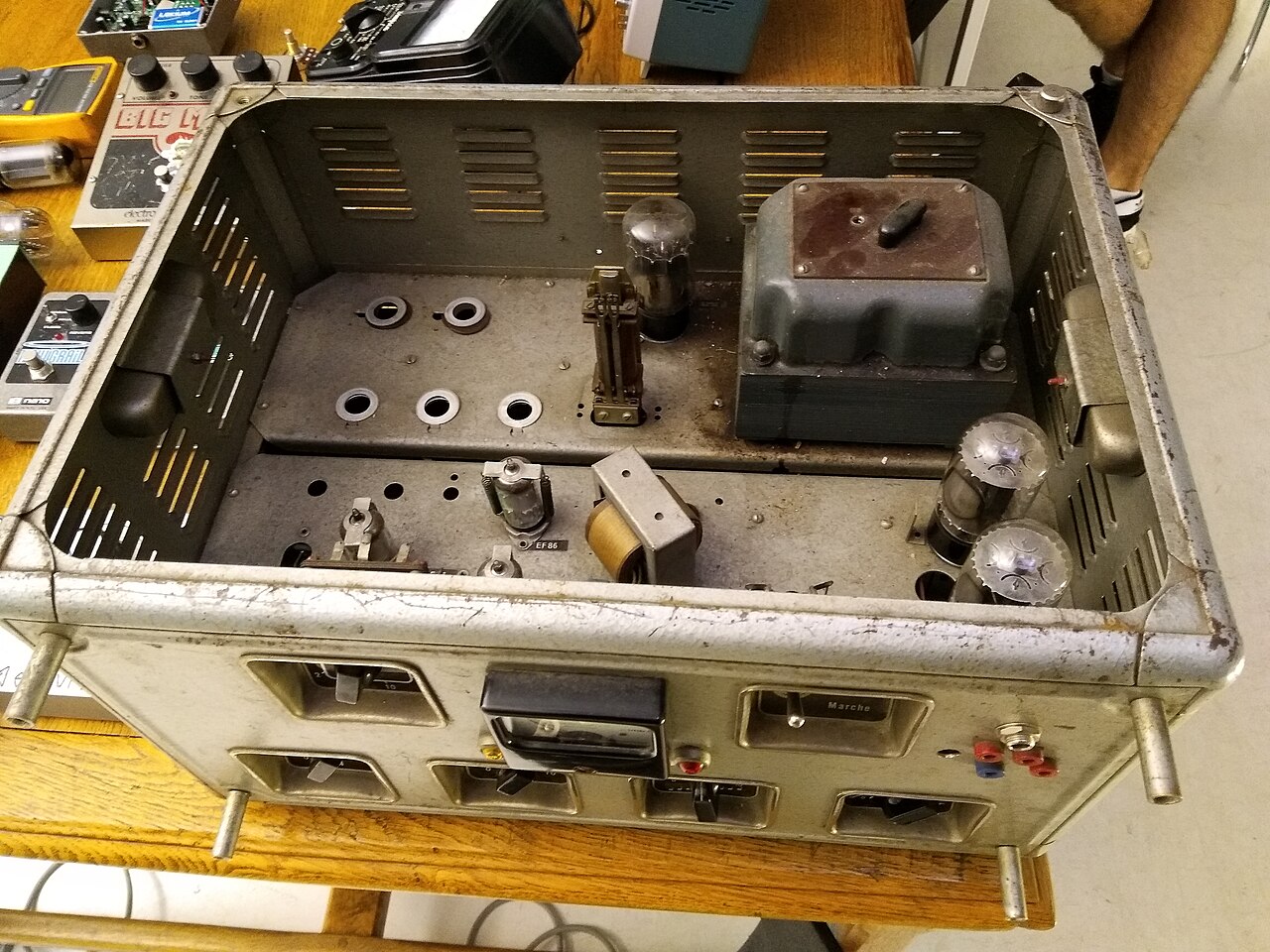
- The inside of a converted tube amp: Skimel, Wikimedia Commons, CC BY-SA 4.0.
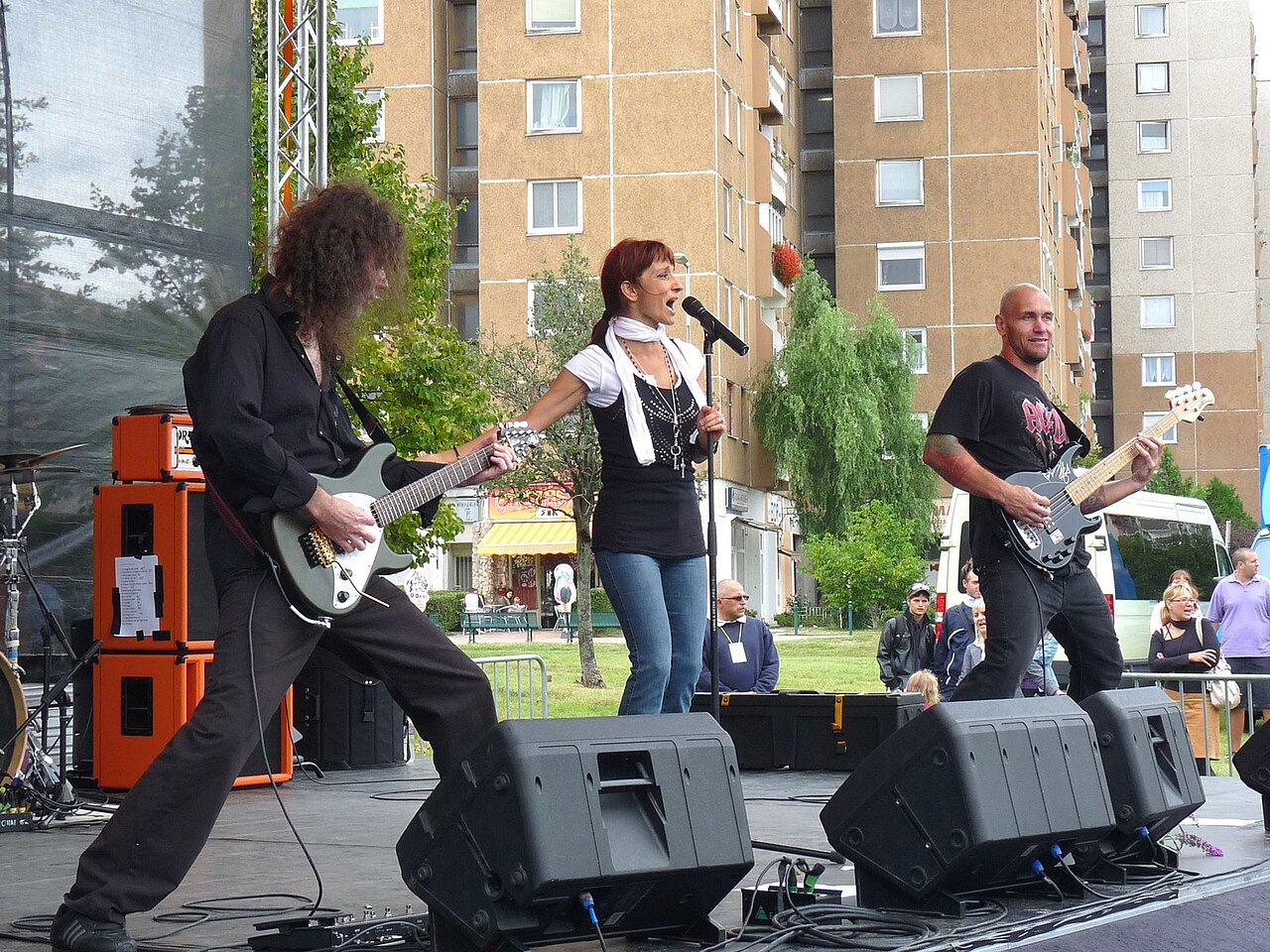
- A band playing outdoors with an orange amp: Fekist, Wikimedia Commons, CC BY-SA 4.0.
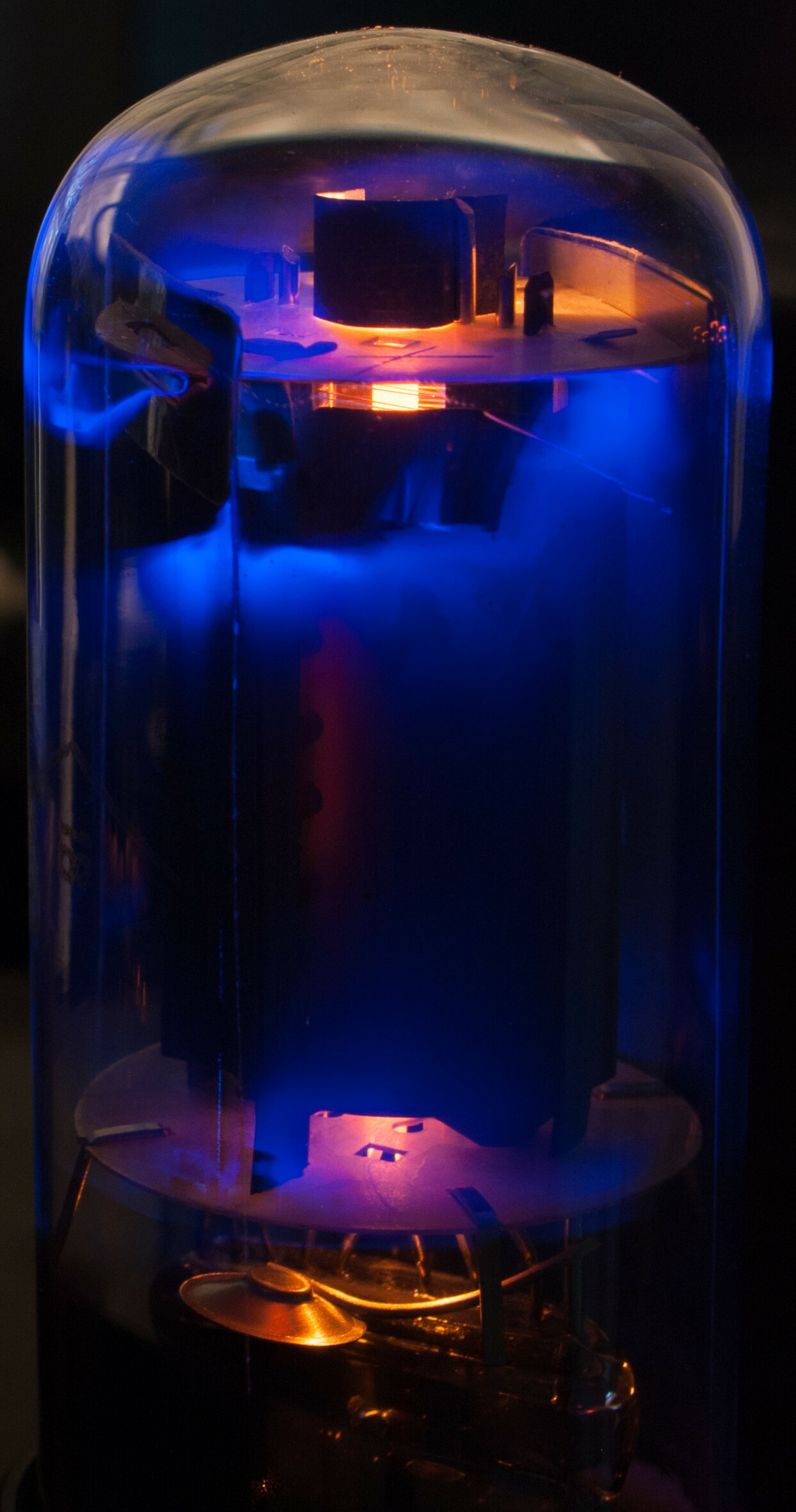
- A glowing power tube: Rob Robinette, Wikimedia Commons, CC BY-SA 4.0.
Latest News
Related
On This Day
Tuesday 10 November
From this week: