Steve Vai: Master of Technique, Tone & Extended-Range Innovation
GuitarGangsters Editorial 30 min read Updated 21 October 2026
Steve Vai: Master of Technique, Tone & Extended-Range Innovation
There are guitarists who chase tone — and then there’s Steve Vai, the guy who built his own universe around it.
Born out of Zappa’s complexity, raised in Satriani’s dojo, and baptized by his own obsession, Vai turned electric guitar into a multidimensional language — a mix of science, soul, and sonic architecture.
To hear Vai play is to hear design in motion. His notes don’t just sing; they orbit. His tone doesn’t just cut; it sculpts air. Whether it’s the alien soundscapes of Passion and Warfare, the celestial glide of For the Love of God, or the mind-bending riffs on Inviolate, Vai never settles for just “great tone.” He builds worlds.
“Tone is your voice — and your hands are the translator,” Vai once said.
That’s the guiding principle of his 45-year career — from wiring his first Frankenstein Strat in his parents’ basement to standing on stage with the Hydra, a three-neck, half-fretless, steampunk monster that looks like it was stolen from another dimension.
And that’s exactly what we’re about to explore:
the journey, the machines, and the mind of one of the most inventive players in guitar history — a man who turned virtuosity into vocabulary and gear into philosophy.
Background / The Artist’s Journey
Steve Vai’s story starts in Carle Place, Long Island, where a young Italian-American kid turned obsession into destiny. Born on June 6, 1960, he grew up in a house filled with music — Sinatra on Sundays, Zappa on vinyl, and the hum of a cheap guitar amp that never quite worked right.
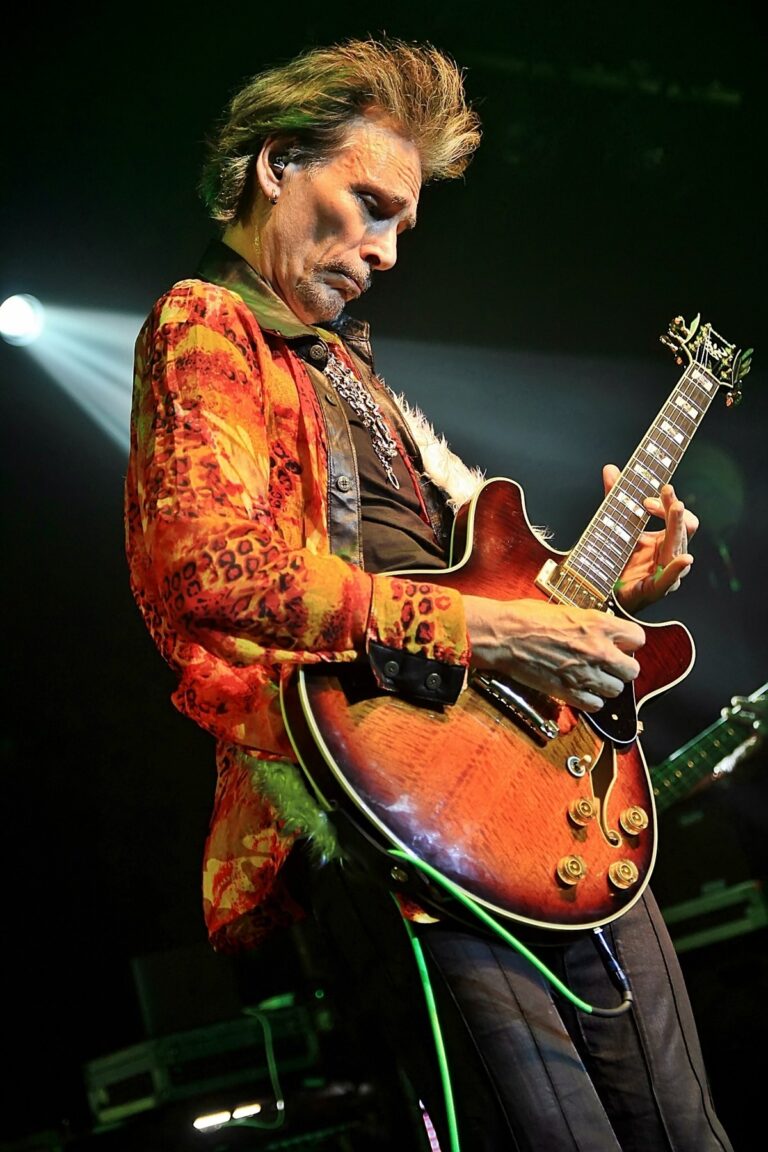
By age 13, Vai was already transcribing Frank Zappa solos note-for-note — not from tab books, but by ear, hunched over a record player, rewinding endlessly. That precision, that hunger to understand sound, shaped everything that followed.
From Student to Apprentice
Vai studied briefly at Berklee College of Music, but his real education came when he landed the gig of a lifetime: working directly for Frank Zappa.
He wasn’t hired for fame — he was hired because he could decode Zappa’s musical puzzles. Vai was dubbed “the little Italian virtuoso” and tasked with playing the impossible.
It was Zappa who taught him that technique was nothing without discipline — that you could write humor and chaos into music and still make it sing.
For Vai, this wasn’t just mentorship — it was initiation into a higher order of musical thinking.
“Frank didn’t just teach me to play — he taught me to listen to everything,” Vai said in an early Guitar World interview.
After three years of touring and recording with Zappa, Vai broke out on his own. He joined Alcatrazz (briefly replacing Yngwie Malmsteen), then David Lee Roth’s post-Van Halen band, where he helped craft Eat ’Em and Smile (1986) — arguably the funkiest shred record ever made.
When Roth introduced Vai as “the devil with an angel’s hair,” he wasn’t kidding. Vai’s tone on that record — liquid sustain, harmonic precision, whammy-bar pyrotechnics — was light-years ahead of anything in the ’80s shred scene.
Passion, Warfare, and the Birth of the Modern Guitar Hero
Then came 1990’s Passion and Warfare, a record so sonically dense and spiritually ambitious that it practically invented its own genre: instrumental rock opera. Vai composed, arranged, and produced every note himself.
It wasn’t a showcase; it was a statement. For the Love of God, The Audience Is Listening, and Blue Powder turned into scripture for guitarists worldwide. Every solo told a story — not of showing off, but of ascending.
The album went gold, landed Vai a Guitar World cover, and permanently cemented him as one of the greatest living guitar architects.
“Passion and Warfare wasn’t about being fast,” Vai said. “It was about being fearless.”
The Carvin Legacy Era
Through the ’90s, Vai’s partnership with Carvin (later Kiesel) gave birth to his Legacy series of amplifiers — all-tube, articulate, and engineered for touch sensitivity over brute force. He spent more than two decades refining them, touring with G3 (the now-legendary guitar summit with Joe Satriani and Eric Johnson), and releasing albums that blurred the line between symphony and shred.
From Fire Garden (1996) to Real Illusions: Reflections (2005), Vai built a mythology that was both deeply personal and technically divine.
When Carvin discontinued amp production in 2017, Vai didn’t mourn — he evolved.
He moved into a modular era, embracing Synergy Amps, where his personal Vai module recreated his Legacy’s DNA inside a compact, studio-ready chassis.
The 7-String Revolution
Long before djent kids were downtuning to oblivion, Vai had already opened that door.
In 1990, alongside Ibanez, he co-designed the Universe 7-string guitar, introducing a low-B string that expanded the guitar’s range without losing clarity.
At the time, most players dismissed it as overkill — until KoRn and an entire generation of metal bands realized that Vai had handed them a new vocabulary.
The Universe wasn’t just an extra string; it was an evolution in tone architecture — a bridge between melody and extended rhythm.
“I didn’t add a string to play lower — I added it to play bigger.”
From the Stage to the Cosmos
By the 2000s, Vai had become both a performer and philosopher.
He launched the Make a Noise Foundation, mentoring young players, and created Alien Guitar Secrets — masterclasses that blended spiritual reflection with tone science.
He toured relentlessly — G3, orchestral collaborations, solo world tours — and by 2022, he unveiled Inviolate, an album recorded during isolation that somehow sounded infinite.
Then, in 2022’s Teeth of the Hydra, he debuted the Ibanez Hydra, a triple-necked beast with a 7-string, a 12-string half-fretless, a bass neck, 13 harp strings, and MIDI control — all wired into a single system.
It wasn’t just a stunt. It was the culmination of a lifetime of design obsession: every neck, pickup, and piezo interacting like a musical ecosystem.
“When I play the Hydra, it’s like conducting a conversation between three instruments that share one soul.”
In 2025, Vai remains unstoppable — reuniting with Joe Satriani for the SATCHVAI Band and releasing Wire & Wood: The Guitars of Steve Vai, a 300-page chronicle of his instruments. He even lent his name to the Spark Mini Vai signature amp — proof that even after four decades, he’s still chasing the next frequency.
When it comes to tone alchemy, Steve Vai’s rig isn’t just equipment — it’s a living, breathing organism. Every knob, pickup, and circuit exists to translate the micro-movements of his fingers into something cosmic. Vai’s approach to gear has never been about collecting — it’s about communion.
As he once said:
“Gear doesn’t make music — it allows you to channel the divine.”
His setup has evolved through seven major eras — each reflecting not just a change in technology, but a shift in philosophy. From the Frankenstein guitars of his Zappa years to the modular monster he commands today, Vai’s rig is both a laboratory and a mirror of his mind.
Guitars – The Weapons of Sonic Design
The Birth of the JEM: 1987 and Beyond
When Steve Vai partnered with Ibanez in 1986 to design the JEM, he wasn’t looking for a signature guitar — he was building the perfect tool. The result, unveiled at NAMM 1987, was unlike anything the guitar world had ever seen.
It had:
- A sculpted “Monkey Grip” handle carved into the body,
- A deep Lion’s Claw tremolo cavity for extreme whammy dives,
- A thin Wizard neck with scalloped upper frets,
- DiMarzio PAF Pro pickups in HSH configuration for wide tonal flexibility.
Every detail served Vai’s stagecraft — from fast access to upper frets to a tremolo system that could survive his acrobatics.
The early models — Loch Ness Green, Shocking Pink, and Desert Sun Yellow — became icons of late-’80s flamboyance. The JEM777 wasn’t just Vai’s guitar; it was a manifesto that playfulness and precision could coexist.
“The JEM is me — it’s how I think about design: playful, functional, and a little outrageous.”
EVO – The Holy Grail
Vai’s most beloved instrument, Evo, is a white JEM7VWH he has used on stage for decades. Its wear pattern alone tells a thousand stories — pickguard scratched to oblivion, finish chipped away, and the neck worn to bare wood.
- Pickups: DiMarzio Evolution (HSH) — bright, articulate, and fierce.
- Neck: Maple with rosewood board, 24 frets, scalloped from 21–24.
- Mods: Internal wiring tweaks for noise reduction, Graph Tech nut, and piezo integration on later tours.
- Strings: Ernie Ball Paradigm .009–.042, changed every other day by tech Thomas Nordegg.
Evo’s tone is both surgical and alive — it cuts through massive stereo mixes while retaining Vai’s dynamic sensitivity.
“Evo isn’t just my guitar — she’s my soulmate. We’ve suffered together.”
The Hydra – Myth Turned Machine
Enter The Hydra: unveiled in 2022 and featured on Inviolate’s opening track, Teeth of the Hydra. Built by Ibanez, this triple-necked, steampunk masterpiece fuses a 7-string guitar, 12-string half-fretless, and bass neck with 13 sympathetic harp strings and MIDI integration.
Specs include:
- 7-string neck: DiMarzio UtoPIA humbuckers, 25.5” scale.
- 12-string neck: Half-fretless, piezo bridge.
- Bass neck: Active electronics for deep, clean fundamentals.
- Harp strings: Tuned chromatically; resonance controlled via onboard preamp.
The Hydra isn’t a gimmick — it’s a testament to Vai’s obsession with interaction. He uses it to play polyphonic compositions live, switching between necks and tunings in real time.
“It’s not three guitars — it’s one creature with many voices.”
The Universe – The 7-String That Changed Everything
In 1990, Vai and Ibanez introduced the Universe UV777, the world’s first mass-produced 7-string guitar. It featured DiMarzio Blaze pickups and extended the range downward to a low B.
Originally intended to expand melodic phrasing, it became the cornerstone of modern metal when KoRn adopted it, using Vai’s innovation to create the downtuned sound of nu-metal.
Even Vai himself calls it “an evolution that got away” — a design that opened doors for genres he never intended to influence.
“I didn’t design the Universe for heaviness — I designed it for wholeness.”
Signature Variants and Collectibles
Over the years, Vai has amassed over 300 guitars, many of them prototypes or artist proofs. Standouts include:
- JEM77WFP “Floral Pattern” (1988) – featured on Wire & Wood’s Ultra Edition release (2025).
- JEM7BSB “Burnt Stained Blue” – used during the Fire Garden era.
- Ibanez PIA3761 – the modern evolution of the JEM, introduced in 2020 with a refined “Petal Grip” and softer curves.
- Mirror JEM – a chrome-finished showpiece that reflects Vai’s light-show theatrics during G3 tours.
Each one, whether pristine or beaten to hell, is treated not as a collectible but as a voice in his orchestra.
Amps & Cabinets – From Legacy to Synergy
Vai’s amplifier philosophy has always balanced clarity and chaos — high headroom for touch dynamics, sculpted mids for vocal sustain, and open power stages that let his technique speak louder than any distortion pedal.
The Carvin Legacy Era (1996–2017)
The Carvin Legacy I & III amps were the backbone of Vai’s live and studio tone for two decades.
- Format: 100W all-tube head (EL34 power section)
- Signature EQ: pronounced mids, warm lows, and treble control that never shrieks.
- Typical settings: Bass 4, Mid 6, Treble 6, Presence 5, Gain 6, Volume 7.
Vai preferred running two Legacys in stereo, each feeding Carvin 4×12 cabinets loaded with Celestion Vintage 30s. One side brighter, one darker — his trademark duality.
The result? A cathedral of sound. One amp shimmered like stained glass; the other roared like thunder.
Synergy Era (2018–Present)
When Carvin discontinued amp production, Vai shifted to the Synergy SYN-2 system — a modular preamp platform that lets him swap tube-based channels.
His personal configuration:
- Slot 1: Vai Module (Red Channel) – Gain 6–7, Bright switch on, Boost engaged for leads.
- Slot 2: Vai Module (Backup) – Gain 5–6, slightly cleaner.
- Slot 3: B-Man Module (Clean) – Gain 0–1, pristine headroom.
- Slot 4: B-Man Module (Crunch) – Gain 4–5, vintage drive.
These feed into a Fractal Axe FX III, which handles spatial effects — stereo delays, modulation, and reverb — before being pushed through a Fryette LX-2 stereo tube power amp and twin Carvin 4×12s.
The rig delivers everything from glassy cleans to molten sustain — but all controlled from Vai’s fingertips, not the knobs.
“I like my amps to whisper when I breathe and scream when I smile.”
Pedals & Signal Chain
Vai’s signal chain is a symphony of precision. Every pedal, switch, and cable serves a singular purpose: to keep his expression limitless while maintaining surgical clarity.
Current live chain (2023–2025):Ibanez JEM7VWH (Evo) → Little Lehle III (A/B switch) → Dunlop 95Q Auto Wah → Ibanez Jemini Distortion → Digitech Whammy DT (+7 semitone jump) → Morningstar ML5 MIDI Looper → Synergy SYN-2 → Fractal Axe FX III → Fryette LX-2 → Carvin 4×12 Cabs (Stereo)
Highlights:
- Jemini Distortion – his dual-channel signature pedal with drive stacking.
- Whammy DT – used for live harmonized pitch shifts and dramatic solos.
- Morningstar ML5 – allows complete MIDI patch control between songs.
All effects are balanced in stereo for phase-perfect imaging — delays alternate left-right for a “breathing” spatial feel.
Strings, Picks & Setup
- Strings: Ernie Ball Paradigm .009–.042 (standard live set)
- Alternate Gauges: heavier sets (.010–.046) for 7-string or drop-tuned compositions.
- Picks: Ibanez Steve Vai Signature (1.0mm) – sharp tip, grippy surface.
- Action: medium-low (~1.5mm at 12th fret) — designed for controlled whammy dives and vibrato articulation.
- Nut: Graph Tech Ratio tuners for perfect tension balance.
- Maintenance: strings replaced every 2–3 shows; tremolo calibrated daily.
Nordegg’s rule backstage: “If it doesn’t feel like Vai’s breathing through it, it’s not ready.”
Tunings & Tone Philosophy
Vai’s tuning palette is vast — from standard E to open tunings and low-B 7-string registers.
Common live tunings:
- E Standard (6-string) – default for most catalog.
- Low B (7-string) – for extended compositions (The Animal, Teeth of the Hydra).
- Open D / DADGAD – used in acoustic compositions and hybrid live sets.
Tone-wise, Vai’s philosophy hasn’t changed since the Zappa days:
Technique creates tone; gear reveals it.
He often repeats:
“The tone is in the intention — the rig just obeys.”
For Vai, distortion is not a mask — it’s a microscope. Every micro-bend, harmonic, and vibrato carries emotional data. That’s why his rigs always favor clarity first, gain second.
Steve Vai doesn’t just play guitar — he sculpts sound out of silence.
His approach to the instrument isn’t about scales or speed; it’s about translating intention into vibration. Every phrase, every bend, every harmonic squeal feels deliberate — as if he’s summoning another dimension through a six-string portal.
“The guitar isn’t just an instrument — it’s a truth machine.”
Vai’s playing is built on paradox: mechanical precision meets spiritual surrender. He plays with mathematic discipline but performs with a preacher’s abandon. It’s this balance — between mind and mysticism — that makes his tone instantly recognizable and utterly inimitable.
The Mechanics of Expression
The Right Hand: The Conductor
Vai’s picking technique is both elegant and explosive.
He uses hybrid picking (pick + fingers) to leap between intervals, often alternating between staccato bursts and legato cascades. His attack is surgical, yet always musical — never sterile.
His control over muting and dynamics gives him the ability to make the guitar whisper or scream on command. Listen closely, and you’ll hear subtle volume-swells, trem-flutter accents, and ghost notes that breathe like vocal inflections.
He once described his approach as “painting with volume.” Every note is part of a larger sonic canvas — not a shred for its own sake, but a brushstroke in motion.
The Left Hand: The Architect
Vai’s legato is legendary — a liquid chain of hammer-ons, pull-offs, and slides that seem to melt the fretboard. His fingers flow across wide intervals, often stretching beyond what most players consider humanly possible.
But what sets him apart isn’t just dexterity — it’s articulation. Each legato phrase retains clarity and contour, even at insane tempos.
His vibrato is similarly unique: slow, vocal-like oscillations that give notes emotional depth. It’s the same phrasing philosophy that defines his melodies — bending the pitch until it feels like a human voice.
Signature Techniques
Whammy Bar Alchemy
The Edge tremolo system on his Ibanez JEM guitars is as much an extension of Vai’s soul as his hands are. He doesn’t just dive-bomb or flutter — he speaks through the bar.
He’ll coax harmonics into melodies, use controlled dips to emulate a singer’s vibrato, or unleash shrieking screams that sound like metal bending in space.
A classic example: “Bad Horsie,” where the whammy acts like a talk box — the guitar literally snarls.
Harmonic Magic
Vai has a near-mystical command of harmonics.
He uses everything from tapped and pinch harmonics to “feedback harmonics,” manipulating his position relative to the amp to summon perfect overtones.
These harmonics aren’t ornaments — they’re punctuation marks in his musical sentences.
Rhythmic Mutations
Vai treats rhythm as a playground, not a prison.
He experiments with quintuplets, septuplets, and odd-meter subdivisions that turn even simple riffs into puzzles.
On tracks like “Building the Church” and “The Animal,” time itself seems to stretch and contract under his fingers.
“Talking Guitar” and Emotional Phrasing
Perhaps the most defining aspect of Vai’s style is his vocal phrasing — shaping notes as if the guitar is breathing.
He often says he’s “having conversations” with his instrument, letting the melody dictate emotion, not the other way around.
“I try to make the guitar speak the things words can’t.”
This emotional intelligence is why Vai’s music transcends shred culture. Behind the alien sounds and impossible runs lies something deeply human — sincerity.
Tone Philosophy
Vai’s philosophy of tone can be distilled into one mantra: technique serves emotion, not ego.
He views tone as the intersection between the physical (gear), the mental (intent), and the spiritual (emotion).
To Vai, distortion isn’t about aggression — it’s about color. His tone always retains clarity, no matter how saturated.
He builds tone in layers:
- Clean foundation – pristine articulation, even under high gain.
- Dynamic midrange – the human voice lives here.
- Stereo space – delays and reverbs that let notes breathe in three dimensions.
Live, he uses stereo rigs to create movement — one amp slightly delayed, the other warmer — producing that signature “breathing tone.”
And yet, despite the complex rigs, Vai remains a minimalist in spirit.
He could plug a single guitar straight into an amp and still sound unmistakably like himself.
“Your tone is the fingerprint of your soul. No one else can copy that — unless they copy you.”
Mindset and the Art of Control
Vai is obsessed with discipline — not as limitation, but liberation. He often describes practice as “spiritual hygiene,” a way to align the body and mind so creativity can flow.
He approaches the guitar like a martial artist — endless repetition until the movement disappears and only intent remains.
That’s why he can step on stage and perform technical sorcery while still looking serene.
He’s not fighting the guitar; he’s dancing with it.
This mindset is what separates Vai from many virtuosos. For him, mastery isn’t about domination — it’s about surrender.
Tone Philosophy in Motion
In Vai’s world, tone is never static.
It breathes, evolves, and reacts.
He rides his volume knob like a violin bow, shifting from whisper to explosion in seconds.
He’ll sculpt feedback into melody, using subtle movements to coax pitch changes mid-note.
When you hear that sustain hang impossibly long on stage, it’s not an effect — it’s physics meeting faith.
“If you can hear what you feel, then you’ve found your tone.”
Trying to sound like Steve Vai is like trying to bottle lightning — it’s possible to get close, but there’s always that element of chaos that refuses to be tamed. His tone isn’t just about pedals or pickups; it’s about precision, movement, and emotional control. Still, for players chasing that celestial Vai tone, there’s a path — a roadmap to expression through technology, technique, and touch.
“You can buy my gear, but you’ll never buy my intent.”
Step 1: Start With the Foundation — The Guitar
If you want the Vai sound, you have to start where he starts: the Ibanez JEM.
His guitars aren’t just aesthetic showpieces — they’re ergonomically engineered to serve expression.
Best options:
- Ibanez JEM7VWH (Evo) – the classic white signature model with DiMarzio Evolution pickups.
- Ibanez PIA3761 – the modern evolution with Petal Grip, smoother neck heel, and refined tone balance.
- Budget route: Ibanez JEMJR or JEM555 — more affordable but still carry Vai’s design DNA.
Key setup tips:
- Action: Medium-low; enough room for controlled vibrato and whammy motion.
- Strings: .009–.042 Ernie Ball Paradigm for Vai’s light touch and fluid bending.
- Pickups: DiMarzio Evolution or Gravity Storm sets capture his articulate, high-output tone.
- Tremolo: Ibanez Edge or Lo-Pro Edge with tight spring tension for precise fluttering.
Vai’s entire setup is designed to enhance articulation — every note must respond like a vocal syllable.
Step 2: The Amp – Clarity Before Chaos
Vai’s tone has always revolved around clarity, not distortion. His amps are designed to stay clean until pushed by his hands or pedals.
Amp options (modern equivalents):
- Synergy SYN-2 with Vai module – authentic replication of his Legacy tones.
- Carvin Legacy 3 Head – the classic Vai amp, 100W of warm mids and glassy highs.
- Fractal Axe FX III / FM9 – for studio or live setups with accurate Legacy and Synergy models.
- Alternative: Neural DSP Archetype or Kemper Profiler with Vai presets.
Starting amp settings (Legacy-style):
- Bass: 4
- Mid: 6
- Treble: 6
- Presence: 5
- Gain: 6
- Volume: 7
These settings aim for warmth and balance — articulate mids that let harmonics pop and sustain without fizz.
Step 3: The Pedalboard – Less Is More
Vai’s pedal philosophy is deceptively simple. He doesn’t drown in effects; he uses them like punctuation — precise, expressive, and always intentional.
Essential pedals:
- Ibanez Jemini Distortion – dual-channel drive (one smooth, one aggressive).
- Digitech Whammy DT – for octave jumps, pitch sweeps, and harmonized leads.
- Dunlop Cry Baby 95Q Auto Wah – set to a subtle range for dynamic quack and vocal tones.
- Little Lehle III A/B Switch – for clean signal routing and bypass control.
- Delay/Reverb: use stereo digital delays in dotted eighth + offset (e.g., 380ms / 400ms).
- Chorus: light, for widening (Fractal or TC Electronic style).
Signal order (Vai 2023–2025 chain):Guitar → Lehle III → Wah → Jemini → Whammy → MIDI Looper → Synergy SYN-2 → Fractal Axe FX III → Fryette LX-2 → Stereo Cabinets
This chain gives Vai total control: every patch can switch MIDI-controlled scenes between lead, clean, or ambient textures — all hands-free.
Step 4: The Digital Setup (Modeler Users)
For players using Helix, Fractal, or Kemper, here’s a template that nails Vai’s tone in digital form:
Signal Chain Template:Input → Overdrive (Tube Screamer) → Amp (Legacy / Vai Module) → Cab IR (4x12 Celestion Vintage 30s) → Stereo Delay → Plate Reverb
Suggested parameters:
- Drive: 4
- Tone: 5
- Level: 7
- Delay 1: 380ms (L), mix 25%
- Delay 2: 400ms (R), mix 30%
- Reverb: Plate, mix 20%
- EQ: boost mids +2dB, cut treble slightly at 7kHz
The goal isn’t a wall of sound — it’s clarity, separation, and feel. Vai’s sound thrives on the dynamic space between notes.
Step 5: Techniques That Build the Sound
Vai’s sound isn’t something you dial in — it’s something you learn to control.
You could have the entire rig and still miss it if you don’t understand how he plays.
1. Dynamic Picking
Vai’s right hand is his tone control. Practice varying pick attack from whisper to roar within a single phrase.
→ Exercise: Play a single note, repeat it 10 times, increasing volume from barely audible to full attack — no amp knob changes.
2. Legato Flow
Vai’s signature sound comes from fluid, endless lines that seem to defy gravity.
→ Exercise: Use 3-note-per-string patterns with strict economy picking, hammer-ons, and pull-offs to maintain even tone.
3. Whammy Bar Control
Treat the trem bar as an extension of phrasing. Learn to sing through pitch shifts.
→ Exercise: Strike a note, slowly dip a half-step, return, and then rise a quarter — stay in tune. It’s harder than it sounds.
4. Vocal Vibrato
Vai’s vibrato mimics the human voice — wide, controlled, emotional.
→ Exercise: Play sustained notes and time your vibrato to a metronome (quarter notes, eighths). It builds rhythmic vibrato awareness.
5. Harmonic Awareness
Stand near your amp and learn to summon harmonics naturally by micro-adjusting your position. Vai uses feedback as an instrument — you should too.
“Harmonics are just notes waiting to be invited into existence.”
Step 6: The Stereo Secret
One of Vai’s greatest tonal weapons is stereo imaging.
He splits his signal between two amps or channels — one slightly delayed (10–20ms) and EQ’d brighter, the other darker and drier. This creates movement, depth, and the illusion that the tone “breathes.”
If you’re using digital gear, simulate this with dual cabs and delays set out of phase. In analog setups, use a stereo delay or reverb like a TC Electronic or Fractal patch.
Step 7: The “Mindset” Factor
You can clone his gear, his notes, even his tempo — but not his mind. Vai’s real secret is intentionality. He doesn’t play scales; he plays ideas.
Every phrase is tied to a visual or emotional concept — a character, a landscape, a color.
Try practicing this: before playing a lick, imagine what it feels like. Anger? Serenity? Chaos? Then play until your phrasing matches that emotion.
“If you can see the sound, you can control it.”
This is how Vai turns technique into storytelling. His playing isn’t fast for the sake of speed — it’s expressive, like dialogue in a language only emotion can translate.
Bonus: Quick EQ & Tone Reference
| Tone Element | Setting | Purpose |
|---|---|---|
| Drive Pedal (Jemini) | Gain 5, Tone 6, Level 7 | Adds mid bite for solos |
| Amp EQ | Bass 4, Mid 6, Treble 6, Presence 5 | Balances sustain and clarity |
| Delay | 380ms / 400ms stereo | Creates breathing motion |
| Reverb | Plate, mix 20–25% | Spatial depth |
| Output Volume | Loud | Always loud. Vai tone needs air. |
Step 8: Build Your Own Vai Tone
Start simple.
- Use a bright amp with midrange presence.
- Add delay and plate reverb in stereo.
- Focus on dynamics before distortion.
- Think of your whammy bar as your voice.
The magic doesn’t happen when you copy Vai’s rig — it happens when you understand why it works.
Vai’s tone isn’t perfection — it’s personality amplified. Every dive-bomb, every harmonic, every impossible stretch is a reminder that tone is alive when you are.
“I’m not chasing tone — I’m chasing inspiration.”
If you’re chasing that same quest for tone mastery, read Joe Satriani – The Teacher of Titans for insights into expressive phrasing or Eddie Van Halen – The Architect of the Brown Sound for how innovation and attitude intertwine.
Influence & Legacy
Steve Vai isn’t just a guitarist — he’s a movement.
His influence runs through the DNA of modern guitar playing like an electric current, reshaping how we think about technique, tone, and expression. For four decades, Vai has stood at the intersection of art and engineering — a musician who made virtuosity emotional and made philosophy sound like rock ‘n’ roll.

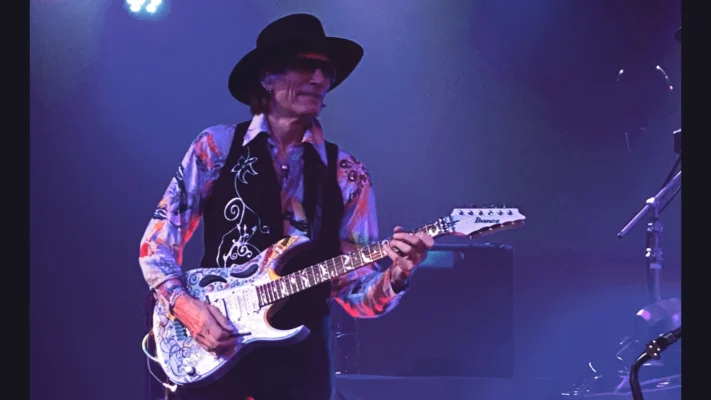
“If your playing doesn’t move someone, then speed doesn’t matter.”
From his earliest days with Frank Zappa to the cosmic theater of Inviolate, Vai has embodied one truth: that music should make you feel something — even when it’s played at the speed of light.
The Legacy of a Sonic Architect
Vai’s legacy begins with redefinition. In the 1980s, guitar virtuosity was already crowded — Malmsteen had the neo-classical throne, Eddie Van Halen had revolutionized rock technique, and Joe Satriani was the professor of melody. Vai entered that arena and built an entirely new kingdom.
Where others chased fire, Vai pursued form.
He designed guitars that looked like sculptures, wrote instrumentals that felt like films, and turned gear experimentation into a spiritual quest.
The release of Passion and Warfare in 1990 didn’t just raise the technical bar — it demolished it. That record became the textbook for future generations of instrumentalists. It proved that a guitar album could be cinematic, emotional, and conceptually cohesive without a single lyric.
It also became a blueprint for how tone could be personal. Vai’s phrasing — wide vibrato, micro-bends, whammy punctuation — taught an entire generation that emotion and precision weren’t opposites; they were partners.
The 7-String Revolution and Extended Range
When Vai co-created the Ibanez Universe in 1990, few realized he was about to rewrite guitar history.
The seventh string wasn’t a gimmick — it was a gateway. Vai envisioned it as an expansion of melody, allowing extended harmonic phrasing rather than simply “heavier riffs.”
But the metal scene heard opportunity. Bands like KoRn, Dream Theater, and Meshuggah took Vai’s concept and ran with it, birthing the modern era of extended-range guitar.
Vai had unintentionally sparked a movement. What he saw as a compositional tool became a cultural shift. Even he admits, “I opened a door — and a thousand players walked through it.”
Today, nearly every progressive or metal act owes a piece of their sound to that single innovation.
The G3 Movement – A Brotherhood of Tone
If the Universe was Vai’s physical contribution to guitar culture, G3 was his spiritual one.
Created alongside Joe Satriani in 1996, G3 wasn’t a competition — it was communion. A celebration of individuality, creativity, and mastery.
The tours have featured everyone from Eric Johnson and John Petrucci to Yngwie Malmsteen, Paul Gilbert, and Steve Morse. But Vai’s presence has always been the gravitational center — a performer equal parts mystic and mad scientist.
Every night, Vai turned the stage into an altar. He didn’t just play for the audience — he connected with them, creating moments that blurred the line between concert and ceremony.
By 2025, the tradition continues with the SATCHVAI Band — a reunion of the original masters. It’s not nostalgia; it’s a victory lap for everything instrumental rock stands for: community, creativity, and freedom.
The Artist as Inventor
Vai’s curiosity extends far beyond the fretboard.
He’s a designer, a producer, and a technologist. From the Ibanez JEM to the Hydra, every instrument he touches becomes part of his mythology. His partnership with Ibanez remains one of the most successful artist collaborations in guitar history — a 35-year saga that’s produced dozens of models, innovations, and global influence.
His move into modular amp design with Synergy Amps cemented his status as both pioneer and futurist. He bridged the gap between analog warmth and digital flexibility years before it became industry standard.
And in 2025, the release of Wire & Wood: The Guitars of Steve Vai transformed his collection into a work of art. A limited ultra-edition of the book even featured a companion JEM77WFP “Floral Pattern” guitar — a literal merging of his music and legacy.
Vai’s relationship with gear is more than obsession. It’s philosophy — proof that design and spirit can co-exist.
Teaching the Next Generation
Vai has always seen himself as both student and teacher. Through his Alien Guitar Secrets masterclasses, he’s mentored thousands of guitarists around the world. His lessons blend technical deep dives with personal philosophy, turning practice routines into spiritual rituals.
He constantly preaches intentionality:
“Don’t practice to get faster. Practice to get freer.”
This mindset has shaped countless players — not to sound like him, but to find themselves. It’s why Vai’s influence reaches beyond genres or eras. You’ll find traces of his thinking in jazz, fusion, prog, metal, and even film scoring.
His foundation, Make a Noise, supports young musicians who lack resources, giving back to the community that raised him. In the same way Zappa gave Vai a shot, Vai has made it his mission to lift others.
The Spiritual Side of Sound
Underneath the pyrotechnics, Vai’s music has always been deeply spiritual.
He speaks often about vibration, energy, and the belief that sound can affect consciousness. For the Love of God wasn’t just a song — it was a meditation.
He approaches performance as a sacred act — a conversation between human will and universal energy.
When Vai steps on stage, it’s less about impressing and more about transmitting.
“Music is a form of invisible architecture. You build it, and it shapes people’s hearts.”
This ethos is why Vai’s fans describe his concerts as transformative experiences — moments where the technical becomes transcendent.
The Modern Vai
Even in his 60s, Vai hasn’t slowed down.
The Hydra remains a showstopper, the Spark Mini Vai keeps his name in the modern gear market, and the SATCHVAI project proves he’s still reinventing himself.
He tours with the energy of a teenager but the wisdom of a monk. His tone — cleaner, deeper, more resonant — reflects decades of exploration distilled into purity.
In an age where digital tools can mimic everything, Vai remains an uncopyable original.
“The future of guitar isn’t about playing faster. It’s about playing truer.”
Legacy in the Hands of Others
Every era has its disciples.
Guitarists like Guthrie Govan, Plini, Tosin Abasi, and Mateus Asato all owe something to Vai’s blend of intellect and imagination. His open-mindedness toward tone and gear paved the way for hybrid artists who think beyond the fretboard.
Vai’s influence is no longer just musical — it’s cultural. He redefined what a guitar hero could be: introspective, humorous, experimental, and deeply human.
He took the stereotype of the “shredder” and turned it into something poetic.
FAQ – How to Get Steve Vai’s Tone, Style & Sound
Before we close the book on Steve Vai’s interdimensional tone, here’s a full FAQ breakdown — designed for readers who came here straight from Google or YouTube, searching for quick, actionable answers.
These are the most common questions guitarists ask when chasing the Vai sound — distilled for clarity, depth, and GuitarGangsters-style precision.
🎸 What Guitar Does Steve Vai Use?
Vai’s main instrument is the Ibanez JEM7VWH “Evo”, his long-time stage companion with DiMarzio Evolution pickups. He also plays the Ibanez PIA3761 (modern successor), the Ibanez Universe 7-string, and his monumental Hydra triple-neck for Inviolate and Teeth of the Hydra.
His guitars share one philosophy: effortless playability and tonal articulation. Every design element — the Monkey Grip, Lion’s Claw trem cavity, scalloped frets — exists to serve expression, not flash.
⚙️ What Amp Does Steve Vai Use?
Historically, Vai used Carvin Legacy I & III heads through 4×12 Celestion-loaded cabs.
Since 2018, he’s switched to a Synergy SYN-2 modular preamp system, featuring his custom VAI module, paired with a Fryette LX-2 stereo tube power amp and stereo cabs.
In studio and live rigs, he integrates a Fractal Axe FX III for effects and routing. This hybrid setup gives him both analog warmth and digital precision.
🎚️ What Are Steve Vai’s Amp Settings?
A good starting point (Legacy-style tone):
- Gain: 6
- Bass: 4
- Middle: 6
- Treble: 6
- Presence: 5
- Volume: Loud — always loud.
Vai’s sound depends on headroom and dynamics. The amp should breathe rather than compress.
🎛️ What Pedals Does Steve Vai Use?
His pedalboard is minimalist but powerful:
- Ibanez Jemini Distortion – Dual-channel drive with independent voicings.
- Dunlop 95Q Auto Wah – Subtle, expressive filter control.
- Digitech Whammy DT – For pitch jumps, octave harmonies, and alien textures.
- Morningstar ML5 MIDI Looper – For full rig automation.
- Little Lehle III – For clean A/B switching.
- Fractal Axe FX III – Handles stereo delays, plate reverb, and modulation.
Signal flow:Guitar → Wah → Distortion → Whammy → MIDI Looper → Preamp (Synergy) → FX (Fractal) → Power Amp → Stereo Cabinets
🎵 How Does Steve Vai Get His Tone?
It’s a fusion of clean articulation, midrange focus, and controlled chaos. Vai shapes tone through:
- High headroom amps (to preserve picking dynamics)
- Stereo delay offsets (~380ms L / ~400ms R)
- Plate reverb around 20–25% mix
- Crystal-clear EQ with subtle mid boost
But above all — his hands. Vai controls tone through pick attack, volume swells, and whammy precision.
🧠 What Is Steve Vai’s Tone Philosophy?
Vai’s philosophy is spiritual as much as technical.
He believes tone is the intersection of intent, discipline, and design. Gear is the translator, not the creator.
“If you can hear what you feel, the rest is just physics.”
His rigs are engineered to respond to the smallest change in touch. That’s why no two Vai performances ever sound identical — his tone is alive, reactive, and emotional.
🪄 What Techniques Should I Learn to Sound Like Vai?
Focus on control before speed:
- Legato: smooth, even phrasing with tone consistency.
- Whammy bar phrasing: treat it like a voice — bend in semitones, not chaos.
- Vibrato: wide, vocal-style motion synced to rhythm.
- Hybrid picking: alternate between pick and fingers for interval leaps.
- Rhythmic phrasing: quintuplets, septuplets, and metric modulation.
Mastering Vai’s tone means mastering nuance — micro-bends, harmonics, and dynamics are where the magic lives.
🔊 What Settings Should I Use in My Modeler (Helix, Fractal, Kemper)?
Signal Chain Example:Input → Overdrive (Tube Screamer) → Amp (Legacy / Vai module) → Cab (4x12 V30 IR) → Stereo Delay → Plate Reverb
Recommended parameters:
- Drive: 4
- Tone: 5
- Level: 7
- Delay (L): 380ms @ 25%
- Delay (R): 400ms @ 30%
- Reverb: Plate, mix 20%
- EQ: Boost mids +2dB
Result: dynamic sustain without mud, perfect for harmonic clarity and vocal articulation.
🧘 How Does Steve Vai Practice?
Vai approaches practice as meditation — spiritual hygiene, as he calls it.
He isolates motion, studies tension, and aims for flow state. His goal isn’t repetition — it’s mastery of awareness.
He once said:
“Every scale is a prayer when you play it with intention.”
That mindset is as important as his gear.
🕹️ What Is The Hydra Guitar?
The Ibanez Hydra is a triple-neck hybrid:
- 7-string guitar (DiMarzio UtoPIA pickups)
- 12-string half-fretless neck
- Bass neck with active electronics
- 13 sympathetic harp strings
- Integrated MIDI & piezo systems
It debuted on Teeth of the Hydra and represents the peak of Vai’s design philosophy — complete integration of sound, performance, and visual storytelling.
🧩 What Makes Steve Vai’s Tone Unique?
It’s not just the frequency response or sustain — it’s his dynamic control. Vai’s tone is alive because it reacts.
He shapes it mid-phrase with volume, pickup selection, bar movement, and touch.
He’s one of the few players who can go from a whisper to a wail in a single note without changing a setting.
⚡ Can Anyone Sound Like Steve Vai?
Not exactly — and that’s the point.
You can copy his signal chain, mimic his licks, and even play his songs note-for-note. But unless you approach your playing with the same intentionality, it will always just be imitation.
The real secret?
Play with purpose.
Vai’s tone comes from authenticity — from caring about every single note as if it’s your last.
“The goal isn’t to sound like me — it’s to sound like you with that same fire.”
Steve Vai stands at the intersection of art and alchemy — a man who turned technique into transcendence and tone into philosophy.
Every note he plays, every circuit he designs, carries the same message: that creativity has no ceiling.
He began as a kid transcribing Zappa’s impossible passages and became the architect of his own musical cosmos — a universe where guitars breathe, amps feel, and distortion becomes a form of storytelling. Vai never asked how far the guitar could go; he simply took it there.
Across four decades, from Passion and Warfare to Inviolate, his journey has been a relentless pursuit of freedom — not just the freedom to play faster, but to feel deeper.
“You can’t fake intention,” Vai once said. “Your sound tells the truth.”
That’s the essence of his legacy.
His guitars may have seven strings, three necks, or even harp strings, but what truly defines Steve Vai isn’t complexity — it’s clarity.
He plays like someone who understands that music is energy — that tone is emotion made visible.
And long after the Hydra has been retired and the Legacy amps have gone silent, that idea will keep resonating through the hands of every guitarist who dares to think beyond the fretboard.
Steve Vai didn’t just master the guitar.
He redefined what it means to be human with one in your hands.
Links
- [Joe Satriani – The Teacher of Titans]
Explore the mentor-student lineage that shaped Vai’s phrasing and tone discipline. - [Frank Zappa – The Mad Scientist of Sound]
The mind that sparked Vai’s obsession with structure and sonic storytelling. - [John Petrucci – The Architect of Precision]
A modern extension of Vai’s discipline and clarity in tone construction.
Image credits
- Top image: Steve Vai, Wikimedia Commons, CC BY 4.0.
- Steve Vai, Phoenix 2024: Kevin Dooley / Wikimedia Commons, CC BY 2.0.
- Steve Vai: Klaus Hellmerich, Wikimedia Commons, CC BY-SA 4.0.
- Steve Vai: Glenn Francis (PacificProDigital.com), Wikimedia Commons, CC BY-SA 4.0.