The Preamp That Carries Forty Years of Tone History: JHS Clover Preamp
JHS Clover Preamp: FET boost and EQ inspired by the Boss FA-1 that The Edge made famous. Full specs, honest player connections, and five tone recipes.
There is a short list of guitar pedals whose reputation rests almost entirely on a single album and a single player. The Boss FA-1 FET Preamp is on that list. When The Edge slipped it into his signal chain during the recording of The Unforgettable Fire in 1984 — the album that rewired the language of arena guitar — the FA-1 stopped being an obscure Boss pocket-series oddity and became something players hunt for at absurd prices four decades later. JHS founder Josh Scott knows his history, and the Clover Preamp is his answer: a faithful FET-preamp circuit with the FA-1’s bones, a mid-control the original never had, an XLR output the original never needed, and a three-position rotary that lets you dial back to the exact FA-1 topology whenever the mood strikes. At $199, built in Kansas City, it slots into a pedalboard with the casual confidence of something that knows exactly why it exists.
The Pocket Series That Changed Everything
In early 1984, Boss released two small, unusual devices under the banner “The Pocket Series.” These were not standard guitar pedals — they were belt-clip preamps intended as tone-shaping tools to run between a guitar and an amp, or into a recording desk. One was the SE-50 Sustainer; the other was the FA-1 FET Amplifier. The FA-1 used a field-effect transistor topology to produce a clean, wide-bandwidth boost with basic treble and bass shelving EQ. At the time it was an unremarkable product in a catalogue full of more headline-grabbing effects.
What happened next is the kind of thing that turns utility pedals into legends. U2’s guitarist Dave Evans — universally known as The Edge — was building the rig he would use for The Unforgettable Fire, produced by Brian Eno and Daniel Lanois at Slane Castle and Windmill Lane Studios, Dublin, in 1984. His signal chain for that album and the subsequent world tour placed the FA-1 as an always-on preamp and gentle EQ shaper, contributing to the particular air and harmonic shimmer that made tracks like “Pride (In the Name of Love)” and “Bad” sound simultaneously intimate and vast. The Edge kept the FA-1 in rotation through subsequent tours, cementing its reputation as an essential component of one of the most recognizable guitar sounds of the late twentieth century.
Boss discontinued the FA-1 in the mid-1980s. By the 2010s, original units were fetching serious money — not because the circuit is technically difficult to build, but because demand from players who wanted to access that specific sonic reference point had completely outrun supply. Boutique builders responded with clones, and JHS’s response was the Clover: not a straight clone, but an interpretation that starts with the FA-1’s FET-based topology and adds the controls a modern pedalboard player actually wants.
What the Clover Actually Is — and Is Not
The distinction matters: the Clover is a preamp and EQ pedal built around a FET (field-effect transistor) gain stage, not an overdrive or distortion. At unity-gain settings it is transparent — it adds a slight warmth and a sense of widened dynamics, but it does not impose its own colour on a clean signal the way a tube screamer or a dirty boost does. What it does is give you control over the frequency balance of your signal before it hits anything downstream, and the ability to push the front end of a tube amplifier with a clean signal rather than a clipped one.
FET topology in a preamp context matters because field-effect transistors respond to transient dynamics in ways that are sonically closer to a vacuum tube than a standard bipolar transistor. The input impedance of the Clover — greater than one megaohm — means your guitar’s pickups see a near-ideal load, preserving high-frequency detail and pick attack that lower-impedance inputs can blunt. When you engage the Volume control as a boost, you are sending a strengthened but clean signal into your amplifier’s input stage, encouraging it to work harder and begin producing its natural harmonic complexity at lower volume knob settings. This is the original FA-1 application, and it remains the primary use case for the Clover.
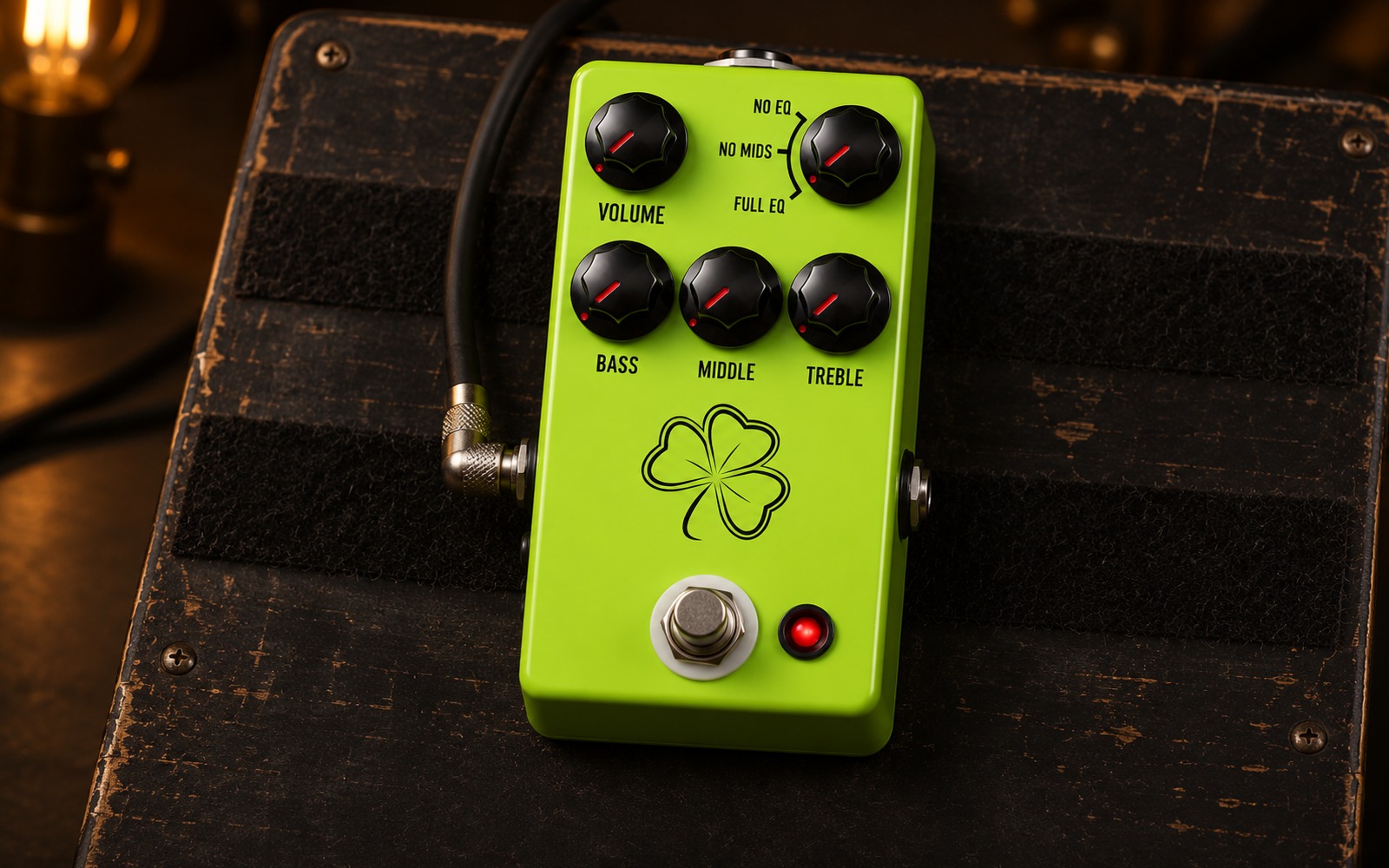
The additions JHS made over the FA-1 circuit are practical rather than exotic. The original had treble and bass shelving controls but no mid control; the Clover adds a peaking midrange control centered at 1.3kHz. The three-position rotary switch on top of the pedal governs how those controls behave: Full EQ engages all three bands simultaneously; No Mid removes the mid control and leaves treble and bass, replicating the original FA-1’s two-band topology; No EQ bypasses all three EQ controls and turns the Clover into a pure FET boost with no frequency shaping at all. The Low Cut dip switch on the right side engages a high-pass filter with a -3dB point at 212Hz, which can tighten up a muddy low end when running the Clover into a dark-voiced amplifier or using it as a DI for bass or acoustic.
The XLR output is arguably the biggest addition beyond what any FA-1 clone offers. It is electrically identical to the quarter-inch output — the same FET-amplified, EQ-shaped signal — and both outputs can operate simultaneously. This means the Clover functions as a proper DI box, sending a balanced signal to a mixing desk or interface while simultaneously feeding a stage amplifier through the quarter-inch. A ground lift switch on the side kills the signal earth on the XLR to eliminate hum loops, which is a standard professional-grade feature that JHS made a genuine effort to include correctly. For acoustic players running into a PA, for bass players who want to preserve low-end definition on the way to the front-of-house, and for guitarists recording at home directly into an interface, the XLR output transforms the Clover from a pedalboard EQ into a complete front-end solution.
Specifications
Famous Players
The Edge (U2) — On the Original FA-1, Not the JHS Clover
The Edge is the reason this circuit exists, but the relationship requires a clarification that every article on the Clover should make explicit: The Edge used the Boss FA-1 FET Amplifier, the original 1984 Pocket Series device. He did not endorse the JHS Clover and there is no evidence he has used one. What the Clover inherits from The Edge is a circuit philosophy and a tonal archetype, not a verified player relationship. JHS’s own product description acknowledges this directly, describing the Clover as “our faithful interpretation of the FA-1.” The distinction is meaningful. If you want The Edge’s specific FA-1 connection, you need to track down a vintage unit. If you want a modern, more versatile version of the same topology with better I/O and a mid control, the Clover is the argument. A link to The Edge’s gear history gives context on the full rig from which the FA-1 story emerges.

Paul Gilbert — Verified, Pedalboard Photo March 2019
Paul Gilbert is not the first name that comes to mind when you think of a clean preamp pedal — his reputation is built on technique, precision, and a guitar tone that has always been about pickups hitting amp inputs rather than layers of processing. Which is precisely why his documented Clover use is interesting. In a Facebook post from March 28, 2019, Gilbert published an image of his complete pedalboard assembled ahead of a tour, with the caption “Ready for the tour!” The JHS Clover is visible on that board. A preamp-and-clean-boost between guitar and amp is consistent with Gilbert’s preference for letting his playing dynamics drive the amp rather than relying on compressed effects — the Clover in No EQ or pure FET boost mode is exactly the kind of tool a technique-focused player reaches for.

Mateus Asato — Verified, Current Live Rig 2026
Mateus Asato is among the most photographed guitarists on the internet, which means his pedalboard gets documented thoroughly. As of 2026, Equipboard confirms the JHS Clover as part of his active live setup. Asato’s playing style — lyrical, dynamics-driven, often using his guitar’s volume knob as an expressive tool — is well served by a FET preamp that preserves transient detail and responds to picking nuance rather than flattening it. The XLR output on the Clover is also relevant here: Asato frequently plays direct-to-front-of-house situations and studio sessions where a good DI signal is as important as the stage amp tone.
Michael Guy Chislett — Verified, Instagram Pedalboard Photo
Michael Guy Chislett, guitarist for The Afters and a well-documented pedalboard nerd in his own right, posted an Instagram image showing his board with the JHS Clover positioned sideways in the chain — a recognizable placement for an always-on preamp that you want tucked in without eating footswitch real estate. The Equipboard documentation of the Instagram post is clear photo evidence rather than a brand claim. His style — clean to light crunch, ambient textures, studio-quality live tone — maps directly to the Clover’s design intent.

Barry Quinlan
Equipboard also documents a fourth verified player — guitarist and singer Barry Quinlan — with a pedalboard photo clearly showing the Clover. Quinlan is a smaller profile artist, and the most honest framing of his inclusion is that it confirms the Clover’s reach across working musicians of varying visibility, not just headline-named players.
Tone Recipes and Settings
1. The FA-1 Reference — Classic Edge Clean
Set the rotary to No Mid to replicate the original FA-1’s two-band topology. This removes mid control and leaves bass and treble as your only frequency tools — exactly the circuit The Edge was working with on The Unforgettable Fire.
Run this into a clean Fender-style amp. The 10kHz treble lift adds air without harshness; the slight bass cut prevents the low-register chord voicings from getting woolly. Add a delay pedal after the Clover and you have the sonic architecture of early U2 stadium tone.
2. Pure FET Boost — Amp Pushing
Rotary to No EQ, Volume turned up. This is the Clover as a transparent, wide-bandwidth boost to drive an amp’s input stage into its natural harmonic zone at lower volume settings.
Works best into a tube amp with some natural character. A Fender Deluxe Reverb at 3–4 on the volume dial with the Clover pushing the front end will give you touch-sensitive breakup and natural compression that a master-volume pad position simply cannot replicate. This is the application Paul Gilbert’s setup suggests.
3. Acoustic DI — XLR Straight to Desk
Full EQ mode, with EQ contoured to the particular acoustic. The bass shelving filter at 270Hz is critical for fighting the proximity-effect buildup that piezo pickups produce when playing close to a microphone or in a small room.
Send the XLR to front-of-house balanced and the quarter-inch to a stage monitor or small amp for personal monitoring. Engage the ground lift if you hear hum. This setup replaces a dedicated acoustic preamp pedal for players who need a DI at gigs without dedicating board space to a dedicated acoustic unit.
4. Single-Coil Thickener
Tele and Strat players often find their pickups sit slightly thin in a full-band mix — the presence of a room, a drummer, and a bassist can leave single-coil guitar tones sounding wispy at the low-mid register. The Clover’s mid control at 1.3kHz is unusually well-targeted for this fix.
The 1.3kHz lift pushes the guitar into the frequency band where electric guitar sits in a dense mix. The result is not a different-sounding guitar — it is the same guitar sitting more assertively in the same space.
5. Humbucker Clarity and Definition
Humbucker-loaded guitars can sometimes become thick and undefined in the midrange when running into a pushed amp. The Clover’s mid-cut option, combined with the treble lift, gives Les Paul and SG players the clarity of a brighter guitar without changing pickups.
This setting is the Clover working as a tone-sculpting tool rather than a straight boost — you are actively reshaping the frequency balance of a humbucker signal to bring out picking definition in the upper midrange. Run it before an overdrive and the downstream drive pedal will have a cleaner, more note-defined signal to work with.

How It Compares
The Clover’s closest obvious competition is the Xotic EP Booster, another always-on preamp staple that draws from vintage Echoplex circuit topology. The EP Booster is smaller and simpler — a single boost control and a pair of internal dip switches — and it has a subtly different character: slightly more low-mid emphasis and a warmth that comes from its particular FET-to-transformer-to-amp-front-end pathway. The Clover is more surgical: the three-band EQ plus rotary gives you control the EP Booster simply does not have, and the XLR output takes the Clover into territory the EP Booster was never designed for. At $199 vs the EP Booster’s $149, the Clover asks for $50 more and returns substantially more functionality.
Against JHS’s own Colour Box V2 , the Clover is a different instrument entirely despite both carrying “preamp” in their descriptions. The Colour Box V2 is a Neve 1073-inspired studio console channel strip in pedal format, with a transformer-coupled output, gain stages that can be pushed into saturation, and 48V phantom pass-through for microphones. It is a recording studio tool that happens to fit on a pedalboard. The Clover is a guitar-circuit preamp designed to interface with amplifiers and live DI situations. They can coexist on the same board — Colour Box V2 as a studio recording front-end, Clover as the always-on rig foundation — but they are solving different problems.
For players whose primary need is amp modelling and complete signal processing, the Line 6 Helix Floor or Neural DSP Quad Cortex include preamp blocks and EQ within their processing chains. The Clover is not competing with those systems; it is the answer for the player who already has an amp they love and wants a single-function, always-on preamp to optimise the signal entering it. Players who have given up tube amplifiers for the Kemper Profiler or the Fractal Axe-Fx III will generally find the Clover redundant — those units handle their own input gain staging — though the XLR DI functionality may still be useful in multi-output live rigs.
Compared with the original Boss FA-1, the JHS Clover is objectively more capable: it adds the mid control, the No Mid and No EQ rotary modes, the XLR DI with ground lift, the Low Cut dip switch, and standard 9V power rather than requiring a vintage battery configuration. An original FA-1 in playable condition sells for $200–$450 on Reverb depending on condition and how badly the seller knows their history. For most players, the Clover is the more intelligent purchase unless owning a provenance piece is specifically the point.
Buying Guide
The Clover is a current-production JHS pedal, available new at $199 from JHS’s authorised dealer network and major music retail chains. Used units appear regularly on Reverb in the $120–$160 range; because the Clover has no vacuum tubes, no capacitors requiring re-capping, and no moving parts beyond the rotary switch, used units in fully working condition are essentially equivalent to new ones. The only thing to check on a used Clover is the Low Cut dip switch — it sits on the side panel and can be fiddly to locate if it has been moved and the buyer has forgotten its position — and the XLR output to confirm the ground lift switch functions correctly.
Power: the Clover draws 45.5mA at idle. This is not a heavy current consumer — most quality isolated power supplies allocate 100mA or more per output — but it is worth confirming your supply has a free output at or above 100mA. Do not power the Clover from a daisy chain shared with higher-current pedals unless your supply is rated for the combined load. The pedal requires standard 9V DC center-negative; it does not ship with a power supply.
Placement in the signal chain: as an always-on preamp, the Clover works best at or near the front of the chain — after tuner and wah, before overdrives and modulation. Running overdrives into the Clover’s input rather than the other way around will produce a different result: the Clover will shape the frequency content of a driven signal, which has legitimate applications for EQ-ing an overdrive before it hits the amp. Neither position is wrong, but the FA-1 tradition and the JHS description both assume front-of-chain placement as the primary use case.
Ownership Notes
The Clover’s bypass is buffered, not true-bypass. This is appropriate for a preamp pedal — the high input impedance and low output impedance of the FET circuit means the Clover functions as a professional buffer even in bypass mode, conditioning the signal for the rest of the chain. Players with long cable runs or multiple true-bypass pedals benefit from having an active buffer at the front of the chain; the Clover provides this at no additional cost. If you have a strong preference for true-bypass or already have a dedicated buffer, this is worth knowing, but for most practical pedalboard situations it is a benefit rather than a drawback.
The XLR output and the quarter-inch output are simultaneously active when both are connected. This is not a switchable configuration — the XLR is always on when a cable is inserted. In a live single-amp situation where you are not using the XLR, simply leave it empty. The output impedance of 520 ohms is ideal for driving long balanced cable runs to a mixing desk without signal degradation.
The Low Cut dip switch is a useful but easy-to-forget feature. It is not accessible with a finger in live conditions — it requires a small implement or a sturdy fingernail to engage. Set it for your primary application and leave it. Acoustic and bass players will generally want it engaged; electric guitar players using the Clover as an amp boost will generally want it off unless the amp is genuinely dark-voiced.
Because the Clover is built in Kansas City under JHS’s standard quality controls, fit and finish on new units is consistent. Josh Scott’s operation has been making pedals full-time since 2009, and the Clover is one of their longer-running production designs, meaning any early teething issues are long resolved. The warranty and repair policy from JHS is well-regarded in the pedal community — customer support is accessible and the Kansas City location means US-based repairs are practical.
Frequently Asked Questions
Is the JHS Clover the same circuit as the Boss FA-1?
It is a faithful interpretation of the FA-1’s FET preamp topology with additional controls — a mid frequency band, a three-position EQ rotary switch, and an XLR output — that the original did not have. The No Mid rotary setting removes the mid control and replicates the original FA-1’s two-band EQ architecture. JHS describes the Clover as “our faithful interpretation” rather than a clone, which is an accurate and honest characterisation.
Did The Edge use the JHS Clover?
No. The Edge used the original Boss FA-1 FET Preamp from 1984, on The Unforgettable Fire and subsequent tours. The JHS Clover draws its inspiration from that pedal, but there is no documented evidence that The Edge has used the Clover itself. The distinction matters if you are buying the Clover for its provenance — what you are buying is the circuit philosophy, not a direct player connection.
Can I use the Clover as a DI for acoustic guitar?
Yes, and it works well. The XLR output is balanced, electrically identical to the quarter-inch output, and the ground lift switch handles hum loops. The three-band EQ gives you meaningful control over piezo pickup tones — specifically the ability to cut the bass shelving filter at 270Hz, which addresses the low-end buildup that undersaddle pickups typically produce. Engage the Low Cut dip switch (212Hz high-pass) for additional low-end cleanup on small-body acoustics.
What is the rotary switch doing exactly?
It governs which EQ controls are active. Full EQ: all three bands (bass, mid, treble) in circuit. No Mid: treble and bass only, mid removed — this is the FA-1 replica mode. No EQ: all EQ controls bypassed, the Clover becomes a pure FET boost with no frequency shaping. You can switch between the three modes while the pedal is engaged; the change is seamless.
Does the Clover add any distortion or overdrive?
At moderate Volume settings the Clover is clean — its primary function is amplification and EQ, not saturation. At extreme Volume positions with the amp already working hard, the downstream amplifier will respond to the increased signal level with its own natural harmonic distortion. That interaction is not the Clover distorting; it is the Clover pushing the amp. If you want drive from the pedal itself, you need a different tool.
Where does the Clover go on the pedalboard?
As an always-on preamp, it works best at or near the front of the chain: after a tuner and wah, before overdrives, distortions, and modulation. It can also be placed after overdrives to function as a post-drive EQ and volume trim before the amp input. The FA-1 tradition — and JHS’s own application notes — assume front-of-chain as the primary position.
How does the Clover compare to the JHS Colour Box V2?
They are different instruments. The JHS Colour Box V2 is a Neve 1073-inspired studio console preamp with a transformer-coupled output, XLR/combo input, 48V phantom power, and gain stages that can push into saturation — it is a studio recording front-end designed to run microphones and instruments into a DAW. The Clover is a guitar-circuit FET preamp designed to interface with amplifiers and live DI situations. Both are JHS products, both sit in the “preamp” category, and both have XLR outputs, but they are solving fundamentally different problems at different price points ($199 vs $449).
What power supply should I use?
Any isolated 9V DC center-negative output rated at 100mA or above. The Clover draws 45.5mA at idle — well within the output capacity of any quality power supply. Do not use a daisy chain shared with higher-current or digitally noisy pedals if you are using the Clover as a front-end preamp, since noise injected at the signal front has nowhere to go but forward through the chain.
Image credits
- Top image: GuitarGangsters AI-generated reference illustration, not a photograph.
- The Edge: iinchicore, Wikimedia Commons, CC BY-SA 4.0.
- The Edge: by Joe Ahorro, Wikimedia Commons, CC BY-SA 4.0.
- Paul Gilbert: GS2019 – Paul Gilbert by Production Partner / Lars Horstmann, Wikimedia Commons, CC BY-SA 4.0.
- Michael Guy Chislett: Tubescreamer606, Wikimedia Commons, CC0.
Latest News
Related
On This Day
Monday 9 November
From this week: