The Pedal That Never Makes a Sound — And Might Be the Most Important One on Your Board
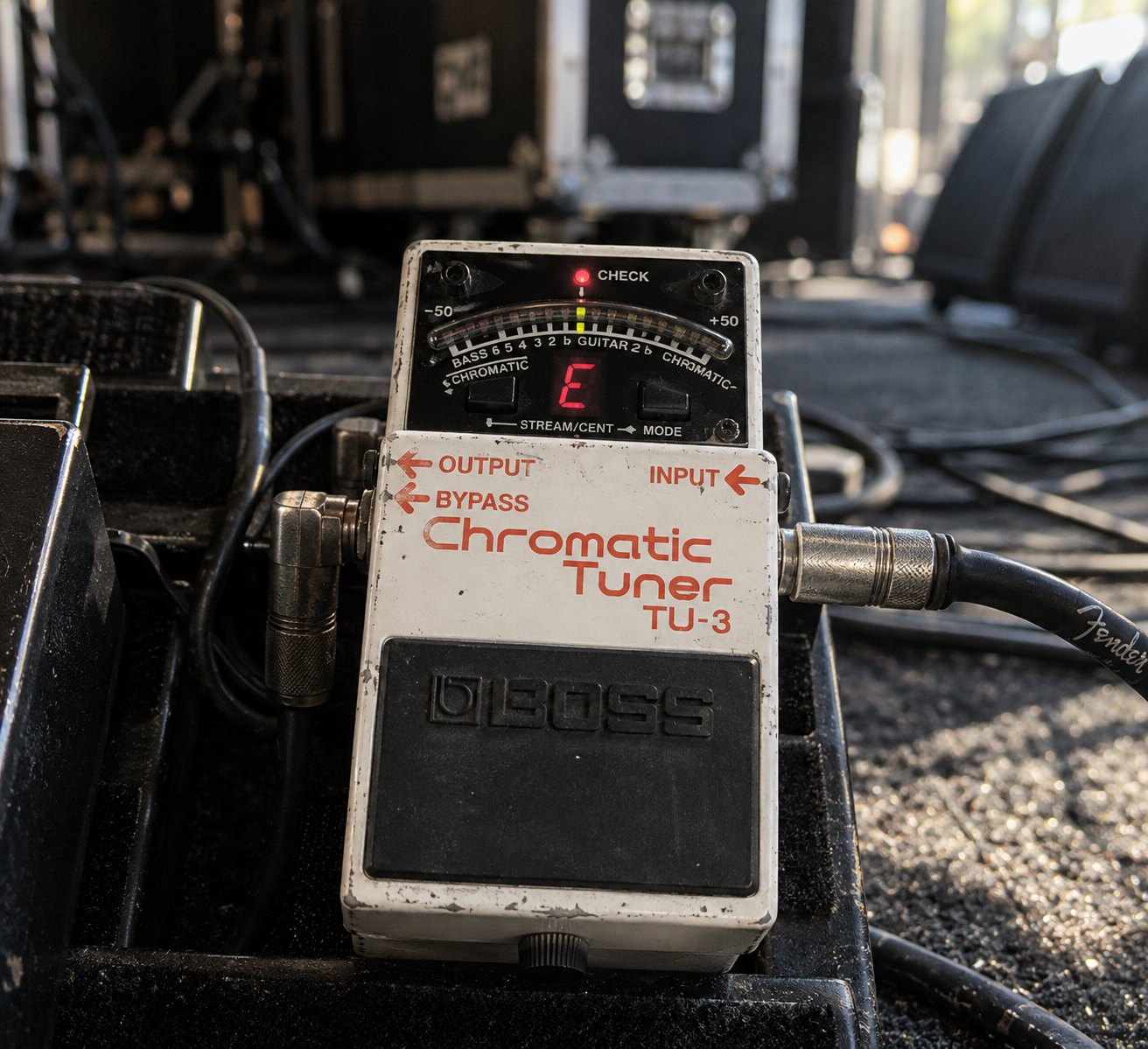
BOSS TU-3 Chromatic Tuner Pedal. AI-generated reference illustration, not a photograph.
The Boss TU-3 Chromatic Tuner is the most common pedal on professional stages worldwide. Here's why it matters and how to use it right in your signal chain.
There is a paradox sitting at the front of almost every professional pedalboard in the world. It does not distort, delay, modulate, or reverb. It costs less than fifty bucks used. It is the least glamorous piece of gear in any rig — and it might be the single most essential one. The Boss TU-3 Chromatic Tuner is, by any reasonable measure, the most common pedal in professional guitar. Walk the stages at any major festival, watch any Premier Guitar Rig Rundown, zoom into any touring guitarist’s signal chain, and you will find a black Boss compact pedal at the head of the chain with a row of LEDs and a single job to do. Not “one of the most common.” The most common. And there are reasons for that — seven of them, all good, none of them marketing.
This article is not a review. Guitar Gangsters does not review gear. Instead, it is an honest examination of why the TU-3 became the global default, how it functions inside a signal chain beyond its obvious tuning role, and when it is — and is not — the right call. Understanding a tuner pedal at this level of detail may seem excessive. It is not. The TU-3’s buffer circuit, power distribution function, and muting behaviour directly affect tone and workflow across your entire pedalboard. Getting those things right is not trivial.
How the Boss TU Pedal Series Rewired the Stage
Before 1998, tuning onstage meant one of three compromises: a rack-mounted chromatic tuner wired into your rig (expensive, space-consuming, requiring a separate footswitch to mute), a clip-on tuner used between songs (visible, slow, unreliable in loud stage environments), or a standalone stage tuner plugged in with a Y-cable that split your signal and introduced tone-sucking impedance problems. None of these were elegant solutions, and none were universal. Professional guitarists dealt with tuning as an inconvenience baked into live performance rather than a solved problem.
Boss solved it in 1998 with the TU-2 Chromatic Tuner. In the same compact enclosure used for every Boss pedal since the DS-1 in 1978 — the enclosure guitarists already trusted, already knew how to power, already had on their boards — Boss delivered a chromatic tuner with true +/- one-cent accuracy, a bright LED display, an automatic mute function, and a DC output for powering other pedals. The TU-2 was the world’s first chromatic tuner in pedal format, and it landed as an immediate standard. Within a few years it was the default choice for touring professionals at every level.
The TU-3 arrived in 2009, replacing the TU-2 with an improved 21-segment LED display, the new High-Brightness mode for outdoor and harsh lighting conditions, expanded tuning modes, the Accu-Pitch Sign streaming indicator function, and a slightly wider A4 reference pitch range of 436 to 445 Hz. The tuning engine’s accuracy remained the same ±1 cent. The enclosure remained the same dimensions. The DC output remained. For players who had built workflows around the TU-2, the TU-3 was a frictionless upgrade with genuine display improvements. For everyone else entering the market, it was the new baseline.
Over fifteen years later, the TU-3 remains in continuous production and in active use on more professional pedalboards than any other single pedal model. Not any other tuner. Any other pedal, full stop.
What the TU-3 Actually Does: Four Jobs, Not One
Most players buy a TU-3 to tune their guitar. They end up using it for four distinct functions, three of which they may not have thought about when they bought it.
1. Chromatic Tuning with ±1 Cent Accuracy
The core function. The TU-3 tunes any instrument to chromatic pitch with ±1 cent accuracy across the full range of C0 (16.35 Hz) to C8 (4,186 Hz), covering guitar, bass, and extended-range instruments. It operates in six modes: Chromatic, Chromatic Flat, Guitar (open-string note names), Guitar Flat (drop tuning), Bass, and Bass Flat. The 21-segment LED meter shows pitch deviation in Cent mode, or can be switched to Stream mode — a strobe-style display that rotates clockwise when sharp and counterclockwise when flat, stopping when the note is in tune. Stream mode is preferred by some players for faster, more intuitive pitch reading. The A4 reference pitch is adjustable from 436 to 445 Hz in 1 Hz increments for orchestral tuning situations.
The Accu-Pitch Sign function is a productivity feature: when it is enabled, the entire LED display flashes a streaming indicator the moment you land on target pitch. Rather than trying to read whether the meter has stopped, you get an unambiguous visual confirmation. In a loud stage environment with lights in your eyes, this is a meaningful improvement over watching individual LED segments.
The High-Brightness mode doubles the LED intensity for direct sunlight or harsh stage lighting conditions. In normal indoor use you will never need it. On an outdoor festival stage at noon it can be the difference between reading your tuner and guessing.
2. Automatic Signal Muting
When you engage the TU-3 to tune, the output jack is automatically muted. Your audience hears nothing — no open-string ringing, no fumbling between notes, no silence broken by accidental pick scrapes. This is not merely a courtesy to the audience. It is a practical necessity for any pedalboard with drives and reverbs in the chain: if your signal is live while you are tuning, every plucked note goes through your full rig and potentially into a venue PA. The TU-3’s mute function eliminates this problem silently and instantly.

This muting behaviour also functions as an on-demand killswitch between guitar swaps, during inter-song breaks, or in any situation where you need to silence your rig without interrupting your signal chain’s power or settings. This is less trivial than it sounds. Many players use the TU-3 for onstage guitar changes specifically because it kills the signal cleanly and resets to active bypass the moment they step on it again — no latency, no click, no noise.
3. Signal Buffering
This is the TU-3 function that most players do not consciously choose, but benefit from every night. The TU-3 uses Boss’s standard buffered bypass circuit, which means that even when the pedal is not actively engaged for tuning — even when the LED is off and the signal is passing through normally — the TU-3 is converting your guitar’s high-impedance output to a low-impedance signal at its output jack.
Why does this matter? Cable capacitance. A standard instrument cable acts as a low-pass filter at high impedances: the longer the cable, the more high-frequency content bleeds off before reaching your pedalboard. A guitar with 10 feet of cable into a board with another 10 feet out to an amp is operating through 20 feet of cable at high impedance for the entire first leg. Add multiple true-bypass pedals whose switching creates daisy-chained cable lengths even when bypassed, and the cumulative treble loss is audible — instruments go from clear and dynamic to slightly dulled and compressed before they have done anything.
The TU-3’s buffer circuit solves this by converting the signal to low impedance at the first pedal in the chain. From that point, cable capacitance has negligible effect. The output of the TU-3 — and everything downstream — behaves as if plugged directly into an amplifier input with a short cable. Tommy Emmanuel’s on-record praise for the TU-3 includes exactly this understanding: he knows the tuner makes his rig sound better even when he is not using it to tune. Boss technical staff and guitar tech Pete Thorn have documented this benefit extensively.
The buffer caveat worth knowing: fuzz pedals with germanium transistor designs — Fuzz Face and Fuzz Face-derivative circuits — require a high-impedance input to function correctly. Placing such a fuzz after a buffered TU-3 will degrade its character. The fix is to either place fuzz before the TU-3 in the chain (which requires a separate signal loop or switcher), use the TU-3W with its true-bypass option enabled, or use a different tuner solution for boards built around germanium fuzz as their primary dirt sound.
4. Power Distribution
The TU-3 includes a DC output jack on its rear panel, allowing it to serve as a power distribution hub for up to seven other Boss compact pedals when combined with Boss’s PSA-S power supply and a PCS-20A daisy-chain cable. For players running Boss-heavy pedalboards, this eliminates the need for a separate multi-output power supply for the Boss section of the board. It is not a replacement for a dedicated isolated power supply like the Strymon Zuma or Voodoo Lab Pedal Power 2+ — current draw limits apply, and high-current digital pedals are incompatible — but for an all-analog Boss compact setup, the TU-3 can handle power distribution entirely on its own.
Specifications
| Specification | TU-3 | TU-3W Waza Craft | TU-3S |
|---|---|---|---|
| Tuning Accuracy | ±1 cent | ±1 cent | ±1 cent |
| Tuning Range | C0–C8 (16.35–4,186 Hz) | C0–C8 | C0–C8 |
| A4 Reference | 436–445 Hz | 436–445 Hz | 436–445 Hz |
| Display | 21-segment LED (Cent/Stream) | 21-segment blue LED | 21-segment LED |
| High-Brightness Mode | Yes | Yes | Yes |
| Accu-Pitch Sign | Yes | Yes | Yes |
| Tuning Modes | Chromatic, Guitar, Bass (each with flat) | Same | Same |
| Bypass Type | Buffered electronic | Selectable: buffered or true bypass | Buffered electronic |
| Buffer Quality | Standard Boss buffer | Premium analog Waza Craft buffer | Standard Boss buffer |
| Footswitch | Yes (engage/disengage tuning) | Yes | No (always-on) |
| DC Output | Yes (powers up to 7 Boss compact pedals) | Yes | Yes |
| Power | 9V battery or AC adapter | 9V battery or AC adapter | 9V battery or AC adapter |
| Dimensions | 73 × 129 × 59 mm | 73 × 129 × 59 mm | 73 × 55 × 59 mm (smaller) |
| Weight | 390 g (with battery) | ~395 g | ~310 g |
| Price New | ~$59–69 USD | ~$99–119 USD | ~$79–89 USD |
| Price Used | ~$25–45 USD | ~$55–80 USD | ~$40–60 USD |
Who Uses the TU-3 — And Why Everyone Is the Answer
The honest answer to “which famous guitarists use the Boss TU-3” is: most of them. The TU-3 — and its predecessor the TU-2 — have been the default professional tuner pedal for long enough that singling out specific users would be more misleading than informative. The more accurate framing is this: when a touring guitarist at major-venue level does not have a Boss TU in their rig, that is the notable exception, not the rule.
That said, a few documented cases are worth examining for what they reveal about how professionals think about the TU-3 beyond its basic function.
Tommy Emmanuel
Tommy Emmanuel is one of the most technically accomplished fingerstyle guitarists in the world — a player with ears acute enough to hear any tone-sucking in his signal chain instantly. His use of the TU-3, documented in a 2015 Premier Guitar Rig Rundown, comes with the clearest on-record explanation of why the TU-3 is the professional default: “This is what I use on stage: it’s a little BOSS chromatic tuner. Everybody’s got these things, and they’re as good as it gets on stage. The reason I like it is because it’s simple. When the light is red, that’s bad — I’m out of tune. When it’s green, everything’s good. I don’t need to know my G string is spinning at 432 cycles per second and all that. I need to know I’m in tune. So, keep it simple on stage.”
Emmanuel’s endorsement is notable because he is not a Boss-endorsed artist, not particularly associated with Boss pedals, and makes no broader claims about Boss products. He uses the TU-3 because it is the best available tool for a specific job. That is the most credible form of endorsement a utility pedal can receive.
The Edge (TU-3S)
The Edge runs one of the most extensively documented and rigorously maintained rigs in rock history. In a 2018 Premier Guitar Rig Rundown with longtime U2 guitar tech Dallas Schoo, Schoo confirmed the presence of a Boss TU-3S at the head of the tuning chain. The Edge uses the TU-3S rather than the standard TU-3 — the switchless version designed for loop-switcher-based rigs where the tuning function is routed via an external switching system rather than by stepping on the pedal directly. This is the professional approach in large-format touring rigs: the TU-3S sits in a dedicated tuner loop on the switcher, is activated by the switcher’s mute function, and the guitar tech can engage it remotely. The tuning engine is identical to the standard TU-3.
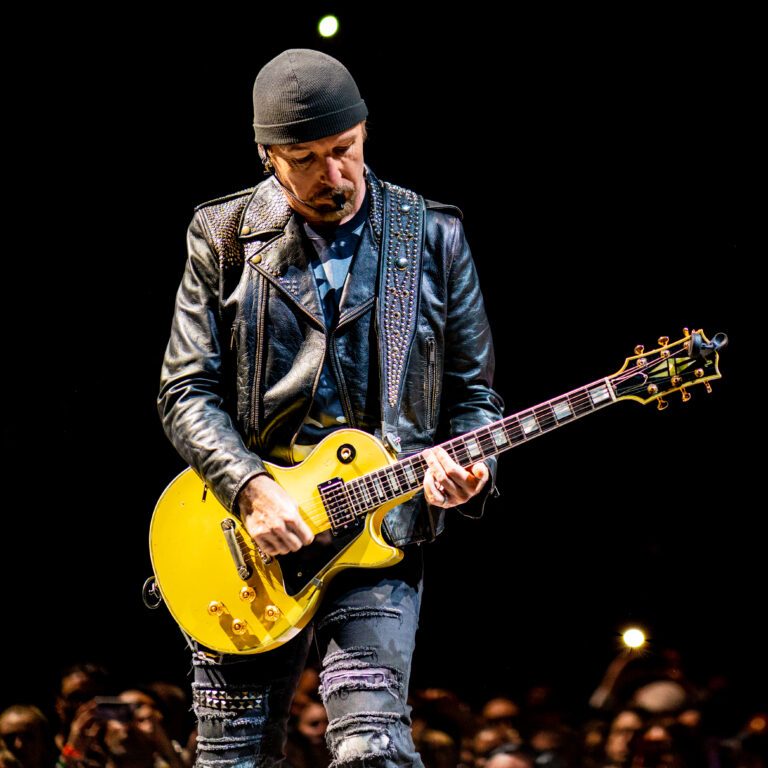
The Edge’s adoption is a data point about the TU-3S’s utility in high-end touring setups specifically — rigs where the guitarist never steps on individual pedal switches because all routing goes through a master switching system. If the TU-3S meets U2’s touring requirements, it meets virtually any touring requirement.
The Wider Pedalboard Population
Across documented Rig Rundowns and gear features, the Boss TU series appears on boards belonging to players across every genre: Billie Joe Armstrong’s Green Day touring rig includes a Boss tuner alongside his Ibanez TS9 and Boss BD-2 Blues Driver. Alex Turner of Arctic Monkeys has used the Boss TU-3 since at least the band’s early touring years. Kevin Parker (Tame Impala) uses a TU-3S in his always-on configuration. Equipboard, which aggregates confirmed professional gear from rig documentation, lists over 400 verified professional users of the TU-3 and TU-3S combined — making it the most widely documented single pedal in the platform’s database.
The point is not that famous guitarists use it. The point is that no professional tuner alternative has dislodged it despite decades of competitors, which means the TU-3 is solving its problem in a way that nothing else solves better for live guitar performance. That is the story of this pedal.
Signal Chain Placement and Professional Strategies
The TU-3 belongs at the front of the signal chain — first in line, before every other pedal. This placement is not arbitrary.
First, for the buffer to function correctly, it must convert the signal’s impedance before cable capacitance and true-bypass pedal switching compound their effects downstream. A buffer at the end of a chain helps almost nothing. A buffer at the start helps everything that follows.
Second, the muting function is only useful if it silences the full signal path. If the TU-3 sits after a drive pedal, engaging the tuner mutes everything between the TU-3 and the amp — but the guitar is still live into the drive pedal. If the drive pedal has any self-noise or the guitar’s pickups hum, that signal will reach the TU-3 input and potentially create audible artifacts depending on the drive pedal’s output stage. Front-of-chain placement eliminates this issue entirely.
Third, tuner-first placement protects your signal quality analysis. If the TU-3 is reading pitch after a drive, wah, or EQ pedal, those pedals are filtering and compressing the signal before it reaches the tuner’s pitch-detection circuit. While the TU-3 will usually still detect pitch correctly, tracking accuracy is fastest and most reliable from the raw guitar signal.
Exception: Fuzz Before the Buffer
The one exception is the germanium fuzz situation described above. If your rig is built around a Fuzz Face-style circuit as its primary dirt sound — not stacked with other drives, but as the main character — the fuzz must come before the TU-3 in the chain. The practical solutions are: use a short cable directly into the fuzz (keeping high impedance for the fuzz input), then into the TU-3, then continue your chain; or use the TU-3W with the bypass switch set to true bypass so the buffer is not active in bypass mode; or route the fuzz independently through an A/B switcher that the TU-3 sits before. Chris Shiflett’s described rig — where TU-3 sits at the head before drive and delay — is the standard configuration and works correctly because his primary drives are Boss and non-germanium-fuzz designs.
The TU-3S Configuration
Players running loop switchers and programmable routing systems often prefer the TU-3S because it removes the footswitch entirely. Without a footswitch, the TU-3S cannot be accidentally engaged by a mis-step on stage, cannot be knocked into tuning mode by road vibration in a rack, and saves real estate on a board where every centimetre counts. The tuner is routed through the switcher’s dedicated tuner loop — when the switcher mutes, the TU-3S is engaged; when the switcher unmutes, signal bypasses it. This is how The Edge’s tech operates it, and it is the correct approach for any switching-system-based rig of comparable complexity.
Power Distribution in Practice
The TU-3 as power hub works well for boards of four to seven Boss compact pedals of the analog variety. The DS-1, SD-1, BD-2, TS9, CE-2B, and similar analog compact pedals draw 7–20mA each and are fully compatible with TU-3 daisy-chain power. Once your board includes digital pedals — delay processors, multi-effects, modelling units — or exceeds the PSA-S’s current capacity, you need a dedicated multi-output power supply regardless of the TU-3’s DC output. The Strymon Zuma and Voodoo Lab Pedal Power 2+ are the professional standards at this level.
The TU-3 vs TU-3W: The Buffer Question
The TU-3W Waza Craft is the premium version, launched as part of Boss’s high-end Waza Craft line with one specific improvement over the standard TU-3: a premium analog buffer circuit and the option to bypass it entirely with true-bypass switching. Every other aspect of the tuning engine is identical. Same accuracy, same display, same modes, same DC output.
The question of whether the TU-3W is worth roughly twice the price of the standard TU-3 comes down to a single question: do you need true bypass on your tuner? If your board is built primarily around true-bypass pedals — boutique drives, effects-loop switching systems, handwired vintage-style pedals — and you are concerned about the TU-3’s standard buffer influencing your signal character, the TU-3W lets you select true bypass mode and remove the buffer from your chain when the pedal is disengaged. The premium buffer circuit means that when you do want the buffer engaged, it is measurably cleaner and more transparent than the standard circuit.
For the majority of players, the standard TU-3’s buffer is not a liability — it is an asset. The scenarios where it causes problems are specific and relatively rare. The TU-3W makes sense for players with germanium fuzz as a primary sound, players building reference-quality transparent signal chains, and players using high-end boutique boards who are paying attention to signal path purity at a fine-grained level. For everyone else, the standard TU-3 at $59 is not a compromise — it is the correct tool.
Comparisons: The TU-3 in Context
vs. TC Electronic PolyTune 3
The PolyTune 3 is the TU-3’s most significant competitor in the professional market. Its primary advantage is polyphonic tuning mode: strum all six strings simultaneously and the display shows which strings are in tune and which need adjustment, dramatically reducing tuning time between songs. Its buffer is broadly comparable in quality to the TU-3 standard circuit. At roughly the same price point (~$79-89 new), the PolyTune 3 is a legitimate alternative for players who prioritise tuning speed over the TU-3’s 25-year ecosystem of professional trust, power compatibility, and standard form factor. Neither is definitively better for all use cases. The TU-3 is faster to read for single-string fine tuning; the PolyTune 3 is faster for whole-guitar checks.
vs. Peterson StroboStomp HD
The Peterson StroboStomp HD is a strobe-type tuner offering ±0.1 cent accuracy — ten times more precise than the TU-3’s ±1 cent. For setup work, intonation adjustment, and recording situations where exact pitch relationships between strings affect recorded tone, this precision is meaningful. Onstage, the difference between ±0.1 and ±1 cent is not audible to any audience. The StroboStomp HD at ~$179 is a legitimate choice for players who do a lot of guitar setup work and want one tool for both stages, but it is not a better stage tuner than the TU-3 in the ways that matter in a live context.
vs. Polytune Clip / Boss TU-10
Clip-on tuners are not a replacement for the TU-3 in a live rig. They read sympathetic resonance through the headstock, which is unreliable in loud stage environments. They do not mute the signal. They provide no buffer. They cannot power other pedals. They are adequate for quiet practice, acoustic gig tuning checks, and quick reference purposes — not for a professional electric guitar rig under live conditions.
vs. Korg Pitchblack Advance
The Korg Pitchblack Advance is a well-regarded alternative at ~$50-60 new with true-bypass switching, a bright display, and similar accuracy to the TU-3. Its primary advantage is true bypass at a lower price point than the TU-3W. Its primary disadvantage is no DC output, smaller footprint of professional adoption (fewer guitar techs carrying replacement units on tour), and no decades-long track record of indestructibility under touring conditions. Viable for players who specifically need true bypass at budget. Not the TU-3’s equal in practical touring terms.

Buying Guide
The standard TU-3 is available new from every major retailer at approximately $59 to $69 USD, depending on bundle and retailer. Used units in excellent condition typically sell for $25 to $45. The TU-3 has been in continuous production since 2009 with no meaningful circuit changes, so all production runs are equivalent — there is no vintage premium, no sought-after early version, and no reason to pay more for any particular production year. Buy the cheapest well-cared-for unit you can find.
The TU-3S (switchless) runs approximately $79 to $89 new, $40 to $60 used. Worth the premium over the standard TU-3 specifically if you are running a loop switcher or programmable routing system. Not worth the premium for a standard sequential pedalboard.
The TU-3W Waza Craft runs approximately $99 to $119 new, $55 to $80 used. Worth the premium for players who need selectable true bypass, players running high-end boutique boards, and players with germanium fuzz in a prominent position. Not necessary for most setups.
One practical note: the TU-3 is a stolen and lost item on the secondary market. While no specific fraud pattern applies to it (unlike vintage boutique pedals), the low price means used sellers sometimes list units in questionable condition. Inspect the footswitch housing, the display, and the DC jacks. The footswitch on TU series pedals is highly durable — if it feels wobbly or inconsistent, the unit has been heavily used or abused. Mechanically sound TU-3 units last decades of continuous professional use.
Ownership Notes
The TU-3’s 9V battery compartment opens from the bottom without tools, using the same thumb-slot Boss has used on compact pedals since the 1970s. Battery life is sufficient for casual use but professional players almost universally power the TU-3 from an AC adapter — the DC output function requires external power anyway, and a battery failure mid-set would kill the tuner and any pedals it is powering. Use the included PSA-S power supply or any 9V center-negative adapter with sufficient current capacity.
The display stream mode versus cent mode preference is a personal choice. Cent mode shows absolute deviation in LED segments and is easy to learn. Stream mode shows relative deviation as a rotating pattern and rewards familiarity — players who use it regularly find it faster for fine tuning. The Accu-Pitch function is on by default and should be left on unless its visual indicator is distracting.
The flat tuning modes (Chromatic Flat, Guitar Flat, Bass Flat) allow quick access to Eb, D, Db, and other drop tunings without reprogramming. If you switch between standard and drop tunings regularly, set the relevant flat mode before the show and step through tunings by mode selection rather than retuning individual strings to a standard chromatic reference.
The TU-3 does not track polyphonic input. Some players strum open chords into it hoping for a quick multi-string check. The display will not read this usefully. Tune one string at a time, let the note decay slightly before evaluating the LED position, and give low strings slightly longer to stabilise before reading pitch — low-frequency pitch detection inherently takes longer per wave cycle. The TU-3 handles this quickly relative to earlier generation tuners, but physics still applies.
Frequently Asked Questions
Is the Boss TU-3 worth it when cheaper tuner pedals exist?
Yes. The TU-3’s value is not only in its tuning accuracy — comparable accuracy exists in cheaper units. It is in the combination of accuracy, display quality, proven stage durability, the signal buffer, the muting function, and the power distribution in one unit that fits the Boss standard enclosure. Cheaper tuner pedals often compromise on one or more of these functions. If budget requires it, the Korg Pitchblack at $50-60 is a reasonable substitute. But at $59-69 new, the TU-3 is not expensive in absolute terms, and its professional track record makes it the lower-risk purchase.
Does the TU-3’s buffer hurt my tone?
For the vast majority of rigs, the TU-3’s buffer improves tone by eliminating cable capacitance loss. The only scenario where it causes a tone problem is when a germanium fuzz (Fuzz Face-type) circuit follows it in the chain. In that specific case, the buffer lowers the input impedance seen by the fuzz’s transistor, changing its character. Solutions: place the fuzz before the TU-3, use the TU-3W with true bypass selected, or route the fuzz via a separate signal path.
Can the TU-3 power all my pedals?
The TU-3’s DC output, combined with a Boss PSA-S power supply and PCS-20A daisy-chain cable, can power up to seven Boss compact analog pedals — think DS-1, BD-2, SD-1, CE-1B, TR-2, and similar low-current analog units. It cannot power digital pedals with high current requirements (DD-8, RE-20, GT series multi-effects) or non-Boss pedals from other manufacturers (voltage compatibility varies). For boards with digital effects or mixed-brand setups, use a dedicated isolated multi-output power supply.
What is the difference between the TU-3 and TU-3S?
The TU-3S is identical to the TU-3 in its tuning engine, accuracy, display, and DC output. The only difference is the absence of a footswitch. This makes the TU-3S an always-on unit — appropriate for loop switcher rigs where the tuner is engaged and bypassed by the external switching system rather than by the player’s foot. For standard sequential pedalboards where you step on the TU-3 to tune and step again to bypass, the standard TU-3 is correct. The TU-3S is for programmable routing systems only.
Where should the TU-3 go in my signal chain?
First. Always first, before any other pedal. This position allows the buffer to act on the full signal before any other processing, ensures the muting function silences your complete rig, and gives the pitch detection circuit the cleanest raw signal. The only exception is a germanium fuzz placed before the TU-3 to preserve its high-impedance input — in which case the fuzz comes first and the TU-3 comes second.
Should I get the TU-3 or TU-3W?
Standard TU-3 if: you run a standard sequential pedal board, your primary drive sounds are silicon-based (Boss DS-1, SD-1, BD-2, TS9, RAT, etc.), and you do not have specific concerns about buffer character. TU-3W if: you need selectable true bypass (germanium fuzz users, boutique-board purists), you are building a high-end reference signal chain and want the premium buffer when it is engaged, or you simply want the best available TU and cost is not a primary concern. Both tune to the same ±1 cent accuracy.
How accurate does a tuner need to be for live performance?
±1 cent is more than accurate enough for live performance. At concert pitch A4 = 440 Hz, one cent of deviation equals approximately 0.254 Hz — an interval so small it is not audible as out-of-tune to any audience. The perceptible threshold for out-of-tune pitch in ensemble music is approximately 5–10 cents depending on context and timbre. ±1 cent accuracy means you will never be detectable as out of tune if you tune correctly between songs. The ±0.1 cent accuracy of strobe tuners like the Peterson StroboStomp is meaningful for setup and intonation work, not for live tuning speed.
What is Accu-Pitch Sign and do I need it?
Accu-Pitch Sign is a display function that causes the entire LED meter to flash a streaming indicator the moment you reach exact target pitch. Rather than watching the LED segments stabilise, you get a single unambiguous confirmation event. In noisy stage environments with lights in your eyes, this reduces the cognitive load of tuning. It is enabled by default. Leave it on unless you find the visual flash distracting — some players prefer the continuous meter display and disable Accu-Pitch for that reason.
Image credits
- Tommy Emmanuel: Martin Rulsch, Wikimedia Commons, CC BY-SA 4.0.
- The Edge: iinchicore, Wikimedia Commons, CC BY-SA 4.0.
- Top image: GuitarGangsters AI-generated reference illustration, not a photograph.
- The Edge: by Joe Ahorro, Wikimedia Commons, CC BY-SA 4.0.
Latest News
Related
On This Day
Monday 9 November
From this week: