Walrus Audio Canvas Tuner: The Most Ridiculous Pedal On Your Board, And You Will Not Give It Up
Walrus Audio Canvas Tuner guide: full specs, the custom photo screen, ten tuning presets, four bypass modes, verified players, comparisons and FAQ.
Nobody has ever queued outside a guitar shop for a tuner. Nobody has ever argued on a forum about the mojo of a particular year’s tuner. Tuners are the dental floss of the pedal world — you know you need one, you resent buying one, and you replace it only when the old one dies.
Then Walrus Audio built one with a full-colour screen you can put a photograph of your dog on, and the entire guitar internet lost its composure.
The Walrus Audio Canvas Tuner arrived on 1 November 2023 at a retail price of $148.99. On paper it does exactly what a hundred cheaper boxes do: it tells you whether your low E is flat. In practice it is the first tuner in decades that people have actually been excited about, and the reasons for that are only about forty percent gimmick. The other sixty percent is a genuinely thoughtful piece of engineering with one of the best buffer specs in the utility-pedal category and a bypass menu deeper than most people ever discover.
This is the full story: what the Canvas Tuner really does, what the spec sheet hides, who has actually been photographed using one, and — the part most write-ups skip — the honest case for buying something cheaper instead.
The Canvas Series: Walrus Builds The Boring Stuff
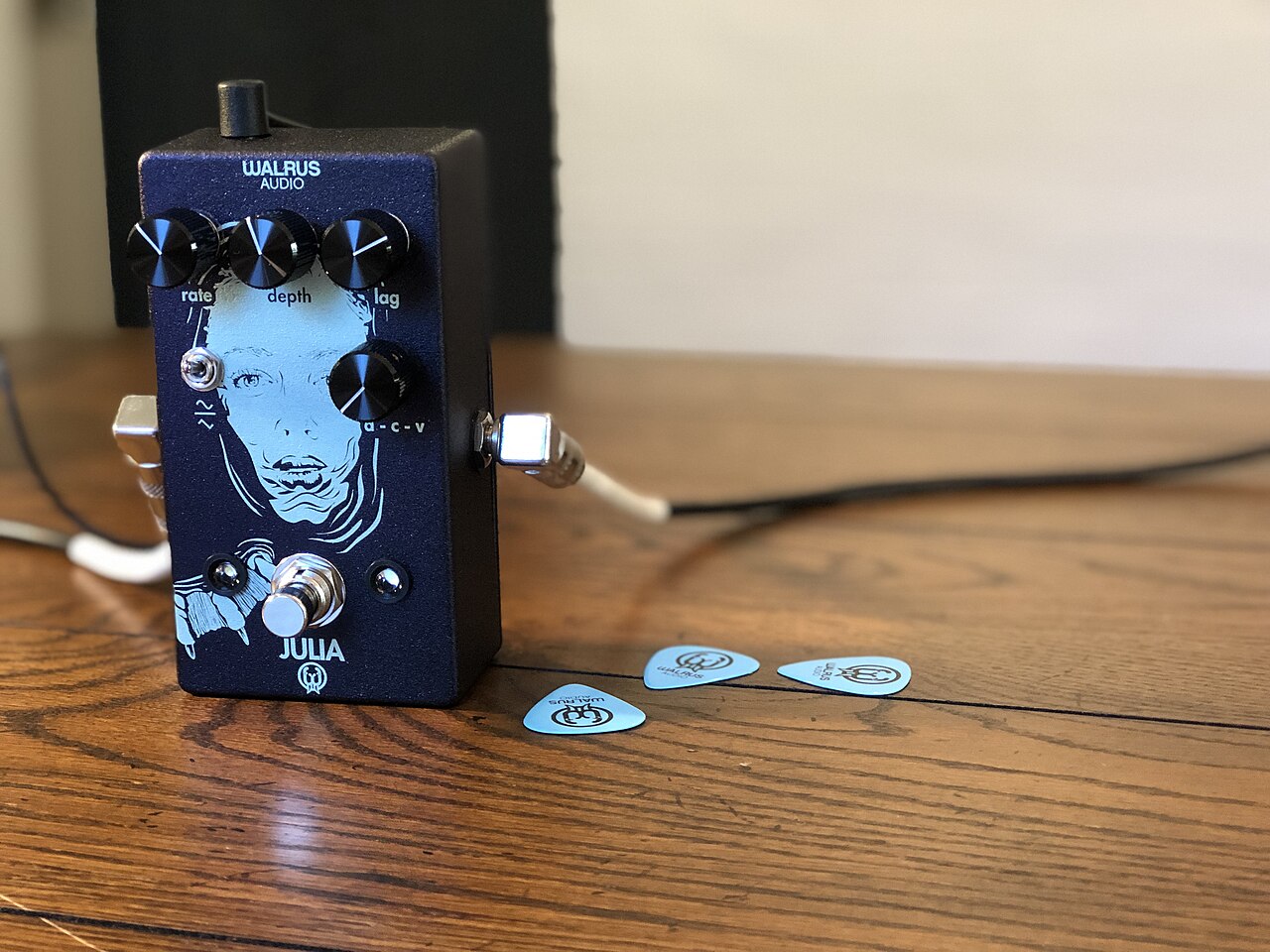
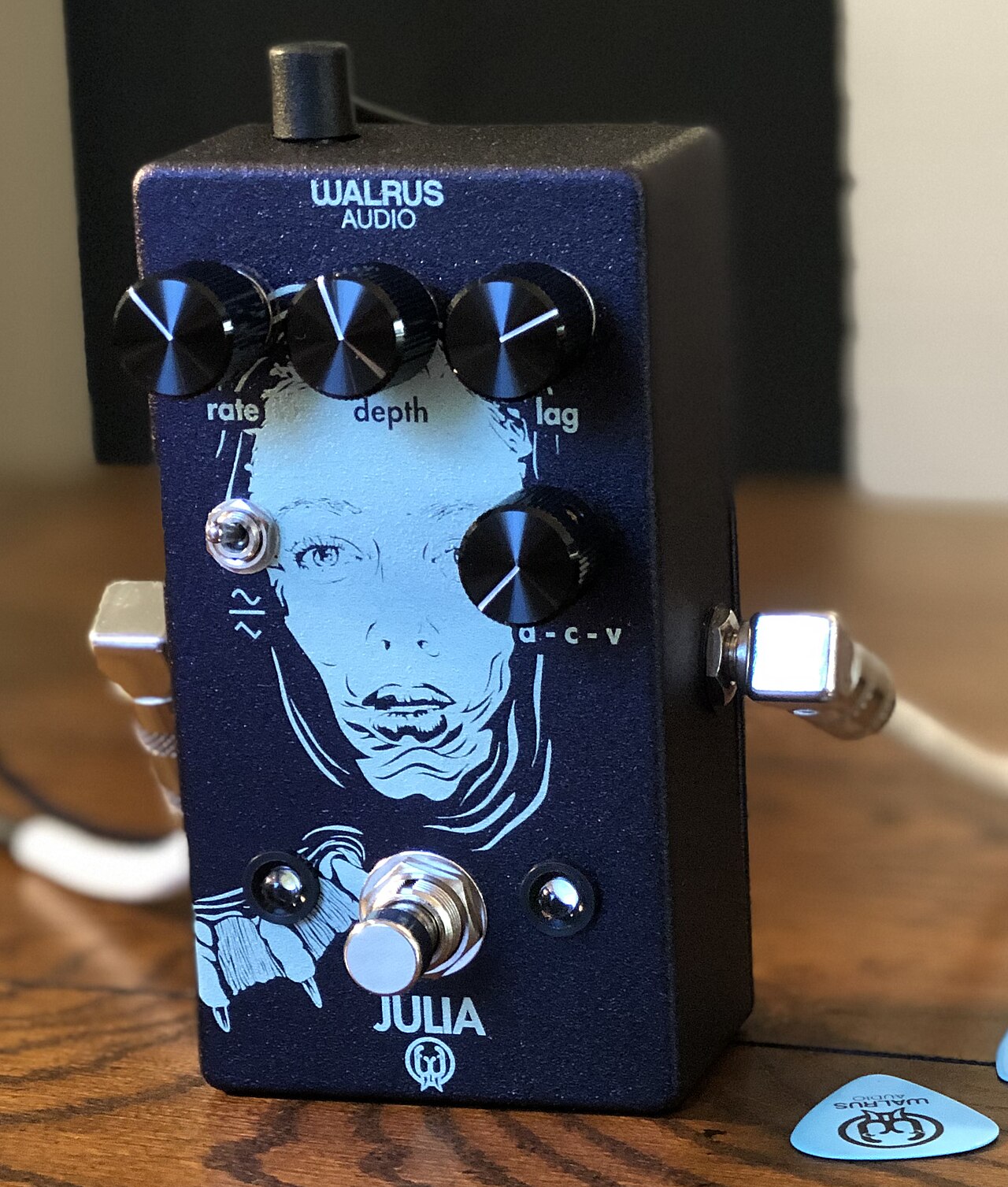
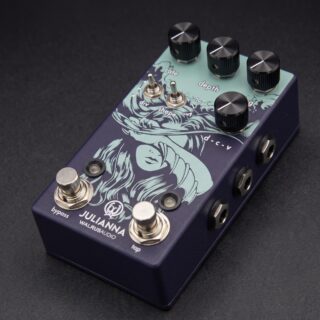
Walrus Audio has been an Oklahoma City company since 2011, and for its first decade the reputation was built entirely on colour: the swirling artwork, the ambient reverbs, the modulation boxes. The Slö Multi Texture Reverb and the Julia Analog Chorus/Vibrato are the pedals that made the brand’s name, and neither of them is a piece of infrastructure.
The Canvas line is the opposite instinct. It is Walrus doing plumbing: line isolators, DI boxes, re-amp boxes, power supplies, a volume pedal, an expression pedal, a stage clock, a rehearsal metronome, and this tuner. Every one of them wears the same 1970s rainbow-stripe graphic identity, and every one of them is a category where the incumbent products are functional and joyless.
That framing matters, because it explains the Canvas Tuner’s entire design logic. Walrus did not set out to beat Peterson at strobe accuracy. They set out to make the least interesting pedal on your board into something you enjoy looking at, and then made sure the audio path underneath was good enough that nobody could dismiss it as jewellery.
Specifications
The Screen: Yes, It Is A Gimmick, And Yes, It Works
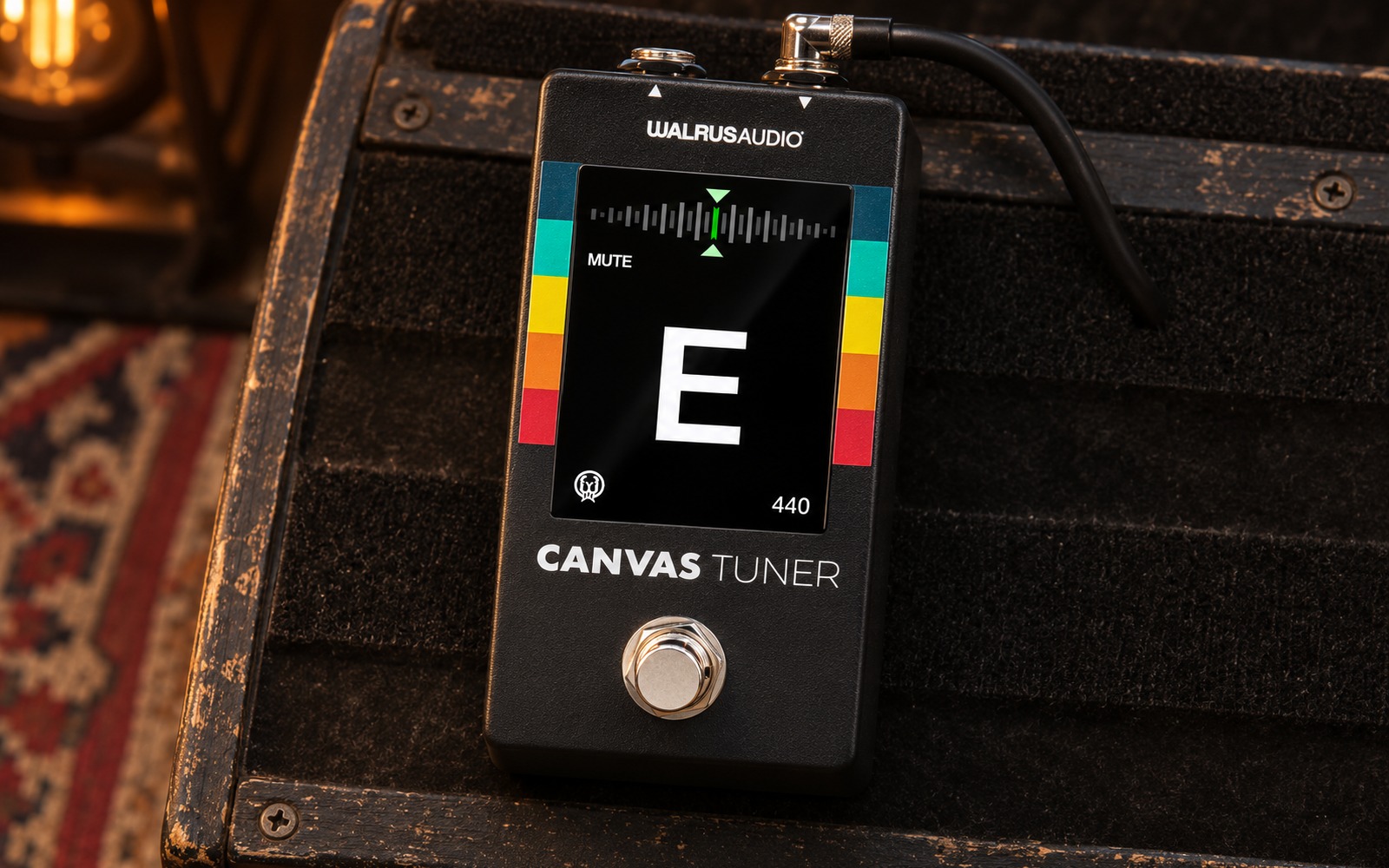
Let us deal with the elephant immediately. You can plug the Canvas Tuner into a laptop with a USB-C cable, open walrusaudio.io in a browser, and upload up to twelve photographs that the pedal will display when it is not actively tuning. Guitarists have used this for pictures of their children, their pets, their setlists, band logos, motivational text, and — inevitably — memes.
Guitar.com’s Josh Gardner, reviewing the pedal in January 2024, called it “undeniably charming” and admitted he found it hard to go back to a board that did not greet him with a cat meme. He scored the pedal 8/10 and described the whole proposition as injecting whimsy into “the staid and utilitarian world of tuners.”
He is right that it is superfluous. He is also right that it is not the point. The genuinely useful half of the customisation story is the part nobody photographs: eight colour themes and multiple screen orientations. If your tuner sits at the far left of a crowded board and you read it at an angle, being able to rotate the display ninety degrees and switch to a high-contrast theme is not decoration. It is legibility, and legibility on a dark stage is the only thing a tuner is actually for.
Six display modes, not two
Premier Guitar’s launch announcement and most retail listings mention “needle and strobe modes.” The pedal actually ships with six selectable tuning display modes, of which Needle and Strobe are simply the two most familiar. This is a persistent small inaccuracy in the secondary coverage, and it undersells the pedal: the choice of readout is a genuine preference issue, and having six of them means most players find one that suits how their eye works.
Tune Assist
Tune Assist is the feature that earns its keep in a live context. Once a note has held within tolerance for longer than a preset threshold, a border flashes around the entire perimeter of the display. You do not have to read a needle at all — you glance down, see the whole screen frame flash, and move to the next string. On a 2.8-inch screen that is a large, unmissable visual event, and it is considerably faster than squinting at a centre LED between songs.
Tuning Presets, Transposition And Reference Pitch
This is the section that separates the Canvas Tuner from a novelty. Ten presets ship on the pedal, covering Chromatic, Guitar Standard, Bass Standard, Drop D, DADGAD, FACGCE, EAEAC#E, DADF#AD and DGDGBD, plus a Sweetened Buzz Feiten preset that tracks against the pitch offsets defined by the Buzz Feiten Tuning System.
Each preset is transposable: up to Capo +5 semitones and down to Drop −6. That combination is the real workhorse feature. If you play in Eb standard, you do not need a dedicated preset — you take Guitar Standard and transpose it down one, and the display now reads the string names you expect rather than making you do mental arithmetic on a dark stage.
The reference pitch adjusts continuously from 390 Hz to 490 Hz, which is a far wider window than the 435–445 Hz most tuners offer. That range covers baroque pitch at the bottom end, the 432 Hz crowd in the middle, and the sharp continental orchestra pitches at the top.
None of the guitarists below are Canvas Tuner users, but they illustrate why a preset library matters. Jimmy Page built entire records on DADGAD and open tunings. Johnny Marr and Jonny Greenwood both work across altered tunings within single sets. James Hetfield and Kurt Cobain made Eb standard the default tuning of two entire genres. Any of those workflows is a case for a tuner that stores tunings rather than making you count semitones.
The Bypass Menu Nobody Reads
The Canvas Tuner offers four bypass behaviours, and the manual is the only place most owners ever encounter three of them.
Buffered bypass
The default. Signal passes through a low-noise op-amp buffer with 0.001% THD, a 1 MΩ input impedance and a 400 Ω output impedance. Those numbers are genuinely good — better than the buffer inside most drive pedals — and they mean the Canvas Tuner can legitimately serve as the front-of-chain buffer for a long-cable rig. Put it first, and you have solved high-frequency loss for the whole board.
Relay (true) bypass
A small-signal relay lifts the buffer entirely out of the path. Choose this if you run a fuzz that hates being buffered, or if you already have a dedicated buffer elsewhere in the chain.
Monitor mode
The tuner reads continuously while your signal continues to pass through. Useful in a stereo or split-signal rig, and useful for anyone who wants to watch tuning drift across a set without muting.
Pass-thru
Signal passes untouched with no tuner engagement, which matters in rigs where the pedal is being used as an always-on display or timer.
The rehearsal timer
The Canvas Tuner will run a set timer on the tuning screen, the standby screen, or both. It is a small thing. It is also the sort of feature a working band discovers three shows in and then cannot live without, because the alternative is a phone taped to a monitor.
Famous Players: Let Us Be Honest About This One
The gear list this guide follows describes the Canvas Tuner as rig-standard rather than artist-specific, and for once that assessment is close to correct — but “close” is not “correct,” and the pedal does have a documented user base worth naming.
Here is the honest scale of it. As of September 2026, Equipboard lists eight artists using the Canvas Tuner. The same database lists 1,082 for the Boss TU-3, 779 for the older TU-2, and 443 for the original TC Electronic PolyTune. The Canvas Tuner is a three-year-old boutique product competing against tuners that have been standard issue since the 1990s. Any claim that it is a professional standard is marketing, not observation.
What is documented, with sourcing, is this:
Video and rundown evidence
- Yvette Young (Covet) discusses the Canvas Tuner directly at the 5:36 mark of her “pack for tour with me (w board rundown)” video. First-person, on camera.
- Mark Bowen (IDLES) — a Canvas Tuner is clearly visible on his board at 9:55 in “Idles’ Mark Bowen: My Go-To Guitars.” The pedal is also credited on IDLES’ 2024 album TANGK.
- Layne Meylain (The Tony Danza Tapdance Extravaganza) — visible at 24:01 in the band’s Premier Guitar Rig Rundown.
- Michael Trent (The Films) — Premier Guitar’s coverage of the band’s board explicitly notes a pair of Walrus Canvas tuners, one each for electric and acoustic, alongside an MXR Blue Box, an EHX Nano Big Muff, an EarthQuaker Devices Hummingbird and a Boss OC-5.
Photographic evidence
- Jeremy Galindo (This Will Destroy You) — board photograph from a March 2025 European tour date in Nantes.
- Lucia de la Garza and Bela Salazar (The Linda Lindas) — both boards photographed from behind-the-scenes footage at Chase Field, Phoenix, on 18 September 2024, opening for Green Day.
The one to treat carefully
Adam Prendergast posted an enthusiastic close-up of the Canvas Tuner on Instagram — but his own caption thanks Walrus for “sending out” the pedal. That is an artist-relations placement, and it should be read as one. It is evidence that he owns it; it is not evidence that he chose it over alternatives.
Two Premier Guitar rundowns, one on-camera artist explanation, and three independently photographed boards is a modest but genuine footprint — and it skews exactly where you would expect: post-rock, math rock, punk and post-hardcore, where boards are aesthetic statements and the players are the demographic Walrus speaks to. Players like St. Vincent and Jack White have made pedalboard visual identity part of the performance for years; the Canvas Tuner is the first tuner designed for that sensibility.
Setup Recipes
A tuner has no tone knobs, so the “settings” that matter are configuration choices. These are the four that actually change how the pedal behaves in use.
The long-cable buffer setup
Bypass: buffered. Position: first in chain, before wah and before any drive. Display: Needle, high-contrast theme. This uses the 1 MΩ input and 400 Ω output to drive the rest of the board and any long run to the amp. If you run more than about twenty feet of cable total, this configuration alone will noticeably restore top end.
The fuzz-friendly setup
Bypass: relay. Position: after a vintage-style fuzz, or first in a chain where the fuzz is first. Germanium and silicon Fuzz Faces interact with the impedance of whatever precedes them, and a buffer in front will thin them out. Take the buffer out of the equation and put it somewhere else on the board.
The alternate-tunings live setup
Preset: whichever base tuning you use most, with transpose set rather than switching presets. Mode: Strobe for precision when you have time, Needle plus Tune Assist for between-song speed. Accidental display: flats if you play in Eb, Db or drop tunings, so the readout matches how you talk about the tuning.
The acoustic and bass setup
Preset: Bass Standard or Chromatic. The flat 20 Hz–20 kHz response means a low B on a five-string tracks as reliably as a high-strung acoustic’s top E, which is not true of every compact tuner. For acoustic-electric use, buffered bypass also tidies up the output of a piezo system, which typically wants a high input impedance.
How It Compares
Canvas Tuner vs Boss TU-3
The Boss TU-3 is the default answer to the tuner question and has been for a generation. It is cheaper, it draws 55 mA against the Canvas Tuner’s 300 mA, and — critically — it can power other pedals from its DC out. The Canvas Tuner cannot. What the TU-3 cannot do is display anything in colour, store ten tunings with transposition, offer four bypass modes, or run a set timer. If your priority is “a tuner that works and powers my board,” buy the Boss. If your priority is anything beyond that, the Boss stops being competitive quickly.
Canvas Tuner vs TC Electronic PolyTune 3 Mini
The PolyTune 3 Mini wins decisively on two counts: footprint and current draw. It occupies a fraction of the board space and asks for 100 mA. It also has polyphonic tuning, which the Canvas Tuner does not — strum all six strings, see all six at once. That is a genuine functional advantage the Walrus does not answer. Against that, the Mini’s display is a strip of LEDs the size of a postage stamp. This is a straight trade: information density and personality versus space and efficiency.
Canvas Tuner vs Peterson StroboStomp HD
The closest competitor on price at $149, and the closest on ambition. The StroboStomp HD has a colour LCD too, has Peterson’s strobe heritage and enormous sweetened-tuning library, and — like the Boss — can power other pedals. The Walrus counters with a bigger and brighter screen, the custom image function, four bypass modes rather than two, and better published buffer specs. Peterson is the tool; Walrus is the tool you look forward to using. Reasonable people go both ways.
Canvas Tuner vs Boss TU-3W Waza Craft
The TU-3W costs more at $169 and its pitch is entirely about the signal path: a discrete Waza Craft buffer plus a true-bypass option. If buffer quality is your sole concern, the TU-3W is the traditionalist’s answer — but the Canvas Tuner’s published figures (0.001% THD, −112 dBu noise floor, 98 dB SNR) are not conceding anything, and the Walrus adds every feature the Boss omits.
Where It Goes In The Signal Chain
Front of chain is the default and the correct default for most rigs, for two reasons. First, a tuner reads a raw, uncompressed, unaffected signal most accurately — put it after a drive pedal or a modulation box and tracking degrades. Second, in buffered mode the Canvas Tuner then acts as your input buffer for everything downstream.
The exception is the fuzz rig. If a vintage-voiced fuzz is your first pedal and you like how it loads your pickups, put the tuner in relay bypass and place it wherever it does not sit in front of that fuzz — or accept it up front with the buffer switched out.
In an amp-loop or stereo rig, monitor mode is the setting that earns its keep, letting the tuner watch a split of your signal continuously while the main path stays live. And if you are running a Walrus board end to end — Canvas Tuner into 385 Overdrive MKII into ARP-87 into Fathom, say — the tuner’s buffer is comfortably the best-specified input stage on the board.
Buying Guide
Current pricing. The Canvas Tuner launched at $148.99 and that remains the list price. Walrus’s own store has been discounting it to around $126, and dealer pricing in 2026 generally sits in the $125–150 window. It is a current-production item with no discontinuation notice, and Walrus is still shipping firmware updates for it — the current manual revision is dated February 2026, which tells you the product is being actively maintained rather than left to age.
Used market. Because it is a recent product with an enthusiastic owner base, used examples are not dramatically cheaper than new. Expect $100–120 for a clean one. Given the lifetime warranty applies to original purchasers, the discount is rarely worth the trade.
The power question is the real buying decision. 300 mA is a lot. For comparison, that is the same draw as a Strymon BigSky — a full stereo reverb processor. A PolyTune Mini asks 100 mA, a TU-3 asks 55 mA. If your power supply is already close to its ceiling, the Canvas Tuner will break it, and it gives nothing back because it has no power outputs of its own. Budget for a spare 300 mA isolated output before you budget for the pedal.
Buy it if: you have power headroom, you read your tuner in awkward lighting or at an awkward angle, you use multiple tunings, you want a genuinely good front-of-chain buffer, or you simply want one thing on your board that makes you smile.
Do not buy it if: your board is power-constrained, you need a tuner that powers other pedals, you need polyphonic tuning, or you need to save every square inch of space. Those are all real requirements and the Canvas Tuner fails all four.
Ownership Notes
Power. 9 V DC, centre-negative, 300 mA, isolated supply strongly recommended. Walrus explicitly advises against daisy-chain supplies across their entire line. Do not attempt to run this from a 9 V battery — the pedal has no battery compartment and the current draw would make it pointless anyway.
Relay bypass caveat. Like the rest of the current Walrus range, true bypass here is implemented with a small-signal relay rather than a mechanical switch. That means the pedal passes no signal at all without power. If your supply fails mid-set, the Canvas Tuner does not fall back to passing audio — plan a bypass cable if that risk matters to you.
The side-mounted controls. The audio jacks are top-mounted, which saves board space. The DC socket and the parameter buttons are on the side, which gives some of that space straight back. Guitar.com’s reviewer found that a neighbouring pedal’s side jack physically blocked access to the buttons, forcing him to lift the tuner off the board to change settings. If you switch presets frequently, plan your board layout around left-side access.
Firmware and images. Both go through USB-C and the walrusaudio.io web portal — no application to install. Twelve images can be stored on the pedal at once. New firmware has continued to arrive since launch, so check the portal periodically.
Enclosure. Powder-coated die-cast aluminium, the same shell used across the Walrus range, covered by the company’s limited lifetime warranty. The screen is the only component that is meaningfully more fragile than a conventional tuner, and it sits recessed rather than proud of the enclosure — but it is still a 2.8-inch LCD directly under your foot. Treat it accordingly.
Frequently Asked Questions
Is the Walrus Audio Canvas Tuner accurate enough for studio use?
Yes. ±0.1 cent is the same accuracy specification quoted by Peterson’s strobe tuners and is well beyond the threshold of audibility. For intonation setup work a dedicated strobe tuner with sweetened temperaments is still the specialist’s tool, but for tracking guitars the Canvas Tuner is not the limiting factor.
Can the Canvas Tuner power other pedals?
No. It has no DC output. This is its single biggest functional deficit against the Boss TU-2, TU-3 and Peterson StroboStomp HD, all of which have offered pass-through power for years, and it stings more because the Canvas Tuner itself is so power-hungry.
Why does it draw 300 mA?
The 2.8-inch backlit colour TFT display and its driver circuitry account for most of it. Colour LCDs are simply expensive in current terms compared with the handful of LEDs or the monochrome segment display in a conventional tuner. It is the direct cost of the feature that makes the pedal interesting.
Does it do polyphonic tuning?
No. Unlike the TC Electronic PolyTune family, you tune one string at a time. Tune Assist is Walrus’s answer to tuning speed, and it is a good one, but it is not the same thing as seeing all six strings at once.
What image formats can I upload, and how?
Connect the pedal to a computer by USB-C, open walrusaudio.io in a web browser, and upload through the device page. No software installation is required. The pedal stores up to twelve images and lets you choose which appears on the standby screen.
Should I use buffered or true bypass?
Buffered, unless you have a specific reason not to. The buffer is high quality, sits at 1 MΩ in and 400 Ω out, and placing it first in the chain protects your top end across long cable runs. Switch to relay bypass if you run a vintage-style fuzz first in the chain, or if you already have a dedicated buffer you prefer.
Can I use it with bass or a seven-string?
Yes. The flat 20 Hz–20 kHz response and the dedicated Bass Standard preset handle low B comfortably, and the Drop −6 transposition covers extended-range tunings well below anything a standard six-string requires.
Is it worth the extra money over a PolyTune or TU-3?
Strictly on tuning function, no — a $99 PolyTune 3 Mini tunes your guitar just as well and takes a third of the space. The Canvas Tuner justifies its price through the display, the preset library, the four bypass modes, the buffer specification and the set timer. Whether that bundle is worth roughly fifty extra dollars is a question about how you use a pedalboard, not a question about tuning.
Is the Canvas Tuner still in production?
Yes. It remains a current catalogue item in the Canvas series alongside the Canvas Volume, Canvas Expression, Canvas Clock and Canvas Rehearsal, with no end-of-production notice and an actively maintained manual and firmware.
The Verdict
The Canvas Tuner is not the best tuner in the world by any measurable criterion. It is not the most accurate, it is not the smallest, it is not the cheapest, it does not tune polyphonically, and it is a glutton for power that gives nothing back. Every sensible objection to it is a fair one.
And it does not matter, because the Canvas Tuner was never competing on those terms. It is competing on the observation that guitarists spend money on cable colour and board fabric and pedal artwork, and that the one box on the board nobody had ever bothered to make enjoyable was the one you look at most often. Walrus noticed. Then, having noticed, they did the unglamorous engineering as well: ten transposable presets, a 100 Hz reference-pitch range, four bypass behaviours, and a buffer good enough to anchor the whole signal chain.
The list of confirmed players is short, honest and unsurprising — Yvette Young, IDLES’ Mark Bowen, both guitarists in The Linda Lindas, and a handful of others in the post-rock and hardcore world. That is not a professional standard, and nobody should pretend otherwise. But it is the beginning of one, and no other tuner in history has ever needed a famous-players section at all.
Image credits
- Top image: GuitarGangsters AI-generated reference illustration, not a photograph.
- A mint green distortion pedal: Danelectro French Toast octave distortion rehouse on metal case (2011-10-03 by Andrés Galeotti).jpg: Andrés Galeotti fro, Wikimedia Commons, CC BY 3.0.
- A Walrus Audio Julia chorus and vibrato pedal: Guitar Chalk, Wikimedia Commons, CC BY 2.0.
- A Walrus Audio Julia chorus and vibrato pedal, close up: Guitar Chalk, Wikimedia Commons, CC BY 2.0.
Latest News
Related

On This Day
Monday 9 November
From this week: