The Jet That Changed Everything: Electro-Harmonix Electric Mistress Flanger/Filter Matrix
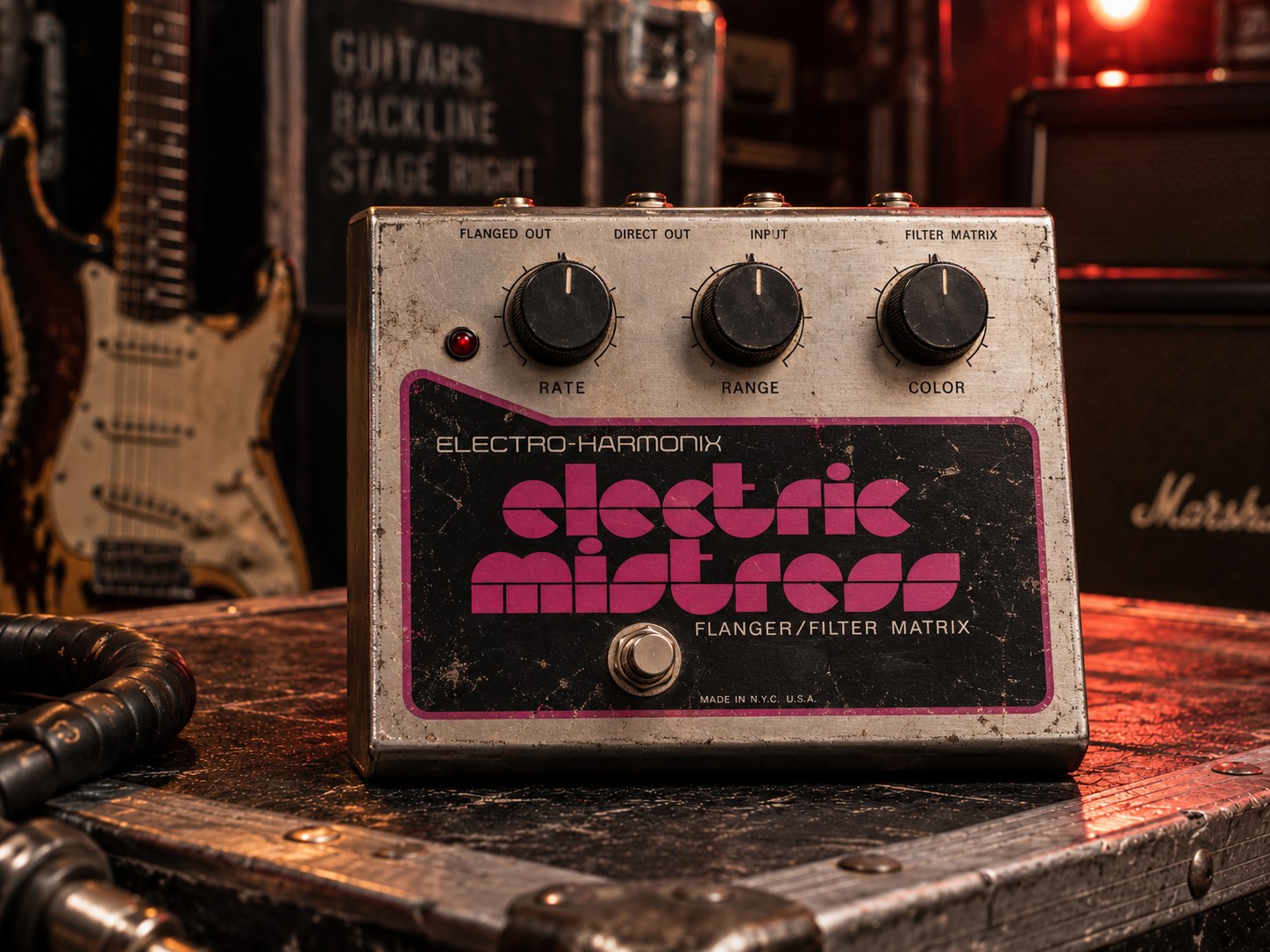
Electro-Harmonix Electric Mistress. AI-generated reference illustration, not a photograph.
The Electric Mistress defined flanging for Gilmour and Summers. Learn how this iconic EHX pedal works, who used it, and what makes it irreplaceable.
In 1977, a green-and-black pedal on David Gilmour’s Pete Cornish board started warping the air around Pink Floyd concerts in ways nobody had heard from a stompbox before. A year later, Andy Summers would plug into the same circuit and give “Walking On the Moon” one of the most recognisable guitar sounds in new wave history. The pedal was the Electro-Harmonix Electric Mistress, and nearly five decades on, it remains the benchmark by which all analog flangers are judged.
This is not a review — it’s a deep field guide to a pedal that shaped the sound of the late 1970s and never quite let go. Whether you’re chasing Gilmour’s vast, sweeping flanged Hiwatt tones, Summers’ shimmering Police-era grooves, or just want to understand why the Electric Mistress sounds the way it does, this article covers everything from the circuit to confirmed settings to the used-market reality in 2026.
Origin Story: David Cockerell and the Race for Flange
The Electric Mistress was designed by David Cockerell, who had previously worked at EMS (Electronic Music Studios) where he created the Synthi Hi-Fli — a multi-effect unit used by Gilmour himself during the Dark Side of the Moon era, 1973–75. When Cockerell moved to Electro-Harmonix, he brought that instinct for lush, organic modulation with him. His new flanger circuit first appeared in 1976, making it one of the earliest stompbox flangers ever marketed — concurrent with the MXR Flanger and Tycobrahe Pedalflanger, with ads for all three appearing in Guitar Player magazine at roughly the same time.
Flanging itself is an older technique than any pedal. Les Paul was among the first to exploit it in the mid-1940s, achieved by running two tape reels simultaneously and physically slowing one with a thumb on the flange (rim) of the reel — hence the name. The Beatles used it famously on “Lucy in the Sky with Diamonds.” What Cockerell and his contemporaries accomplished was reducing that studio-only process to a 9-volt box a guitarist could put on the floor.
The original Electric Mistress ran on two 9V batteries (the 1981 model was updated to a single battery) and was housed in a Big Muff-sized enclosure. Five distinct variants were produced between 1976 and 1981. They shared a character: a liquidy, slightly chorusy flanging quality that didn’t so much sound like a jet engine as it did like a vast body of water shifting under your signal. The original units were also notorious for two things: significant noise even when switched off, and a volume drop when engaged. Pete Cornish reportedly performed modifications on Gilmour’s pedals to address both issues.
The Deluxe Electric Mistress arrived in 1978, designed by EHX engineer Howard Davis (who also created the Deluxe Memory Man). It added a noise filter, making it considerably quieter than the original, and shifted the character slightly toward a more defined, mid-range-present jet quality. The Deluxe was offered alongside the original Mistress through 1981, then reissued in 1999, and updated again in 2015 with True Bypass switching and a standard power supply. EHX discontinued the 2015 Deluxe Electric Mistress in 2023, making the current-production version — the Andy Summers Walking On the Moon — the only way to buy a new Electric Mistress today.
Specifications: Deluxe Electric Mistress (2015 Reissue, Discontinued 2023)
The Dry Out jack is worth highlighting: the Deluxe Electric Mistress has two output jacks — Flanged Out (the effected signal) and Dry Out (a direct pass-through of the input). This allows true wet/dry rig configurations, running the flanged signal to one amp and the clean signal to another. For players building parallel effect loops, this is a significant functional advantage over most flangers that offer only a single output.
How It Works: The Controls Explained
The Electric Mistress has three knobs and one switch, each doing something genuinely distinctive in the context of this specific circuit.
Rate controls the speed of the LFO (low-frequency oscillator) — the sweep from slow, vast tidal motion at the low end to fast warbling vibrato at the high end. Gilmour ran it at the slow end of the range. Summers used it slightly faster for a more pronounced shimmer. The range of the Rate control is wider than most players expect; at its fastest, the Electric Mistress produces something close to a vibrato effect.
Range is the control most specific to the Electric Mistress’s character. Unlike a Manual control (found on many other flangers, which sets the center delay time), the Range control on the Electric Mistress adjusts the lower limit of the flanger sweep — it lowers the frequency range while keeping the upper frequencies consistent. This is what creates the pedal’s distinctive treble shimmer and bite: the top end of your guitar signal stays present and bright while the sweep moves through the lower frequencies. It’s a fundamentally different approach from simply shifting a delay time.
Color sets the intensity of the flanger effect — equivalent to what other manufacturers call feedback, regeneration, or resonance. Higher Color settings produce more pronounced, resonant flanging with a stronger notch filter character. Lower settings give a subtler, more washy modulation closer to chorus territory.
Filter Matrix switch is the Electric Mistress’s wild card. When engaged, it disconnects the LFO from the flanger circuit entirely, freezing the sweep at whatever position the circuit happens to be at when you flip the switch. The result is a static comb-filter effect — a fixed pattern of frequency cancellations that can be tuned by adjusting the Range knob. These are the metallic, chiming, almost resonator-like tones that make the Electric Mistress capable of things no other standard flanger can do. Players like Keith Levene of PiL used this kind of static filtered texture to striking effect.
One important technical note about vintage original Electric Mistress models: on the earlier 18V variants, the potentiometers were positioned differently from later models and reissues. On some versions, 50% effect is not at the noon position but can be at 3 o’clock, 6 o’clock, or 9 o’clock depending on which variant you have. This matters significantly when trying to replicate settings from photos of Gilmour’s rig.
Famous Players: Verified Connections
David Gilmour — Pink Floyd
No guitarist is more associated with the Electric Mistress than David Gilmour, and the documentation here is unusually thorough. A 1976 green-logo V2 Electric Mistress is visible on top of his Pete Cornish pedalboard at the Animals tour rehearsals at Olympia Exhibition Hall, London, in late 1976. Pete Cornish subsequently modified and built the pedal into the board.

During the 1977 Animals tour, Gilmour used the Electric Mistress together with a Ram’s Head Big Muff Pi on “Dogs” and “Pigs,” running through a blend of Hiwatt amps and Yamaha RA-200 rotating speakers. The Hiwatt’s darker character made the Mistress produce a more mellow, tidal flanging that blended organically with the Big Muff’s saturation — the combination defined his huge sound for that era.
The 1978 solo album David Gilmour is the Electric Mistress’s showcase record. It appears prominently on “Mihalis” (both rhythms and solo), “So Far Away” (solo), “Short and Sweet” (main riff and rhythms), “Raise My Rent” (solo), and “I Can’t Breathe Anymore” (rhythms). Gilmour used it again extensively on The Wall tour (1980–81), where both his main Pete Cornish board and a secondary mini-board featured the pedal, and on The Final Cut (1983) — notably on “Fletcher Memorial Home” and “Not Now John.”
In 2015–16, for the Rattle That Lock tour and Live at Pompeii, Gilmour’s stage rig included a vintage Electric Mistress (likely a 1976–78 V2–V4 model) linked with a Lehle Parallel L for volume compensation — addressing the Mistress’s characteristic slight volume drop. He used it on “Run Like Hell” and, combined with a Ram’s Head Big Muff, on live performances of “Comfortably Numb.”
Andy Summers — The Police
Andy Summers of The Police used the Electric Mistress across a range of sonic applications that demonstrated its unusual versatility — from slow, deep flanging on “Bring On the Night” to the shimmering, chorus-adjacent effect on “Walking On the Moon.” The latter track has long been debated online, with many listeners assuming it’s a chorus pedal. Electro-Harmonix settled the matter definitively by naming their current-production reissue the Andy Summers Walking On the Moon flanger — ending the forum debate once and for all.
Summers also used the Electric Mistress on “Don’t Stand So Close to Me,” “De Do Do Do De Da Da Da,” and “If The World is Running Down.” His approach consistently showed that the Electric Mistress could be dialled into a range wide enough to encompass both lush atmospheric shimmer and identifiable heavy flanging — a versatility that eluded many of its competitors.
Alex Lifeson — Rush
Alex Lifeson used the Electric Mistress on several iconic Rush recordings. Guitar World’s 2024 retrospective on the pedal specifically cites “Spirit of the Radio” and the solo section of “Red Barchetta” as Electric Mistress applications. Both tracks appear on Permanent Waves (1980) and Moving Pictures (1981) respectively — a period when Lifeson was at the peak of his tonal sophistication, blending precise technique with bold effects choices. The Electric Mistress’s ability to add motion without consuming the pick attack was clearly useful in a prog-rock context where clarity and dynamics were non-negotiable.

Robin Trower
Robin Trower‘s use of the Electric Mistress appears on the album In City Dreams (1977) — documented in Guitar World’s 2024 retrospective. Trower’s approach to modulation was always rooted in a Hendrix-influenced feel for motion and space, and the Electric Mistress’s analog warmth fit naturally into that vocabulary.
Billy Corgan — Smashing Pumpkins
Billy Corgan used the Electric Mistress during the Smashing Pumpkins’ early era, with Guitar World citing both Gish (1991) and Siamese Dream (1993) as Electric Mistress albums. On a pedal list already dominated by Big Muffs and chorus units, the Electric Mistress provided a different textural tool — particularly useful for creating the studio density that defined those records’ guitar sound.
Dimebag Darrell — Pantera
Dimebag Darrell‘s use of the Electric Mistress on Pantera’s “The Great Southern Trendkill” (title track, 1996) is one of the more surprising entries in the pedal’s history. Dimebag was not primarily a modulation player, but his deployment of heavy flanging on that track — an effect applied to the main guitar figure — shows the Electric Mistress’s ability to function in a metal context when driven hard. Guitar World confirmed this application in their 2024 retrospective.
Other Documented Users
James “Munky” Shaffer of Korn used the Electric Mistress on “No Place to Hide.” Keith Levene of Public Image Ltd. used it on “Public Image” — particularly in Filter Matrix mode for the track’s metallic, static tonal character. John Ashton of Psychedelic Furs deployed it for that band’s early 1980s post-punk texture. Travis Stever of Coheed and Cambria has been documented as a user, carrying the legacy forward into the progressive rock space.
The Sound: What Makes the Electric Mistress Different
Most flanger pedals operate by varying a delay time around a center point controlled by a Manual knob, creating a sweep that moves above and below that center. The Electric Mistress has no Manual control. Its delay time appears fixed at a center point estimated around 5–10ms — a crossover zone where flanging and chorus overlap. This is one reason the Electric Mistress can produce convincing chorus-like shimmer at certain settings: the underlying delay time sits in a range where both characters are plausible.
The Range control’s function of maintaining upper frequency consistency while lowering the sweep’s lower limit is what delivers the pedal’s distinctive treble bite. When you engage a heavily flanged signal, you normally lose some of the top-end clarity to the notch filter sweeps. The Electric Mistress is relatively transparent up top, which makes it stack better with distortion and fuzz than many competing flangers. The Big Muff into Electric Mistress combination — Gilmour’s signature wall of sound — works precisely because the Mistress doesn’t muddy the Big Muff’s already complex harmonic content.
Compared to digital flangers, the Electric Mistress has what many players describe as a liquid or organic quality — a slight compression and softening of the sweep that feels more like water moving than a laser beam scanning a room. Part of this comes from the bucket-brigade device (BBD) analog circuit’s inherent slight non-linearity and noise floor. The Deluxe version’s noise filter cleans this up considerably without removing the underlying character.
Tone Recipes and Settings
David Gilmour “Comfortably Numb” Live / Wall Tour
Gilmour’s live Wall tour setup combined the Electric Mistress with a Ram’s Head Big Muff Pi through Hiwatt amps. For the Mistress: Rate at approximately 9–10 o’clock (slow sweep), Range at 10 o’clock, Color at 9 o’clock (low intensity). Run after a Ram’s Head Big Muff. The Hiwatt’s darker midrange makes the flanging more mellow and integrated; on a Fender-style amp, you’ll need to reduce Color further to avoid the effect becoming too prominent. Add Boss CE-2 chorus after the Mistress for Gilmour’s stereo spread on the 1980-81 tour.
Andy Summers “Walking On the Moon” Style
The exact settings vary slightly by Electric Mistress variant, but the general approach: Rate at 10–11 o’clock (moderate-slow, slightly faster than Gilmour’s deep sweep setting), Range at noon, Color at 9 o’clock. The effect reads as shimmer rather than heavy flanging at these settings — the crossover between flanger and chorus behavior that makes the song’s guitar sound ambiguous to casual listeners. Use a Stratocaster-type neck or middle pickup into a clean amp for the closest approximation.
Heavy Flanging — “Great Southern Trendkill” Territory
Rate at 2 o’clock (faster), Range at noon, Color at 2 o’clock (high intensity). Run into a distorted channel or after a hard-clipping distortion. The elevated Color setting pushes the notch filter character harder, producing more pronounced metallic whoosh. Works with humbuckers or single coils, but humbuckers provide more low-end mass to the swept frequencies.
Filter Matrix Mode — Static Comb Filter
Engage the Filter Matrix switch. Rate becomes irrelevant. Sweep Range slowly to find a frequency position that adds presence or cuts unwanted resonance. At lower Range settings, the fixed notch is deeper in the frequency spectrum; higher Range shifts it toward treble-area cancellations. Color controls resonance of the frozen filter. This mode functions like a tunable resonant EQ notch — useful for creating tonal colour that doesn’t modulate. Keith Levene’s PiL applications exploited this static character extensively.

Comparisons: Electric Mistress vs. The Field
Electric Mistress vs. MXR Flanger
The MXR M-117R Flanger and the Electric Mistress emerged from the same era. The MXR has a Manual control (sets center delay time) and a Speed/Width/Regeneration/Manual layout that gives more precise parameter control over conventional flanging. It leans more toward the jet-aircraft character when dialed in for heavy flanging. The Electric Mistress is less precise but more organic, with the Range control providing a kind of sweep behavior the MXR can’t replicate. For players who want conventional flanger sounds with surgical control, the MXR is logical. For players who want the Electric Mistress’s liquid, borderline-chorus quality, there’s no real substitute.
Electric Mistress vs. Boss BF-3
The BF-3 is a digital flanger with Ultra and Gate/Pan modes. It’s more versatile in a conventional sense — MIDI-syncable, four modes, stereo output — but produces a digital character that’s distinct from the Electric Mistress’s BBD warmth. Players who need heavy modern flanging in a pedalboard-friendly package often choose the BF-3. Players who specifically want 1977–1983 analog flanging character look elsewhere.
Deluxe Electric Mistress vs. Original Vintage Electric Mistress
This comparison matters because many players seek out vintage originals. The original models have the liquidy, slightly noisier character with the volume drop. The Deluxe (original 1978 version and its reissues) adds a noise filter and shifts the character very slightly toward a more mid-present, jet-like sweep. The 2015 Deluxe reissue adds True Bypass and a standard power supply — significant practical advantages. Gilmour’s own studio houses what appears to be a 1976–78 V2–V4 original, suggesting he prefers the original’s character; the reissue is nonetheless extremely close and more consistent than vintage units, which vary significantly in component quality between examples.
Andy Summers Walking On the Moon vs. Deluxe Electric Mistress
The Walking On the Moon is EHX’s current production flanger — the Deluxe Electric Mistress circuit in a slightly different package with Andy Summers’ name on it. It replaced the Deluxe Electric Mistress when the latter was discontinued in 2023. The circuit is the same Electric Mistress flanger. If you want a new, warranty-backed Electric Mistress-type pedal in 2026, the Walking On the Moon is the answer.
Buying Guide: 2026 Market Reality
The Deluxe Electric Mistress (2015 reissue) was discontinued in 2023, so the used market is the primary source. Excellent-condition units typically trade in the $100–$150 range on Reverb and eBay in 2026. The pedal was widely distributed before discontinuation, so supply is reasonably good.
Vintage original Electric Mistress pedals from the 1976–1981 era are a different proposition entirely. Prices start around $350 for fair-condition examples and can reach $600 or more for clean units. Two caveats apply to vintage purchases: first, vintage Electric Mistress units are notorious for component inconsistency — two seemingly identical pedals can sound notably different. Second, the pots’ zero-position varies by variant, meaning a setting dial from a photo won’t necessarily translate directly to your unit. Buy from sellers who can confirm the unit is working correctly and who ideally have a return policy.
For players who want the Electric Mistress sound without the used-market search, the Andy Summers Walking On the Moon is available new. It’s the same circuit in a slightly smaller form factor, with True Bypass and a power adapter included — a genuine option rather than a consolation prize.
Ownership Notes
Volume drop: All variants of the original Electric Mistress have a slight volume drop when engaged. Gilmour addressed this with a Lehle Parallel L for volume compensation. On the 2015 Deluxe reissue, the effect is minimal but may still be audible in quiet, precise studio settings. Set your amp’s volume with the pedal engaged to calibrate correctly.
Noise: Original vintage models are notably noisy — sometimes even when switched off (the circuit draws current regardless of bypass state on the original). The Deluxe’s noise filter addresses most of this. The 2015 reissue with True Bypass means no signal path interaction when switched off. If you’re using a vintage original in a quiet recording environment, a noise gate after the Mistress is advisable.
Power: The 2015 Deluxe reissue runs on 9.6VDC-200mA with the adapter included. It draws 40mA — notable, because many compact flangers draw significantly less. Make sure your power supply has a port rated for at least 100mA on the relevant output (200mA is safer for headroom). Vintage originals used batteries or had their own power quirks depending on variant.
Dry Out jack: The Deluxe reissue’s Dry Out jack is a genuine feature worth exploiting. Running Flanged Out to one amp and Dry Out to a second creates a true wet/dry rig — the effected signal moves with the sweep while the dry signal remains anchored. This is closer to how Gilmour’s rig functioned (Electric Mistress to one amp, dry signal preserved) than simply running a single flanged signal.
Stacking with Big Muff: Place the Electric Mistress after the Big Muff in the signal chain, not before. Big Muff into Electric Mistress is the Gilmour approach — the fuzz’s harmonically dense signal runs into the flanger’s sweep for a combined modulated-fuzz character. Reversed (Mistress first, then fuzz), the distortion clips the Mistress’s output and destroys the sweep’s expressiveness.
Filter Matrix in live use: The Filter Matrix switch is a toggle, not a footswitch. To use it live, you’ll need to physically reach down and flip it during a song. Some players put the Electric Mistress toward the back of their board specifically so they can reach the switch during a breakdown without disrupting the rest of the pedalboard. Alternatively, a switching system that bypasses the whole pedal while you flip the switch manually solves the problem elegantly.
FAQ
Is “Walking On the Moon” by The Police a flanger or a chorus pedal?
It’s a flanger — specifically, an Electric Mistress set for slow-rate, relatively low-intensity flanging that produces a shimmering, chorus-adjacent sound. Electro-Harmonix named their current-production reissue the “Andy Summers Walking On the Moon” specifically to settle this debate. The Electric Mistress’s fixed center delay time puts it in a frequency range where flanging and chorus overlap, which is why the track’s guitar effect sounds ambiguous to listeners accustomed to heavier, more obvious flanger sounds.
What’s the difference between the original Electric Mistress and the Deluxe version?
The original Electric Mistress (1976–1981) is battery-powered (two 9V batteries on early models), has no noise filter, a notable volume drop when engaged, and a liquidy, slightly thinner character. The Deluxe Electric Mistress (introduced 1978) adds a noise filter for a quieter output and shifts the character slightly toward a more mid-present, defined sound. The 2015 Deluxe reissue adds True Bypass and a standard power supply. The core circuit character remains recognisably related across all versions, but the practical differences between a vintage original and the Deluxe reissue are meaningful.
What albums is the Electric Mistress most prominently featured on?
David Gilmour’s 1978 self-titled solo album is the single most Electric Mistress-saturated record. Pink Floyd’s The Wall (1979) features it in places, and the associated 1980–81 tour used it extensively. Andy Summers’ work on The Police’s Reggatta de Blanc (1979) — including “Walking On the Moon” and “Bring On the Night” — is another primary showcase. Rush’s Permanent Waves (1980) and Moving Pictures (1981) include Alex Lifeson’s Electric Mistress applications.
Can I use the Electric Mistress for bass guitar?
Yes. The Electric Mistress is not specifically voiced for guitar and works on bass — the Range control’s ability to maintain upper frequencies while sweeping lower ones means bass fundamental content is preserved better than in flangers that sweep the full spectrum indiscriminately. Filter Matrix mode on bass produces particularly useful static filtered tones.
What does the Filter Matrix switch do, exactly?
The Filter Matrix switch disconnects the LFO from the flanger circuit, freezing the sweep at whatever position it happens to be when you flip the switch. Instead of a modulating sweep, you get a static pattern of frequency cancellations — a comb filter. The Range knob tunes which frequencies are affected. The Color knob controls the resonance of the frozen filter. The effect produces metallic, chiming, or hollow tones depending on the Range setting. It’s fundamentally different from the standard flanger mode and is one of the Electric Mistress’s most distinctive and least commonly replicated features.
Does the Electric Mistress require true bypass? Does it colour the signal when off?
The 2015 Deluxe Electric Mistress reissue has True Bypass — when switched off, the signal passes through the pedal’s switching mechanism without touching the circuit, and the Dry Out jack provides a parallel clean signal option. Original vintage models do not have true bypass; they draw current and can affect the signal even when nominally switched off, which contributes to their reputation for noise. If you’re using a vintage unit in a long signal chain, a quality buffer before the Mistress may help.
What’s the current production equivalent of the Deluxe Electric Mistress?
The Electro-Harmonix Andy Summers Walking On the Moon flanger. It uses the same Electric Mistress circuit as the Deluxe version, discontinued in 2023, in a slightly different form factor. The Walking On the Moon includes the same Rate, Range, Color controls and Filter Matrix switch. If you want a new, warranted Electric Mistress-circuit flanger in 2026, this is it.
What’s a realistic budget for the Electric Mistress used market in 2026?
Deluxe Electric Mistress (2015 reissue, discontinued 2023): excellent condition typically $100–$150. Vintage original models (1976–1981): $350–$600+ depending on condition and variant, with well-documented V2 and V3 models often at the higher end. Andy Summers Walking On the Moon (current production, new): check current dealer pricing. Factor in that vintage units may need service — caps, pots, and battery contacts on 40-50 year old units often require attention.
Image credits
- Andy Summers: Acroterion, Wikimedia Commons, CC BY-SA 4.0.
- Top image: GuitarGangsters AI-generated reference illustration, not a photograph.
- David Gilmour: Jan Hagelskamp, Wikimedia Commons, CC BY 4.0.
- Andy Summers: Andy Summers Atlanta 1, Wikimedia Commons, CC BY-SA 4.0.
Latest News
Related
On This Day
Monday 9 November
From this week: