Lonnie Mack Guitars & Gear: The Wham of That Memphis Man Complete Rig Guide
Lonnie Mack guitars gear — Gibson Flying V, Magnatone vibrato deep-dive for the foundational blues-rock instrumentalist behind "Memphis" and "Wham!"
Lonnie Mack guitars gear is the subject of one of rock guitar’s most genuinely foundational and most under-celebrated stories — the equipment and approach of the guitarist whose 1963 instrumental hit “Memphis” and its B-side “Wham!” demonstrated, years before Hendrix, Clapton, or Beck, that the electric guitar could be a primary lead instrument capable of carrying an entire recording on the strength of its own voice. Mack’s combination of blistering speed, genuine blues feeling, and the specific tonal signature of his Gibson Flying V through a Magnatone amplifier’s distinctive vibrato gave guitar instrumentalism a new vocabulary that the entire subsequent history of rock lead guitar would draw from, whether or not individual guitarists knew they were doing so.
Gear Timeline
His specific position in guitar history — too country for pure blues audiences, too blues for pure country audiences, recording in a specific Midwestern context (Cincinnati’s King Records) that placed him outside both the Chicago blues and Nashville country power centres — gave him a career of persistent under-recognition relative to his actual influence. Musicians who came after him — Stevie Ray Vaughan most explicitly, but also Jeff Beck, Duane Allman, and countless others — acknowledged Mack’s foundational importance even as the broader audience remained largely unaware of who had actually originated the specific combination of speed, blues feeling, and tonal signature that “Memphis” represented. This is the complete breakdown of Lonnie Mack guitars gear, technique, and tonal philosophy.
Background
Lonnie McIntosh — known professionally as Lonnie Mack — was born on July 18, 1941, near Harrison, Indiana, close to the Ohio border in the specific Midwestern region where Appalachian country music traditions, the blues traditions carried north by the Great Migration, and the emerging rock and roll all intersected. His family’s musical background was rooted in country and gospel music traditions, giving him an early foundation in the specific vocabulary of American roots music that predates the rock and roll era — the bent notes, the call-and-response phrasing, and the emotional directness of both the country and gospel traditions that he absorbed before electric guitar amplification gave those traditions new sonic possibilities.
His professional career began in the Cincinnati area’s club circuit, playing in bands that worked the specific regional circuit connecting the Midwest’s country, blues, and early rock and roll scenes. His connection to King Records — the Cincinnati label founded by Syd Nathan that was one of the most important independent labels in American music history, releasing material across country, R&B, and gospel genres and giving James Brown his start — gave Mack access to a recording context that was specifically open to genre-crossing material in ways that more genre-segregated labels were not.
“Memphis” (1963) — recorded almost by accident, reportedly as a warm-up during a recording session for another artist, with Mack’s instrumental rendition of the Chuck Berry song capturing the engineers’ attention sufficiently that it was released as a single — became an unexpected hit, reaching the Billboard Top 5. Its B-side, “Wham!” — Mack’s own original instrumental composition — demonstrated his specific combination of speed, blues feeling, and the Magnatone’s distinctive vibrato even more directly than “Memphis” itself. Both recordings established Mack’s specific guitar vocabulary as a permanent reference point for subsequent rock guitar instrumentalism, even as his subsequent career — a mixture of continued recording, periods of relative obscurity, and eventual rediscovery by the blues-rock revival of the 1970s and 1980s — never matched the immediate commercial impact of these early recordings.
Lonnie Mack Guitars Gear: The Complete Rig
Guitars
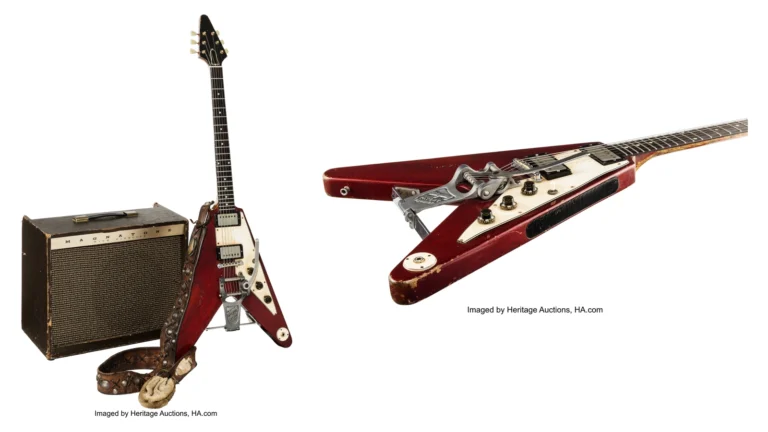
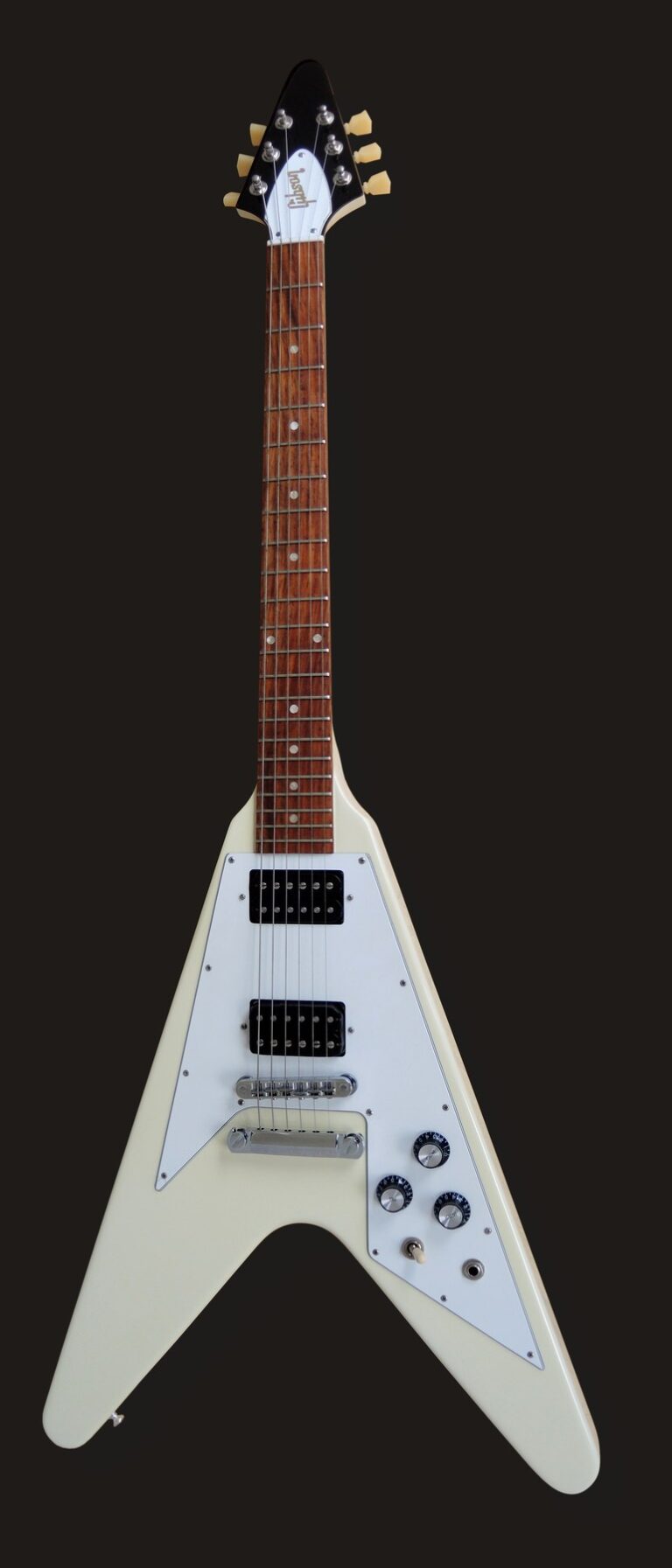
Lonnie Mack’s primary and most historically significant guitar was a 1958 Gibson Flying V — one of the earliest production examples of Gibson’s radically angular, futuristic-styled solid-body design, which Mack acquired as one of the first seven Flying V instruments Gibson produced (giving the guitar its nickname, “Number Seven,” sometimes referred to by Mack himself as “Number Seven” in interviews documenting its specific history). The Flying V’s design — a V-shaped body with the neck emerging from the point of the V, two humbucking pickups, and a distinctive angular silhouette that Gibson designed as part of a 1958 attempt to give their solid-body line a “modernistic” image to compete with Fender’s commercial success — was a commercial failure on its initial release (very few were sold in 1958, and Gibson discontinued the model until reissuing it in the mid-1960s), which meant that Mack’s acquisition of an original example placed him in possession of one of the rarest electric guitars in existence by the time “Memphis” made it famous.
The Flying V’s specific tonal character — humbucking pickups (PAF-specification on the 1958 originals) giving warm, full output, combined with the V-shaped body’s specific resonance characteristics (the body’s reduced mass relative to a Les Paul, and its specific bracing and weight distribution) — gave Mack’s playing a tonal foundation that was both powerful (the humbuckers driving his Magnatone amplifier into the specific saturation that gave “Memphis” and “Wham!” their character) and resonant (the V-shaped body’s acoustic properties contributing to the sustain and harmonic complexity of his playing). Mack’s “Number Seven” became as identified with his music as any signature instrument in this series — a 1958 Gibson Flying V whose rarity and historical significance gave it a status far beyond its modest original commercial reception.
As Mack’s career continued across decades, various subsequent Flying V instruments — including Gibson’s 1967 reissue and later production examples — appeared in his setup, particularly as the original “Number Seven” became increasingly valuable and increasingly fragile with age and use. His continued commitment to the Flying V design across these instrument changes demonstrated the depth of his identification with the instrument’s specific tonal and visual character.
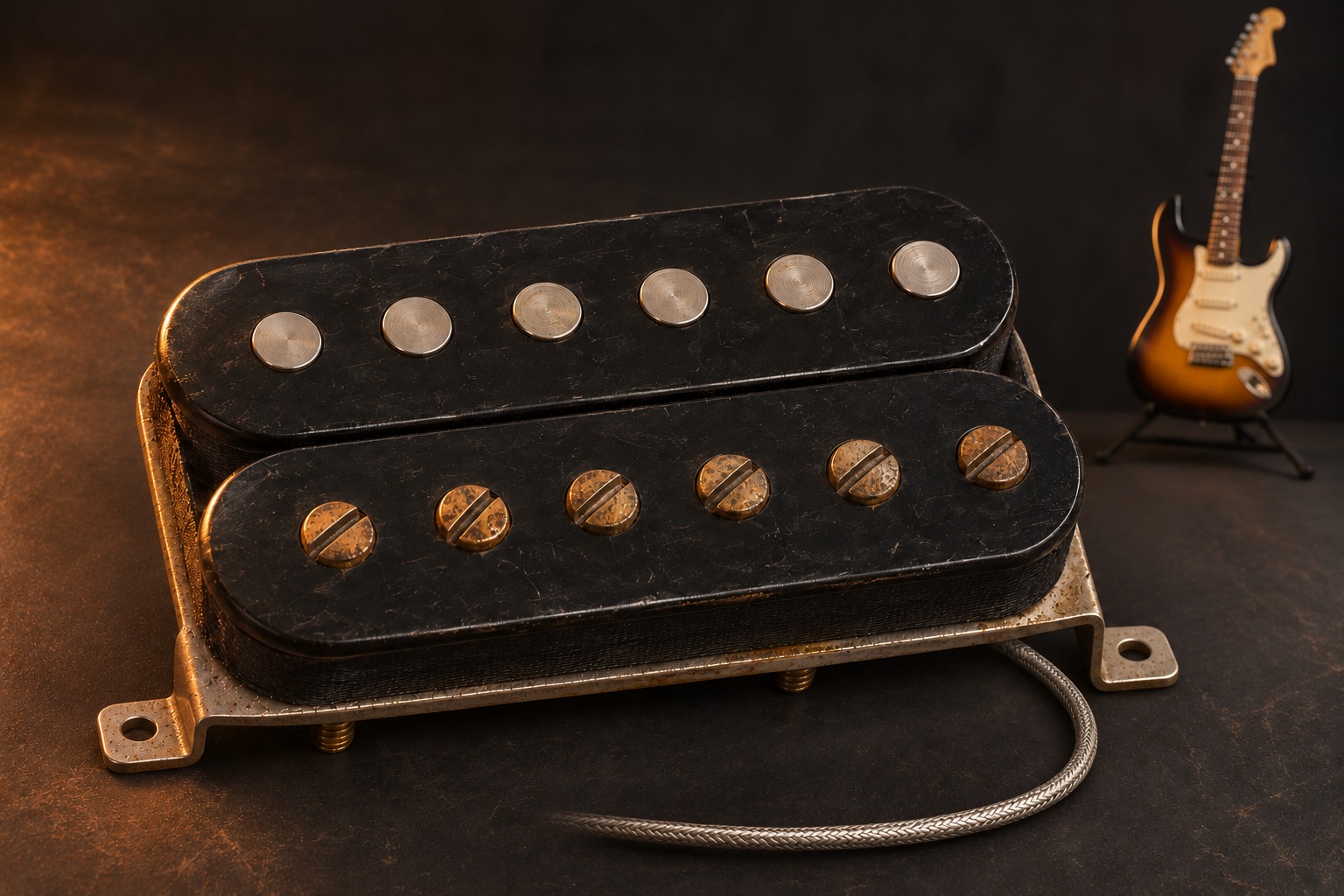
The PAF (Patent Applied For) humbucking pickups in Mack’s original Flying V — Gibson’s then-new humbucker design, introduced in 1957, using two coils wound in opposite polarity and opposite magnetic orientation to cancel 60-cycle hum while combining their outputs for a warm, full tonal character — gave his playing its foundational warmth and output. The 1958-era PAFs’ specific characteristics (Alnico magnets, hand-wound coils with the scatter-winding variability that gave each PAF slightly individual tonal character, approximately 7.5–8.5k ohms DC resistance) gave Mack’s Flying V the specific combination of warmth and output that drove his Magnatone amplifier appropriately.
Mack used heavier-gauge strings than became standard in later decades — period-appropriate heavy-gauge strings (.012 or heavier on the high E) that gave his playing its specific physical resistance and tonal fullness, consistent with the general string-gauge practices of the late 1950s and early 1960s before the lighter-gauge strings that became standard with the British blues-rock guitarists of the mid-to-late 1960s.
Amps
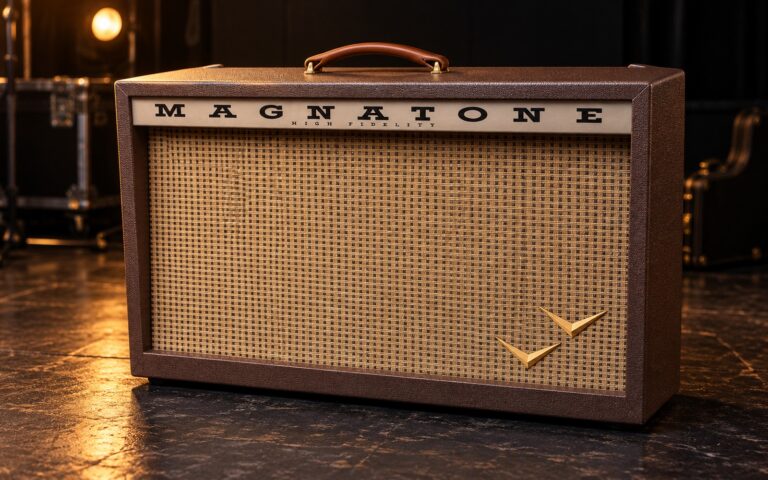
The Magnatone amplifier — produced by the Magna Electronics Company, whose specific vibrato circuit design used a unique pitch-shifting vibrato (as opposed to the more common amplitude-modulation tremolo that most “vibrato” amplifier circuits actually produced) — was the central element of Lonnie Mack guitars gear and the source of the specific tonal signature that distinguished “Memphis” and “Wham!” from every other guitar instrumental of the period. The Magnatone’s vibrato circuit used a specific phase-shift design (employing varistors — voltage-dependent resistors — in a configuration that varied the phase relationship between two signal paths, creating genuine pitch modulation rather than the volume modulation that “tremolo” circuits typically produced) to give a warbling, swooping pitch-vibrato effect unlike anything else commercially available. When applied to Mack’s already-distinctive Flying V tone, the Magnatone’s vibrato gave his sustained notes and bent notes a specific quality of liquid, swooning movement that became as identified with his sound as the Flying V itself.
The Magnatone’s specific construction — typically using 6V6 or 6L6 output tubes depending on the specific model, with the vibrato circuit’s varistor-based phase-shift design as its most distinctive feature — gave a warm, harmonically rich foundation onto which the vibrato added its specific swooping character. Mack’s amplifier settings typically used the vibrato at a relatively fast rate and moderate-to-deep intensity — giving sustained notes and bent notes their characteristic liquid quality without overwhelming the underlying tone’s clarity. The combination of the Flying V’s humbucker warmth and the Magnatone’s vibrato gave “Memphis” and “Wham!” their instantly recognisable sonic signature — a combination that subsequent guitarists who wanted to capture a similar quality found genuinely difficult to replicate without the specific Magnatone circuit, since standard tremolo circuits (volume modulation) produced a fundamentally different effect from the Magnatone’s genuine pitch-vibrato.
As Mack’s career continued across decades, various other amplifiers appeared in his touring and recording setups — standard Fender and other American amplifiers giving more conventional amplification when the specific Magnatone vibrato character wasn’t required or when Magnatone amplifiers (which became increasingly rare as the company’s production ended) weren’t available. His later-career setups reflected the practical reality of touring musicians adapting to available equipment while maintaining the Flying V as the consistent visual and tonal signature.
Effects
The Magnatone’s built-in vibrato circuit functioned as Mack’s primary “effect” in the sense that subsequent guitarists would understand effects — a specific tonal modification integral to his signature sound, even though it was built into the amplifier rather than added through an outboard pedal (effects pedals as a widespread guitar accessory category were still in their infancy in the early 1960s). The vibrato’s specific phase-shift pitch modulation gave his sustained and bent notes their characteristic liquid quality, functioning compositionally (as an integral element of “Memphis” and “Wham!”‘s specific musical identity) rather than merely decoratively.
Built-in amplifier reverb — whether from the Magnatone’s own reverb circuit (some Magnatone models included reverb alongside the vibrato) or from supplementary amplification — gave Mack’s recordings their atmospheric spatial dimension, consistent with the general early-1960s American guitar instrumental tradition’s use of reverb for atmospheric depth (the surf guitar tradition’s extensive reverb use being the most extreme example of this general period tendency).
The specific saturation character of “Memphis” and “Wham!” — present but relatively restrained by later rock standards — came from the natural saturation of the Magnatone’s output stage when driven by the Flying V’s humbucker output at performance volumes, rather than from any dedicated distortion device (which, again, were not yet widely available guitar accessories in 1963). This natural-saturation approach — the amplifier itself providing whatever harmonic complexity the recording required, without dedicated distortion devices — was the standard approach for guitarists of this period, and Mack’s specific combination of Flying V output and Magnatone saturation gave his recordings their characteristic edge without requiring any device beyond the guitar and amplifier themselves.
Playing Style & Tone Philosophy
Lonnie Mack is one of the most genuinely foundational guitarists in this entire series — a player whose specific combination of techniques and tonal choices, demonstrated on a pair of 1963 recordings, established a vocabulary for rock lead guitar that the subsequent decades of guitar heroes would develop, refine, and ultimately receive far more credit for than Mack himself ever did. His playing on “Memphis” and “Wham!” combined several elements that, individually, had precedents in earlier guitar playing but that, in combination and at the specific tempo and intensity Mack deployed them, created something genuinely new.
His speed — “Wham!” in particular features guitar playing of a velocity that was genuinely unusual for 1963, predating the “guitar hero” speed-as-virtuosity tradition that would become central to rock guitar from the late 1960s onward — demonstrated that the electric guitar could be played with the kind of rapid, sustained melodic motion that had previously been more associated with horn players or pianists than with guitarists. His specific picking technique — combining alternate picking with the specific physical approach that the heavier strings of the period required — gave this speed a tonal substance that lighter-string, higher-gain approaches of later decades would produce differently.
His blues feeling — the bent notes, the call-and-response phrasing, the specific emotional directness that connected his playing to the blues tradition despite his Midwestern, country-adjacent background — gave his speed musical meaning rather than mere technical display. The combination of speed and blues feeling — fast playing that nonetheless had the bent-note vocabulary and phrasing logic of blues guitar — was itself one of his most influential contributions: subsequent “blues-rock” guitarists (a category that essentially didn’t exist as a recognised genre in 1963) would build entire careers on this combination, often without recognising Mack as among its first practitioners.
His specific tonal signature — the Flying V’s humbucker warmth combined with the Magnatone’s pitch-vibrato — gave his recordings an immediately identifiable sonic character that, because the Magnatone vibrato circuit was both relatively rare and genuinely difficult to replicate with other amplifiers’ tremolo circuits, remained specifically his own in a way that few subsequent guitarists’ tonal signatures (more often built from widely available equipment combinations that other players could straightforwardly replicate) achieved. The Magnatone vibrato’s genuine pitch modulation — as opposed to the volume modulation of standard tremolo — gave sustained and bent notes a quality of liquid movement that became permanently associated with “Memphis” and “Wham!” specifically.
Tonally, Lonnie Mack guitars gear philosophy was built on the combination of a rare, historically significant instrument (the 1958 Flying V) with a specific and relatively uncommon amplifier circuit (the Magnatone vibrato) — giving a tonal signature that was genuinely distinctive without requiring any dedicated effects devices, since the period’s technology hadn’t yet made such devices widely available. His specific achievement was demonstrating what was possible with guitar, amplifier, and genuine musical ability alone — years before the explosion of guitar effects technology gave subsequent guitarists additional tools for achieving tonal distinctiveness.
The Gibson Flying V’s 1958 commercial failure — and the specific circumstances that gave Mack access to one of the first seven production examples — deserves expanded examination because it illuminates the broader pattern of “failed” guitar designs becoming historically significant decades after their commercial rejection, a pattern documented repeatedly throughout this series (the Jazzmaster, the Jaguar, the Mustang, the SG to a lesser extent). Gibson’s 1958 “Modernistic” series — which included the Flying V and the equally angular Explorer — represented the company’s attempt to compete with Fender’s growing commercial success by offering radically futuristic body designs that broke completely from the traditional archtop and Les Paul aesthetics that had defined Gibson’s identity. The Flying V’s specific design — the V-shaped body that gave the guitar its name, with the neck emerging from the body’s point — was visually striking but commercially unsuccessful: reports suggest fewer than 100 examples were produced in the initial 1958 run before Gibson discontinued the model, not reintroducing it until a 1967 reissue that itself had limited initial success before the Flying V’s gradual rehabilitation through use by prominent guitarists (including Albert King, Jimi Hendrix, and eventually the heavy metal guitarists documented earlier in this series) gave it the iconic status it eventually achieved. For Mack, acquiring one of these original 1958 examples — “Number Seven” — meant that by the time “Memphis” made the Flying V’s sound famous in 1963, he possessed one of a tiny handful of examples in existence, an instrument whose rarity (whether by design or accident) gave his sound a literal uniqueness that few subsequent guitarists, regardless of their access to Flying V reissues, could fully replicate with the original instrument’s specific aged-PAF tonal character.
King Records’ specific position in American music history — and how it shaped the recording context that produced “Memphis” and “Wham!” — deserves examination because the label’s genre-crossing approach was unusual for the period and gave Mack’s specific genre-crossing music a receptive context that more genre-segregated labels might not have provided. King Records, founded by Syd Nathan in Cincinnati in 1943, built its business on a specific strategy: recording across multiple genres (country, R&B, gospel, and eventually rock and roll) often with overlapping personnel and recording facilities, and frequently having artists from one genre cover material associated with another genre — country artists covering R&B hits, R&B artists covering country material — as a way of maximising the commercial potential of successful songs across different radio formats and audience segments. This genre-crossing business strategy, while primarily commercially motivated, created a recording environment where a guitarist like Mack — whose own musical formation crossed country, blues, and rock and roll boundaries in ways that more genre-purist labels might have found awkward to market — could record material that didn’t fit neatly into a single genre category without that being treated as a problem. “Memphis” itself exemplified this: an instrumental guitar rendition of a Chuck Berry rock and roll song, recorded by a guitarist with a country-and-blues Midwestern background, released by a label whose entire business model was built around exactly this kind of genre-crossing material. Lonnie Mack guitars gear, in this context, was deployed within a specific commercial and cultural environment that was unusually well-suited to its genre-crossing character — a fortunate alignment between artist and label that more conventional label relationships might not have provided.
The varistor-based phase-shift vibrato circuit that gave Magnatone amplifiers their distinctive sound deserves further technical explanation because the specific electronic principle is genuinely unusual relative to the tremolo circuits found in most vintage American amplifiers. A varistor (variable resistor, specifically a voltage-dependent resistor whose resistance changes based on the voltage applied across it) can be used to create a circuit whose phase response varies as the varistor’s resistance is modulated by a low-frequency oscillator. When this phase-shifting circuit is applied across two parallel signal paths and the paths are then recombined, the varying phase relationship between the paths creates genuine frequency modulation of the combined signal — the perceived pitch of the note actually rises and falls cyclically, which is the technical definition of vibrato (as distinct from tremolo, which is amplitude/volume modulation without pitch change). Most vintage Fender amplifiers’ “vibrato” channels (the Fender Vibrolux, Vibroverb, and similar models, despite their “vibrato” naming) actually produce tremolo — volume modulation via a bias-varying oscillator affecting the power tubes’ operating point — which is perceptually quite different from genuine pitch-vibrato. The Magnatone’s varistor-based phase-shift circuit was one of the few widely available production amplifier circuits to produce genuine pitch-vibrato, and this specific technical distinction — pitch modulation versus volume modulation — is precisely why the Magnatone sound proved so difficult for subsequent guitarists to replicate using the far more common Fender-style tremolo circuits: no amount of adjusting a volume-modulation tremolo circuit can produce the specific liquid, swooping quality of genuine pitch modulation.
How to Sound Like Lonnie Mack
Guitar Approach
A Gibson Flying V (1967 reissue specification or current production Gibson Flying V, since 1958 originals are essentially unobtainable museum pieces) with PAF-specification humbuckers (Gibson 57 Classic or equivalent) is the foundational Lonnie Mack guitars gear instrument. Heavier strings than contemporary standard (.011 or .012 on the high E) for the physical resistance and tonal fullness appropriate to the period style. The specific technique combination: alternate picking at speed for the fast passages, combined with blues-vocabulary bending and phrasing — the speed should have blues feeling, not merely technical display.
Amp Approach
A genuine Magnatone amplifier (increasingly rare and valuable, but the specific source of the signature vibrato character) or, as a more accessible alternative, an amplifier with a genuine pitch-vibrato circuit rather than standard volume-modulation tremolo — some boutique amplifier manufacturers have produced Magnatone-vibrato-inspired circuits specifically because the original Magnatone character is so difficult to replicate with standard tremolo.
| Control | Setting (0–10) | Notes |
|---|---|---|
| Amplifier Volume | 7–8 | High enough for natural saturation — the Flying V’s humbuckers should drive the amp into its characteristic edge |
| Magnatone Vibrato Rate | 6–7 | Moderately fast — gives sustained notes their characteristic swooping liquid quality |
| Magnatone Vibrato Intensity | 5–6 | Moderate-to-deep — present and identifiable without overwhelming pitch clarity |
| Reverb | 3–4 | Light — atmospheric depth consistent with early-1960s guitar instrumental tradition |
| Bass | 5 | Neutral — Flying V’s humbuckers give natural warmth; balance rather than emphasise |
| Treble | 6 | Present — gives the fast picking passages their definition and cut |
| Picking approach | Alternate picking, heavy attack | Period-appropriate heavier strings reward and require firm picking attack |
The Magnatone vibrato is the single most important and most specifically irreplaceable element of Lonnie Mack guitars gear — without genuine pitch-vibrato (as opposed to volume tremolo), the specific liquid quality of “Memphis” and “Wham!” cannot be approximated. The Flying V’s humbucker warmth combined with high amplifier volume for natural saturation. Heavier strings for period-appropriate tonal fullness. Alternate picking at speed combined with blues phrasing and bending vocabulary. The combination of speed and blues feeling — not merely speed alone — is what gave Mack’s playing its specific and enduringly influential character.
Influence & Legacy
Lonnie Mack’s influence on rock guitar is foundational but persistently under-credited — “Memphis” and “Wham!” established, years before the British blues-rock explosion and the American “guitar hero” tradition that followed it, that the electric guitar could carry an entire recording as a lead instrument through the combination of speed, blues feeling, and a distinctive tonal signature. The specific musicians who acknowledged this influence — Stevie Ray Vaughan recorded with Mack and has cited him as a foundational influence; numerous other blues-rock guitarists have acknowledged “Memphis” and “Wham!” as foundational listening — gave Mack a specific posthumous (he died in 2016) recognition within the guitar community that the broader public never fully extended.
His specific combination of country, blues, and rock and roll vocabulary — appropriate to his Midwestern, genre-crossing background — gave subsequent “blues-rock” (a genre category that essentially developed in his wake, even if not directly because of him in every case) a model for what the combination could sound like when executed with genuine ability rather than merely as a marketing category.
The comparison with Magic Sam — the Chicago blues guitarist whose own combination of speed and emotional intensity gave Chicago blues guitar one of its most influential voices in a different regional and stylistic context — illuminates the broader landscape of early-1960s American blues guitar from which the British blues-rock explosion would draw so heavily. The parallel with Dave Alvin — whose Blasters work similarly combined American roots traditions (rockabilly, blues, country) into a synthesis that owed something to the same Midwestern and Southern crossroads that shaped Mack’s formation — shows the continuing American tradition of genre-crossing roots guitar that Mack’s work anticipated. And the connection to Gary Moore — whose own blues-rock guitar work, decades later, demonstrated the specific combination of speed and blues feeling that Mack had pioneered, now fully absorbed into the mainstream blues-rock vocabulary that Mack’s work had helped establish — places Lonnie Mack guitars gear at the genuine origin point of a guitar tradition whose subsequent practitioners often received far more recognition than its pioneer.
Frequently Asked Questions: Lonnie Mack Guitars & Gear
What guitar did Lonnie Mack play?
Lonnie Mack’s primary and most historically significant guitar was a 1958 Gibson Flying V — one of the earliest production examples of Gibson’s V-shaped solid-body design, nicknamed “Number Seven” in reference to its place among the first production examples. The Flying V’s PAF humbucking pickups gave his playing its warm, full tonal foundation. As his career continued, various subsequent Flying V instruments (including Gibson reissues) appeared in his setup, but the original 1958 “Number Seven” remained the historically definitive instrument associated with his sound.
What amplifier did Lonnie Mack use?
Mack’s signature amplifier was the Magnatone — specifically valued for its unique vibrato circuit, which used varistor-based phase-shift to create genuine pitch modulation (true vibrato) rather than the volume modulation (“tremolo”) that most amplifier “vibrato” circuits actually produced. This Magnatone vibrato, combined with the Flying V’s humbucker warmth, gave “Memphis” and “Wham!” their distinctive liquid, swooping tonal signature. Various other amplifiers appeared in his later touring setups as Magnatone amplifiers became increasingly rare.
What is “Memphis” and why was it significant?
“Memphis” (1963) is Lonnie Mack’s instrumental rendition of Chuck Berry’s “Memphis, Tennessee,” recorded reportedly as a warm-up during another artist’s recording session at King Records in Cincinnati. The recording’s quality caught the engineers’ attention and it was released as a single, reaching the Billboard Top 5. Its significance: it demonstrated, years before the British blues-rock explosion and the American “guitar hero” tradition, that an instrumental electric guitar recording — guitar as the primary melodic and expressive voice, without vocals — could achieve mainstream commercial success on the strength of genuine guitar virtuosity and tonal distinctiveness.
What is “Wham!” and how does it differ from “Memphis”?
“Wham!” was the B-side to “Memphis” — an original Lonnie Mack composition (rather than a cover) that showcased his specific combination of speed and blues feeling even more directly than “Memphis” itself. Where “Memphis” demonstrated Mack’s ability to reinterpret an existing melody with guitar virtuosity, “Wham!” demonstrated his own compositional voice — fast, blues-inflected, and built around the same Flying V/Magnatone tonal signature. Both recordings, taken together, gave a complete picture of Mack’s specific guitar vocabulary at its first major public demonstration.
What is the Magnatone vibrato and why is it hard to replicate?
The Magnatone vibrato is a specific amplifier circuit using varistors (voltage-dependent resistors) in a phase-shift configuration that produces genuine pitch modulation — the note’s pitch actually rises and falls cyclically — rather than the volume modulation that standard “tremolo” circuits (found on most vintage Fender amplifiers, for example) produce. This distinction matters because pitch-vibrato and volume-tremolo are perceptually quite different effects despite both often being marketed as “vibrato” in period amplifier nomenclature. The specific Magnatone circuit was relatively rare even in its own time, and the company’s production history (ending years before “Memphis” made the sound famous, meaning Magnatone amplifiers were already becoming scarce when guitarists wanted to replicate Mack’s sound) made genuine examples increasingly difficult to obtain, giving subsequent guitarists who wanted Mack’s specific vibrato character a genuinely difficult equipment challenge.
How did Stevie Ray Vaughan relate to Lonnie Mack?
Stevie Ray Vaughan was a vocal admirer of Lonnie Mack’s foundational influence on blues-rock guitar, and the two musicians recorded together — Vaughan appeared on Mack’s 1985 album Strike Like Lightning, which Vaughan also helped produce, giving Mack a career resurgence connected to the broader blues-rock revival that Vaughan himself was central to. This collaboration gave explicit, high-profile acknowledgment from one of the 1980s’ most celebrated guitarists to one of the genre’s actual foundational figures — a rare instance of a “guitar hero” of a later generation directly crediting and working with a foundational predecessor whose influence the broader public had largely overlooked.
What happened to Lonnie Mack’s career after “Memphis” and “Wham!”?
Mack’s career after the immediate success of “Memphis” and “Wham!” followed a pattern common to many roots-music pioneers: continued recording and performing without matching the commercial impact of the initial hits, periods of relative commercial obscurity through the late 1960s and 1970s, and eventual rediscovery and career resurgence connected to the blues-rock revival of the 1980s (the Vaughan collaboration being the most prominent example). His specific position — too country for blues audiences, too blues for country audiences, recording for a Cincinnati label rather than the major blues or country centres — meant that his career never achieved the sustained mainstream recognition that his foundational influence would seem to warrant, though his standing within the guitar community itself remained consistently high among those aware of his work.

The broader question of why “Memphis” succeeded as an instrumental in 1963 — at a moment when vocal-led pop and rock and roll dominated the charts — connects to a brief but commercially significant tradition of guitar instrumentals in American popular music of the late 1950s and early 1960s. The Ventures, Duane Eddy, Link Wray, and various surf guitar acts had demonstrated that instrumental guitar recordings could achieve substantial commercial success, giving radio programmers and audiences a framework within which an instrumental guitar recording wasn’t an automatically uncommercial proposition. Within this context, “Memphis” succeeded not merely because instrumentals were commercially viable in the abstract, but because Mack’s specific combination of recognisable melody (Chuck Berry’s already-familiar song), genuine guitar virtuosity, and a distinctive tonal signature (the Flying V/Magnatone combination) gave it both familiarity (the melody) and novelty (the specific guitar treatment) simultaneously. This combination — familiar melodic material treated with genuinely novel instrumental virtuosity and tonal character — gave “Memphis” a specific appeal that distinguished it from both purely novelty instrumentals and from guitar instrumentals that were merely technically accomplished without distinctive tonal character. Lonnie Mack guitars gear, in this context, was not merely technically impressive but specifically marketable — the Flying V’s visual distinctiveness (a guitar shape unlike anything else commercially available) combined with the Magnatone’s tonal distinctiveness gave “Memphis” a complete sensory identity that radio audiences, even without seeing Mack perform, could recognise through the recording’s specific sonic character alone.
Mack’s vocal career — often overshadowed by his guitar instrumental fame but a significant part of his complete musical identity — deserves brief acknowledgment because it illuminates the breadth of his musical formation beyond the specific guitar instrumental moment that “Memphis” and “Wham!” represent. Mack was a genuinely accomplished vocalist in the soul and blues traditions, and much of his recorded output across his career featured his vocals alongside his guitar work — material that, while less commercially impactful than the instrumental hits, demonstrated the same combination of country, blues, and soul influences that shaped his guitar playing. This vocal dimension gives important context for understanding “Memphis” and “Wham!” themselves: these instrumentals were not the work of a guitarist who couldn’t sing finding an instrumental niche, but specific artistic statements by a complete musician whose guitar playing carried the same emotional and stylistic vocabulary as his singing. The instrumental format gave that guitar vocabulary room to be the primary expressive voice without competing with vocal melody — but the vocabulary itself drew from the same wells (blues phrasing, country directness, soul emotional intensity) that informed his singing. Lonnie Mack guitars gear, deployed in service of “Memphis” and “Wham!”‘s instrumental format, was ultimately expressing the same complete musical personality that his vocal recordings expressed through a different primary voice.
The specific historical position “Memphis” and “Wham!” occupy — recorded in 1963, three years before the British blues-rock explosion (Cream formed in 1966, the Jeff Beck Group and Led Zeppelin followed shortly after) that is conventionally credited with establishing “guitar hero” lead guitar as a central rock phenomenon — deserves emphasis because it locates Mack’s specific achievement at a genuine point of origin rather than as part of an already-established trend. When British guitarists including Eric Clapton, Jeff Beck, and Jimmy Page began developing the extended, virtuosic, blues-based lead guitar approaches that would define late-1960s rock guitar, American blues guitarists (Chicago blues figures, Texas blues figures, and players like Mack working in genre-crossing contexts) had already demonstrated many of the same fundamental elements — speed, blues feeling, sustained lead lines as primary musical content — years earlier, often in recordings that achieved greater immediate commercial success than the early work of the British guitarists who would later receive more historical credit for “inventing” the guitar hero phenomenon. This is not to diminish the British guitarists’ genuine contributions — their specific synthesis, their specific tonal innovations (Marshall amplification at higher gain, for instance), and their specific cultural impact were real and significant — but to correctly locate “Memphis” and “Wham!” as evidence that the fundamental elements of what would become “guitar hero” rock guitar were present in American recordings years before the British explosion gave those elements their most historically celebrated expression. Lonnie Mack guitars gear represents one of the clearest documented instances of this earlier American foundation — a foundation that subsequent rock guitar history often acknowledges only in passing, if at all, despite its genuine chronological priority.

The string-gauge practices of Mack’s era — heavy strings by contemporary standards, often with a wound third string rather than the plain third strings that became standard with lighter-gauge sets — gave guitarists of his generation a fundamentally different physical relationship to the instrument than players using contemporary light-gauge sets experience. A wound G string (the third string) has a fundamentally different bending feel and tonal character from a plain G string: the wound construction gives more mass and a different harmonic profile, but also more resistance to bending, requiring greater physical effort to achieve the same pitch interval. Mack’s specific bending vocabulary — developed on heavy strings with a wound third — would have required more physical strength and would have produced a specific tonal quality (the wound string’s harmonic complexity during a bend) that the plain-third light-gauge sets standard since the mid-1960s (popularised partly by the British blues-rock guitarists’ adoption of lighter strings for easier bending at speed) don’t replicate. For guitarists attempting to genuinely replicate Lonnie Mack guitars gear’s specific bending character, the heavier, wound-third string configuration represents a meaningful technical difference — not merely a historical curiosity but a specific factor in how bent notes sound and feel, and therefore in how a player’s bending vocabulary develops. The transition from heavy wound-third strings to lighter plain-third strings across the 1960s represents one of the more significant but less-discussed equipment evolutions in the history of electric guitar technique, and Mack’s recordings document guitar playing from before that transition was complete.
Finally, Lonnie Mack guitars gear deserves consideration as a case study in how musical influence can be genuine, traceable, and substantial while remaining largely invisible to broader public recognition. The mechanisms by which influence typically becomes publicly recognised — sustained commercial success, prominent media coverage, induction into highly visible institutions — often correlate imperfectly with the actual structure of musical influence, which frequently flows through specific musician-to-musician transmission (one guitarist hearing and absorbing another’s specific innovations) that doesn’t require or produce broad public awareness of the original source. Mack’s specific innovations — demonstrated in two 1963 recordings — were absorbed by subsequent guitarists through exactly this kind of direct transmission: hearing “Memphis” and “Wham!,” recognising the specific combination of speed, blues feeling, and tonal signature as something worth absorbing, and incorporating elements of that combination into their own subsequent playing, often without the broader public ever connecting the dots between the absorbed elements and their original source. This pattern — genuine influence without proportional recognition — is not unique to Mack, but his case is among the clearest documented examples in American rock guitar history: a foundational moment, acknowledged by those who built on it, but never achieving the kind of broad cultural recognition that its actual historical importance would seem to warrant. Understanding Lonnie Mack guitars gear fully means understanding both the specific equipment and technique that produced “Memphis” and “Wham!,” and the specific historical pattern by which genuinely foundational musical innovations can remain underappreciated even as their influence continues to shape the music that more visible figures receive credit for.
Image credits
- Gibson PAF humbuckers (1958 specification, primary pickup): GuitarGangsters AI-generated reference illustration, not a photograph.
- Jeff Beck: Shannon Kringen, Wikimedia Commons, CC BY-SA 2.0.
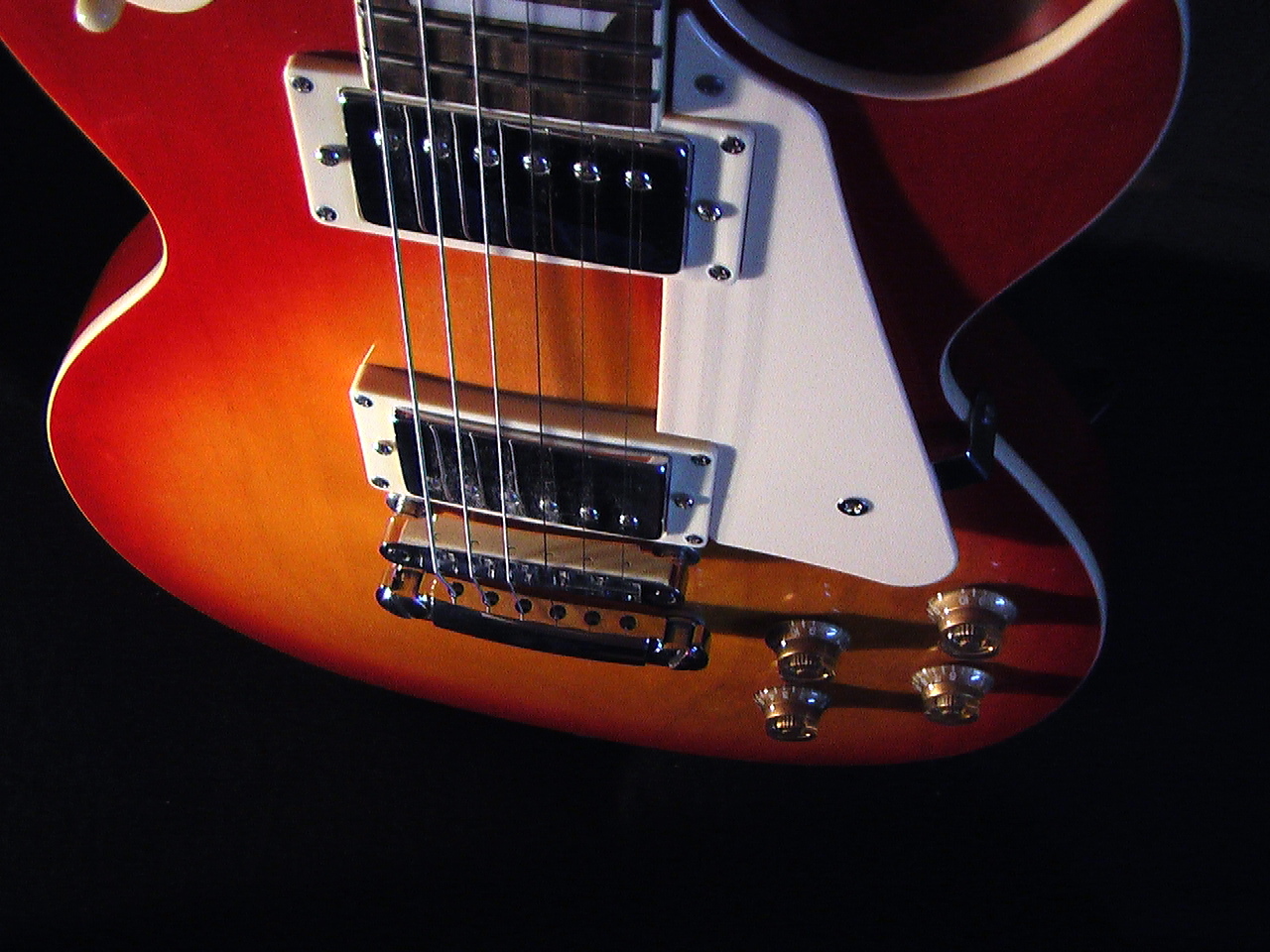
- A close view of a Gibson Les Paul body and bridge: Delhovlyn, Wikimedia Commons, CC BY-SA 3.0.
- Jeff Beck: Shannon Kringen, Wikimedia Commons, CC BY-SA 2.0.
- Gibson Flying V: Monika Fischer (retouch: Auge=mit), Wikimedia Commons, CC BY-SA 2.5.