Rory Gallagher Guitars & Gear: The Most Honest Rig in Rock
Rory Gallagher guitars gear — battered '61 Strat and Vox AC30 deep-dive for the Irish blues rock icon's raw tone, slide technique, and complete effects chain.
Heinrich Klaffs
When you research Rory Gallagher guitars gear, you quickly realize something that sets this Irishman apart from virtually every other guitarist in the blues rock canon: the man played one guitar for most of his career, bought it secondhand as a teenager, and wore it down to bare wood through sheer force of sweat, passion, and relentless touring. No endorsement deal, no signature model vanity, no rack of identical spares — just a battered 1961 Fender Stratocaster, a handful of honest amplifiers, and enough raw conviction to make Eric Clapton admit he was intimidated.
This guide tears into every detail of Rory Gallagher’s rig: the legendary Strat and why its particular combination of specs produced that voice, the Vox AC30s and Fender Bassmans he hammered into submission night after night, the effects chain that added colour without ever masking the music, and the specific techniques that made him one of the most physically committed players the guitar has ever seen. Whether you’re a tone chaser trying to dial in that Cork grit or simply a fan who wants to understand why his equipment sounded the way it did, this is your definitive deep dive.
Background
William Rory Gallagher was born on 2 March 1948 in Ballyshannon, County Donegal, and grew up primarily in Cork, Ireland. He started playing guitar at around seven years old, initially drawn to skiffle and then rapidly consumed by American blues — Robert Johnson, Muddy Waters, Leadbelly, Lonnie Donegan — music that was reaching Ireland in fragments through Radio Luxembourg and the rare imported record. By his early teens he was performing professionally with the Fontana Showband and then Impact, touring Ireland in the circuit that formed the backbone of the country’s live music economy in the early 1960s.
In 1965, Gallagher formed Taste, a power trio that became one of Ireland’s most potent live acts and eventually made significant waves on the UK blues circuit, sharing stages with Cream and Blind Faith. Taste released two studio albums and a landmark live album — Live at the Isle of Wight — before internal tensions dissolved the band in 1970. Gallagher immediately went solo, releasing his debut solo album in 1971 and never really stopping until his death in June 1995 from complications related to a liver transplant.
What defined Gallagher’s career was volume and consistency of output: he released twelve studio albums, multiple live records, and toured incessantly, playing three-hour sets with the physical commitment of a man who believed every show could be the last one anybody ever saw. He played everywhere — arenas, pub venues, stadiums in Ireland and Germany where he was worshipped with near-religious devotion. He never broke America the way contemporaries did, partly by choice, partly by circumstance, but his reputation among fellow guitarists was astronomical. Hendrix’s “best guitarist alive” quote may be apocryphal or misattributed, but the reverence from peers like Clapton, Beck, Page, and Stevie Ray Vaughan was entirely real and entirely documented.
Throughout all of it — the showbands, Taste, twenty-five years of solo work — the gear barely changed. That’s the whole point. Gallagher wasn’t pursuing the latest technology; he was pursuing a sound he heard inside his head, and the equipment was simply the most direct path to it.
Rory Gallagher Guitars Gear: The Complete Rig
Guitars
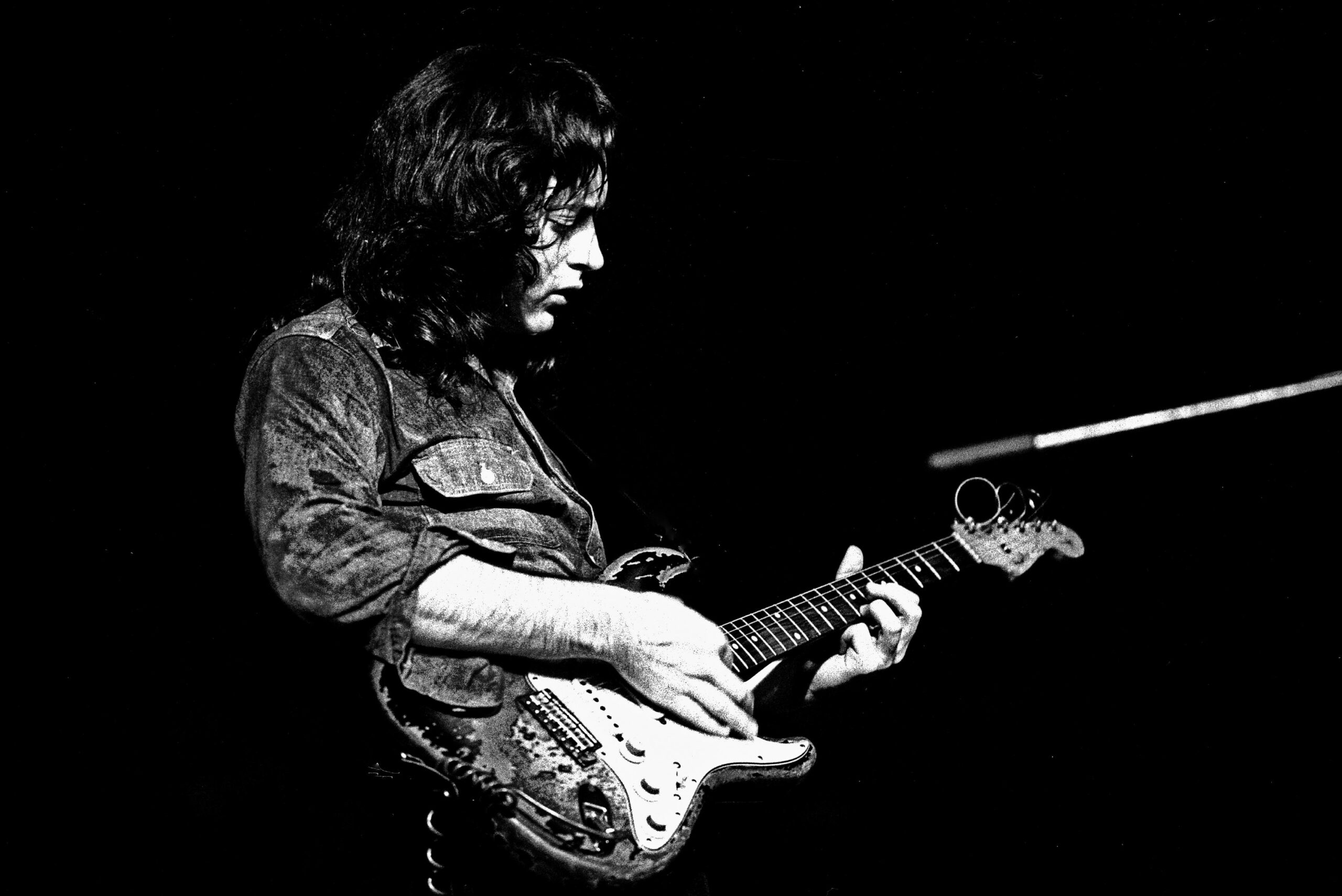
The story starts and nearly ends with a single instrument: Rory Gallagher’s 1961 Fender Stratocaster, serial number 64351, purchased secondhand in Cork in 1963 for £100. It is among the most famous — and most visually striking — guitars in rock history, and by the time Gallagher died, it had been worn to the point where the sunburst finish was almost entirely gone, the body showing bare alder wood across much of its surface, and the neck worn through to bare maple in virtually every place his hand would grip it.
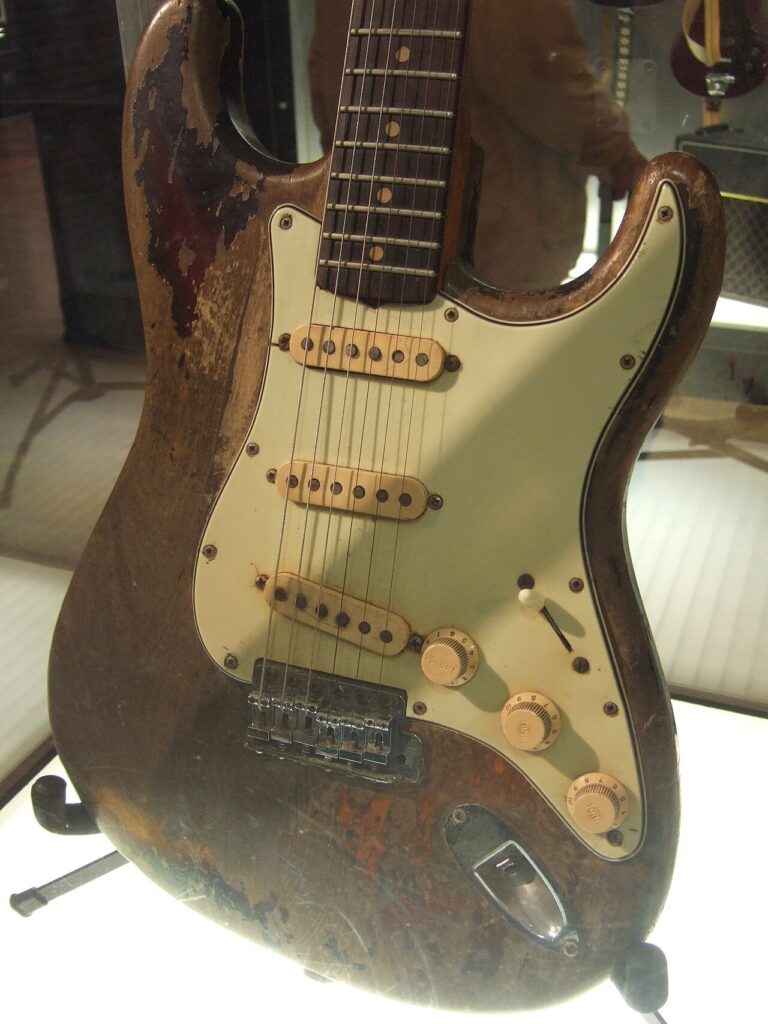
Let’s establish the specs, because they matter enormously to the tone. The guitar is an early-’61 Stratocaster, which places it in a transitional period for Fender. The body is alder, the standard Fender choice for Stratocasters from 1956 onwards (pre-CBS models with ash bodies being the exception for blonde or transparent finishes). The neck is maple with a rosewood fingerboard — Fender switched from one-piece maple necks to rosewood-capped necks beginning in late 1959, so this is absolutely a period-correct slab rosewood board, which adds a certain warmth and softness to the upper-mid attack compared to maple-board Strats. The nut width is 1.650 inches, standard for the period.
The pickups are the critical element. The 1961 Strat came equipped with three original Fender single-coil pickups wound to the specs of that era — typically around 5.8k to 6.2k ohms DC resistance, using Alnico V magnets in the bridge and middle positions and Alnico V in the neck as well (though some early ’60s guitars used Alnico III in the neck, which produces a slightly warmer, softer response). The staggered pole pieces compensate for the varying string heights of a period setup. These pickups are brighter and more aggressive than later CBS-era replacements, with a clarity in the top end that became Gallagher’s harmonic trademark.
Over the decades, the guitar was repaired, refretted multiple times, and had various parts addressed, but Gallagher was insistent that the core instrument — body, pickups, neck — remained original. The Stratocaster’s five-way switch (which in the original ’61 configuration was actually a three-way switch; the five-position “notch” trick was a later player modification that Fender didn’t standardise until 1977) was occasionally used for the in-between positions, giving that classic out-of-phase quacky tone that appears in some of his cleaner work.
Beyond the famous Strat, Gallagher used a number of other guitars, particularly during recording sessions or when the Strat needed attention. His 1932 National Style O resonator guitar was used extensively for his acoustic and slide work — a single-cone resonator in the characteristic round-neck Style O configuration, which Gallagher would play both in open tunings for slide and in standard tuning for fingerpicked parts. The instrument has a particular plaintive, metallic weep to it that appears all over his acoustic recordings.
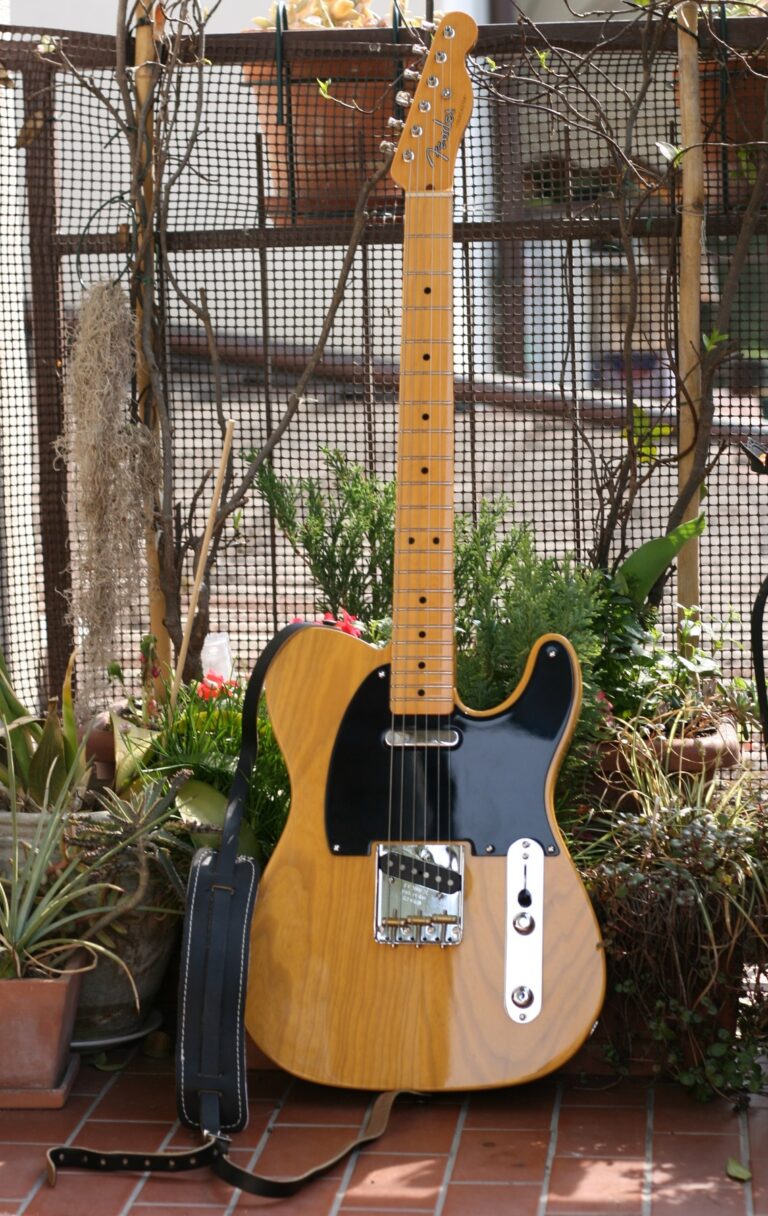
He also played a Fender Telecaster at various points, a guitar that suited his raw, direct approach perhaps even better than the Strat in some respects — particularly for the country-blues and rock’n’roll-influenced material. A Martin 000-28 acoustic appeared for folk and singer-songwriter material, and he occasionally used a Gretsch Corvette and a Gibson Les Paul Special during Taste-era recordings. But nothing in his collection defined him the way that ’61 Strat did. The other guitars were tools; the Strat was a extension of his own body.
String gauge is worth noting: Gallagher played relatively heavy strings by blues-rock standards, typically .010–.046 or occasionally .011–.050, which contributed enormously to the thickness and sustain of his tone even through relatively modest amplification. Heavy strings require more physical effort — and Gallagher had the hands for it, having built his technique through years of relentless playing rather than carefully managed studio sessions.
Amps
Rory Gallagher’s amplifier choices were consistently focused on British valve designs that could deliver clean headroom, natural valve breakup, and the kind of three-dimensional midrange response that flatters a Stratocaster’s single-coil pickups. He wasn’t a Marshall wall-of-stacks man — that wasn’t his music — but he wasn’t a delicate boutique amp aficionado either. He hit his amplifiers hard.
The centrepiece of his rig for much of his career was the Vox AC30 Top Boost. The AC30 — specifically the late 1960s and early 1970s variants he used — is a 30-watt combo running four EL84 output valves in two parallel pairs, cathode biased, which gives the amp its characteristic compression and harmonic richness when driven. The Top Boost channel adds treble and bass controls to the standard AC30 Normal channel, which has only a volume control, and it was the Top Boost channel that Gallagher primarily used. The output transformer in the AC30 is relatively modest, which contributes to the early saturation when pushed — Gallagher would run the amp into significant overdrive, letting the EL84s compress and sag in a way that produced a complex, multi-harmonic breakup quite unlike a Marshall’s more aggressive EL34-driven character.
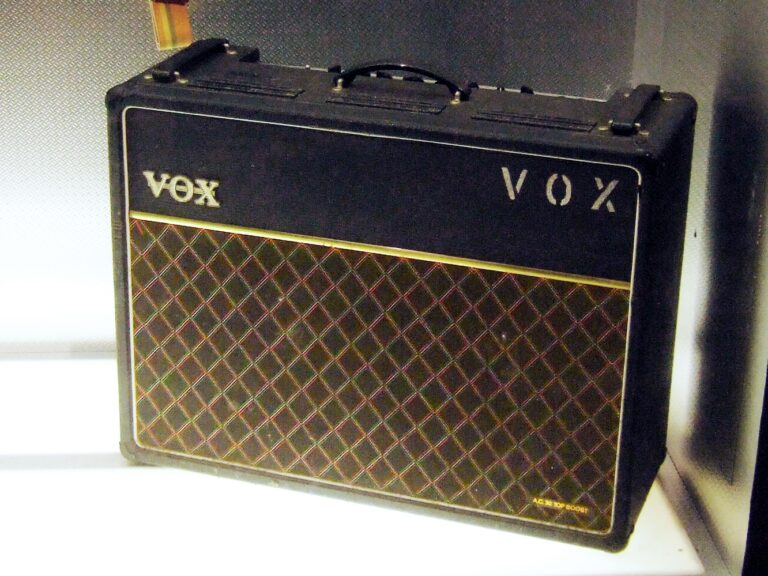
The speakers in his AC30 were the crucial detail: original Celestion Silver Alnico (T530) speakers, commonly referred to as Blues or Silvers depending on the era. These 12-inch alnico-magnet speakers handle 15 watts each, and their combination of sensitivity, midrange warmth, and gentle top-end roll-off complements the inherent brightness of a Stratocaster perfectly. They break up at lower volumes than ceramic-magnet equivalents, adding their own smooth compression to the signal chain. The pairing of EL84-driven AC30 with alnico Celestions and a single-coil Strat is one of the most harmonically complete amp-and-guitar relationships in the blues rock world.
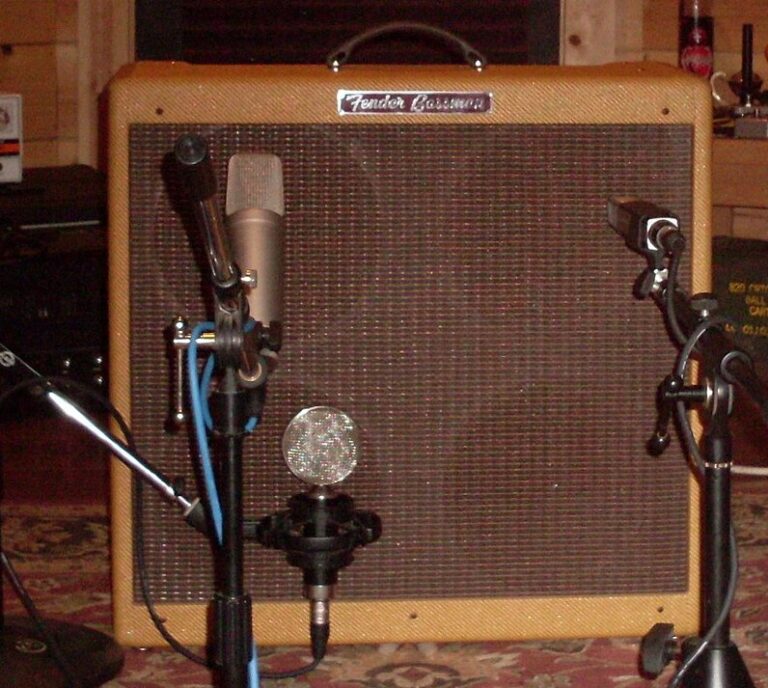
Gallagher also used Fender Bassman amplifiers extensively, particularly the late-1950s and early-1960s 4×10 combo versions. The Bassman was originally designed as a bass amplifier (naturally), but guitarists rapidly discovered that its 6L6 output valve configuration, cathode-follower tone stack, and Jensen P10R speakers produced a warm, rich, relatively clean tone that was perfect for blues. Gallagher would pair a Bassman with the AC30 for a layered sound — the Fender warmth and bottom end complementing the Vox’s chimey top end.
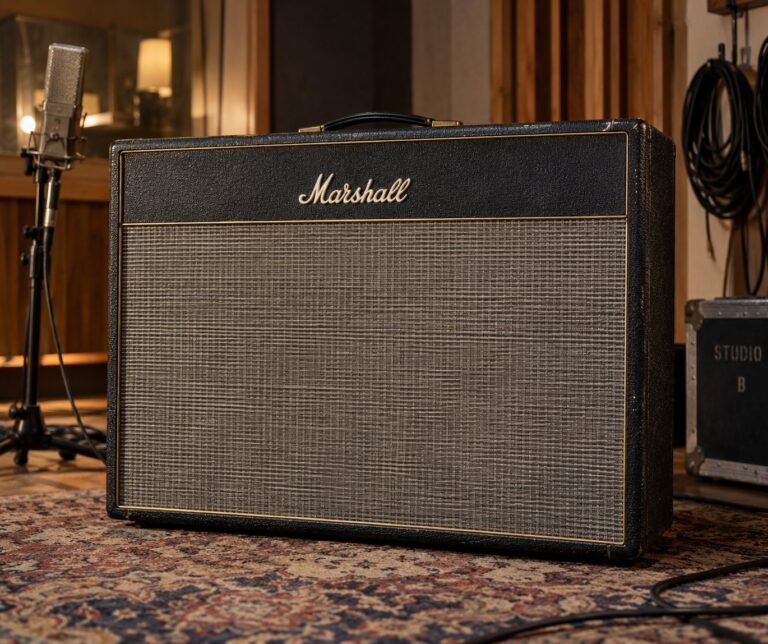
The Marshall 1962 Bluesbreaker combo — the 2×12 combo famously associated with Clapton’s Beano album — also appeared in Gallagher’s arsenal at various points, particularly during Taste. The Bluesbreaker runs EL34 output valves at around 35 watts, with a character notably different from the Plexi heads: less preamp gain, more output stage warmth, a rounder attack. It’s a wonderful amp for blues, and Gallagher understood exactly what it offered.
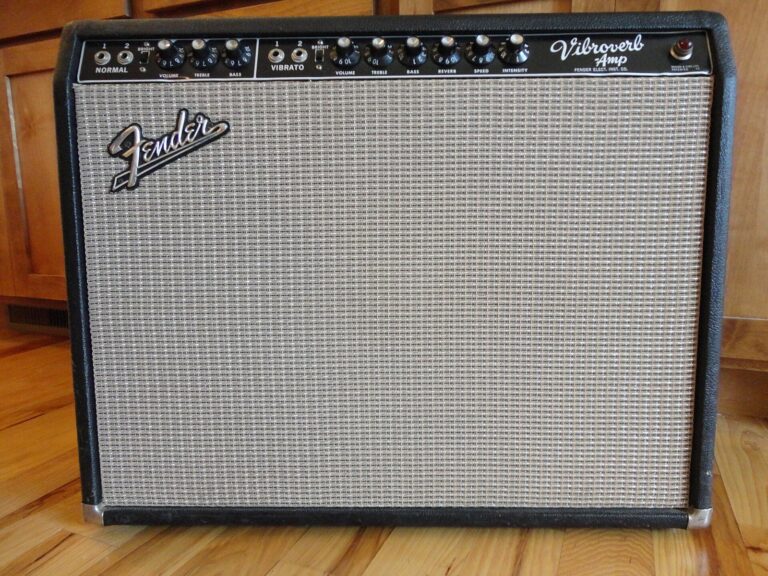
Later in his career, Gallagher also used Fender Vibroverb amplifiers — the blackface 1964 version with the 15-inch speaker — for certain recording sessions and tours, particularly for his slide work where the amp’s reverb circuit added the requisite space and bloom. The 6L6-based Vibroverb at lower gain settings produces a crystalline, almost vocal clean tone that slides across like silk under a glass bottleneck.
Effects
Rory Gallagher’s effects use was restrained and purposeful — he wasn’t a pedalboard architect, he was a guitarist who used specific tools for specific sounds. His chain was, by the standards of the era, relatively simple, and that simplicity is part of why every note he played had weight and definition rather than being lost in layers of processing.
The Vox Treble Booster was perhaps his most important effect — a germanium-transistor-based treble booster that increased the high-frequency content of the signal hitting the amplifier’s input. Treble boosters were widely used in the British blues rock scene (Tony Iommi, Brian May, and Ritchie Blackmore all used variants), and for good reason: they push the amp’s preamp stage into saturation while emphasising the top end, which helps a single-coil guitar cut through a loud stage mix. The germanium transistor (typically an OC44 or similar PNP germanium type) adds its own mild harmonic softness to the signal that silicon transistors don’t replicate. With the Vox AC30’s naturally chimey character and the Strat’s inherent brightness, the treble booster pushed everything into a zone of harmonically complex, singing overdrive.
A Dallas Rangemaster — the archetypal British treble booster, using a Mullard OC44 germanium transistor, introduced in 1965 — was another boost device in his collection, offering a slightly different voicing to the Vox unit. The Rangemaster passes frequencies above approximately 500Hz while cutting bass, which means it’s adding gain to the midrange and treble without muddying the low end — exactly what you want when running a Strat into a valve amp on stage.
For fuzz, Gallagher used a Hornet Fuzz pedal — a British-made unit from the late 1960s that used germanium transistors. The Hornet is less common than the Tone Bender or Fuzz Face but occupies a similar sonic territory: a loose, organic, velvet-textured fuzz with a particular vocal mid character that works well with single-coil pickups. He also used a Univox Super-Fuzz at various points, a silicon-transistor octave fuzz with a particular honking mid peak around 1kHz that gives it an almost synthesiser-like quality when engaged — apparent on some of his heavier studio recordings.
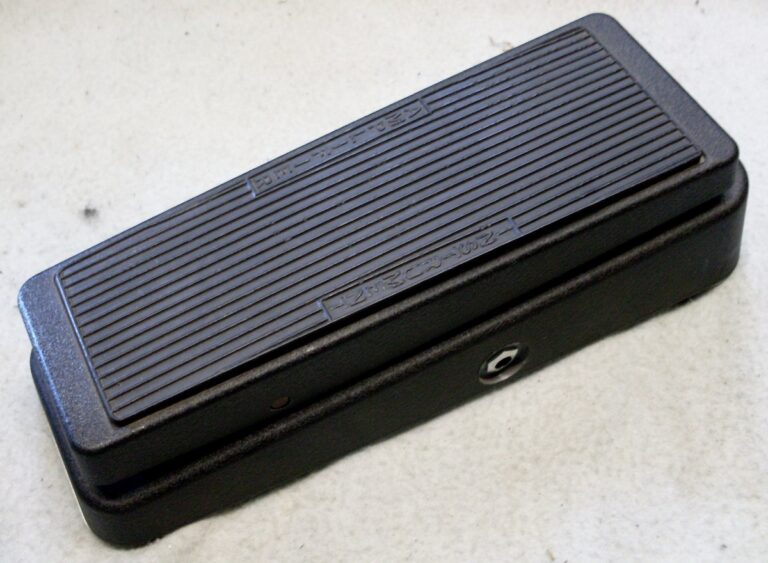
A Dunlop Cry Baby wah pedal appeared regularly in his signal chain for both straight wah effects and as a fixed filter — leaving the pedal rocked slightly forward to boost midrange frequencies without sweeping it, creating a permanent vowel character to the tone. This technique was common among blues players of his generation and has a surprisingly dramatic effect on the perceived voice of the guitar.
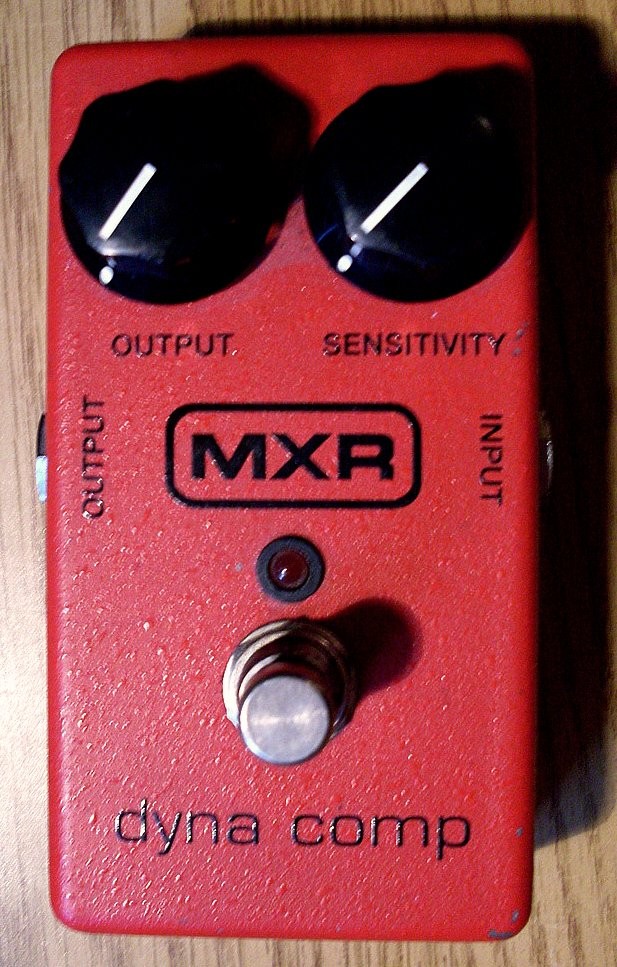
The MXR Dynacomp compressor was used selectively, primarily to control dynamics during clean passages and to sustain notes during softer playing. Gallagher’s natural dynamics were already extraordinary — he had superb right-hand control — so the compressor was an accent rather than a crutch. He also occasionally used a Maestro Echoplex tape echo unit, particularly for studio work, adding depth and dimension without overloading the signal with repeats.
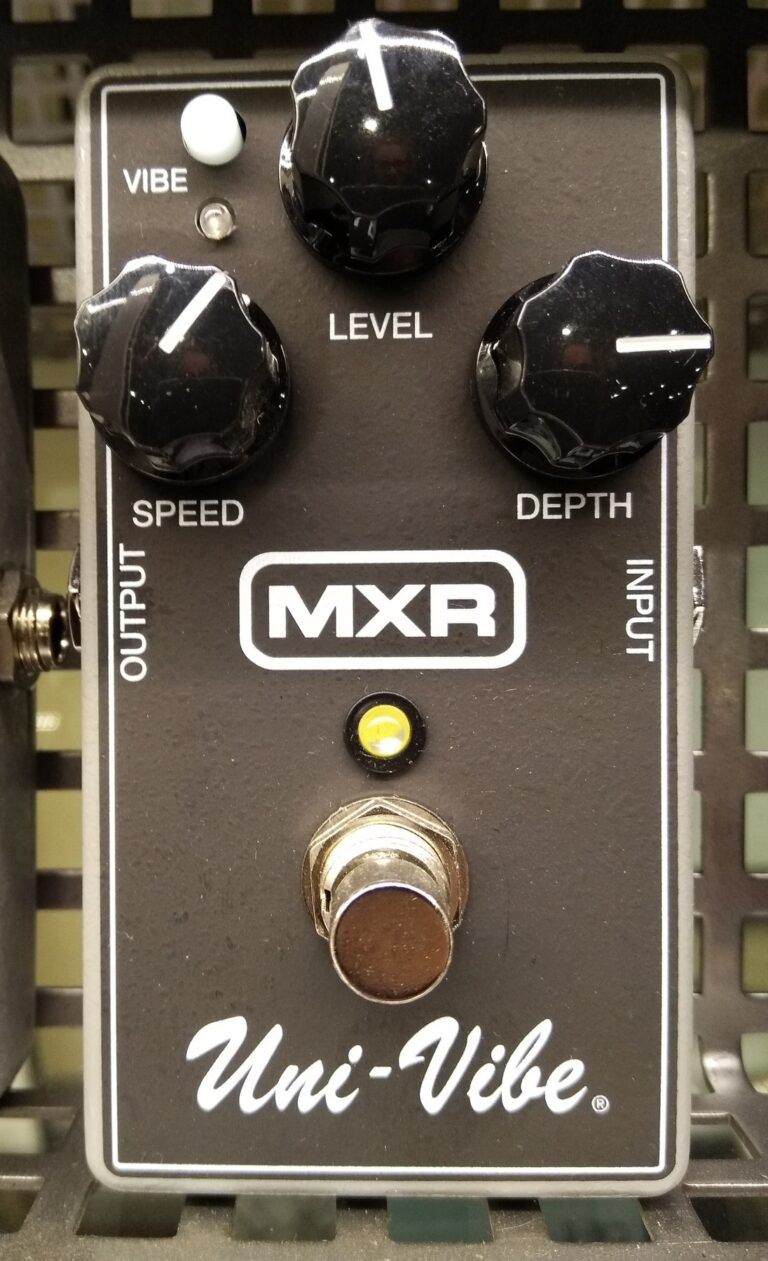
An Univibe — the rotating speaker simulator developed by Shin-ei in Japan, using an LDR-and-bulb photocell circuit to create a chorus/vibrato with a slight pitch wobble characteristic of a real Leslie cabinet — appeared in his effects chain for specific material, giving certain passages that liquid, underwater pulse associated with Hendrix’s “Machine Gun” and various psychedelic blues recordings of the era.
Playing Style & Tone Philosophy
Rory Gallagher’s playing was fundamentally an act of physical commitment. He didn’t stand still. He didn’t play with cool economy. He hit the strings hard, bent strings to their limit, used his whole body as part of the musical expression, and left every stage drenched in sweat regardless of venue size, temperature, or audience. This physical intensity was not performance — it was simply how he played, how he had always played, the natural extension of his emotional engagement with the music.
His right-hand technique was particularly distinctive. He used a heavy pick — typically a medium-to-heavy Fender celluloid pick — with a strong downstroke bias that gave his rhythm playing an aggressive, percussive quality and his lead playing a natural accent that emphasised the beat. He combined this pick attack with frequent use of his thumb and fingers for hybrid picking passages, particularly in country-influenced material and acoustic playing, which allowed him to simultaneously pick melody lines and strum chord voicings in a way that a pure flatpicker cannot achieve.
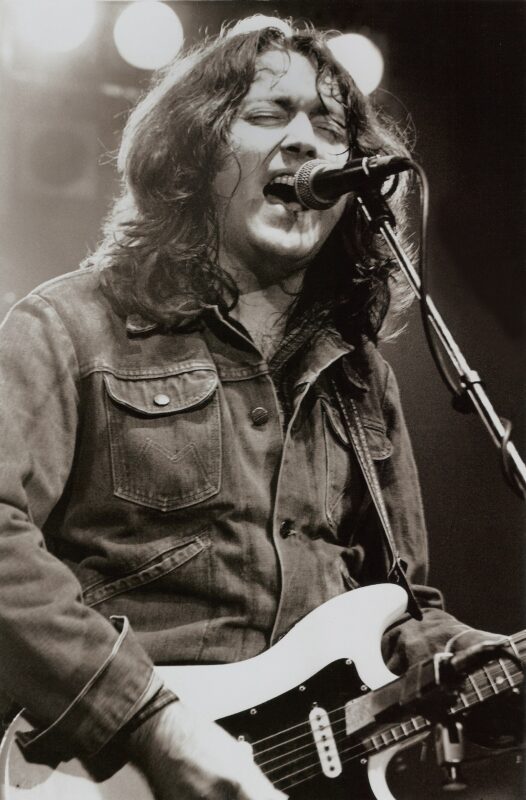
His vibrato was deeply personal and immediately recognisable. Unlike the classical rotary vibrato taught in conservatories, or the mechanical vibrato of a tremolo arm, Gallagher’s vibrato was a wide, fast, lateral push-and-release of the string, applied with tremendous tension and released with equal conviction. It had a vocal quality — you could hear emotion in it the way you can hear emotion in a singer’s vibrato — and it functioned as a kind of extension of his phrasing rather than an ornament applied after the fact.
His slide work — using a glass bottleneck on the little finger of his left hand — was another central pillar of his technique. He played slide in both standard tuning and open tunings (E, G, and D were all documented), and his approach emphasised fluid, sinuous melodic lines rather than the more static, chord-based approach of some Delta blues slide players. He could move between standard fretting and slide playing within a single song, sometimes within a single passage, which required unusual dexterity and an ability to mute the non-played strings effectively.
Gallagher was a dedicated student of American roots music — not just electric blues but country picking, Celtic folk, jazz, and rockabilly — and this breadth of influence showed in his harmonic language. He wasn’t strictly a minor pentatonic blues player; he used major pentatonic passages, chromatic approach notes, double-stop sixths in the Albert Lee/country style, and open-string drones in the Celtic tradition. His rhythm playing was similarly diverse: he could play chunky, direct power chord rock, finger-picked arpeggios, open-tuned slide rhythms, and the chopped, percussive funk-influenced rhythm work that appeared on his late-career material.
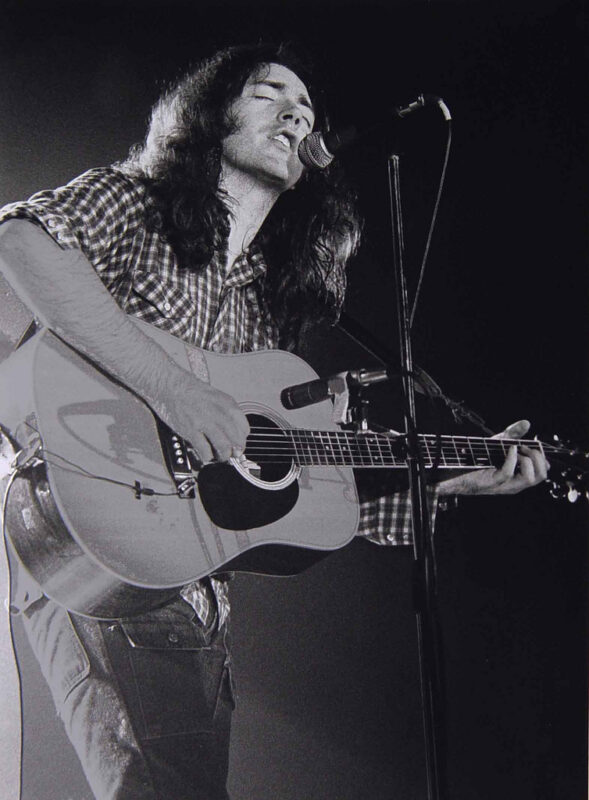
Tonally, Gallagher believed in the guitar-to-amplifier signal path as the foundation of everything. He did not believe in effects as a substitute for the fundamental tone — the effects he used were accent tools. His philosophy was entirely consistent with the approach of the great Chicago blues players he admired: the character of the guitar and the way it drove the amplifier were the tone, and everything else was seasoning. He was also, famously, indifferent to pristine equipment. The worn finish on his Strat was not a fashion statement; he simply played the guitar until it wore out, because it was the guitar that sounded right. This was a man who, if the guitar sounded good, could not have cared less what it looked like.
How to Sound Like Rory Gallagher
Guitar Approach
Start with a Stratocaster — ideally a vintage or vintage-spec instrument with Alnico V single-coil pickups in the 5.8k–6.2k ohm range. A rosewood fingerboard helps with the warmth of his tone, though maple-board Strats can work well in the bridge position for brighter, more cutting material. Use heavier strings than you think you need — a .010–.046 set at minimum, and .011s if you can manage the extra tension. String gauge contributes enormously to the density and sustain that characterises his tone.
For slide work, use a glass bottleneck rather than metal — the glass has a slightly warmer, less aggressive edge that suits the vocal quality of his slide lines. Practice in both standard tuning and open E (E–B–E–G#–B–E) to access the different textural areas of his slide playing. Develop your ability to mute unwanted strings aggressively with both the picking hand and the fretting hand — sloppy string noise is the enemy of articulate slide playing.
Play hard. This sounds obvious but it’s the most important instruction. Gallagher’s tone at the amplifier was significantly driven by the physical energy of his picking attack — soft playing through his rig would have produced a clean, polished tone that bears no resemblance to what he actually sounded like. Dig in.
Amp Approach
A Vox AC30 with alnico speakers is the most direct path to his sound. Run the Top Boost channel with the treble around 7 and the bass around 5, volume high enough that the EL84s are starting to compress and sing — this typically means 5 or 6 on a vintage unit, louder on a modern reissue with a fixed bias. Add a treble booster (a Dallas Rangemaster clone or a BK Butler Tube Driver set with very low drive) before the amplifier to push the input stage and add harmonic complexity.
If AC30 ownership isn’t in the picture, a Fender Blues Junior or Blues Deluxe set clean with a treble booster pushing it into breakup is a reasonable approximation of the character — the 6L6 voicing isn’t as chimey as EL84s, but at appropriate gain levels the difference is less significant than amp nerds might suggest. For the Bassman component of his tone, any good-sounding blackface or tweed Fender will add the warmth and bottom end that counterbalanced the Vox’s top-end emphasis.
| Control | Setting | Notes |
|---|---|---|
| Volume (Top Boost) | 6–7 | Push for natural EL84 compression and breakup |
| Treble | 7 | High treble emphasises single-coil bite and harmonic content |
| Bass | 4–5 | Moderate bass — too much muddies the signal at high volume |
| Treble Booster (before amp) | On, medium gain | Rangemaster-style unit pushing amp input into saturation |
| Master Volume (if fitted) | N/A | Original AC30s have no master volume — it’s all output stage |
| Reverb | Off or minimal | Gallagher used very little reverb; natural room ambience preferred |
Influence & Legacy
Rory Gallagher’s legacy is one of the most interesting cases in rock guitar precisely because it operates so differently from conventional fame. He isn’t in the Rock and Roll Hall of Fame. He doesn’t have the mainstream cultural profile of Clapton or Page. His name doesn’t appear on the T-shirts of teenagers who’ve never listened to blues rock. And yet among guitarists — particularly guitarists who play with any seriousness — his name carries extraordinary weight. This is the musician who Stevie Ray Vaughan cited as a formative influence, who Gary Moore considered a close friend and direct inspiration, who Joe Bonamassa has called the guitarist he most wishes he could have seen live.
The reason is simple: Gallagher represented authenticity in its purest form. In an era when rock music was increasingly about image, spectacle, and commercial calculation, he showed up night after night in a plaid shirt with a battered guitar and played his soul out for three hours without apology. He wasn’t trying to be the most famous guitarist; he was trying to be the most honest one. That distinction resonated across generations.
His influence can be traced through the entire Irish and UK blues rock tradition that followed him. Every Irish guitarist who plays with fire and emotion is working, consciously or not, in the tradition Gallagher established. The annual Rory Gallagher International Tribute Festival in Ballyshannon, County Donegal — held in the town of his birth — draws tens of thousands of visitors every year and features international artists paying homage to a man who, in his lifetime, never achieved the superstar status his talent warranted.
Gallagher also demonstrated something important about the relationship between equipment and artistry: a single guitar, played with total commitment over a thirty-year career, is capable of an extraordinary range of expression. The fans who pilgrim to see his battered ’61 Strat in the Crawford Art Gallery in Cork aren’t just looking at a guitar — they’re looking at a document of a life’s work, worn into the wood grain by decades of passionate playing.
For further exploration of the British and Irish blues rock tradition Gallagher inhabited and influenced, see the rigs of Paul Kossoff, whose similarly raw emotional approach to the Les Paul defined Free’s sound in the early 1970s, Robin Trower, who took the Stratocaster into psychedelic blues territory with comparable conviction, and Gary Moore, who was perhaps Gallagher’s most direct Irish successor and one of his closest friends in music.
It is also worth noting Gallagher’s significance within the specific Irish cultural context. Ireland in the 1960s and 1970s had a complex relationship with rock music — the showband circuit was enormous and conservative, and the path from showband work to serious original music was not obvious or easy. Gallagher navigated it successfully, starting in the showbands but rapidly developing a distinct artistic identity that had nothing to do with the commercial covers-band economy. His success — modest by global standards but enormous within Ireland and in Germany, where he was a genuine stadium act — demonstrated that it was possible to build a serious rock career from an Irish base, and that demonstration mattered to the generation of Irish musicians who came after him, some of whom went on to global success on a scale he never achieved but would have recognised as a continuation of what he started.
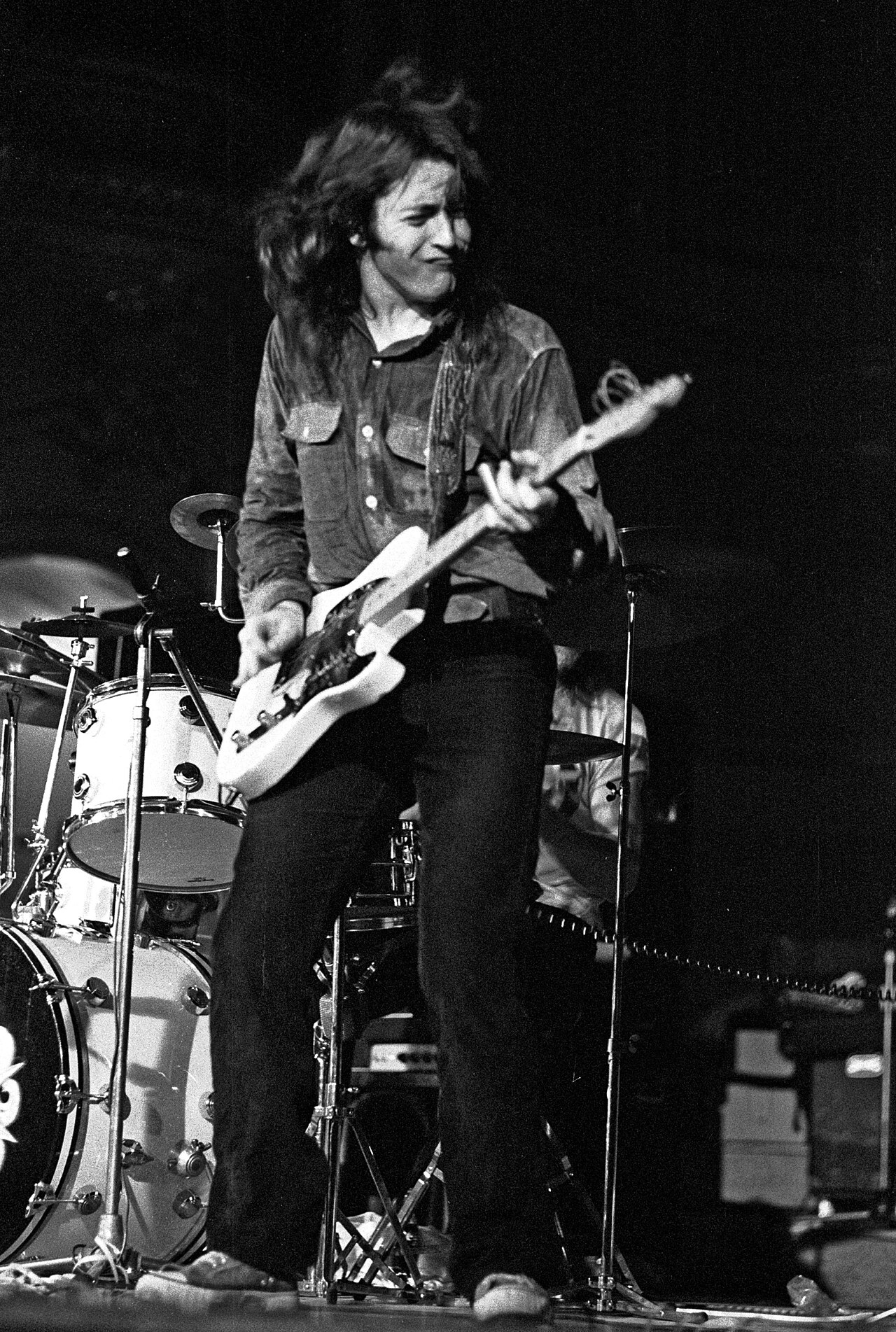
The Rory Gallagher International Tribute Festival in Ballyshannon runs annually and typically draws performers from multiple countries alongside Irish acts, all united by their engagement with the tradition he represented. That a town in rural County Donegal hosts an internationally recognised music festival in perpetuity is a measure of the affection in which he is held and the size of the community that formed around his music over the decades. Equipment collectors seek out AC30s, Dallas Rangemasters, and battered early-’60s Stratocasters partly because of him. Players who were born after he died are learning his solos and studying his technique because someone whose records they loved turned them onto the source. The specific worn-to-the-wood look of his Strat has influenced how guitarists think about their relationship with their instruments — the idea that a guitar should be played, not preserved, and that the evidence of use is not damage but history. These are not small things. For a musician who never topped the charts outside of Ireland and Germany, his reach has been remarkable, patient, and deep.
One final element of Gallagher’s legacy that deserves specific attention in a gear guide is his role in popularising certain pieces of equipment that were undervalued or overlooked at the time. The AC30’s reputation as a blues and rock amplifier owes something to Gallagher’s association with it — while the amp was obviously known from its use by the Beatles, the Shadows, and Tom Petty, Gallagher’s deployment of it in a specifically blues-rock context demonstrated its versatility and extended its cultural association beyond British Invasion pop. Similarly, his use of the Dallas Rangemaster treble booster at a time when players were moving towards higher-gain dedicated overdrive pedals helped establish the case for germanium-transistor boost devices as valid, musically expressive tools rather than obsolete technology.
The treble booster’s revival in boutique guitar culture — the dozens of Rangemaster clones now available from every small manufacturer, the appreciation for germanium transistor characteristics among tone aficionados — has multiple sources, but Gallagher is a key one. He kept using it because it was the right tool for his sound, and enough players paying attention to his records and live performances eventually worked backwards to discover why. That’s a quiet but genuine form of influence: not the obvious genre-defining statement of a Hendrix or a Page, but the steady insistence on a particular approach that, over time, changes what other musicians consider worth exploring.
Gallagher also contributed to the guitar community through his personal openness about his equipment and technique. In an era when some guitarists were deliberately mysterious about their gear choices, Gallagher was consistently forthcoming in interviews: he named his equipment, explained his choices, described his setup, and talked about tone in a way that was knowledgeable without being exclusionary. This generosity of information — the willingness to show rather than to mystify — reflects his broader character and created a community of players who understood not just what he used but why, and who were equipped to make thoughtful equipment decisions of their own based on that understanding.
Frequently Asked Questions: Rory Gallagher Guitars & Gear
What guitar did Rory Gallagher play?
Rory Gallagher’s primary guitar throughout his career was a 1961 Fender Stratocaster, serial number 64351, which he purchased secondhand in Cork in 1963 for £100. By the end of his life the sunburst finish had been almost entirely worn away through decades of heavy playing, leaving the alder body exposed. He also played a 1932 National Style O resonator guitar for slide and acoustic work, a Fender Telecaster, and various acoustic instruments including a Martin 000-28.
What amp did Rory Gallagher use?
Gallagher’s most iconic amplifier was the Vox AC30 Top Boost, a 30-watt combo running four EL84 output valves. He often paired it with a Fender Bassman — either the late-1950s 4×10 tweed version or early-1960s variants — to add warmth and bottom end to the Vox’s chimey top end. He also used Marshall 1962 Bluesbreaker combos, particularly during the Taste era, and Fender Vibroverb amplifiers for certain recording sessions.
Did Rory Gallagher use a treble booster?
Yes — treble boosters were a fundamental part of his rig. He used both a Vox Treble Booster and a Dallas Rangemaster, both germanium-transistor-based units that pushed the high-frequency content of his signal into the amplifier’s input stage, driving the valve preamp into saturation while emphasising the clarity and bite of his Stratocaster’s single-coil pickups.
What effects did Rory Gallagher use?
His effects chain was relatively simple and purposeful. Key pedals included germanium fuzz units (notably the Hornet Fuzz and occasionally the Univox Super-Fuzz), a Dunlop Cry Baby wah, an MXR Dynacomp compressor, a Maestro Echoplex tape delay for studio work, and an Univibe phaser/vibrato for specific material. He used effects to accent his already fully-formed basic tone rather than to construct it from scratch.
What strings did Rory Gallagher use?
Gallagher typically used heavier string gauges than most blues players — a .010–.046 set was common, with .011s used at various points in his career. The heavier gauge contributed significantly to the density, sustain, and physical presence of his tone, and complemented his hard-hitting picking attack and wide-vibrato technique.
Why is Rory Gallagher’s Stratocaster so worn?
The extreme wear on Gallagher’s ’61 Stratocaster is simply the result of decades of intense, physically committed playing. He toured incessantly, playing long sets night after night, and the combination of sweat, physical motion, and thousands of hours of contact with the instrument gradually wore through the nitrocellulose lacquer finish to the bare alder wood. Gallagher never stripped the guitar deliberately or had it reliced — the wear is entirely authentic and documents a lifetime of genuine use.
Where is Rory Gallagher’s guitar now?
Rory Gallagher’s 1961 Fender Stratocaster is on display at the Crawford Art Gallery in Cork, Ireland. It was donated by the Gallagher family and is considered one of Ireland’s most important cultural artefacts. The guitar is exhibited as a tribute to its owner and to the impact his music had on Irish cultural life.
The Live Experience: Gallagher on Stage
To understand Rory Gallagher’s gear in its full context, you have to understand the conditions under which it was deployed. Gallagher was, first and foremost, a live musician. The studio was a necessary part of his career, but the stage was his natural habitat, and his equipment choices reflected the demands of live performance above all other considerations. He toured continuously — not the select-dates, prestige-venues touring of the rock elite, but relentless, month-after-month road work that took him through every city and town in Ireland, Britain, Germany, and beyond, playing to audiences of a hundred and audiences of twenty thousand with equal ferocity.
His stage volume was substantial. Running an AC30 alongside a Fender Bassman at working volume — the kind of volume that actually drives those amplifiers to their characteristic sweet spots — produces a significant amount of acoustic energy, and Gallagher did not believe in pulling back for monitoring convenience. His monitor mix was essentially the stage amp sound plus the P.A. reinforcement, and in smaller venues there was often no significant P.A. involvement for the guitar at all. The result was a physical, room-filling guitar sound that was experienced as much as heard by the audience.
The battered condition of his equipment was not incidental to this approach — it was a consequence of it. Amplifiers that get hauled in and out of vans nightly, set up on stages of varying quality, subject to temperature changes, humidity swings, and the occasional accident, develop a character that is different from the same amplifier kept in a climate-controlled studio. Gallagher’s AC30 had been through everything he had, and the result was an amplifier with a voice that was entirely its own — tubes that had settled into a particular bias, capacitors that had aged into their roll-off frequencies, transformers that had been pushed hard enough that their magnetics were in a state of constant productive saturation.
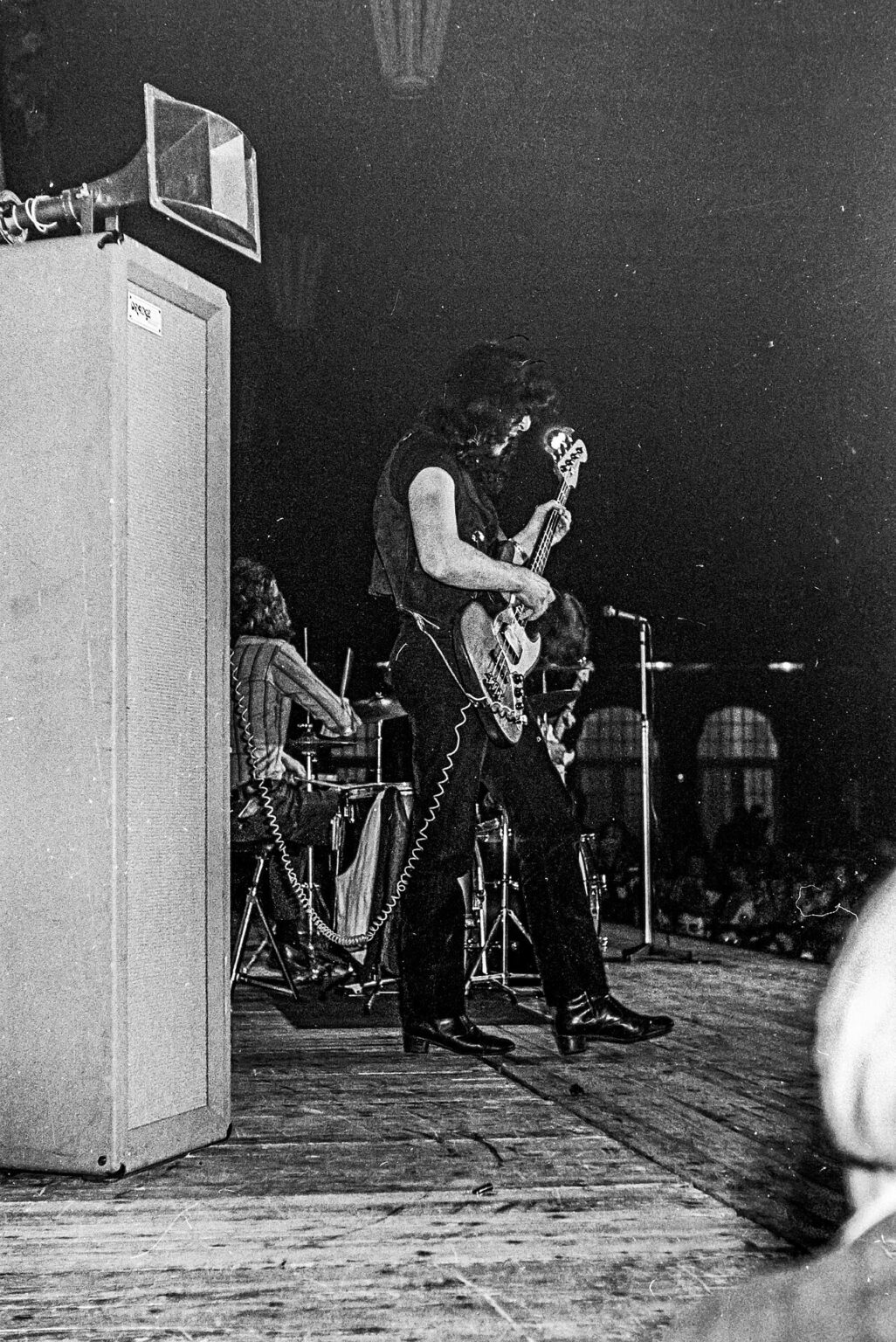
Road musicians of Gallagher’s generation also developed an entirely different relationship with equipment maintenance than the modern boutique gear obsessive. If something broke, you fixed it with whatever was available. Gallagher’s guitar had been repaired, refretted, and adjusted numerous times over the decades. The nut had been replaced, the tuners updated at points, the electronics serviced. None of this diminished the guitar; it was part of the instrument’s ongoing life, the way a working craftsman’s tools are repaired and maintained without becoming different tools. The guitar that hung in the Crawford Art Gallery in Cork was not a museum piece that had been carefully preserved — it was a working instrument that had been worked nearly to destruction and kept going.
Gallagher’s set design was similarly non-theatrical. No elaborate lighting rigs, no pyrotechnics, no costume changes. A microphone, two or three amplifiers, a pedalboard on the floor, and a guitarist in a checked shirt who played until there was nothing left in him. Audiences who saw Gallagher live consistently report the same experience: the intensity was physical and personal, as if he were playing specifically to each individual regardless of how many people were in the room. That quality — the sense of direct, unmediated communication between performer and audience — is the hardest thing in music to manufacture, and Gallagher had it naturally, consistently, for his entire career. It is not something that comes from equipment. It comes from character.
Recording Career: Translating the Live Sound
Gallagher’s studio work represents a fascinating ongoing negotiation between the raw immediacy of his live sound and the demands of record production. He was never entirely comfortable in the studio — not because he lacked studio craft, but because the controlled environment worked against the spontaneity and physical energy that defined his playing. His best studio recordings are the ones that managed to preserve some element of live performance energy, and his weaker ones are those where production choices smoothed that energy away in favour of a commercial finish.
His 1971 debut solo album, simply titled Rory Gallagher, is a strong example of effective studio translation: recorded largely live in the studio with minimal overdubs, it captures the directness of his approach without sounding like a compromised demo. The guitar tones on that record — the Strat through the AC30, boosted by the Rangemaster into natural valve compression — are as close to his live sound as any studio recording managed. Tattoo (1973) and Against the Grain (1975) both show Gallagher expanding his tonal palette, using the Fender Bassman’s warmth on more country-blues-influenced material and exploring the resonator guitar’s acoustic qualities in ways that a live club set could not accommodate.
His live albums are arguably more representative documents than the studio work. Live in Europe (1972) and Stage Struck (1980) capture the full electricity of his performances in a way that controlled studio production could not fully replicate, and the guitar tones on those records — particularly the way the AC30 breathes and compresses in the context of a genuine live performance — are as good a record as exists of what that rig actually sounded like when deployed by the man who built it. If you want to understand what Rory Gallagher’s gear setup actually achieved in practice, start with those two records and follow the thread backwards and forwards from there.
Gallagher was also a genuine multi-instrumentalist who used the studio to explore instruments that did not feature in his live show. Mandolin, harmonica, and piano all appear on his records, usually played by Gallagher himself, adding a folk and Americana dimension to his work that pure blues classification obscures. He was a broader, deeper musician than the shorthand summary suggests, and his studio catalogue rewards patient exploration even beyond the celebrated guitar playing. The gear tells part of the story; the songs tell the rest.
Genre: Blues Rock
Decades: 1960s | 1970s | 1980s | 1990s
Image credits
- Rory Gallagher: Heinrich Klaffs, Wikimedia Commons, CC BY-SA 2.0.
- Top image: Heinrich Klaffs
- Rory Gallagher: photo by Harry Potts, via Wikimedia Commons, CC BY-SA 2.0.
- Rory Gallagher: photo by Chris Hakkens, via Wikimedia Commons, CC BY 2.0.
- Fender Telecaster: Massimo Barbieri, Wikimedia Commons, CC BY-SA 3.0.
- Vox AC30 Top Boost: wetwebwork; existing crop and contrast/color adjustments: Clusternote, Wikimedia Commons, CC BY-SA 2.0.
- Dunlop Cry Baby: Roadside Guitars, Flickr, CC BY-SA 2.0.
- MXR Uni-Vibe: Skimel, Wikimedia Commons, CC BY-SA 4.0.
- Marshall 1962 Bluesbreaker: GuitarGangsters AI-generated reference illustration, not a photograph.
- Rory Gallagher’s 1961 Stratocaster: wetwebwork, Wikimedia Commons, CC BY-SA 2.0.
- Rory Gallagher live: Herbert Weber, Hildesheim, Wikimedia Commons, CC BY-SA 4.0.
- Fender Bassman: Roadside Guitars, Wikimedia Commons, CC BY-SA 2.0.
- Fender Vibroverb: GabeMc, Wikimedia Commons, CC BY-SA 3.0.
- MXR M102 Dyna Comp: Roadside Guitars, Wikimedia Commons, CC BY-SA 2.0.