
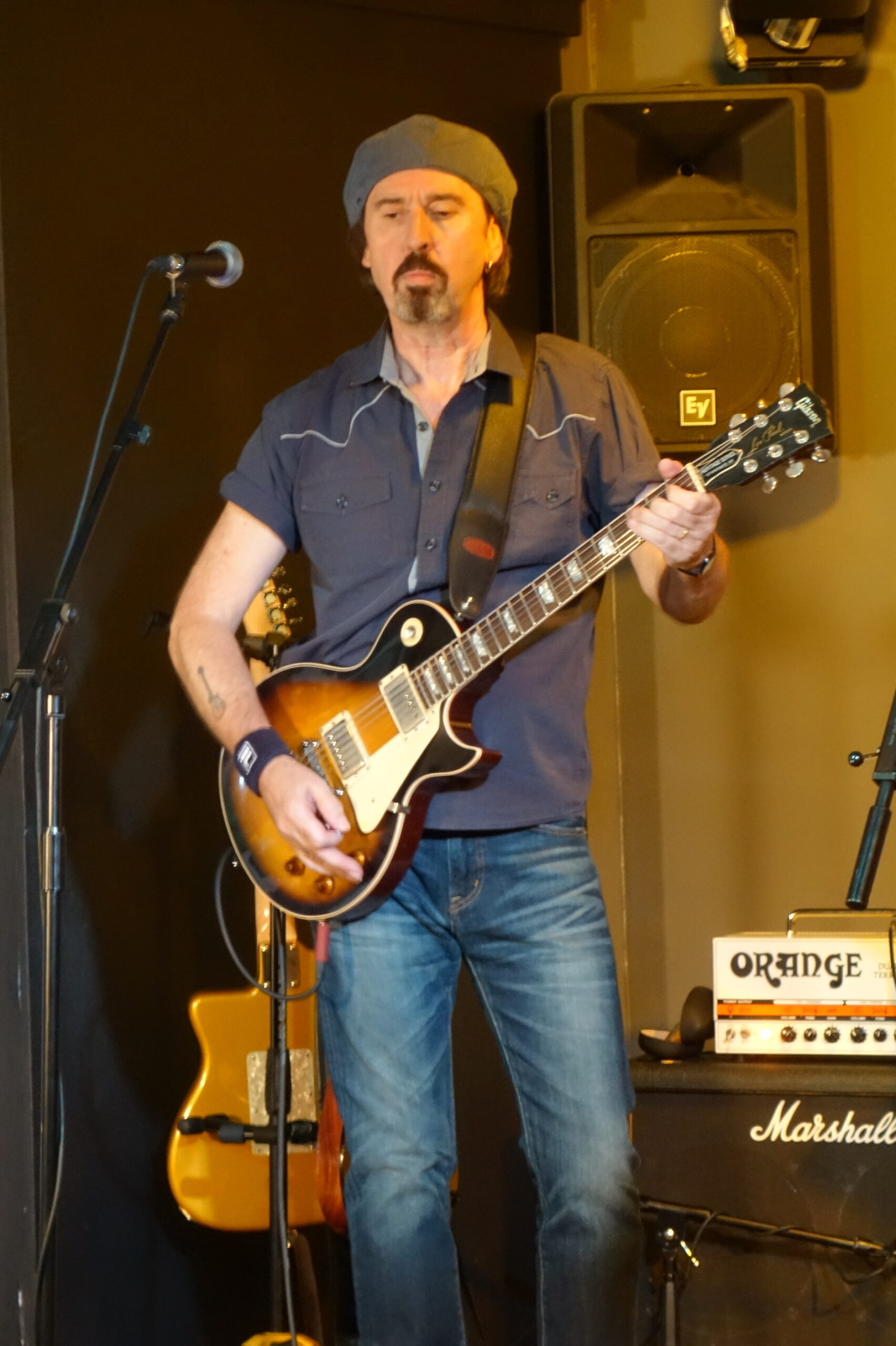
When you investigate Micky Moody guitars gear, you find one of British hard rock’s most underappreciated tonal architects — a guitarist whose blues-drenched slide work and fat Les Paul tone helped define the early Whitesnake sound and whose career stretched across some of the most important British rock recordings of the 1970s and 1980s. Moody was never a shredder, never a technically flashy player in the conventional sense, but he possessed something rarer and more valuable: an instinctive feel for the blues and a slide technique developed to the point where it sounded like a natural extension of his voice rather than an applied skill.
The Journey
This guide covers Micky Moody’s guitars, amplifiers, and effects in full detail — the Les Pauls and Strats he favoured, the Marshall and Fender amplifier combinations that gave him his warm, singing tone, the slide technique that became his signature, and the specific characteristics that made him the perfect foil to Bernie Marsden in Whitesnake’s classic twin-guitar lineup. Whether you’re tracing the origins of that early Whitesnake sound or simply trying to understand how a deeply blues-rooted approach translates into a hard rock context, Moody’s rig tells the story.
Background
Michael “Micky” Moody was born on August 30, 1950, in Middlesbrough, in the northeast of England — a region with a surprisingly rich musical heritage that sits well outside the London-centric narrative of British rock history. He began playing guitar in his early teens, drawn initially to the American blues and R&B records that were flooding into Britain in the early 1960s and inspiring a generation of young musicians to pick up instruments. The British blues boom of the mid-1960s — driven by players like Clapton, Green, and Mayall — was the cultural context in which Moody came of age musically, and its influence on his playing remained audible throughout his career.
His professional career began in the early 1970s with Juicy Lucy, a British blues rock band that had a UK hit in 1970 with a cover of Bo Diddley’s “Who Do You Love.” Moody joined the band during this period and began developing the slide technique that would become his calling card. Juicy Lucy was a working band in the true sense — touring constantly, playing clubs and theatres across Britain — and the experience of developing his playing in live settings night after night gave Moody the kind of practical, under-pressure musical development that no studio or practice room replicates.
After Juicy Lucy, Moody worked with various artists and projects through the mid-1970s before the connection that would define his career: joining David Coverdale’s newly formed Whitesnake in 1978. The band emerged from the ashes of Deep Purple Mark III and IV, with Coverdale assembling a lineup of experienced British players who could deliver the blues-rooted hard rock he wanted to make. Moody and co-guitarist Bernie Marsden formed one of British hard rock’s finest twin-guitar partnerships — Moody’s bluesy, slide-inflected approach complementing Marsden’s more conventional but equally soulful playing in a way that gave the early Whitesnake albums their distinctive character.
The classic Whitesnake albums of this period — Trouble (1978), Lovehunter (1979), Ready an’ Willing (1980), Come an’ Get It (1981), and the live document Live… in the Heart of the City (1980) — represent Moody’s finest recorded work. These records captured a band operating with genuine blues feeling within a hard rock framework, and Moody’s guitar contributions were central to that character. His slide work on tracks like “Ain’t No Love in the Heart of the City” (the Harvey Scales original that became a Whitesnake signature) and his lead playing throughout Ready an’ Willing demonstrate a musicality and emotional directness that harder-edged players of the era rarely matched.
Moody left Whitesnake in 1982 — around the time the band began moving toward the more polished, American-market-oriented sound that would bring them commercial success later in the decade — and pursued a varied subsequent career that included session work, solo projects, blues collaborations, and reunion appearances with Marsden and other Whitesnake veterans. He remained active as a performer and recording artist, continuing to develop his playing and maintain the blues-rooted approach that had defined him from the beginning.
Micky Moody Guitars Gear: The Complete Rig
Guitars
Micky Moody’s guitar arsenal during the classic Whitesnake period was centred on two instruments that reflect his twin musical personalities: the blues-rock lead player and the slide specialist.
His primary electric guitar was a Gibson Les Paul Standard — specifically late-1950s and early-1960s examples that he acquired and used throughout the Whitesnake years. The Les Paul’s combination of mahogany body and neck, carved maple top, and PAF-style humbucker pickups produced the warm, sustaining tone that his playing required. The original PAF humbuckers in these instruments — measuring typically 7.5k to 8.5k ohms DC resistance with Alnico II or Alnico V magnets — have a particular clarity and warmth that higher-output replacements don’t provide, and Moody’s tone on the early Whitesnake records has that characteristic PAF openness: notes that bloom rather than compress, with a three-dimensional quality to the midrange that sounds like the amplifier is responding to something alive rather than simply processing a signal.
For slide work, Moody used a Fender Stratocaster — typically a late-1960s or early-1970s CBS-era example. The Stratocaster’s single-coil pickups, particularly the bridge pickup, have an inherent brightness and clarity that complements slide playing well: the note definition allows individual string articulation even when the bottleneck is covering all six strings, and the Strat’s natural top-end presence cuts through a band mix in a way that humbuckers, with their warmer, rounder character, don’t always achieve. Moody typically set his slide guitar up with higher action than a conventionally fretted instrument — raising the bridge saddles and nut height to accommodate the bottleneck without the slide buzzing against the frets — and used medium-to-heavy string gauges that gave the slide enough tension to track accurately.
He used a glass bottleneck for his slide work — specifically on the ring finger of his left hand, which allowed him to fret conventionally with the other fingers when needed and switch between slide and standard playing within a performance. Glass produces a warmer, smoother tone than metal slides: the edge is softer, the sustain longer, and the attack less aggressive. For blues-influenced material, this character serves the music better than the bright, metallic sharpness of a steel or brass slide.
Moody also used various Gibson SG models at different points in his career — the SG’s lighter weight and different neck join angle (compared to the Les Paul’s angled neck joint) produces a different tonal character, with slightly more top-end presence and a different resonance in the upper register. For specific live applications where the lighter instrument was practical and the tonal difference worked in context, the SG was a useful alternative.
String gauges ran to medium-heavy — typically .010–.046 on the Les Paul and similar on the Strat — heavy enough to provide the sustain and string tension that his technique required, light enough to accommodate the string bends central to his blues phrasing. His pick of choice was a medium celluloid Fender pick, which produced a warm attack without the harshness of heavier nylon or Tortex materials.
Amps
Micky Moody’s amplifier setup during the Whitesnake period was rooted in the British valve tradition but with a warmer, more blues-oriented character than the full-on Marshall assault favoured by heavier players of the era. He used a combination of amplifiers to achieve the layered warmth his playing required.
His primary amplifier was a Marshall JMP 100-watt head — the early-1970s aluminium-panel variant that followed the Plexi-panel Super Leads of the late 1960s. The JMP uses four EL34 output valves in a push-pull configuration and has a character that sits between the pure Plexi’s vintage warmth and the later JCM800’s more aggressive preamp distortion. Moody ran the JMP into Marshall 4×12 cabinets loaded with Celestion G12M Greenback speakers — the 25-watt ceramic-magnet Greenback with its characteristic midrange bark and natural compression at working volumes, which complemented his playing’s emphasis on feel over aggression.
Alongside the Marshall, Moody regularly used a Fender Twin Reverb — the blackface or silverface 2×12 combo running a pair of 6L6 output valves at 85 watts. The Twin’s fundamentally different tonal character — cleaner, warmer in the low end, with less preamp gain and a different midrange voicing than the EL34 Marshall — provided a clean or lightly driven foundation that he blended with the Marshall’s heavier character. Running the Twin simultaneously with the Marshall gave him a layered tone: the Fender contributing warmth, clean headroom, and the characteristic American sparkle to the low end, while the Marshall added midrange bark, drive, and the singing quality of driven EL34s.
For recording, Moody occasionally used a Vox AC30 — particularly for cleaner, more chimey passages where the EL84-driven Vox’s natural compression and top-end clarity suited the musical context better than the Marshall’s more aggressive midrange emphasis. The AC30’s ability to produce a full, three-dimensional clean tone at lower volumes made it practical in studio settings where the full Marshall volume was unnecessary or impractical.
The combination of British EL34 drive from the Marshall and American 6L6 warmth from the Fender Twin is a classic approach that numerous blues-rock players have employed — it covers more tonal ground than either amplifier alone and provides natural contrast between rhythm and lead playing without requiring channel-switching or complex signal routing.
Effects
Moody’s effects chain was relatively concise by modern standards — he was not a pedalboard architect but a practical musician who used specific tools for specific purposes. Every element in his chain was there because it contributed something identifiable and musical to the sound.
A Dallas Rangemaster treble booster — the germanium OC44-transistor-based unit that was a fixture of the British blues rock scene from the mid-1960s onwards — sat before his amplifier and pushed the high-frequency content of his signal into the Marshall’s input stage. The Rangemaster passes frequencies above approximately 500Hz while attenuating bass, which means it adds gain and presence to the midrange and treble without muddying the low end. With a Les Paul’s inherently warm humbucker sound, this brightening effect is musically productive — it prevents the combination from becoming too thick and dark at high volume, maintaining the note definition that blues phrasing requires.
A Dunlop Cry Baby wah pedal provided both conventional swept wah expression and fixed-filter tonal shaping. Moody used the wah both as a lead effect — sweeping through phrases to emphasise specific notes — and as a static filter left at a position that added a midrange emphasis to his tone without the sweep. This technique, common among blues players, adds a vowel-like character to the guitar that gives individual notes a more vocal quality.
A Boss CE-1 Chorus Ensemble — the original chorus pedal released by Boss in 1976, using a bucket-brigade delay chip to create a lush, analogue chorus effect — appeared in his rig for specific clean and lightly driven applications. The CE-1 has a warmer, more complex modulation character than later digital chorus effects, with a slight pitch variation and amplitude modulation that gives chords a shimmering quality without the obvious artificiality of later chorus implementations. For clean Strat passages in particular, the CE-1 added depth and dimension without altering the fundamental character of the tone.
A MXR Phase 90 phaser provided the swept, cyclic modulation effect that was ubiquitous in 1970s rock guitar — a single-stage phase shift circuit using operational amplifiers to create a sweeping notch filter that produces the characteristic swirling, underwater quality. The Phase 90 in its original script-logo version has a warmth and musical quality to its sweep rate that later variants don’t fully replicate, and its ability to add movement to sustained chords without the obvious pitch variation of a chorus or vibrato made it a versatile colouring tool.
Simple reverb — primarily the onboard reverb of the Fender Twin Reverb, a genuine spring reverb tank rather than digital simulation — provided the spatial dimension that his playing required without over-processing the signal. Spring reverb has a specific character: a slightly metallic, splashy quality on the decay that sounds natural in the context of valve amplification and becomes part of the instrument’s voice rather than an effect applied after the fact.
Playing Style & Tone Philosophy
Micky Moody’s playing is defined by restraint and feel — two qualities that are harder to develop than technical speed and more musically valuable in most contexts. He is not a player who demonstrates his ability through complexity or velocity; he is a player who demonstrates his ability through the rightness of every note he chooses to play and the emotional commitment with which he plays it. This approach is deeply rooted in the blues tradition he absorbed as a teenager, where the quality and timing of a phrase matters infinitely more than its technical complexity.
His slide technique is the most distinctive element of his playing. Unlike the more aggressive, percussive slide approach associated with some American blues players, Moody’s slide work has a lyrical, almost vocal quality — long, singing lines that move between positions on the neck with fluid grace, using the natural sustain of the instrument and amplifier to extend notes beyond what the string’s unamplified decay would allow. His vibrato with the slide — a rapid oscillation of the bottleneck on the string that produces a pitch modulation similar to a singer’s vibrato — is particularly well-developed, giving sustained notes an expressiveness that distinguishes his slide playing from technically accomplished but emotionally neutral approaches.
In his conventional (non-slide) playing, Moody favours a pentatonic vocabulary inflected with blues bends and chromatic approach notes — the standard toolkit of British blues rock, but deployed with a taste and timing that elevates it above the formulaic. His rhythm playing, often overlooked in discussions of his work, is equally strong: he understood the guitar’s role within the band’s collective sound and played in a way that supported the rhythm section and served the song rather than simply filling available space with guitar noise. In the Whitesnake context, where Bernie Marsden’s more rhythmically assertive playing provided one dimension of the guitar sound, Moody’s ability to complement and contrast rather than compete was a significant musical virtue.
Tonally, Moody’s philosophy was straightforwardly rooted in the British blues tradition: the tone lives in the interaction between the guitar and the amplifier, mediated by the hands, and effects are seasonal seasoning rather than the main meal. His setup was designed to give him a range of sounds — from clean Strat sparkle to driven Les Paul sustain — that he could access through picking dynamics and guitar controls rather than through tap-dancing on a complex pedalboard. This approach kept his playing connected and responsive in live performance, where the ability to react immediately to what’s happening musically is more important than the ability to recall a preset.
How to Sound Like Micky Moody
Guitar Approach
For his lead and rhythm work, start with a Les Paul Standard equipped with PAF-style humbuckers in the 7.5k–8.5k ohm range — Alnico II in the neck for warmth, Alnico V in the bridge for cut. For slide work, a late-1960s CBS Stratocaster or equivalent single-coil instrument with the bridge pickup as your primary sound. Set the slide guitar’s action higher than normal — raise the bridge saddles and consider a bone nut with slightly deeper slots filled with bone dust and superglue to raise the string height at the nut — and use a glass bottleneck on your ring finger.
The key to capturing Moody’s slide tone is the right-hand muting technique: the palm of the picking hand rests lightly against the strings behind the slide, damping unwanted sympathetic vibrations from the strings above and below the one being played. Without this muting, slide playing becomes a wash of indistinct noise; with it, individual notes ring clearly and the melodic lines have definition. Practice this muting technique separately before combining it with slide technique proper.
Amp Approach
A Marshall JMP or Super Lead paired with a Fender Twin Reverb is the authentic combination. Run the Marshall at moderate-to-high volume for the EL34 output stage to start working, and keep the Twin relatively clean. Blend the two — either through an A/B/Y switch or by running both simultaneously — to achieve the layered warmth that characterised his live sound. A Dallas Rangemaster or equivalent treble booster before the Marshall adds the presence and midrange push his Les Paul tone required.
| Amp/Control | Setting | Notes |
|---|---|---|
| Marshall JMP — Volume | 6–7 | Push EL34s into natural compression |
| Marshall JMP — Treble | 6 | Moderate — Greenbacks add midrange naturally |
| Marshall JMP — Middle | 7 | High mids for blues cut |
| Marshall JMP — Bass | 4–5 | Keep bass controlled for clarity |
| Fender Twin — Volume | 3–4 | Clean foundation layer |
| Fender Twin — Reverb | 3 | Moderate spring reverb — not saturated |
| Rangemaster (before Marshall) | On | Brightens Les Paul humbuckers, pushes front end |
Influence & Legacy
Micky Moody’s legacy is inseparable from the early Whitesnake recordings that represent the best of British blues-influenced hard rock in the late 1970s and early 1980s. Those albums — Trouble, Lovehunter, Ready an’ Willing — have aged exceptionally well precisely because they were made by musicians who cared more about feel and authenticity than about commercial trends. Moody’s guitar work on these records is a masterclass in how to bring blues sensibility to a rock context without diluting either.
His influence on subsequent British blues rock guitarists is significant if difficult to quantify. Players who grew up listening to early Whitesnake absorbed his approach to slide, his tonal palette, and his understanding of dynamics and restraint as part of the broader tradition they inherited. The specific character of his playing — the combination of slide work and conventional lead playing within a hard rock context — established a template that many British guitarists have followed.
Within the twin-guitar partnership tradition, the Moody/Marsden combination deserves consideration alongside the more celebrated pairings of British rock. Where other twin-guitar lineups emphasised power and interplay through similarity, Moody and Marsden worked through contrast — Moody’s blues slide and warmth against Marsden’s more rhythmically assertive playing — creating a whole that was genuinely more than the sum of its parts.
For players exploring the blues-rooted British hard rock tradition that Moody inhabited, the rigs of Bernie Marsden — his partner in the classic Whitesnake twin-guitar lineup — provide essential complementary context, as does the work of Mick Abrahams, whose approach to blues guitar within a British rock framework predated and influenced Moody’s generation. The broader tradition is illuminated by Michael Bloomfield‘s American blues rock, which filtered through the British scene and shaped how players like Moody approached the instrument.
Moody and Marsden: The Twin-Guitar Partnership
Any serious account of Micky Moody’s playing has to engage with the specific dynamic that made the early Whitesnake so musically compelling: the partnership between Moody and Bernie Marsden as the band’s twin-guitar lineup. This was not simply two guitarists playing simultaneously — it was a genuine musical dialogue between two players with distinct approaches, distinct tonal identities, and distinct musical personalities, who had learned to complement each other in ways that amplified the strengths of both.
Marsden’s approach — rooted in the same British blues tradition as Moody’s but expressed differently — favoured a more conventionally rock-oriented Les Paul tone, with greater emphasis on driven midrange and a playing style that was rhythmically more assertive and harmonically more grounded in chord-based thinking. Moody’s approach was melodically more linear, slide-inflected, and emotionally more diffuse in the best sense — more concerned with the shape of a melodic line than with its relationship to the underlying harmonic structure. These complementary approaches created a natural division of labour in the band: Marsden anchoring the rhythm and harmonic foundation, Moody providing the floating, bluesy melodic voice that gave the music its emotional colour.
In live performance, the two guitars occupied different tonal spaces almost automatically. Marsden’s Les Paul through his Marshall tended toward a slightly brighter, more cutting tone in the midrange; Moody’s setup — particularly when he was playing slide Strat — sat in a different frequency range, allowing the two guitars to coexist without fighting for the same sonic space. The rare twin-guitar combination that genuinely works in a live mix is one where each instrument occupies its own space naturally, without requiring artificial EQ separation, and the Moody/Marsden combination achieved this through the genuinely different characters of their respective approaches.
Guitarists who grew up on early Whitesnake often cite the guitar interplay on the live album Live… in the Heart of the City as a particular revelation — the way the two instruments weave around each other in extended live arrangements reveals a level of musical communication that studio recordings, where parts are typically overdubbed rather than performed simultaneously, can’t fully document. Hearing Moody’s slide lines curling around Marsden’s chord work in a long improvised section gives a direct picture of how the partnership functioned and why it was more than the sum of its parts.
The Slide Tradition: Moody in Context
Micky Moody’s slide work needs to be understood in the context of the specific tradition he was working within — the British blues slide tradition that drew on American sources but developed its own distinct character through the cultural filter of British musical sensibility and the specific equipment available in the UK in the 1960s and 1970s.
The American slide guitar tradition — rooted in the Mississippi Delta blues of Robert Johnson, Son House, and Elmore James, extended through Chicago electric blues by players like Earl Hooker and Hound Dog Taylor, and brought into the rock era by Duane Allman and others — informed Moody’s approach directly. He absorbed the vocabulary of blues slide playing from records, and the emotional vocabulary of that tradition is audible in his playing: the bent note phrases that imitate the human voice, the use of the slide to approach target notes from below in a way that creates a sense of yearning or tension, the rhythmic use of double stops and chord fragments.
But the British context shaped how he deployed this vocabulary. British blues rock — influenced by the relatively clean, articulate tone that players like Peter Green and Eric Clapton favoured, and by the specific characteristics of British valve amplification — tended toward a more lyrical, less percussive approach than the earthier, rawer American originals. Moody’s slide playing reflects this: his lines are melodically complete in a way that Delta blues slide often isn’t, with clear phrase shapes, defined resolutions, and an overall sense of musical architecture that reflects a trained musical sensibility rather than pure intuitive expression.
He was also working within a hard rock context that imposed its own constraints. Slide guitar in a band like Whitesnake — with a driving rhythm section, a powerful vocalist in David Coverdale, and a partner guitarist in Marsden — needed to cut through the mix while remaining musically complementary rather than competitive. The specific combination of Strat bridge pickup brightness, glass bottleneck warmth, and moderate-to-high amplifier volume that Moody used was calibrated to sit correctly in that context: present enough to be heard, focused enough to maintain note definition, warm enough to retain the blues feeling that justified the slide approach in the first place.
His intonation — consistently cited by other musicians as exemplary — reflects years of intensive live playing in conditions where the ear was the only guide. Slide intonation is entirely dependent on the player’s ear and muscular memory: the slide has no frets to guarantee correct pitch, and the tolerance for error in a live band context, where pitch mismatches are immediately audible against the other instruments, is narrow. Moody’s ability to play in tune in challenging live conditions, night after night on long Whitesnake tours, was a professional achievement that deserves recognition alongside the more obviously impressive aspects of his technique.
The combination of these elements — the American blues tradition absorbed and filtered through British sensibility, deployed in a hard rock context with equipment calibrated for that purpose, executed with a level of live-performance intonation discipline that most slide players never fully achieve — is what makes Moody’s slide work genuinely distinctive rather than merely competent. He is one of the few British rock guitarists for whom the slide guitar is not an occasional colour but a genuine second voice, as fully developed as his conventional playing and as immediately recognisable as his musical identity.
Studio Work and the Whitesnake Sound
The early Whitesnake albums on which Moody appears were produced with a directness that allowed the character of the live band to translate to the recording. Producer Martin Birch — whose credits included work with Deep Purple, Black Sabbath, and Iron Maiden — understood how to capture valve amplification and live performance energy without sanitising it into the polished but lifeless product that much hard rock recording of the era became. The guitar tones on Trouble and Lovehunter in particular have a room-filling warmth and organic quality that reflects both the equipment being used and the approach taken to capturing it.
Moody’s studio method was consistent with his live approach: set up the amplifier at a volume where it sounds right, place a microphone in front of it, and play. The guitar tones on the early Whitesnake records are not elaborately processed or layered; they are the sound of specific amplifiers being driven by specific guitars played by a specific guitarist, captured by a microphone in a room. This simplicity is not limitation — it is a deliberate choice that reflects a clear understanding of where the music’s character comes from.
The slide guitar passages on these records benefit particularly from this directness. Slide guitar, more than almost any other technique, is dependent on the physical relationship between the player’s hands, the instrument, and the amplifier — the feedback, the sustain, the way the room’s acoustic character adds dimension to the sustained notes. Capturing this realistically, as the Whitesnake records do, gives Moody’s slide work a physical presence in the mix that more processed approaches would have reduced to a flatter, less convincing version of itself.
The tonal contrast between Moody’s Strat-and-slide passages and his Les Paul lead work is also clearly audible in the recordings — a range of guitar voices within a single set that added musical interest and variety without requiring elaborate production techniques. This range was simply the result of two different instruments with two different tonal characters being recorded with appropriate amplification, and it stands as evidence that the most straightforward equipment choices, made by musicians who understand what they need and why, consistently produce more interesting results than more complicated approaches that attempt to compensate for a lack of fundamental clarity about the sonic goal.
Moody’s contribution to the Whitesnake recordings has been somewhat obscured over the years by the band’s later commercial success with a substantially different lineup and a substantially different sound. The albums that charted internationally in the mid-1980s — featuring John Sykes’s very different guitar approach and a production style worlds removed from the organic blues rock of the early records — are what most casual listeners know as “Whitesnake.” But among guitarists and blues rock devotees, the early albums with Moody and Marsden are consistently regarded as the band’s finest work, valued precisely for the qualities that the later commercial period lacked: feel, authenticity, and the specific blues-rooted warmth that Moody’s playing provided.
His legacy in the studio is therefore somewhat paradoxical: recorded work of genuine quality and lasting value, made as part of a band that most people know for something else entirely. This is not an unusual fate for musicians who do their best work in a less commercially successful context, and it does not diminish the recordings themselves. The early Whitesnake albums sound as vital now as they did when they were recorded, and Micky Moody’s guitars are a central reason why.
One final aspect of Moody’s equipment philosophy deserves attention: his understanding of the guitar’s volume and tone controls as part of the instrument rather than set-and-forget settings. Like all players rooted in the British blues tradition, he used the volume knob actively — rolling it back for rhythm passages to clean up the Marshall’s natural overdrive, bringing it forward for solos to restore the full-drive character. This technique, which requires a guitar whose volume pot cleans up gracefully under reduction (a characteristic of PAF humbuckers and good quality pots, but not of high-output replacement pickups or poorly specified electronics), was central to his ability to cover dynamic range within a single continuous performance without touching his pedalboard. The practical result is a playing approach that sounds naturally dynamic and varied — responsive to the musical moment in the way that preset-switching can never quite be — because the variation comes from the player’s hands rather than from switching between pre-programmed sounds. It is a fundamentally musical approach to the instrument, and it is one of the things that makes Moody’s playing, at its best, feel alive in a way that more technically elaborate approaches often don’t.
The other dimension of his tone control use — specifically the treble rolloff technique of gradually reducing the tone control to warm up the sound for specific phrases, then restoring full brightness for others — is equally characteristic of his playing style and equally rooted in the blues tradition. A Les Paul’s tone control, unlike many guitars’ tone circuits, has a relatively musical taper that allows it to be used actively without sounding like a simple high-cut filter. Moody’s ability to shade his tone through these means, in real time during live performance, is a technique that requires as much practice and musical intelligence as any of the more obviously impressive physical aspects of his slide or lead work. It is the kind of invisible technique that makes a player’s output consistently musical even when individual moments don’t call attention to themselves, and it is central to understanding why Micky Moody’s guitar work holds up so well on repeated listening.
Moody’s post-Whitesnake career, while lower-profile commercially, continued to develop his musical approach in ways that repay attention. His work with various blues and rock projects in the 1980s and 1990s maintained the quality of playing that had distinguished his Whitesnake contributions, and occasional reunion appearances with Bernie Marsden — recreating the twin-guitar format that had worked so well in the original band — demonstrated that the musical chemistry between them was as productive decades later as it had been in the original context. Several of these reunion recordings capture Moody’s playing at a level of maturity and refinement that arguably surpasses even the early Whitesnake work: the technique more settled, the taste even more developed, the emotional communication between his guitar and his musical intention even more direct.
He also remained active as a teacher and commentator on guitar technique, discussing his approach to slide playing, tone, and musical feeling with the kind of specific practical knowledge that comes only from decades of actual performance. His willingness to engage with the guitar community on the specifics of his technique — what equipment he used and why, how he approached particular musical challenges, what he felt about different approaches to tone — reflects a generosity toward the wider guitar community that has ensured his influence extends beyond the recordings themselves. Players who have never seen Moody perform live have nonetheless been able to absorb his musical philosophy through these discussions, and traces of that philosophy are audible in British blues rock playing across the generations that followed his Whitesnake period. That is a form of legacy that outlasts chart positions and commercial success, and it is ultimately the kind of legacy that matters most.
Frequently Asked Questions: Micky Moody Guitars & Gear
What guitars did Micky Moody play?
Micky Moody’s primary instruments during the classic Whitesnake period were a Gibson Les Paul Standard — late-1950s and early-1960s examples with original PAF humbuckers — for his lead and rhythm work, and a Fender Stratocaster for slide playing. He also used Gibson SG models at various points. For slide technique, he used a glass bottleneck worn on his ring finger, which gave his slide tone a warm, smooth quality distinctly different from metal slide approaches.
What amp did Micky Moody use?
Moody’s primary amplifier was a Marshall JMP 100-watt head run into Marshall 4×12 cabinets with Celestion G12M Greenback speakers. He frequently paired this with a Fender Twin Reverb to add clean warmth and American-character low end alongside the Marshall’s driven midrange. This combination gave him the layered tonal complexity his playing required without the complexity of a large effects rig.
What was Micky Moody’s slide technique?
Moody used a glass bottleneck on his ring finger, which allowed the other fingers to fret notes conventionally when not playing slide. His slide approach emphasised lyrical, vocal melodic lines rather than the percussive, rhythmic approach associated with some Delta blues styles. Key to his clean slide tone was right-hand palm muting to damp sympathetic string vibrations, combined with accurate intonation developed through years of live performance.
What effects did Micky Moody use?
His key effects included a Dallas Rangemaster treble booster before his Marshall, a Dunlop Cry Baby wah, a Boss CE-1 Chorus Ensemble for clean passages and Strat work, an MXR Phase 90 for modulation colour, and the onboard spring reverb of his Fender Twin. His effects chain was purposefully simple — each pedal served a specific musical function rather than adding complexity for its own sake.
What is Micky Moody’s most famous guitar work?
Moody’s most celebrated contributions are found on the early Whitesnake albums, particularly Trouble (1978), Lovehunter (1979), Ready an’ Willing (1980), and the live album Live… in the Heart of the City (1980). His slide guitar work on “Ain’t No Love in the Heart of the City” is frequently cited as among the finest British blues slide guitar on record, and his partnership with Bernie Marsden gave the early Whitesnake its distinctive twin-guitar character.
Why did Micky Moody leave Whitesnake?
Moody departed Whitesnake in 1982 as the band’s direction shifted toward a more polished, American-market-oriented sound under pressure from their record label and in response to changing commercial conditions. The blues-rooted, groove-focused approach that had defined the early band was being replaced by a harder-edged, more produced sound, and Moody’s musical sensibility was better suited to the original direction than the new one. He subsequently pursued varied projects that maintained his blues-rooted approach.
How did Micky Moody influence British rock guitar?
Moody demonstrated that slide guitar technique could function effectively within a hard rock context without losing its blues character or becoming merely decorative. His work with Whitesnake established a template for blues-inflected hard rock guitar — combining slide playing with conventional lead work over a driving rhythm section — that influenced subsequent British players. His approach to dynamics and restraint, rooted in the blues tradition, provided an alternative model to the increasingly technical and aggressive approach that dominated British hard rock through the 1980s.
Genre:
Blues Rock
Decades:
1970s | 1980s
Related stories

Yngwie Malmsteen Guitars & Gear: The Complete Guide to the Shred Master’s Rig
Yngwie Malmsteen's guitars, amps, and effects — the complete guide. The Duck Stratocaster, scalloped fretboard, Marshall wall, DiMarzio HS3, and how to nail that neoclassical metal tone.
Sylvain Sylvain Guitars & Gear: The Complete Guide to the New York Dolls’ Gretsch, Les Paul Junior & Automatic Guitar Proto-Punk Rig
Sylvain Sylvain guitars & gear: New York Dolls guitarist. Les Paul Junior 'automatics', Gretsch Golden Anniversary, white Les Paul Custom stolen by Steve Jones — proto-punk tone.

Ted Nugent Guitars & Gear: The Complete Guide to the Motor City Madman’s Byrdland Rig
Ted Nugent guitars & gear: the Motor City Madman's Byrdland rig. 12 vintage Gibson Byrdlands, Fender Twin Reverbs, Peavey 6505, zero effects, and the Stranglehold tone.