Uli Jon Roth Guitars & Gear: The Sky Guitar Pioneer’s Complete Rig
Uli Jon Roth guitars gear — Sky Guitar and Marshall Plexi deep-dive for the Scorpions and Electric Sun neo-classical pioneer's extraordinary tone and complete rig.
Dieter Stork
Explore Uli Jon Roth guitars gear and you encounter one of rock guitar’s most singular and restless minds — the German virtuoso who gave Scorpions their most creatively adventurous period, who pioneered the neo-classical approach to rock guitar that would later be codified by Yngwie Malmsteen, and who then abandoned the commercial rock world entirely to pursue a personal vision of guitar as a vehicle for the highest musical expression. Roth’s equipment story is inseparable from his philosophical evolution as a musician: the guitars he designed himself, the amplification he developed to serve a playing style that no existing equipment could fully accommodate, and the continued refinement of his approach across five decades of work that has never compromised for fashion or commercial pressure.
The Journey
This guide covers the full picture of Roth’s equipment: the Sky Guitars he designed and the vintage instruments he played during the Scorpions era, the amplification that allowed him to realise sounds nobody had previously attempted on electric guitar, the effects chain he used to extend the sonic palette, and the playing philosophy rooted in classical music, jazz, and blues that made him one of the most distinctive and technically extraordinary guitarists of his generation. Understanding Roth’s gear is understanding how a musician can build equipment around a vision rather than adapting a vision to available equipment.
Background
Uli Jon Roth was born on December 18, 1954, in Düsseldorf, West Germany. His early musical formation was unusually broad for a rock guitarist: he absorbed classical music — particularly Bach, Beethoven, and Mozart — alongside American blues and rock, and the coexistence of these influences in his musical thinking was not a stylistic affectation but a genuine integration that shaped how he heard and played the guitar from the beginning. He was listening to Hendrix and Cream while simultaneously studying classical violin and piano music, and the cross-pollination of these traditions produced the specific approach to guitar that distinguished him from all of his contemporaries.
He formed his first serious band, Dawn Road, in the early 1970s, and joined the Scorpions in 1973 as the replacement for Michael Schenker, who had departed to join UFO. The Scorpions at this point were a moderately successful German hard rock band on the verge of their first significant creative breakthrough, and Roth’s arrival transformed them: the five albums he made with the band between 1974 and 1978 — Fly to the Rainbow, In Trance, Virgin Killer, Taken by Force, and Tokyo Tapes — represent some of the most musically ambitious hard rock of the era, with Roth’s guitar work incorporating classical phrasing, extended improvisations, and harmonic complexity that the standard blues-rock vocabulary didn’t include.
His departure from Scorpions in 1978 was motivated by the same creative dissatisfaction that had driven his best work within the band — a sense that the commercial hard rock format was too constraining for the musical ideas he wanted to pursue. He formed Electric Sun, a more experimental trio that released three albums (Earthquake, Firewind, and Beyond the Astral Skies) through the early 1980s, before transitioning to an essentially solo career focused on increasingly ambitious fusions of classical music, rock, and his own compositional vision.
The development of his Sky Guitar — a custom instrument designed specifically to accommodate the extended upper register that his playing increasingly required — marked a decisive point in his equipment evolution. The Sky Guitar’s extended range, allowing him to play notes not available on a standard guitar, was not a novelty but a musical necessity: he was hearing music in ranges that standard guitar couldn’t access, and he designed an instrument that could. This logic — start from the music and build the equipment — defines his relationship with his gear throughout his career.
Roth has continued recording and performing into the 2020s, releasing orchestral-scale works that combine rock guitar with full orchestration, giving masterclasses, and developing his guitar designs with ongoing refinement. His influence on the neo-classical guitar movement — acknowledged by Malmsteen himself as a primary inspiration — has been enormous, and his reputation within the serious guitar community has grown consistently as his work has become more widely available and better understood.
Uli Jon Roth Guitars Gear: The Complete Rig
Guitars
Uli Jon Roth’s guitar history divides into two distinct periods: the vintage Gibson and modified production guitar period of his Scorpions years, and the Sky Guitar era that has defined his approach from the late 1970s onwards. Understanding both is essential to understanding his tonal development.
During the Scorpions period, Roth’s primary instrument was a Gibson SG Standard — the double-cutaway mahogany solid body that he used throughout the band’s mid-1970s peak. The SG’s specific properties suited his playing in important ways: its double-cutaway design allowed access to the upper frets that his classical-influenced upper-register playing required, its lighter weight facilitated the extended performances that his improvisational approach demanded, and its humbucking pickups provided the warmth and sustain that his sustained, vibrato-heavy lead lines needed. The late-1960s and early-1970s SG Standards he used came equipped with Gibson T-Top humbuckers — the transition-era pickup that followed the original Patent Applied For humbuckers, with a DC resistance typically around 7.5k to 8.0k ohms and Alnico V magnets, producing a slightly brighter and more aggressive character than the early PAFs.
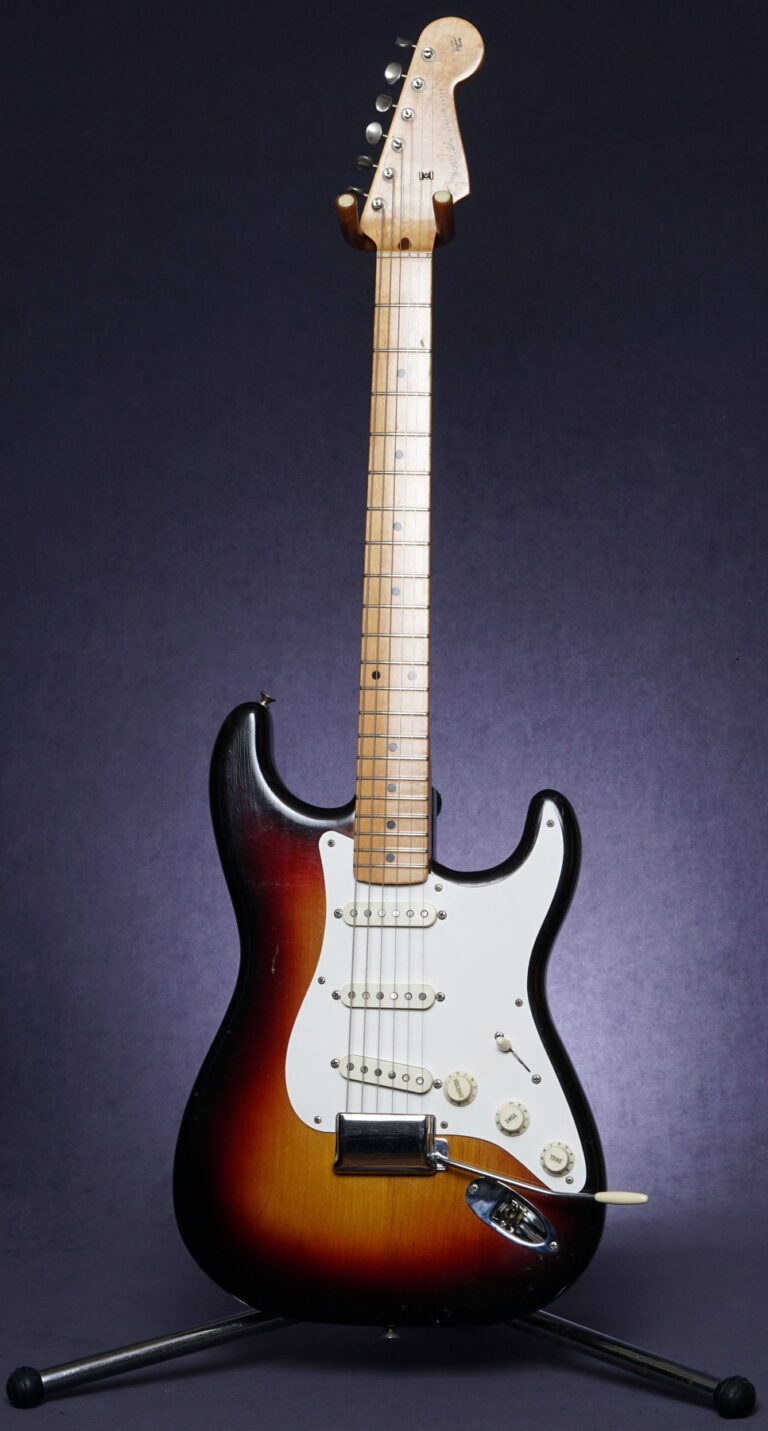
He also used a Fender Stratocaster during the Scorpions era — particularly for material where the single-coil character suited the musical context better than the SG’s warmer humbucker tone. The Stratocaster’s three-pickup configuration, its vibrato system (which Roth used extensively for the pitch-bending effects central to his Hendrix-influenced playing), and the specific brightness of its single-coil pickups gave him tonal options that the SG didn’t provide. The late-1960s Stratocasters he favoured had the CBS-era large headstock and three-bolt neck joint, with pickups wound to approximately 5.8k to 6.2k ohms DC resistance using Alnico V magnets — bright, clear, and responsive to pick attack in the way that single-coil pickups are but humbuckers aren’t.
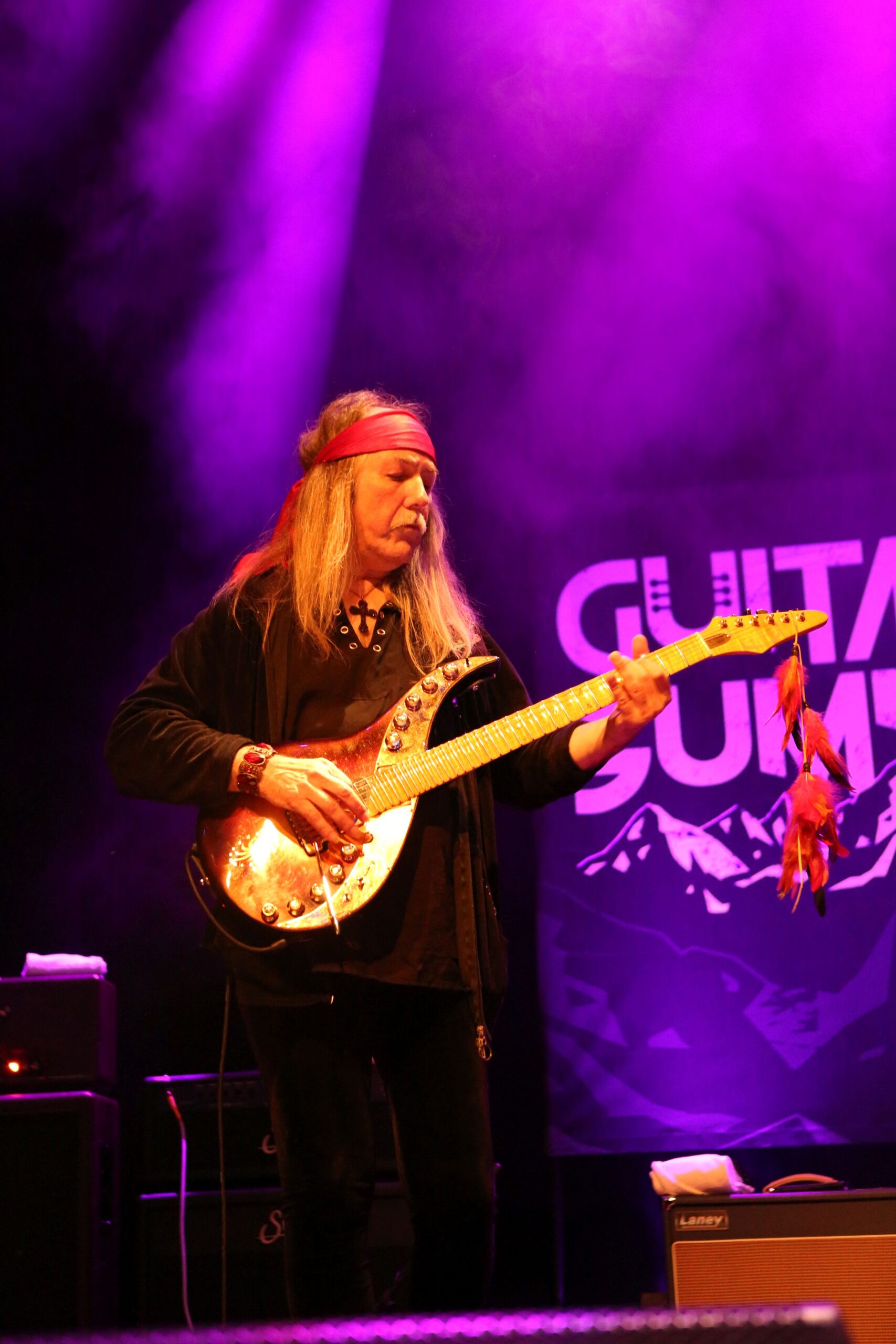
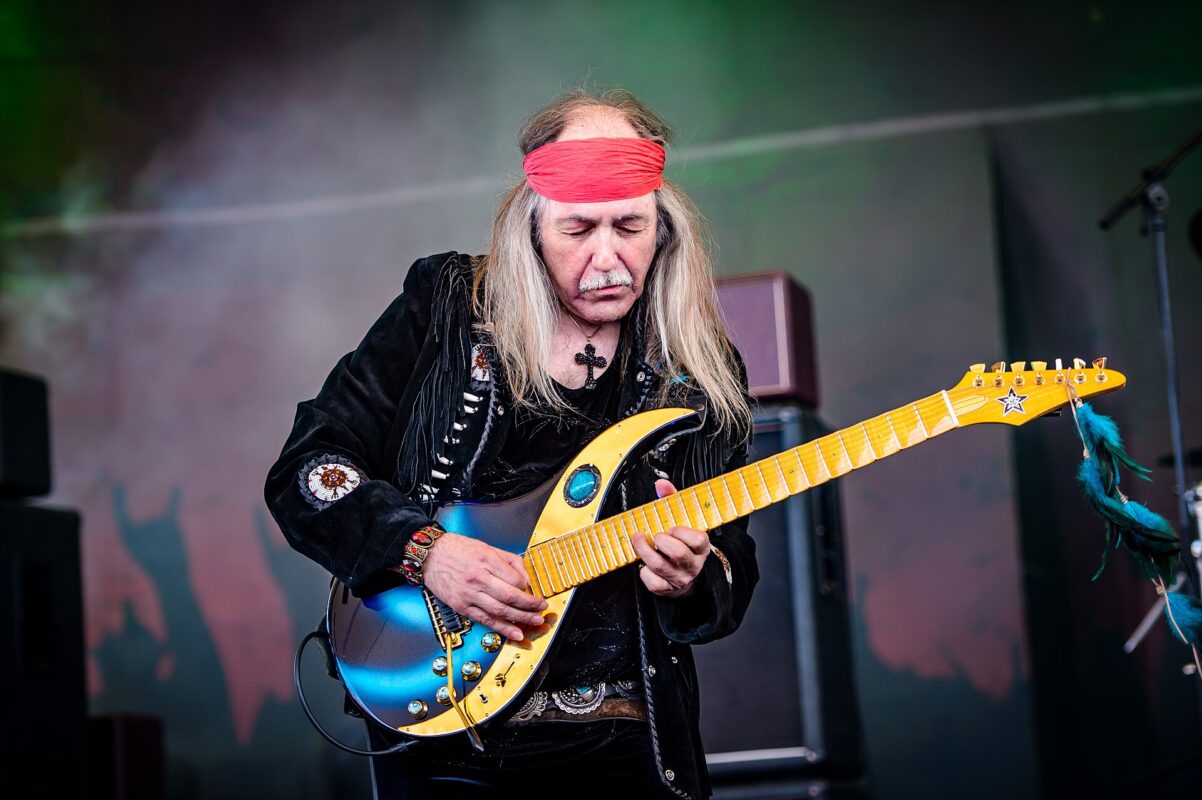
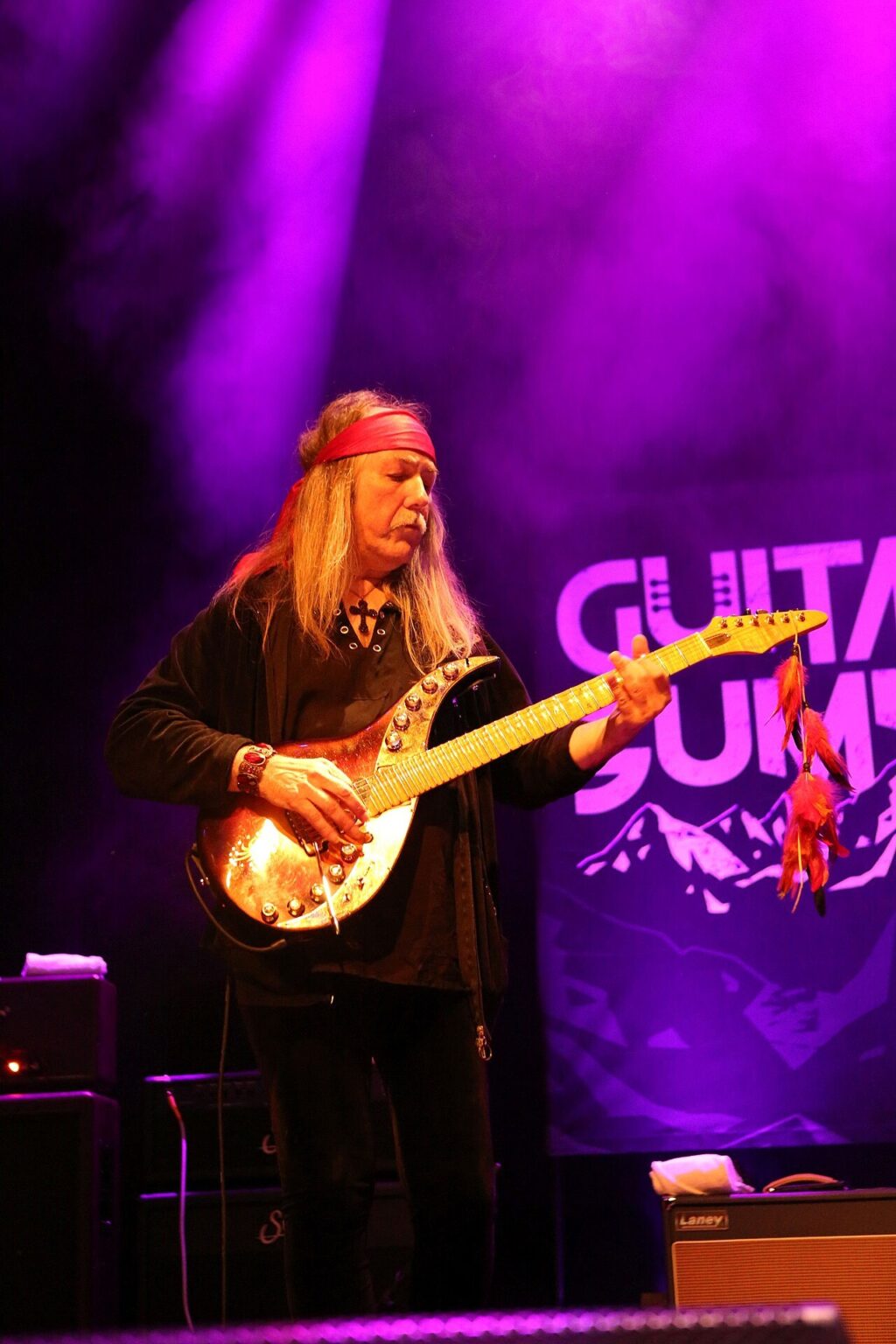
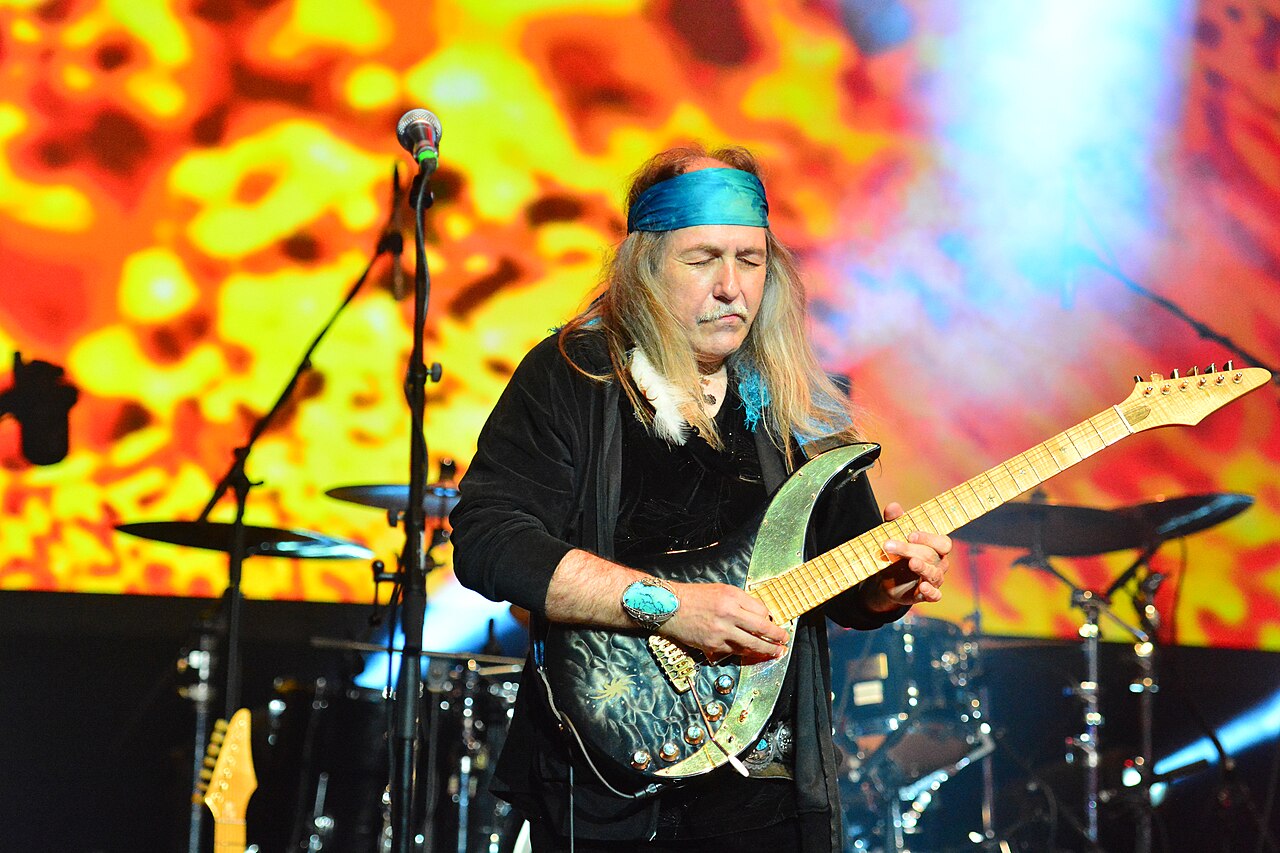
The decisive development was the creation of the Sky Guitar — a custom instrument that Roth designed in collaboration with luthier Karl Barth beginning in the late 1970s. The Sky Guitar’s most fundamental innovation is its extended upper range: the instrument features a longer neck than a standard guitar, with additional frets extending the playable range up to approximately 36 frets (compared to the standard guitar’s 21 or 22). This extended range allows Roth to play in the violin and soprano saxophone register — notes that are simply not available on a standard guitar regardless of technique.
The Sky Guitar’s body shape is derived from the Stratocaster aesthetic but modified significantly for ergonomic and tonal reasons. The neck is longer and thinner than a standard guitar neck, with a radius designed for the specific technique Roth employs in the extended upper register. The pickups are custom-wound single-coil units voiced for the specific characteristics of the extended range — standard Stratocaster pickups would not provide adequate output or appropriate frequency response in the extreme upper register where Roth frequently operates.
Several generations of Sky Guitar have been developed over the decades, with each iteration refining specific aspects of the design based on Roth’s evolving understanding of what the instrument needed to do. The current Sky Guitar models, produced in collaboration with various luthiers and manufacturers, incorporate decades of refinement and represent a highly evolved solution to a specific musical problem: how to give an electric guitarist access to the full pitch range of an orchestral instrument.
String gauges for Roth’s Sky Guitars are lighter than typical rock guitar gauges — the extended scale length and the extreme upper register playing that the instrument was designed for require strings that can be fretted and bent in the upper octaves without excessive tension. Custom gauge sets, developed specifically for the Sky Guitar’s scale length and playing requirements, are a regular part of his equipment requirements.
Amps
Uli Jon Roth’s amplification philosophy has evolved significantly over his career, moving from the standard British valve amplification of his Scorpions period toward increasingly custom and modified solutions as his playing requirements became more specific and demanding.
During the Scorpions era, his primary amplification was Marshall Super Lead 100-watt heads — the Plexi and early aluminium-panel variants that were standard for British and German hard rock bands of the early-to-mid 1970s. The Marshall’s four EL34 output valves, running approximately 100 watts into 4×12 cabinets loaded with Celestion G12M Greenback speakers, provided the combination of volume, drive character, and midrange emphasis that hard rock required. Roth ran the Marshalls at working volume — high enough that the EL34 output stage was starting to compress and saturate — which gave his guitar tone the natural harmonic complexity that defines output-stage-driven valve distortion.
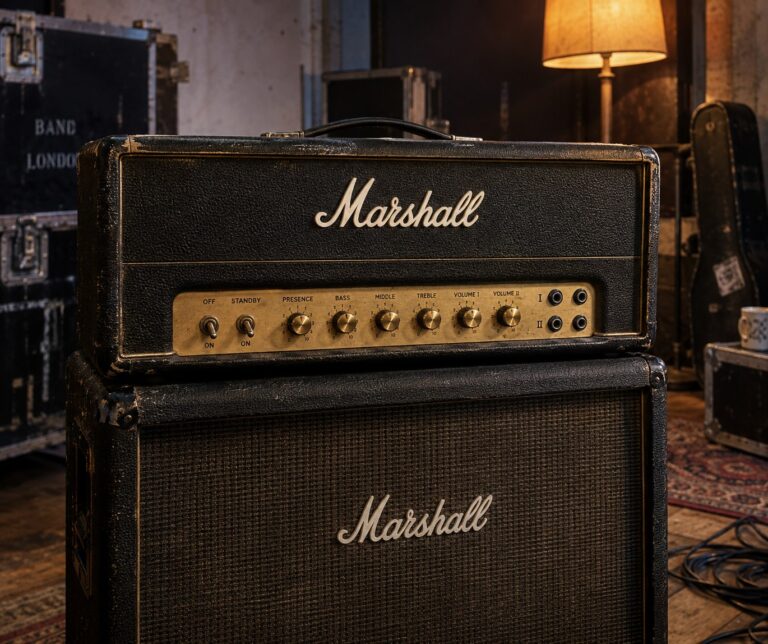
He also used Hiwatt DR103 100-watt heads — the British alternative to Marshall, built with military-grade components by Dave Reeves and featuring a different tonal character from the Marshall’s more aggressive midrange. The Hiwatt’s EL34 configuration produces a cleaner, tighter low end and a different quality of top-end presence than the Marshall, with more headroom at comparable volumes. For material requiring a cleaner, more defined foundation — particularly the more introspective and classical-influenced passages in his playing — the Hiwatt’s character was more appropriate than the Marshall’s natural drive tendency.

As his playing moved increasingly into the extended range of the Sky Guitar, Roth developed relationships with amplifier builders to create equipment specifically voiced for the extended frequency range of his instrument. The Sky Guitar’s extended upper register produces frequencies that push into the range where standard guitar amplifiers — designed with conventional guitar frequency ranges in mind — begin to respond less efficiently. Custom amplifier voicing, with extended high-frequency response and modified equalization curves, was necessary to allow the Sky Guitar’s full range to be reproduced faithfully.
His current amplification includes custom-built valve amplifiers designed specifically for the Sky Guitar’s requirements, alongside more conventional equipment used for specific applications. The core philosophy remains consistent with his Scorpions-era approach: valve amplification, driven to the point where the output stage is contributing its own harmonic character to the signal, with speakers and enclosures chosen for their specific contribution to the overall tonal picture.
Effects
Roth’s effects use reflects his musical priorities — the effects serve the music, and the music is primary. His chain during the Scorpions period was relatively concise, focused on a small number of tools that each contributed something specific and irreplaceable to his sound.
The wah pedal — specifically the Vox Clyde McCoy and later Cry Baby variants — was a central element of his Scorpions-era playing. Roth’s wah technique was influenced by Hendrix but developed in a distinctly personal direction: he used the wah both as a conventional lead effect and as a fixed filter, leaving the pedal at a specific position to emphasise midrange frequencies and give his tone a vocal, forward quality. His ability to synchronise wah movement with his vibrato and picking technique added an additional dimension of expressiveness to his lead playing.
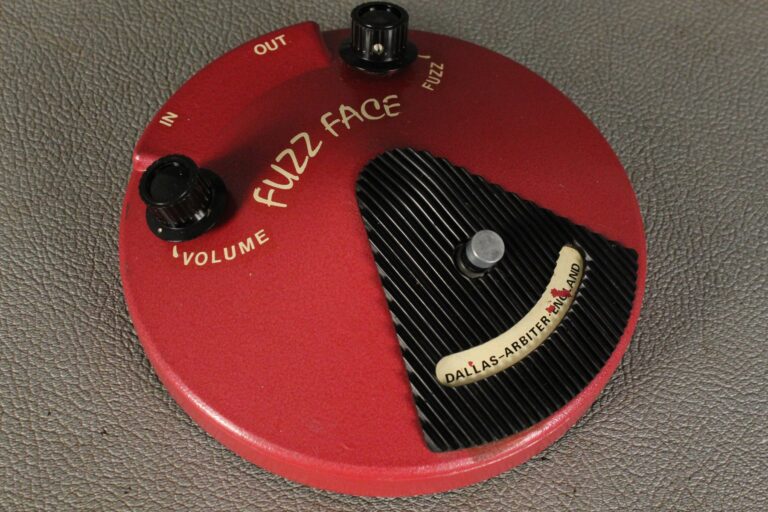
A fuzz pedal — germanium-transistor units similar to the Dallas Arbiter Fuzz Face — appeared in his chain for specific textural applications. Roth’s approach to fuzz was musical rather than mechanical: he used it where the added harmonic complexity served a specific musical purpose rather than as a constant setting. The germanium fuzz character — warm, asymmetrically clipping, sensitive to pick attack and guitar volume — complemented his SG and Stratocaster tones in ways that silicon-based alternatives couldn’t replicate.
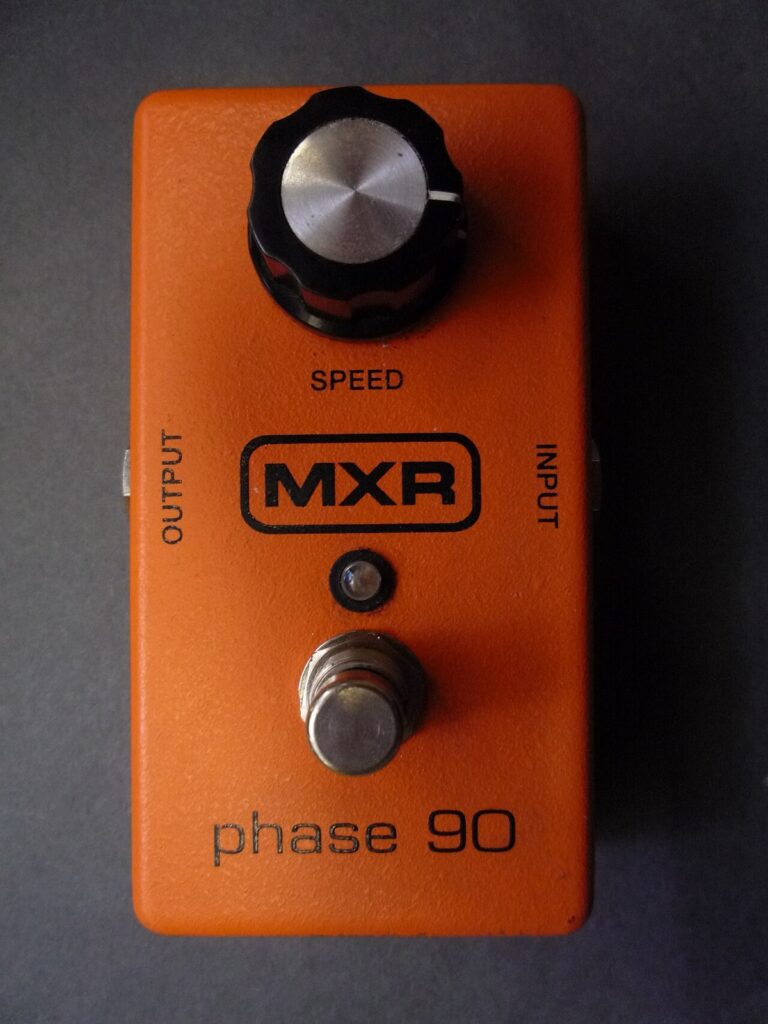
A phaser — the MXR Phase 90 in its original script-logo configuration — provided swept modulation for specific passages where the rotating quality suited the musical content. His use of the phaser was particularly interesting in the context of his classical-influenced material, where the phaser’s cyclic sweep added a dimensional quality to sustained chord voicings that complemented the harmonic language without imposing a purely rock character.
An Echoplex tape delay appeared for studio applications and specific live passages where echo and repetition were musically required. The Echoplex’s tape-based delay — with its warmth, slight pitch variation, and natural decay — was more musically appropriate for Roth’s playing than the clinical precision of digital delay alternatives. The specific quality of tape echo decay, where each repeat is slightly different from the previous one, creates a living ambience that digital delays don’t replicate.
In his more recent work, Roth has incorporated more sophisticated signal processing — including digital effects units for specific tonal requirements of the Sky Guitar’s extended range — while maintaining his fundamental commitment to valve amplification and organic tonal character as the foundation of his sound. The effects serve the music; the music determines what the effects need to do.
Playing Style & Tone Philosophy
Uli Jon Roth’s playing is defined by the synthesis of three traditions that he has integrated at a genuinely deep level: the blues and rock vocabulary of Hendrix and Cream, the classical phrasing and harmonic language of Bach and Beethoven, and the improvisational approach of jazz. This is not a superficial combination of different musical elements but a genuine synthesis in which each tradition informs and enriches the others, producing a musical language that is distinctly Roth’s own.
His classical influence is immediately audible in the structure and direction of his melodic lines. Where rock and blues guitar improvisation typically works through short phrases that build and resolve within a few bars, Roth’s improvisations often develop over much longer arcs — melodic lines that establish a theme, develop it through variation and sequence, and resolve it over dozens of bars in a way that reflects the developmental logic of classical composition rather than the call-and-response structure of blues improvisation. This long-form melodic thinking is unusual in rock guitar and reflects the genuine depth of his classical absorption rather than mere decoration.
His vibrato is among the most distinctive in rock guitar — wide, fast, and applied with a specific technique that involves both left-hand movement and, on the Stratocaster, the vibrato arm working in conjunction. The resulting pitch modulation has a singing, operatic quality that transcends the conventional rock vibrato and gives sustained notes a vocal expressiveness that few guitarists achieve. This vibrato technique, combined with his legato approach to fast passages (using hammer-ons and pull-offs extensively rather than picking every note), gives his playing a flowing, connected quality that distinguishes it from more pick-attack-centred approaches.
His tone philosophy begins with the music: what does this piece of music require, and what equipment best serves that requirement? This question-first approach, which produced the Sky Guitar when no existing instrument could answer the question, reflects a musician who refuses to be constrained by available tools when the music demands something that those tools can’t provide. It is a demanding philosophy — it requires both the musical clarity to know what you need and the technical and financial resources to get it — but it produces results that purely market-driven equipment choices cannot achieve.
How to Sound Like Uli Jon Roth
Guitar Approach
For the Scorpions-era Roth sound, a Gibson SG Standard with T-Top or PAF-style humbuckers is the starting point — the double-cutaway design essential for the upper-register access his playing requires. For the Stratocaster-era material, a late-1960s or early-1970s Strat with Alnico V single-coil pickups captures the specific bright, responsive character his tone required. Develop your vibrato specifically — wide, fast, and emotionally committed — and study his legato technique, which requires independent finger strength and coordination across all four fingers of the left hand.
The classical dimension of his playing requires specific study: transcribe passages from Bach violin sonatas and Beethoven violin concertos, and work on applying those melodic structures to the guitar. The specific quality of long, developed melodic lines that characterises his best improvisational work doesn’t emerge from blues scale practice; it requires the specific kind of melodic thinking that classical study develops.
Amp Approach
A Marshall Super Lead or equivalent Plexi-style amplifier, run at a volume where the EL34s are starting to compress and sing, is the core of his Scorpions-era tone. Add a wah pedal (set to a specific fixed position for rhythm work, swept actively for lead) and a germanium fuzz for heavier passages. The key is running the amplifier genuinely hard — the harmonic complexity that characterises his tone comes from output-stage saturation, not from preamp gain or external distortion pedals.
| Control | Setting | Notes |
|---|---|---|
| Volume (Input 1) | 7–8 | High volume — EL34 output stage compression is the key |
| Treble | 6–7 | Moderate-high — SG humbuckers benefit from treble presence |
| Middle | 6–7 | High mids for cut and upper-register projection |
| Bass | 4–5 | Controlled — SG adds low-end naturally |
| Presence | 6 | Moderate presence — adds air without harshness |
| Wah (fixed position) | Midrange boost | Fixed for rhythm, swept actively for lead lines |
| Germanium fuzz (optional) | Medium fuzz | For heavier passages — before amp input |
Influence & Legacy
Uli Jon Roth’s legacy operates on several levels simultaneously. At the most direct level, he is one of the primary originators of the neo-classical approach to rock guitar — the synthesis of classical violin and keyboard vocabulary with rock amplification and technique that Yngwie Malmsteen later codified and commercialised. Malmsteen has explicitly acknowledged Roth as a primary influence, and listening to the Scorpions albums of 1974–1978 makes the lineage immediately audible: the Baroque-influenced scalar passages, the use of diminished and harmonic minor scales, the long-form melodic development — all present in Roth’s playing years before Malmsteen’s debut.
His development of the Sky Guitar — creating an instrument to serve a musical vision rather than adapting the vision to available instruments — has influenced subsequent custom guitar development and inspired players who find standard guitar’s range limiting for the music they hear in their heads. The concept of the extended-range guitar, now represented commercially by various seven-, eight-, and nine-string instruments, owes something to the philosophical precedent Roth established, even if the specific implementations differ.
His influence on German rock specifically, and European rock more broadly, is substantial. The Scorpions’ early work — energised by Roth’s contribution — established that European hard rock could achieve a level of musical sophistication and technical ambition that the British and American originals didn’t always reach. Subsequent generations of European rock guitarists have worked in a context that Roth helped shape, even when his specific musical approach was not their primary influence.
For players exploring the neo-classical and classical-influenced rock guitar tradition that Roth established, the rigs of Alan Holdsworth — who pursued an equally personal and uncompromising approach to guitar from a jazz rather than classical foundation — and Ollie Halsall, whose jazz vocabulary and technical range offer a parallel case of musical intelligence in the service of personal vision, provide illuminating comparison. The Hendrix influence that shaped Roth’s early playing is explored through the rigs of Leigh Stephens and the broader psychedelic blues tradition that formed the foundation of Roth’s development.
The Scorpions Albums: Peak Roth in Context
The five studio albums Uli Jon Roth made with Scorpions between 1974 and 1978 represent some of the most musically ambitious hard rock of the decade, and examining them in sequence reveals a guitarist in rapid creative development — absorbing influences, integrating them with existing vocabulary, and pushing toward a synthesis that would take full shape only after he left the band.
Fly to the Rainbow (1974) introduced Roth to the Scorpions audience and established immediately that a different kind of guitar player had arrived. The album’s title track — an extended, atmospheric piece unlike anything in the Scorpions’ previous catalogue — showed Roth’s ambition and his willingness to operate in musical territory that had no precedent in German hard rock. The guitar tone throughout the album is his SG-through-Marshall sound, still developing but already distinctive: warm, sustained, with a quality of melodic thinking in the lead passages that went beyond the blues-pentatonic vocabulary of most British and American contemporaries.
In Trance (1975) is frequently cited as the peak of his Scorpions work — the album on which his playing is most passionate, most direct, and most fully integrated with the band’s overall sound. The title track and “Dark Lady” feature lead guitar work that is simultaneously technically accomplished and emotionally immediate, with the classical phrasing and blues feeling in genuine dialogue rather than awkward juxtaposition. His vibrato on these recordings — wide, warm, applied with the kind of total physical commitment that gives it an operatic quality — is at its most expressive, and the Marshall amplification at working volume provides the sustain and harmonic complexity that his sustained notes require.
Virgin Killer (1976) showed the band incorporating harder-edged production alongside Roth’s increasingly ambitious guitar work, and the contrast between the heavier rhythm tracks and his more lyrical lead contributions created a musical tension that was productive rather than conflicting. Taken by Force (1977) represents perhaps his most complex and classically ambitious Scorpions work — the extended pieces on this album incorporate classical structural thinking at a level that most hard rock of the era didn’t attempt.

The live double album Tokyo Tapes (1978), recorded on what would prove to be the final Scorpions tour with Roth, documents his live playing at its most fully developed. The extended improvised passages — which in live performance went significantly beyond the studio arrangements — show how his classical and jazz influences functioned in the heat of live performance: not as formal structures imposed on the music but as resources available for improvisation, drawn on spontaneously as the musical moment required.
Electric Sun and the Post-Scorpions Development
The three Electric Sun albums — Earthquake (1979), Firewind (1981), and Beyond the Astral Skies (1985) — show Roth developing the approach he had established at Scorpions in a freer, more personally controlled context. Freed from the commercial and collaborative constraints of a major-label rock band, he was able to pursue the more explicitly classical and experimental dimensions of his musical vision without the need to compromise for format or audience expectations.
The guitar tones on the Electric Sun albums reflect this greater freedom: the equipment remained broadly similar — Marshall amplification, Sky Guitar increasingly replacing the SG as the primary instrument — but its deployment was more varied and more extreme, with extended pieces that pushed his playing into territory the Scorpions context had only hinted at. The Sky Guitar’s extended range, developed concurrently with the Electric Sun albums, appears increasingly prominently through this period, and the upper-register passages that would become a signature of his mature style are more fully developed here than in the Scorpions work.
Firewind in particular contains some of his most extraordinary recorded guitar work — the title track in particular is a showcase for his full range of techniques and influences, with classical phrasing, blues feeling, and rock energy all present and in genuine dialogue. The guitar tone is the Marshall-driven Sky Guitar sound in its early form, and the recording captures both the warmth of the valve amplification and the extended range of the custom instrument with unusual clarity.
The progression from the Scorpions work through the Electric Sun albums to his subsequent solo career shows a musician who never stopped developing — each period building on the previous one rather than repeating it, each new project pushing into territory that the previous one had approached but not fully explored. This consistent development across five decades of work is one of the most impressive things about Roth’s career, and it is enabled by a relationship with equipment that has always been subordinate to the musical vision: the equipment changes when the music requires it, and the music is always the primary driver. His Sky Guitar was not built because it was a cool concept; it was built because the music he heard in his head required notes that didn’t exist on standard instruments. That is the only valid reason to build a new kind of guitar, and the fact that Roth had it is the most eloquent statement of his musical seriousness.
The Classical Synthesis: How It Actually Works in the Guitar
Roth’s classical influence is often discussed in terms of which composers he listened to, but the more interesting question is how that listening translated into specific changes in his guitar technique and harmonic language — because the translation from violin concerto or keyboard sonata to electric guitar is not automatic or simple. It requires both deep absorption of the classical tradition and significant technical development to make that tradition available as a resource in a guitar improvisation context.
The most fundamental element is the melodic architecture. Classical melodies — particularly Baroque melodies in the Bach tradition — are constructed through a specific logic of development: a theme is stated, developed through sequence and variation, transformed through harmonic modulation, and resolved. This developmental logic, applied to rock guitar improvisation, produces solos that have an internal narrative — a beginning, middle, and end — rather than the more common rock approach of playing with energy and hoping that something interesting emerges. Roth’s improvisations have this narrative quality: you can hear the development, the tension, the resolution, in ways that purely blues-based improvisation rarely achieves.
The harmonic dimension is equally important. Classical harmony — particularly the use of the harmonic minor scale and its characteristic raised seventh degree, the use of diminished seventh chords as transitional harmonies, and the specific voice-leading logic that drives classical chord progressions — provides a vocabulary that is genuinely different from the blues-based pentatonic thinking of most rock players. When Roth incorporates these elements into his playing, the result doesn’t sound like classical music played on electric guitar; it sounds like rock guitar informed by classical thinking, which is a significantly more interesting combination.
The technical requirements of this approach are considerable. Playing classical-influenced passages at rock tempos, on an instrument with a significantly different physical character from the violin or piano that the original music was written for, requires both a deep knowledge of the original tradition and the specific guitar technique to execute the ideas that knowledge generates. Roth developed this technique through intensive practice and through the specific demands of performing these ideas in live contexts — the crucible that develops technique faster than any practice room.
His vibrato, developed in a direction influenced by the classical violin vibrato rather than the blues guitar vibrato, reflects this synthesis at the most fundamental level of technique. The classical violin vibrato is a pitch oscillation produced by the left-hand finger oscillating on the string, creating a symmetrical modulation above and below the target pitch. The blues guitar vibrato is typically a push-and-release motion that produces primarily upward pitch variation. Roth’s vibrato incorporates elements of both — wider than classical and more symmetrical than typical blues, with a warmth and vocal quality that draws on both traditions. This synthesis at the most basic technical level is the clearest evidence that his integration of classical and rock vocabulary is genuine rather than cosmetic.
The equipment served this synthesis in specific ways. The Sky Guitar’s extended range made the upper-register classical passages physically possible; the Marshall amplification’s natural compression and harmonic richness at working volume gave the classical-influenced lines a warmth and sustain that the more clinical sound of a clean amplifier wouldn’t have provided. The wah pedal, used as a fixed filter, added the forward presence in the midrange that allowed the intricate melodic lines to project clearly in a rock band context. Each element of the rig was chosen, consciously or intuitively, because it served the specific synthesis of classical and rock that was Roth’s musical vision — and that specific fit between vision and equipment is ultimately the most important lesson in the Uli Jon Roth gear story.
The Hiwatt Dimension: Clean Power and Tonal Headroom
The Hiwatt DR103 amplifier that appeared alongside the Marshall in Roth’s Scorpions-era rig deserves more specific attention than it typically receives in accounts of his equipment. The Hiwatt, built by Dave Reeves in Hythe, Kent, using point-to-point wiring and military-specification components, has a tonal character substantially different from the Marshall Super Lead despite both using EL34 output valves in a push-pull configuration at comparable power levels.
The fundamental difference lies in the quality and specification of the components. Reeves used Partridge transformers — regarded by many engineers as among the finest output and power transformers ever produced for a guitar amplifier — and point-to-point wiring on a quality turret board, rather than the printed circuit boards that were beginning to appear in Marshall amplifiers by the mid-1970s. The Partridge output transformer in particular contributes a specific quality to the Hiwatt’s sound: an extended frequency response in both the bass and treble, with a tightness in the low end and a sweetness in the top end that Marshall’s transformers don’t replicate. The Hiwatt at comparable gain settings has more clean headroom than the Marshall — the output stage remains cleaner at working volume before transitioning into saturation — and the saturation character, when it occurs, is different: smoother in the high frequencies, with a different quality of EL34 compression.
For Roth’s playing, the Hiwatt’s extended headroom was musically useful in specific contexts. The classical-influenced passages that required clear articulation of complex melodic lines — passages where the Marshall’s natural overdrive might blur the note-to-note definition — were better served by the Hiwatt’s cleaner response. The sustained, vibrato-heavy notes where the Marshall’s drive character added harmonic richness were better served by the Marshall. Using both amplifiers — the Hiwatt for articulation, the Marshall for warmth and sustain — gave him a combined tonal palette that neither alone could provide.
This dual-amplifier approach, blending British valve designs with complementary tonal characters, was common among serious players of the era and remains a standard approach in contexts where tonal range is more important than tonal simplicity. The specific combination of Marshall warmth and Hiwatt clarity that Roth used in the Scorpions period is one of the more sonically interesting amplifier pairings of its era, and it contributed significantly to the specific character of his guitar tone on those recordings — a tone that was simultaneously warm and clear, driven and articulate, heavy and precise. The equipment combination, in other words, served the musical combination — classical clarity within a rock energy context — with a directness that suggests either careful thought or very good instincts. With Roth, it was almost certainly both.
One detail worth noting in any account of Roth’s SG period is the specific pickup configuration of the late-1960s and early-1970s SG Standards he used. The Gibson T-Top humbucker — named for the characteristic “T” impression on the bobbin top that distinguished it from earlier Patent Applied For units — was the primary Gibson humbucker through the early-to-mid 1970s, produced from approximately 1967 onwards. The T-Top measures typically in the 7.4k to 7.8k ohm DC resistance range, slightly lower on average than the late PAF examples it succeeded, with Alnico V rod magnets and a marginally different winding pattern that produces a slightly different tonal character. The T-Top has a reputation for brightness and clarity relative to PAF humbuckers — less midrange emphasis, more defined top end — which suited Roth’s classical-influenced melodic lines better than the warmer, more midrange-forward PAF character might have. His upper-register playing required a pickup that would reproduce the high-frequency content of notes in the upper register of the neck without the softening that very warm pickups impose, and the T-Top’s character provided this without the harshness of high-output replacement pickups. In the context of his developing Sky Guitar work, this tonal character preference carries forward into the custom pickups he uses in the extended-range instruments — the need for clarity and upper-register definition remains constant across the evolution of his playing, and the equipment choices that serve it reflect this consistent requirement.
Frequently Asked Questions: Uli Jon Roth Guitars & Gear
What is the Sky Guitar?
The Sky Guitar is a custom electric guitar designed by Uli Jon Roth in collaboration with luthier Karl Barth, beginning in the late 1970s. Its primary distinguishing feature is an extended neck with additional frets — up to 36 frets compared to a standard guitar’s 21 or 22 — that allows the player to access notes in the violin and soprano saxophone register that are unavailable on standard instruments. The Sky Guitar was designed specifically to accommodate the extended upper-register playing that Roth’s classical-influenced musical vision required.
What guitars did Uli Jon Roth play with Scorpions?
His primary instruments during the Scorpions period were a Gibson SG Standard, equipped with T-Top humbucking pickups, and a Fender Stratocaster with late-1960s single-coil pickups. The SG provided the warmth and upper-register access his classical-influenced lead playing required; the Stratocaster’s single-coil character and vibrato system suited more Hendrix-influenced material. Both instruments were run through Marshall Super Lead 100-watt amplifiers into Greenback-loaded 4×12 cabinets.
What amp did Uli Jon Roth use?
During the Scorpions era, his primary amplifiers were Marshall Super Lead 100-watt Plexi heads and Hiwatt DR103 100-watt heads — both EL34-based British valve amplifiers with significantly different tonal characters. He ran these into Marshall 4×12 cabinets with Celestion G12M Greenback speakers. His later work with the Sky Guitar required custom amplification specifically voiced for the extended frequency range of the instrument.
How did Uli Jon Roth influence Yngwie Malmsteen?
Malmsteen has explicitly cited Roth as a primary influence and a formative inspiration for his neo-classical approach. The specific elements Malmsteen absorbed from Roth — the use of harmonic minor and diminished scales, the Baroque-influenced phrasing and scalar passages, the long-form melodic development in improvisation, the classical vibrato technique — are all present in Roth’s Scorpions-era work years before Malmsteen’s debut, and the lineage is directly audible to anyone familiar with both players.
What effects did Uli Jon Roth use?
His key effects during the Scorpions period included a Vox Clyde McCoy wah pedal (used both as a swept lead effect and as a fixed midrange filter), a germanium fuzz pedal for heavier material, an MXR Phase 90 for modulation, and an Echoplex tape delay for studio applications. His effects use was purposeful rather than extensive — each element served a specific musical function rather than contributing to a complex signal chain for its own sake.
Why did Uli Jon Roth leave Scorpions?
Roth left Scorpions in 1978, driven primarily by creative dissatisfaction with the constraints of commercial hard rock. His musical vision — combining classical composition, jazz improvisation, and rock energy — was increasingly difficult to pursue within the framework of an album-and-touring rock band oriented toward commercial success. The formation of Electric Sun allowed him to pursue a more personally directed musical agenda, and his subsequent career has been consistently oriented toward his own musical vision rather than commercial considerations.
What is Uli Jon Roth’s most important recorded work?
Within the Scorpions catalogue, the albums In Trance (1975) and Taken by Force (1977) are generally considered to represent his best work with the band — the former showing his playing at its most passionate and blues-influenced, the latter at its most complex and classically ambitious. The live double album Tokyo Tapes (1978) documents his live playing with the band at its most fully developed. His later Electric Sun albums, particularly Firewind (1981), show the subsequent development of his approach in a freer context.
Genre:
Hard Rock / Neo-Classical
Decades:
1970s | 1980s | 1990s | 2000s | 2010s | 2020s
Image credits
- Uli Jon Roth: F. Schwichtenberg, Wikimedia Commons, CC BY-SA 3.0.
- Uli Jon Roth: Frank Schwichtenberg, Wikimedia Commons, CC BY-SA 3.0.
- Uli Jon Roth: photo by © Markus Felix | PushingPixels (contact me), via Wikimedia Commons, CC BY-SA 4.0.
- Uli Jon Roth: photo by Frank Schwichtenberg, via Wikimedia Commons, CC BY-SA 4.0.
- Gibson SG Standard: Sonya, Wikimedia Commons, CC BY-SA 4.0.
- Fender Stratocaster: Lightburst, Wikimedia Commons, CC BY-SA 4.0.
- Marshall 1959 Super Lead Plexi: GuitarGangsters AI-generated reference illustration, not a photograph.
- Dallas Arbiter Fuzz Face: sploshette, Wikimedia Commons, CC BY 2.0.
- Hiwatt DR103 Custom 100: GuitarGangsters AI-generated reference illustration, not a photograph.
- MXR Phase 90: Roadside Guitars, Wikimedia Commons, CC BY-SA 2.0.
- Uli Jon Roth live: Dieter Stork, Wikimedia Commons, CC BY-SA 4.0.
- Gibson SG Standard: Sonya, Wikimedia Commons, CC BY-SA 4.0.
- Gibson SG Standard: Sonya, Wikimedia Commons, CC BY-SA 4.0.