
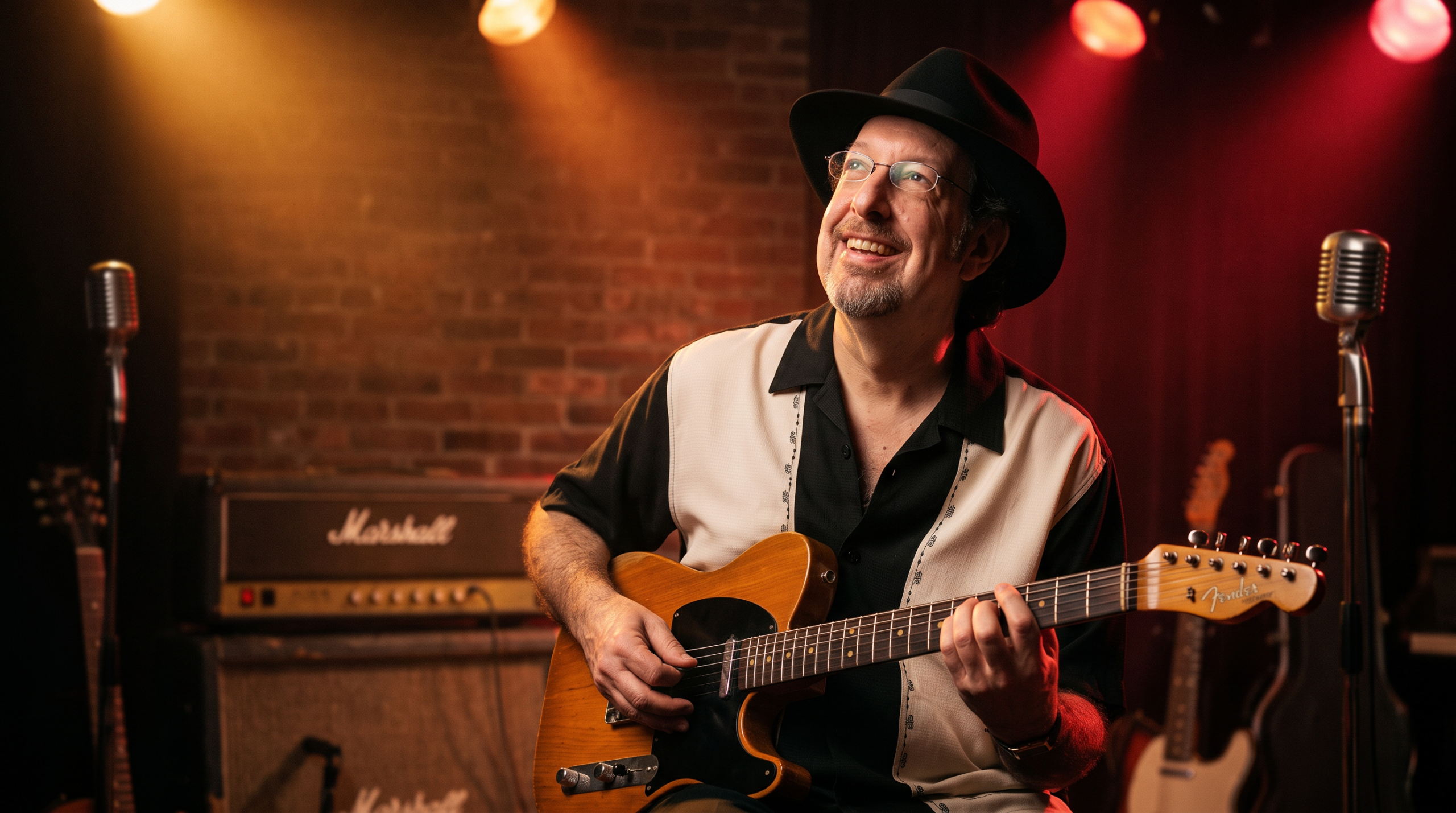
Investigate Tom Principato guitars gear and you find the equipment of one of American blues rock’s most versatile and most consistently excellent working guitarists — a Washington DC-area musician who has spent four decades developing a guitar approach of extraordinary range that encompasses Chicago blues, Texas blues, jump blues, swing, soul, and rock with equal technical authority and equal musical conviction. Principato is the kind of guitarist that other guitarists admire intensely while mainstream audiences remain largely unaware of him — a musician’s musician whose depth of blues knowledge, technical range, and consistent recording quality have given him a specific reputation within the blues and blues rock community that transcends his commercial profile. His Stratocasters and hollowbody instruments through vintage amplification serve a musical vision that takes the full American guitar tradition seriously.
This guide covers Principato’s complete equipment picture: the Fender and Gibson instruments that served his diverse musical approach, the amplification that gave his playing its specific warm American character, his effects chain, and the playing philosophy of a musician who understood that genuine blues versatility required genuine knowledge of each tradition rather than superficial familiarity with multiple styles. Understanding Tom Principato’s gear is understanding how decades of dedicated musical study produce playing of extraordinary range without losing emotional depth in any specific tradition.
Background
Tom Principato was born in 1955 in the Washington DC area — a city whose specific musical culture had always been more diverse than its political reputation suggested, with a specific blues, soul, and go-go tradition alongside the jazz and classical music of its arts institutions. His early musical formation encompassed the full range of American guitar traditions available through the Washington DC musical environment and through the intensive listening that would characterise his entire musical life.
He developed as a guitarist through the Washington DC area music scene, building his approach through a combination of live performance experience and intensive study of recordings across the full range of the American guitar tradition. The Washington DC area blues scene gave him professional blues performance experience; the recordings gave him knowledge of the full historical range of the tradition; and the combination of both produced a musical approach of unusual breadth and depth.
His recording career — a series of albums on Powerhouse Records and other independent labels from the mid-1980s onward — documented his guitar approach across multiple decades of professional development. Albums including Straight Up! (1988), Midnight Believer (1993), Blues This Bad (2002), and subsequent recordings showed a musician developing consistently within a broad musical vision rather than narrowing to a single commercial style.
His session and sideman work — recordings with various Washington DC area and national artists — extended his professional musical activity beyond his own recordings and showed the same versatility in a variety of specific musical contexts that his solo work demonstrated across a single artist’s range.
Tom Principato Guitars Gear: The Complete Rig
Guitars
Principato’s guitar collection was diverse and historically calibrated — reflecting the breadth of his musical approach across multiple American guitar traditions.
His primary guitar was a Fender Stratocaster — vintage and vintage-specification examples that gave his blues and blues rock playing the specific single-coil brightness and tonal versatility that suited both the Texas blues material and the jump blues and swing-influenced passages in his diverse repertoire. The Stratocaster’s three-pickup configuration gave access to the full range of single-coil tonal characters, and his understanding of which pickup position suited which specific musical context was as sophisticated as any of the more technical elements of his playing approach.
He also used Gibson semi-hollow and hollow instruments — ES-335 and ES-175 models for the Chicago blues and jump blues material where the warmer humbucker or P-90 character suited the specific traditions better than the Stratocaster’s single-coil brightness. This context-specific instrument selection reflected the same historical knowledge that Duke Robillard brought to similar instrument decisions — understanding which specific acoustic properties served which specific musical traditions.
Various Telecasters appeared for specific material where the Telecaster’s particularly bright, cutting bridge pickup character was more appropriate than either the Stratocaster or the hollowbody alternatives.
String gauges were medium — appropriate for the diverse demands of both the technical single-note work and the chord-based rhythm playing across his diverse repertoire.
Amps
Principato’s amplification was primarily American valve — consistent with the diverse blues and jump blues traditions he worked within, where the clean American valve character suited the music’s specific acoustic requirements better than the driven British alternatives.
His primary amplifiers included Fender Twin Reverb and Fender Super Reverb — the high-headroom 2×12 and warm 4×10 configurations that gave his blues and jump blues playing the clean American character appropriate for each specific context. The Twin’s clean headroom suited the hollowbody and jazz-influenced material; the Super Reverb’s warmth and natural compression suited the more blues-oriented material.
Various vintage Fender and boutique amplifiers appeared across his recording career for specific applications where their unique characters served the music best.
Effects
Principato’s effects chain was developed and context-specific — serving the diverse musical approach with specific tools for specific traditions.
A Dunlop Cry Baby wah for expressive blues passages — deployed with the blues tradition’s specific understanding of the wah as vocal extension rather than as tonal colour.
A Tube Screamer or similar smooth overdrive for the driven blues rock passages — typically used as a boost into the Fender amplification’s natural compression rather than as a standalone distortion source.
Various reverb and delay effects for atmospheric dimension appropriate to specific musical contexts — the reverb calibrated to the specific performance environment and the delay to the specific song tempo.
A tremolo pedal for the swing and soul-influenced material where the effect’s pulsing character suited the specific aesthetic tradition.
Playing Style & Tone Philosophy
Tom Principato’s playing style was defined by the specific combination of broad musical knowledge and consistent emotional depth that gave his guitar work its particular quality of both range and conviction. He was not a specialist who had developed extraordinary depth within a narrow musical territory — he was a genuinely comprehensive player who brought genuine knowledge and genuine emotional commitment to every tradition he worked within.
His Chicago blues playing showed genuine absorption of the West Side and South Side traditions — the harmonic vocabulary, the specific expressive techniques, and the emotional register of the Chicago approach. His Texas blues playing showed equal depth of engagement with the Texas tradition — the specific picking attack, the specific harmonic vocabulary, and the specific emotional directness of the Lone Star approach. His jump blues and swing playing showed the jazz harmonic knowledge and the specific rhythmic intelligence of the jump blues tradition.
This breadth of genuine mastery — rather than surface familiarity with multiple styles — was the defining quality of his musical approach and the quality that placed him in the company of players like Duke Robillard who had pursued similar comprehensive engagement with the American guitar tradition. The technical range was in service of genuine knowledge and genuine emotional commitment rather than of mere stylistic display.
Tonally, his philosophy was the comprehensive blues guitarist’s philosophy: the right instrument for each specific tradition, clean to lightly compressed American valve amplification that served the harmonic complexity of the diverse playing, and effects used purposefully for specific musical reasons rather than as habitual tonal additions.
How to Sound Like Tom Principato
Guitar Approach
A Fender Stratocaster for the Texas blues and blues rock material; a Gibson ES-335 or ES-175 for the Chicago blues and jump blues material; a Telecaster for specific cutting single-coil material. Medium strings. The harmonic vocabulary across multiple traditions is as important as the instrument — Principato’s comprehensive approach required genuine knowledge of Chicago blues, Texas blues, jump blues, and swing simultaneously. Study recordings from all four traditions with equal depth.
Amp Approach
A Fender Twin Reverb for the clean character needed for jazz and jump blues material; a Fender Super Reverb for the warmer blues character. Tube Screamer boost for the driven blues rock passages. Minimal processing for the most traditional material — letting the instrument and amplifier’s natural characters carry the primary statement.
| Control | Setting | Notes |
|---|---|---|
| Volume | 6 | Natural 6L6 compression — blues warmth zone |
| Treble | 5–6 | Moderate — matches instrument to material |
| Middle | 6 | Present mids for blues authority |
| Bass | 4–5 | Controlled for harmonic clarity |
| Reverb | 3 | Light spring reverb for atmospheric dimension |
Influence & Legacy
Tom Principato’s legacy was the specific legacy of a musician whose consistent quality and genuine musical breadth gave the Washington DC area blues scene one of its most distinguished long-term representatives while contributing to the national blues conversation through recordings that consistently demonstrated the full possibilities of comprehensive blues guitar knowledge.
His career demonstrated that genuine musical breadth — real mastery of multiple American guitar traditions rather than commercial specialisation in one — was achievable and sustainable across a four-decade professional career, and that the specifically musical rewards of this breadth (the ability to serve any musical context authentically, the continuous musical development that comprehensive study enabled) were worth the commercial costs of not having the single commercial identity that simpler approaches produced.
For players exploring the comprehensive blues guitar tradition that Principato exemplifies, the rigs of Duke Robillard — whose Roomful of Blues work showed similar comprehensive blues tradition engagement with similar stylistic range — and Arlen Roth, whose session and teaching work showed similar comprehensive guitar knowledge applied across multiple musical contexts, provide essential comparison. The Washington DC blues scene connection reaches toward Danny Gatton‘s approach, which shows how the same DC area musical environment produced a completely different but equally comprehensive guitar approach from a musician who absorbed all the same American guitar traditions through the same regional musical culture.
Straight Up!: The Album That Introduced a Comprehensive Voice
Straight Up! (1988) — Principato’s breakthrough album that introduced his comprehensive blues approach to a wider audience — was one of the more distinctive blues guitar debuts of its decade, showing a musician whose stylistic range was broader than any single commercial category could contain and whose depth within each specific tradition was genuine rather than superficial. The album’s stylistic diversity — moving between Chicago blues, jump blues, Texas blues, and blues rock within a single record — was both its most distinctive quality and the commercial challenge that prevented it from fitting neatly into any single marketing category.
The guitar tones across the album’s diverse material showed Principato’s context-specific instrument and amplifier deployment at its most fully realised: the Stratocaster’s single-coil brightness through the Super Reverb’s natural compression for the blues material, the hollowbody’s warmth through the Twin’s clean headroom for the jump blues passages, and the Telecaster’s cutting character for specific material that required that particular tonal authority. Each instrument and amplifier combination appeared exactly where it was most acoustically appropriate, and the overall effect was a recording that moved between diverse musical territories with complete tonal authenticity in each.
The Washington DC recording environment — the specific studios and engineers that the DC area music scene made available in the late 1980s — gave the recordings their specific character of warm documentation without the commercial slickness of major label production. The Powerhouse Records aesthetic — smaller label documentary commitment over major label commercial polish — suited Principato’s specific musical values as completely as Alligator’s approach suited the Chicago blues artists who recorded for that label.
The Danny Gatton Connection: Washington DC’s Guitar Tradition
The Washington DC area’s most celebrated guitarist — Danny Gatton, whose extraordinary technical range and musical comprehensiveness made him one of the most widely admired players in American roots music — was a natural point of comparison for Principato’s own comprehensive approach. Understanding the Gatton connection — both the similarities and the differences between the two DC area guitarists — gives a more complete picture of what the DC musical environment produced when it formed musicians of genuine ambition and genuine comprehensive curiosity.
Danny Gatton’s specific approach — the rockabilly, jazz, country, blues, and soul synthesis that gave his playing its extraordinary range — was both comparable to Principato’s comprehensive orientation and different in specific ways that reflected different personal histories and different specific influences. Gatton’s approach was primarily rooted in the rockabilly and country jazz tradition, with blues and soul incorporated as extensions of that foundation; Principato’s approach was primarily rooted in the blues tradition, with jazz, swing, and rock incorporated as extensions of that foundation. Both approaches encompassed the full range of American roots guitar traditions; both were genuinely comprehensive rather than superficially multi-stylistic; but the specific entry point and the specific emphases were different.
The Washington DC musical environment that formed both Gatton and Principato — the specific professional music scene of the DC metropolitan area, with its specific concentration of professional musicians and its specific musical culture that valued historical knowledge and technical range over narrow commercial specialisation — was itself a distinctive musical ecosystem. The DC area blues and roots music scene maintained a specific culture of musical knowledge and musical seriousness that was different from both the Texas and California blues rock traditions and from the Chicago blues scene, and both Gatton and Principato developed within this specific culture in ways that reflected its particular values.
The Jump Blues Dimension: A Comprehensive Player’s Most Distinctive Territory
Principato’s jump blues playing — his engagement with the Louis Jordan, Big Joe Turner, and jump blues swing tradition that was as central to Duke Robillard’s musical vision as Chicago or Texas blues — showed the full implications of his comprehensive approach in the specific territory where it was most distinctive relative to other contemporary blues rock players. Most blues rock guitarists worked within the Chicago and Texas traditions without fully engaging with the jump blues and swing vocabulary; Principato’s genuine mastery of the jump blues tradition gave his playing a specific dimension that few contemporaries matched.
The jump blues guitar vocabulary was rooted in the T-Bone Walker and Charlie Christian traditions more than in the Delta or Chicago electric blues traditions — the jazz chord substitutions, the specific swing feel, and the harmonic sophistication of the jump blues approach all connected to jazz rather than to the more pentatonically focused blues traditions. Principato’s genuine knowledge of this vocabulary — reflected in his hollowbody instrument choices, his Twin Reverb amplification for jump blues material, and the specific harmonic language of his jump blues playing — showed a musician who had absorbed the tradition deeply enough to understand not just its surface characteristics but its underlying musical logic.
The ES-175’s P-90 character through the Twin’s clean headroom gave his jump blues playing the specific warmth and definition that the tradition required — the P-90’s upper-midrange character giving single-note lines their appropriate cutting presence in the jump blues ensemble context, and the Twin’s clean headroom preserving the hollowbody’s natural acoustic resonance without the feedback complications that driven amplification would have produced at performance volumes. This specific equipment combination — hollowbody P-90 into clean Fender headroom — was as historically appropriate for jump blues as the Stratocaster into Super Reverb was appropriate for Chicago blues, and Principato’s context-specific deployment of each gave his comprehensive approach its specific quality of authentic engagement with each tradition rather than generic blues playing applied uniformly across different stylistic contexts.
Session Work and Musical Versatility
Principato’s session and sideman work — the recordings with various Washington DC area and national artists that extended his professional musical activity beyond his solo recordings — gave his musical versatility its most practical demonstration. Where solo recordings showed range across a single artist’s catalogue, session work required the ability to serve specific musical visions that might have completely different aesthetic requirements from his own approach, and to do so without imposing his personal musical signature on contexts that required different specific qualities.
The session guitarist’s fundamental skill — quickly identifying what each specific recording context required and delivering it efficiently, reliably, and with genuine musical quality — was as demanding in its way as the comprehensive solo artist’s range, and Principato’s ability to serve both contexts with equal professional quality reflected a musical intelligence that was genuinely comprehensive rather than merely stylistically diverse. The session musician needed to be musically selfless in the same way that Nelson’s Winter band role demanded — knowing what the music required and subordinating personal preferences to serve that requirement — and Principato’s decades of professional work in both solo and session contexts showed the same quality of selfless musical service alongside the personal artistic depth that distinguished his solo recordings.
The specific instruments and amplifiers that served his session work were as diverse as the work itself — different musical contexts required different specific acoustic properties, and his maintenance of a diverse collection that gave him access to the right acoustic tool for each specific context was as professionally important as any specific technical ability. The Stratocaster for Texas blues sessions; the ES-175 for jazz and jump blues sessions; the Telecaster for country blues sessions; the Super Reverb for warm blues sessions; the Twin for cleaner jazz-influenced sessions — each element of his collection had specific professional applications, and his ability to select the right combination for each specific context was one of the marks of professional guitar intelligence at its most complete.
Tom Principato’s career — four decades of consistent recording and performing across the full range of the American guitar tradition, in both solo and session contexts, with genuine musical depth in every specific tradition he worked within — was one of the more quietly extraordinary sustained achievements available in contemporary American roots music. The equipment he used: the diverse collection of Stratocasters, hollowbodies, and Telecasters through appropriate Fender amplification, with effects deployed purposefully for specific musical reasons — was as comprehensively appropriate as his musical approach was comprehensively engaged with the tradition. The gear served the knowledge; the knowledge served the music; and the music honoured the full American guitar tradition with the consistency and depth of engagement that four decades of genuine musical commitment had made possible.
The Fender Super Reverb’s specific contribution to Principato’s blues playing — and how the specific combination of 6L6 natural compression and four P10R Jensen speakers served different aspects of his diverse approach — reflected the same acoustic logic that had made this amplifier the standard for multiple generations of professional blues guitarists. For his Chicago blues material, the Super Reverb’s natural 6L6 compression at working volume gave the ES-335’s humbucker output its specific quality of warm, singing sustain that Chicago blues single-note playing required. For his Texas blues material, the same amplifier gave the Stratocaster’s single-coil brightness a specific warmth and presence that the clean headroom of the Twin would have been too clean to provide — the Super Reverb’s gentle natural compression adding warmth to the Stratocaster’s inherent brightness in ways that suited the Texas material’s specific emotional character. The Fender Super Reverb’s specific operating point — warm enough for blues character but clean enough for harmonic clarity — made it the appropriate central amplifier for the diverse blues material across his catalogue, serving multiple specific traditions from the same fundamental equipment choice rather than requiring different amplifiers for each stylistic territory.
The specific harmonic vocabulary that Principato brought to each tradition he worked within — and how this harmonic knowledge was different for each specific tradition — illustrated the genuine depth of his comprehensive approach rather than the superficial versatility of a musician who applied the same technique across different stylistic contexts. Chicago blues harmony was built primarily on the pentatonic minor and blues scale, with specific bent-note approaches and vibrato techniques that gave the tradition its characteristic emotional character. Jump blues harmony incorporated the jazz extended chord vocabulary — major sevenths, minor sevenths, dominant ninths, and chromatic passing chords that connected jazz and blues in the T-Bone Walker tradition. Texas blues occupied a middle position between the Chicago blues rawness and the jazz-influenced sophistication of the jump blues, with more consistent use of the major third and more blues rock energy than either the Chicago or jump blues approaches. Each tradition required specific harmonic knowledge and specific technical approaches, and Principato’s genuine command of all three reflected four decades of dedicated study rather than superficial stylistic sampling.
The tremolo pedal’s role in Principato’s swing and soul-influenced material — deployed for the pulsing volume modulation that gave chord and arpeggio playing its specific emotional character in these traditions — connected his playing to the same long American history of tremolo use that stretched from early Fender amplifier tremolo circuits through the soul and gospel music of the 1950s and 1960s to the country guitar of the same era. The tremolo effect in each of these traditions served a slightly different specific purpose — the soul tradition using it for emotional intensity in sustained chord playing, the country tradition using it for rhythmic character in strummed passages, and the swing tradition using it for atmospheric shimmer in slower, more introspective passages — and Principato’s ability to deploy it appropriately for each specific tradition reflected the same comprehensive historical knowledge that characterised his instrument and amplifier choices. The tremolo wasn’t a generic effect applied uniformly; it was a tradition-specific tool used with tradition-specific musical understanding.
The Midnight Believer album (1993) — Principato’s second major recording and one that showed his development at a more mature stage than the debut had captured — documented his guitar approach with a production quality and a musical range that showed the full scope of what his comprehensive blues engagement had produced by the early 1990s. The album’s diverse material — blues, jump blues, soul blues, Texas blues rock — was served by the same context-specific instrument and amplifier deployment that had characterised the debut, but with greater confidence and greater musical authority at each specific point. The guitar tones on the album showed a musician who had internalised the connection between specific equipment and specific musical traditions deeply enough that the right tool appeared without apparent deliberation — the Stratocaster into the Super Reverb for the blues material, the hollowbody into the Twin for the jump blues, the Telecaster for the cutting single-coil passages. This effortless appropriateness of equipment to musical context — the result of genuine study rather than lucky accident — was one of the primary markers of genuine musical mastery in the comprehensive blues tradition.
The Blues This Bad album (2002) — Principato’s most ambitious and most musically complete recording — showed the full realisation of his comprehensive approach at a stage of development where four decades of study and professional performance had produced a musical range and a depth of emotional engagement that the earlier recordings had only partially previewed. The album encompassed the full range of his stylistic versatility — each tradition served with genuine technical command and genuine emotional depth — and the guitar tones showed his equipment approach at its most precisely calibrated to the specific requirements of each specific musical moment. The Super Reverb’s warmth for the Chicago material, the Twin’s clean headroom for the jump blues, the JTM45 or similar British character for the more driven blues rock passages — each amplifier character appearing exactly where it was most musically appropriate, and the diverse instrument collection providing exactly the right acoustic character for each specific moment. Understanding Blues This Bad as the fullest available document of his comprehensive guitar approach gives the most accurate picture of what four decades of genuine musical commitment to the American guitar tradition’s full range had actually produced.
The specific character of the Washington DC blues scene that gave Principato his professional development context — and how this specific regional musical culture shaped both his comprehensive approach and his specific playing character — was as important to understanding his musical formation as any specific recording or technical influence. The DC area music scene had a specific culture of musical knowledge and musical seriousness that was different from the more commercially driven LA and Nashville scenes and from the more tradition-focused Chicago and Texas blues scenes. DC musicians tended to value comprehensive knowledge of the full American musical tradition over commercial specialisation in any single style — a cultural value that suited and reinforced Principato’s own comprehensive orientation rather than pushing him toward the narrower commercial identity that other regional scenes might have encouraged.
The Powerhouse Records context that gave Principato his primary recorded legacy — the small independent label that documented his work across multiple decades — was as important to understanding his career’s trajectory as any specific guitar or amplifier choice. Powerhouse’s specific approach — independent label documentary commitment over major label commercial management — gave Principato the consistent recording opportunities that his comprehensive approach required without the commercial pressure to simplify or specialise that a major label association might have imposed. Small independent label recording was consistently more economically precarious than major label recording, but it also provided artistic freedom and consistent access to recording that allowed a musician like Principato to document his full musical range across decades of sustained professional development. The label’s commitment to his comprehensive vision was as much a part of his musical legacy as any individual recording, and it showed that independent blues and roots music recording at its best could produce genuinely distinguished artistic documentation even outside the commercial mainstream.
The wah pedal’s blues tradition deployment in Principato’s playing — for the specific blues passages where the vocal extension of the swept filter was musically appropriate — illustrated his understanding of the effect as a blues tradition tool rather than as a rock guitar colour. In the blues context, the wah’s vocal quality — the consonant-vowel approximation of the filter movement through the frequency spectrum — was an extension of the guitar’s function as a voice speaking from personal experience, and this function was as authentic in blues music as the tradition’s use of the singing voice itself. Principato’s selective, blues-appropriate use of the wah — deployed only when the tradition specifically used it, absent from the many passages where it wasn’t part of the specific tradition’s vocabulary — reflected the same historical knowledge and the same musical intelligence that governed every other aspect of his comprehensive approach. Each effect was a tradition-specific tool; the tradition was the guide for when to use each tool; and the knowledge of the tradition was the foundation for using any specific tool with genuine musical purpose.
The comprehensive blues guitarist’s specific relationship with American musical history — the specific way that deep knowledge of multiple traditions gave the playing its particular quality of historical grounding — was the most valuable and least commercially obvious dimension of the approach that Principato exemplified. Musicians who played within one tradition knew that tradition’s specific references and responded to them authentically within that tradition’s specific values; musicians who played across multiple traditions could recognise and respond to historical references from each, giving their playing a specific quality of musical conversation with the full American tradition rather than with a single strand of it. Principato’s playing, at its best, showed this quality of comprehensive historical conversation — the specific note choices, the specific harmonic vocabulary, and the specific emotional register of each passage reflecting genuine knowledge of where that music came from and what it was expressing. The equipment served this knowledge; the knowledge honoured the tradition; and the tradition was extended and preserved by the depth and consistency of the engagement that Tom Principato brought to it across four decades of genuinely comprehensive musical commitment.
The T-Bone Walker influence that ran through both Principato’s jump blues playing and his broader blues approach — Walker’s specific synthesis of jazz harmony and blues expression being the foundational model for the entire sophisticated electric blues guitar tradition — showed in the specific harmonic language and the specific tonal approach that characterised his most jazz-influenced blues playing. Walker’s contribution to the electric blues — the jazz chord substitutions, the chromatic passing notes, the specific swing feel that gave his blues a harmonic richness and a rhythmic elegance that distinguished it from the rawer Delta-rooted approaches — was as central to Principato’s harmonic formation as to Duke Robillard’s or any other comprehensive blues guitarist who had absorbed the jump blues and sophisticated electric blues traditions. The T-Bone Walker model showed what blues guitar could achieve when the jazz harmonic language was fully integrated rather than applied as an overlay, and Principato’s absorption of this model gave his most harmonically sophisticated blues playing its specific character of warmth within complexity.
The soul and R&B dimension of Principato’s musical approach — the influence of the Washington DC area’s specific soul and go-go music tradition on his playing’s rhythmic character and emotional register — gave his blues guitar a specific quality of rhythmic groove and urban sophistication that distinguished it from either the rawer country blues or the more technically oriented jazz guitar approaches. DC’s soul tradition — the specific funky, groove-based music that emerged from the African American musical culture of the city and its Maryland and Virginia suburbs — was as much a part of the local musical environment that formed Principato as the blues and jazz traditions he explicitly studied, and its influence showed in the specific rhythmic feel that gave his playing its quality of urban groove alongside the historical depth of the multiple blues traditions he inhabited. The Stratocaster’s single-coil brightness suited this soul-influenced dimension as well as it suited the Texas blues influence — the specific attack and definition of the single-coil giving both rhythmic authority and tonal presence in the soul-influenced passages that the warmer humbucker or the rounder P-90 didn’t provide in the same way. Equipment appropriateness was never a simple question with a single answer for a player of Principato’s comprehensive range; it was always a specific question about which specific acoustic property best served which specific musical tradition in which specific musical moment.
The specific acoustic logic that governed Principato’s context-specific instrument deployment — the Stratocaster for Texas blues, the ES-335 for Chicago blues, the ES-175 for jump blues, the Telecaster for cutting single-coil material — was ultimately rooted in genuine understanding of why each specific instrument’s acoustic properties served each specific tradition’s musical requirements better than alternatives. The Texas blues tradition had developed its specific character around single-coil Fender instruments at the specific volume levels and playing intensities that gave those instruments their particular tonal character; using a different instrument for Texas blues material wasn’t prohibited, but it produced a different tonal character that wasn’t exactly right for the specific tradition. The Chicago blues tradition had developed around the semi-hollow Gibson’s specific warmth and sustain; again, using a different instrument wasn’t prohibited, but the specific acoustic character of the ES-335 was the one that had shaped the tradition’s sound and that produced the most acoustically authentic result for that specific tradition. Understanding this principle — that specific instruments had developed their traditional associations because they were genuinely acoustically appropriate for the specific musical requirements of specific traditions, not merely because musicians had used them by chance — was the foundation of Principato’s context-specific instrument approach, and this understanding was as central to his comprehensive blues mastery as any specific technical or harmonic knowledge.
Tom Principato’s ongoing recording career — continuing to document his comprehensive blues guitar approach across new albums through the 2010s and beyond with the same musical commitment and the same comprehensive engagement with the American guitar tradition’s full range — showed a musician for whom the forty-year professional development was the beginning of a continuing creative process rather than the conclusion of a completed one. The equipment remained consistently appropriate to the diverse musical approach; the musical approach remained consistently engaged with the full range of traditions it had always inhabited; and the commitment to genuine musical depth over commercial simplification remained as strong in the fourth decade of professional recording as it had been in the first. That consistency — of approach, of equipment, of values, and of genuine musical engagement — was ultimately the defining quality of Tom Principato’s career, and it was a quality that deserved recognition proportional to the musical achievement it had produced across four decades of dedicated American blues guitar playing.
Frequently Asked Questions: Tom Principato Guitars & Gear
What guitars does Tom Principato play?
Tom Principato’s primary guitars include Fender Stratocasters (for Texas blues and blues rock), Gibson semi-hollow instruments (ES-335 and ES-175 for Chicago blues and jump blues), and Fender Telecasters for specific cutting single-coil material. His diverse instrument collection reflects his genuine mastery across multiple American guitar traditions rather than a single signature instrument preference.
What amp does Tom Principato use?
His primary amplifiers include Fender Twin Reverb (clean headroom for jazz and jump blues material) and Fender Super Reverb (warmer 4×10 character for blues). His consistent use of clean American valve amplification reflected genuine understanding of what each specific musical tradition’s acoustic requirements were and why the clean Fender character served them better than driven British alternatives.
What makes Tom Principato’s guitar approach distinctive?
Principato’s distinctive quality is the combination of genuine mastery across multiple American guitar traditions — Chicago blues, Texas blues, jump blues, swing — with the emotional commitment that gives each specific tradition its authentic character. He is not a specialist who approximates other styles; he is a comprehensive player who brings genuine knowledge and genuine emotional depth to each specific tradition he works within.
What is Tom Principato’s connection to the Washington DC blues scene?
Principato has been one of the Washington DC area’s most distinguished blues musicians for four decades, developing and maintaining his career within the DC area music scene while building a national and international profile through his recordings on Powerhouse Records and other labels. His consistent Washington DC area presence gave the local blues scene one of its most musically distinguished long-term representatives.
What effects does Tom Principato use?
His key effects include a Dunlop Cry Baby wah (for expressive blues passages), a Tube Screamer or similar overdrive in boost mode (for driven blues rock passages), reverb and delay (for atmospheric dimension appropriate to specific contexts), and a tremolo pedal (for swing and soul-influenced material). His effects use was context-specific rather than habitual.
What are Tom Principato’s most important recordings?
His most significant recordings include Straight Up! (1988), which introduced his comprehensive blues approach to a wider audience; Midnight Believer (1993), which documented his development at a more mature stage; and Blues This Bad (2002), which showed his full musical range across the diverse American guitar traditions. His consistent recording quality across multiple decades on Powerhouse Records gave him a documented musical legacy proportional to his genuine musical achievement.
What is the Washington DC blues tradition?
The Washington DC area blues tradition was more diverse than the city’s political reputation suggested — encompassing a specific local blues, soul, and go-go tradition alongside the broader American blues rock that was available through the DC area’s diverse musical community. Principato’s decades-long development within this specific regional musical culture gave his playing a specific character shaped by the DC tradition’s particular blend of musical influences, including the soul and R&B traditions that were particularly prominent in the DC area music scene alongside the broader blues guitar tradition he pursued so comprehensively.
Genre:
Blues Rock / Session
Decades:
1980s | 1990s | 2000s | 2010s
Related stories
Wayne Kramer Guitars & Gear: The Complete Guide to MC5’s Proto-Punk Guitar Insurrectionist’s Rig
Wayne Kramer guitars & gear: MC5's proto-punk guitar insurrectionist. Star-spangled Strat, Big Muff Triangle, Marshall stacks, MXR Jail Guitar Doors Drive — the complete rig.
Wes Montgomery Guitars & Gear: The Complete Guide to the Jazz Master’s Rig
Wes Montgomery's guitars, amps, and effects — the complete guide. Gibson L-5 CES, Standel amps, thumb picking technique, flatwound strings, and how to nail that warm jazz tone.
Yngwie Malmsteen Guitars & Gear: The Complete Guide to the Shred Master’s Rig
Yngwie Malmsteen's guitars, amps, and effects — the complete guide. The Duck Stratocaster, scalloped fretboard, Marshall wall, DiMarzio HS3, and how to nail that neoclassical metal tone.