St. Vincent Guitars & Gear: The Complete Guide to Annie Clark’s Rig
St. Vincent's guitars, amps, and effects — the complete guide. Ernie Ball Music Man signature, Harmony Bobkat, Kemper, Death by Audio fuzz, Eventide H9, and how to nail Annie Clark's art-rock guitar tone.
Photo by Raph_PH, licensed under CC BY 2.0 (https://commons.wikimedia.org/wiki/File:St._Vincent_WOWGoth090818-68_(44961716475).jpg)
Gear Timeline
Annie Clark came from a jazz background. Her uncle, Tuck Andress of the jazz guitar-vocal duo Tuck & Patti, gave her a roadie job the summer she graduated from high school. She attended Berklee College of Music for two and a half years before dropping out. She can read charts and play changes and comfortably inhabit the harmonic world of post-bop jazz guitar. And then she went and made Strange Mercy and “Cruel” and “Rattlesnake” and all the other music that sounds like no jazz you’ve ever heard — angular, punishing, melodically brilliant, distorted with precision, orchestrated with a composer’s intelligence and a guitarist’s fearlessness. “The ear and the heart are king,” she has said. Both of hers are exceptional.
Born Anne Erin Clark on September 28, 1982, in Tulsa, Oklahoma, and raised in Dallas, Texas, she is known professionally as St. Vincent — a stage name derived from a Nick Cave song about the hospital where Dylan Thomas died. Rolling Stone named her the 26th greatest guitarist of all time in 2023. She has won four Grammy Awards. Her 2014 self-titled album — the first Grammy for Best Alternative Album won by a solo female artist in twenty years — established her as one of the defining guitar voices of the 2010s. All Born Screaming (2024), her self-produced first record, earned some of the strongest reviews of her career and three more Grammys. She is the first female artist to design her own line of guitars from the ground up for a major manufacturer. She is one of the most technically adventurous and compositionally sophisticated guitarists working in rock today. And she never plays in standard E tuning.

“I never play in standard E. I drop everything down a whole step, so it’s D G C F A D. That just ends up being better for my voice.” This single statement — the guitarist whose primary tuning is chosen for its relationship to her singing rather than for its relationship to guitar convention — tells you everything about the hierarchy of values that governs her relationship with the instrument. The guitar serves the song. The tuning serves the voice. The effects serve the composition. The gear serves the music. Everything else is secondary to these priorities, and the extraordinary sonic landscape she has built across seven albums is the result of applying those priorities with absolute consistency.
Background: From Dallas to Berklee to Polyphonic Spree to Guitar Icon
The musical formation that produced Annie Clark begins in Dallas, Texas, with a mother who gave a five-year-old a red plastic guitar from Target for Christmas, and a family with specific musical connections. Her uncle Tuck Andress of Tuck & Patti is a jazz guitarist of exceptional ability — one of the most technically sophisticated jazz guitarists working in the small-ensemble format. Clark worked as Tuck & Patti’s roadie the summer she graduated from high school, getting close to professional jazz guitar performance from the inside before attending Berklee, where she studied with professor of guitar Lauren Passarelli. She left Berklee after two and a half years: “I think that with music school and art school, or school in any form, there has to be some system of grading and measurement. Art shouldn’t be judged — it should feel true.”
After Berklee, she returned to Texas and joined the Polyphonic Spree — the large choral rock ensemble led by Tim DeLaughter — just before a European tour. This is the specific training environment that followed her formal education: large-band touring, professional production experience, the discipline of working within someone else’s musical vision. She then joined Sufjan Stevens’ touring band for a period that further expanded her professional experience before she began recording as St. Vincent in 2006. The debut album Marry Me (2007) demonstrated immediately that she was something unusual: a guitarist and songwriter capable of sophisticated, orchestral arrangements delivered with the directness and energy of rock music.

The Berklee experience — specifically leaving before graduating because she felt art shouldn’t be measured — produced a musician who carries her formal education as a foundation while refusing to be limited by it. The jazz harmonic vocabulary from studying with Lauren Passarelli. The sight-reading and ear training. The understanding of arrangement and orchestration that gives her records their specific quality of feeling fully composed rather than assembled from guitar parts and production. All of this was absorbed and then set aside in the sense that she left the institutional framework but kept the knowledge. This is the ideal relationship with formal music education: take what is useful, leave the credential behind, go make the work.
Her breakthrough to wider cultural notice came through the David Byrne collaboration Love This Giant (2012) — the brass-band-incorporating album that brought her to the attention of audiences beyond the indie rock scene. The subsequent self-titled album (2014), made with producer John Congleton, won the Grammy and established her commercial profile. MassEducation (2017) moved further into electronic production. Daddy’s Home (2021) took a deliberate turn toward 1970s funk and soul aesthetics. All Born Screaming (2024) — her first self-produced album — returned to guitar-centered rock with deliberate rejection of the digital guitar tones she had been using: “I’ve done enough direct guitar sounds. I wanted to move some air again.”
Her guitar design collaboration with Ernie Ball Music Man — which produced the first Ernie Ball Music Man guitar designed entirely by a female artist — is simultaneously a commercial product and an artistic statement. The guitar’s specific design (ergonomic, lightweight, HHH pickup configuration, onboard fuzz circuit) reflects her specific playing requirements and compositional personality rather than a generic “player signature model” that reproduces a vintage instrument in the artist’s name. She designed it from scratch, in a single meeting with Sterling Ball, and it has become one of Ernie Ball’s most successful artist models.
The Rig: St. Vincent’s Guitars, Amps, and Effects
Guitars
The Ernie Ball Music Man St. Vincent signature guitar is the instrument most closely associated with Clark’s current work and the one she designed in a first meeting with Sterling Ball of Ernie Ball. “I sat down with Sterling [Ball] and he said, ‘Why don’t you design a guitar?’ Really, the guitar that I drew up on that first day is very similar to what ended up making the final cut.” The guitar was conceived to create an instrument that was comfortable and lightweight, fitting her form and playing technique, with complete tonal flexibility — requirements that no existing production guitar fully met.
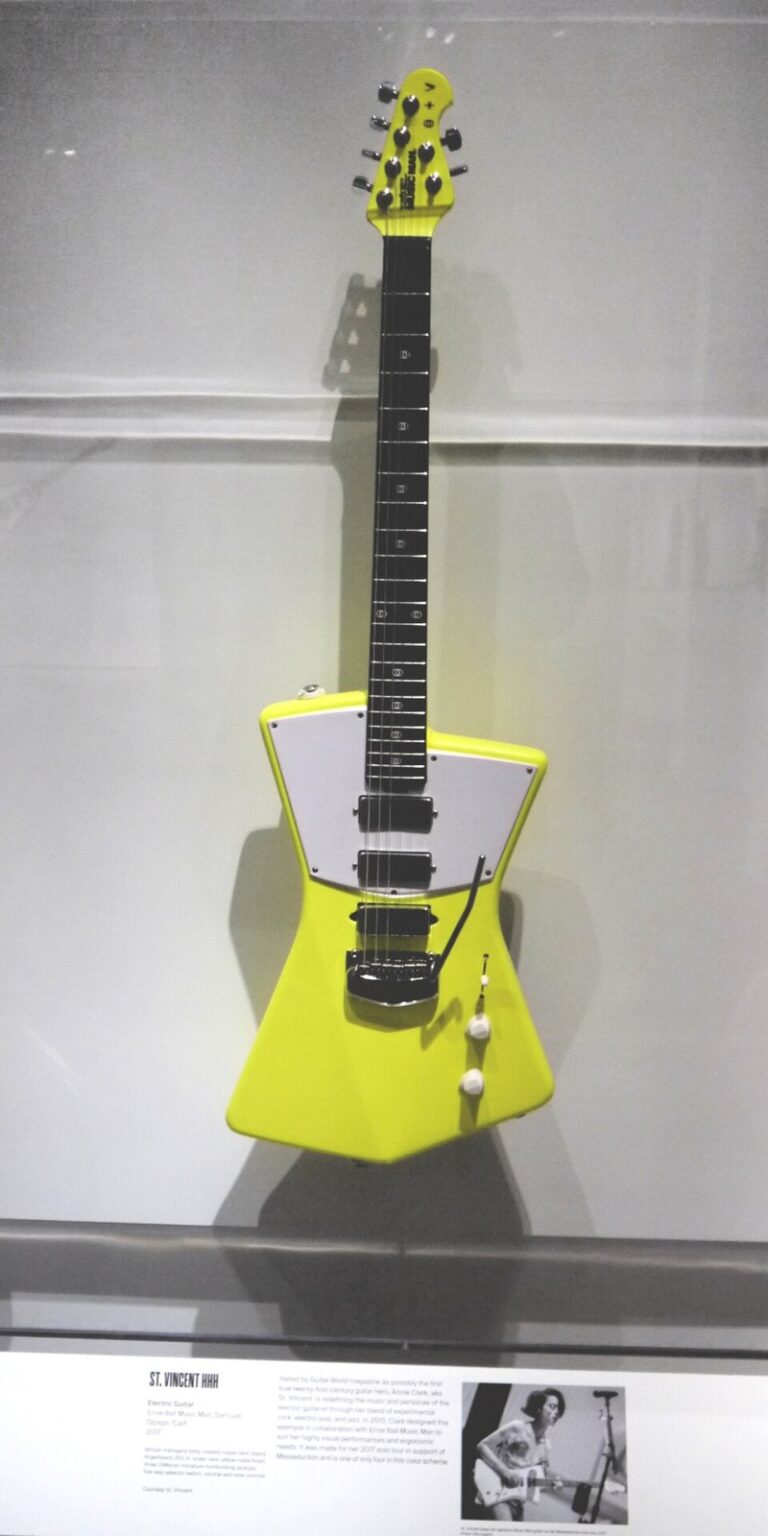
The St. Vincent signature is built around a distinctively shaped body — resembling a Gibson Firebird in silhouette but with the bolt-on neck construction more commonly found on Fender-style instruments. The body is African mahogany, providing warmth and sustain, while keeping weight low through careful wood selection and body contouring. The most distinctive feature is the HHH pickup configuration: three humbuckers (versus the standard two on most Les Paul-style instruments), providing a middle-position pickup that gives the guitar access to tonal positions unavailable from a two-humbucker design. The middle pickup’s inclusion came from Clark’s specific desire for the specific “neck-and-middle” or “middle-and-bridge” blended tones that provide different frequency emphasis from either single-pickup selection. There is an onboard fuzz circuit — accessible from the guitar’s controls — that provides the fuzz tone she uses without requiring an external pedal. Ernie Ball Regular Slinky strings, tuned to D G C F A D (a whole step down from standard) as her primary tuning.
She designed multiple versions and colorways of the signature, including the “Goldie” in Cashmere finish and the “Stealth Black” model. The guitar won Guitar World’s “Guitar of the Year” award in 2016 and has become one of the most distinctive and most-recognized guitars in contemporary alt-rock. The fact that she is the first female artist to design a guitar line from the ground up for Ernie Ball Music Man is documented by Guitar.com: “the distinctive, African Mahogany/Rosewood model was designed by Clark herself, becoming the first female artist to design her own line of guitars for the mass market from the ground up.”
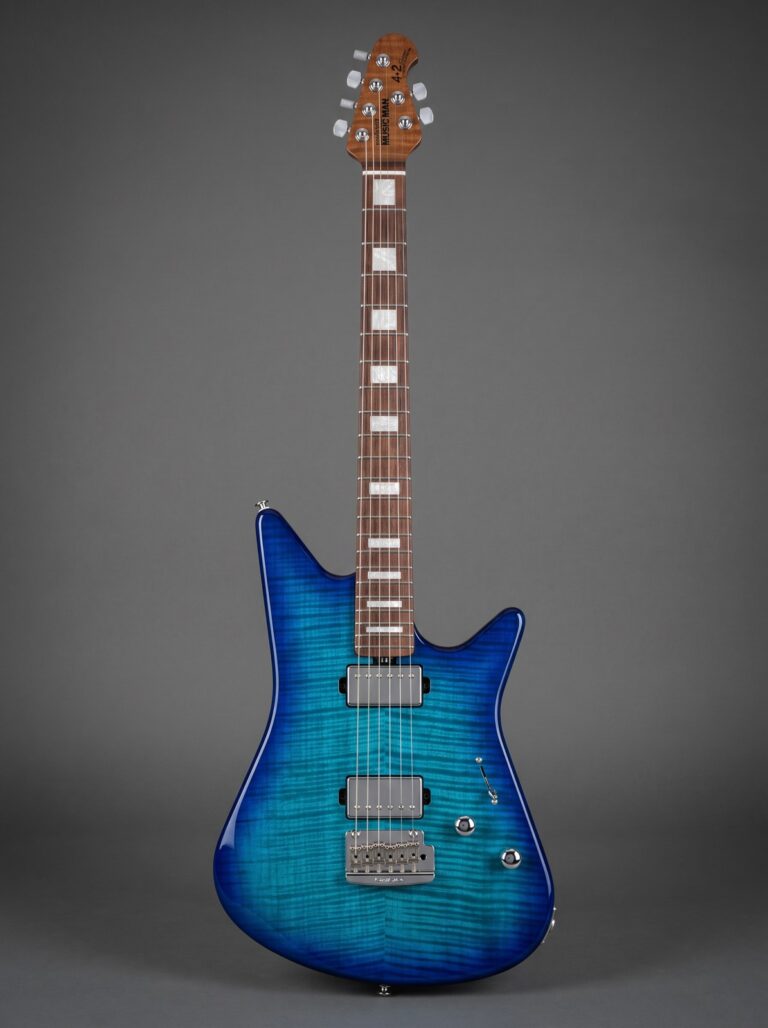
Before the St. Vincent signature was available, Clark’s primary live weapon of choice during the St. Vincent (2014) album touring cycle was the Ernie Ball Music Man Albert Lee HH — the signature model of the legendary British country-rock guitarist. The Albert Lee HH’s dual-humbucker okoume body configuration provided a warm, full-bodied tonal character that suited the St. Vincent album’s guitar requirements. “Before Clark had her own signature model, the Albert Lee HH was her live weapon of choice, regularly appearing on the road during the St. Vincent album touring cycle.”
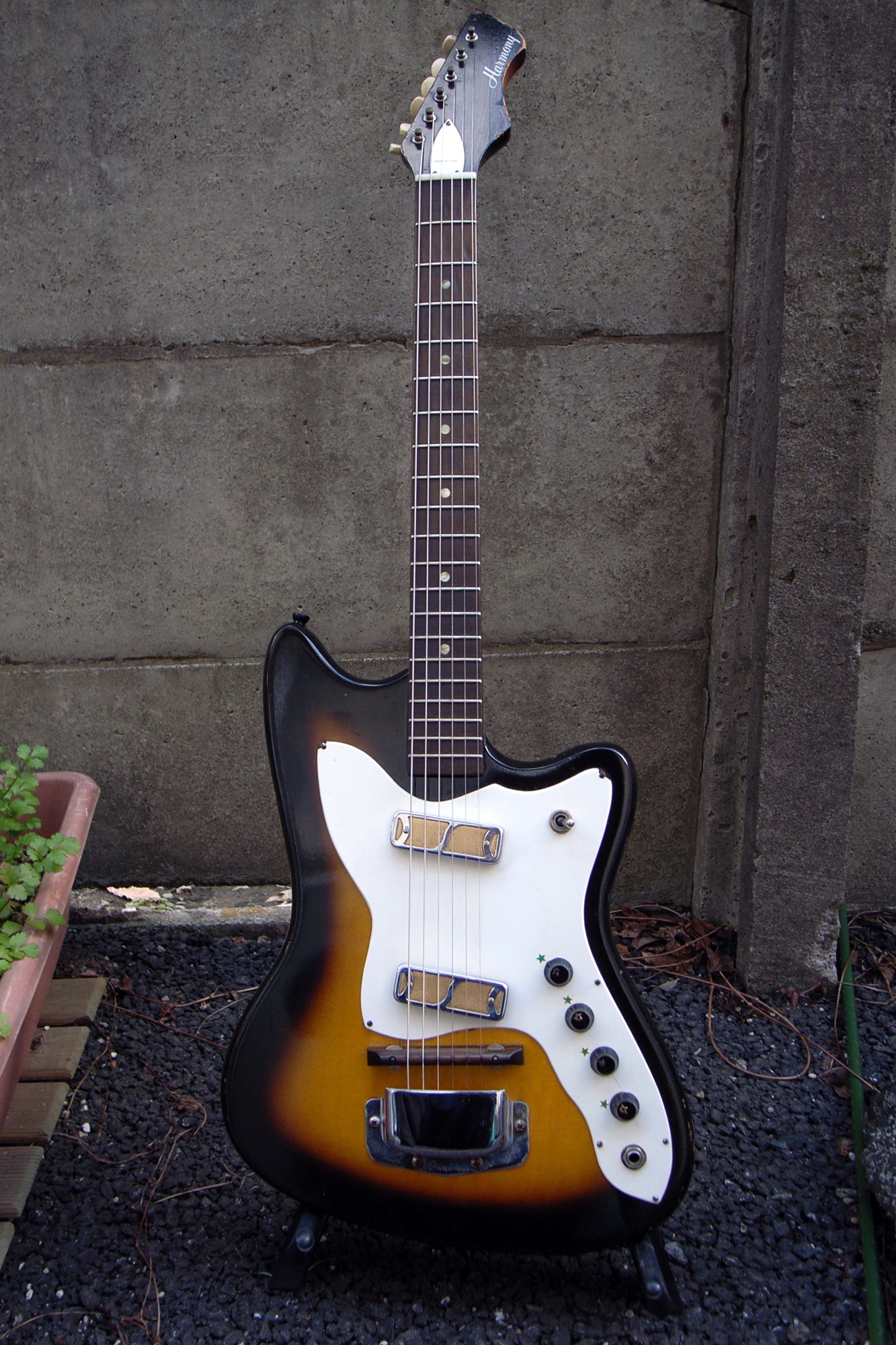
For the recording of Strange Mercy (2011) — one of her most critically celebrated albums — Clark’s primary guitar was a 1967 Harmony Bobkat, played through a Death by Audio Interstellar Overdriver Supreme pedal, primarily straight into a late-1970s Fender Princeton amp. “I played a ’67 Harmony Bobkat through a Death by Audio Interstellar Overdriver Supreme pedal, usually straight into a late-’70s Fender Princeton — not lots of pedals, more driving the amp pretty hard.” The Harmony Bobkat is a Chicago-made budget guitar from the 1960s — semi-hollow, with DeArmond single-coil pickups, light in weight, with a specific cheap-and-resonant quality similar to the Kay and Airline instruments that appealed to Jack White. Its vibrato bar is described as “super sensitive — you can dive bomb on it and it will stay in tune.” The combination of cheap instrument, one effects pedal, and a small amp driven hard is the Strange Mercy guitar tone — the approach of a minimalist who had not yet designed her own comprehensive instrument.
On her 2014 self-titled album, Clark recorded with producer John Congleton’s Fender Thurston Moore Jazzmaster. “She was drawn to its simplicity (it only has a volume knob), as well as its characteristically bright tone.” The single-volume-knob approach — eliminate all tone-shaping controls except the fundamental level control — is consistent with her philosophy of simplifying the guitar’s interface to maximize its responsiveness to playing rather than to settings adjustment. The Thurston Moore Jazzmaster’s specific character (long scale, floating tremolo, warm-but-bright single-coil pickups) suited the St. Vincent album’s specific tonal requirements, which differ from both the earlier Harmony Bobkat era and the subsequent Music Man signature era.
Alongside the Harmony Bobkat, Clark used a 1960s Silvertone 1488 in her early career work. Like the Bobkat, the Silvertone 1488 has a sensitive vibrato bar — “the Bobkat and Silvertone have this amazing vibrato bar that’s super sensitive — you can dive bomb on it and it will stay in tune.” The Silvertone 1488 is a single-cutaway hollowbody with a built-in amplifier in the case (a feature of several Silvertone models) and the specific cheap-but-expressive character that appealed to Clark in her pre-signature era.
For live performance during the Strange Mercy period, Clark used a 1979 or 1980 Hagström Super Swede — a Swedish-made guitar designed as a Gibson Les Paul equivalent. “The only other guitar I play on stage is a 1980 Hagström Swede. It’s like a Les Paul but it’s lighter and Swedish. That’s the only difference that I know of. It has two humbuckers.” The characteristically self-deprecating description (“that’s the only difference that I know of”) captures her pragmatic relationship with instruments — the Hagström works, it’s lighter than a Les Paul, it plays well, it has humbuckers. The fact that it’s Swedish is charming but not particularly relevant.
A heavily modified Fender Lead II circa 1980 appears in her Coachella 2015 performance documentation — “Originally a Fender Lead II Circa 1980. It has lots of changes: 2 EMG pickups, refinished green, added Roland synth pickup with pin output as well as regular output.” The added Roland synth pickup — which allows the guitar’s MIDI output to trigger synthesizers — reflects her integration of guitar and electronic synthesis that characterizes her production approach.
Clark drops everything down a whole step to D G C F A D as her standard tuning. For specific songs — “Regret” and “Birth in Reverse” among others — she uses additional alternate tunings that involve multiple strings tuned to the same note, creating drone-string effects. She uses Ernie Ball Regular Slinky strings at standard gauge in the whole-step-down tuning, and heavier .012-.054 gauge for specific alternate tunings.
Amps
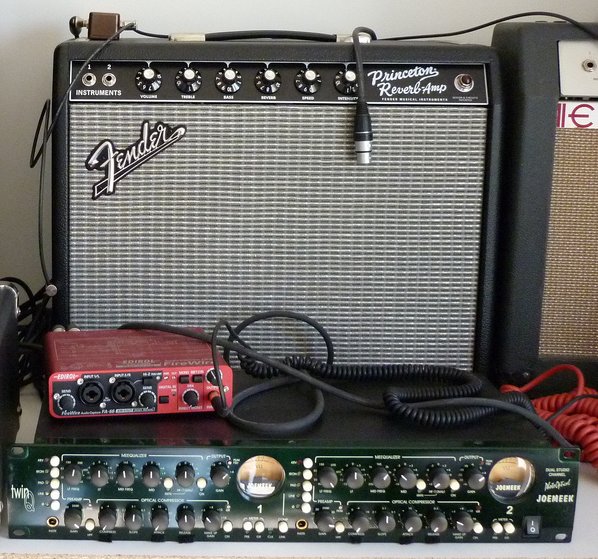
The late-1970s Fender Princeton — driven hard without many effects — was Clark’s primary studio amplification for Strange Mercy. The Princeton’s small size (typically 12-15 watts) and its specific tonal character when pushed into natural saturation gave Strange Mercy its specific driven, intimate guitar quality. “Not lots of pedals, more driving the amp pretty hard” is the Strange Mercy guitar philosophy, and the small Princeton driven hard provides exactly the tone that description implies: the edge of breakup from a small tube amp, every note slightly saturated, the amplifier breathing with the guitar rather than remaining neutral to it.
For All Born Screaming (2024), Clark deliberately returned to real amplifiers after years of digital solutions. A Marshall handled the dirty tones across the record — “heard most prominently on ‘Broken Man’, delivering what she described as a punchy, slightly spanky aggression rather than full-on fuzz.” The Marshall characterization — “punchy, slightly spanky” rather than “full-on fuzz” — describes the moderate gain, attack-forward quality of a good Marshall at working volume, where each note is defined and the distortion is controlled rather than saturating everything to a smooth blur.
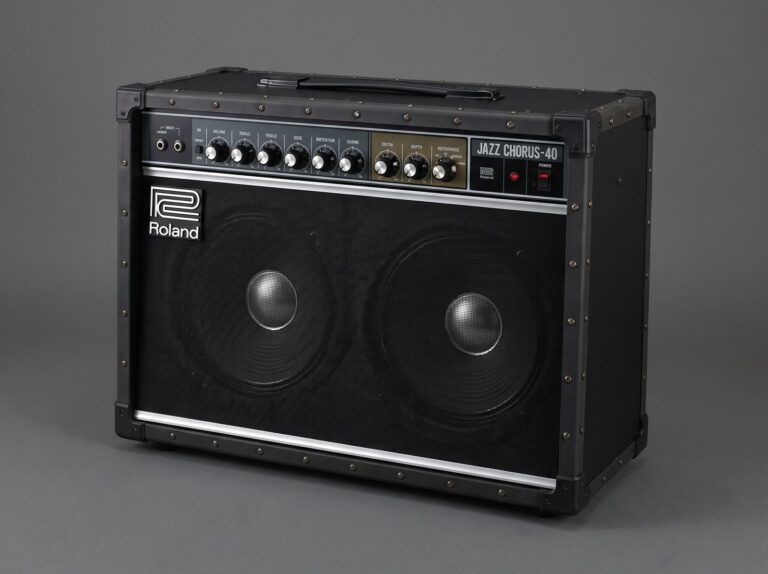
The Roland JC-40 — a solid-state, stereo 40-watt combo — provided the clean, funk-driven tones across All Born Screaming. “A solid-state amp well suited to the tight, pocket-driven guitar parts Clark was after.” The JC-40’s solid-state character (crystalline clean, no tube saturation, the specific stereo imaging of its built-in chorus) suited the album’s funk and soul influences, giving the clean guitar parts a precision and tightness that tube amplifiers’ natural compression would have softened.
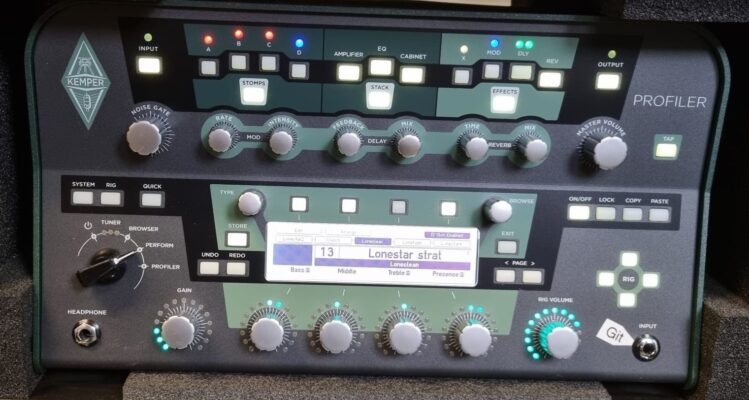
Following the St. Vincent album cycle, Clark moved to a Kemper for live performances, with her entire effects setup programmed show by show. “For an artist whose live production is as considered as her records, the reliability and consistency of the Kemper make it a natural fit on the road.” The Kemper Profiler — which captures the specific character of a tube amplifier through a profiling process — allows Clark to reproduce the tonal character of any amplifier she has profiled in a consistent, reliable format for touring. The show-by-show programming reflects her approach to live performance as a produced experience with the same compositional intention as her studio recordings.
The specific Princeton model — late 1970s, not the earlier silverface or black-face versions — gives the Strange Mercy recordings their specific tonal character. The 1970s Princeton’s particular preamp response and the small Jensen or Oxford speaker’s specific character when driven contributed to the intimate, slightly raw, organic quality of that album’s guitar sound.
Effects
The Death by Audio Interstellar Overdriver Supreme — a high-gain, harmonically rich overdrive/fuzz pedal from the Brooklyn-based effects builder — was Clark’s primary and essentially only effects pedal during the Strange Mercy recording sessions. Plugged into the late-1970s Princeton and driven hard, the Interstellar Overdriver provided the specific aggressive, harmonically complex character of Strange Mercy’s guitar tone. Death by Audio’s specific approach to gain — the circuit has a particular character that combines overdrive and fuzz in a way that’s musically coherent at high settings — suited Clark’s approach of using a single overdriving effect rather than multiple layered pedals.
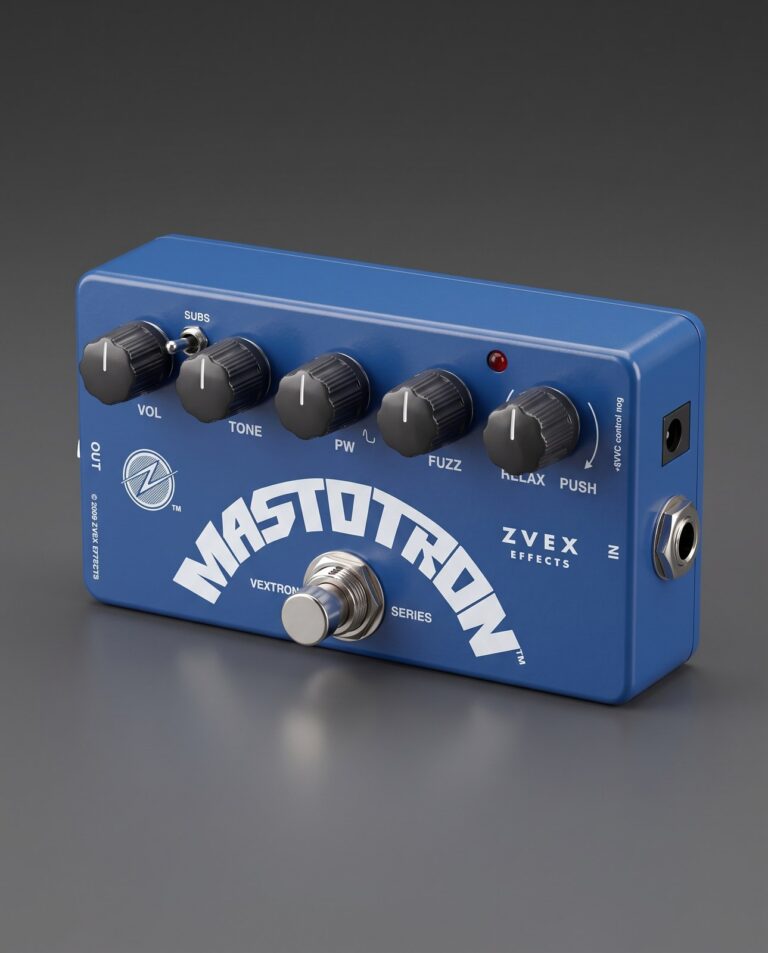
“I use — actually I think it’s a pretty cheap pedal — a Z.Vex Mastotron, and it’s like if the Fuzz Factory had girth.” The Z.Vex Mastotron is a silicon fuzz pedal designed to produce the massive low-end and the controllable tone of a fuzz while avoiding the tuning sensitivity and pick-direction-sensitivity problems of some fuzz designs. Clark’s description — “like if the Fuzz Factory had girth” — captures its specific character: the Fuzz Factory’s controllable, musical fuzz character with additional low-frequency weight. It appears across multiple St. Vincent recordings as a specific distortion color.
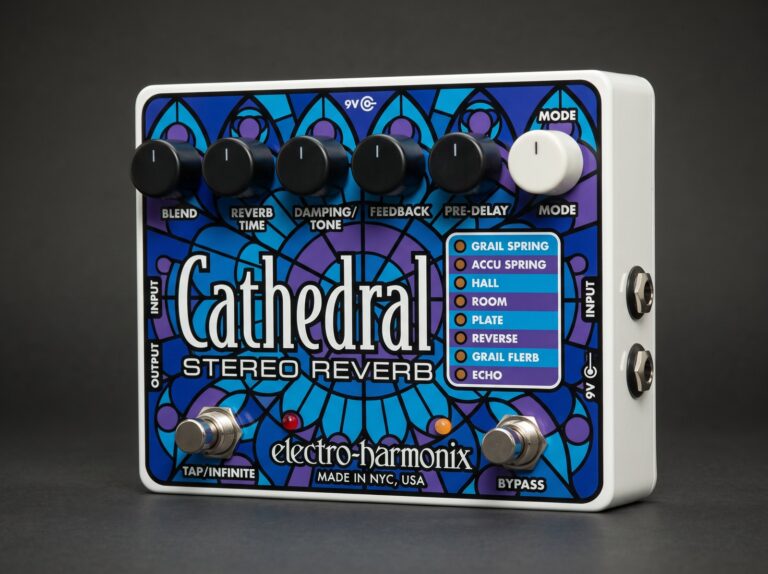
“I think that is the Electro-Harmonix Cathedral Reverb pedal” — Clark’s identification of the reverb on specific St. Vincent album clean tones. The Cathedral’s eight reverb modes (room, hall, plate, spring, reverse, infinite, tremolo-reverb, and cathedral) provide a comprehensive reverb palette, and the specific cathedral mode’s long, complex decay gave certain clean guitar passages their particular spatial depth.
“On the ‘Northern Lights’ solo I used a Sitori Sonics Tapeworm pedal. It is a delay pedal with two synth oscillators built in to it. I use it a lot live during the more chaotic bits.” The Tapeworm’s combination of delay and built-in synth oscillators creates a specific sound that is neither pure delay nor pure synthesis but something between: the oscillators can track the guitar’s pitch (approximately) while the delay creates rhythmic complexity, producing the unsettling, quasi-electronic quality that appears in St. Vincent’s more adventurous live moments.
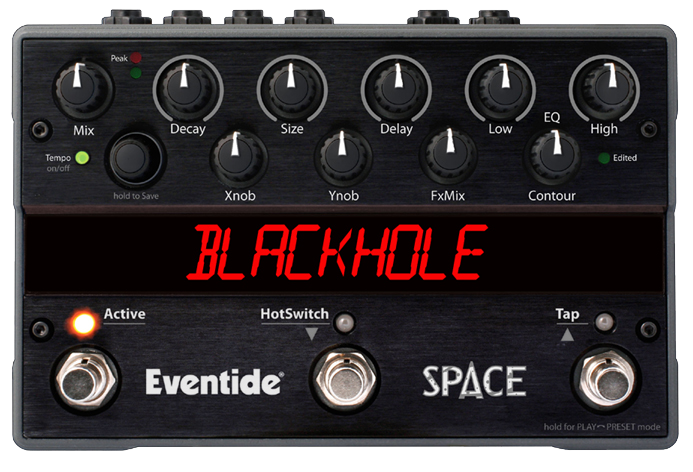
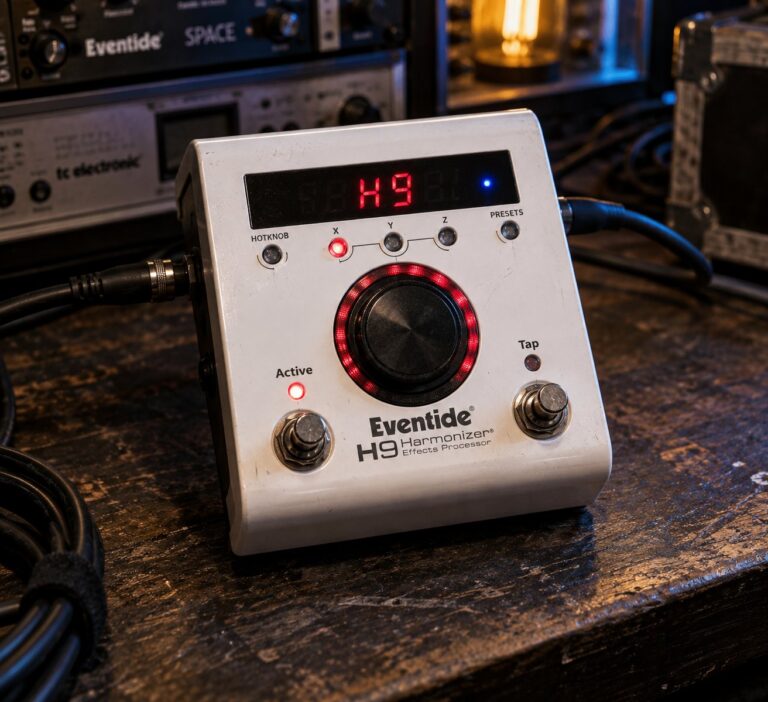
Two Eventide H9 Max multi-effects processors sit on Clark’s board for live performance, giving her access to the full Eventide effects library across both units. “On Clark’s board, giving her access to the full Eventide library, and her synth sounds, tremolos, delays, and reverbs are all programmed and ready to go for live performances.” The H9 Max’s comprehensive effects library — including the legendary Eventide pitch-shifting, harmonizing, modulation, delay, and reverb algorithms — provides the full tonal palette her technically diverse live show requires, all accessible via MIDI preset recall.
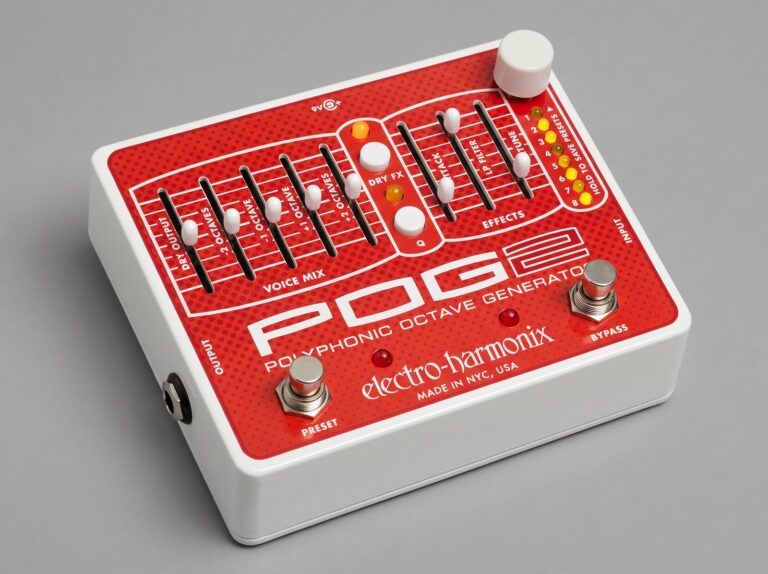
“Used on ‘Regret’ from St. Vincent, Clark borrowed John Congleton’s unit during the studio session before liking it enough to buy her own. Responsible for the remarkable sustain on [specific St. Vincent tracks].” The POG2’s octave-shifting capability — adding sub-octave, fundamental, and super-octave layers — gives Clark’s guitar tone the impression of additional instruments in the arrangement when combined with her Music Man’s onboard fuzz.
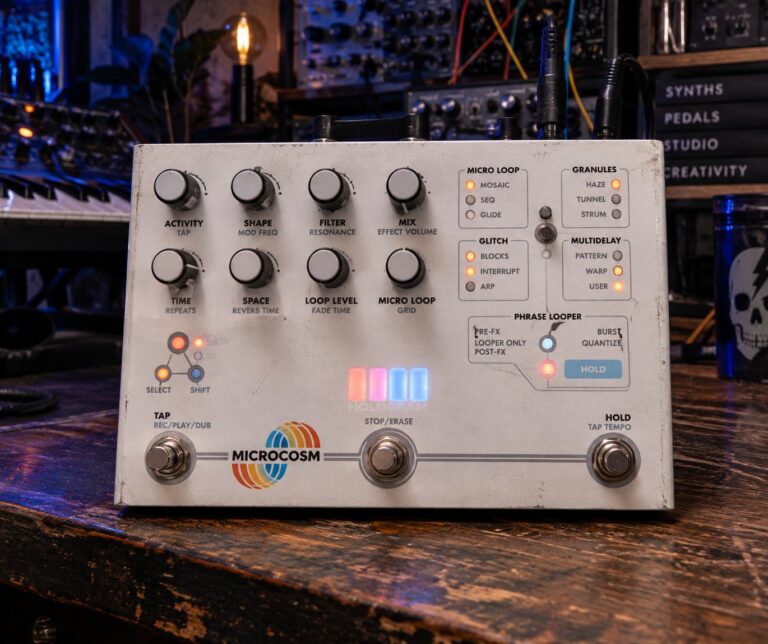
The Hologram Microcosm — a “granular looper” that combines pitch-shifting, delay, and granular processing — was one of the key textures on All Born Screaming. “Clark used it for the kaleidoscopic delay trails heard across the record.” The Microcosm’s specific character — the granular slicing and reassembly of the input signal, creating complex, evolving textures from a single guitar note — suits Clark’s compositional approach to effects as tonal color rather than simple signal processing.
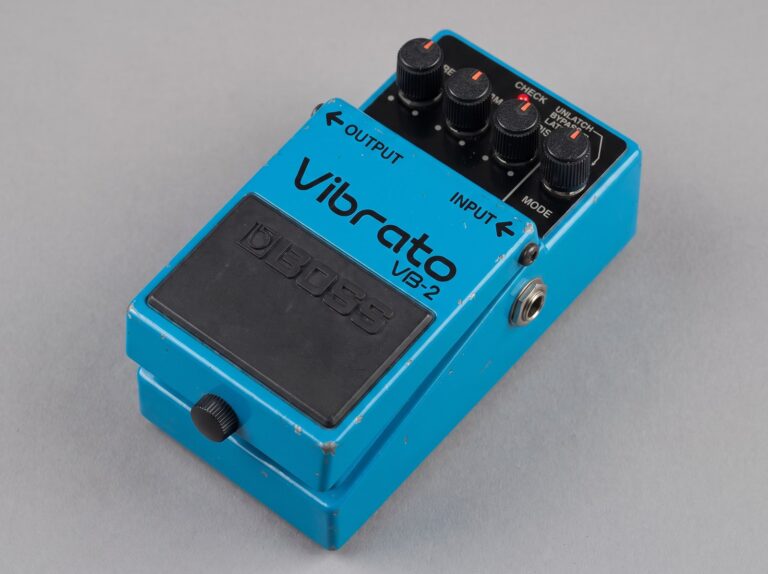
“Clark recorded her Roland JC-40 with a Boss VB-2 — the original version, famously Prince’s vibrato pedal of choice.” The Boss VB-2’s specific pitch-modulating vibrato — true vibrato rather than the amplitude modulation of tremolo — provides the pitch-wobble that appears in specific All Born Screaming passages. The Prince connection is appropriate: Clark’s rhythmic sophistication and her willingness to deploy a specific Prince-associated effect on her funk-influenced album reflects the conscious engagement with that tradition.
Clark uses Ableton Live as part of her live setup for backing tracks, electronic elements, and triggering specific samples that complement the live guitar performance. The integration of Ableton into her live show reflects her producer’s sensibility: the live performance is a produced event, with all elements — guitar, electronics, arrangement — managed and coordinated at the same compositional level.
Playing Style & Tone Philosophy
Annie Clark’s playing style is built on the specific combination of trained musicianship (Berklee theory, jazz guitar from Tuck Andress’ world) and avant-garde compositional sensibility that gives St. Vincent music its specific character: technically fluent but not technically demonstrative, harmonically sophisticated but not academically dry, and physically aggressive in specific moments with the specific purpose of emotional impact rather than technical display.
Her approach to avoiding guitar clichés is explicit: “I do try to shy away from the pitfalls of the poorly played blues guitar… approaching the guitar from a melodic standpoint as a jumping-off point instead of relying solely on muscle memory — this might feel fun to play, but how does it sound? The ear and the heart are king.” This anti-muscle-memory philosophy — the deliberate avoidance of the patterns that feel natural to hands trained in conventional rock guitar — produces her specific angular quality. Her solos don’t cycle through familiar pentatonic patterns; they develop melodic ideas that come from a different harmonic starting point, often reflecting the jazz and classical training she absorbed alongside the rock influences.

The technical aggressiveness of her distorted guitar moments — the “Rattlesnake” solo, the “Cruel” guitar parts, the angularity of “Bring Me Your Loves” — comes from a deliberate choice to push the guitar into genuinely uncomfortable, physically demanding territory. This is not the comfortable shredding of technically accomplished rock guitar; it is the controlled savagery of a player who understands that discomfort produces the right emotional result and deploys it accordingly. She has said she was “a 10-year-old fan of Pearl Jam and Nirvana, and I would’ve got into a fistfight defending them. Art mattered.” That Nirvana and Pearl Jam physicality is present in her most aggressive guitar work, filtered through the harmonic intelligence she absorbed from Tuck Andress and Lauren Passarelli at Berklee.
Her relationship with the guitar as a physical object is worth examining. She does not play seated or in a relaxed posture — her live performances are physically charged, with the guitar serving as a prop and a weapon as much as an instrument. The angular, sometimes violent quality of her most aggressive playing reflects a physical relationship with the instrument that is different from the studied, disciplined approach of a conservatory-trained guitarist. She plays into the guitar rather than over it, with the full body commitment that punk and grunge guitarists value over technical precision. This physical intensity, combined with her harmonic intelligence, produces the specific combination of brain and body that distinguishes her performances from guitarists who are equally technically capable but physically more restrained.
Her tone philosophy centers on what the song needs rather than on maintaining a consistent sonic identity. The Strange Mercy approach (single pedal, amp driven hard) is completely different from the St. Vincent approach (Jazzmaster, various effects, Kemper for live) which is completely different from the All Born Screaming approach (real Marshall for dirty, Roland JC-40 for clean, Microcosm for granular texture). Each record is sonically distinct because each record’s compositional needs are distinct. The gear serves the work rather than defining it.
How to Sound Like St. Vincent
Getting Annie Clark’s tone requires accepting that her tone changes with every record, and that the most useful entry point is the signature guitar’s onboard fuzz combined with any high-headroom tube amp.
Guitar: The Ernie Ball Music Man St. Vincent signature is the authentic choice, available in several configurations. The HHH pickup layout and the onboard fuzz are specific to this instrument. For accessible alternatives: any guitar with a humbucker in middle position for the blended tones she favors, tuned down a whole step to D G C F A D.
Amp: For the All Born Screaming era: a Marshall for dirty tones (gain moderate, not extreme) and a Roland JC-40 for clean tones. For the Strange Mercy era: a Fender Princeton or similar small tube amp, driven as hard as it will go with the input gain high. For the live setup: a Kemper with profiled amp characters for each show’s requirements.
Amp Settings (Marshall or similar, clean-to-crunch for dirty channel):
| Control | Setting (0–10) | Notes |
|---|---|---|
| Gain | 5–7 | Moderate — “punchy, slightly spanky” not full saturation |
| Bass | 5–6 | Full but controlled — Clark’s D-tuning adds natural bass |
| Mid | 6–7 | Forward — the melodic midrange of her playing lives here |
| Treble | 6–7 | Clear and present — angular guitar needs treble definition |
| Presence | 5–6 | Adds the cutting quality that records with authority |
The anti-cliché technique: Learn the pentatonic scales but actively avoid using them in their most familiar patterns. When a musical phrase comes naturally to your hands, ask whether it sounds like something you’ve heard a hundred times. If it does, find a different note. Clark’s methodology — melodic starting point rather than muscle memory — requires conscious effort to implement but produces the specific freshness that distinguishes her playing from generic rock guitar.
Influence & Legacy
Annie Clark’s influence on guitar playing operates through her simultaneous embodiment of multiple things that rock guitar culture has often treated as incompatible: technical fluency and avant-garde sensibility, commercial accessibility and genuine musical innovation, feminine identity and physical guitar aggression. Her existence as a guitar icon at the Rolling Stone 26th-greatest-of-all-time level — with a signature guitar she designed herself, multiple Grammy awards, and critical acclaim across a twenty-year career — demonstrates that these combinations are not only possible but commercially viable.
The Ernie Ball Music Man St. Vincent signature’s market success — becoming one of the company’s most recognized artist models despite being designed entirely by a female artist, a demographic historically underrepresented in signature guitar design — is a specific measurable influence. The guitar’s existence changed what Ernie Ball’s portfolio represented, and its commercial success created precedent for subsequent female artists pursuing signature instrument relationships with major manufacturers.
Her compositional approach to the guitar — treating it as one element in a produced arrangement rather than as the primary vehicle of expression — has influenced the generation of singer-songwriter guitarists who came up after her breakthrough: players who think about guitar tone and arrangement with the same care they give to songwriting, rather than treating the guitar as a vehicle for virtuosity or blues vocabulary.
For context on where Clark fits within the tradition of experimental guitar applied to accessible rock, the comparison with The Edge’s approach to guitar as texture and effect is illuminating — two guitarists who both brought studio production intelligence to the question of what guitar should sound like in a contemporary rock context, each arriving at distinctive and immediately recognizable answers. The Edge’s answer is delay and ambience; Clark’s is angular melody and controlled distortion. Both are responses to the same question: what does guitar bring to pop music that other instruments can’t?
The comparison with Joni Mitchell’s approach to alternate tunings as compositional foundation illuminates another parallel — two major female guitarists who both made alternate tuning the primary framework for their guitar work, each using the specific tonal and harmonic properties of non-standard tunings as compositional tools rather than simply as color variation. Mitchell’s open tunings gave her folk music its specific harmonic richness; Clark’s whole-step-down tuning gives her guitar parts their specific relationship to her vocal range and the harmonic context she composes in.
And for the deepest context of the guitarist-as-total-artist that Clark represents — the musician who composes, produces, performs, and designs instruments — the comparison with Prince’s approach to guitar within total musical control shows the tradition she inhabits. Both Prince and Clark are guitarists whose guitar playing is inseparable from their compositional intelligence, their production skill, and their total artistic vision. The instrument is not separate from the art. The instrument is how the art becomes audible.

Annie Clark is forty-two years old in 2026, self-producing her records, winning Grammys, designing guitars, and still never playing in standard E. The Music Man is tuned to D G C F A D. The Marshall is providing punchy, slightly spanky aggression. The Roland JC-40 is clean and pocket-tight. The Kemper has each show programmed. The Eventide H9s have the full library available. The Hologram Microcosm is creating kaleidoscopic delay trails. The ear and the heart are king. All born screaming.
The Grammy for Best Alternative Album won by the 2014 self-titled record was the first such Grammy won by a solo female artist in twenty years. That it took twenty years for a solo female artist to win that specific award is not a statement about the available female artists. It is a statement about the Recording Academy. Clark winning it changed the statement, slightly. The subsequent recognition: four Grammys total, Rolling Stone 26th greatest guitarist, Guitar World Guitar of the Year for the Music Man signature. She earned all of it with music made in D G C F A D tuning, with a guitar she designed herself, through amps chosen for what each record specifically needed. The ear and the heart are king. This is what it looks like when they are.
Frequently Asked Questions: St. Vincent Guitars & Gear
What guitar does St. Vincent play?
St. Vincent’s primary current guitar is the Ernie Ball Music Man St. Vincent signature — an instrument she designed herself in a 2015 meeting with Sterling Ball of Ernie Ball, “the first female artist to design her own line of guitars for the mass market from the ground up.” The guitar features an African mahogany body, bolt-on neck, HHH pickup configuration (three humbuckers), and an onboard fuzz circuit. It comes in multiple colorways including “Goldie” in Cashmere finish and a Stealth Black model. Before the signature was available, she used the Ernie Ball Music Man Albert Lee HH as her primary live guitar. Earlier recordings used a 1967 Harmony Bobkat (Strange Mercy), a Thurston Moore edition Fender Jazzmaster (2014 self-titled), a 1960s Silvertone 1488, and a 1979/80 Hagström Super Swede. She always plays tuned down a whole step to D G C F A D, stating “I never play in standard E.”
How did St. Vincent design her signature guitar?
St. Vincent designed her Ernie Ball Music Man signature guitar in a single initial meeting with Sterling Ball in spring 2015. “I sat down with Sterling [Ball] and he said, ‘Why don’t you design a guitar?’ Really, the guitar that I drew up on that first day is very similar to what ended up making the final cut.” The design priorities were comfort, lightweight construction, and complete tonal flexibility — specifically a Firebird-inspired body shape with bolt-on neck construction, African mahogany body, HHH pickup configuration for additional tonal positions versus standard two-humbucker designs, and an onboard fuzz circuit for immediate distortion access without external pedals. The guitar won Guitar World’s Guitar of the Year award in 2016.
What amps does St. Vincent use?
St. Vincent’s amplifier choices have varied by era and project. For Strange Mercy (2011), she drove a late-1970s Fender Princeton hard with minimal effects. For the St. Vincent album (2014), she used producer John Congleton’s Jazzmaster through various studio amplifiers. Post-2014 live touring, she moved to a Kemper Profiler with each show’s amp characters programmed specifically for that performance. For All Born Screaming (2024), she deliberately returned to real amplifiers: a Marshall for dirty, punchy tones (“punchy, slightly spanky aggression rather than full-on fuzz”) and a Roland JC-40 for clean, pocket-tight funk-influenced parts. The All Born Screaming decision reflected a specific desire to “move some air again” after years of direct guitar sounds.
What effects does St. Vincent use?
St. Vincent’s effects have evolved significantly across her career. Strange Mercy-era: Death by Audio Interstellar Overdriver Supreme as primary/only pedal into a driven Princeton. Live touring (post-2014): two Eventide H9 Max multi-effects units providing the full Eventide library for synth sounds, tremolos, delays, and reverbs, all programmed per show. Additional pedals include: Z.Vex Mastotron fuzz (“like if the Fuzz Factory had girth”), Electro-Harmonix Cathedral Reverb, Sitori Sonics Tapeworm (delay with built-in synth oscillators, for live chaotic sections), Hologram Electronics Microcosm (granular looper for All Born Screaming), Boss VB-2 vibrato (All Born Screaming, the same pedal Prince used), and Electro-Harmonix POG2. Ableton Live handles backing tracks and electronic elements in the live setup.
Why does St. Vincent play in D G C F A D tuning?
St. Vincent plays with everything tuned down a whole step from standard — D G C F A D rather than E A D G B E — primarily because “that just ends up being better for my voice.” The relationship between guitar tuning and vocal comfort is the first reason: the lower tension and pitch of the guitar strings shift the tonal center of the instrument’s relationship to her voice, making the guitar parts complement her singing range more naturally. She also uses additional alternate tunings for specific songs, including configurations with multiple strings tuned to the same note for drone-string effects. She uses Ernie Ball Regular Slinky strings at standard gauge in the whole-step-down tuning and heavier .012-.054 gauge for specific alternate tunings.
What was the guitar tone on Strange Mercy?
The guitar tone on Strange Mercy (2011) was notably stripped-down. Clark’s primary setup was a 1967 Harmony Bobkat guitar, a Death by Audio Interstellar Overdriver Supreme pedal as the only effects unit, plugged straight into a late-1970s Fender Princeton combo amp driven hard. “Not lots of pedals, more driving the amp pretty hard.” The Harmony Bobkat’s sensitive vibrato bar was a key textural element (“you can dive bomb on it and it will stay in tune”). The approach — cheap vintage guitar, one aggressive overdrive, small amp at maximum volume — was entirely different from her subsequent Ernie Ball signature/Kemper/Eventide live setup, demonstrating her willingness to completely rebuild her sonic approach for each record’s specific requirements.
Is St. Vincent in the Rock and Roll Hall of Fame?
As of 2026, St. Vincent has not been inducted into the Rock and Roll Hall of Fame. She became eligible in 2032 (the Hall’s twenty-five-year rule from first album release), so 2026 is premature. However, her Grammy recognition (four Grammys including Best Alternative Music Album, Best Rock Performance, Best Rock Song from All Born Screaming in 2025) and Rolling Stone’s ranking of her as the 26th greatest guitarist of all time (2023) represent significant establishment recognition. She has been widely discussed as a future Rock and Roll Hall of Fame inductee given her influence and career arc. Guitar World named her signature guitar Guitar of the Year. Premier Guitar has featured her multiple times as a primary guitarist of her generation.
Image credits
- Albert Lee: Andreas Lawen (Fotandi), Wikimedia Commons, CC BY-SA 4.0.
- Harmony Bobkat: yoppy, Wikimedia Commons, CC BY 2.0.
- Top image: by Raph_PH, Wikimedia Commons, CC BY 2.0.
- St. Vincent: photo by David Lee from Redmond, WA, USA, via Wikimedia Commons, CC BY-SA 2.0.
- St. Vincent: photo by Thomson200, via Wikimedia Commons, CC0.
- Fender Princeton Reverb: sploshette, Flickr, CC BY 2.0.
- Eventide H9 Harmonizer Effects Processor: GuitarGangsters AI-generated reference illustration, not a photograph.
- Hologram Electronics Microcosm Effects: GuitarGangsters AI-generated reference illustration, not a photograph.
- St Vincent live: Bruce from Sydney, Australia, Wikimedia Commons, CC BY 2.0.
- St. Vincent’s Music Man St. Vincent HHH: Eden, Janine and Jim, Wikimedia Commons, CC BY 2.0.
- Electro-Harmonix POG2: GuitarGangsters AI-generated reference illustration, not a photograph.
- Boss VB-2 Vibrato: GuitarGangsters AI-generated reference illustration, not a photograph.
- Kemper Profiler: Vonvon, Wikimedia Commons, CC0.
- Ernie Ball Music Man Albert Lee HH: GuitarGangsters AI-generated reference illustration, not a photograph.
- Roland JC-40 Jazz Chorus: GuitarGangsters AI-generated reference illustration, not a photograph.
- Z.Vex Mastotron: GuitarGangsters AI-generated reference illustration, not a photograph.
- Electro-Harmonix Cathedral: GuitarGangsters AI-generated reference illustration, not a photograph.