
Gear Timeline
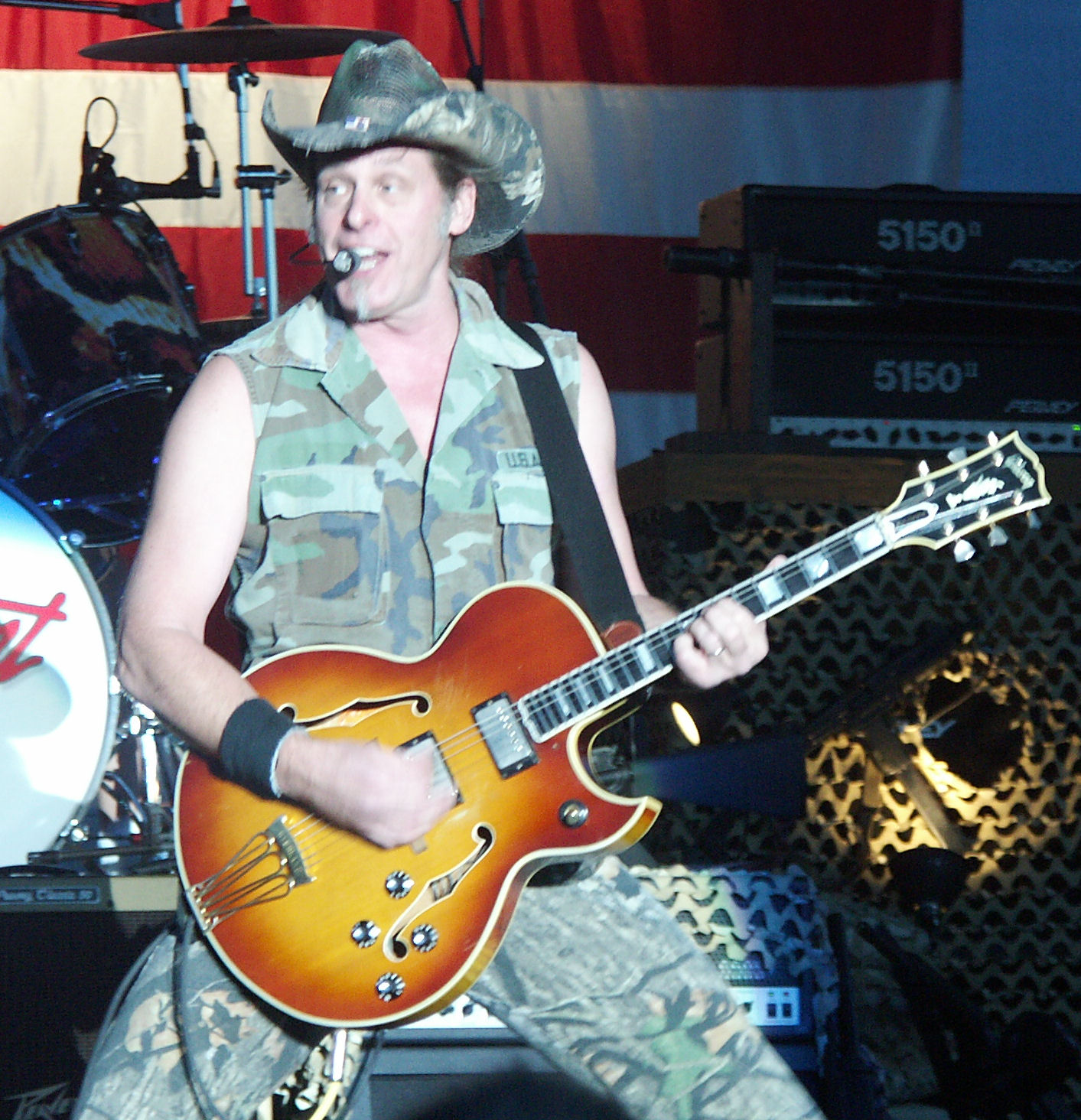
In 1964, a thirteen-year-old Ted Nugent stood in front of the stage at the Walled Lake Casino near Milford, Michigan, watching Jimmy McCarty play a Gibson Byrdland guitar with Mitch Ryder’s early band Billy Lee and the Rivieras. What he heard changed the trajectory of his entire musical life. McCarty’s Byrdland — a jazz guitar, technically, a thin-body, short-scale instrument designed for bebop players who valued comfort and warmth over the aggressive possibilities of a cranked-up rock context — was feeding back. It was fighting the amplifier. It was making, in Nugent’s own description, “scary noises that made the notes have a new dimension of sound.” He was thirteen years old. He was obsessed immediately. And he has been playing the Gibson Byrdland — and wrestling controlled feedback out of it at concert volumes — for the sixty-plus years since, making it one of the longest and most committed guitar-instrument relationships in rock history. “When Jimmy McCarty played that Byrdland,” Nugent told the Premier Guitar Rig Rundown cameras, “it wanted to feedback and make scary noises that made the notes have a new dimension of sound and I was too young to understand what was happening, but I wasn’t too young to want it.”
The Journey
Theodore Anthony Nugent was born on December 13, 1948, in Redford Township, Michigan — a suburb of Detroit that would become, in the 1960s and 1970s, one of American rock’s most fertile breeding grounds. His early musical education was in the Detroit and Chicago area club scene, where he formed the Amboy Dukes in 1964 — a psychedelic hard rock band that would produce the 1968 classic “Journey to the Center of the Mind” and serve as the vehicle through which Nugent developed the aggressive, feedback-wielding guitar approach that would define his solo career. The Amboy Dukes were the training ground; the solo years from 1975 onward were where the approach reached its full, ridiculous, magnificent development. Ted Nugent (1975), Free for All (1976), Cat Scratch Fever (1977), and the live Double Live Gonzo (1978) represent the peak of the Nugent catalog — albums that contain “Stranglehold,” “Cat Scratch Fever,” “Wang Dang Sweet Poontang,” “Dog Eat Dog,” and “Free for All,” all produced from the same basic recipe: Gibson Byrdland, Fender Twin Reverbs cranked to the point of feedback, absolutely zero effects pedals, and a guitarist who has studied and mastered the art of using feedback and controlled resonance as musical tools rather than accidental noise.
The no-effects philosophy is central to understanding both Nugent’s tone and his broader musical identity. In an era of increasingly elaborate pedalboards — MXR Phase 90s, Electro-Harmonix fuzz units, talk boxes, chorus units, wah pedals used in increasingly creative ways — Nugent planted his flag firmly in the “guitar straight into amp” camp and has never moved it. He does not use distortion pedals. He does not use overdrive pedals. He does not use wah pedals in the conventional sense. He does not use delay, reverb, or modulation effects of any kind in his core signal chain. His tone comes entirely from the interaction between the Byrdland’s semi-hollow resonant body, the guitar’s neck pickup running into Fender Twin Reverb amplifiers pushed beyond their clean headroom threshold, and Nugent’s specific understanding of how to position himself relative to the speakers to elicit the specific feedback pitches he wants. The guitar and the amp, talking to each other — that’s the whole Nugent system.
What Nugent did with the Byrdland was genuinely innovative and genuinely counterintuitive. The Gibson Byrdland is a jazz guitar. It was designed in 1955 in collaboration with country and jazz guitarists Billy Byrd and Hank Garland — hence the name — and produced in a thinline, single-cutaway, fully hollow body design with a shorter-than-standard 23.5-inch scale length that makes it comfortable for jazz playing techniques. Its fully hollow body, while ideal for the warm, clear, acoustically complex tone of jazz, is also a feedback machine at rock volumes: the body resonates sympathetically with the amplified signal through the hollow chamber, creating the kind of uncontrolled howl that most rock guitarists spend time and money trying to eliminate. Nugent went the opposite direction. He leaned into it. He learned to control it. He turned a liability into the defining characteristic of one of hard rock’s most distinctive guitar sounds.
His political views are loud, specific, and well-documented — pro-hunting, pro-gun, anti-drug in terms that are frequently colorful and occasionally inflammatory. These views are the reason Nugent is a divisive figure in the culture beyond music, and they cannot be entirely separated from his musical biography because he has made them so prominent a part of his public identity. This is a gear guide, not a political assessment, so the treatment here will be the same as for any other guitarist: his views are part of who he is, they inform his public persona, and they are not the subject of this article. The subject of this article is the Byrdland, the Fender Twins, the Peavey 6505s, and the specific, genuinely remarkable guitar approach of a player who made a jazz instrument sound like the most aggressive rock guitar on the planet through no more technology than a hollowbody guitar and a couple of amplifiers running at full chat.
Background: The Motor City Madman and the Feedback Education
The story of how Nugent destroyed his first Byrdland — a fact of rock history that Guitar World documented in loving detail — is too good to omit. After acquiring his first Gibson Byrdland, he was eventually involved in an incident at a gig where the guitar was thrown around and “crushed to smithereens.” He described his reaction with the kind of retrospective equanimity that only comes after decades of subsequent guitar relationships: “I must admit, it looked and sounded phenomenal, but the poor girl was crushed to smithereens. I was totally heartbroken.” The destroyed first Byrdland was replaced; the obsession continued; and the subsequent collection of approximately twelve vintage Byrdlands, primarily from the 1962–1967 period, became the defining instrument collection of his professional career.
The Amboy Dukes years were the laboratory in which Nugent’s approach was developed. The Chicago and Detroit club circuit of the mid-1960s was a competitive, demanding environment — the Shadows of Knight, the Ides of March, and various other bands were competing for audiences and prestige on the same circuit, and the pressure to stand out produced the aggressive, high-volume, feedback-embracing approach that distinguished Nugent from his contemporaries. “Journey to the Center of the Mind” (1968) — the Amboy Dukes’ biggest hit — is a psychedelic hard rock track whose guitar work already shows the feedback-positive approach that would fully mature on the solo albums. The wah-influenced sound on some Amboy Dukes recordings came from a phase of experimentation that Nugent later definitively abandoned; by the time of the solo career, effects were gone entirely.
The specific Fender Twin Reverb approach that defined the classic Nugent tone of the 1975–1978 period was, by his own account, developed through a specific understanding of what happens when a semi-hollow guitar is used at volumes that the instrument was not designed for. A Fender Twin Reverb pushed beyond its clean headroom — driven hard enough that the 6L6 output stage begins to produce natural saturation — creates a character quite different from either a clean Twin or a cranked Marshall. The specific 6L6 saturation character (warmer, more compressed, with a different harmonic profile from EL34-powered Marshalls) combined with the Byrdland’s semi-hollow resonance creates the tone of “Stranglehold” — that slow, warm, slightly woozy, supremely confident guitar sound that is one of hard rock’s most immediately recognizable tonal signatures.
The Peavey transition happened during the Damn Yankees period — his supergroup with Jack Blades of Night Ranger and Tommy Shaw of Styx that produced two albums in the early 1990s. Nugent experimented with Peavey 5150 heads (the Eddie Van Halen signature model, produced before EVH and Peavey parted ways and the 5150 became the 6505) and found them revelatory: “It sounded awesome. And so I stuck with it and today I’m using 6505s.” The 6505 is a significant amplifier evolution from the Fender Twins — higher gain, more aggressive preamp character, capable of producing stadium-level high-gain rock tone with greater consistency and power than the vintage Twins. Its adoption didn’t eliminate the vintage Fender Twins from Nugent’s rig; they continue alongside the 6505s, with the two amplifier families contributing different tonal characters to his live sound. The Fender Twins for the warm, slightly woozy classic Stranglehold character; the Peavey 6505s for the more aggressive modern high-gain needs.
Nugent’s famous sobriety — he has famously never taken drugs or drunk alcohol, a claim that has defined his counter-cultural rock persona almost as much as his hunting and his politics — has given him a different relationship to the excesses that consumed contemporaries. He describes his musical life with consistently energized enthusiasm that seems genuinely felt rather than performed: “Wang Dang Sweet Poontang is my favorite 12 minutes every day. It goes places where no other song can go.” Whether you are aligned with the Motor City Madman’s broader worldview or not, the authentic enthusiasm of a guitarist who has been playing the same songs for fifty years and still means every word of that sentence is hard to dismiss. The Byrdland still feeds back. The “scary noises” still happen. And Nugent still loves every one of them.
The Rig: Ted Nugent’s Guitars, Amps, and Effects
Guitars
The Gibson Byrdland is, unambiguously, Ted Nugent’s guitar — the instrument from which his entire musical identity flows, the hardware responsible for “Stranglehold,” “Cat Scratch Fever,” “Wang Dang Sweet Poontang,” and everything else in the core Nugent catalog. He owns approximately twelve vintage Byrdlands, primarily from the 1962–1967 production period, and has confirmed: “mostly it’s the Byrdland, especially on those classics that demand that tone. You really can’t play some of those songs properly with anything else.” The Byrdland’s specifications are unusual for a hard rock guitarist’s primary instrument: a fully hollow thinline body (unlike the semi-hollow ES-335 or the fully solid Les Paul); a shorter-than-standard 23.5-inch scale length (versus the 24.75-inch Les Paul or 25.5-inch Stratocaster scale, making the strings feel lighter and less tense under the fingers); dual humbucker pickups in a small, slender body that produces the naturally warm, acoustically complex resonance of a hollow-body instrument. The neck pickup position on the Byrdland — the source of Nugent’s most characteristic tones — produces a warm, full, slightly woozy character when pushed into feedback-friendly territory through a powerful amplifier. The guitar’s fully hollow body makes it far more susceptible to feedback at rock volumes than solid or semi-hollow alternatives, which for most guitarists would be a problem. For Nugent, it is the entire point. He has spent sixty years learning to control the Byrdland’s feedback responses with the same systematic, deliberate approach that Hendrix applied to his Stratocaster’s feedback — treating the guitar’s natural acoustic resonance as an instrument in its own right, a voice that can be directed and shaped through body position, guitar orientation relative to the speakers, and specific hand technique. Each of his vintage Byrdlands has slightly different tonal characteristics — different wood resonance, different pickup output, different acoustic properties from decades of different playing and environmental histories — and Nugent chooses between them for different songs and contexts based on his deep familiarity with each instrument’s specific voice.
Beyond the Byrdlands, Nugent’s most significant guitars are his vintage Les Paul Standards. He has spoken about his vintage Les Pauls with characteristic intensity: “I got a ’58 and ’59 to die for and if you touch them, you will.” The specific threat aside, the 1958 and 1959 Les Paul Standards represent the same Burst-era production that is the most sought-after guitar in the world — PAF humbuckers, mahogany body, figured maple top, the whole package. Nugent uses these on recordings where the Byrdland’s fully hollow character isn’t right — the Les Paul’s solid mahogany body produces a fundamentally different resonance, with more focused note clarity and less susceptibility to feedback, making it appropriate for passages where the Byrdland’s atmospheric wooze would be counterproductive. He described the Les Paul’s contribution to his Love Grenade album with characteristic Nugent elaboration, noting “numerous moments of tonal splendor where my ’59 Les Paul’s join the fray.”
Nugent plays a Gibson Stars and Stripes Custom Les Paul — a guitar decorated with the American flag imagery that reflects both his patriotic identity and the visual statement that has always been part of the Nugent brand. He is enthusiastic about this instrument in terms that go beyond the flag imagery: “My American Flag Les Paul is one of my favorite guitars in the world to play. In fact, I play it more on stage than even my Byrdlands or my PRS’s. All my Les Pauls are killers.” The Stars and Stripes Custom’s standard Les Paul construction — mahogany body, maple top, humbucker pickups — provides the warm, sustaining solid-body tone that complements the Byrdland’s hollow-body character, and the guitar’s visual statement makes it a centerpiece of the Nugent live experience in a way that a more conventionally finished instrument would not.
Paul Reed Smith guitars form a substantial part of Nugent’s modern arsenal, and he speaks about them with genuine enthusiasm: “I’ve got a whole arsenal of Paul Reed Smiths that are just world-class, right up there with any guitar ever made anywhere.” He specifically mentions “those very special hollow body PRS masterpieces” as contributing to specific recordings and live performances — the hollow-body PRS models providing a different version of the semi-hollow acoustic resonance that he values in the Byrdland, with more modern construction consistency and reliability. The solid-body PRS models appear primarily in sections of the live setlist that require the wide-fat neck profile and the versatile humbucking tone that PRS’s instruments deliver. He uses PRS models particularly for “Fred Bear” (his ode to his hero, the legendary bowhunter Fred Bear) and other acoustic-electric numbers in the setlist.
Taylor electric guitars also appear in Nugent’s documented arsenal: “I really got some cool Taylor electrics that I have a lot of fun with.” Taylor is primarily known as an acoustic guitar manufacturer, but their electric line produces quality instruments with the company’s characteristic attention to construction consistency and playability. Nugent’s inclusion of Taylor electrics in his working collection reflects the same practical eclecticism — “I play them all” — that produces a guitarist who maintains a primary identity (Byrdland, always Byrdland for the classics) while remaining genuinely curious about other tonal possibilities.
Nugent’s collection also includes a 1959 Gibson Super 400 — a fully hollow archtop jazz guitar of considerable vintage value (approximately $25,000 in contemporary market terms) that represents the apex of Gibson’s carved-top archtop tradition. The Super 400’s tone is in the same family as the Byrdland — warm, acoustically resonant, fully hollow — but with a larger body that produces even more acoustic volume and bass depth. Its presence in Nugent’s collection reflects his broader interest in the hollow-body tradition that the Byrdland inhabits, and his genuine appreciation for the acoustic properties of hollow-body instruments beyond the specific Byrdland design.
Three Fender Duo-Sonics from the 1960s — part of Nugent’s early Amboy Dukes era equipment — appear in his documented collection. The Duo-Sonic is a budget-range Fender student guitar from the 1950s and 1960s, smaller than a standard Stratocaster, with a shorter scale length and a simpler construction approach. Its presence in the early Amboy Dukes context reflects the practical reality of a young guitarist building his first professional setup with whatever instruments were available and affordable before the Byrdland became his primary and permanent choice.
A rare 1961 Gibson L-5 CES — another vintage carved-top archtop, one of the most prestigious hollow-body electric guitars Gibson has ever produced, originally associated with Wes Montgomery and other jazz greats — appears in Nugent’s documented collection for occasional jazz-influenced instrumental segments. The L-5 CES’s full hollow construction and premium archtop construction produce a tone in the Byrdland family but with the larger body’s additional depth and warmth.
Amps
The amplifier responsible for the classic Nugent sound — the tone of “Stranglehold,” “Cat Scratch Fever,” and the period from the mid-1970s through the Damn Yankees era — was the Fender Twin Reverb, specifically pre-CBS (pre-1965) examples pushed well beyond their clean headroom into natural power-amp saturation. During the 1970s, Nugent reportedly used up to eight Fender Twin Reverbs simultaneously onstage — a configuration that would provide enormous acoustic volume from the combined output of sixteen twelve-inch speakers, all pushing the 6L6-powered amplifiers into natural saturation at the same time. The 6L6’s saturation character is fundamentally different from the EL34’s: warmer, rounder, with a different quality of harmonic complexity — the “American” voice that contrasts with the British EL34 character of Marshall amplification. Pushed hard through the Byrdland’s warm, hollow-body signal, the Twin Reverb’s natural saturation produces the specific, warm, slightly woozy, enormously powerful tone that is the “Stranglehold” sound. The built-in reverb was also a factor — a touch of spring reverb from the Twin’s onboard reverb tank adding bloom and spatial dimension to the naturally dry character of the Byrdland’s pickup signal. Nugent continues to use pre-CBS Fender Twins alongside his Peavey 6505s in his modern live rig, with the vintage Twins contributing the warm “old Fender” character to specific songs and the 6505s providing the higher-gain modern rock power for others: “it is the combination of Peavey 6505s and some old pre-CBS Fender Twin amps that ultimately make the sound so wonderful.”
Nugent’s transition to Peavey amplification happened during the Damn Yankees period when he experimented with the Peavey 5150 (the Eddie Van Halen signature head, subsequently renamed 6505 after EVH departed Peavey and took the 5150 branding with him). His response to the experiment was unambiguous: “It sounded awesome. And so I stuck with it and today I’m using 6505s.” His documented live rig includes four Peavey 6505 heads, each running through a pair of 4×12 cabinets — eight 4×12 cabinets total, providing sixteen speakers’ worth of amplification for the arena-level live performances the Nugent brand demands. The 6505’s high-gain character is quite different from the vintage Twin Reverbs — more gain, more preamp drive, more aggressive compression — and its adoption for the modern touring context reflects the practical reality that high-gain amplification is more appropriate for large venues and the sonic expectations of modern rock audiences than the all-natural-saturation approach of the vintage Twins. He also documents using a Peavey 50-watt Classic for specific cleaner applications.
Marshall amplifiers feature in Nugent’s early Amboy Dukes touring equipment — the standard choice for a young rock guitarist of the mid-to-late 1960s who wanted British-voiced amplification. His subsequent transition to Fender Twins as his primary amplification was a deliberate choice — the American 6L6 character better suited the specific warm, feedback-friendly interaction with the Byrdland that he was developing. The Marshall’s EL34 character, while excellent for many applications, produces a different quality of natural saturation that doesn’t interact with the Byrdland’s hollow-body resonance in the same way the Fender’s 6L6 does.
Effects
In a gear series that has covered everything from Tommy Bolin’s always-on Sam Ash fuzz, to Michael Schenker’s cocked wah, to Matthias Jabs’s talk box and Echoplex, to Brad Whitford’s carefully curated modern pedalboard — Ted Nugent occupies the most extreme position on the effects spectrum: he uses none. Or more precisely, he used none for the entirety of the classic period that defines his legacy, and the approach remains his philosophical baseline even as a small number of utility pedals have appeared in his more recent live rig. “The guitar straight into the amp” is not just a setup preference for Nugent; it is a creative philosophy that reflects his conviction that tone comes from the player’s hands, the guitar’s acoustic properties, and the amplifier’s natural response — not from electronic processing inserted between them. The “Stranglehold” solo, one of hard rock’s most celebrated and enduring guitar performances, was played with no effects whatsoever. The feedback, the sustain, the warm wooze, the controlled resonance — all of it from a Byrdland running directly into cranked Fender Twin Reverbs, in the hands of a guitarist who had spent a decade learning to use his body position, picking technique, and volume knob to sculpt exactly the tonal response he wanted from the specific guitar-amp physics of that combination. This is the most sophisticated possible approach to guitar tone — understanding the instrument and amplifier so completely that no additional processing is required — and it is genuinely rare.
In his modern live rig, documented in the Premier Guitar Rig Rundown, Nugent uses a small number of Jim Dunlop stompboxes — representing the most significant concession to effects use in his documented career. The specific Dunlop units in his modern setup have not been extensively catalogued in available documentation, but their presence confirms that his no-effects philosophy has evolved slightly toward “minimal effects” in the current touring context, likely including basic utility functions (tuner, perhaps a light gain boost for specific passages) rather than the complex modulation, delay, and drive chains of most professional rock guitarists.
Alongside the Dunlop units, Boss stompboxes also appear in Nugent’s modern documented live rig — again, minimal and utility-focused rather than the expansive Boss pedal collection that many professional guitarists maintain. A Boss TU-series tuner is the most likely Boss unit in his setup, providing the muted, silent tuning capability that any professional live rig requires. His comments in the Premier Guitar Rig Rundown confirm the existence of “a few stompboxes from Jim Dunlop and Boss” without specifying their exact function, suggesting that the overall approach remains strongly in the minimal-effects camp even if absolute zero-effects is no longer the strict standard.
The most important “effect” in Ted Nugent’s guitar philosophy is not a pedal or an electronic device — it is his systematic understanding and control of guitar feedback. A fully hollow-body guitar like the Byrdland at concert volume through powerful amplifiers will naturally produce feedback if the player doesn’t actively manage it. Most guitarists manage it by reducing volume, changing position, or using a damper. Nugent manages it by learning which frequencies his specific guitar produces at specific distances and angles from the amplifier speakers, and then deliberately positioning himself to elicit the specific feedback pitches he wants. Each vintage Byrdland in his collection has a slightly different feedback response — different resonant frequencies, different threshold points — and Nugent knows each one’s specific behavior well enough to use the feedback as a musical tool rather than a problem to be solved. This is years of systematic practice and patient, deliberate attention to the physics of amplified hollow-body guitar — not a technique that can be explained in a paragraph and implemented in an afternoon, but the most distinctive and irreplaceable element of the Nugent guitar approach.
Nugent’s string choice is GHS Boomers — one of the most widely used string brands in rock guitar — in a custom gauge set: .010, .012, .015, .030, .040, .050. He typically tunes half a step down from standard (Eb-Ab-Db-Gb-Bb-Eb), which reduces string tension slightly and produces a slightly darker, warmer overall character. The specific gauges — slightly heavier on the wound strings than a standard .010 set — are calibrated for the shorter-scale Byrdland (23.5 inches versus 24.75 inches for a Les Paul), where the reduced scale length means lower string tension at the same pitch. Using slightly heavier wound strings compensates for this reduced tension, maintaining a more consistent playing feel and tonal weight than standard-gauge strings would provide on the shorter scale length.
Playing Style & Tone Philosophy
Ted Nugent plays guitar with the physical energy of a man who genuinely believes each note is a matter of life or death — or at minimum, a matter of music versus silence, which for Nugent seems to occupy the same emotional register. His right-hand technique is aggressive, committed, and rhythmically sophisticated in the way that the best American hard rock rhythm work always is: locked in with the drums, driving the groove forward rather than sitting on top of it, with an attack that is physical rather than merely technical. The “Stranglehold” riff is one of the most perfectly conceived rhythm guitar figures in hard rock — deceptively simple in structure, endlessly effective in execution, and dependent on a specific quality of pick attack and note placement that makes the groove feel inevitable.
His lead playing is grounded in the blues tradition — Hendrix, Chuck Berry, and the Detroit soul and R&B scene that surrounded him as a teenager — but filtered through the specific tonal possibilities of the Byrdland-into-Twin-Reverbs setup. Where most blues-rock players use pentatonic scales over conventional distortion from a Marshall, Nugent uses the same pentatonic vocabulary over the warm, semi-acoustic resonance of the Byrdland’s natural character plus the Twin Reverb’s 6L6 saturation — and the result is a tone that has a different quality of warmth, a different quality of sustain, and a different relationship to feedback than anything produced through a conventional rock guitar setup. The feedback is not decoration; it is part of the melody. It extends notes beyond their natural decay, introduces harmonic overtones that wouldn’t exist in a clean signal, and creates the specific quality of “dangerous beauty” that Nugent identified from the moment he heard Jim McCarty’s Byrdland in 1964.
His rejection of effects pedals is not technological conservatism — it is aesthetic conviction. He has heard what effects pedals do to guitar tone. He has experimented with them during the Amboy Dukes years. He chose not to use them because they introduce processing between the guitar and the amplifier that changes the guitar-amp relationship in ways he doesn’t want. His tone is not “guitar plus effects equals sound” but “guitar into amp equals everything.” The implications of this philosophy for how the guitar should be played are significant: if the guitar and the amp are the only variables, then the guitar player’s body, hands, and positioning become the effects system. Nugent has spent a lifetime developing that system into one of the most distinctive approaches in rock guitar history.
How to Sound Like Ted Nugent
The Nugent tone equation is the simplest in this entire series to describe and the most demanding to actually execute. You need a fully or semi-hollow guitar with humbucker pickups — ideally a Byrdland, but an Epiphone Casino or even an ES-335 gets you into the territory. You need a Fender amplifier of the Twin Reverb family, pushed beyond its clean headroom through both high input volume and high master volume. You need no effects between the guitar and the amp. And you need years of practice learning to control feedback through body positioning and volume manipulation rather than through damping or noise gates. The gear is simple. The technique is not.
For the Stranglehold-era tone specifically: the neck pickup of the Byrdland through the Twin Reverb’s input, guitar volume at maximum, amp controls arranged for warm, slightly overdriven fullness rather than the more aggressive Marshall crunch. The 6L6 saturation character comes from the output stage being driven by both the guitar’s high output and the preamp volume being pushed — not preamp gain from a channel-switching architecture, but old-school power-amp saturation from a non-master-volume amp responding to everything being turned up. For modern concert use, the Peavey 6505 provides the additional gain and volume needed for stadium-scale reinforcement that the vintage Twins can’t achieve at safe equipment-operating levels.
| Control | Setting (0–10) | Notes |
|---|---|---|
| Guitar Volume | 10 (always) | Maximum. Nugent runs his guitar volume wide open at all times. The guitar’s volume control is not a dynamic tool in his setup — it’s set and left at maximum. The Byrdland’s neck pickup at full volume driving the Twin Reverb’s input is the fundamental signal. |
| Guitar Pickup Selection | Neck pickup | The neck pickup’s warmer, fuller character is the primary Byrdland voice for the classic Nugent tone. The bridge pickup is occasionally used for brighter passages, but the warm, slightly woozy neck pickup tone is what “Stranglehold” is built on. |
| Twin Reverb Bass | 6 | Moderate-to-warm bass — the Byrdland’s hollow body produces natural bass depth; the amp bass setting supports rather than exaggerates this. The 6L6 output stage has a different bass response from EL34 Marshalls — warmer, rounder. Let it breathe. |
| Twin Reverb Mid | 6 | The Fender Twin’s mid control on vintage models has a scooped quality at its center position — the characteristic Fender scoop. For the Nugent tone, keep mid at 6 or above; don’t push it into the scooped zone. The Byrdland’s hollow-body warmth needs the midrange to project. |
| Twin Reverb Treble | 6–7 | Moderate treble — enough for clarity and note definition without the ice-pick quality that pushed treble produces on a hollow-body guitar at high volumes. The Byrdland’s naturally bright neck pickup does not need treble boosting from the amp. |
| Twin Reverb Volume / Presence | Volume: 7–8; Presence: 5 | Push the volume for 6L6 output stage saturation. Moderate presence — the hollow-body guitar’s acoustic resonance provides substantial natural presence without amp presence control boosting. Too much presence control at high volume on a hollow-body guitar increases feedback risk in uncontrolled ways. |
| Twin Reverb Reverb | 2–3 | Light spring reverb — Nugent’s tone benefits from a touch of the Twin’s onboard spring reverb, adding bloom and spatial depth to the naturally dry Byrdland signal. Keep it subtle: enough to hear the spring quality, not enough to create a swimming, washy effect. |
| Peavey 6505 (Modern Loud Application) | Gain: 6; Bass: 5; Mid: 6; Treble: 6; Presence: 5 | For the high-gain modern Nugent concert context: the 6505’s lead channel at moderate gain — enough for the aggressive rock attack, not so much that the hollow-body guitar’s natural resonance is compressed into homogeneity. The 6505 provides the stadium-level volume that the vintage Twins can’t safely sustain. |
| Effects | None | None. Nothing. Zero. The guitar goes directly into the amp. Any electronic processing between the Byrdland and the amplifier changes the specific guitar-amp resonance relationship that produces the feedback-positive, warm, woozy Nugent tone. No exceptions. No boost pedal. No tuner in the signal path. Direct. |
| Feedback Control (Technique) | Body positioning: 45–90° to speaker | Nugent’s most important “effect.” Position the guitar’s body at roughly 45–90° to the speaker cabinet — the angle that allows the hollow body’s acoustic chambers to resonate sympathetically with the speaker output. Experiment with distance (typically 2–6 feet) and angle to find the specific feedback pitch you want. Each hollow-body guitar responds differently. Practice until you know your instrument’s specific feedback responses and can reproduce them reliably. |
Influence & Legacy
Ted Nugent’s influence on hard rock guitar is both significant and specific. He demonstrated that a fully hollow-body jazz guitar — an instrument that most rock guitarists would never consider for high-volume electric rock — could produce one of the most distinctive and powerful rock guitar tones in the genre’s history. The idea that feedback is a musical tool rather than an acoustic problem, that a guitarist can learn to control and direct resonant feedback the way a singer controls vocal tone, owes something of its rock development to Nugent’s specific, sustained exploration of the Byrdland’s possibilities. He was not the first to use controlled feedback as a musical tool (that honor belongs primarily to Hendrix), but he developed a specific application of the technique — through the hollow-body/Fender combination — that was entirely his own.
The no-effects philosophy has inspired a tradition of guitarists who take the “straight-into-the-amp” approach as a point of pride and a genuinely musical preference. The argument that effects pedals come between the guitarist and the direct relationship with the amplifier — that every unit inserted in the signal chain represents both a tonal compromise and a missed opportunity to develop a deeper understanding of the guitar-amp interaction — is a legitimate one, and Nugent’s career is the most sustained argument for it in hard rock history. For the broader American hard rock context in which Nugent operated, see the approaches of his contemporaries: Leslie West’s equally stripped-back Les Paul Junior approach, and the various Michigan and Detroit-area rock influences that shaped the Motor City’s specific hard rock character. The legacy of using unusual, non-rock instruments for rock purposes that Nugent pioneered with the Byrdland also connects to players who used the guitar’s own acoustic properties rather than processing to create distinctive tones, explored through Paul Kossoff’s direct Les Paul and Marshall approach. The feedback-as-music philosophy connects backward to Alvin Lee’s approach.
The polarizing nature of Nugent’s public persona — the politics, the hunting, the relentless self-promotion as the “Motor City Madman” — has sometimes overshadowed serious engagement with his actual guitar approach, which is a shame because that approach is genuinely interesting and genuinely original. He took an instrument designed for jazz and made it sound like hard rock’s most dangerous weapon. He did it without effects pedals, without elaborate signal chains, without any technology beyond a hollow guitar, powerful amplifiers, and a sixty-year commitment to understanding what happens when all three interact at maximum volume. “Stranglehold” will outlast every controversy. The Byrdland will still be the right guitar for it. The scary noises will still happen. And Ted Nugent, somewhere in Michigan, will still be having the time of his life playing “Wang Dang Sweet Poontang” every night and meaning every word of it.
Frequently Asked Questions: Ted Nugent Guitars & Gear
What is the Gibson Byrdland and why does Ted Nugent use it for hard rock?
The Gibson Byrdland is a thinline, fully hollow-body electric guitar designed in 1955 in collaboration with country and jazz guitarists Billy Byrd and Hank Garland. It features a shorter-than-standard 23.5-inch scale length, a fully hollow arched top body, and dual humbucker pickups — making it, on paper, an instrument designed for jazz playing rather than hard rock. Ted Nugent adopted it after seeing Jim McCarty play one with Mitch Ryder’s early band in 1964, where the hollow body was feeding back at performance volume in ways that Nugent described as “making scary noises that gave the notes a new dimension.” He leaned into this “liability” — learning to control and direct the Byrdland’s feedback response through body positioning and technique rather than eliminating it through choice of a more feedback-resistant solid-body guitar. The result is the warm, slightly woozy, feedback-rich tone of “Stranglehold” and his core catalog — a sound utterly unlike anyone else’s because nobody else was doing this specific thing with this specific instrument family.
What amps did Ted Nugent use on “Stranglehold”?
The classic Nugent tone on “Stranglehold” and the core 1970s catalog was produced through Fender Twin Reverb amplifiers — specifically pre-CBS examples, pushed beyond their clean headroom into natural 6L6 power-amp saturation. During the peak touring years of the late 1970s, Nugent was reportedly using up to eight Fender Twin Reverbs simultaneously onstage, providing sixteen speakers of combined output and creating the enormous, warm, slightly woozy amplification field that his Byrdland’s feedback-sensitive hollow body interacted with to produce its characteristic sound. The 6L6 output tube’s saturation character — warmer and rounder than the British EL34 — combined specifically well with the Byrdland’s warm, hollow-body resonance to produce the “Stranglehold” tone. In his modern live rig, vintage pre-CBS Fender Twins continue alongside four Peavey 6505 heads, each running through a pair of 4×12 cabinets.
Does Ted Nugent use any effects pedals?
For the entirety of the classic period that defines his legacy — the 1975–1985 era of Aerosmith (sic: Nugent) solo albums and touring — Nugent used zero effects pedals. Guitar straight into amplifier, no processing in between. This is the most extreme “no effects” position of any major rock guitarist, and it is deliberately chosen rather than accidentally arrived at. “The guitar straight into the amp” reflects Nugent’s conviction that effects processing between guitar and amp changes the specific guitar-amp resonance relationship that produces his distinctive tone. His more recent live rigs include a small number of Dunlop and Boss stompboxes — likely basic utility functions — representing some concession to modern live practicality without abandoning the fundamental philosophy of minimal processing.
How many Gibson Byrdlands does Ted Nugent own?
Nugent owns approximately twelve vintage Gibson Byrdlands, primarily from the 1962–1967 production period, valued between $8,000 and $15,000 each. Each instrument has slightly different tonal characteristics — different resonant frequencies, different pickup output, different acoustic properties from decades of different histories — and Nugent selects between them for different songs based on his intimate familiarity with each guitar’s specific voice and feedback response. He has described the Byrdland’s role in his music with characteristic conviction: “mostly it’s the Byrdland, especially on those classics that demand that tone. You really can’t play some of those songs properly with anything else.”
What was Ted Nugent’s experience with Peavey amplifiers?
Nugent discovered Peavey amplification during the Damn Yankees period — the supergroup with Jack Blades of Night Ranger and Tommy Shaw of Styx that produced two albums in the early 1990s. He experimented with Peavey 5150 heads (the Eddie Van Halen signature model, subsequently renamed 6505 when EVH departed Peavey and took the 5150 name with him). His reaction was enthusiastic: “It sounded awesome. And so I stuck with it and today I’m using 6505s.” His modern live rig includes four Peavey 6505 heads, each running a pair of 4×12 cabinets — a formidable high-gain amplification system that provides the stadium-level volume and modern high-gain character unavailable from the vintage Fender Twins. The two amplifier families (Fender and Peavey) coexist in his live rig, with each contributing different tonal characters to different songs and contexts.
What strings does Ted Nugent use and why those specific gauges?
Nugent uses GHS Boomers in a custom gauge set: .010, .012, .015, .030, .040, .050, typically tuned half a step down from standard (Eb tuning). The specific gauges — slightly heavier wound strings than a standard .010 set — are calibrated for the Gibson Byrdland’s shorter-than-standard 23.5-inch scale length. A shorter scale length means lower string tension at the same pitch, which can make the guitar feel “lighter” under the fingers but can also reduce tonal weight and note definition. Using slightly heavier wound strings on the shorter scale compensates for this reduced tension, producing a playing feel and tonal character closer to what a standard-gauge set provides on a full-scale instrument. The half-step down tuning reduces overall tension slightly and produces a marginally darker, warmer overall character — consistent with the warm, woozy Byrdland tone that defines his approach.
What is the significance of Ted Nugent’s “no-effects” philosophy for understanding his tone?
Nugent’s no-effects philosophy is not a nostalgic preference or a marketing position — it is a coherent aesthetic conviction backed by sixty years of practical experimentation. By removing all signal processing between the guitar and the amplifier, he preserves the specific acoustic and electrical relationship between the Byrdland’s hollow-body resonance and the amplifier’s power stage. This relationship — the way the guitar’s acoustic properties interact with the amplifier’s response at the specific volume and power level at which Nugent operates — is the source of the feedback control, the warm saturation, and the specific quality of sustain that defines his tone. Every effects pedal inserted into this chain changes the signal before it reaches the amplifier and therefore changes what the amplifier hears and produces. Nugent’s position is that the guitar-amp relationship produces something that cannot be replicated or improved by any amount of processing — and “Stranglehold,” played with no effects through a hollow-body guitar and a cranked Fender, makes a fairly compelling argument that he’s right.
Related stories
Warren DeMartini Guitars & Gear: The Complete Guide to Ratt’s Torch Guitarist’s Rig
Warren DeMartini guitars & gear: Ratt's Torch guitarist. Charvel Bomber, snakeskin, Jose-modded Plexi, Fender Super Champ, RTM pickup, slapback echo — the complete rig.
Warren Haynes Guitars & Gear: The Complete Guide to Gov’t Mule’s Guitar Master’s Rig
Warren Haynes' guitars, amps, and effects — the complete guide. Gibson Les Paul Chester, Soldano SLO-100 modified, Klon Centaur, Emma Discombobulator, and how to nail that Gov't Mule blues-rock tone.
Wayne Kramer Guitars & Gear: The Complete Guide to MC5’s Proto-Punk Guitar Insurrectionist’s Rig
Wayne Kramer guitars & gear: MC5's proto-punk guitar insurrectionist. Star-spangled Strat, Big Muff Triangle, Marshall stacks, MXR Jail Guitar Doors Drive — the complete rig.