Scotty Moore Guitars & Gear: The Complete Guide to the First Rock and Roll Guitarist
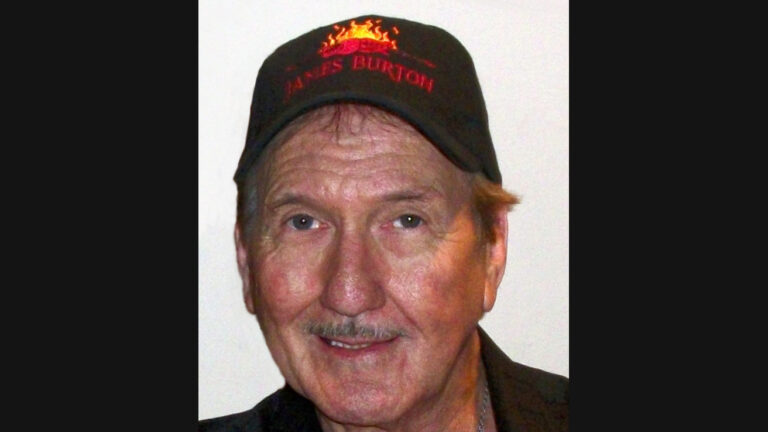
Scotty Moore at his Rock and Roll Hall of Fame induction in New York, 2000. Photo: John Mathew Smith & www.celebrity-photos.com, CC BY-SA 2.0 (https://creativecommons.org/licenses/by-sa/2.0/), via Wikimedia Commons. Full-frame Wikimedia Commons resize; no crop or further image edits by GuitarGangsters. This web version is licensed under CC BY-SA 2.0. Source: https://commons.wikimedia.org/wiki/File:Scotty_Moore_Elvis_2000.jpg
“Like a hound dog hit by lightning, the first notes of rock and roll blasted out of radios across the country in July of 1954.”
That’s Vintage Guitar magazine’s description of the moment “That’s All Right” hit the radio. The voice was Elvis Presley’s. The guitar was Scotty Moore’s. The guitar was a gold Gibson ES-295, serial number A-12290, bought at the O.K. Houck Piano Company in Memphis, Tennessee in 1953, modified with a Melita Synchro-Sonic bridge for better intonation.
Moore said it himself: “That ES-295 enhanced Elvis’s voice better than anything else I could have used.”
He also described what drove him to buy it in the first place. He’d tried a Fender Esquire — standard for the period, Leo Fender’s stripped-down Telecaster predecessor. It didn’t feel right. “Maybe I was hiding behind my guitar, but onstage, that little Fender just did not seem like much to hold onto.” The guitar needed to be something he could connect with physically and emotionally. The ES-295’s large hollow body, its gold finish, its feel under his arms — all of it was right. “The Gibson was more feminine. I could make out with the Gibson. I couldn’t get it on with a Fender.”
The ES-295 is what you hear on Elvis Presley’s first four Sun singles. “That’s All Right.” “Blue Moon of Kentucky.” “Good Rockin’ Tonight.” “I’m Left, You’re Right, She’s Gone.” These are the recordings that started rock and roll. The guitar is the ES-295.
Only 1,770 ES-295s were built in the original production run. It became the first rock and roll guitar by accident — Gibson had conceived it as an upmarket jazz instrument, not as the foundation of a genre. History had other plans.
Background: Gadsden, Tennessee, Memphis, and the Most Important Recording Session in Rock History
Winfield Scott Moore III was born December 27, 1931, in Gadsden, Tennessee — a small town north of Jackson, about forty-five minutes north of Memphis. He started playing guitar in his early teens, learning from his older brothers and copying jazz and country licks from records. The jazz foundation — he specifically absorbed the playing of Charlie Christian and Chet Atkins — would prove significant: when he applied jazz guitar’s harmonic sophistication and fluency to the blues and country material that became rockabilly, the combination produced a guitar approach that was more harmonically mature than most of its contemporaries.
He moved to Memphis and was playing with various bands when he met Elvis Presley through Sun Records owner Sam Phillips in 1954. The introduction was deliberate — Phillips was looking for a specific combination of musical elements, and he believed Presley’s voice needed the right instrumental accompaniment to communicate its potential.
The first recording session — July 5, 1954, at Sun Studios — produced “That’s All Right,” recorded more or less spontaneously when Elvis, Moore, and bass player Bill Black began improvising during a break between formal takes of other material. Phillips heard what was happening from the control room and stopped them: “That’s fine, boys. What is that?” They didn’t know what it was. He recorded it. It became the first rock and roll record.
Moore’s role in the Elvis operation was total: guitarist, band leader, personal manager for the initial period. He booked shows, negotiated fees, and played guitar — a combination of roles that only became professionally separated as Elvis’s fame grew beyond what a self-managed operation could sustain. When Colonel Tom Parker took over management and the RCA deal changed the financial structures, Moore received a flat fee rather than a percentage — a decision that meant he didn’t share proportionally in the enormous financial returns of Elvis’s subsequent career.
He eventually separated from Elvis’s organization, returned for the 1968 “Comeback Special,” and continued performing and recording. In later years, arthritis made sustained playing increasingly difficult. He was inducted into the Rock and Roll Hall of Fame in 2000. He died June 28, 2016, in Nashville, Tennessee, at age 84.
Tone note: “That’s All Right” was recorded during a break. Not during a formal session — during a break in a formal session. The spontaneity of the recording is part of the historical record. Moore, Presley, and Black were relaxing, fooling around, playing something they were enjoying, and Phillips heard it and stopped the room. The first rock and roll record was an accident of attention — Phillips recognizing something in the noise that everyone else was making for fun.
The Rig: Scotty Moore’s Guitars, Amps & Gear
Guitars: The Gold ES-295 and the Progression of Gibson Jazzboxes
1952 Fender Esquire — The Guitar He Rejected
Before settling on the ES-295, Moore tried a 1952 Fender Esquire — a single-pickup solid-body instrument that Leo Fender had designed as his streamlined, practical approach to the electric guitar. Moore’s reaction was negative: “The streamlined Fender just didn’t feel right when I played it. It probably had something to do with its shape. The Gibson was more feminine. I could make out with the Gibson. I couldn’t get it on with a Fender.”
This is one of the more distinctive quotes about a rejected instrument in this series. The physical and emotional connection he describes — the sense that the guitar must fit the body and the personality, not just produce the right notes — reflects the same instinct that drove Carl Perkins to paint his Goldtop blue and Otis Rush to play upside-down. The instrument has to feel right as a physical object, not just as a sound source.
He also had a Champ amp with the Esquire. Neither was kept — the ES-295 replaced the Esquire before the Sun Records sessions began.
1953 Gibson ES-295 — The First Rock and Roll Guitar
Moore bought his ES-295 in 1953 from the O.K. Houck Piano Company in Memphis. Vintage Guitar confirmed: serial number A-12290. Only 1,770 ES-295s were built in the original production run. It was Gibson’s upscale version of the ES-175 jazz archtop: a fully hollow single-cutaway body with a flat pressed maple top, floral pickguard, gold finish (“Gold Bullion”), and two P-90 pickups.
Moore described his attraction to the guitar: “I dearly love the hollowbody sound. To me, that’s the sound of jazz — and rock and roll. To me, a hollowbody is the sound of wood making music.”
His specific modification: he replaced the original bridge with a Melita Synchro-Sonic bridge with adjustable saddles — one of the earliest after-market intonation bridges for hollow-body guitars. This allowed him to intonate the guitar individually for each string rather than using the compromise of a fixed bridge. The Kluson tailpiece was also installed as part of this modification.
The ES-295 is the guitar on Elvis Presley’s first four Sun singles:
- “That’s All Right” / “Blue Moon of Kentucky” (Sun 209, July 1954)
- “Good Rockin’ Tonight” / “I Don’t Care If the Sun Don’t Shine” (Sun 210)
- “Milkcow Blues Boogie” / “You’re a Heartbreaker” (Sun 215)
- “I’m Left, You’re Right, She’s Gone” / “Baby Let’s Play House” (Sun 217)
These recordings established what rock and roll sounded like. The ES-295’s two P-90 pickups, through Sam Phillips’s studio echo, produced the specific bright, present, hollow-body guitar tone that every subsequent rockabilly guitarist was either directly imitating or reacting against.
Moore was eventually reunited with his original ES-295 in 2007 — the guitar had passed through other hands over the decades — and described the reunion as emotional. Gibson produced the limited-edition Gibson Memphis ES-295 Scotty Moore signature model in 2013, with only 81 made, each personally signed by Moore.
Tone note: “I could make out with the Gibson. I couldn’t get it on with a Fender.” That’s the complete argument for the hollow-body archtop over the solid-body electric guitar as a rock and roll instrument, delivered in one sentence. The physical relationship between guitarist and guitar — the way the guitar body sits against the player’s body, the way it resonates, the way it makes the player feel while playing — is as important as any acoustic or electronic specification.
1954 Gibson L-5 — The Final Sun Sessions Guitar
On July 7, 1955, Moore traded in the ES-295 for a 1954 Gibson L-5. Guitar.com confirmed: “This all-out jazzbox had a carved spruce top rather than pressed plywood, and the staple P-90 pickups had a clarity and brightness that resembled the sound of DeArmonds.”
The L-5 is one of Gibson’s most prestigious archtops — a professional jazz guitar with fully carved (not pressed) spruce top, hand-carved back and sides, and the higher quality of construction that distinguished the top-tier Gibson instruments from the production-line models. The staple P-90 pickups (a variant of the standard P-90 with a different mounting style) provided a slightly different character from the standard soapbar P-90 — similar fundamental qualities but with specific tonal nuances.
The L-5 was used on the final Sun Studios sessions and RCA recordings up until January 1957. This means it’s the guitar on some of the most important Elvis recordings of the post-Sun period, though the ES-295’s recordings are the ones most associated with the mythological founding of rock and roll.
1956 Gibson Super 400-CESN — The RCA Era Primary
After securing a Gibson endorsement, Moore was sent a 1956 Gibson Super 400-CESN (serial number A-24672) in January 1957. Guitar.com confirmed: “This was the guitar he used for the rest of his time with Elvis.”
The Super 400 is Gibson’s most prestigious and most expensive archtop — larger than the L-5, more ornately appointed, with the highest level of craftsmanship in Gibson’s production. The CESN designation indicates Cutaway, Electrified, Spruce top, Natural finish — the specific configuration Moore received. Like the L-5, it featured staple P-90 pickups.
The Super 400 is audible on major Elvis RCA recordings. Notably, it was also later played by Reggie Young on “Suspicious Minds” and “Kentucky Rain” — confirming its physical presence in the Memphis session scene beyond Moore’s specific use.
Other Documented Instruments
- 1952 Fender Esquire — Tried before the ES-295; rejected; “I couldn’t get it on with a Fender”
- Gibson ES-5 — Used during the recording session for “Hound Dog” and “Don’t Be Cruel” on July 2, 1956 (documented in photograph from the session); possibly borrowed rather than owned at the time
- Magnatone Troubadour amp-era guitars — Later career use with the Magnatone; specific models not confirmed
Complete Guitar List
- 1952 Fender Esquire — Pre-Sun; rejected; never used on significant recordings
- 1953 Gibson ES-295 (serial A-12290, gold, two P-90s, Melita bridge, Kluson tailpiece) — Sun Records era (1954-1955); first four Sun singles; “That’s All Right”; “the first rock and roll guitar”; reunited with Moore in 2007; Gibson ES-295 Scotty Moore signature produced 2013
- 1954 Gibson L-5 (staple P-90s) — Final Sun sessions and early RCA (July 1955-January 1957); carved spruce top
- 1956 Gibson Super 400-CESN (serial A-24672, staple P-90s) — Rest of Elvis career (January 1957 onward); most prestigious Gibson archtop; later played by Reggie Young on “Suspicious Minds”
- Gibson ES-5 — Used at “Hound Dog”/”Don’t Be Cruel” session July 1956; may have been borrowed
Amps: The Fender Champ He Discarded, the EchoSonic That Changed Everything
The Fender Champ — Rejected with the Fender Esquire
Moore’s initial setup paired the Fender Esquire with a Fender Champ amplifier — a five-watt tube combo that was Fender’s smallest and most affordable offering. Like the Esquire, the Champ was rejected in favour of the Gibson-centred approach that the ES-295 represented.
The Ray Butts EchoSonic — The Game-Changing Acquisition
Moore became aware of the EchoSonic around 1955 after hearing Chet Atkins use a similar echo effect on the radio. Equipboard confirmed: “Recognizing its potential, Moore ordered a custom-built EchoSonic amplifier from Ray Butts.”
The EchoSonic’s significance in Moore’s career: it allowed him to bring the studio-based slapback echo that Sam Phillips was applying in post-production directly to the live stage. Before the EchoSonic, the Elvis live performances sounded different from the records — the records had the slapback echo, the stage did not. After the EchoSonic, the specific sound of the Sun Records sessions was reproducible in real time, on stage.
Vintage Guitar documented the specific recording that marked the EchoSonic’s debut: “He used that guitar [the newly acquired L-5] — along with the new EchoSonic amp he bought in May of ’55 — to record the band’s last Sun single, #223 ‘Mystery Train’ / ‘I Forgot to Remember to Forget.'” The EchoSonic on “Mystery Train” is one of the defining moments of rockabilly guitar production — the specific tape-echo character of the built-in unit is audible in the recording.
Carl Perkins also owned an EchoSonic; Chet Atkins was another user. The three guitarists who defined the early Memphis/Nashville rockabilly and country guitar sound all owned examples of the same sub-70-unit production amplifier.
The technical distinction of the EchoSonic: it was “groundbreaking because it integrated a tape delay mechanism directly into the amplifier, with controls for echo intensity and delay time. This allowed guitarists to manipulate echo in real time during performances.” The tape loop inside the amplifier recorded the guitar signal and played it back after a delay — the delay time and the feedback (number of repeats) were controllable. This was genuinely new technology in 1955.
Later Career Amplification
A collection sold at auction included “Scotty’s personal Magnatone Troubadour amp” — a small Magnatone tube amplifier, the same brand (though different model) that Duane Eddy had used. The Troubadour was a budget-priced Magnatone with less power than Eddy’s modified version but the same basic circuit approach.
His personal brief case that accompanied him to every gig in later years included “his small but useful assortment of effects to achieve his signature ‘slapback’ delay sound” — confirming that the slapback echo remained essential to his approach throughout his career, even as the specific equipment used to create it evolved.
| Amp | Era | Notes |
|---|---|---|
| Fender Champ | Pre-Sun (rejected) | Paired with rejected Fender Esquire; never used on significant recordings |
| Ray Butts EchoSonic | May 1955 onward (primary through Elvis career) | Ordered after hearing Chet Atkins use similar echo; debut on “Mystery Train”; integrated tape delay with controllable echo intensity and delay time; fewer than 70 built total; brought studio slapback to live stage for first time |
| Magnatone Troubadour | Later career | Confirmed in auction collection; smaller Magnatone tube amp; used with separate delay effects |
Pedals & Signal Chain: Before Pedals and After
On the Sun Records recordings, Moore’s signal chain was simply guitar → amp → Sam Phillips’s studio echo in post-production. The studio echo was not a real-time effect but a production choice applied after recording — a specific tape-based echo that Phillips used across the Sun catalog to give recordings spatial depth and the characteristic slapback quality.
The EchoSonic’s acquisition in May 1955 changed this: from “Mystery Train” onward, the echo was in the signal chain rather than in post-production. Guitar → EchoSonic (with tape echo engaged) → wherever the sound went from there. Simple, direct, the echo built into the amplifier itself.
His later-career brief case of effects confirms that he maintained a collection of small effects for the slapback echo even when the EchoSonic wasn’t present. The specific pedals in this collection are not documented beyond the general “assortment of effects.”
The hybrid picking technique — not an effect but a right-hand approach — is the most important “signal chain” element in his playing. Moore used a combination of flatpick and fingers: the pick handles some strokes while the fingers handle others, producing a specific combination of attack characters within a single phrase that a pure flatpick technique cannot replicate.
Strings, Picks & Setup
Strings: Not documented in specific commercial detail for the Sun Records period. Medium-gauge electric strings appropriate for the hybrid picking technique and the semi-hollow body guitars he used throughout his career. The P-90 pickups on the ES-295 benefit from medium-weight strings — heavier than .009 light gauge for better output and more midrange presence from the P-90’s magnetic field interaction with the strings.
Hybrid picking: Moore’s most distinctive technical contribution — using both a flatpick and the fingers of the picking hand simultaneously. The pick handles downstrokes and certain phrases; the fingers handle other notes within the same phrase. Guitar.com identified this: “His innovative use of the ‘Slapback’ effect, as well as his unique style of hybrid picking became the blueprint of what the world grew to call ‘Rockabilly’ guitar playing.”
The hybrid approach produces specific tonal variety within a single phrase: the pick produces a sharper, more defined attack; the fingers produce a softer, more rounded tone. Used within the same melodic line, this creates dynamic and tonal interest that pure flatpicking cannot achieve. Country guitarists like Chet Atkins and Merle Travis had been using hybrid picking before Moore; he applied the technique to the rockabilly context and produced the specific approach that subsequent rockabilly players absorbed.
ES-295 specific setup:
- Melita Synchro-Sonic bridge (his specific modification) — adjustable saddles for individual string intonation
- Kluson tailpiece — period-appropriate hardware
- P-90 pickups in original configuration — no modifications to the pickups themselves
Tuning: Standard E. Rockabilly’s guitar vocabulary operates in standard tuning; no documented alternate tuning use.
Tone note: “The sound of wood making music.” That’s Moore’s description of the hollow-body archtop’s specific quality. Not electronics making music, not amplification making music — wood. The specific acoustic resonance of a carved or pressed wooden body contributing its natural character to the amplified signal. This is the property that separates hollow-body instruments from solid-body guitars in his aesthetic, and it’s the property that makes the ES-295 specifically appropriate for “That’s All Right” rather than the Fender Esquire he rejected.
Playing Style & Tone Philosophy: Jazz into Rock, Country into Roll
Scotty Moore’s guitar playing is built on a jazz foundation applied to blues and country material — the same synthesis as Carl Perkins, though coming from a slightly more explicitly jazz-trained starting point. Where Perkins emphasised the blues component of the country-blues synthesis, Moore brought more jazz harmonic sophistication and a more fluid single-note lead style to the same fundamental material.
The Jazz Foundation
Moore explicitly absorbed jazz guitar from records — Charlie Christian and Chet Atkins were his primary influences. Charlie Christian’s single-note melodic approach to jazz improvisation on the electric guitar; Chet Atkins’s country guitar finger-picking with jazz inflections. Both of these absorbed and translated into the rockabilly context produce exactly what Moore’s playing sounds like: fluent, melodically sophisticated single-note lines that have more harmonic awareness than pure country picking but more rhythmic drive than jazz.
The jazz influence is audible in the way Moore constructs his melodic responses to Elvis’s vocal phrases — the note choices, the rhythmic placement, the way phrases begin and end — all reflect someone who has internalised the jazz guitar vocabulary and is applying it to material that doesn’t conventionally use it. This harmonic sophistication is part of what made the early Sun recordings specifically appealing to musicians: there was a guitar player on those records who was doing something harmonically interesting, not just chord strumming.
The Hybrid Picking — The Technical Signature
The hybrid picking technique is Moore’s most specific and most imitated technical contribution. The combination of flatpick and fingers within a single phrase creates the specific character of his playing that defined the rockabilly guitar style — not quite country fingerpicking, not quite flatpicked rock lead, but something specifically itself.
In practical terms: the pick handles the downstroke bass notes and certain rhythm strokes; the middle and ring fingers of the picking hand pluck the treble strings either simultaneously with the pick or in alternation. This allows bass notes and treble melody notes to sound simultaneously — producing the self-accompanied, multi-voice character of the best rockabilly guitar playing.
Combined with the slapback echo, each picked note doubles — producing the characteristic “twang” that Moore described enhancing Elvis’s voice. The echo is not merely a spatial effect; it’s a rhythmic doubling that makes the guitar’s rhythmic contribution twice as dense without requiring the player to pick twice as fast.
Tone note: The slapback echo doubles every note. Moore’s hybrid picking is already producing multiple voices simultaneously. The combination produces the specific density and energy of the Sun Records guitar sound — a single guitarist occupying far more sonic space than a single guitarist conventionally does. The echo is doing half the work. The picking is doing the other half. Together they produce what sounds like more guitar than one person is playing.
The Emotional Connection to the Instrument
Moore’s description of his relationship to the ES-295 — the physical, almost intimate connection he describes — is a recurring theme in his accounts of his instrument choices. He could “make out with the Gibson.” The Fender “didn’t feel right.” These descriptions reflect a player whose technique and expression developed around a specific physical relationship with a specific type of instrument — the large hollow-body archtop.
This is not mere preference or brand loyalty; it’s a recognition that the way a guitar sits against the body, the way its resonance is felt through the chest and arms, the way its neck feels under the hand — all of these physical facts shape the music that comes from it. Moore could not have played “That’s All Right” the way he played it on a Fender Telecaster. The body of the ES-295 was part of the music.
How to Sound Like Scotty Moore: The Sun Records Rockabilly Tone
Moore’s tone is achievable with the right guitar and the right echo. The hollow-body archtop with P-90 pickups is the essential instrument; the slapback echo is the essential effect. The hybrid picking technique is the essential practice.
The Guitar
Fully hollow archtop with P-90 pickups. The hollow body’s specific acoustic resonance is the “sound of wood making music” that Moore described. Semi-hollow instruments approximate the character; solid-body guitars don’t.
- Gibson ES-295 (vintage or reissue) — The authentic choice; limited edition with 81 units; Epiphone versions available
- Gibson ES-175 (P-90 version) — The ES-295’s close sibling; same basic construction; more readily available
- Any fully hollow Gibson archtop with P-90s — L-5, ES-125, ES-150; the specific model matters less than the hollow construction and P-90 character
- Epiphone ES-295 or ES-175 — Budget approximation; Epiphone’s construction approach produces a different character but captures the hollow-body P-90 essence
- Avoid: Semi-hollow guitars (ES-335 style) — they approximate but don’t replicate the fully hollow body’s specific resonance
The Amp
Clean tube amplifier, modest power, with slapback echo as the primary effect. The EchoSonic’s character can be approximated; the clean American tube amp foundation is readily achievable.
| Control | Setting | Notes |
|---|---|---|
| Volume | 5–7 (clean to light breakup) | The hollow body at working volume produces its own compression; the amp doesn’t need to add significant saturation |
| Treble | 5–6 | Present but not harsh; P-90s have natural upper-mid character |
| Middle | 6 | Forward for the “twangy” character; the hollow body’s midrange resonance needs to be allowed through |
| Bass | 5 | Warm; the hollow body adds natural bass warmth |
| Slapback echo | 80-120ms, 1 repeat, moderate level | The defining effect; single short repeat; not long reverb; the EchoSonic character |
The Essential Effect — Slapback Echo
Identical to the Carl Perkins section: 80-120 milliseconds, single repeat, moderate effect level. The EchoSonic’s specific character is a tape-based echo — slightly warmer and more compressed than modern digital delays. Options:
- Boss DM-2W — Analog delay in compact pedal; set to short delay time, single repeat
- TC Electronic Flashback (analog/tape mode) — Digital but with analog/tape character options
- Strymon El Capistan — Tape echo emulation at higher quality; closer to the EchoSonic’s specific character
- Any delay pedal — Short delay, one repeat, moderate volume; the simplicity of slapback is achievable on essentially any delay unit
Budget vs Authentic
Budget:
- Guitar: Epiphone ES-175 or ES-295 with P-90 pickups
- Amp: Fender Blues Junior or similar clean tube combo
- Effect: Boss DM-2W or TC Electronic Flashback at slapback settings
Authentic:
- Guitar: Gibson ES-295 or L-5 with P-90 pickups (vintage or reissue); Melita bridge
- Amp: Ray Butts EchoSonic (if findable at any price) or clean tube amp with quality tape echo emulation
- Effect: Strymon El Capistan or similar high-quality tape echo emulation
The Technique — Hybrid Picking
The hybrid picking technique requires developing independence between the flatpick and the bare middle and ring fingers of the picking hand. With the pick held in the standard position (between thumb and index finger), practice plucking the G, B, and high E strings with the middle and ring fingers while the pick handles the D, A, and low E strings.
Start with a simple alternating-bass pattern: pick the low E with the flatpick (downstroke), then pluck the G string with the middle finger simultaneously. Then pick the A string, then pluck the B string. The independence between pick and fingers — playing two separate parts of the instrument simultaneously — is the foundation of the hybrid technique.
Then add the single-note rockabilly lead lines that Moore plays over this pattern. Learn “That’s All Right” — specifically the guitar fills between Elvis’s vocal phrases. These fills are short, melodically clear, and rhythmically precise. They are the essence of what Moore did and what every subsequent rockabilly guitarist has been trying to replicate.
Influence & Legacy: The Guitarist Who Started Everything
Scotty Moore’s influence is specifically located at the origin of rock and roll — not as one of the contributors to a tradition that already existed, but as the guitarist present at the moment the tradition began. “That’s All Right” in July 1954 is the starting point. Moore’s guitar is on it.
The specific influences are well-documented:
- Keith Richards — Explicitly cited Moore as the guitarist who made him want to play guitar; hearing “That’s All Right” and “Blue Moon of Kentucky” was the specific trigger
- George Harrison — Similarly cited; the early Beatles’ guitar vocabulary absorbed Moore’s playing through its absorption of the Sun Records catalog
- Every rockabilly guitarist — His hybrid picking technique, his slapback echo approach, his hollow-body P-90 tonal character are the foundational template for rockabilly guitar
- Carl Perkins — Both worked in the same Sun Records milieu; their approaches complemented and influenced each other
- Mark Knopfler — The hybrid picking technique that Knopfler uses has Moore ancestry, filtered through the broader finger-picking tradition
The Rock and Roll Hall of Fame induction in 2000 acknowledged the foundational role. His autobiography, Scotty and Elvis: Aboard the Mystery Train (2013), provided the most detailed first-person account of the Sun Records period and the specific circumstances that produced the music.
His description of the ES-295 — “That ES-295 enhanced Elvis’s voice better than anything else I could have used” — is the complete account of why the gear choices matter: the instrument served the singer. The hollow body’s warmth, the P-90’s brightness, the Melita bridge’s intonation accuracy, all of it existed to make Elvis’s voice communicate more effectively. The guitar was always in service of the song. The song changed the world. The guitar was a gold ES-295.
Tone note: Keith Richards heard “That’s All Right” and wanted to play guitar. George Harrison heard the Sun Records catalog and absorbed Moore’s vocabulary into what became the Beatles. The guitar on those records was an ES-295 that Gibson had designed as a jazz instrument and priced for professional musicians. It became the first rock and roll guitar by accident, because the right player bought it and played it in the right place at the right time. That’s how history actually works — not through planning but through proximity and talent and a gold guitar that felt right to hold.
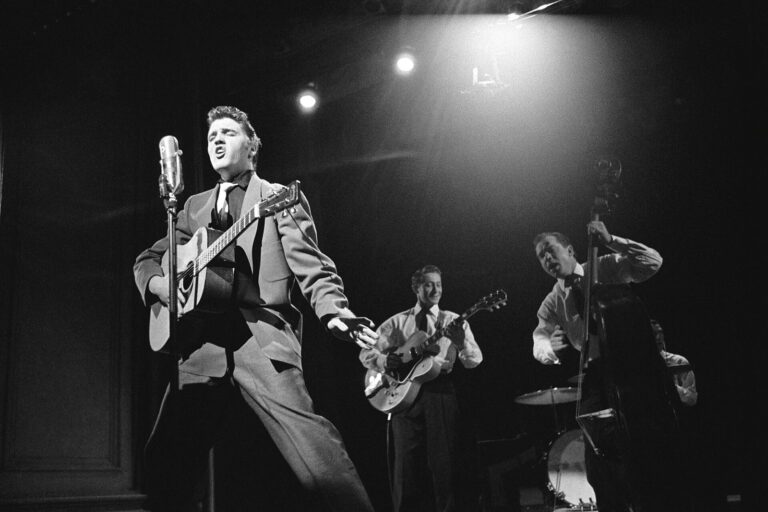
At Sun Studios in Memphis, in July 1954, three people were taking a break from a recording session that wasn’t going particularly well. Elvis Presley started singing “That’s All Right,” an Arthur Crudup blues. Scotty Moore’s gold Gibson ES-295 began playing along. Bill Black’s upright bass began walking. Sam Phillips heard it from the control room.
“That’s fine, boys. What is that?”
They didn’t know what it was. They recorded it. The recording went to radio. Memphis heard it first. Then everything else.
The guitar was an ES-295, serial number A-12290, bought at the O.K. Houck Piano Company in Memphis in 1953. It had a Melita bridge for better intonation. It had two P-90 pickups and a gold finish. It had a floral pickguard. It felt right against Moore’s body in a way the Fender Esquire he’d tried hadn’t. “The Gibson was more feminine. I could make out with the Gibson.”
Sixty years later, Moore described it: “That ES-295 enhanced Elvis’s voice better than anything else I could have used.”
Keith Richards heard it and wanted to play guitar. George Harrison heard it and learned the fills. The whole world heard it eventually, in one form or another.
The guitar was reunited with Moore in 2007. He held it again. The wood made music, the same way it always had.
If Moore’s hollow-body P-90 approach — the “sound of wood making music,” the slapback echo, the hybrid picking — has you exploring the Sun Records rockabilly tradition, check out our complete guide to Carl Perkins’s guitars and gear — Moore’s Sun Records contemporary who painted his Les Paul blue and taught the Beatles everything they needed to know about rockabilly guitar.
And for the guitarist who heard the Sun Records singles as a teenage boy in England and explicitly credited Moore with making him want to play guitar, don’t miss our breakdown of Keith Richards’s complete gear guide — whose early guitar vocabulary is a direct inheritance from what Moore played on “That’s All Right” in July 1954.
FAQ: Scotty Moore Guitars & Gear
- What guitar did Scotty Moore play on “That’s All Right”?
- A 1953 Gibson ES-295, serial number A-12290, in gold (“Gold Bullion”) finish. Moore bought it at the O.K. Houck Piano Company in Memphis in 1953. He modified it with a Melita Synchro-Sonic bridge with adjustable saddles for better intonation, and a Kluson tailpiece. The ES-295 had two P-90 single-coil pickups and a fully hollow single-cutaway archtop body. Only 1,770 ES-295s were built in the original production run. It was present on Elvis’s first four Sun singles. Moore was eventually reunited with the guitar in 2007, and Gibson produced a 81-unit limited edition Scotty Moore signature ES-295 in 2013.
- Why did Scotty Moore choose the Gibson ES-295 over the Fender Esquire?
- He tried both instruments before the Sun Records sessions. The Fender Esquire’s solid-body design didn’t feel right to him physically: “Maybe I was hiding behind my guitar, but onstage, that little Fender just did not seem like much to hold onto.” He elaborated in his autobiography: “The streamlined Fender just didn’t feel right when I played it. It probably had something to do with its shape. The Gibson was more feminine. I could make out with the Gibson. I couldn’t get it on with a Fender.” The physical and emotional connection to the large hollow-body Gibson was the deciding factor. He later said of the ES-295: “That ES-295 enhanced Elvis’s voice better than anything else I could have used.”
- What guitars did Scotty Moore use after the ES-295?
- On July 7, 1955, he traded the ES-295 for a 1954 Gibson L-5 — a top-tier jazzbox with carved spruce top and staple P-90 pickups. This was used on the final Sun Studios sessions and early RCA recordings until January 1957. After securing a Gibson endorsement, he was sent a 1956 Gibson Super 400-CESN (serial A-24672) with staple P-90s, which became his primary guitar for the remainder of his time with Elvis. The Super 400 was later also played by Reggie Young on “Suspicious Minds” and “Kentucky Rain.”
- What was the Ray Butts EchoSonic and how did it change Moore’s sound?
- The EchoSonic was a handbuilt amplifier (fewer than 70 total) by television repairman Ray Butts that integrated a tape delay mechanism directly into the amplifier body. Moore became aware of it around 1955 after hearing Chet Atkins use a similar echo effect on radio. He ordered one, and used it from May 1955 onward — its debut was on “Mystery Train.” Before the EchoSonic, the slapback echo heard on Sun Records was applied in post-production by Sam Phillips; the EchoSonic allowed Moore to reproduce this sound live on stage for the first time, with controllable echo intensity and delay time.
- What is hybrid picking and why is it associated with Scotty Moore?
- Hybrid picking uses both a flatpick and the fingers of the picking hand simultaneously. The flatpick handles certain strings and strokes while the bare middle and ring fingers handle others, allowing bass notes and treble melody notes to sound simultaneously from a single guitarist. Guitar.com identified it as central to Moore’s style: “His innovative use of the ‘Slapback’ effect, as well as his unique style of hybrid picking became the blueprint of what the world grew to call ‘Rockabilly’ guitar playing.” The technique produces the multi-voice, self-accompanied character of rockabilly guitar — more sonic content than pure flatpicking can generate.
- What is the significance of “That’s All Right” in guitar history?
- Vintage Guitar described the moment: “Like a hound dog hit by lightning, the first notes of rock and roll blasted out of radios across the country in July of 1954, courtesy of Elvis Presley’s supercharged-hillbilly singing on ‘That’s All Right’ and ‘Blue Moon Of Kentucky,’ backed by Scotty Moore’s guitar.” The recording began spontaneously during a break in an unrelated recording session when Presley, Moore, and Bill Black began playing Arthur Crudup’s blues for fun. Sam Phillips heard it from the control room and stopped them to record it. The ES-295’s two P-90 pickups through Phillips’s studio echo produced the guitar sound on the recording that initiated rock and roll.
- How do I get Scotty Moore’s guitar tone?
- A fully hollow archtop guitar with P-90 pickups (Gibson ES-295, ES-175, or L-5; or Epiphone equivalents) through a clean tube amplifier with slapback echo (80-120ms single repeat, moderate level) as the primary effect. The hollow body is essential — semi-hollow instruments approximate but don’t fully replicate the “sound of wood making music” that Moore described. Any delay pedal set to short delay, one repeat, moderate effect level produces the slapback. The hybrid picking technique (flatpick plus middle and ring fingers simultaneously) is the critical performance technique. Learn the fills on “That’s All Right” and “Mystery Train” from the original recordings — these specific phrases are the foundational vocabulary of rockabilly lead guitar.
Image credits
- Scotty Moore: Unknown author, Wikimedia Commons, Public domain.