Roy Buchanan Guitars & Gear: The Complete Guide to the World’s Greatest Unknown Guitarist
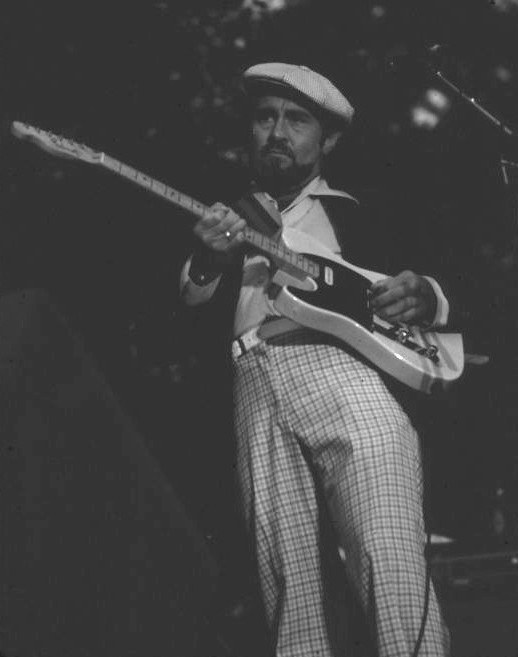
Roy Buchanan at Pinecrest Country Club, Shelton, Connecticut, USA. Photo: Carl Lender, CC BY-SA 3.0, via Wikimedia Commons (File:RoyBuchananPerforming.jpg).
The Rolling Stones asked him to replace Brian Jones. He said no.
He preferred to play local bars in the Maryland suburbs. He preferred to drink. He preferred the company of his wife Judy and his children. He preferred a battered 1953 Telecaster that he’d named Nancy over any opportunity the music industry could offer. He was, as the PBS documentary called him in 1971, “The World’s Greatest Unknown Guitarist,” and he seemed to prefer the unknown part.
Jeff Beck dedicated “Cause We’ve Ended As Lovers” from Blow by Blow to Roy Buchanan. That’s Jeff Beck — the guitarist consistently ranked among the top five guitarists alive — acknowledging Buchanan’s influence on a dedicated track on his most celebrated album. Robbie Robertson cited him. Gary Moore cited him. David Gilmour cited him. Danny Gatton studied under him. Jerry Garcia absorbed him.
He played a 1953 Fender Telecaster named Nancy through a Fender Vibrolux with both volume and tone at full — ten and ten, maximum everything. He controlled his sound entirely from the guitar’s own volume and tone knobs. The tone knob swept across its range produced a wah-like effect that predated wah pedals. The volume knob used for swells produced the vocal, crying quality of his lead playing. He used no effects pedals on the early recordings. He used a razor blade to slit the paper cones of his speakers — the same technique Dave Davies of the Kinks used to record “You Really Got Me” — because he wanted the specific distorted character the damaged speakers produced.
Guitar Player listed his version of “Sweet Dreams” as having one of the 50 Greatest Tones of All Time.
He died in 1988. He was 48 years old. He never had a hit of his own.
Background: Ozark, Arkansas, Bakersfield, and the Maryland Bars Where History Played Nightly
Leroy Roy Buchanan was born September 23, 1939, in Ozark, Arkansas, and raised partly there and partly in Pixley, California — a farming area between Visalia and Bakersfield in the San Joaquin Valley. His father was a sharecropper in Arkansas and a farm laborer in California. He learned steel guitar as a child — his earliest lessons were on pedal steel, which explains the specific steel guitar-influenced techniques that appear throughout his playing: the volume swells, the legato sustain, the ability to make the electric guitar imitate a voice or a violin.
His early influences were the Bakersfield country sound — Buck Owens and Roy Nichols specifically — which embedded the Telecaster’s specific character into his foundational musical vocabulary. He subsequently absorbed jazz, blues, R&B, gospel, and funk through his voracious musical curiosity and his decade of sideman and session work. The combination — country Telecaster foundation, jazz harmonic knowledge, blues emotional vocabulary, R&B rhythm understanding — is the specific synthesis that made his playing genuinely distinctive. Nobody else had put those specific elements together in exactly that proportion.
His teens and twenties were spent as a sideman and session musician — the invisible professional musician working behind performers who received the recognition. He played on Bobby Gregg’s “The Jam” (1961-62), which hit near the top of the R&B charts with Buchanan’s signature riffs. Gregg recorded and claimed credit. Buchanan received his session fee. This experience of watching his own distinctive playing generate commercial success for someone else’s name was the specific disillusionment that shaped his relationship with the music industry for the rest of his life.
A 1971 PBS documentary titled The World’s Greatest Unknown Guitarist — focused specifically on Buchanan — reached enough of an audience that Polydor Records offered him a recording contract. His debut album for Polydor (1972) and the subsequent recordings produced two gold albums. He was not unrecognised among musicians; he was unrecognised among the general public, which was a different matter entirely.
He declined the Rolling Stones’ offer to replace Brian Jones in 1969. He declined repeated major label offers over the years. He chose the Maryland bar scene, local club performances, and the specific freedom of not having to be famous.
He died August 14, 1988, in a jail cell in Fairfax County, Virginia, where he had been held overnight after a domestic disturbance call. The official ruling was suicide by hanging. His family disputed this finding. He was 48 years old.
Tone note: He turned down the Rolling Stones. He turned down major labels. He played local bars in Maryland. The music industry’s conclusion was that he didn’t want to be successful; the reality was that he didn’t want to be famous on terms that would compromise the specific musical life he had. Those are different things. The guitar playing was always exceptional. The choices around it were entirely his own.
The Rig: Roy Buchanan’s Guitars, Amps & Gear
Guitars: Nancy and Her Successors
1953 Fender Telecaster “Nancy” — The Primary Instrument
Roy Buchanan’s signature guitar — his primary instrument from approximately 1969 until 1985 — was a 1953 Fender Telecaster, serial number 2324, nicknamed “Nancy.” There are two very different stories explaining how Buchanan got the guitar. He himself said that, while enrolled in 1969 in a school to learn to be a hairdresser, he ran after a guy walking down the street with that guitar, and bought him a purple Telecaster to trade. A friend of Buchanan’s, however, said that Buchanan was playing a Gibson Les Paul at the time, and traded it for the 1953 Telecaster. Both accounts agree on the year: 1969.
Nancy’s specifications:
- Body: Ash, in the blonde finish characteristic of early Telecasters
- Neck: Maple, with the specific feel of a 1953 Fender neck — slightly deeper than contemporary production
- Pickups: Original 1953 single-coil bridge and neck pickups; at some point “Nancy” had jumbo frets installed, but remained largely original
- Condition: Battered, worn, heavily played — the physical evidence of decades of heavy use visible in photographs and described by everyone who saw it
Vintage Guitar’s account described the guitar with appropriate reverence: “Roy Buchanan and his battered 1953 Telecaster guitar got inside your head and grabbed you in the gut.”
Buchanan also owned a Butterscotch Blonde 1952 Fender Telecaster that eventually wound up in the possession of Wishbone Ash guitarist Andy Powell. One of Buchanan’s Telecasters was later owned by Danny Gatton and then Mike Stern, who lost it in a robbery.
Nancy was Buchanan’s primary instrument through the Polydor and early Atlantic recording periods — the records that produced his two gold albums and that established the “Sweet Dreams” guitar tone that Guitar Player listed among the 50 Greatest Tones of All Time.
Tone note: A 1953 Fender Telecaster, battered and worn, with jumbo frets added. No pickup replacements. No significant modifications beyond the fret swap. The specific sound that Jeff Beck dedicated a song to, that David Gilmour absorbed, that Gary Moore cited — all produced by an unmodified (except for frets) 1953 Telecaster with the bridge pickup selected, at full volume, into an amplifier running at maximum.
1979-1985: The Stratocaster and Les Paul Period
Early in 1979, Buchanan switched to a Fender Stratocaster for a few years. He vacillated between guitars until 1985, when he permanently retired his ’53 in favor of a 1983 Tele loaded with Bill Lawrence pickups and a Gibson 30th Anniversary Les Paul goldtop.
The Stratocaster period is less celebrated than the Nancy period — his most distinctive playing is generally associated with the Telecaster’s bridge pickup character, and the Stratocaster’s different pickup configuration and switching options produced a different tonal character. Players who love Buchanan specifically for the Nancy-era recordings often consider the Stratocaster period transitional.
The 1983 Telecaster with Bill Lawrence pickups represents a return to Telecaster format while updating the pickup technology. Bill Lawrence pickups were known for higher output and a specific aggressive midrange character than original 1950s Telecaster pickups — producing a different character than Nancy’s vintage single coils but maintaining the Telecaster’s essential attack and twang.
The Gibson Les Paul Goldtop (30th Anniversary) represents a significant departure from his Telecaster identity — a humbucker-equipped solid-body with fundamentally different tonal character. Less documented in performance photographs than the Telecaster period.
Other Instruments
- Gibson L-5 — A young Buchanan was photographed playing a Gibson L-5 with Mickey Rooney around 1956; his earliest documented professional instrument
- Guild L250 (or similar Guild Telecaster-style) — Used at some point; Buchanan reportedly covered the Guild logo with electrical tape due to dissatisfaction with the company (though reportedly liked the guitar itself)
- Roy Buchanan Bluesmaster (signature model) — His final endorsed guitar; in a last session video he described it as combining the sounds of a Stratocaster, Les Paul, and Telecaster in one instrument; fitted with EMG pickups (as was the Fritz Bros. model)
- Fritz Bros. Buchanan model — The last model endorsed by Roy; also had EMG pickups
Complete Guitar List
- Gibson L-5 (early career, approximately 1956) — Earliest documented professional instrument
- 1953 Fender Telecaster “Nancy” (serial 2324, jumbo frets) — Primary instrument 1969-1985; the guitar on all key recordings; “the star of more hit records than perhaps any other guitar” according to those who knew him; Jeff Beck dedicated a track to Buchanan’s playing on this guitar
- 1952 Fender Telecaster (Butterscotch Blonde) — Also owned; eventually to Andy Powell of Wishbone Ash
- Fender Stratocaster (1979-early 1980s) — Transitional period; temporarily replaced Nancy
- 1983 Fender Telecaster (Bill Lawrence pickups) — Nancy’s successor; higher-output pickups
- Gibson Les Paul Goldtop 30th Anniversary — Late career; humbucker equipped; less characteristic of his primary sound
- Guild L250 (or similar) — Covered Guild logo with tape; “liked the guitar, dissatisfied with company”
- Roy Buchanan Bluesmaster — Final signature model; EMG pickups; combined Strat/LP/Tele sounds per his description
- Fritz Bros. Buchanan model — Last endorsed model; EMG pickups
Amps: Maximum Volume, Sliced Speakers, and the Vibrolux
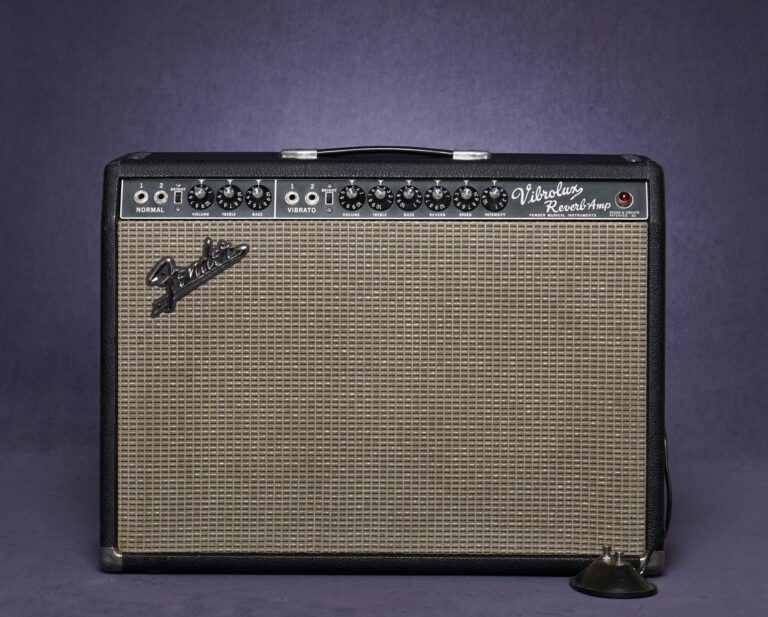
Fender Vibrolux — The Primary Amp (Volume and Tone Full Out)
Roy Buchanan’s signal chain philosophy was radical in its simplicity: Buchanan played the Telecaster through a Fender Vibrolux amplifier with the volume and tone “full out”, and used the guitar’s volume and tone controls to control volume and sound (he achieved a wah wah effect using the tone control).
The Fender Vibrolux is a 35-watt (approximately) tube combo with two 10-inch speakers and built-in vibrato. At full volume and full tone, the Vibrolux’s output stage would be operating near saturation — producing natural tube compression and saturation that gives sustained notes their singing quality. By keeping the amp at maximum and using the guitar’s controls to manage dynamics, Buchanan achieved several specific advantages:
- The amp was always in its most responsive, most touch-sensitive operating range — small changes in picking pressure produced audible dynamic changes
- Rolling back the guitar volume reduced the signal going into the saturated amp, cleaning up the tone; rolling forward increased it, adding harmonic complexity
- The tone knob, swept across its range, modified the frequency content of the signal hitting the saturated amp — producing the wah-like effect that results from changing the frequency emphasis of the input to a saturated circuit
This approach — amp at maximum, all control from the guitar — represents the most direct possible connection between the player’s physical actions and the resulting sound. No buffers, no effects pedals to re-process the signal, no complex switching. The guitar’s controls are directly in the signal path, doing exactly what they’re supposed to do, with the amp’s saturated operating range making every adjustment audible and expressive.
To achieve his desired distorted sounds, Buchanan at one point used a razor blade to slit the paper cones of the speakers in his amplifier, an approach also employed by the Kinks’s Dave Davies. The sliced speaker cones produce harmonic distortion similar to the punctured-speaker approach Link Wray had used with a pencil — deliberate equipment modification to achieve a specific tonal quality unavailable from undamaged equipment.
The Telecaster Forum confirmed the amp from firsthand accounts: “All the times we saw him in the 1970’s it was the ’53 and a Silverface Vibrolux.”
The Early DIY Speaker Setup
Vintage Guitar documented Buchanan’s earliest performing amplification: Roy’s equipment had a homemade appeal to it; his speaker system was a 4′ X 4′ piece of plywood with 16 five-inch speakers and a Bogen PA amplifier. This improvised speaker array — the same instinct as Link Wray’s pencil-and-speaker and Dick Dale’s 100-blown-speakers approach — reflects a musician solving a specific acoustic problem (projection without conventional guitar amplification) with whatever was available.
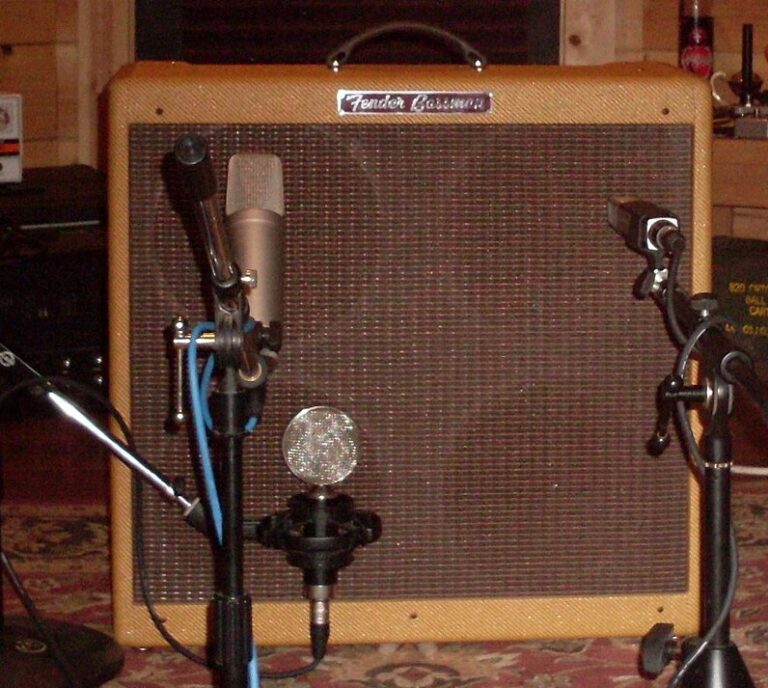
He also used a 4×10 Fender Bassman during the 1960s — confirmed by a musician who played his guitar between sets at the time.
Later Career Amps — The Roland JC-120

During this period Buchanan explored a variety of amplifiers, including Peaveys, Mesa/Boogies, and Marshalls, before eventually settling on a Roland JC-120.
The Roland Jazz Chorus 120 is a solid-state amplifier — unusual for a guitarist whose foundational tone came from the natural saturation of a maxed-out tube amplifier. The JC-120’s characteristic clean headroom and built-in stereo chorus produce a very different character from the Vibrolux’s tube saturation. His adoption of the JC-120 represents either a change in aesthetic direction or a practical adaptation to the changing performance contexts of his later career.
| Amp | Era | Notes |
|---|---|---|
| DIY: 4×4 plywood with 16 five-inch speakers + Bogen PA | Early career (~1960-early 1960s) | Improvised speaker array; characteristic homemade approach; same instinct as Wray’s pencil and Dale’s speaker experiments |
| Fender Bassman 4×10 | Mid 1960s | Confirmed by musician who played his guitar between sets; standard of the era |
| Fender Vibrolux (Silverface, volume and tone full out) | Primary 1970s amp (Nancy era) | The definitive Buchanan amp; all controls maxed; guitar controls manage dynamics; razor blade sliced speaker cones for distortion; “all the times we saw him in the 1970’s it was the ’53 and a Silverface Vibrolux” |
| Peavey, Mesa/Boogie, Marshall (various) | Early 1980s exploration | Experimental period alongside guitar changes; tried multiple amp types before settling |
| Roland JC-120 Jazz Chorus | Late career primary | Final settled amp; solid-state; unusual choice given tube-saturated history; “eventually settling on a Roland JC-120” |
Pedals & Signal Chain: Almost None — Then Some
Roy Buchanan’s early signal chain was the simplest documented in this series: Nancy → Fender Vibrolux. Period. No effects pedals. No buffer. No EQ. No reverb unit. Just the Telecaster’s controls and the maxed Vibrolux.
He sliced his speaker cones with a razor blade rather than use a distortion pedal. He used his tone control to produce wah effects rather than use a wah pedal. He used his volume knob for swells rather than use a volume pedal. Everything that other guitarists achieved through dedicated external effects, Buchanan achieved through technique and the guitar’s built-in controls.
The Echoplex — The One Effect (Eventually)
Buchanan rarely used effects pedals, though he started using an Echoplex on A Street Called Straight (1976). The Echoplex — the same tape-echo unit that Carl Perkins, Scotty Moore, and Chet Atkins used — was adopted for its tape-based echo and slap-back character, and (as with Hubert Sumlin) partly for the warmth that its tube preamp circuit added to the signal.
Boss DD-2 Delay — Late Career
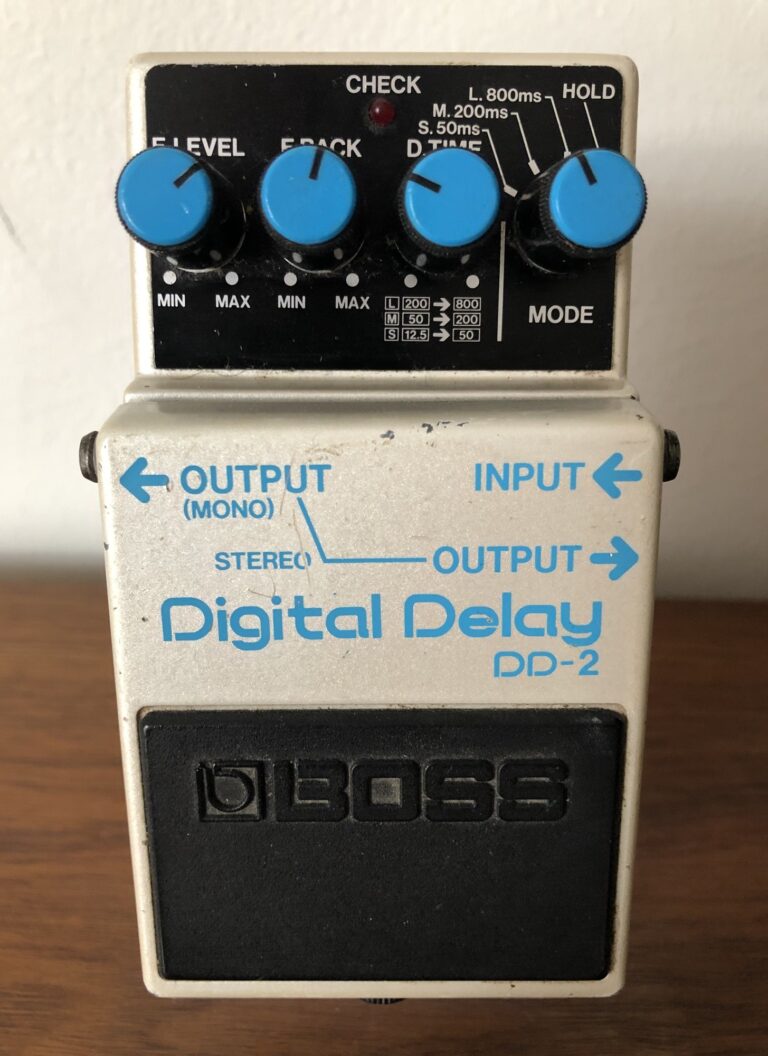
In his later career he played with a Boss DD-2 delay. The DD-2 was Boss’s first digital delay — a compact pedal with precise delay times and cleaner repetitions than the Echoplex’s tape-based echo. Its adoption represents a practical modernisation of the delay function that the Echoplex had served.
Tone note: He produced wah effects with his tone knob. He produced volume swells with his volume knob. He produced distortion by slicing his speaker cones with a razor blade. The signal chain was guitar and amp, with the guitar’s built-in controls as the only effects. And the result was one of the 50 Greatest Tones of All Time. The signal chain could not be simpler. The technique could not be more demanding.
Strings, Picks & Setup
Strings: He wore his Tele high, used light gauge Fender Rock and Roll strings, and would only change them “when they break.” Light gauge strings — standard Fender electric strings in the era, probably .010 gauge or lighter — suited his bending technique and his specific picking approach. He didn’t change strings until they broke, which meant they were always old and slightly dead — producing the specific compressed, warm character that dead strings have (similar to what Lightnin’ Hopkins preferred and what contributed to his specific acoustic sound).
Vintage Guitar documented an additional string insight: he told a friend about “using an A string from a tenor banjo as a replacement for the high E string on my guitar” — the same instinct as James Burton’s banjo-string experiments, applied to produce a specific tone on the high E string.
Picks — and Thumb: Buchanan sometimes used his thumb nail rather than a plectrum, and also employed it to augment his index finger and pick. Holding the pick between his thumb and forefinger, Buchanan also plucked the string and simultaneously touched it lightly with the lower edge of his thumb at one of the harmonic nodes, thus suppressing (the sentence continues) unwanted frequencies while emphasising the harmonic partial — this is the specific mechanism of his pinch harmonic technique.
The pick-plus-thumb combination: the flatpick makes initial string contact while the lower fleshy edge of the thumb simultaneously contacts the string at a specific point (a harmonic node). This simultaneous contact produces the pinch harmonic — a high, singing overtone that sits above the fundamental pitch of the fretted note. Buchanan’s ability to produce these “whistlers” at will, consistently, at any point in a performance, represented a level of control over the technique that other guitarists found remarkable and difficult to replicate.
Technique notes from Vintage Guitar: “He pioneered numerous techniques, from the pinched harmonic (or ‘squealer’) to his manipulation of the Telecaster’s simplified tone and volume controls to produce wah-wah effects that predated pedals by a decade. Buchanan’s techniques stunned, puzzled and intimidated other players.”
Tone note: He changed his strings when they broke. Not when they got old, not on a schedule, not when the tone started to go — when they broke. Old strings and new strings have different tonal characters. Buchanan’s sound on his most celebrated recordings has the specific compressed, slightly dark quality of strings that have been played extensively. This is not accidental. It’s the result of a specific maintenance philosophy that produced a specific tone.
Playing Style & Tone Philosophy: The Six Techniques That Defined Everything
Roy Buchanan’s playing contains more distinct technical innovations in a single performance than most guitarists develop across an entire career. Premier Guitar’s lesson on his technique documented the specific approaches: He not only was a master of expressive bends, but also more extended techniques like muting, pinch harmonics, and tone swells.
1. Pinch Harmonics (“Whistlers” or “Squealer”)
The pinch harmonic is Buchanan’s most imitated and most discussed technique. By contacting the string simultaneously with the pick and the lower edge of the thumb, and positioning this contact precisely at a harmonic node (a specific fraction of the string length), he could produce harmonic overtones up to three octaves above the fretted note — the specific “whistle” or “squeal” that defines his sound on recordings like “Sweet Dreams.”
To execute these “whistlers,” as Buchanan called them, you’re aiming to strike the string with both the pick and the fleshy side of the thumb closest to the guitar. Some claim he invented the technique, which is likely hard to prove, but it’s fair to say that Buchanan made it more popular.
Buchanan’s ability to produce whistlers was described as “at will” — not occasionally, not in specific prepared passages, but whenever he chose, consistently, at any point in a performance. This level of control requires knowing precisely where the harmonic nodes are for every string at every fret position, and having the right-hand positioning so consistent that the thumb contacts the correct node reliably even during fast playing.
2. Volume Knob Swells
Using the guitar’s volume knob to produce violin-like bow-in notes — the same technique Steve Hackett used with a volume pedal, but executed by Buchanan with his picking-hand pinkie on the guitar’s volume knob while his other fingers were picking. Premier Guitar confirmed his earliest guitar training was on steel guitar: “It’s plausible that this use of volume swells comes from there.”
The volume swell technique requires simultaneous coordination: the fretting hand frets the note, the picking hand picks the string while (with the pinkie) simultaneously rolling the volume knob from zero to full in a controlled arc. The result is a note that fades in without the initial pick transient — exactly the bowing quality that Hackett and others pursue with volume pedals.
Buchanan’s ability to execute this without a volume pedal — using only the guitar’s control while his fingers also managed the picking — was considered specifically remarkable by other guitarists who tried to replicate it.
3. Tone Knob Wah
Sweeping the Telecaster’s tone control across its range while playing produces a filter sweep similar to a wah pedal’s effect. One of Buchanan’s signature techniques was to manipulate his tone knob to give a faux wah sound.
This technique works specifically because of the amp running at full saturation: the tone knob changes the frequency content of the signal hitting the saturated amp, changing which frequencies are emphasised in the harmonic distortion. The result — particularly through the maxed Vibrolux — produces a frequency sweep that sounds convincingly like a wah pedal to the listener.
4. Oblique Bends and Compound Bends
We break out some compound bends in Ex. 4. The basic idea is to bend to a target note, hold it, and then bend it even more to a second note. The oblique bend involves bending one string while another remains stationary, creating harmonic movement between the bent and unbent strings simultaneously. Buchanan used both techniques extensively — he was noted as well for his oblique bends. This was particularly notable in his approach to using double and triple stops.
5. Muting and String Control
Buchanan could play harmonics at will, and could mute individual strings with free right-hand fingers while picking or pinching others. The ability to selectively mute specific strings within a chord or phrase while clearly sounding others requires exceptional right-hand finger independence — the ability to control each finger’s pressure independently while the picking motion continues.
6. Slide-to-Bridge Scrape
To build drama, Buchanan would often slide his finger beyond the fretboard, following the string right up to the bridge pickup to generate high-pitched, bird-like sounds. This technique — continuing to slide after the last fret, across the body of the guitar toward the pickup, produces increasingly high pitches as the vibrating string length decreases — is one of his most distinctive and most unsettling sounds. It requires physical commitment and produces sounds that no conventional guitar technique can replicate.
Tone note: Six distinct advanced techniques, most of which he invented or refined to a level nobody else had reached. Volume swells without a pedal. Tone-control wah without a wah pedal. Pinch harmonics at will. Compound bends. Oblique bends. Slide-to-bridge scrapes. All executed on a battered 1953 Telecaster through a maxed Vibrolux with no effects pedals. The technique IS the signal chain.
How to Sound Like Roy Buchanan: The Maximum Vibrolux Tone
Buchanan’s tone is theoretically the most achievable in this series — Telecaster, clean-to-driven amp at maximum, no effects. In practice, it’s the hardest to achieve because the tone is entirely the technique, and the technique took him decades to develop.
The Guitar
Fender Telecaster. Bridge pickup. Original single-coil or similar vintage-output pickup. The bridge pickup’s specific aggressive character — the tightest, most percussive Telecaster tone — is the foundation for all six of his techniques.
- Fender American Vintage ’52 or ’53 Telecaster reissue — Closest to Nancy’s specifications; vintage-voiced single coils
- Fender Player Telecaster — More accessible; bridge single coil provides the correct character
- Any Telecaster with vintage-voiced bridge single coil — The pickup type is the essential element
- Avoid: High-output pickups, humbuckers — these change the fundamental character of the technique’s response
The Amp — Maximum Everything
Fender Vibrolux or equivalent small-to-medium tube combo. Both volume and tone controls at full. Control everything from the guitar.
| Control | Setting | Notes |
|---|---|---|
| Volume | Full (10) | Maximum — the amp should be at or near natural saturation; this is essential, not optional |
| Tone | Full (10) | Maximum — all control comes from the guitar’s tone knob, not from a pre-set amp tone |
| Treble/Bass/Mid (if available) | Guitar Chalk: Volume 6-7, Treble 5-6, Bass 3-4, Reverb 2-4 | If the amp has these controls, these settings approximate the Vibrolux’s clean-to-driven character at working volume |
| Guitar volume | Variable (0-10 from guitar) | This is your primary volume control; roll back for cleaner tones, push full for bite and saturation |
| Guitar tone | Variable (0-10 from guitar) | Sweep this to produce the tone-control wah effect; at 10 = bright and cutting; at 0 = warm and muffled |
No Effects (Early Period)
For the Nancy-era sound: no effects pedals. Guitar to amp. Nothing else. If you feel you need a wah pedal, use the guitar’s tone control instead. If you feel you need a volume pedal, use the guitar’s volume control instead and practice the coordination required to do so while playing. If you feel you need distortion, turn the amp up further and put your guitar volume at full. This is the complete signal chain.
Later period: add an Echoplex or analog delay pedal (Boss DD-2 or equivalent) at subtle settings. The delay should add depth, not dominate.
Budget vs Authentic
Budget:
- Guitar: Squier Classic Vibe Telecaster; bridge single coil
- Amp: Fender Blues Junior cranked, or any small tube combo at maximum volume
- Effects: None for the early period; analog delay for the later period
- Strings: Light gauge (.010–.046); don’t change until they break
Authentic:
- Guitar: Fender American Vintage Telecaster; original or vintage-voiced bridge pickup
- Amp: Fender Vibrolux (Silverface or vintage Blackface); both volume and tone controls at full
- Effects: None initially; Echoplex EP-3 or Boss DD-2 for later period
The Techniques — Where Everything Lives
Pinch harmonics. Practice this before anything else. With the pick held between thumb and forefinger, allow the lower fleshy edge of the thumb to contact the string immediately after the pick. The contact point should be at a harmonic node — for most positions, approximately halfway between the bridge and the 12th fret produces audible harmonics, but the exact position varies by string and fret. Start by playing an open string with the pick-and-thumb contact at the 12th fret position on the body side (not the fret — the harmonic node above where the 12th fret would be if extended into the body). A harmonic should sound. Move the contact point slightly until you find the positions that produce harmonics clearly.
Volume knob swells. Practice with the pinkie of the picking hand on the guitar’s volume knob. Pick a note with the volume at zero, then immediately roll the volume up with the pinkie. The note bows in. This requires coordination between pick hand and pinkie, which develops with practice. Eventually — weeks to months of dedicated practice — the coordination becomes automatic.
Tone knob wah. Play a note and sweep the tone control from 0 to 10 and back. The frequency sweep through the maxed amp produces the wah sound. Practice making this sweep rhythmically synchronized with the notes you’re playing.
Influence & Legacy: The Blueprint That Others Built With
Roy Buchanan’s influence on electric guitar is disproportionate to his commercial success — which is the cleanest possible definition of an artist’s historical significance. Players who achieved vastly more commercial success cited him as the specific inspiration for techniques and sounds they considered foundational to their own identities.
The documented direct influences:
- Jeff Beck — Dedicated “Cause We’ve Ended As Lovers” from Blow by Blow specifically to Buchanan; the most visible and most emotionally explicit of all the tributes
- David Gilmour — Cited; the specific compound bend technique that Gilmour uses extensively on Pink Floyd recordings has Buchanan ancestry. Premier Guitar documented both as using compound bends
- Robbie Robertson — Cited; the specific Telecaster approach in the Band’s recordings
- Gary Moore — Cited; the sustained, vocal lead guitar character that Moore pursued in his later blues work
- Danny Gatton — Considered the most direct student of Buchanan’s approach; a Washington D.C. area guitarist who absorbed Buchanan’s vocabulary and developed it in his own direction (more jazz-inflected)
- Jerry Garcia — Cited; the specific tone-from-technique approach
- Nils Lofgren — Cited; the volume control work and the emotional intensity
- Arlen Roth — Cited and studied; the Telecaster techniques specifically
His pinch harmonic technique was first documented on record on Bobby Gregg’s “Potato Peeler” (approximately 1962) — predating the technique’s widespread adoption by other guitarists by several years. The “whistlers” he used consistently through his career were a specific innovation that other guitarists subsequently learned and incorporated into their own playing.
The tone-control wah predated the commercial availability of the Cry Baby wah pedal (1967) — Buchanan was using the technique through the maxed-amp-plus-guitar-control approach for years before a dedicated pedal made the effect commercially accessible.
Guitar Player’s listing of “Sweet Dreams” among the 50 Greatest Tones of All Time represents the formal acknowledgment of what musicians had always known: he produced sounds from the simplest possible equipment that other guitarists with more elaborate rigs couldn’t replicate. The tone was in the hands and the brain, not in the pedal board.
Tone note: He was offered the Rolling Stones. He said no. He played Maryland bars. He is in Guitar Player’s 50 Greatest Tones of All Time. Jeff Beck dedicated a track to him. David Gilmour absorbed his compound bends. The Rolling Stones moved forward without him. He moved forward without them. The guitar playing was what mattered, and the guitar playing was extraordinary regardless of which band was in front of it or not.
In a bar somewhere in Maryland, sometime in the 1970s, Roy Buchanan plugged Nancy — the battered 1953 Telecaster — into a Silverface Fender Vibrolux. Both volume and tone at full. All control from the guitar. No effects pedals.
He played “Sweet Dreams.” Guitar Player later listed the tone as one of the 50 greatest ever recorded. Jeff Beck heard it and dedicated a track on his most celebrated album to Buchanan. David Gilmour heard it and incorporated the compound bends into his own playing. Robbie Robertson heard it. Gary Moore heard it. Danny Gatton heard it and spent his career trying to understand it.
The Rolling Stones asked him to replace Brian Jones. He said no. He preferred the bar.
He died in 1988 at 48 years old. He was the World’s Greatest Unknown Guitarist. The unknown part was his choice. The greatest part was not.
If Roy Buchanan’s Telecaster-only, maximum-amp approach — the technique-as-signal-chain philosophy — has you exploring the tradition of Telecaster mastery, check out our complete guide to James Burton’s guitars and gear — the other Telecaster master whose chicken pickin’ technique ran parallel to Buchanan’s development in a completely different direction from the same instrument.
And for the guitarist who most directly absorbed Buchanan’s specific Telecaster vocabulary and developed it into something distinctively his own — the Washington D.C. area connection, the same specific techniques — don’t miss our breakdown of Danny Gatton’s complete gear guide.
FAQ: Roy Buchanan Guitars & Gear
- What guitar did Roy Buchanan play?
- His primary instrument from 1969 to 1985 was a 1953 Fender Telecaster, serial number 2324, nicknamed “Nancy.” He acquired it in 1969 — either by running after a man on the street and trading a purple Telecaster for it (his own account) or by trading a Gibson Les Paul for it (a friend’s account). Nancy had jumbo frets installed at some point but was otherwise largely original. He also owned a 1952 Butterscotch Blonde Telecaster (which eventually went to Wishbone Ash guitarist Andy Powell), used a Stratocaster briefly from 1979, and in 1985 retired Nancy in favor of a 1983 Telecaster with Bill Lawrence pickups and a Gibson Les Paul Goldtop.
- What was Roy Buchanan’s amp setup?
- His primary setup was a Fender Vibrolux (Silverface) with both volume and tone controls set at full — maximum everything. He controlled all dynamics and tone from the guitar’s own volume and tone knobs rather than the amp controls. The amp running at full volume produced natural tube saturation; rolling back the guitar volume cleaned up the tone. He occasionally sliced the speaker cones with a razor blade to achieve additional distortion, similar to Dave Davies of the Kinks on “You Really Got Me.” In later career he tried Peavey, Mesa/Boogie, and Marshall amplifiers before settling on a Roland JC-120.
- How did Roy Buchanan produce wah effects without a wah pedal?
- By sweeping the Telecaster’s tone control across its range while playing. With the amplifier running at maximum volume and saturation, changing the tone control altered which frequencies were emphasised in the saturated amp’s output, producing a filter sweep similar to a wah pedal. Premier Guitar documented this as “one of Buchanan’s signature techniques.” He developed this approach years before the commercial wah pedal became available (1967), and it required him to coordinate the tone-knob sweep with his fretting and picking simultaneously.
- What are pinch harmonics and did Roy Buchanan invent them?
- A pinch harmonic (Buchanan called them “whistlers”) is produced by striking the string simultaneously with the pick and the fleshy lower edge of the thumb, with the thumb contact positioned at a harmonic node. The simultaneous pick-and-thumb contact produces a high overtone (up to three octaves above the fretted note) that “whistles” above the fundamental pitch. Buchanan didn’t necessarily invent the technique — his earliest documented use is on Bobby Gregg’s “Potato Peeler” (approximately 1962) — but he popularised it and could produce whistlers at will, consistently, throughout performances. His playing was described as “stunning, puzzling and intimidating” to other guitarists for this ability.
- Why did Roy Buchanan turn down the Rolling Stones?
- He was reportedly offered the position as guitarist after Brian Jones left in 1969. He declined. Buchanan consistently declined major commercial opportunities throughout his career, preferring to play local bars in the Maryland area and maintain control over his musical life. He gave varying explanations across different interviews, but the consistent pattern — declining the Rolling Stones, declining major label deals, staying in the Maryland bar scene — suggests a genuine preference for musical freedom over commercial success rather than indecision or missed opportunity.
- What is Roy Buchanan’s “Sweet Dreams” and why is it significant?
- “Sweet Dreams” appears on his 1972 debut album on Polydor Records and is the recording Guitar Player listed in their “50 Greatest Tones of All Time” (2004). The track showcases the complete range of his Telecaster technique — volume swells, pinch harmonics, oblique bends, tone-control wah — on the signature Nancy Telecaster through the Vibrolux at full. The guitar tone is produced with essentially no effects pedals: just the guitar, the amp at maximum, and the guitar’s own controls. The fact that this sound was achieved with minimal equipment and maximum technique is part of what earned it the Guitar Player recognition.
- How do I get Roy Buchanan’s guitar tone?
- Fender Telecaster with bridge single-coil pickup (vintage-voiced, not high-output). Into a Fender Vibrolux or equivalent small-to-medium tube combo — both amp volume and amp tone at full. Control all dynamics and tone from the guitar’s own volume and tone knobs (guitar volume manages dynamics; guitar tone sweep creates the wah effect). No effects pedals for the early period. Optional: Boss DD-2 or Echoplex at subtle settings for depth. The tone requires developing: the volume-knob swell technique (pick hand pinkie on volume knob while fingers pick), the tone-control wah sweep, and the pinch harmonic (pick-and-thumb-edge simultaneous contact at harmonic nodes). These techniques, not the equipment, produce the sound.
Image credits
- Top image: Carl Lender, Wikimedia Commons, CC BY-SA 3.0.
- Gibson L-5: Cruciniacus at German Wikipedia, Wikimedia Commons, CC BY-SA 3.0.
- Fender Vibrolux Reverb: Tonereport, Wikimedia Commons, CC BY-SA 4.0.
- Roland JC-120: Solomon203, Wikimedia Commons, CC BY-SA 4.0.
- Fender Bassman: Roadside Guitars, Wikimedia Commons, CC BY-SA 2.0.
- Gibson L-5: Cruciniacus at German Wikipedia, Wikimedia Commons, CC BY-SA 3.0.
- Gibson L-5: Cruciniacus at German Wikipedia, Wikimedia Commons, CC BY-SA 3.0.
- Gibson L-5: Cruciniacus at German Wikipedia, Wikimedia Commons, CC BY-SA 3.0.
- Boss DD-2 Digital Delay: Kuriosatempel, Wikimedia Commons, CC BY-SA 4.0.