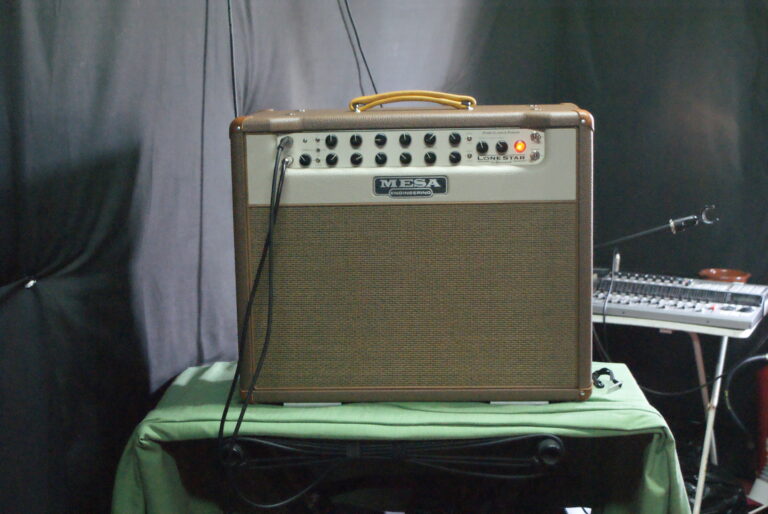
Mesa/Boogie Studio .22+: The EL84 Boogie Nobody Talked About — and Why That Suited Its Players Fine
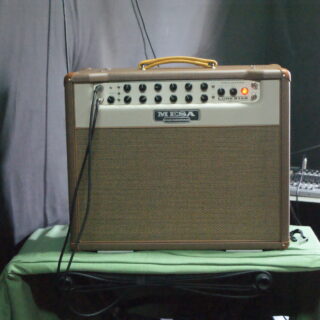
Mesa/Boogie Studio .22+: 20W Class A EL84 combo with Mark preamp DNA, five-band graphic EQ, and spring reverb — built for studio and small-venue use.
There is a Mesa/Boogie for people who do not want to announce that they own a Mesa/Boogie. It weighs around thirty pounds. It fits in the boot of a hatchback. It produces twenty watts of Class A power through a pair of EL84 tubes into a single twelve-inch speaker, and it contains enough of the Mark Series DNA to make experienced Boogie owners do a double-take when they hear it through a wall. That amp is the Mesa/Boogie Studio .22+, and its restraint is not an accident.
Where the Mark series announced itself in rack towers, multi-channel switching arrays and enough control knobs to suggest a small aircraft, the Studio .22+ stripped the formula back to what actually mattered: a refined preamp circuit derived from Mesa’s flagship line, pushed through power tubes with a very different sonic personality, in a format that fit on a coffee table. It was Mesa’s first genuinely low-wattage amplifier, launched in 1985 as the Studio Caliber and refined over several years into the .22+. By the late 1980s it was quietly appearing on stages and in studios in the hands of players whose primary touring rigs were far more expensive — and far less interesting to listen to in a small room.
This is the story of how Mesa built a modest amp that turned out not to be modest at all.
Origins: Mesa’s First Low-Watt Experiment, 1985
By 1985 Mesa/Boogie had spent the better part of a decade building a reputation on loud, complex, feature-dense amplifiers. The Mark series had grown from Randy Smith’s original hot-rodded Fender into a multi-tiered product line that defined the high-gain studio sound of the early 1980s. Players loved it; roadies did not. The Mark IIC+ weighed the better part of seventy pounds in its combo configuration, required careful maintenance of an elaborate switching matrix, and sounded best at volumes that guaranteed a noise complaint.
The Studio Caliber — the first version of what would become the .22+ — arrived as a deliberate counterpoint. Mesa wanted a low-wattage amp that preserved the essential character of the Mark preamp circuit while reducing the power, the weight and the complexity. The solution was to build a two-channel combo around two EL84 output tubes running in Class A, producing approximately twenty watts into a single twelve-inch speaker. The EL84 choice was significant. Mesa’s flagship line used 6L6 power tubes — American-character tubes with a wide, open, relatively linear response. EL84s are the European counterpart: compressed, harmonically richer, with a characteristic “chime” in the upper midrange that differs meaningfully from anything in the 6L6 stable. In placing EL84s in a Mesa circuit, the company produced something that sat between American and British amplifier traditions without entirely belonging to either.
The original Studio Caliber carried “Caliber Series Class ‘A’ Power” on the rear panel — an accurate description and a deliberate contrast to the Simul-Class branding that distinguished the Mark III. Early units used metal toggle switches; later production switched to plastic rocker switches throughout. Speaker options included the Celestion-built Mesa MC-90 (a ninety-watt-rated driver with a relatively bright character) and the Eminence-built VS-12, Mesa’s discontinued “Vintage” speaker with a darker, warmer tonality. Tube sockets were mounted directly to the circuit board, including those for the EL84 power tubes — convenient for manufacturing, less so for eventual maintenance.
The first iteration was called the Studio Caliber, sometimes badged “Studio Series” on the front panel. This was followed by the Studio .22, which standardised the name and the circuit. Then came the version that fixed the amp’s principal operational flaw.
What the “+” Actually Means
The non-plus Studio .22 had a known problem: a significant volume imbalance between its two channels. The Rhythm mode and the Lead mode were voiced differently and driven from the same preamp structure, but without a dedicated Lead Master volume control, there was no clean way to balance them. Players either accepted the imbalance, used the graphic equaliser to compensate on the Lead channel, or sent the amp back to Mesa — which Mesa did, in fact, offer as a service.
The .22+ addressed this directly. Mesa added a separate Lead Master volume control to the front panel, providing independent level control for the two channels without requiring the graphic equaliser as a workaround. The footswitchable graphic EQ — a five-band shelving unit — could now be switched in and out of the signal path via footswitch, whereas on some earlier models it was either always in or cumbersome to bypass. Mesa also revised the component layout, moving some parts to the top side of the PCB in a manner similar to the Mark series practice. A second four-ohm speaker jack was added for external cabinet use.
The schematics for the .22 and .22+ are nearly identical otherwise — the fundamental circuit did not change. What changed was usability. The .22+ is the version that works the way it should; the non-plus is an amp that requires workarounds Mesa’s own engineers knew were suboptimal. For any player looking at a used example, the “+” designation is the one to seek out.
Specifications
| Feature | Mesa/Boogie Studio .22+ |
|---|---|
| Output power | ~20 watts, Class A |
| Power tubes | 2× EL84 |
| Preamp tubes | 4× 12AX7 (approx., configuration varies by production run) |
| Channels | 2 (Rhythm / Lead) |
| EQ | Shared 3-band (Treble / Mid / Bass) + 5-band switchable graphic EQ |
| Reverb | Spring reverb (tank inside chassis) |
| Effects loop | Yes |
| Speaker | 1×12″ (Celestion MC-90 or Eminence VS-12, depending on production run) |
| Speaker jacks | Dual 4-ohm (external cab option added on .22+) |
| Footswitch | Yes — channel switching and EQ in/out |
| Head version | Available (less common) |
| Production years | ~1985 (as Studio Caliber) through ~early 1990s |
| Country of origin | USA (Petaluma, California) |
| Used market | ~$500–$1,000 (condition dependent, 2025–2026) |
A note on the power rating: twenty watts of Class A EL84 power is a subjective measurement with meaningful practical implications. Class A operation means both output tubes conduct continuously throughout the full audio cycle, producing even-order harmonic distortion that begins to saturate in a tonally musical way at lower volume levels than a Class AB push-pull amp of equivalent rated output would require. In practice, the Studio .22+ saturates into pleasing harmonic territory at volumes that a Mark III would still consider “clean.” This is the amp’s core advantage for home and studio use.
The Circuit: Mark Series DNA Through a Different Lens
Players who arrive at the Studio .22+ expecting a miniature Mark series are going to encounter something related but distinct. The preamp circuit draws on the same general architecture — the cascaded gain stages, the five-band graphic equaliser, the shared three-band tone stack — but the EL84 power section changes the character of everything that comes before it.
Where the Mark series 6L6 sound is open, punchy, and relatively wide in its dynamic response, the EL84 adds compression. Not the unpleasant limiting of a poorly designed amplifier, but the natural, touch-responsive compression that characterises good Class A single-ended and Class A push-pull EL84 designs. Pick harder and the amp compresses more, creating a sustain that increases with attack rather than cutting out at the edges. Pick lightly and the amp responds with a clarity that the big Boogies could not easily deliver at comparable volumes. The overall character has been described by players who know the Mark series well as “like a Mark, but smaller and more alive at low levels.” The studio value of this is obvious.
The five-band graphic equaliser — when footswitched in — gives the amp the same tone-shaping versatility that made the Mark series indispensable for studio engineers working with difficult guitar tones. The five bands sit at approximately 80Hz, 240Hz, 750Hz, 2.2kHz, and 6.6kHz, the same configuration used across Mesa’s Mark and Caliber lines. Boosting or cutting at 750Hz changes the fundamental “body” of the guitar tone; 2.2kHz controls the upper-midrange presence that determines how a guitar sits in a mix; 6.6kHz adds or removes “air” and string definition. The practical result is an amplifier that can be set for an excellent base tone on the Rhythm channel and then switch to a completely different EQ profile on the Lead channel — a level of real-time tone flexibility that was uncommon in a twenty-watt Class A combo in the late 1980s.
The spring reverb is a genuine asset. Mesa’s reverb tanks have consistently been among the better-regarded spring units in production amplifiers, and the Studio .22+ benefits from the same approach used in the larger models: the tank lives inside the chassis, positioned to minimise mechanical interference, and the circuit’s driving characteristics produce a reverb that extends musically rather than cutting abruptly. It is a studio-quality reverb by the standards of a hardware spring tank and competes well against many later boutique designs.
Famous Players
The honest version of this section is short, because the Studio .22+ was not a high-profile touring amplifier. It was built for circumstances — a studio session, a small venue, a living room — where a twenty-watt Class A combo made more practical sense than two hundred watts of Mark series rack gear. Players who owned one tended not to list it prominently in their equipment profiles, because the amp whose name you put in the magazine profile is the one with four hundred watts and a custom road case, not the modest combo you use for Tuesday afternoon overdubs.
With that context clearly stated:
Bono (U2) is the most well-documented connection to the Studio .22 family. Photographic evidence from an on-stage interview during the Joshua Tree Tour (1987) shows a Mesa/Boogie Studio .22 combo visible between Bono and Larry Mullen Jr., positioned underneath the drum riser. The Joshua Tree Tour ran 1987; the .22+ refinement came somewhat later, making this most likely a non-plus Studio .22 or an early transitional unit — but the connection to the amp family is real and photo-verified. Bono’s guitar work on that tour was understated by rock standards — the Gibson ES-335 through a modest combo amp rather than walls of speaker cabinets, which was consistent with the quieter, more atmospheric direction of U2’s songwriting at that point.
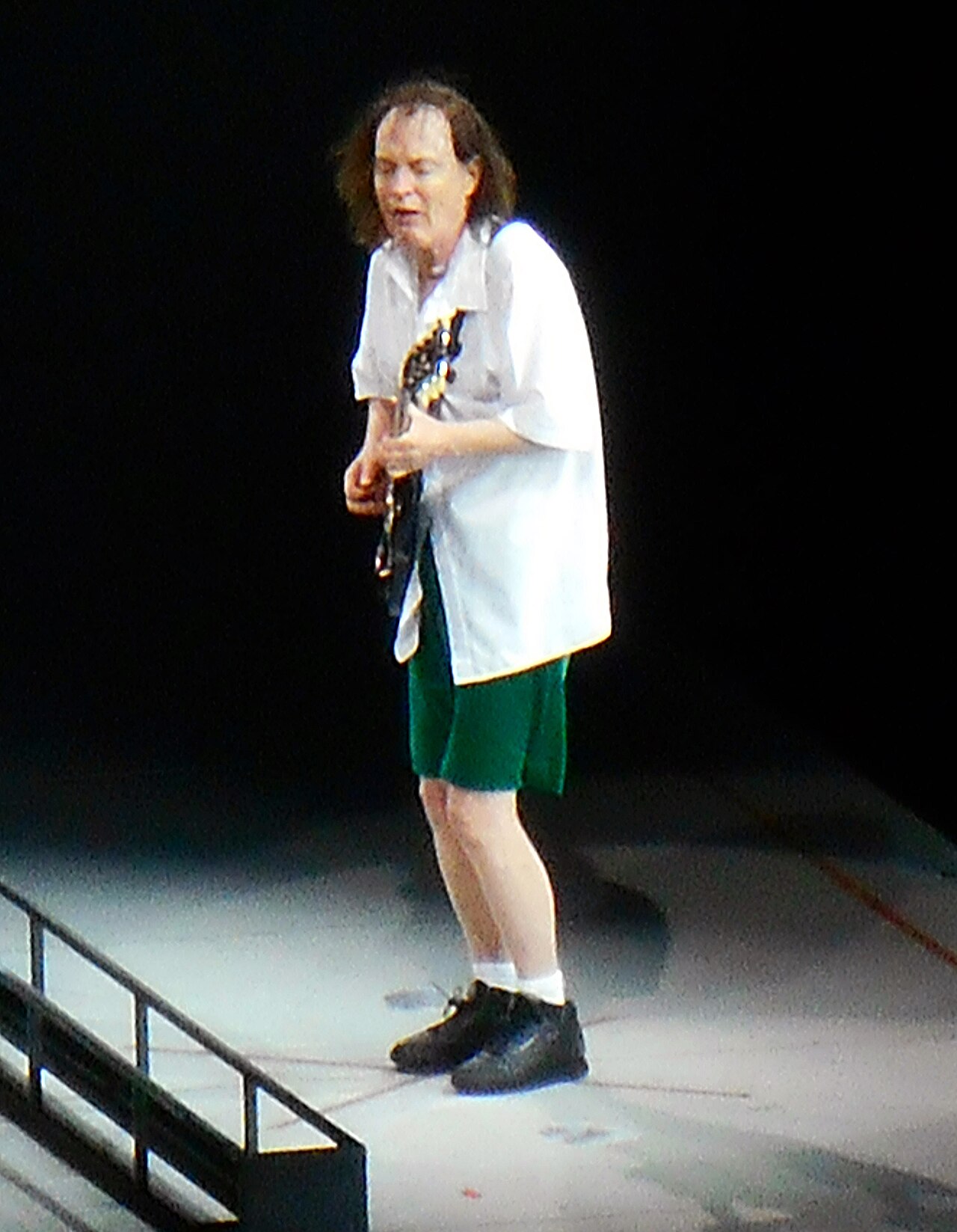
The amp family also circulates in discussion of Angus Young (AC/DC), with occasional online claims that he used a Studio .22 combo during certain periods. No primary source — manufacturer page, rig rundown, interview, or confirmed photograph — has been located to support this. Angus Young’s documented touring and studio history is built on Marshall heads and cabinets, with very occasional references to other equipment; the Studio .22 does not appear in any credible account of his gear. This claim should be treated as internet mythology until a primary source emerges.
A meaningful distinction must be drawn between the Studio .22+ combo and the Mesa/Boogie Studio Preamp — a rack-mounted unit from the same family that shared the preamp circuit but had no power section of its own. These are frequently conflated online. The Studio Preamp was used by a number of higher-profile players: Pat Smear paired it with power amplifiers during his time with Nirvana and later with Foo Fighters, and Kurt Cobain’s touring rig from May 1990 onward was built around a Studio Preamp driving Crown and later Crest power amplifiers. A Studio .22 combo is also reportedly visible in a small number of Nirvana-era photographs and has been cited as appearing at the Nevermind recording sessions, though documentation is secondary and consistent with borrowed or backline use rather than a deliberate personal choice of the .22+ specifically. The combo and the rack preamp are different products from the same circuit family; attributing the touring rack users to the combo amp is the kind of error that multiplies when equipment databases conflate related model names.
The Studio .22+ is well-suited to the kind of player who acquires it: someone who knows what they are looking for, does not need a name on the front panel to justify a purchase, and wants the essential character of Mesa’s preamp design at a scale that actually fits their daily playing environment. This demographic tends to be experienced and tends not to appear in gear magazines. It is a legitimate population of professional and semi-professional players, and the Studio .22+ earned its reputation among them on its own terms.
Tone Recipes and Settings
1. Sunday Morning Clean (Rhythm channel, EQ off)
Gain: 2–3 | Treble: 6 | Mid: 5 | Bass: 5 | Rhythm Master: 4 | Reverb: 3–4
Graphic EQ: bypassed. This is the amp’s fundamental clean voice — the EL84s providing a slightly compressed, warm-but-clear base tone with a Vox-adjacent chimey top end. Works best with a guitar set clean at the pickup selector. The character here is more European than American: where a Fender Twin would stay truly clean until cranked, this amp begins to bloom at low output levels, adding subtle harmonic interest to sustained chords without crossing into clipping. Good for arpeggiated parts, clean single-note lines, and fingerpicked work. Guitar with neck single-coil recommended.
2. Pushed British Crunch (Rhythm channel, EQ in)
Gain: 5–6 | Treble: 6 | Mid: 5 | Bass: 4 | Rhythm Master: 4
Graphic EQ: 80Hz +1, 240Hz flat, 750Hz +2, 2.2kHz +1, 6.6kHz flat. The EL84 push-pull begins to saturate in a way that’s harder to achieve with a 6L6 amp at equivalent volume. This setting produces a crunchy rhythm tone with strong midrange presence, natural pick dynamics, and the kind of harmonic sustain that works for British rock and blues-rock playing. The 750Hz boost fills the midrange without sounding nasal. Useful for players working in a Vox AC30 sonic neighbourhood who want more headroom and graphic EQ flexibility.
3. Mark Series Lead Without the Bulk (Lead channel, EQ in)
Gain: 6–7 | Lead Master: 3–4 | Treble: 6 | Mid: 4 | Bass: 5
Graphic EQ: 80Hz flat, 240Hz -1, 750Hz +2, 2.2kHz +2, 6.6kHz flat. This is where the Mark preamp lineage is most audible — the cascaded gain stages producing a lead tone with long decay and tight low end. The Lead Master volume (the .22+’s key addition) allows the lead channel to sit at a sensible stage level without overwhelming the Rhythm channel setting. The EL84 power section smooths the Mark’s characteristic attack slightly, making the lead voice slightly rounder than a Mark IIC+ or Mark IV in the same gain range. Good for melodic lead playing and sustained chord overdubs where the 6L6 version would feel too bright.
4. Small Room Blues (Lead channel, low gain)
Gain: 3–4 | Lead Master: 2–3 | Treble: 5 | Mid: 6 | Bass: 4 | Reverb: 4
Graphic EQ: 80Hz flat, 240Hz +1, 750Hz +1, 2.2kHz flat, 6.6kHz -1. The Studio .22+ at low-to-moderate Lead channel gain settings in Class A saturation produces a compressed, vocal blues tone that’s well-suited to single-coil bridge pickup playing. The EL84 compression enhances string attack dynamics without masking them, giving bends and vibrato a clear shape. The 240Hz lift adds body to single-note lines without muddying up. Reverb at 4 provides the sense of room space without clouding definition. Works well at genuinely low volumes — an advantage that a twenty-watt Class A combo has over any high-watt amp in this genre.
5. Studio Overdub (Lead channel, graphic EQ sculpted)
Gain: 5 | Lead Master: 2 | Treble: 5 | Mid: 4 | Bass: 5
Graphic EQ: 80Hz -1, 240Hz flat, 750Hz +1, 2.2kHz +3, 6.6kHz -1. Designed to sit in a dense mix. The 2.2kHz presence boost places the guitar in the upper-midrange frequency window where it can cut through bass, drums and keyboards without competing with the vocal. Cutting 6.6kHz prevents the amp’s natural top-end chime from conflicting with high-hat and cymbal information. The Lead Master at 2 keeps the output quiet enough for close-mic recording without losing the power tube saturation that defines the tone. For four-track and studio recording at low speaker volumes, the Studio .22+ excels in ways that high-powered amps simply cannot replicate.
How It Compares
The Studio .22+ sits in a specific and unusual position in Mesa’s product history: it predates the boutique low-watt movement by a decade, and does many of the things that movement later celebrated without having been marketed as a boutique product. Comparing it to other amps clarifies what it actually is.
Against the Mesa/Boogie Mark IV, the Studio .22+ is neither a simplification nor a downgrade — it is a reorientation. The Mark IV has four channels, complex switching, dramatically higher output power, and 6L6 power tubes that produce a fundamentally different sonic character. The Mark IV is an amplifier for players who need to cover a wide range of tones in a live band context; the Studio .22+ is for players who have already found the tone they want and need it to work at realistic volumes. The EL84 compression and the lower wattage make the Studio .22+ more useful at low volumes than the Mark IV; the Mark IV is more versatile at live performance volumes.
The Mesa/Boogie Fillmore 50 Combo is a more recent point of comparison. Both amps draw on specific pre-Rectifier branches of Mesa’s circuit history, and both use a tweed-influenced preamp architecture compared to the blackface-derived Rectifier line. The Fillmore 50 runs 6L6 tubes at fifty watts with considerably more headroom and a different tonal character — broader and warmer in the low end, with more clean ceiling before saturation. The Studio .22+ saturates earlier and more compressed, with less clean headroom but more harmonic complexity at moderate volumes. For home and studio use, the Studio .22+ wins on sheer manageable volume; for a small club at stage volume, the Fillmore 50 has more room to work.
The Mesa/Boogie Recto-Verb 25 Combo is the closest modern production equivalent in Mesa’s catalogue — also EL84, also 25W, also a Dyna-Watt combo. The Recto-Verb 25 is built on the Rectifier preamp platform with Silicon diode-only rectification, whereas the Studio .22+ is built on the Mark/Studio preamp family. They are genuinely different sounding amps from the same tube configuration. The Recto-Verb 25 has the Rectifier’s characteristic scooped voicing in its high-gain modes; the Studio .22+ retains the Mark’s more midrange-forward signature throughout. Players who prefer the Mark sound in a small format are better served by the used Studio .22+; players who prefer the Rectifier voicing should pursue the Recto-Verb 25.
The Mesa/Boogie Mini Rectifier Twenty-Five shares the EL84 power section and approximate wattage but is a head without a speaker, built on the Rectifier preamp rather than the Studio/Mark lineage. It is more portable, more modern, and has a very different voicing. The Studio .22+ is the more vintage-sounding of the two and has the spring reverb that the Mini Rectifier lacks.
Outside Mesa’s range, the amp competes naturally with Vox AC15 and AC30 territory — both EL84-based Class A designs operating at comparable wattage. The Vox amps have a bright, jangly character with very pronounced top end; the Studio .22+ has the Mark preamp’s midrange authority, making it a better choice for players who want EL84 compression with a more neutral, mix-friendly frequency distribution. The studio application favours the Mesa; the chime-and-jangle British application favours the Vox.
Buying Guide
The Studio .22+ is consistently available on the used market in the $500–$1,000 range, with price variation driven almost entirely by cosmetic condition and whether the original footswitch is included. Cosmetically excellent examples at the top of that range represent good value by comparison with new boutique EL84 combos costing $1,500–$2,500 for a similar circuit ambition. Beat-up examples below $500 can be serviced back to original specification for a reasonable cost if the chassis and speaker are intact.
When evaluating a used Studio .22+, the first check is whether it is actually a .22+ and not a non-plus Studio .22 or early Studio Caliber. The distinguishing feature is the separate Lead Master control on the front panel — if there is no dedicated Lead Master, it is the earlier version. This matters less than it did before Mesa retired the upgrade service, since the upgrade is now unavailable through the manufacturer, but it remains the single biggest factor in the amp’s usability. A non-plus Studio .22 can be managed with graphic EQ compensation on the Lead channel, but the .22+ is the version Mesa intended you to own.
The two speaker options (Celestion MC-90 and Eminence VS-12) produce meaningfully different tonality. The MC-90 is brighter with more top-end extension; the VS-12 is darker and warmer with a more compressed character. The VS-12 has been discontinued and examples in working condition command a premium from collectors. Either speaker can be confirmed by checking the cone stamp — the manufacturer and model designation are printed on the speaker’s center cone or on a sticker on the back plate. Both are appropriate for the amp; preference depends on playing style and genre.
Tube sockets mounted to the PCB are the Studio .22+’s principal service vulnerability. A qualified technician should inspect the sockets and their joint integrity before purchase if the amp has not been recently serviced. EL84 tube replacement is straightforward once the board is accessible; the inconvenience is accessing the component side for diagnostics rather than the tube replacement itself. Ask the seller for service history — a recently serviced example at a slightly higher price is generally the better buy.
Head versions exist but are uncommon. When encountered, they typically trade for slightly less than comparable combo versions because the Studio .22+’s value proposition is partly about the integrated package — preamp, power amp, speaker, and spring reverb in a single carry-on-sized unit. A head requires a separate speaker cabinet, which changes the cost-benefit calculation.
Ownership Notes
The Studio .22+’s weight and size make it genuinely portable in a way that Mesa’s flagship models are not. A standard combo is manageable as a one-person carry, which means it can move between home, studio, and small venue without the assistance of a tech or road case. This is not a trivial feature in the context of how professional players actually work — the ability to take an amp to a session in a car rather than a truck has direct economic value.
EL84 tubes in Class A operation run hot and work the power section harder than equivalent Class AB designs at the same power rating. Plan on tube replacement every one to two years with regular use. The current JJ EL84 and Mullard reissue EL84 are both widely used in the Studio .22+ with good results. The standard quartet of 12AX7 preamp tubes is less critical and typically needs attention less frequently, though a fresh set at purchase is always advisable when the service history is unknown.
The spring reverb tank inside the chassis is susceptible to the same physical-shock issues that affect all spring tanks — walking the amp briskly, setting it down hard, or transporting it without padding can cause the characteristic “twang” of disturbed reverb springs. The tank mounting is internal; most versions have adequate isolation, but handle with the same care you would apply to any quality spring reverb combo.
The graphic EQ section is one of the Studio .22+’s most useful tools and one of the most under-utilised by owners who set it once and forget it. Because the EQ is footswitchable, it can serve as a pre-programmed tone shift rather than a fixed setting — set the EQ to a configuration that works for lead playing, leave the non-EQ-engaged setting for rhythm, and use the footswitch as a tone channel rather than a gain channel. This is particularly useful in a recording context where the same amp is being used for rhythm and lead overdubs in the same session.
Frequently Asked Questions
What is the difference between the Studio Caliber, Studio .22, and Studio .22+?
All three names refer to the same basic circuit in different production iterations. “Studio Caliber” and “Studio Series” were earlier badging used on initial production. “Studio .22” standardised the name. “Studio .22+” added a dedicated Lead Master volume control, footswitchable graphic EQ, revised component layout, and a second speaker jack. The core preamp and EL84 power section remained consistent throughout. For practical purposes, the .22+ is the most desirable version due to its improved channel balance.
Is the Studio .22+ a Class A amplifier?
Mesa designated it “Caliber Series Class ‘A’ Power” on the rear panel. This appears accurate — two EL84 tubes operating in Class A push-pull means both tubes conduct continuously, producing the characteristic compression and harmonic enrichment associated with Class A operation. It should be noted that “Class A” in amplifier marketing is not always rigorously defined; in this case, the sonic characteristics of the amp are consistent with genuine Class A EL84 operation.
How loud is twenty watts of Class A EL84 power in practice?
Loud enough for a rehearsal room and a small venue; not loud enough to compete with an unmiked drummer on a large stage without microphone support. The Class A configuration means the amp reaches its most interesting saturation at volumes that are comfortable for recording and small venue use. Through a PA system with a microphone on the speaker, a twenty-watt Class A combo can cover a large venue without any additional power. Most players who own a Studio .22+ use it through a mic or a direct output in live contexts rather than relying on its acoustic volume alone.
Can I use the Studio .22+ with an external speaker cabinet?
Yes. The .22+ added a second four-ohm speaker jack for precisely this purpose. Adding an external cabinet changes the acoustic projection and character of the amp significantly — a 2×12 cabinet with Celestion Vintage 30s, for example, produces a substantially different presentation from the stock 1×12. The internal speaker remains in circuit unless the output jack configuration disconnects it; check with a technician or the original manual if you are uncertain about your particular unit.
What is the difference between the Studio .22+ and the Mesa/Boogie Studio Preamp?
The Studio Preamp is a rack-mounted unit that contains only the preamp section, with no power amplifier. It requires a separate power amp and speaker cabinet to produce sound. The Studio .22+ is a complete combo amplifier: preamp, power amp, speaker, and spring reverb in one chassis. Both share the same preamp circuit design; the Studio .22+ includes its own EL84 power section and spring reverb that the rack unit does not have. Kurt Cobain and Pat Smear used the rack Studio Preamp, not the combo .22+, though the two are frequently confused online.
What tubes does the Studio .22+ use and how often should they be replaced?
Power section: two EL84 tubes. Preamp section: typically four 12AX7 tubes (exact count can vary by production run). EL84 power tubes in Class A operation run harder than equivalent Class AB designs and should be replaced every one to two years with regular playing use. Popular replacements include JJ EL84 and the Mullard reissue EL84 — both have been used in Studio .22+ amps by experienced technicians with positive results. Preamp tubes are less critical and may last several years before noticeable degradation.
Is the Studio .22+ good for recording?
Very. The combination of twenty-watt Class A output, a refined preamp with five-band graphic EQ, and good spring reverb makes the Studio .22+ one of the more useful small combo amps for studio use. The power level allows genuine power-tube saturation at recording volumes without requiring extreme attenuation, and the EL84 compression character is particularly flattering for guitar overdubs that need to sit in a dense mix without fighting for frequency space. The direct out (where fitted) provides a second signal path for DI recording.
Why is the Studio .22+ relatively obscure compared to other Mesa models?
Several reasons compound each other. The amp was produced during a period when high-gain, high-wattage equipment dominated public attention; twenty-watt Class A EL84 combos were not the story the rock press wanted to tell in the late 1980s and early 1990s. The players who owned Studio .22+ amps tended to use them in contexts — studio work, home practice, small venue gigs — that generated less press coverage than arena touring. And the Studio Preamp rack unit, which shared the preamp circuit, attracted more high-profile names to its documentation (Cobain’s touring preamp, Smear’s rack rig) without the confusion resolving clearly in the combo amp’s favour. The result is an amp that is quietly respected by players who have found it and largely unknown to players who haven’t.
Image credits
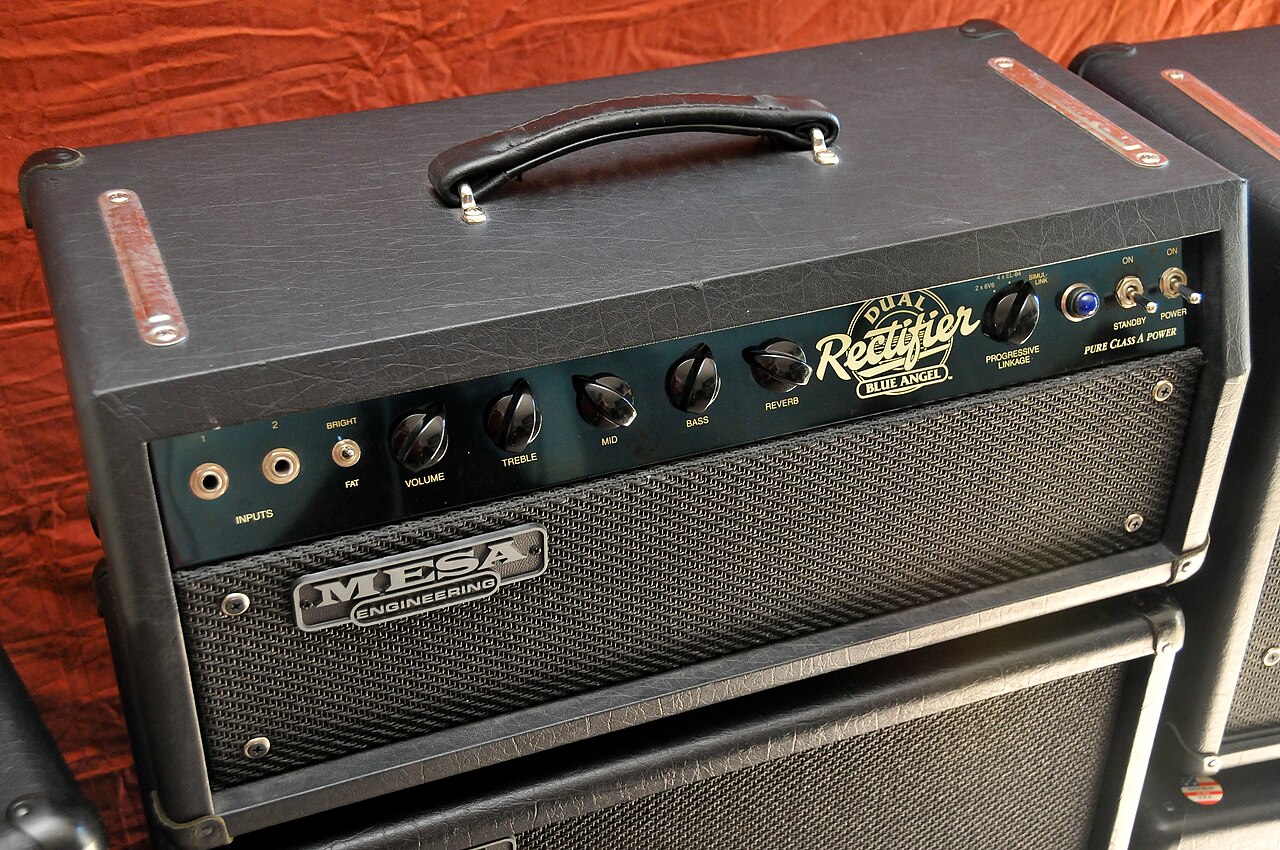
- A Mesa Boogie Blue Angel head: ArtBrom from Seattle, Wikimedia Commons, CC BY-SA 2.0.
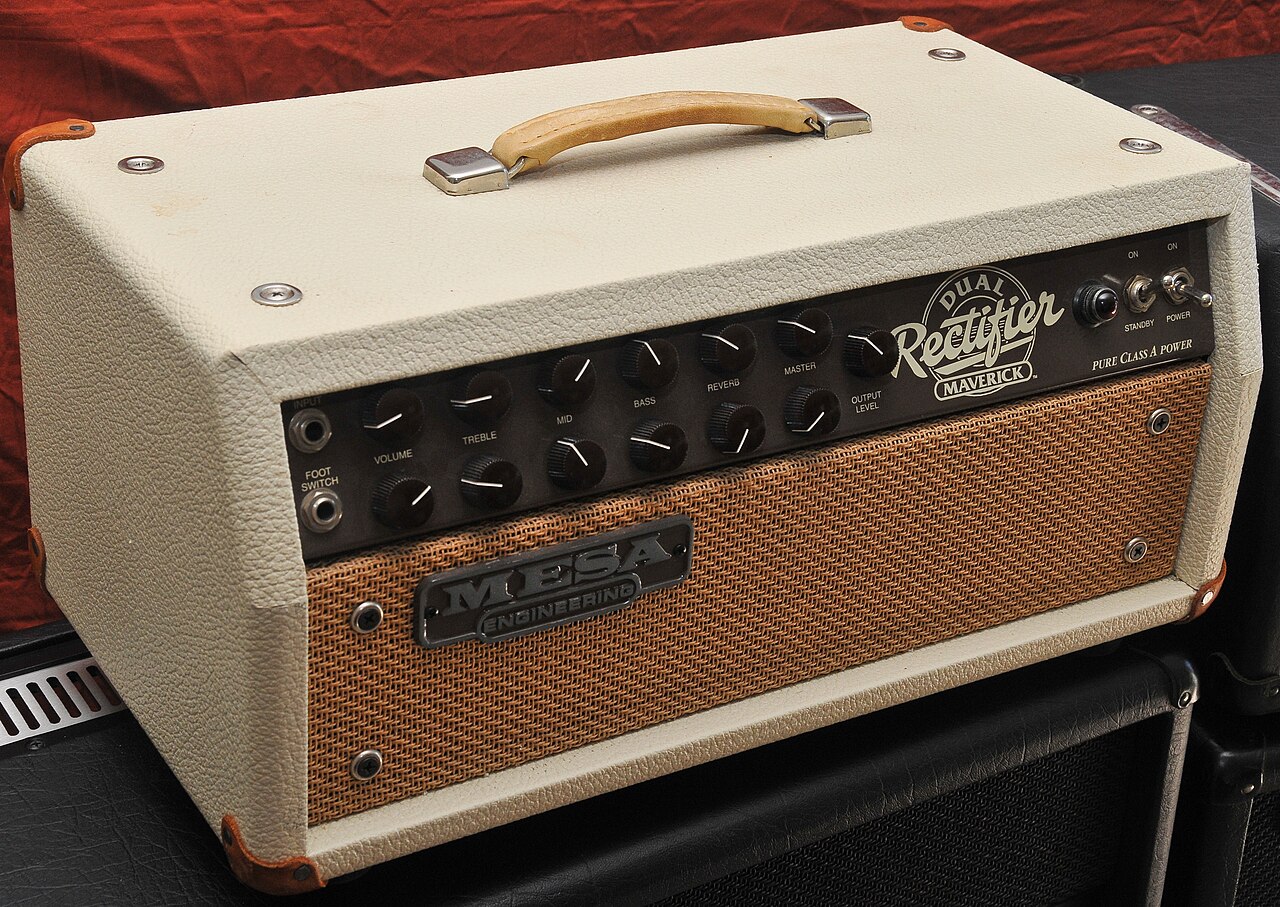
- A Mesa Boogie Maverick short head in an angled view: ArtBrom from Seattle, Wikimedia Commons, CC BY-SA 2.0.
- Angus Young: TheACDCDoctor, Wikimedia Commons, CC BY-SA 4.0.
Latest News
Related
On This Day
Monday 9 November
From this week: