Adam Jones Guitars & Gear: The Complete Guide to Tool’s Sonic Architect
The Gibson Silverburst Les Paul Custom was manufactured between 1978 and 1985. It was discontinued by Gibson because the unique metallic paint finish was flaking off — the paint was literally falling off the guitars, which guitarists found understandably problematic.
Adam Jones finds the paint’s effect on the tone to be exactly what he needs.
“The good thing about vintage amps is that all these little imperfections in the circuitry and the wood actually contribute to the tone.” He said this about vintage Marshalls, but the same philosophy extends to the Silverburst finish: the weight of the metallic paint alters the resonance characteristics of the mahogany body in specific ways that stock-finished Les Pauls don’t. The flaw is the feature. The failure mode is the desired outcome.
This is the complete Adam Jones gear philosophy in one observation: the imperfection that was someone else’s problem is exactly his specification.
He has a handful of Silverburst Les Paul Customs dating from 1978 through 1983. They are his primary instrument for essentially every Tool recording and live performance. He keeps them completely stock except for swapping in a Seymour Duncan JB in the bridge position. He plays them through a Diezel VH4 “blueface” — an early production run of the amplifier that he adopted before anyone knew what Diezel was — and a 1976 Marshall Super Bass that is bone-stock and that he goes to great lengths to keep that way.
He also directed most of Tool’s music videos. He is a visual artist whose work extends the same aesthetic that his guitar playing occupies: dense, layered, mathematically organized, and capable of sudden lyrical beauty in the spaces between the heavy parts.
Rolling Stone ranked him 75th on their Greatest Guitarists list. Guitar World placed him 9th among the greatest heavy metal guitarists. He was Tom Morello’s bass player in their high school band Electric Sheep in Libertyville, Illinois.
He played bass then. He plays guitar now. Both times he was building something specific.
Background: Libertyville, Hollywood, and the Band That Wouldn’t Play Short Songs
Adam Jones was born January 14, 1965, in Libertyville, Illinois — the same Chicago suburb as Tom Morello. He was a year ahead of Morello at Libertyville High School, and the two were musical collaborators before either of them had careers. In Electric Sheep — their high school band — Jones played bass while Morello played guitar. The specific sonic combination they were building already showed the appetite for heavy, complex music that would define both their subsequent careers in different directions.
Jones moved to Los Angeles after high school and worked in the film and special effects industry — he did creature design and special effects for movies including Terminator 2, Jurassic Park, and others. This visual arts background directly informed his approach to Tool’s multimedia aesthetic: the music videos, the album art (in collaboration with Alex Grey and other artists), the stage production. Tool is not just a band that makes music; it is a complete artistic environment, and Jones is one of its primary architects.
Tool formed in 1990 with Jones on guitar, Maynard James Keenan on vocals, Danny Carey on drums, and Paul D’Amour on bass (replaced by Justin Chancellor in 1995). Their progression through albums — Opiate (1992), Undertow (1993), Ænima (1996), Lateralus (2001), 10,000 Days (2006), and Fear Inoculum (2019) — is one of the most deliberate and consistent artistic developments in progressive metal. Each album builds on the previous while extending the range: longer songs, more complex rhythmic structures, more atmospheric texture alongside the heavy riffing.
Tool is known for spreading misinformation about themselves and their music — Guitar FX Depot noted this directly: “Compiling an accurate guide to the gear used by Adam Jones is tricky business, as Tool as a whole are known for spreading misinformation about themselves and their music, which extends to gear.” This mystification is both a marketing strategy and a genuine artistic choice: the band has always resisted easy categorization and easy access.
Tone note: He worked on Jurassic Park and Terminator 2 before Tool was famous. The visual intelligence that goes into Tool’s music videos — which Jones directs — is the same visual intelligence that goes into designing dinosaurs and terminators. He is a craftsman of specific visual and sonic worlds. The guitar is one instrument in the total artistic environment he helps construct. The videos, the album art, the live stage production, and the guitar sound are aspects of the same aesthetic project.
The Rig: Adam Jones’s Guitars, Amps & Gear
Guitars: The Silverburst Collection
Gibson Les Paul Custom Silverburst (1978-1983) — The Entire Career
Adam Jones’s primary guitars throughout Tool’s career are Gibson Les Paul Custom guitars in the rare Silverburst finish — a metallic silver-to-black burst that was produced from 1978 to 1985 before being discontinued. He has “a handful of these instruments dating from ’78 through ’83.”
The Silverburst’s specific characteristics:
- Body: Mahogany body with maple cap — standard Les Paul Custom construction
- Neck: Mahogany neck with ebony fingerboard — the ebony is specifically harder and denser than rosewood, contributing to the clarity of note articulation in complex riffs
- Original pickups: Gibson’s Tim Shaw patent-number humbuckers — highly regarded vintage pickup designed by Tim Shaw while at Gibson in the early 1980s
- Jones’s modification: Seymour Duncan JB (SH-4) in the bridge position — a high-output humbucker that provides the specific aggressive attack he needs for Tool’s riffing
- The Silverburst finish’s tonal contribution: The metallic paint’s weight alters the body’s resonance — Jones has specifically cited this as desirable. The paint flaking that led Gibson to discontinue the finish is what Jones found musically useful. The imperfection is the specification
He keeps everything else completely stock — only the bridge pickup swap. No other modifications to the electronics, the tuners, the bridge, or the nut.
He also has copies — “Adam Jones has several Silverburst copies that he has collected over the years” — confirming that the specific finish and model are important enough to his approach that he maintains multiple instruments in the same configuration. The ’79 Les Paul Custom became the basis for the official Gibson Adam Jones Signature model.
Reverb.com confirmed the specific pickup configuration and approach: “He is known to have a handful of these instruments dating from ’78 through ’83, which he keeps stock except for swapping in a Seymour Duncan JB in the bridge position. It’s a simple and instantly recognizable formula that has followed him throughout his career.”
Guitar FX Depot confirmed: “Popular opinion seems to be that Jones fits all his Gibson Silverburst Les Paul Customs with a Seymour Duncan SH-4 JB in the bridge and Seymour Duncan Jazz in the neck.”
Tone note: Gibson discontinued the Silverburst because the paint was flaking off. The metallic paint’s weight, as it altered the guitar’s resonance, was the documented reason the finish behaved differently from standard finishes. Adam Jones specifically wants the paint-weight-altered resonance. He collects guitars from a production run that was cancelled specifically because of the quality issue he has decided is a tonal asset. The defect is the feature. This is the purest possible expression of the “vintage imperfection as specification” approach.
Gibson Les Paul Custom (Black and Natural/Yellow) — Alternate Tuning Guitars
Jones uses additional Les Paul Custom guitars for songs requiring non-standard tunings:
- Black Gibson Les Paul Classic (Ebony finish) — Used for “Prison Sex” (tuned B-A-D-G-B-E, dropped B/DADGBE-style) and “Parabol/Parabola” (tuned B-E-D-G-B-E); confirmed in Guitar FX Depot and Guitar Lobby documentation
- Natural/yellow finish Gibson Les Paul Custom (quilted maple top) — Used specifically for “Parabol” and “Parabola” in the B-E-D-G-B-E tuning; Guitar Lobby: “this was likely a guitar Adam toured with specifically to keep in that special tuning while keeping his Silverburst tuned to drop D”
The pattern: the Silverburst guitars in Drop D for the majority of Tool songs; dedicated alternate-tuning guitars for songs requiring specific non-Drop-D configurations. Like the Seattle grunge guitarists, Jones maintains dedicated instruments per tuning rather than retuning on stage.
The Gibson Flying V (Prototype)
Guitar Lobby documented a mysterious new guitar that appeared at recent shows: fans noticed a Flying V-shaped instrument and speculated about a potential Gibson Adam Jones Signature Flying V. Jones shared photos on Instagram. A new signature development is possible — but specifics as of the current documentation are limited.
Other Documented Instruments
- Gibson SG — Used for “studio chores” per Guitar World; no specific model confirmed; no live photographs documented
- Epiphone Adam Jones 1979 Les Paul Custom (signature) — Production signature model; more accessible price point; ebony fretboard; Seymour Duncan Distortion bridge pickup
- Gibson Adam Jones Les Paul Standard Silverburst (signature) — The official Gibson signature model based on the ’79 Silverburst; built to Les Paul Standard (not Custom) specs but captures the visual identity
Complete Guitar List (Key Instruments)
- Gibson Les Paul Custom Silverburst (1978-1983, multiple) — Primary for all Tool recordings and tours; Seymour Duncan JB bridge; Jazz neck (probable); Drop D tuning for majority of material; discontinued finish valued for paint-weight tonal alteration
- Gibson Les Paul Classic (Ebony, black) — B-A-D-G-B-E / “Prison Sex” tuning; B-E-D-G-B-E / “Parabol/Parabola” tuning
- Gibson Les Paul Custom (Natural/yellow quilted maple) — B-E-D-G-B-E dedicated guitar
- Gibson SG — “Studio chores”
- Gibson Flying V (prototype) — Recent; details TBC
- Epiphone Adam Jones Signature — Production model; Seymour Duncan Distortion bridge
- Gibson Adam Jones Signature Standard Silverburst — Production replica
Amps: The Diezel Blueface and the Bone-Stock Marshall Super Bass
Diezel VH4 “Blueface” — The Primary High-Gain Amp

Adam Jones is one of the earliest and most prominent adopters of the Diezel VH4 — the four-channel, 100-watt tube head that Reinhold Bogner’s former colleague Peter Diezel designed in the early 1990s. Jones acquired his “blueface” version — the early production run of the amplifier, identifiable by the blue control panel rather than the later silver face — in the mid-1990s, before Diezel had significant name recognition in the guitar community.
Guitar Lobby confirmed: “As an extremely early adopter of the Diezel VH4, Jones was responsible for carving the amp’s third channel grind into the Mt. Rushmore of high-gain tones.”
He uses Channel 3 of the VH4 live and has not been documented switching channels during performances. Guitar FX Depot: “When playing live, Jones does not switch channels on the VH4, leaving them set on channel 3.”
The Diezel VH4’s specific specifications: 100 watts, four channels, seven 12AX7 preamp tubes, four JJ KT77 power amp tubes. Each channel has its own 3-band EQ, volume, and gain controls, plus its own effects loop. The KT77 power tubes (a variant of the EL34) provide a specific character between the EL34’s compressed brightness and the 6L6’s scooped authority — a midrange-forward character that suits Tool’s complex, articulate riffs.
He owns multiple VH4 heads, both “blueface” and “silverface” versions, though he prefers the blueface.
1976 Marshall Super Bass — The British Mid-Range
Alongside the Diezel, Jones uses a 1976 Marshall Super Bass 100-watt head as his second primary amplifier. The Marshall Super Bass was designed for bass guitar — its circuit is optimized for low-frequency response — but Jones uses it for guitar, combining both channels wired together for additional gain and character.
Reverb.com: “Another amp that is just as vital to the Tool sound is his 1976 Marshall Super Bass. By blending this amp with the VH4s, he’s able to add that unmistakable British roar that perfectly fills up the middle frequencies. This amp remains bone-stock to this day. And according to Dunlop TV’s rundown of Jones’ gear, he goes to great lengths to keep it that way.”
The specific modification: both channels wired together — “Jones has extensively used a hot-rodded Marshall Super Bass 100 watt bass head from the mid-’70s, modified with both channels wired together for an insanely hot output.” When both channels of a vintage Marshall are connected together (“jumped”), the two channels interact, creating additional harmonic complexity and a hotter effective gain. But Jones otherwise maintains the amp completely stock — “goes to great lengths to keep it that way.”
The two-amp combination: the Diezel VH4 handles the high-gain grind with articulate top-end and scooped-mid aggressive character; the Marshall Super Bass adds the British midrange roar that fills the frequency gap. Blended, they produce the specific Tool guitar tone — heavy but not formless, aggressive but not indistinct.
The Cabinet Configuration
For cabinets, Jones uses a combination of Mesa/Boogie 4×12 Rectifier cabinets (which he chose for their superior low-end response) and a Mesa/Boogie 2×15 bass cabinet. The bass cabinet is specifically chosen to supplement the low-end response that the guitar amps don’t fully produce. Guitar amp: “Jones actually uses both a 4×12 Rectifier cabinet and a 2×15 Bass Cabinet. The bass cabinet is used to give his guitar sound more low end and power since he is the only guitarist in Tool.”
As the sole guitarist in a band with a virtuoso drummer and a harmonically sophisticated bassist, Jones must produce a guitar sound that occupies the full frequency range without sounding thin or mid-only. The 2×15 bass cabinet adds the specific low-frequency authority that the 4×12 Rectifier cabs alone don’t provide.
Studio Amplifiers
Recording engineer Joe Barresi described the 10,000 Days recording approach in Mixonline: “Adam mainly runs three amps: He has a Marshall that he loves, a Diezel, and then he was using a Mesa Boogie at one point. I brought in a Bogner Uberschall head and a Rivera Knucklehead Reverb, and several other things. Then we just experimented with combinations of heads and cabinets until it worked for the song.”
Other studio amps:
- Sunn Beta Lead — Used during Lateralus recording; vintage solid-state amp known for its specific character
- Roland JC-120 — Used for effects-driven tracks on 10,000 Days; the same transparent platform that Ernest Ranglin and Danny Gatton preferred for different reasons
- Roland Cube 15 (small practice amp) — Used specifically for the Heil Talk Box: “According to Jones, the Cube 15 is perfect for his talkbox effect” — the small solid-state amp’s tight, clean output is ideal for powering the Talk Box without the complications of a larger tube amp
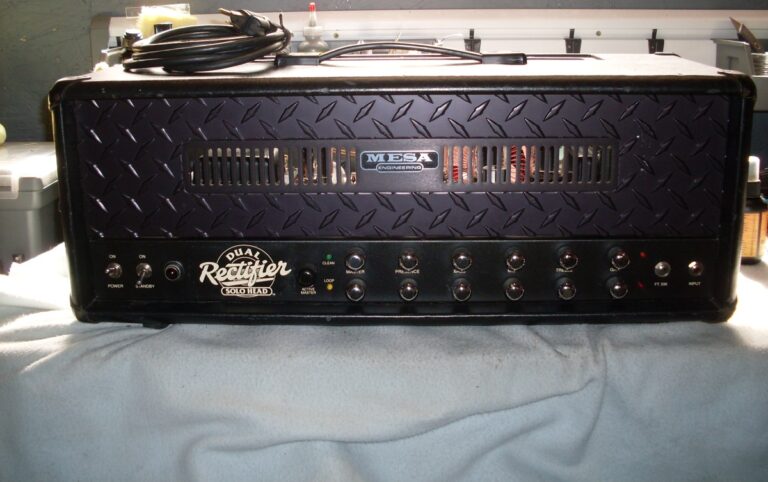
- Mesa/Boogie Dual Rectifier — Used in early live and recording contexts (1990s)
- Bogner Uberschall — Studio use on 10,000 Days
- Rivera Knucklehead Reverb — Studio use on 10,000 Days

Pedals: The Talk Box, the DOD, and the Boss Foundation
The DOD FX40B EQ — Always On
Reverb.com documented: “These tonal weapons include an MXR Micro Amp boost and an old DOD FX40B seven-band bass equalizer pedal, both of which are often left on during driven parts to achieve fullness and cut.”
The DOD FX40B is a seven-band graphic equalizer — originally designed as a bass equalizer but used by Jones for frequency shaping of his guitar signal. Left on during driven parts, it shapes the frequency content of the signal before it reaches the amplifiers, allowing more precise control of the specific frequency balance than the amp EQ controls alone.
The MXR M-133 Micro Amp is a clean boost pedal — it increases the signal level going into the amp chain, driving the amp’s preamp harder for additional saturation and sustain. This boost-before-amp approach (the same technique used by many guitarists in this series) allows the gain level of the amplifier to remain at its optimal operating point while the signal level adjusts the saturation character.
The Heil Talk Box — The “Jambi” Sound
One of the most distinctive effects in Tool’s catalog: the Heil Talk Box on “Jambi” (10,000 Days) produces the vocalized, singing quality of the guitar solo — the sound of a guitar being “voiced” through the guitarist’s mouth.
The Talk Box works differently from most effects: it routes the guitar signal through a small amplifier (the Roland Cube 15 in Jones’s case), through a driver horn, and through a plastic tube that the player places in their mouth. The player shapes the sound with their mouth movements (vowel and consonant articulations) while the guitar signal passes through the mouth cavity. A microphone captures the combined sound: guitar signal acoustically modified by the oral resonance of the player’s mouth.
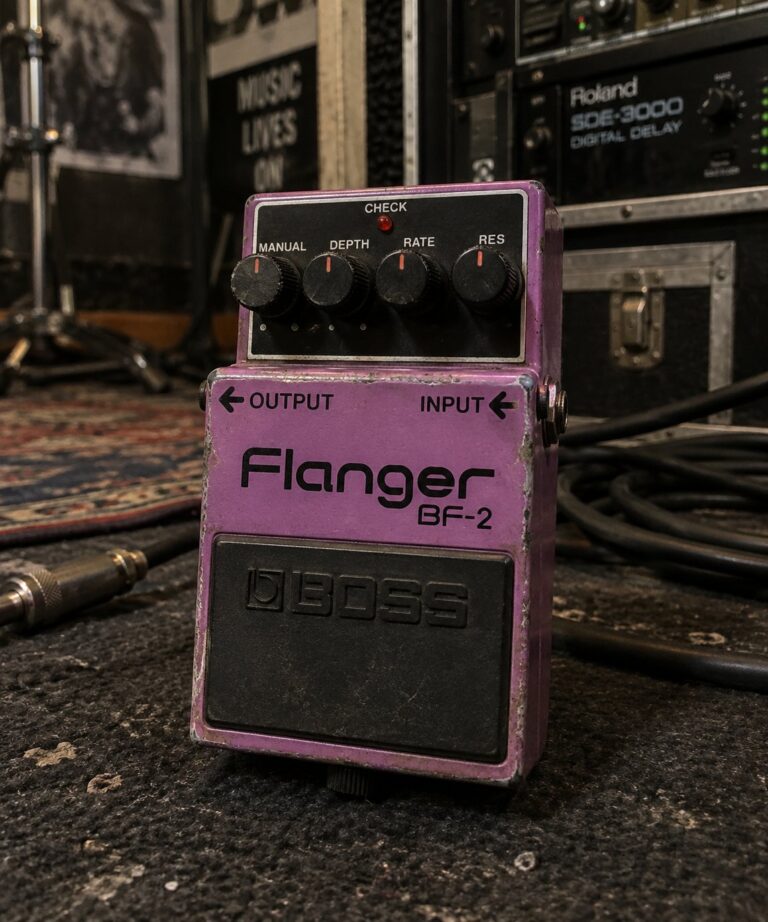
Reverb.com confirmed: “Next up are a Boss DD-3 digital delay, a Dunlop 535Q wah, a Heil Talk Box, and a Boss BF-2 flanger heard on everything from the swirling ‘Stinkfist’ to the cutting ‘Jambi’ solo.”
Complete Pedalboard (Documented)
- MXR M-133 Micro Amp — Always on during driven parts; clean boost driving the amps into saturation
- DOD FX40B Seven-Band Graphic EQ (bass equalizer) — Always on during driven parts; frequency shaping of the guitar signal; the “bass EQ” used for guitar
- Boss BF-2 Flanger — The “Stinkfist” and “Jambi” flanger; “heard on everything from the swirling ‘Stinkfist’ to the cutting ‘Jambi’ solo.” The BF-2 is a classic analog flanger with a specific warm, liquid character
- Boss DD-3 Digital Delay — Primary delay; used throughout Tool’s catalog for the atmospheric trailing effects in slower passages and the rhythmic delays in complex riff sections
- Dunlop 535Q Crybaby Wah — Expressive wah pedal; used for specific passages including unison bends with wah (as in “Parabola”)
- Heil Talk Box — “Jambi” solo; voiced guitar sound through mouth cavity; powered by Roland Cube 15
- Ernie Ball Volume Pedal / Goodrich 120 — Volume control for dynamic swells and song transitions; he transitioned from Ernie Ball VP series to the Goodrich 120
- Peterson StrobStomp Tuner — Primary tuner; the StrobStomp’s strobe accuracy is appropriate for the alternate tunings that require precision
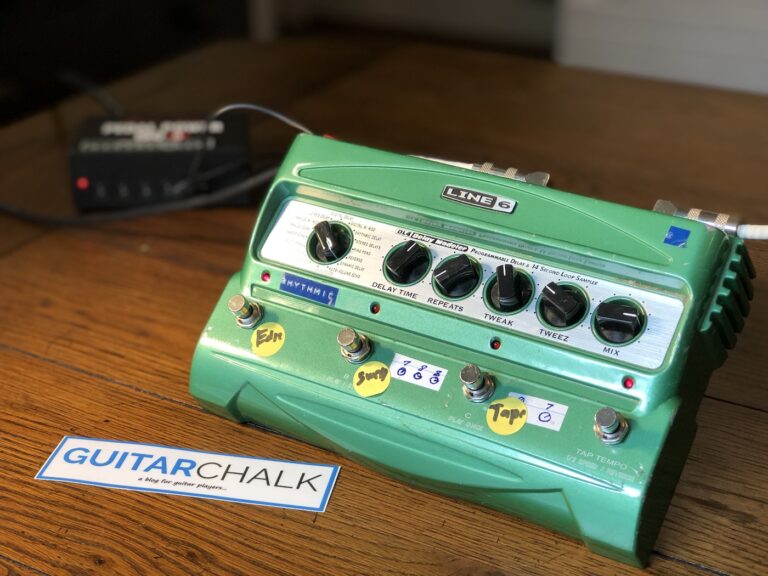
- Line 6 DL-4 Delay Modeler — Additional delay and looping capabilities
- Access Virus A Synthesizer + Roland PK-5 MIDI Pedals — Synthesizer module triggered by MIDI foot pedals; for specific atmospheric and electronic-textured passages
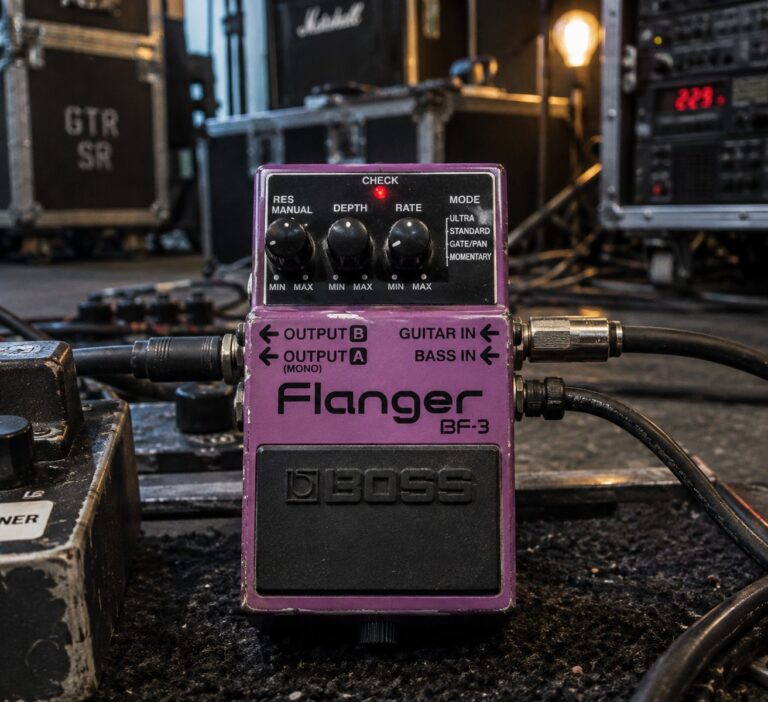
- Boss BF-3 Flanger — Used in 2019-2020 period, replacing/supplementing the BF-2
- Gamechanger Audio Plasma Pedal — Recent addition; high-voltage xenon tube distortion with specific “plasma discharge” character
Tone note: The DOD FX40B is a bass equalizer used as a guitar equalizer. The Roland Cube 15 is a small practice amp used to power the Talk Box. The 2×15 bass cabinet is a bass cabinet used for additional guitar low-end. Adam Jones regularly uses bass-oriented gear for guitar applications — the opposite of guitarists who use guitar-oriented gear for bass-adjacent sounds. The pattern is consistent: the instrument designed for one frequency range, applied to a different frequency range, produces the specific character that no instrument designed for the correct range can achieve.
Strings, Picks & Setup
Strings: Ernie Ball Regular Slinkys .010-.046 — confirmed in various sources as his primary string gauge. The .010 gauge provides appropriate tension for the Drop D tuning while allowing the string bending that appears throughout Tool’s catalog.
Picks: Not documented with the specificity of some other artists in this series. His technique — involving palm muting, unison bends, slide guitar, and occasional pick scraping — suggests a medium-to-firm pick that provides consistent attack for the rhythmically precise riffing Tool requires.
Drop D tuning: The Silverburst Les Paul Customs are maintained in Drop D (D-A-D-G-B-E) as the standard configuration. This allows the single-finger power chord on the low two strings while maintaining the standard interval relationships on the higher strings. The Drop D configuration is the foundation of most Tool riffs.
Alternate tunings by guitar:
- Silverburst LPs — Drop D (D-A-D-G-B-E) — most Tool material
- Black/Ebony LP Classic — B-A-D-G-B-E for “Prison Sex”; B-E-D-G-B-E for “Parabol/Parabola”
- Natural/yellow LP Custom — B-E-D-G-B-E dedicated
Gain staging philosophy: VVN News documented: “Rather than using maximum distortion at all times, he carefully balances his guitar volume, amplifier settings, and boost pedals to create tones that are heavy yet articulate. This attention to gain structure allows Tool’s complex arrangements to remain clear even with multiple layers of guitar processing.” He rolls back the guitar volume for cleaner tones rather than switching to a dedicated clean channel — maintaining the same signal path through the amplifiers while reducing the input level to change the saturation character.
Playing Style & Tone Philosophy: Polyrhythm, Texture, and the Space Between Riffs
Adam Jones’s guitar playing philosophy is the most compositionally sophisticated in the progressive metal tradition. Tool’s music requires a guitarist who can execute mathematically complex rhythmic patterns with precision, create atmospheric texture in the spaces between heavy riffs, navigate unusual time signatures naturally, and integrate effects as compositional elements rather than decorative additions.
The Polyrhythmic Foundation
Tool’s music is built on polyrhythmic complexity — multiple simultaneous rhythmic patterns in different meters creating a constantly shifting rhythmic landscape. “Schism” is in 5/8 and 7/8. “Lateralus” is in 9/8 and 8/8 and 7/8, with the syllables of its lyrics following the Fibonacci sequence. “Ænema” shifts between 7/4 and 4/4. Jones navigates these structures not as academic exercises but as musical intuition developed over thirty years of playing in this specific context.
His primary technique for polyrhythmic guitar: syncopated riffing where the guitar’s rhythmic emphasis falls in different positions relative to the drum’s downbeat. The guitar may be “in time” while its accents fall in places that sound like they’re ahead of or behind the beat — creating the specific disorienting-but-grooving quality of Tool’s rhythm section.
The Unison Bend
A signature Jones technique: the unison bend, where two strings are bent together — one string bends up to match the pitch of another string, then both continue bending in unison. The result is a brief dissonance followed by a coincident pitch rise, producing the “rubbing” effect that appears in “Parabola” and other songs. Often combined with the wah pedal for additional timbral variation during the bend.
The Slide Guitar
Jones uses a slide for specific passages — “Right in Two” features slide guitar work that adds expressiveness to passages that the guitar’s fretted notes wouldn’t produce as smoothly. The slide allows continuous pitch movement rather than the stepped movement of fretted playing — appropriate for certain melodic passages in Tool’s more atmospheric sections.
The Pick Scrape + Delay
The “Parabola” intro uses pick scraping across the strings with delay engaged — producing the haunting, ghostly texture that introduces the song. The pick scrape’s harsh, metallic sound is transformed by the delay into something ethereal. This is the Jones approach to effects: the effect doesn’t clean up the sound; it transforms a harsh input into something useful.
Palm Muting Architecture
Jones’s palm muting — pressing the picking hand against the strings near the bridge to dampen sustain — creates the specific percussive “clickety-click” texture that anchors Tool’s riffs. The alternation between fully muted (percussive), partially muted (tonal but compressed), and open (fully ringing) string responses within single riff patterns is a primary Tool rhythmic tool. The muting profile of a single riff passage creates rhythmic information separate from the pitch information of the notes themselves.
The Visual Artist’s Ear
Jones worked in special effects before Tool was famous. The attention to specific sonic texture — the way the talk box humanizes the guitar on “Jambi,” the way the flanger creates the swirling quality of “Stinkfist,” the way delay transforms pick scraping into an intro — reflects the visual artist’s ear for specific, controlled effects rather than the casual applications of a traditional rock guitarist. Each effect is deployed for a specific result, in a specific song, for a specific duration. Nothing is on by default.
How to Sound Like Adam Jones: The Tool Guitar Tone
The core Tool tone requires: Silverburst (or equivalent) Les Paul, Drop D tuning, high-gain amplification (Diezel or Marshall character), the DOD EQ boost, and the specific restraint of not using maximum gain but instead balancing the gain structure for articulation.
The Guitar
- Gibson Adam Jones Signature Les Paul Standard Silverburst — The official production model
- Epiphone Adam Jones 1979 Les Paul Custom Silverburst — Budget access; Seymour Duncan Distortion bridge
- Any Gibson Les Paul Custom with Seymour Duncan JB (SH-4) bridge — The functional equivalent
- Drop D tuning standard — Lower the low E string one whole step to D
The Amp
Diezel VH4 (Channel 3) for the primary tone; Marshall plexi for the mid-range supplement. Or: one good high-gain amp at moderate gain settings for articulation.
| Control | Diezel VH4 Channel 3 | Marshall Super Bass |
|---|---|---|
| Gain | 6–7 (not maximum) | High (jumped channels) |
| Bass | 5–6 | 6 (Marshall Super Bass has more low-end) |
| Middle | 5 (somewhat scooped) | 7 (fills the mid-range gap) |
| Treble | 5–6 | 5–6 |
| Volume | Stage-appropriate high volume | Blended with Diezel |
The Essential Pedals
- MXR Micro Amp (boost, always on) — Essential gain staging; drives the amp into saturation
- DOD FX40B EQ (always on) — Frequency shaping; boosts specific frequencies for fullness and cut in the mix
- Boss BF-2 Flanger — For “Stinkfist,” “Jambi,” and the atmospheric swirling quality; set for moderate rate and depth to avoid over-obvious flanging
- Boss DD-3 Delay — Atmospheric trails and rhythmic delay passages
- Dunlop 535Q Wah — For expressive passages and the unison bend wah combination
Budget vs Authentic
Budget:
- Guitar: Epiphone Adam Jones Les Paul Custom Silverburst or any Les Paul with Seymour Duncan JB bridge; Drop D tuning
- Amp: Mesa/Boogie Dual Rectifier or Marshall DSL100 (as the two-amp system in one head)
- Pedals: MXR Micro Amp + DOD FX40B + Boss BF-2 + Boss DD-3
Authentic:
- Guitar: Vintage Gibson Silverburst Les Paul Custom (1978-1983) with Seymour Duncan JB bridge
- Amps: Diezel VH4 (blueface preferred) + 1976 Marshall Super Bass (channels jumped); Mesa/Boogie 4×12 + Mesa 2×15 bass cabinet
- Pedals: Full documented board including Heil Talk Box + Roland Cube 15 for Talk Box power
The Polyrhythmic Practice
The hardest element to acquire: Tool’s rhythmic complexity requires sustained practice with odd time signatures. Start with “Schism” — the alternating 5/8 and 7/8 patterns are the gateway to Tool’s rhythmic approach. Count the time signatures while playing until the counting becomes internal. Then remove the counting and trust the feeling. Tool’s rhythmic precision comes from musicians who have internalized the asymmetric patterns to the point where they feel as natural as 4/4.
Influence & Legacy: The Architect of Progressive Metal’s New Language
Adam Jones’s influence on heavy guitar extends through every band that has attempted to combine progressive rock’s rhythmic complexity with heavy metal’s sonic weight since Tool’s formation. His specific contributions:
- Polyrhythmic heavy guitar — The systematic application of compound and asymmetric time signatures to heavy riffing; previously, prog and metal were largely separate traditions; Tool unified them
- The Diezel VH4’s reputation — As an early adopter, Jones is largely responsible for the Diezel VH4’s prestige in the heavy guitar world; his use of Channel 3 as the definitive high-gain sound established the amp’s reputation
- The Silverburst Les Paul’s rehabilitation — The discontinued finish that Gibson killed for quality reasons became, through Jones’s use, one of the most desired vintage guitar configurations in heavy metal
- The “effects as composition” approach — The use of talk box, flanger, and delay as compositional elements specific to specific songs rather than as general stylistic coloring
- Bands influenced: Deftones, Mastodon, Between the Buried and Me, Periphery, Animals as Leaders — the progressive metal tradition that developed after Tool absorbed Jones’s approach to rhythmic complexity
Rolling Stone ranked him 75th. Guitar World placed him 9th in heavy metal guitarists. He was in Electric Sheep with Tom Morello. He played bass then. He directs Tool’s music videos. He goes to great lengths to keep his 1976 Marshall Super Bass bone-stock.
The paint is flaking off the Silverburst finish. The flaking is the feature.
Tone note: He goes to great lengths to keep the 1976 Marshall Super Bass bone-stock. In the same interview context, he loves vintage amps for their “little imperfections in the circuitry and the wood.” He’s right about both. The vintage amp’s imperfections are what he values. The bone-stock maintenance is what preserves the specific imperfections he has chosen. To modify the amp would be to change the specific imperfections he has committed to. The maintenance of imperfection is its own form of perfectionism.
Adam Jones was Tom Morello’s bass player in a high school band in Libertyville, Illinois. He moved to Los Angeles and worked in special effects, contributing to Terminator 2 and Jurassic Park. Then Tool.
His primary guitars are Gibson Silverburst Les Paul Customs — a finish that Gibson discontinued in 1985 because the metallic paint was flaking off. The paint’s weight alters the resonance. Jones finds this desirable. He collects the defective instruments.
His primary amplifiers are a Diezel VH4 blueface — one of the first VH4s ever made, acquired before anyone knew what Diezel was — and a 1976 Marshall Super Bass that he keeps bone-stock and goes to great lengths to maintain in its original state. The amps load into a Mesa/Boogie 4×12 Rectifier cabinet and a Mesa/Boogie 2×15 bass cabinet. He is the only guitarist in Tool. The bass cabinet adds the low-end authority that a single guitarist needs in a band with a virtuoso drummer and bassist.
He plays in Drop D. He uses a DOD bass equalizer for guitar. He uses a Roland Cube 15 practice amp to power a Heil Talk Box. He uses a Seymour Duncan JB bridge pickup because of its attack. He does not use maximum gain; he stages the gain carefully for articulation in complex riffs.
The paint is flaking. The imperfection is the point.
If Adam Jones’s Silverburst Les Paul in Drop D through Diezel and Marshall — the polyrhythmic riffs, the talk box on Jambi, the painting of Tool’s complete visual world — has you exploring the progressive metal tradition he helped build, check out our complete guide to Tom Morello’s guitars and gear — Jones’s high school bandmate in Electric Sheep who went in a different direction toward Rage Against the Machine’s political hip-hop-metal and eventually the Arm the Homeless Frankenstrat.
And for the guitarist whose systematic approach to sonic environment construction is the closest parallel to Jones’s architectural visual sensibility — operating from a completely different tradition — don’t miss our breakdown of Kim Thayil’s complete gear guide.
FAQ: Adam Jones Guitars & Gear
- What is a Silverburst Les Paul and why does Adam Jones use them?
- The Gibson Les Paul Custom Silverburst was a metallic silver-to-black burst finish produced from 1978 to 1985 before being discontinued. Gibson discontinued the finish because the metallic paint was flaking off the guitars — a quality control problem. Adam Jones specifically values the way the metallic paint’s weight alters the guitar’s resonance: “The good thing about vintage amps is that all these little imperfections in the circuitry and the wood actually contribute to the tone” — and the same philosophy applies to the paint. He has “a handful of these instruments dating from ’78 through ’83” and keeps them stock except for installing a Seymour Duncan JB in the bridge position. The discontinued defective finish became his signature instrument specification.
- What amplifiers does Adam Jones use?
- Two primary amplifiers: a Diezel VH4 “blueface” (early production model, acquired in the mid-1990s before Diezel had significant name recognition; used on Channel 3 live, never switching channels) and a 1976 Marshall Super Bass 100-watt head (both channels wired together for additional gain; otherwise bone-stock). He combines these into Mesa/Boogie 4×12 Rectifier cabinets plus a Mesa/Boogie 2×15 bass cabinet — the bass cabinet added specifically for low-end authority as the sole guitarist in Tool. Studio amps have included a Sunn Beta Lead (Lateralus), Roland JC-120 (10,000 Days effects tracks), Roland Cube 15 (for powering the Heil Talk Box), Bogner Uberschall, and Rivera Knucklehead.
- What pedals does Adam Jones use?
- Core always-on pedals: MXR M-133 Micro Amp (clean boost driving the amps harder) and DOD FX40B seven-band graphic EQ (originally a bass equalizer, used for guitar frequency shaping). Additional core pedals: Boss BF-2 Flanger (the “Stinkfist” and “Jambi” flanger), Boss DD-3 Digital Delay (atmospheric and rhythmic delay), Dunlop 535Q Wah, Heil Talk Box (powered by Roland Cube 15 for “Jambi”), Ernie Ball Volume Pedal (later Goodrich 120), Peterson StrobStomp tuner, Line 6 DL-4 Delay. He also uses an Access Virus A synthesizer with Roland PK-5 MIDI pedals for electronic textures.
- What tuning does Adam Jones use?
- Drop D (D-A-D-G-B-E) as the standard configuration for his Silverburst Les Paul Customs — used for the majority of Tool material. Additional tunings for specific songs: B-A-D-G-B-E for “Prison Sex” and B-E-D-G-B-E for “Parabol/Parabola” — these songs each have a dedicated Les Paul (ebony finish or natural/yellow quilted maple) maintained in that specific tuning. He uses one guitar per tuning rather than retuning on stage.
- What is the Heil Talk Box and where does Adam Jones use it?
- The Heil Talk Box is a device that routes the guitar signal through a small amplifier, through a driver horn, and up a plastic tube into the player’s mouth. The player shapes the sound with their mouth movements while a microphone captures the result — the guitar sound acoustically modified by the oral resonance of the player’s mouth cavity. Jones uses it on “Jambi” from 10,000 Days, where it creates the vocalized, singing quality of the guitar solo. He powers it with a Roland Cube 15 practice amp rather than a larger tube amplifier — “According to Jones, the Cube 15 is perfect for his talkbox effect.”
- What is Adam Jones’s connection to Tom Morello?
- Both grew up in Libertyville, Illinois, and both attended Libertyville High School. In their high school band Electric Sheep, Jones played bass while Morello played guitar. Adam Jones was one year ahead of Morello. After high school, Jones moved to Los Angeles and worked in the film special effects industry (Terminator 2, Jurassic Park) before Tool; Morello also moved to Los Angeles and eventually formed Rage Against the Machine. Their careers diverged from the same starting point — heavy, complex music — in entirely different directions.
- How do I get Adam Jones’s guitar tone?
- Gibson Les Paul Custom with Seymour Duncan JB bridge pickup; Drop D tuning (D-A-D-G-B-E). MXR Micro Amp (always on as boost) and DOD FX40B EQ (always on for frequency shaping) into a high-gain amp — Diezel VH4 Channel 3 for authenticity, or Mesa Dual Rectifier/Marshall DSL for the budget approach. Blended with a vintage Marshall plexi character if possible. Mesa/Boogie 4×12 Rectifier cabinet. Amp settings: moderate gain (not maximum) with careful balance for articulation in complex riffs; roll back guitar volume for cleaner tones rather than switching channels. Boss BF-2 Flanger for atmospheric swirling passages; Boss DD-3 for trailing delays; Dunlop 535Q Wah for unison bend wah combinations. Practice Drop D riffs and odd time signatures methodically — Tool’s polyrhythmic complexity requires internal rhythmic understanding, not just memorized patterns.
Image credits
- Diezel VH4: GuitarGangsters AI-generated reference illustration, not a photograph.
- Roland JC-120: Solomon203, Wikimedia Commons, CC BY-SA 4.0.
- Mesa/Boogie Dual Rectifier: Roadside Guitars, Flickr, CC BY-SA 2.0.
- BOSS BF-2 Flanger: GuitarGangsters AI-generated reference illustration, not a photograph.
- Line 6 DL4: Guitar Chalk, Flickr, CC BY 2.0.
- BOSS BF-3 Flanger: GuitarGangsters AI-generated reference illustration, not a photograph.