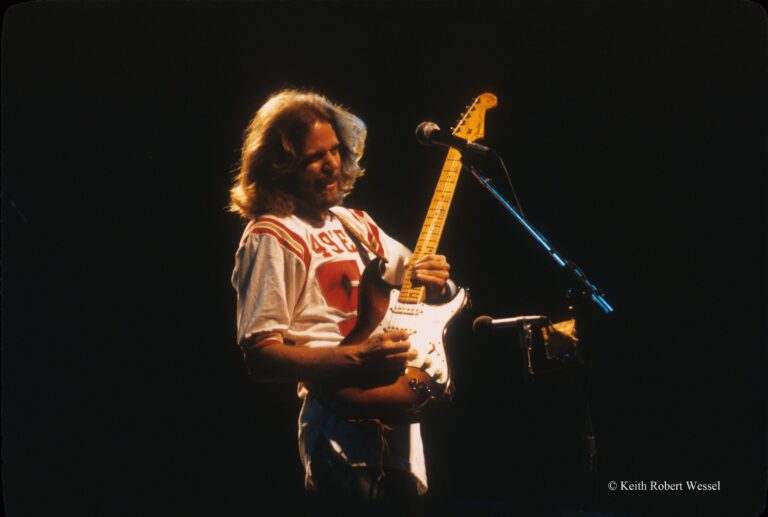
Ace Frehley Guitars & Gear: The Complete Guide to the Spaceman’s Smoking, Rocket-Shooting Rig
In September 1975, a newspaper review of a KISS concert in Norfolk, Virginia, noted something unusual: “During a solo, Frehley’s guitar begins to smoke and at the end fires a ball of flame.”
The concert reviewer was not describing a metaphor.
Ace Frehley had installed a smoke bomb in the neck pickup cavity of his Les Paul — protected from the asbestos liner he’d added to keep the heat from the wood, lit backstage by a tech, and timed to billow clouds of smoke during his guitar solo while audiences lost their minds. This is how KISS did things. Nothing was metaphorical. Everything was quite literally on fire.
But underneath the theatrics — beneath the smoke bombs, the rocket-shooting headstocks, the thousand-bulb LED Les Pauls, and the platform boots and Spaceman makeup — was a guitarist with a genuinely excellent blues-based hard rock vocabulary, a melodic instinct that earned the respect of players from John 5 to Dimebag Darrell to Paul Gilbert, and a tone philosophy of radical simplicity: a Les Paul Custom, a dimed Marshall, and a DiMarzio Super Distortion in the bridge.
Paul Frehley — “Ace” to everyone — died on October 16, 2025, at age 74 in New Jersey. He was the original Spaceman, a founding member of KISS, and one of the most visually iconic guitarists in the history of rock and roll. This is the complete gear story.
Background: The Bronx Kid Who Auditioned With a Firebird and Started a Mythology
Paul Daniel Frehley was born April 27, 1951, in the Morris Park neighbourhood of the Bronx, New York City. He started playing guitar at thirteen, self-taught by ear from records — the Beatles, Eric Clapton, Jeff Beck, Jimmy Page, Jimi Hendrix. The British Invasion and the British blues-rock tradition that followed it provided the entire vocabulary he would deploy for the next fifty years.
In early 1973, three musicians — Paul Stanley, Gene Simmons, and Peter Criss — were assembling what would become KISS. They’d been through multiple guitarists without finding the right fit. Ace Frehley answered their Village Voice advertisement and walked into the audition. According to his own autobiography No Regrets, he arrived carrying a late-1960s or early-1970s Gibson Firebird in what he described as nasty condition — no documentation has ever confirmed this with photographs, but the story has persisted. He played with one red light bulb and one green one, which amused the band enough to make them pay attention.
He got the gig. KISS was formed. They recorded their debut album in October and November of 1973.
The first album was largely recorded with an Ovation Breadwinner — an unusual choice that reflected the gear Frehley had access to before signing with the band and receiving the advance money. Once that advance arrived, he went directly to Manny’s Music on 48th Street in Manhattan and bought a Gibson Les Paul Deluxe and a 100-watt Marshall amp. This combination would define his sound for the next fifty years.
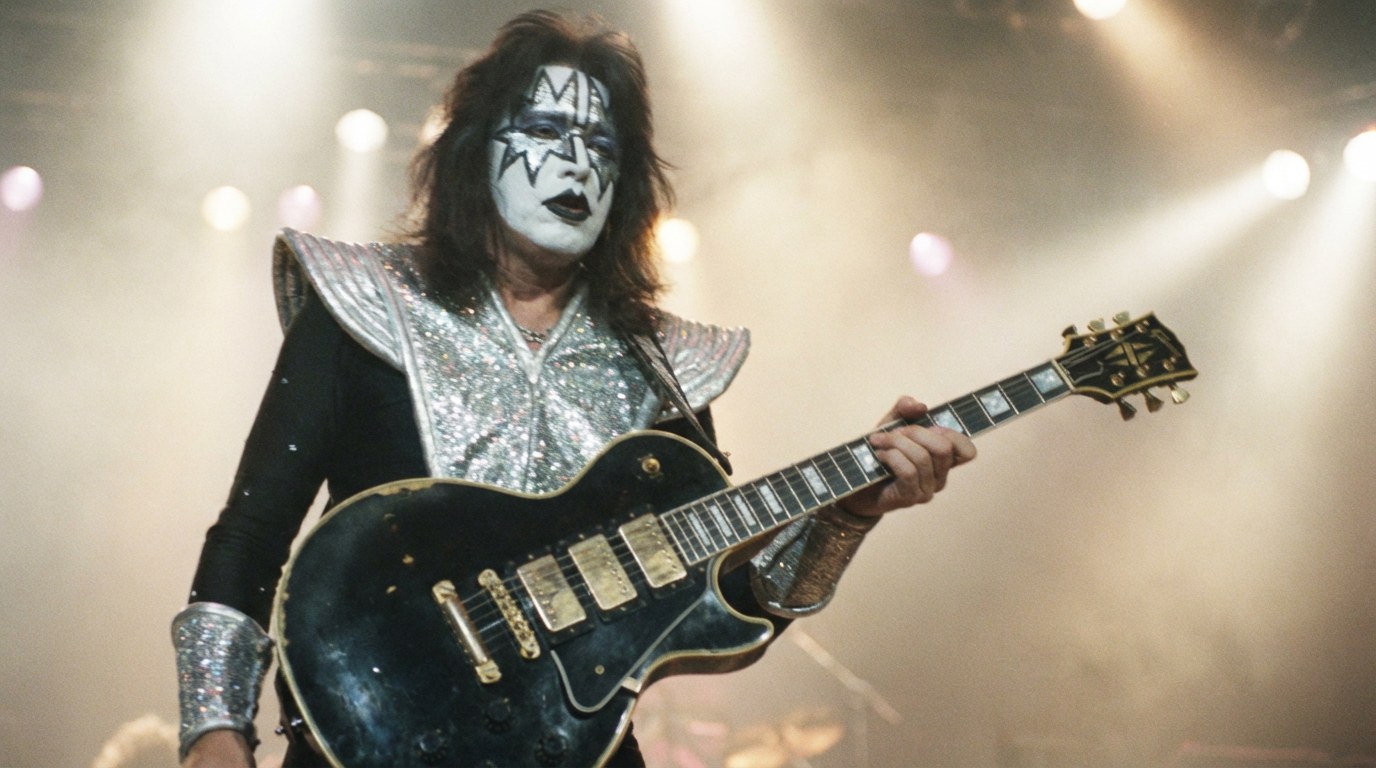
KISS’s commercial trajectory through the mid-1970s was extraordinary: a dedicated fanbase that grew to enormous size through touring, a marketing strategy that created a mythology larger than almost any band in rock history, and albums that delivered exactly what that fanbase wanted — anthemic riffs, heroic solos, and the theatrical spectacle of four men in elaborate makeup and costumes performing with the production values of a Broadway show.
Frehley’s role in that mythology was specific and essential: the Spaceman, the cool one, the guitarist who seemed to be somewhere else even when he was onstage, playing melodic solos with his eyes half-closed while things literally caught fire around him. The persona was not entirely separate from the person — Frehley’s genuinely laid-back demeanour, his love of science fiction and space imagery, and his sometimes chaotic personal life all fed into the Spaceman character in ways that made it feel authentic rather than constructed.
He left KISS in 1982 due to personal issues including substance abuse. He formed Frehley’s Comet, which had modest commercial success. He rejoined KISS for the Reunion Tour in 1996 — one of the most commercially successful reunion tours in rock history. He left again in 2002. He continued as a solo artist, releasing Anomaly (2009) and Space Invader (2014) to positive critical response from fans of his specific melodic hard rock approach.
His last years were marked by health challenges. He died in October 2025. His former bandmates paid tribute at an unplugged event shortly after. KISS’s farewell touring without him had already drawn the line on the original chapter; his death closed the book.
Tone note: He walked into the audition with one red light and one green one. The visual thinking that would produce smoking guitars and rocket-shooting headstocks was there from the first moment. The gear followed the vision.
The Rig: Ace Frehley’s Guitars, Amps & Gear — Complete Era-by-Era Breakdown
Frehley’s gear story divides cleanly into eras defined by his relationship with specific instruments: the Ovation Breadwinner debut, the tobacco burst Les Paul Deluxe that made KISS famous, the Les Paul Custom period that defined the classic visual image, the theatrical modifications that made the instruments into stage props as much as instruments, and the signature model era that continued until his death.
Guitars: Les Pauls on Fire, Literally
Ovation Breadwinner — The Debut Album Guitar
The recording of KISS’s first self-titled album (October–November 1973) was largely done with an Ovation Breadwinner — a distinctive American-made solid body guitar with an unusual body shape, fiberglass back, and active electronics that was popular in the early 1970s among players who wanted something unconventional. Frehley’s use of it on the debut was circumstantial rather than strategic — it was the guitar he had access to before the signing advance arrived.
By the time KISS began performing shows in support of the first album, the Breadwinner had been replaced by the Gibson Les Paul that would define the next chapter.
1973 Gibson Les Paul Deluxe “Tobacco Sunburst” — The Guitar That Made KISS Famous
Ace’s first significant guitar purchase — made with KISS signing advance money from Manny’s Music on 48th Street in Manhattan — was a 1973 Gibson Les Paul Deluxe in Tobacco Sunburst finish. This guitar was his primary instrument from late 1973 through September 1976, appearing at virtually every KISS show and on the recordings that established the band’s commercial presence.
The Les Paul Deluxe of this era featured mini-humbuckers (smaller, brighter-sounding pickups than the full-size humbuckers of the Les Paul Standard) and a pancake body construction — a layered maple and mahogany body that Gibson used during this period for manufacturing efficiency. Frehley quickly modified it:
- DiMarzio pickups — replaced the stock mini-humbuckers with full-size DiMarzio humbuckers (PAF DP103 in the neck, Super Distortion DP100 in the bridge, both with cream bobbins)
- Star decal — added a star-shaped decal to the headstock between the “Gibson” and “Les Paul” logos
- Pickguard removed — the stock pickguard was taken off
- Heel modified — Frehley used a screwdriver to contour the neck heel for more comfortable upper-fret access
- Strap button relocated — moved from the standard factory position above the neck to the rear of the guitar just above the neck joint
- Grover tuners — square pearl-button Grover Rotomatics replaced the stock Kluson-style tuners
- Top-wrapped strings — strings loaded over rather than under the stop bar, changing the break angle and slightly reducing string tension
This is the guitar heard on the Alive! live album (1975) — the album that broke KISS into the mainstream. To faithfully recreate the Ace Frehley sound on Alive!, as one authoritative source puts it, “you have to start with a Gibson Les Paul Deluxe with DiMarzio pickups and top-wrapped strings.”
The smoking guitar modification began in late summer or early fall of 1975, around the start of the Alive! tour. A smoke bomb was installed in a dummy neck pickup cavity, with asbestos lining to protect the wood from the heat. Initially lit with a cigarette lighter during the solo, the mechanism was later refined with backstage tech control. A separate “Smoker” Les Paul Deluxe was eventually built specifically for the smoke effect, saving the primary guitar from the nightly chemical assault.
Tone note: He used a screwdriver to contour the heel for comfortable upper-fret access. This is not a casual modification — it requires commitment and physical effort. He wanted access to the upper register badly enough to take a screwdriver to his primary guitar.
1976 Gibson Les Paul Custom — The Iconic Image Guitar
By fall 1976, the tobacco sunburst Deluxe had been through considerable modification, had been painted black (which Frehley didn’t like), and had eventually been converted into a double-cutaway body. It was time for a new guitar. He returned to Manny’s Music and purchased a 1976 Gibson Les Paul Custom.
The Les Paul Custom in its standard form features a mahogany body, maple cap, ebony fretboard with block inlays, and Gibson’s multi-ply binding. The three-pickup configuration — with an additional middle pickup compared to the standard two-pickup Les Paul — became Frehley’s visual signature. He modified this guitar as he had the Deluxe:
- Bridge and middle pickups: DiMarzio Super Distortions
- Neck pickup: DiMarzio PAF-style
- The middle pickup position was eventually replaced by a “dummy” (non-functional) pickup for the smoking effect in later touring instruments
- Grover tuners with square pearloid buttons (his go-to from this period onward)
- Cream pickguard, cream pickup covers, triple binding
The Les Paul Custom in black or cherry burst finish, with the three-pickup configuration and KISS stage production behind it, became one of the most recognisable guitar images in rock history. Every subsequent Ace Frehley signature model is based on this visual template.
Multiple Les Paul Customs were used across the KISS touring periods — some for normal playing, some modified as dedicated Smokers. By the 1990s Reunion era, a 1957 Gibson Black Beauty (Les Paul Custom with three PAF pickups, considered by many guitarists to be among the finest Les Pauls ever built) was modified with a Steve Carr-designed double-barreled contraption that shot rockets at the ceiling. A late-1950s TV Yellow Les Paul Special had its face routed to hold approximately 1,000 incandescent bulbs — the “light-up guitar” that created a spectacular visual effect before LEDs made such modifications practical.
Tone note: He put a thousand light bulbs in a vintage late-1950s Les Paul Special. And a rocket launcher in a 1957 Black Beauty. And smoke bombs in at least a dozen Les Paul Customs. These are not the decisions of someone who thinks of guitars as precious artifacts. These are the decisions of someone who thinks of guitars as instruments of spectacle, which is a legitimate artistic position.
Complete Guitar List
- Ovation Breadwinner — Used for most of the debut KISS album recording (1973)
- Gibson Firebird (late 1960s/early 1970s) — Reportedly used for the KISS audition (no photographic confirmation)
- 1973 Gibson Les Paul Deluxe (Tobacco Sunburst) — Primary guitar 1973–1976; DiMarzio pickups; star decal; screwdriver-contoured heel; the Alive! guitar
- “Smoker” Les Paul Deluxe (dedicated) — Second Deluxe modified exclusively for the smoke bomb effect; smoke bomb in dummy neck pickup cavity; asbestos lining
- 1976 Gibson Les Paul Custom (Cherry Burst and Ebony) — Primary guitar from fall 1976 onward; three DiMarzio pickups; Grovers with square pearloid buttons; the visual signature of Ace Frehley
- 1957 Gibson Les Paul Custom (Black Beauty) — Reunion era; double-barreled rocket launcher modification; shot rockets at venue ceilings
- Late-1950s Gibson Les Paul Special (TV Yellow) — “Light-up guitar”; face routed for approximately 1,000 incandescent bulbs; battery pack in back
- Late-1950s Gibson Les Paul Standard (“1959 vintage sunburst”) — Used extensively in the late 1970s studio recordings; “I recorded almost the whole [solo] album exclusively with my 1959 vintage sunburst Les Paul”
- Ibanez 2459 “Lawsuit” Explorer — Given to him by Paul Stanley in spring 1976; used occasionally; genuine Gibson Explorer provided by Gibson for Paul Lynde Halloween Special TV appearance in October 1976
- Epiphone Coronet (early 1960s, white) — Tour guitar during the Hotter Than Hell period
- Travis Bean TB1000 — Used briefly; players including Frehley complained the aluminum neck was “too cold”
- Veleno (aluminum body) — Custom American guitar with aluminum body; used briefly
- Gibson Les Paul Custom (Blue Sparkle, Custom Shop) — Post-reunion solo era; custom finish; used in “Fire and Water” video with Paul Stanley
- Gibson Ace Frehley Signature Les Paul (1997) — First official signature model; based on his classic three-pickup Custom configuration
- Various Epiphone Ace Frehley Signature models — Production versions across multiple years
- Various additional Les Paul Customs — Confirmed by Frehley himself: “I use Gibson Les Paul Customs live because they’re simply the best guitars for loud rock ‘n’ roll”
Amps & Cabinets: Marshalls, All the Way Up
100-Watt Marshall Plexi — The Foundation
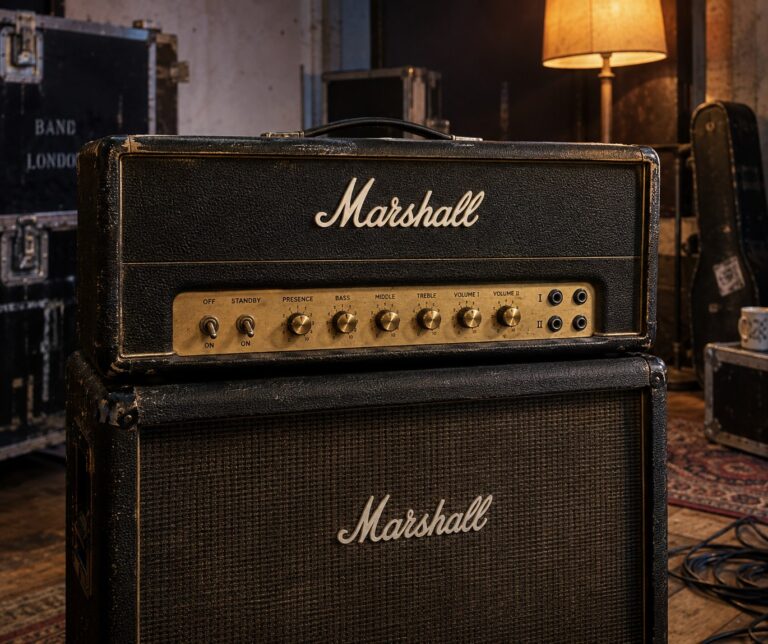
Frehley’s amp philosophy is perhaps the most simply stated in this entire series: “Once we got signed, I bought a Gibson Les Paul and a 100-watt Marshall amp.” The Marshall — a Plexi-era 100-watt Super Lead in the classic KISS years — was his primary amplification from the beginning of the band through the first KISS era, and remained the central amp choice throughout his career.
The vintage Marshall Plexi circuit doesn’t produce modern high-gain tones. It produces a dynamic, open distortion that responds directly to picking intensity — the harder you hit the strings, the more the amp saturates; pull back and it cleans up partially. This responsiveness suited Frehley’s playing style: melodic, blues-influenced, with genuine dynamic variation between rhythm passages and lead solos.
He drove the Marshall hard — “dimed” (everything at 10) was the approach during the KISS peak years. Combined with the DiMarzio Super Distortion’s high output, the amp worked at maximum saturation. The Big Muff Pi fuzz pedal was sometimes used to push the amp further for overdrive passages.
Frehley used multiple Marshall heads simultaneously during KISS touring — the scale of KISS productions required massive stage volume, and the wall of Marshalls was as much a visual statement as a practical audio decision.
Marshall JCM800 and JCM900 — The Later Years
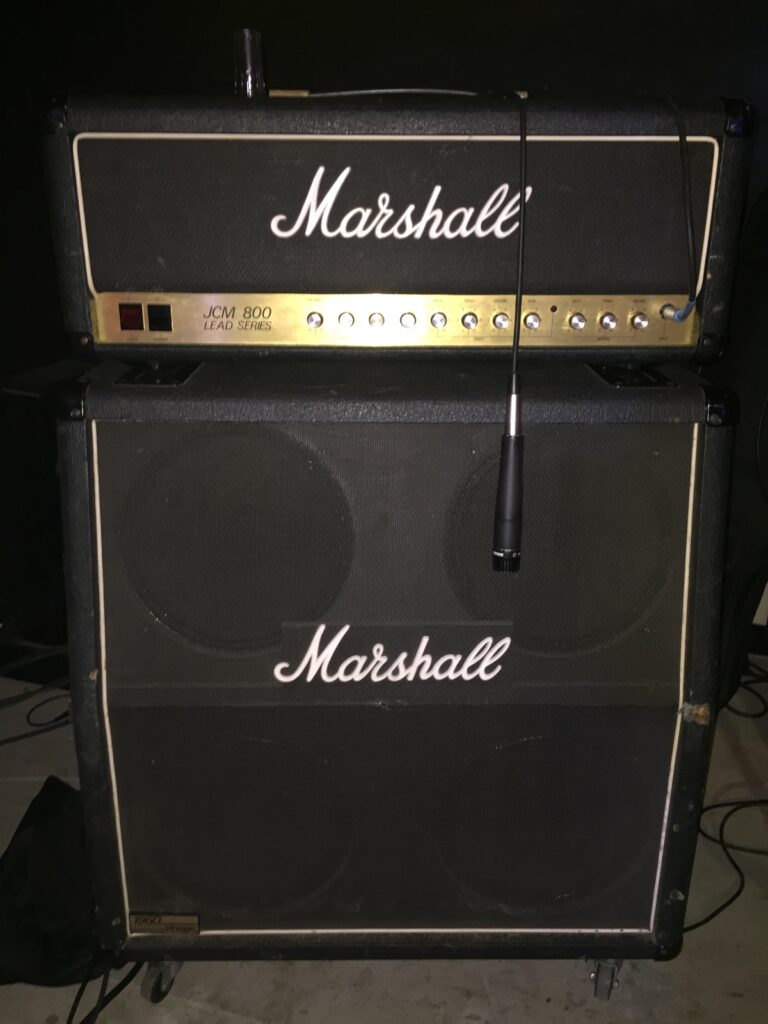
As Marshall evolved through the 1980s, Frehley adopted the JCM800 series — the high-gain successor to the Plexis that provided more preamp gain and a master volume for lower-stage volume without losing the Marshall character. By the reunion era and his solo career, JCM900 and eventually JCM2000 models appeared in his rig. His stated preference remained consistent: Marshall, loud.
Fender Tweed Amp — Studio Recordings
Frehley described his studio approach: “I used my tobacco sunburst Gibson Les Paul Standard with a rewound hot pickup, through a Marshall stack or old Fender tweed amp, on most of the studio recordings.” The Fender tweed — a vintage American amp with a completely different character from the Marshall — was used for specific tonal colours in the studio, particularly on cleaner or mid-gain passages where the Marshall’s aggressive character was less appropriate.
Laney AOR — Solo Career
During his Frehley’s Comet solo career in the late 1980s, Frehley used Laney AOR heads — British-made high-gain amps that provided Marshall-adjacent character during a period when his endorsement relationship with Marshall was not formally in place. The Laney AOR is a channel-switching amp with good gain structure for 1980s hard rock requirements.
| Amp | Era | Notes |
|---|---|---|
| Marshall Plexi 100W Super Lead | Classic KISS era (1973–1982) | “Once we got signed, I bought a Gibson Les Paul and a 100-watt Marshall amp.” Multiple heads used simultaneously for stage volume and wall-of-Marshalls visual |
| Fender tweed amp (various) | Studio recordings throughout career | Specific studio use for cleaner tonal colours; complement to Marshall |
| Laney AOR heads | Frehley’s Comet (late 1980s) | Solo career; Marshall-adjacent British character |
| Marshall JCM800 | 1980s–1990s | Higher gain successor to Plexis |
| Marshall JCM900 / JCM2000 | Reunion era and later | Contemporary Marshall models; same fundamental approach |
| Line 6 rack unit | Later KISS era | Backup for wall of Marshalls; used for effects during solo sections |
Pedals & Signal Chain: Big Muff, Wah, and Smoke Bombs
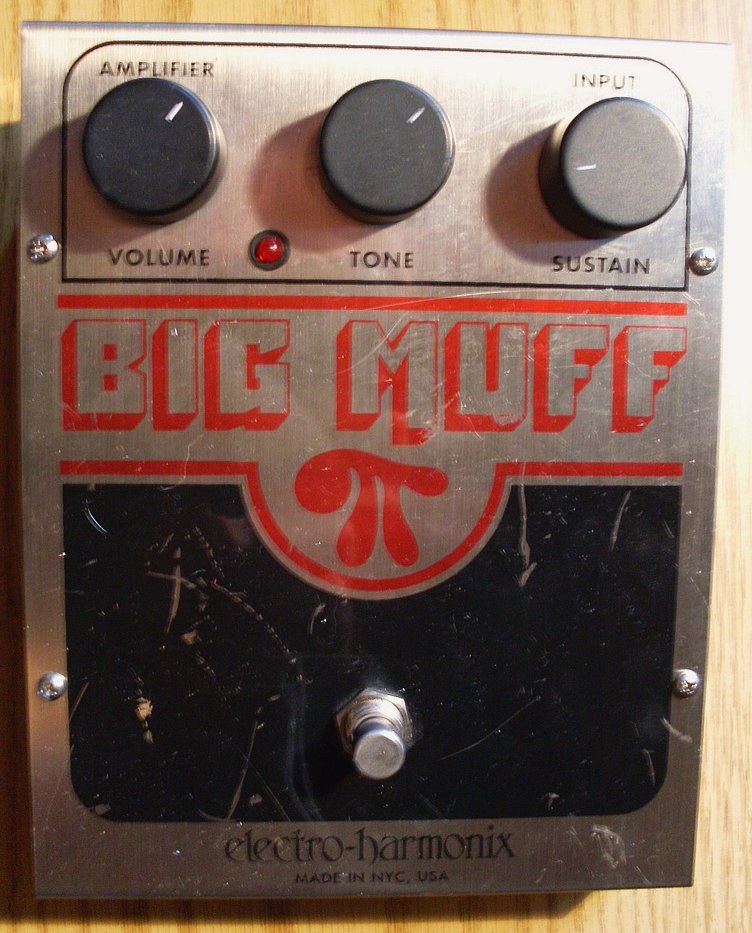
Frehley’s signal chain was minimalist by design and by preference. He described his approach explicitly: “I try to stay away from effects as much as I can.” What effects he did use were specific and functional rather than elaborate.
Electro-Harmonix Big Muff Pi — The Overdrive
The Big Muff Pi — one of the great fuzz/overdrive pedals of all time, with its specific, sustain-heavy, harmonically rich character — was Frehley’s primary overdrive in the early KISS years. He used it “to overdrive” the Marshall stack and Fender tweed amps, adding additional saturation and sustain beyond what the amp alone provided. The Big Muff’s character — rounder and more sustained than a Marshall Plexi’s natural breakup — complemented the Les Paul’s warmth to produce the specific Frehley lead tone.
In later years and in interviews, he described recreating the Big Muff sound through the Zoom G3 multi-effects unit: “I like the tape delay effect and the Big Muff sound, because I used a Big Muff years ago.”
Vox Wah (V846) — The Expression Tool
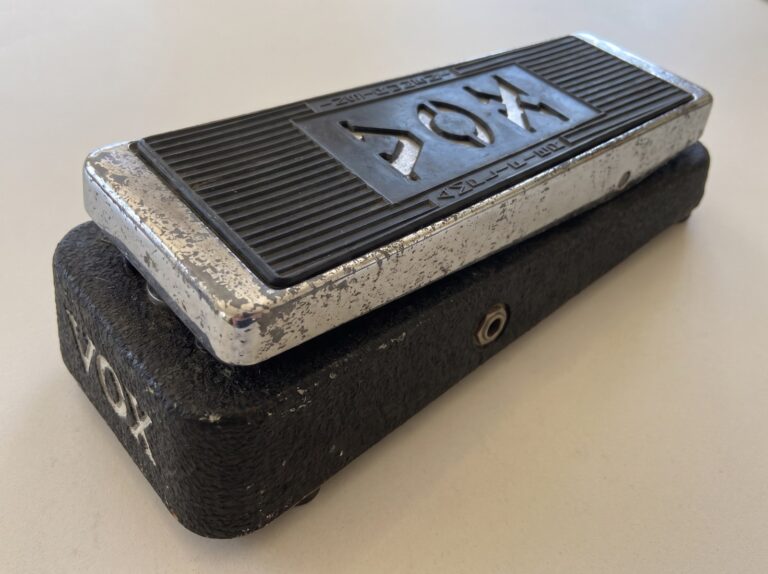
Frehley used a Vox wah pedal rather than the Dunlop Cry Baby that most of his contemporaries preferred. The Vox V846’s wider sweep range makes it stand out more when soloing over a rhythm guitar in a band context — an important distinction in KISS, where Frehley’s leads needed to cut through the dense rhythm guitar of Paul Stanley, Gene Simmons’ bass, and Peter Criss’s drums simultaneously. He used it selectively, most notably in extended solo sections of live shows.
Danelectro Daddy-O Overdrive — Interview Amp-Driving
Documented in interview footage where Frehley used a Danelectro Daddy-O overdrive to drive his Marshall to an interview-appropriate volume while demonstrating tones — the overdrive compensating for the amp’s lack of master volume control. A practical solution to a practical problem.
Zoom G3 — Later Career Multi-Effects
In his later touring career, Frehley used a Zoom G3 multi-effects unit: “The only pedal I used was the Zoom G3. I’ve been using Zoom stuff for a long time. It’s quick and you can dial up sounds fast. It’s like having three boxes in front of you.” The G3 provided the tape delay effect he used in extended solo sections and the Big Muff emulation for overdrive passages, consolidating his minimal effects needs into a single unit.
Delay — The Solo Section Secret
During live show solo sections — the moments when smoke poured from his guitar and the crowd lost control — Frehley used a delay unit set for “lots of repeats,” running directly into his amps to produce the cascading, looping echo that built intensity during the crescendo of his solos. This effect, combined with the smoke and stage theatrics, created the emotional climax of every KISS show for decades.
The Smoke Bombs — Not a Pedal, But Essential
The smoke bomb mechanism — installed in a dummy pickup cavity of dedicated Les Paul Customs — evolved from a crude cigarette-lighter ignition in 1975 to a sophisticated backstage-controlled system. The mechanism used:
- Asbestos lining in the pickup cavity to protect the wood from heat
- A cardboard shield installed to protect Frehley himself from the smoke and heat during the “Shock Me” solo
- Backstage tech control via a phantom-powered system (later versions)
- Battery-powered self-control via the pickup selector (most sophisticated versions)
The rocket-shooting headstock mechanism on the 1957 Black Beauty was designed by Steve Carr and used a double-barreled system that fired actual bottle rockets at arena ceilings. This is a level of guitar modification that has no precedent in the gear stories of any other player in this series.
Tone note: He installed asbestos and a cardboard shield in a guitar so he could be next to a smoke bomb during a guitar solo without being burned. That is the most specific personal safety modification in the history of guitar. And he kept doing it for thirty years.
Strings, Picks & Setup
Strings: Standard electric gauges consistent with his playing style. The top-wrapped string loading on the 1973 Les Paul Deluxe (strings loaded over rather than under the stop bar) reduced the break angle and slightly reduced string tension — a subtle modification that affects feel and slightly affects sustain.
Picks: Not extensively documented in specific commercial terms. His articulate, melodic lead playing suggests medium to heavy gauge picks for the precise single-note work, consistent with the Les Paul’s natural response to medium-pressure pick attack.
Setup priorities:
- DiMarzio Super Distortion in bridge position — the defining pickup choice across virtually all his primary guitars
- Three-pickup configuration with non-standard middle (eventually dummy for smoke effect)
- Grover tuners with square pearloid buttons — his consistent hardware preference from 1976 onward
- Heel carving — the Les Paul’s deep neck joint limited upper-fret access; Frehley literally carved his way to it with a screwdriver
- Top-wrapped strings on the Deluxe — for reduced string tension and slightly different feel
Tone note: His signature pickup configuration — DiMarzio Super Distortion in the bridge — has remained constant across every era of his career. From the tobacco burst Deluxe in 1974 to the signature models released in 2025, the bridge pickup is a Super Distortion. Some tonal decisions are made once and kept forever.
Tunings & Tone Philosophy
Standard E tuning throughout his career. KISS’s music is fundamentally in standard tuning — the hard rock vocabulary Frehley drew from (British blues-rock, Led Zeppelin, Cream) operated in standard tuning, and his playing approach doesn’t require alternate configurations.
His stated tone philosophy is as direct as the gear itself: “I use Gibson Les Paul Customs live because they’re simply the best guitars for loud rock ‘n’ roll.” And: “I try to stay away from effects as much as I can.” And: “On the early KISS records, I used my tobacco sunburst Gibson Les Paul Standard with a rewound hot pickup, through a Marshall stack or old Fender tweed amp.” There is no mystification in these statements. The guitar, the amp, the occasional overdrive pedal. Everything else is theatrics.
The DiMarzio Super Distortion is central to his tone philosophy in a way that connects back to a specific piece of musical history: Gene Simmons attended college in upstate New York in the 1960s with Larry DiMarzio, founder of DiMarzio Pickups. The connection between Simmons and DiMarzio influenced the entire band’s relationship with the company’s pickups — and Frehley’s adoption of the Super Distortion as his primary pickup (across virtually every guitar he has ever used seriously) became one of the signature elements of the KISS guitar sound.
Tone note: Les Paul. Marshall. DiMarzio Super Distortion. “I try to stay away from effects as much as I can.” That is the complete tone philosophy. It has never changed. It never needed to.
Playing Style & Tone Philosophy: The Melodic Spaceman
Ace Frehley’s playing is frequently underrated by the technically sophisticated guitar community — overshadowed by the spectacle of KISS, misread as simple, dismissed as a product of image over musicianship. This is inaccurate.
His solos are melodic in the way that the best popular music solos are: singable, memorable, emotionally direct, and perfectly suited to the songs they inhabit. “Cold Gin,” “Shock Me,” “Rocket Ride,” “Parasite” — these solos do exactly what a guitar solo in this specific musical context should do. They build energy, they peak at the right moment, they have a beginning and a middle and an end, and they leave the listener feeling something.
The Blues Foundation
Frehley’s influences — Clapton, Beck, Page, Hendrix — all come from the British blues-rock tradition, and that tradition’s emphasis on feel over speed, melody over technique, and emotional communication over technical display is audible in every note he plays. He is, at his core, a blues-based rock guitarist applying that vocabulary to hard rock contexts. The melodic instinct comes from the same place as the blues musicians he learned from.
His vibrato is wide and expressive — a slow, arm-influenced technique that gives sustained notes a singing quality rather than a nervous stutter. Combined with the DiMarzio Super Distortion’s high-output sustain and the Marshall’s natural compression at high volume, his long sustained notes have a singing, almost vocal quality that distinguishes them from the more clinical approach of the shred era that came after him.
Tone note: He learned from Clapton, Beck, Page, and Hendrix. Not from neo-classical theory or shred technique. The melodic directness and blues feeling in his solos come from the tradition that produced those four players. It’s not simplicity — it’s authenticity.
The Melodic Soloing
The “Shock Me” solo — from Destroyer (1976) — is perhaps the most representative example of his approach at its best. The solo builds gradually, using the natural minor scale in a melodic context rather than as a technical exercise, with rhythmic variety (some longer notes, some faster runs) that maintains interest without ever losing the melodic thread. It escalates to a conclusion that feels earned rather than imposed.
John 5, Dimebag Darrell, Marty Friedman, and Paul Gilbert have all cited Frehley as a primary influence — players who developed far more technical sophistication than he possessed but who absorbed his melodic instinct and emotional directness as foundational values. That’s the impact of a player who sounds like himself rather than like an exercise book.
Tone note: Paul Gilbert cites him as an influence. Paul Gilbert, who plays with a drill, studied Ace Frehley’s melodic instinct. That is the clearest possible evidence that the melodic quality of Frehley’s playing transcends any specific technical level.
The Theatrics as Music
The smoke bombs and rocket launchers and thousand-bulb light guitars are not separate from the music — they are part of it. KISS’s music is theatre music, stadium spectacle, designed to be experienced as a total sensory event rather than as pure audio. The guitar solo section of a KISS show is a theatrical set piece: the smoke builds, the lights change, the delay echoes, the solo escalates, the crowd builds. The gear serves the performance in the most complete sense possible.
Frehley understood this completely. He was not embarrassed by the theatrics and he did not try to present himself as a “serious musician” who just happened to be in a spectacular band. He was the Spaceman. The guitar was part of the costume, part of the mythology, part of the show. Both things — the theatrical function and the musical function — were real and equally important.
How to Sound Like Ace Frehley: The Spaceman Tone
Frehley’s tone is one of the most achievable in this series — the Les Paul Custom through a Marshall is a combination that every guitar shop carries, and the DiMarzio Super Distortion is a standard production pickup available everywhere.
The Guitar
Les Paul Custom, three pickups if possible, DiMarzio Super Distortion in the bridge. The three-pickup configuration is part of the visual signature; the middle pickup can be a dummy (non-functional) as in many of his actual guitars, or a functional pickup for additional tonal variety.
- Gibson Ace Frehley Signature Les Paul — Purpose-built; three-pickup configuration; most authentic option
- Epiphone Ace Frehley Signature Les Paul — Budget version; same visual configuration
- Gibson Les Paul Custom (any year) — Standard two-pickup version; add DiMarzio Super Distortion in bridge; the middle pickup position is easily added with a dummy or functional pickup
- Gibson Les Paul Standard — Starting point; DiMarzio Super Distortion bridge upgrade; most of the tone with less of the visual
The Amp
Marshall. Loud. If the room allows it, push the amp hard. Frehley’s tone is in the natural saturation of the Marshall driven by the DiMarzio’s high output — it’s not a modern high-gain amp tone, it’s the organic, responsive breakup of a cranked Plexi-era circuit.
| Control | Classic KISS Setting | Notes |
|---|---|---|
| Volume / Gain | 8–10 (“dimed”) | The DiMarzio Super Distortion pushes the input; the amp saturates naturally |
| Treble | 7–8 | Present — the Les Paul Custom’s warmth needs treble to cut through |
| Middle | 7 | Midrange presence for the singing, sustain-heavy lead tone |
| Bass | 5–6 | Warm but controlled — the Custom’s mahogany body adds natural warmth |
| Presence | 6–7 | Enough definition for melodic lead lines |
If the room can’t handle a dimed Marshall: a lower-wattage Marshall (Studio Vintage SV20H or DSL20CR) at louder relative volume, or a Big Muff into a lower-gain amp setting to replicate the saturation character.
The Essential Pedal
Electro-Harmonix Big Muff Pi — The original overdrive choice for the early KISS recordings. Set sustain high, tone moderate. Run before the Marshall input for additional saturation. Don’t use it as a standalone distortion — use it to push the Marshall harder.
A Vox wah for lead sections when you want the swept filter effect.
Budget vs Pro Rigs
Budget — Alive! era tone:
- Guitar: Epiphone Les Paul Custom (DiMarzio Super Distortion bridge upgrade)
- Amp: Marshall DSL20CR — Classic Gain channel; treble up, mids present
- Pedal: Electro-Harmonix Big Muff Pi (original or reissue)
- Strings: Ernie Ball .010s; consider top-wrapping on stopbar for the Alive! feel
Pro — Full Frehley approach:
- Guitar: Gibson Ace Frehley Signature Les Paul Custom (or vintage Les Paul Custom with Super Distortion bridge)
- Amp: Marshall Plexi 100W (or Studio Vintage SV20H for manageable volume)
- Pedal: Original Electro-Harmonix Big Muff Pi; Vox V846 wah
- Optional: Zoom G3 or equivalent for delay in solo sections
Tone note: The DiMarzio Super Distortion pickup upgrade is the single most important modification. The pickup’s high output pushing a Marshall Plexi creates more of the Frehley character than any combination of settings on a stock Les Paul through a cleaner amp.
The Technique
Wide, slow vibrato on sustained notes. Build your solos melodically — start with a clear melodic statement, develop it, and bring it to a conclusion. Don’t fill every space; let notes sustain and breathe. Listen to “Shock Me” and “Rocket Ride” and learn the solos note by note — not for the specific notes, but for the melodic architecture: how a phrase starts, what it does in the middle, and how it resolves.
The hardest part of Ace Frehley’s approach to reproduce is the feeling of inevitability — the sense that each note is exactly the right note in exactly the right place. That comes from deep absorption of blues-based melodic vocabulary, not from learning scales.
Influence & Legacy: The Spaceman Who Taught a Generation to Want a Guitar
Ace Frehley’s influence on rock guitar is real, significant, and somewhat different in character from most other players in this series. He is not primarily an influence on technique or tone (though both have been absorbed by many players). He is primarily an influence on desire — the desire to play guitar in the first place.
Millions of people saw KISS in the 1970s — on television, at concerts, in magazines — and saw Ace Frehley standing in platform boots and Spaceman makeup with a smoking Les Paul. Many of those people, for the first time in their lives, wanted to be a guitarist. Not a blues player, not a jazz musician, not a classical performer — a guitarist in a rock band with smoke coming out of the guitar and rockets shooting from the headstock.
That desire — crystallised by one visual image of one guitarist doing something genuinely extraordinary — drove countless people to buy their first guitar and learn their first power chord. Some of them became John 5. Some became Dimebag Darrell. Some became Marty Friedman. All of them are connected to that initial desire, which Ace Frehley created.
The specific playing influence is also real. His melodic approach to lead guitar — the singable phrases, the wide vibrato, the blues vocabulary deployed in hard rock context — can be heard in the playing of guitarists who explicitly cite him and in those who absorbed it indirectly through the rock tradition that his work helped shape. The specific combination of Les Paul warmth, DiMarzio output, and Marshall saturation that defines his tone became a template for an entire generation of hard rock guitarists.
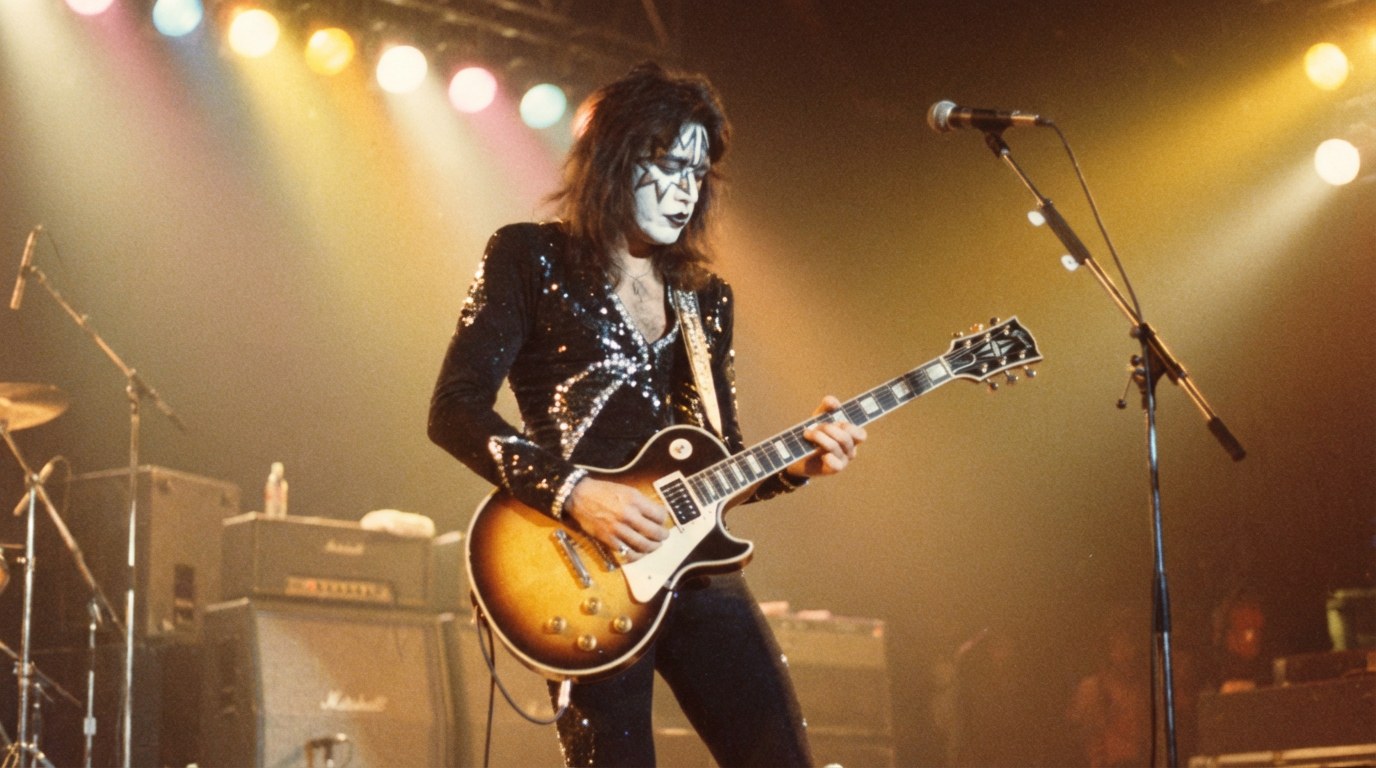
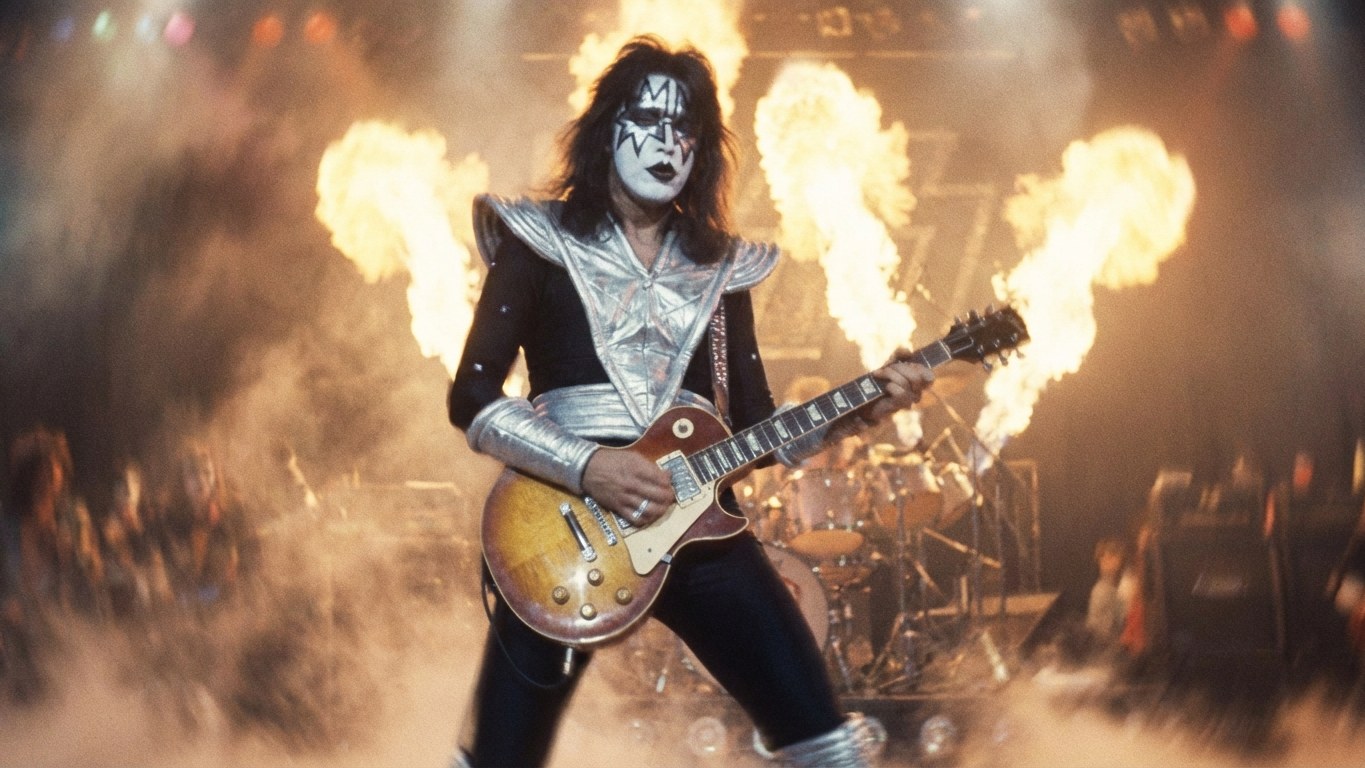
The Gibson signature relationship — formalised in 1997 and continued through his death — acknowledged his status as one of the instrument’s most important ambassadors. The three-pickup Les Paul Custom visual template he established in 1976 became the foundational aesthetic of his legacy: so associated with him that even players who prefer different instruments find themselves reaching for a Les Paul Custom when they want to evoke his spirit.
He died in October 2025. KISS had already done their farewell tour without him. The original band — Stanley, Simmons, Criss, Frehley — had not performed together for decades. The Reunion era of the late 1990s was the last sustained chapter of that specific combination.
But the smoking guitar — the dummy pickup cavity, the asbestos lining, the smoke billowing across an arena while fifty thousand people screamed — that image is permanent. It defined a version of what a rock guitarist could be that had nothing to do with technical sophistication or genre purity or critical approval, and everything to do with spectacle and feeling and the pure, uncomplicated desire to give an audience something to remember.
Tone note: He spent twenty-five years putting smoke bombs in guitars. He did it because it made people go crazy. Both things — the musical and the theatrical — were genuine. He never apologised for either.
At Manny’s Music on 48th Street in Manhattan, in 1973 or 1974, a young guitarist from the Bronx spent some of his KISS signing advance money. He bought a Gibson Les Paul Deluxe in Tobacco Sunburst and a 100-watt Marshall amplifier.
He took the Les Paul home and modified it: replaced the mini-humbuckers with DiMarzios, removed the pickguard, added a star decal, took a screwdriver to the heel to get better upper-fret access, moved the strap button, changed the tuners.
He played that guitar on Hotter Than Hell and Dressed to Kill and Alive! and Destroyer and the records that made KISS one of the biggest rock bands in the world.
Then he bought a Les Paul Custom, added a smoke bomb to the neck pickup cavity, lined the cavity with asbestos, and installed a cardboard shield to protect himself from the smoke during the “Shock Me” solo.
Paul Frehley — Ace — died on October 16, 2025. He was 74 years old. He was the Spaceman. He was one of the founding members of KISS. He was one of the most recognisable guitarists in the history of rock and roll.
He never put down the Les Paul. He never turned down the Marshall. He never stopped thinking that a guitar solo should be something you could feel and something you could remember.
No regrets.
If Ace Frehley’s melodic Les Paul through Marshall approach has you exploring the Les Paul tradition, check out our complete guide to Peter Green’s guitars and gear — the British blues player whose “Greeny” Les Paul established the template for what the combination of a great Les Paul and a great amp could produce, long before KISS took it into the arena.
And for the closest parallel to Frehley’s simple-but-effective Les Paul tone in a harder, more aggressive context, don’t miss our breakdown of Michael Schenker’s complete gear guide — another player who found his sound in a single guitar type through a cranked Marshall and never looked back.
FAQ: Ace Frehley Guitars & Gear
- What guitar is Ace Frehley most associated with?
- The Gibson Les Paul Custom with three pickups — his visual and sonic signature from 1976 onward. His primary guitar in the early KISS years (1973–1976) was a 1973 Gibson Les Paul Deluxe in Tobacco Sunburst, purchased with KISS signing advance money from Manny’s Music in Manhattan. Both instruments were modified with DiMarzio pickups (Super Distortion in bridge, PAF-style in neck), Grover tuners with square pearloid buttons, and various other personal modifications. His first album was recorded primarily with an Ovation Breadwinner.
- What is the smoking guitar and how does it work?
- Ace Frehley’s smoking guitar effect began in fall 1975, when he installed a smoke bomb in a dummy pickup cavity of a Les Paul Deluxe dedicated to the effect. The neck pickup position was fitted with a non-functional “dummy” pickup housing the smoke bomb mechanism; asbestos lining protected the wood from heat; a cardboard shield protected Frehley himself. Early versions were lit with cigarette lighters by backstage technicians; later versions used phantom-powered systems or battery-powered self-control via pickup selector. Multiple “Smoker” Les Pauls were built across his career. A 1957 Black Beauty was separately modified to shoot rockets from its headstock.
- What amplifier did Ace Frehley use with KISS?
- Marshall — specifically 100-watt Marshall Plexi Super Lead heads during the classic KISS era, run at high volume (“dimed” settings across most controls). He confirmed: “Once we got signed, I bought a Gibson Les Paul and a 100-watt Marshall amp.” Multiple Marshall heads were used simultaneously for stage volume and visual impact. Later KISS eras used Marshall JCM800, JCM900, and JCM2000 models. For studio recordings, he also used Fender tweed amplifiers for specific tonal colours on certain tracks.
- What pickups did Ace Frehley use?
- DiMarzio Super Distortion (DP100) in the bridge position is his defining pickup choice — used in the 1973 Les Paul Deluxe from the Hotter Than Hell tour onward, in all subsequent Les Paul Customs, and specified in every Ace Frehley signature model. DiMarzio PAF-style pickups (neck position) and DiMarzio Dual Sound pickups also appeared in various configurations. The DiMarzio connection was partly through Gene Simmons’s college friendship with DiMarzio founder Larry DiMarzio.
- What effects pedals did Ace Frehley use?
- He minimised effects throughout his career: “I try to stay away from effects as much as I can.” Primary effects: Electro-Harmonix Big Muff Pi (used to push Marshall stacks on early KISS recordings), Vox V846 wah (wider sweep than Dunlop Cry Baby; preferred for lead playing over rhythm guitar), and a delay unit set for “lots of repeats” during live solo sections. Later career used a Zoom G3 multi-effects for convenience: “I like the tape delay effect and the Big Muff sound.” A Danelectro Daddy-O overdrive was used to drive the amp at manageable volumes during interview demonstrations.
- What was Ace Frehley’s first guitar on the KISS debut album?
- An Ovation Breadwinner — a solid-body guitar with fiberglass back and active electronics, somewhat unusual for a hard rock guitarist of the era. This was the guitar Frehley had access to before receiving the KISS signing advance. By the time the band began touring in support of the first album, he had purchased the 1973 Gibson Les Paul Deluxe and a 100-watt Marshall with advance money from Manny’s Music on 48th Street in Manhattan.
- How do I get Ace Frehley’s guitar tone?
- Les Paul Custom (or Standard) with a DiMarzio Super Distortion in the bridge position. Run into a Marshall amplifier cranked high — the Super Distortion’s output pushes the Marshall into natural saturation. Add an Electro-Harmonix Big Muff Pi before the Marshall input for the sustained, fuzz-enhanced lead tone on the early KISS recordings. Vox wah for expression passages. The key is the combination of high-output humbucker pushing a Marshall hard — not modern high-gain preamp distortion. The DiMarzio Super Distortion upgrade is the single most important step, followed by getting the Marshall to work at sufficient volume to saturate naturally.
Image credits
- Top image: Tilly antoine, Wikimedia Commons, CC BY-SA 4.0.
- Gibson Les Paul Standard: DonnyBurger1974, Wikimedia Commons, CC BY-SA 4.0.
- Marshall 1959 Super Lead Plexi: GuitarGangsters AI-generated reference illustration, not a photograph.
- Marshall JCM800: John2112, Wikimedia Commons, CC BY-SA 4.0.
- Electro-Harmonix Big Muff Pi: Roadside Guitars, Flickr, CC BY-SA 2.0.
- Gibson Les Paul Standard: DonnyBurger1974, Wikimedia Commons, CC BY-SA 4.0.
- Gibson Les Paul Standard: DonnyBurger1974, Wikimedia Commons, CC BY-SA 4.0.
- Vox V846 Wah-Wah: GuitarGangsters AI-generated reference illustration, not a photograph.
- Ace Frehley (illustration 2): GuitarGangsters AI-generated reference illustration, not a photograph.
- Ace Frehley (illustration 1): GuitarGangsters AI-generated reference illustration, not a photograph.
- Gibson Les Paul Standard: DonnyBurger1974, Wikimedia Commons, CC BY-SA 4.0.
- Ace Frehley (illustration 3): GuitarGangsters AI-generated reference illustration, not a photograph.