
Bill Frisell Guitars & Gear: The Complete Guide to Jazz’s Telecaster Visionary, Line 6 DL4 & Americana ECM Rig
Bill Frisell was born in 1951 — the same year that the Fender Telecaster was introduced. When he discovered a 1951 Telecaster that “got me super fired-up” about his instrument of choice, the coincidence was noted. The Telecaster and Frisell are the same age. The Telecaster became the primary vehicle for everything that Frisell has done musically across four decades of professional recording — through the ECM jazz recordings of the 1980s, through the Americana explorations of Nashville (1997), through the avant-garde noise and looping work, through the Have a Little Faith interpretations of Bob Dylan and Charles Ives and Muddy Waters and Aaron Copland and John Philip Sousa and Madonna in the same album, through the film scores and the colossally wide range of collaborations that includes Bonnie Raitt, Elvis Costello, John Zorn, Elvin Jones, Ron Carter, McCoy Tyner, Jim Keltner, Viktor Krauss, and what appears to be virtually every significant musician of the post-1980 era regardless of genre. “Frisell was arguably the first electric guitarist to completely redefine the instrument since Jimi Hendrix,” Premier Guitar stated. The redefining was done primarily with the Telecaster, which is 1951 vintage technology. The same age as Frisell. “No one refracts age-old Americana through a cutting-edge prism with the warm-hearted, fleet-minded individuality of Frisell,” as All About Jazz put it. The Telecaster through the Line 6 DL4 through the Fender Princeton or Gibson GA-18 or Carr Mercury, with the volume pedal for swells and the EHX Freeze for sustained notes and the Strymon Flint for reverb and tremolo: this is the specific rig that refracts the age-old Americana through the cutting-edge prism. It starts with the 1951 guitar. It ends wherever the imagination goes. Nobody has followed it further.
Bill Frisell was born in Baltimore, Maryland, grew up in Denver, Colorado, attended the Berklee College of Music in Boston, and has built one of the most genuinely eclectic careers in the history of the electric guitar — a career that defies genre classification not as a stylistic statement but as a musical reality: the guitar approach that Frisell has developed over forty-plus years serves the jazz tradition and the country tradition and the Americana tradition and the avant-garde noise tradition and the contemporary classical tradition and the looping-and-electronics tradition simultaneously, without forcing any of them to compromise with the others. “He unapologetically incorporates disparate influences like Americana, country, avant-garde, and contemporary classical into his music, and has no inhibitions about whipping out a looper, distortion pedal, or a sound freezer,” as Premier Guitar describes. The “sound freezer” is the Electro-Harmonix Freeze sound retainer — a pedal that sustains a note or chord indefinitely at the moment of pressing the footswitch, producing the specific ambient, sustaining texture that Frisell uses as a harmonic drone beneath improvisation. No inhibitions. The freezer. The looper. The distortion. The Telecaster. The jazz vocabulary. The Americana. All at once, from the same guitarist, with the same warmth and fleet-minded individuality.
The ECM Records context that launched his international career is the specific institutional environment that first established Frisell as a significant guitarist in the jazz world. ECM — the Norwegian label founded by Manfred Eicher that has defined a specific aesthetic of spacious, atmospheric, acoustically sophisticated recorded sound — placed Frisell in the company of Jan Garbarek, Charlie Haden, Carla Bley, and the other musicians whose ECM recordings defined a specific approach to jazz in the 1980s. His debut, In Line (1983), established the specific atmospheric, melodically fluid guitar approach that would characterize the ECM recordings and that shaped the wider perception of Frisell as a jazz guitarist of distinctive, personal voice. The ECM sound — spacious, reverb-drenched, melodically restrained — is the specific production environment that suited the specific Frisell guitar approach from the beginning: the guitar’s sustained notes, the volume pedal swells, the delay and reverb processing, all served by ECM’s specific aesthetic of recorded space.
The Nashville album (1997) is the specific biographical moment at which Frisell’s Americana dimension became impossible to ignore in the jazz-oriented critical establishment that had defined his career to that point. Nashville — recorded with Nashville studio musicians, featuring acoustic instrumental folk tunes with unpredictable stylistic accents — produced the “dreamy, seductive grandeur” that the LA Weekly described: “Frisell himself picks and strings and most of all floats, laying out liquid tones that settle over the melodies like heat haze on a swampy, swimmerless lake.” The Atlanta Journal-Constitution summed it up as “Americana at its best.” The jazz guitarist made the best Americana album. The same Telecaster. The same DL4. The same Princeton or GA-18. The Americana that was always there beneath the ECM jazz surface, emerging as the primary voice when the Nashville musicians provided the context that released it. The heat haze on the swampy lake. The liquid tones. The Telecaster at the center of everything.
Background: Baltimore, Berklee, ECM, and the Career That Refused to Stay in One Genre
The Berklee connection places Frisell in the same foundational jazz guitar education as Mike Stern and John Scofield — the three guitarists who formed the most celebrated jazz guitar generation of the 1980s, all educated at Berklee, all developing their individual approaches from the same foundational jazz harmonic and improvisational curriculum. Where Stern brought the Telecaster into jazz with rock-and-blues directness and Scofield brought the hollow-body Ibanez with funk-edged vocabulary, Frisell brought the Telecaster into jazz with the specific atmospheric, Americana-inflected, delay-and-looping-and-volume-swell approach that no one had previously assembled into a coherent jazz guitar identity. Three Berklee guitarists, three completely different approaches from the same educational starting point.
The range of musical contexts that Frisell has inhabited across his career is extraordinary even by the standards of this series, which has documented musicians of significant range. Have a Little Faith (1992) — the album that interpretates Bob Dylan, Charles Ives, Muddy Waters, Aaron Copland, John Philip Sousa, Madonna, Stephen Foster, and Sonny Rollins within the same recording — is the most concentrated single-album demonstration of the Frisell range: the American musical tradition from its folk and classical roots through its pop and rock and jazz developments, all filtered through the specific Frisell guitar voice that makes the connections between these apparently disparate traditions audible rather than intellectually argued. The same Telecaster and the same delay and the same reverb and the same volume pedal, playing “The Star-Spangled Banner” and “What the World Needs Now Is Love” in the same album without stylistic apology.
The film scoring career — Finding Forrester, American Hollow, and others — is the specific application of the Frisell atmospheric guitar approach to the cinematic context. Film music requires the specific ability to create emotional atmosphere that serves a visual narrative — the same ability that the Nashville album’s “liquid tones that settle over the melodies like heat haze on a swampy, swimmerless lake” demonstrates. The guitar as atmospheric agent, the delay and reverb as spatial processing, the volume pedal swells as emotional dynamics: all of these are as much cinematic tools as musical ones, and Frisell’s mastery of them in the jazz and Americana context translated directly into the film scoring ability that the Finding Forrester engagement demonstrated.
His collaborators across four decades constitute one of the more comprehensive available lists of significant musicians in post-1980 American music: John Zorn, Bonnie Raitt, Elvis Costello, Elvin Jones, Ron Carter, McCoy Tyner, Charlie Haden, Jan Garbarek, Carla Bley, Paul Motian, Billy Hart, Marc Johnson, Viktor Krauss, Jim Keltner, Jenny Scheinman, Greg Leisz, Kenny Wollesen, Joey Baron, and countless others. The breadth of collaborators across jazz, country, Americana, avant-garde, and contemporary classical confirms what the Nashville album demonstrated and what the Have a Little Faith project proved: Frisell’s guitar is not genre-specific but approach-specific, and the approach serves whatever musical context it inhabits with equal intelligence and equal warmth.
The Rig: Bill Frisell’s Guitars, Amps, and Effects
Guitars
Fender Telecasters (Primary Career — “Got Me Super Fired-Up”)
Bill Frisell’s primary guitar has been the Fender Telecaster throughout his career. When he discovered a 1951 Telecaster — born in the same year as Frisell himself — it “got me super fired-up” about his instrument of choice. The Telecaster’s specific character in the Frisell context: the single-coil pickups’ specific direct, clear, present character that translates the volume pedal swells and the DL4 delay processing with maximum clarity rather than the warmth-obscuring quality of a humbucker; the bolt-neck construction’s specific resonance and sustain character; and the Telecaster’s fundamental identity as an American guitar whose tonal voice suits the American musical tradition that Frisell inhabits. “He used his trusted combination of Fender Telecaster-style ax, Fender tube combo amp and delay and looping effects to achieve his melancholy, art-house version of surf and vintage Nashville tone.” Multiple Telecasters appear in his collection across different recordings and performances.
JW Black Custom T-Style and S-Style (Preferred Recent Primary)
“One of his favorite axes, a custom Telecaster-style electric made by JW Black” was used on the Valentine album. JW Black is a Los Angeles-based custom guitar builder whose T-style and S-style instruments provide the specific high-quality craftsmanship and tonal character that a working professional guitarist requires from a custom-built primary instrument. The JW Black T-style is functionally a Telecaster — the same single-coil pickup architecture, the same bolt-neck construction, the same fundamental acoustic and electric character — built to higher tolerances and with more specific choices of materials than the production Telecaster. Frisell’s use of the JW Black as one of his “favorite axes” confirms the Telecaster as the foundational instrument identity while acknowledging the practical advantages of the custom-built alternative.
Rick Kelly T-Style Guitar (New York Custom — Additional Primary)
The Rick Kelly T-style guitar is another custom Telecaster-style instrument documented in Frisell’s collection — from Rick Kelly, the New York-based luthier who builds guitars from reclaimed New York City wood (including wood from demolition sites in the city) with specific attention to the acoustic and tonal properties of aged wood. The specific character of a Rick Kelly guitar — the aged wood’s specific acoustic resonance, the precise craftsmanship, the New York connection — provides a different but complementary character to the JW Black and the production Telecasters.
Fender Stratocasters, Jaguar, and Jazzmaster (Additional Fender Family)
Frisell’s guitar collection extends across the Fender family to include Stratocasters, Jaguars, and Jazzmasters — the broader Fender guitar vocabulary that provides different single-coil character and different ergonomic and acoustic properties for different musical contexts. The Jazzmaster and Jaguar, with their specific offset body designs and unique switching and control systems, provide additional tonal options that the standard Telecaster doesn’t offer. The Stratocaster’s five-way switching and three single-coil configuration adds the in-between pickup “quack” and the neck pickup warmth that the Telecaster’s two-pickup design doesn’t provide.
Collings I35-LC (Semi-Hollow — Jazz and Archtop Contexts)
The Collings I35-LC — the Texas-built semi-hollow guitar that is Collings’ refined take on the ES-335 format — provides the warm, acoustically resonant semi-hollow character that the jazz context often requires, particularly for the more traditionally jazz-oriented recording contexts. The Collings’ extraordinary construction quality and tonal refinement suit the ECM recording contexts in which the guitar’s specific tonal character needs to occupy the spacious recorded environment with maximum fidelity.
Gibson ES-125 (Vintage Hollow-Body — Historic Jazz Context)
The Gibson ES-125 — the vintage full-hollow archtop from Gibson’s budget-conscious hollow-body line, with a single P-90 pickup — appears in Frisell’s documented guitar collection. The ES-125’s specific vintage hollow-body warmth and the P-90’s specific single-coil-ish, warm character provides the foundational jazz archtop acoustic character in a historically and tonally significant instrument. The ES-125 represents the traditional jazz guitar sound that Frisell’s Telecaster approach departed from and reimagined.
Acoustic Guitars (Andersen, Collings, Gibson LG-2)
Frisell’s acoustic collection includes an Andersen Concert Model flattop, Andersen Custom 17 archtop, Andersen Little Archie, Collings D1, and Gibson LG-2. Stephen Andersen is a Seattle-based luthier whose instruments provide a specific high-quality acoustic character for the acoustic and semi-acoustic passages of Frisell’s diverse recordings. The LG-2’s specific folk-acoustic character adds the American folk tradition’s acoustic voice to the collection.
Amps
Fender Blackface Princeton (Primary — Small, Warm, Responsive)
The Fender blackface Princeton — the small, single-speaker Fender tube combo with the specific 6V6-powered American clean character and the built-in spring reverb of the blackface era — is Frisell’s primary documented amplifier in the Premier Guitar gear list. The Princeton’s small size (10 or 12-inch single speaker) and moderate power (12-15 watts) produce the specific responsive, dynamic tube character that allows the volume pedal swells and the DL4 delay’s long tails to develop within the amplifier’s natural character rather than being compressed by the high-headroom of a larger amplifier. At appropriate volumes, the Princeton’s 6V6 output stage provides the specific warm, slightly saturated character that American small tube combos produce when worked toward their natural limits.
Gibson GA-18 Explorer (Vintage — Warm Tube Character)
The Gibson GA-18 Explorer 1×10 — a vintage Gibson tube combo that appears in multiple Frisell gear descriptions — is the other primary combo in his documented collection. “Bill Frisell’s guitar collection is far too extensive to delve into here, so we’ll stick with what he used on Valentine. Namely, one of his favorite axes, a custom Telecaster-style electric made by JW Black, going into two amplifiers—a vintage Gibson GA-18 and a Carr Mercury.” The GA-18’s specific character: a vintage Gibson tube combo with the warm, American tube character of the Gibson tube electronics, producing a different but complementary tonal quality to the Fender Princeton’s cleaner American character. Running two amplifiers simultaneously — the GA-18 and the Carr Mercury, or the Princeton and another combo — allows the delay’s stereo spread and the different tonal characters to create a wider, more complex ambient space.
Carr Mercury (Contemporary — High-Quality Small Tube Combo)
The Carr Mercury — a handbuilt American tube amplifier from Carr Amplifiers, known for high-quality construction and tone — provides the contemporary high-quality tube combo character alongside the vintage Gibson and Fender amplifiers. The Carr Sportsman is also documented in Frisell’s rig. Carr amplifiers are particularly celebrated among players who value the specific responsive, dynamic quality of hand-built tube amplification at lower volumes, which suits the Frisell approach’s need for the amplifier’s natural tube character without excessive volume.
Effects
Line 6 DL4 Delay Modeler (Career-Defining Primary Effect)
The Line 6 DL4 Delay Modeler is the most significant and most consistently documented effect in Bill Frisell’s signal chain — the delay pedal that has been his primary compositional tool for an extended period and that appears in the gear list of the Valentine album, the Überjam Deux rig rundown reference, and virtually every available Frisell gear description. The DL4’s specific capabilities: multiple delay types (tape delay, analog delay, digital delay, reverse delay, and others), a 14-second loop recorder, and the specific Line 6 digital modeling that approximates the character of multiple historic delay units. The loop recorder in the DL4 allows Frisell to record phrases in real time and loop them as foundational textures for subsequent improvisation — the specific compositional technique that makes Frisell’s solo performances possible and that gives the ensemble recordings their specific layered, ambient quality. The DL4 is the compositional center of the Frisell guitar approach in a way that no other single piece of equipment in this series quite matches.
Electro-Harmonix Freeze (Sound Retainer — Infinite Sustain)
“No inhibitions about whipping out a looper, distortion pedal, or a sound freezer.” The EHX Freeze sound retainer is the specific “sound freezer” that Premier Guitar references — a pedal that captures a note or chord at the moment the footswitch is pressed and sustains it indefinitely, creating an infinite drone of the specific pitch or chord that the guitar was playing. The Freeze’s function in the Frisell approach: capturing a harmonic texture at a specific moment and sustaining it as a drone beneath subsequent improvisation, creating the specific ambient, pad-like quality that the Freeze uniquely provides. Unlike reverb (which decays) or loop (which repeats), the Freeze provides a perfectly sustained, non-repeating drone that can be held indefinitely.
Strymon Flint (Reverb and Tremolo — Valentine Album)
The Strymon Flint reverb and tremolo pedal — from the Strymon boutique effects maker — provides the reverb and tremolo processing for specific Frisell recordings. The Flint’s spring reverb emulation and hall reverb options, combined with its two tremolo modes (tube and photocell), provide the specific vintage American character that suits the Frisell Americana and country-inflected approaches.
Ibanez TS-9 Tube Screamer (Primary Overdrive)
“Mostly though, it’s an Ibanez Tube Screamer,” Frisell told Premier Guitar when asked about his dirt pedals. The TS-9 Tube Screamer — the standard-output, soft-clipping overdrive that has been one of the most widely used guitar effects pedals in rock, blues, and country guitar for decades — provides the specific warm, mid-forward overdrive character that suits the Frisell approach: not the aggressive hard-clipping distortion of the Boss DS-1 or the Pro Co RAT, but the softer, more organic quality of the tube screamer’s soft clipping. He also uses the Pro Co RAT on occasion and a Fuzz-Stang pedal (made in Portland) for specific applications.
Volume Pedal (Primary Expressive Tool — Swells and Dynamics)
The volume pedal is the primary expressive tool in the Frisell approach — the specific physical control that allows the attack of each note to be shaped from zero volume to full volume in real time, producing the specific swell quality that is as immediately identifiable as any note he plays. The volume swell technique — attacking the string while the volume pedal is fully backed off, then gradually bringing the volume up as the note sustains, eliminating the pick attack and producing a note that seems to emerge from silence — is the specific technique that gives the Frisell guitar its specific “floating” quality. Telonics active light-beam volume pedal is documented for the steel guitar context; standard expression pedal for the electric guitar.
Strymon El Capistan (Tape Echo Emulation) and Strymon Timeline (Multi-Delay)
Additional Strymon delay units appear in the Frisell rig across different recording periods — the Strymon El Capistan tape echo emulator for the specific warmth and degradation of vintage tape echo, and the Strymon Timeline for the broader multi-format delay vocabulary. The Strymon ecosystem — premium digital processing with the specific tonal quality that makes digital effects feel less clinical than standard digital processing — suits the Frisell approach’s need for atmospheric, musical delay effects that add depth and dimension without calling attention to themselves as effects.
The specific Berklee-generation jazz guitar connection that links Frisell, Scofield, and Stern — three guitarists from the same educational environment who developed completely different guitar identities and musical approaches — is the most concentrated available demonstration of what a jazz guitar education provides and what it doesn’t determine. Berklee provided all three with the jazz harmonic vocabulary, the jazz improvisational methodology, and the jazz musical culture as foundational equipment. It did not determine which guitar they would play (Scofield: hollow-body Ibanez; Stern: Telecaster from D.C. hot-rod culture; Frisell: Telecaster through volume pedal and looping), which amplifier they would use (Scofield: Vox AC30; Stern: Fender Twin Reverb pair in stereo; Frisell: Princeton and GA-18), or which effect would be the center of their approach (Scofield: reverb on all the time, RAT for fusion; Stern: SPX-90 chorus in stereo; Frisell: DL4 looper and EHX Freeze). The Berklee education was the starting point. The specific life, the specific musical influences, the specific physical instruments, and the specific creative imagination of each musician determined where the starting point led. Three different destinations. Three complete guitar identities. One educational origin.
The guitar-as-American-music-container that Frisell’s approach most completely embodies is the specific quality that distinguishes his contribution from the Scofield and Stern parallel developments: where Scofield brought jazz and funk and blues together through the hollow-body Ibanez, and where Stern brought jazz and rock and country-blues together through the Telecaster and the Miles Davis band, Frisell brought the entire American musical tradition — from the 19th century to the 21st, from folk to contemporary classical to avant-garde to country to jazz — through the same Telecaster and the same Princeton and the same DL4. The Have a Little Faith album is the most concentrated single document of this ambition: the American musical tradition in its totality, filtered through the specific Frisell guitar voice, without hierarchy and without apology. The 1951 Telecaster is the correct instrument for this specific musical mission because it is the American guitar — introduced the same year as Frisell, made from ash and maple and with nickel-plated steel strings and single-coil pickups, producing the specific American tonal character that suits every tradition from Pete Seeger’s folk to Muddy Waters’ blues to John Philip Sousa’s band music. The Telecaster contains the American musical tradition in its specific acoustic character. Frisell found this out in 1951 without knowing it. He has been demonstrating it ever since.
Playing Style & Tone Philosophy
Bill Frisell plays guitar as an artist who understands the instrument not as a genre marker but as a compositional voice that can serve any musical context with equal validity. The Telecaster is the same guitar in every context — the same physical instrument, the same single-coil pickups, the same bolt-neck construction — but the DL4’s loop recorder, the EHX Freeze’s infinite sustain, the volume pedal’s attack shaping, and the Strymon Flint’s reverb and tremolo allow the Telecaster to inhabit completely different tonal and atmospheric worlds depending on the specific musical context. This is the Frisell approach in its most complete form: the American guitar in the service of whatever the American musical imagination requires.
“Frisell was arguably the first electric guitarist to completely redefine the instrument since Jimi Hendrix.” The Premier Guitar assessment is hyperbolic but not wrong: Hendrix transformed what the electric guitar was understood to be capable of in the psychedelic rock context; Frisell transformed what the jazz guitar was understood to be capable of in the post-1980 context. The loop recorder, the sound freezer, the volume pedal swells, the atmospheric delay processing: all of these tools were available before Frisell assembled them into the specific Frisell guitar approach, but no one had assembled them in quite the same way for quite the same musical purposes before Frisell did. The Telecaster through the DL4 through the Princeton with the volume pedal and the Freeze: this is the Frisell redefining, expressed in specific equipment terms.
The warmth that multiple descriptions of Frisell’s music emphasize — the “warm-hearted, fleet-minded individuality,” the “liquid tones that settle over the melodies like heat haze,” the “melancholy, art-house version of surf and vintage Nashville tone” — is not a tonal quality produced by the equipment alone but the specific quality of the musical imagination that the equipment serves. The Telecaster’s single-coil clarity through the Princeton’s modest warmth and the DL4’s atmospheric delay is warm because Frisell understands warmth as a musical value and builds it into every note choice and every volume-pedal swell.
How to Sound Like Bill Frisell
The Bill Frisell tone requires: a Fender Telecaster or equivalent T-style custom (JW Black, Rick Kelly, or similar quality custom builder); a small Fender tube combo (Princeton, Deluxe Reverb) or vintage Gibson GA-18 or Carr Mercury; a Line 6 DL4 for delay and looping; an EHX Freeze for infinite sustain; a volume pedal for attack-shaping and swells; an Ibanez TS-9 for warm overdrive; and the Strymon Flint for reverb and tremolo. Then: the entire American musical tradition from Pete Seeger to Muddy Waters to John Philip Sousa to Madonna, plus jazz harmony, plus free improvisation, plus whatever the Nashville session musicians contribute. The equipment is the vehicle. The destination is wherever the American musical imagination goes.
| Control | Setting (0–10) | Notes |
|---|---|---|
| Fender Princeton / Gibson GA-18 (Small Tube Combo) | Volume: 5–6; Tone: 6; Reverb: 3 | Small tube combo at the edge of its natural compression — responsive to the volume pedal’s dynamics, warm enough for the Americana context, clean enough for the jazz standards. The specific small-combo character: the volume pedal’s swells are shaped by the amplifier’s natural compression at moderate volumes, producing the specific bloom quality of the Frisell swell. Run two combos in parallel for wider stereo ambient when possible. |
| Volume Pedal (Primary Expressive Control) | Swell from 0 to full: slow and controlled | The foundational Frisell technique: attack the string with the volume pedal backed off to zero, then bring the volume up as the note sustains — eliminating the pick attack and producing the specific note-from-silence swell. The swell’s duration (how fast you bring the volume up) controls the emotional character: slow swells are atmospheric, faster swells are more rhythmically active. Practice the swell first; everything else is in service of what the swell reveals. |
| Line 6 DL4 (Primary Delay and Looper) | Delay: 600ms–1.2s; Repeats: 3–5; Loop recorder for real-time composition | The primary compositional tool. Set the delay time to melodically useful subdivisions of the tempo — quarter-note or dotted-quarter delays produce rhythmically integrated repetitions. The loop recorder: build harmonic and rhythmic textures in real time by recording and looping phrases during performance. The delay’s long tails combined with the volume pedal swells produce the specific atmospheric, floating quality of the Frisell sound. |
| EHX Freeze (Infinite Sustain — Sound Freezer) | Press footswitch at harmonic moment; sustain indefinitely | “No inhibitions about whipping out a looper, distortion pedal, or a sound freezer.” Press the Freeze at a harmonically significant moment — a resonant chord, a specific note in the melody — and sustain it as a drone beneath subsequent improvisation. The Freeze’s sustained note doesn’t decay and doesn’t repeat; it holds the exact pitch at the exact moment of pressing, creating the specific ambient harmonic drone that the Frisell approach uses as a compositional foundation. |
| Ibanez TS-9 (Warm Overdrive) | Drive: 4; Tone: 5; Level: 6 | The Frisell overdrive: warm, soft-clipping, present but not aggressive. “Mostly it’s an Ibanez Tube Screamer.” Moderate drive settings for the warm, harmonic complexity of the tube screamer’s soft clipping without the compression and brightness of higher settings. The TS-9 through the Princeton at appropriate volumes adds the specific organic quality of soft-clipping overdrive to the Telecaster’s clean single-coil directness. |
| Strymon Flint (Reverb and Tremolo) | Reverb: spring type; Decay: 1.5s; Mix: 20%; Tremolo: photocell; Speed: 4 | Spring reverb for the vintage American character that the Telecaster’s single-coil voice naturally inhabits. Moderate decay for the “liquid tones” quality — not saturated, but present and warm. Photocell tremolo (slower, more organic than tube tremolo) for the specific vintage American tremolo character that suits the Frisell Americana approach. Combine with the DL4’s delay for the complete atmospheric environment. |
Influence & Legacy
Bill Frisell’s influence on the electric guitar across jazz, Americana, country, avant-garde, and contemporary classical music is the influence of the specific individual who demonstrated that these traditions are not separate but continuous — that the same Telecaster through the same delay and volume pedal can serve John Coltrane’s “Moment’s Notice” and Pete Seeger’s folk songs and Madonna’s “Like a Virgin” (all on Have a Little Faith) with equal musical intelligence and equal warmth. The genre-collapsing quality of the Frisell approach is not a stylistic position but a musical reality: when the playing is this specific and this warm and this fleet-minded, the genre distinctions that critics use to organize musical culture seem arbitrary and insufficient compared to the music itself.
His influence on jazz guitarists who came after him is the influence of the musician who expanded the toolbox — who demonstrated that the loop recorder, the sound freezer, the volume pedal swell, the atmospheric delay processing were valid jazz guitar tools that could serve the jazz context without betraying its foundational values. The guitarists who use loopers in jazz contexts, who use volume pedal swells in jazz recording, who use the DL4’s loop recorder as a compositional tool in live performance: all of these practices have Bill Frisell’s specific example as the most celebrated available demonstration that these tools serve the music rather than betraying it.
For the jazz guitar tradition that Frisell participates in from his specific position, see John Scofield’s entry at #89 and Mike Stern’s entry at #90 — the two other major jazz guitarists who developed in the same Berklee/Miles Davis-adjacent context in the same era, each assembling a completely different guitar identity from the same educational starting point. The Americana dimension that Nashville made the most celebrated public expression of connects to Robbie Robertson’s Band Americana at #88 — the songwriter-guitarist whose mathematical genius served the same foundational American musical tradition that Frisell’s Telecaster inhabits, though in completely different ways.
Born 1951. The same year as the Fender Telecaster. One of them became the primary tool for redefining the electric guitar since Jimi Hendrix. The DL4 does the looping. The Freeze does the infinite sustain. The volume pedal shapes the swells. The Princeton glows. The GA-18 contributes its warm vintage tube character. The TS-9 adds the soft clipping. The Strymon Flint provides the reverb and tremolo. The Telecaster plays Bob Dylan and Charles Ives and Muddy Waters and Madonna in the same album without apology. “Frisell has had a lot of practice putting high concept into a humble package.” The humble package is the Telecaster. The high concept is everything. The liquid tones settle over the melodies like heat haze on a swampy, swimmerless lake. Bill Frisell, born 1951, the same year as the guitar. Still playing. Still refusing genre. Still warm.
Frequently Asked Questions: Bill Frisell Guitars & Gear
What guitar does Bill Frisell use?
Frisell’s primary guitar is the Fender Telecaster, which has been his foundational instrument throughout his career. He noted that discovering a 1951 Telecaster — born the same year as himself — “got me super fired-up” about the instrument. He uses multiple Telecasters alongside custom T-style instruments by luthiers JW Black and Rick Kelly, both of which maintain the Telecaster’s fundamental single-coil character. His broader documented collection includes Fender Stratocasters, Jaguar, Jazzmaster, Collings I35-LC, Gibson ES-125, various acoustic instruments by Andersen, Collings, and Gibson, as well as a Yanuziello guitar.
What amplifiers does Bill Frisell use?
Frisell uses small tube combos as his primary amplification. His documented amps include the Fender blackface Princeton, the vintage Gibson GA-18 Explorer 1×10, and the Carr Mercury and Carr Sportsman. He often runs two amplifiers simultaneously — for the Valentine album, he used a vintage Gibson GA-18 and a Carr Mercury together. The small combo character — responsive, warm, and dynamic at lower volumes — suits his volume pedal swell technique and the atmospheric delay processing of the DL4.
What is the Line 6 DL4 and why is it central to Frisell’s sound?
The Line 6 DL4 Delay Modeler is Bill Frisell’s primary effects pedal — a delay modeler that includes multiple delay type emulations (tape delay, analog delay, digital delay, reverse delay, etc.) and a 14-second loop recorder. The loop recorder allows Frisell to capture musical phrases in real time during performance and loop them as foundational textures for subsequent improvisation. This compositional looping technique — building musical layers in real time from a single guitar — is the specific capability that makes Frisell’s solo performances possible and that gives the ensemble recordings their specific ambient, layered quality. The DL4 appears in virtually every available Frisell gear description.
What is the volume pedal swell and why is it important?
The volume pedal swell is Bill Frisell’s primary expressive technique: attacking a guitar string while the volume pedal is fully backed off, then gradually raising the volume as the note sustains, eliminating the pick attack and producing a note that emerges from silence with a smooth, breath-like quality. This technique is responsible for the specific “floating” quality described as “liquid tones that settle over the melodies like heat haze” — the notes appear without attack, sustain warmly through the delay and reverb processing, and fade naturally. It is the most immediately identifiable single technique in the Frisell approach.
What albums should I listen to first to understand Bill Frisell?
Start with Nashville (1997) for the Americana dimension — described as “Americana at its best” and featuring the lush, liquid guitar tones over acoustic instrumental folk settings. Have a Little Faith (1992) demonstrates the breadth: Bob Dylan, Charles Ives, Muddy Waters, Aaron Copland, John Philip Sousa, and Madonna in one album. Gone, Just Like a Train (1998) with Jim Keltner and Viktor Krauss shows the guitar in its most melodically focused and rhythmically vital form. For the ECM-period jazz approach, In Line (1983) is the foundational document. For the avant-garde exploration, recordings with John Zorn provide the most extreme available expression of the Frisell range.
Why is Frisell considered to have redefined the electric guitar since Hendrix?
Premier Guitar stated that “Frisell was arguably the first electric guitarist to completely redefine the instrument since Jimi Hendrix.” The basis for this assessment: where Hendrix transformed what the electric guitar was understood to be capable of in the psychedelic rock context, Frisell transformed what the jazz guitar was understood to be capable of in the post-1980 context. The loop recorder, the sound freezer, the volume pedal swells, the atmospheric delay processing assembled into a coherent, personal, musically serious approach that no one had previously achieved: this is the specific redefining that the Premier Guitar assessment identifies.
What is the EHX Freeze and how does Frisell use it?
The Electro-Harmonix Freeze sound retainer is a pedal that captures a note or chord at the moment the footswitch is pressed and sustains it indefinitely, creating an infinite drone of the specific pitch or chord. Frisell uses the Freeze to capture harmonically significant moments — a resonant chord or a specific note — and sustain them as drones beneath subsequent improvisation. Unlike reverb (which decays) or a loop (which repeats), the Freeze sustains the exact moment of capture indefinitely without decay or repetition, creating the specific ambient, pad-like quality that is unique to this specific pedal’s function.
Related stories
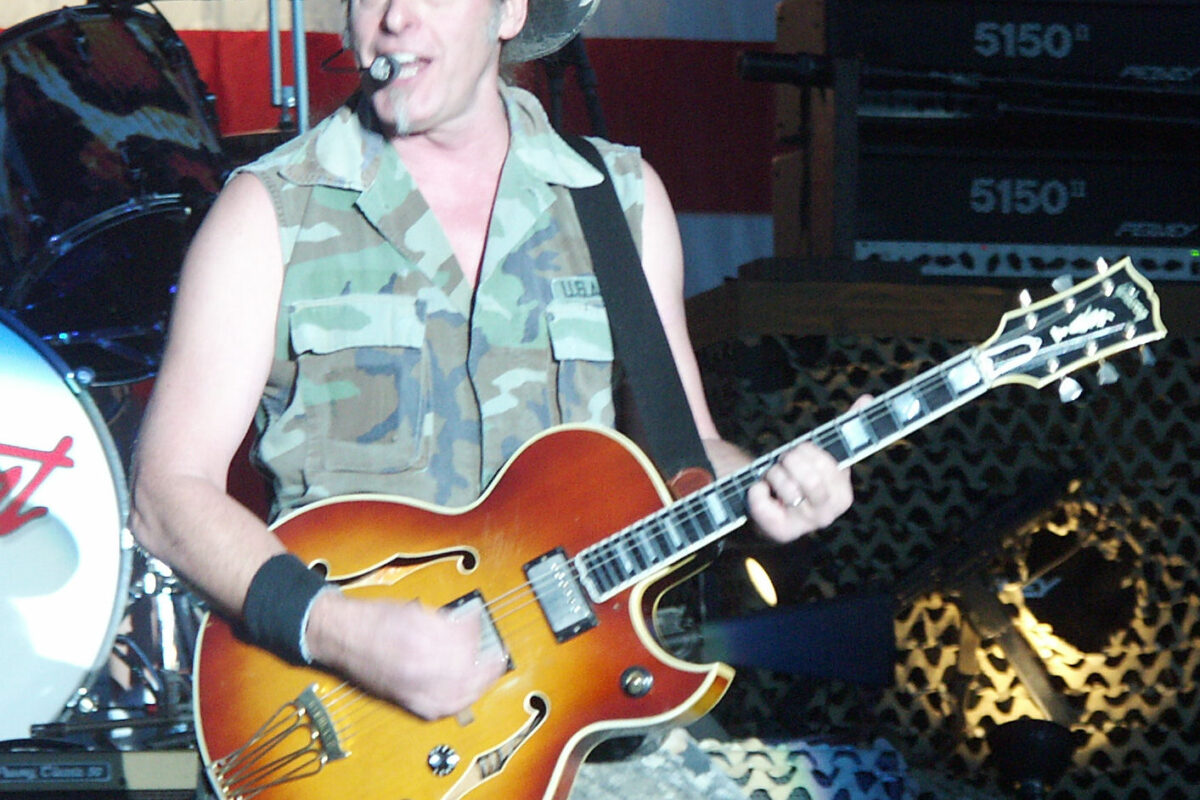
Ted Nugent Guitars & Gear: The Complete Guide to the Motor City Madman’s Byrdland Rig
Ted Nugent guitars & gear: the Motor City Madman's Byrdland rig. 12 vintage Gibson Byrdlands, Fender Twin Reverbs, Peavey 6505, zero effects, and the Stranglehold tone.
Ted Turner Guitars & Gear: The Complete Guide to Wishbone Ash’s Twin Guitar Pioneer’s Rig
Ted Turner guitars & gear: Wishbone Ash's twin-lead pioneer. Stratocasters, Firebird, Orange amps, and the Argus-era tone fully explained.
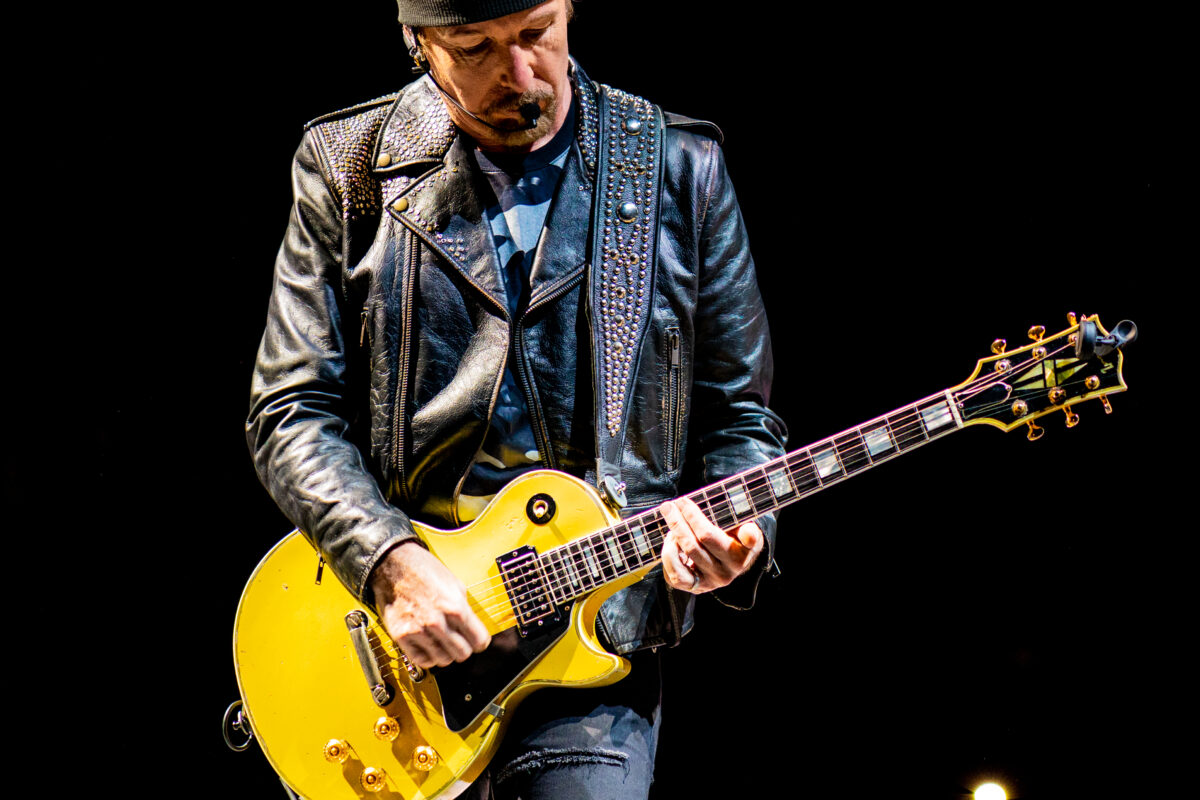
The Edge Guitars & Gear: The Complete Guide to U2’s Guitar Genius’s Rig
The Edge's guitars, amps, and effects — the complete guide. Gibson Explorer, Vox AC30, dotted eighth-note delay, Korg SDD-3000, and how to nail that massive U2 tone.