
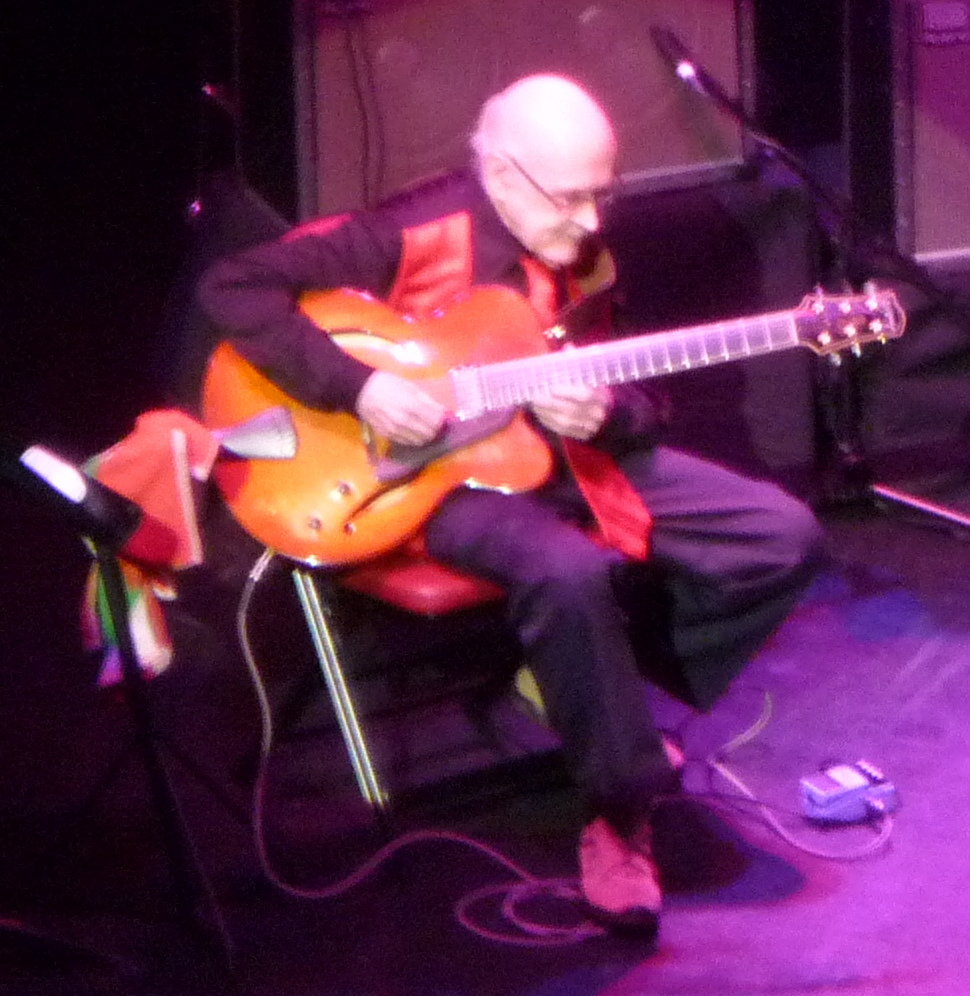
Jim Hall came from a generation that played mostly acoustic. He noted this before a concert during which he was using a Polytone amplifier — a Polytone Mini-Brute II, borrowed — and when the Polytone developed a problem at soundcheck, had to be turned up all the way to 10 to produce enough volume for the gig, Hall’s response to the profuse apology was characteristic: “it’s probably me.” He liked it and used it for eight shows. At another performance, when there was a problem with the club’s amplifier, he said simply that he could just play without an amp. That’s how quiet he liked to play. A colleague ran to his car and produced a Roland JC-77 from the trunk and Hall used that. The point is not that Hall had no preferences about amplification — he did — but that the amplification was incidental to the music, a tool whose specific character mattered less than what was played through it. “Always a full, warm sound, even with borrowed amplifiers.” The warmth was in Hall, not in the amplifier. The tone was in the player. The guitar was the Gibson ES-175 that he had bought in 1956 from Howard Roberts for a few dollars because Roberts was leaving Jimmy Giuffre’s band and Hall was replacing him. Roberts sold Hall the guitar. Hall wore the finish off it playing on the Merv Griffin television show, where he was the house guitarist during long stretches of idle time between segments. He wore the finish off because he played it. The guitar’s lacquer disappeared from the hours of playing and the D’Aquisto custom luthier Jimmy D’Aquisto later replaced the rosewood fingerboard with ebony and changed the P-90 pickup to a Guild humbucker. The tone control was rolled off completely. Flatwound strings. Tone rolled off. Polytone or Roland or whatever was available. Quiet enough to play without an amp. The finish worn off from playing. This is the Jim Hall gear story — the least eventful gear story in this series, because the most specific truth about Hall’s guitar approach is that the equipment was irrelevant to the sound, and the sound was among the most beautiful available in the jazz guitar tradition.
The Journey
Jim Hall was born on December 4, 1930, in Buffalo, New York, and died on December 10, 2013, in his sleep in his Manhattan apartment, at the age of eighty-three — exactly one week after his birthday, which may be the universe’s specific sense of completeness. He started playing guitar at age ten. At thirteen, he heard Charlie Christian — the foundational electric jazz guitarist who established the electric guitar’s vocabulary in the jazz context before his early death at twenty-five — and described it as “his spiritual awakening.” He transcribed not only Charlie Christian’s solos but the solos of saxophonists Coleman Hawkins and Lester Young, establishing from his earliest musical education the horn-influenced, melodically sophisticated approach that would distinguish his playing from the more purely guitar-centric traditions. He studied music theory, joined Chico Hamilton’s quintet in 1955, replaced Howard Roberts in Jimmy Giuffre’s band (and bought Roberts’ ES-175 in the transaction), worked with Ella Fitzgerald, recorded Undercurrent with Bill Evans in 1963, recorded The Bridge with Sonny Rollins in 1962, recorded Concierto in 1975 with Chet Baker and Paul Desmond and Ron Carter and Steve Gadd and Roland Hanna, and influenced essentially every significant jazz guitarist of the subsequent generation: Pat Metheny, John Scofield, Mick Goodrick, John Abercrombie, Mike Stern, Bill Frisell — all of them pointing to Hall as a primary influence. Pat Metheny: “Jim’s musical generosity was an exact reflection of his deep humanity.” That is the peer testimony of the most commercially successful jazz guitarist of the generation that Hall influenced, and it is not about the equipment.
Hall’s own assessments of his technique and his approach are among the most self-effacing available from any musician of his accomplishment: “I don’t really have all that much technique anyway,” he told NPR, which is the specific claim that becomes more extraordinary the more you know of what he actually played. He also said he’d “rather hear BB King play three notes than listen to an hour of technical guitar wizardry,” because “there’s something about BB’s intelligence.” The intelligence of three notes rather than a hundred. The space between notes as meaningful as the notes. The guitar as a “miniature orchestra.” These are not equipment philosophies; they are musical philosophies. The equipment that served them was the ES-175 with the finish worn off, the tone rolled off, the Guild humbucker (D’Aquisto’s modification) in the single pickup position, flatwound strings gauged .011-.050 with an unwound .022 G-string specifically so he could bend it to sound like a horn. The saxophone-transcribing guitarist who played the guitar to sound like a horn. The three notes from BB’s intelligence, applied to the archtop with the finish worn off from the Griffin show. This is the Jim Hall gear story.
The D’Aquisto relationship is the specific gear chapter that shows Hall’s willingness to invest in the equipment when the equipment was worth investing in: Jimmy D’Aquisto — widely considered the finest archtop guitar maker of the modern era, the luthier who inherited the D’Angelico tradition and developed it further into the most technically accomplished and most visually beautiful archtop guitars of the second half of the twentieth century — built two guitars for Hall. A 17-inch acoustic New Yorker style. A 16-inch electric that was “more or less a copy of Jim’s modded 175” — the ES-175 with the Guild humbucker and the ebony fingerboard that D’Aquisto himself had modified, now replicated in the specific D’Aquisto construction quality. Hall played the D’Aquisto until traveling with it became impractical — an irreplaceable instrument is not an instrument for airline baggage — and then Roger Sadowsky built the Jim Hall signature archtop as a practical touring alternative. “Jim and I believe that a laminated top sounds superior to a solid wood top when played through an amplifier, with less feedback as well.” The laminate won over the solid wood. Practical. Specific. The same preference for functionality over prestige that led to the Polytone borrowed at high volume. The same preference for three notes of BB King’s intelligence over an hour of technical wizardry.
Background: Buffalo, Charlie Christian’s Spiritual Awakening, and the Conversation That Changed Jazz Guitar
Charlie Christian’s specific impact on the thirteen-year-old Hall — the “spiritual awakening” description — is the most documented foundational musical influence in the Hall biography, and it is the specific influence that explains both the ES-175 and the horn-influenced phrasing that distinguishes Hall’s guitar approach from more purely guitar-centric traditions. Christian played the electric guitar as a horn instrument — with the specific linear, melodically developed phrasing of the saxophone tradition rather than the chord-and-rhythm approach that preceded the electric guitar’s integration into jazz — and Hall heard this at thirteen and understood it as the correct approach to the instrument. The subsequent transcription of Coleman Hawkins and Lester Young saxophone solos — the two foundational saxophonists of the swing and early bebop periods — confirmed the horn approach as the foundation of Hall’s melodic vocabulary. The guitar should sound like a horn. The strings should bend when necessary to produce the inflection that the horn’s embouchure produces. The unwound G-string (.022) specifically for bending. The flatwound strings for the warmth that approaches the horn’s absence of metallic string brightness.
The Jimmy Giuffre connection is the specific professional formation context that placed Hall in the most sophisticated available jazz chamber music context: Giuffre’s trio — with bassist Red Mitchell or (later) Scott LaFaro or others — was one of the most harmonically sophisticated and most intimate small-ensemble contexts in late-1950s jazz, and Hall’s guitar in that context had to maintain the specific chamber music intimacy that Giuffre’s compositional vision required. The ES-175 with the tone rolled off, quiet enough that the intimacy of the chamber context could be maintained without the electric guitar’s amplified character overwhelming the acoustic sound of the other instruments. The same guitar, the same quietness, the same “it’s probably me” when the amplifier developed a problem.
The Bill Evans collaboration — Undercurrent (1963), Interplay (1962), and Intermodulation (1966) — is Hall’s most celebrated creative partnership and the specific recordings that most completely demonstrate the conversational quality that distinguishes his guitar approach. Bill Evans’ piano and Hall’s guitar on Undercurrent produce the specific quality that NPR’s description identifies as “chamber music” — the intimate interplay and mutual understanding of two musicians who are not soloist and accompanist but equal conversational partners. “A real conversation that you associate with chamber music,” as the NPR Basic Jazz Record Library described it. The guitar and piano in conversation, the guitar not competing with the piano but responding to it, the piano not accompanying the guitar but answering it. This is the “musical generosity” that Metheny identified as Hall’s specific human quality applied to musical form.
The Concierto album (CTI, 1975) — with Chet Baker (trumpet), Paul Desmond (alto saxophone), Ron Carter (bass), Steve Gadd (drums), and Roland Hanna (piano) — is the specific commercial breakthrough that brought Hall’s name to the broadest available jazz audience. The “Concerto de Aranjuez” adaptation (the Spanish classical composition originally for guitar and orchestra by Rodrigo) gave Hall a rare opportunity to demonstrate his classical guitar facility alongside the jazz improvisation that defined his identity: the ES-175 or the D’Aquisto in dialogue with the full CTI studio ensemble, producing the specific warmth and clarity that characterized Hall’s best work in the most commercially accessible form he ever recorded in. “Concierto and Undercurrent” are the two albums most consistently cited as the essential Jim Hall starting points.
The Rig: Jim Hall’s Guitars, Amps, and Effects
Guitars
Jim Hall’s most historically celebrated guitar is the Gibson ES-175 that he bought from Howard Roberts in 1956 when Roberts was leaving Jimmy Giuffre’s band and Hall was replacing him. The ES-175 — Gibson’s professional-grade single-cutaway hollow-body jazz archtop, introduced in 1949 with the distinctive pointed cutaway and the laminated maple construction — had a single P-90 pickup in the neck position when Hall acquired it. Over years of playing on the Merv Griffin television show and through extensive touring, Hall wore the lacquer off the top above the 15th fret from the consistent physical contact of playing. Jimmy D’Aquisto subsequently modified the ES-175: the original P-90 was replaced with a Guild humbucker, and the original Brazilian rosewood fingerboard was replaced with an ebony one. The Guild humbucker’s specific character — warmer than the P-90, with the specific Guild humbucker tonal character that differs from the more common Gibson and Seymour Duncan humbuckers — combined with the ebony fingerboard’s brighter attack character to produce the specific ES-175-era Hall tone. Hall rolled the tone control off completely, which with the laminated hollow body and the flatwound strings and the Guild humbucker produced the specific warm, muffled, “gloved” quality of the classic Hall jazz guitar sound.
Jimmy D’Aquisto built Jim a custom 16-inch electric hollow-body guitar that was designed as an enhanced version of the ES-175 — incorporating the Guild humbucker and ebony fingerboard modifications that D’Aquisto himself had made to the ES-175, built in the D’Aquisto construction quality. The D’Aquisto guitar retained those Guild pickups — as the jazzguitar.be forum documents: “Those Guild pickups go a long way towards that very unique sound; the D’Aquisto guitar Jimmy built for Jim retained those pickups.” The D’Aquisto electric is Hall’s primary guitar for a significant portion of his career — appearing on the cover of the Live! album and in multiple documented performances — until the impracticality of touring with an irreplaceable custom instrument led Hall to commission the Sadowsky signature.
D’Aquisto built Hall two acoustic guitars as well: a classical cutaway guitar #101, the first of D’Aquisto’s builds, with a ledger date of 2/20/1983, and an Avant Garde #1220, the 220th build, with a ledger date of 6/29/1990. The classical cutaway reflects Hall’s classical guitar background and the specific nylon-string acoustic vocabulary that was part of his broader musical identity. The Avant Garde #1220 is the specific acoustic D’Aquisto that the Live! album cover may document.
When traveling with the irreplaceable D’Aquisto became impractical, Roger Sadowsky built the Jim Hall signature archtop as a practical touring instrument. Roger Sadowsky: “Jim and I (and many other players) believe that a laminated top sounds superior to a solid wood top when played through an amplifier, with less feedback as well. Of the original prototypes, one was built with a 5-ply maple top, and the other with a spruce top. The 5-ply maple was the clear winner when played through an amp.” The specific preference for the laminated top over the solid wood top is the specific practical and tonal preference of a guitarist who had played laminated instruments (the ES-175, the D’Aquisto electric) for most of his career and who understood the specific character of the laminated hollow-body through amplification. The Sadowsky signature: a laminated archtop built to Hall’s specifications, practical enough for airline baggage, tonal enough for professional recording and performance.
Hall used D’Aquisto flatwound strings in gauges .011-.050, with an unwound G-string (.022) specifically chosen for bending capability. “The top string is .011 and the bottom is .050 or perhaps a little heavier. I usually use a .022 for the third string, but I also use an unwound .019 so that I can bend it a bit to sound like a horn.” The horn-bending motivation for the unwound G-string is the specific practical application of the saxophone-transcribing guitarist’s desire to produce the horn’s specific pitch inflection on the guitar. Later he used Sadowsky flatwounds in .011-.050 with an unwound .018 G-string. Flatwound strings throughout: the specific warm, sustaining, treble-reduced character of the flatwound that suits the tone-rolled-off ES-175 and D’Aquisto approach.
Amps
Jim Hall was seen using a Polytone Mini-Brute II amplifier during a live performance with Scott Colley on double bass and Joey Baron on drums. The Polytone Mini-Brute series — solid-state jazz guitar amplifiers known for their clean, warm, and acoustically transparent character — is the specific category of amplification that the jazz guitarist of Hall’s generation and approach typically used: small, warm, quiet, and acoustically similar to the acoustic playing that Hall described himself as coming from. When the borrowed Polytone developed a problem at soundcheck and had to be turned up to 10, Hall said “it’s probably me” and used it for eight shows. The Polytone at 10 was still quiet enough for the intimate performance context.
At another performance, when the club’s amplifier developed a problem, Hall said he could just play without an amp — before a colleague produced a Roland JC-77 from the trunk of his car. The Roland JC-77 — the smaller sibling of the JC-120 Jazz Chorus that appears in this series in John McGeoch’s Siouxsie and the Banshees entry — provided the clean, solid-state amplification with the built-in chorus that the Roland JC series is famous for. Hall used it. “Always a full, warm sound, even with borrowed amplifiers.” The amplifier provided clean amplification; the warmth came from the guitar and the player.
“He could just play without an amp. That’s how quiet he liked to play.” This is the most specific amplification philosophy in this series: the amp is not the primary source of the sound; the guitar and the player are. Hall came from a generation that played mostly acoustic, that understood the electric guitar as an amplified acoustic instrument rather than as an electric instrument with acoustic characteristics. The Polytone or the Roland or whatever was available amplified the guitar to performance level without altering its acoustic character. The tone rolled off. The flatwound strings. The laminated hollow-body’s acoustic resonance. The Guild humbucker’s warmth. These are the actual tone sources. The amplifier amplifies them. The amplifier’s specific character matters less than the guitar’s acoustic character.
Effects
The most significant “effect” in Jim Hall’s signal chain is the complete absence of treble from the tone control — “Den Tone-Regler seiner Gitarren hatte Hall angeblich meist ganz zurückgedreht” (Hall’s tone control was reportedly mostly turned all the way off), as the German paleblueice gear description documents. The tone control at zero eliminates the high-frequency content from the guitar signal, leaving the warm, muffled, acoustically rounded character that the jazz guitar tradition describes as the “gloved” tone — the guitar speaking with the equivalent of a felt pick damper, producing the specific warmth and darkness that distinguishes the traditional jazz guitar sound from the brighter, more present sound of the guitar at full tone. This is the most consequential equipment choice in Hall’s signal chain, and it is the simplest available equipment choice: turn the tone control off.
The flatwound strings — with their specific smooth, non-winding surface and their specific warm, bright-reduced tonal character compared to roundwound strings — are the second most consequential tone-shaping element in the Hall signal chain. Flatwound strings reduce the high-frequency content of the guitar’s acoustic output at the string level, before the signal reaches the pickup or the amplifier, producing the specific warm, sustaining, sustain-heavy quality of the flatwound jazz guitar tone. The combination of flatwound strings and tone rolled to zero produces a guitar signal that is almost entirely mid-frequency and low-frequency content, with very little high-frequency character — the specific warm, dark, harmonically full quality of the classic Hall sound.
Jim Hall’s approach to effects was essentially the absence of effects — the guitar through the flatwound strings and the rolled-off tone control into the Polytone or whatever was available, without additional signal processing. This is not the effects minimalism of the guitarist who has experimented with effects and found them unsatisfying; it is the jazz guitar tradition’s specific understanding that the electric archtop guitar through appropriate amplification provides a complete and satisfying tonal vocabulary without the supplements that the rock and blues traditions found necessary. The “space” that Hall’s music is celebrated for — the specific use of silence as a compositional element, the rests between notes that are as meaningful as the notes — is not a product of effects processing but of the musical intelligence that understood silence as a part of the musical conversation rather than as an absence of contribution.
The Jimmy Giuffre trio context — and the specific transaction by which the ES-175 came to Hall as a replacement instrument for a departing colleague’s guitar — is the specific biographical economy of the jazz world in the late 1950s, where the community of professional musicians shared instruments, recommendations, and opportunities with the specific generosity that Metheny identified as Hall’s characteristic quality. Howard Roberts sold Hall the ES-175 because Roberts was leaving; Hall bought it because he was arriving. The instrument changed hands within the professional jazz community, from one accomplished guitarist to another, as one specific chapter of the guitar’s working life ended and another began. The guitar was not a collectable or an investment; it was a working instrument for a working musician, sold between working musicians at a working musician’s price. Hall played it until the finish wore off. Then D’Aquisto improved it. Then the D’Aquisto built a custom version that improved on the improvement. Then the Sadowsky signature improved the practical touring situation. The guitar evolved through the career in service of the music, with each modification and each new instrument responding to the specific musical requirement of the moment rather than to the prestige value or the collector’s calculus of the instrument market. The laminated top beat the solid wood top in the Sadowsky prototype test because it sounded better through an amplifier. The pragmatic result was adopted. This is the Hall equipment philosophy applied to its most significant single decision: the sound matters more than the material tradition. The flatwound strings and the tone rolled off are both the same pragmatic choice applied to the smallest available tonal variables. The sound matters. The material tradition is incidental to the sound.
Playing Style & Tone Philosophy
Jim Hall plays guitar as a miniature orchestra and as a conversationalist — the two descriptions that the available assessments use most often, and that together capture the specific quality of his approach. The “miniature orchestra” characterization (from NPR’s Rez Abbasi description) identifies the harmonic and textural completeness of Hall’s guitar playing — the way the single guitar produced the complete harmonic and rhythmic and melodic content of an ensemble through the specific chord voicings and the specific integration of melody and harmony that his jazz training provided. The “conversationalist” characterization identifies the specific quality of his ensemble playing — the way he listened and responded to the other musicians rather than playing through his own solo regardless of what they offered.
The Undercurrent collaboration with Bill Evans is the specific canonical demonstration of the conversational quality: two musicians of equal sophistication, equal attention to the other’s contribution, and equal willingness to leave space for the conversation to breathe. “A real conversation that you associate with chamber music.” Hall’s guitar on Undercurrent does not compete with Evans’ piano for the melodic primary; it responds to it, extends it, provides the harmonic context and the melodic commentary that Evans’ piano implies and Hall completes. This is the specific quality of musical generosity that Metheny described as an “exact reflection of his deep humanity” — the genuine human generosity of listening before speaking, of completing rather than competing, of silence as contribution rather than as absence.
“I’d rather hear BB King play three notes than listen to an hour of technical guitar wizardry, as there’s something about BB’s intelligence.” This quote contains Hall’s complete guitar philosophy in one sentence: the intelligence of the note selection is more important than the quantity or velocity of the notes. The three notes that BB King plays are more musically intelligent than the hundred notes that the technical wizard plays, because each of BB’s three notes is chosen for a specific musical reason and executed with specific emotional content, while the technical wizard’s hundred notes are chosen for demonstration rather than for music. Hall applied this philosophy to the ES-175 with the tone rolled off, the flatwound strings, the Polytone borrowed at whatever volume was necessary. The intelligence of the three notes. The warmth from the player. The amplifier amplified it.
How to Sound Like Jim Hall
The Jim Hall tone requires: a Gibson ES-175 or equivalent laminated hollow-body archtop (D’Aquisto, Sadowsky, or a well-made copy); flatwound strings in the .011-.050 range with an unwound G-string for bending; the tone control rolled off completely; a small, clean, warm transistor or tube amplifier (Polytone Mini-Brute or equivalent) at the lowest practical performance volume; no effects; and the musical intelligence to play three notes the way BB King plays three notes, from the completeness of jazz harmonic education and the conversational generosity of genuine listening. The equipment is the least important part of this list.
| Control | Setting (0–10) | Notes |
|---|---|---|
| Tone Control (Primary “Effect”) | 0 (completely off) | “Den Tone-Regler seiner Gitarren hatte Hall angeblich meist ganz zurückgedreht.” The tone all the way off: the primary Hall tone-shaping decision. No high frequency. All warmth and midrange. The “gloved” sound. This single setting produces more of the Hall character than any amplifier or effect could. Start here. Everything else supports this. |
| Flatwound Strings (.011-.050, unwound G .022) | Warm; smooth; non-metallic attack | “I usually use a .022 for the third string, but I also use an unwound .019 so that I can bend it a bit to sound like a horn.” Flatwound strings throughout reduce the high-frequency content at the string level. The unwound G-string allows the specific pitch bend toward the horn’s inflection. Flatwounds last longer than roundwounds and produce less fret wear on the ebony fingerboard. |
| Polytone Mini-Brute (Or Equivalent Clean Small Amp) | Volume: as low as the performance context allows | The Polytone at the minimum practical volume — quiet enough to play without an amp if necessary. The solid-state jazz guitar amplifier’s specific transparent, warm character amplifies the ES-175’s or D’Aquisto’s acoustic signal without adding the tube saturation that would alter the flatwound-and-tone-off character. “Always a full, warm sound, even with borrowed amplifiers.” The warmth is in the guitar and player. |
| Gibson ES-175 / D’Aquisto / Sadowsky (Laminated Hollow-Body) | Both pickups or neck single; Volume: 8 | The laminated hollow-body’s specific acoustic character — “Jim and I believe that a laminated top sounds superior to a solid wood top when played through an amplifier, with less feedback.” The neck pickup’s warm output, with the tone rolled off. Volume slightly back for dynamic range. The Guild humbucker’s specific warmth different from standard Gibson or Seymour Duncan character. The ebony fingerboard’s brighter attack moderated by the flatwounds and the zero tone. |
| The Conversation (Primary Technique) | Listen; respond; leave space; complete not compete | “Jim’s musical generosity was an exact reflection of his deep humanity.” The Hall guitar approach: listen to the other musicians before deciding what to play. The note you play is the one the conversation requires, not the one that demonstrates your technique. The rest is as important as the note. The three BB King notes over the hour of technical wizardry. The silence between notes is where the music breathes. Play the silence with the same attention as the notes. |
| Three Notes of Intelligence (BB King Philosophy) | Right note; right moment; right reason; then silence | “I’d rather hear BB King play three notes than listen to an hour of technical guitar wizardry, as there’s something about BB’s intelligence.” Every note chosen for a specific musical reason. After the note: silence. The silence is not the absence of music; it is the music. This is the Hall guitar philosophy in its most compressed available form. Apply it to the ES-175 with the tone rolled off, through the Polytone at low volume, with flatwound strings and the unwound G bent toward the horn sound. The warmth comes from the player. |
Influence & Legacy
Jim Hall’s influence on jazz guitar is the influence of the specific individual who demonstrated that the jazz guitar could be simultaneously harmonically complete (the miniature orchestra) and conversationally generous (the chamber music partner), with the equipment reduced to its most essential possible specification: a hollow-body archtop, flatwound strings, tone rolled off, quiet amplification. Pat Metheny, John Scofield, Mick Goodrick, John Abercrombie, Mike Stern, Bill Frisell — six of the most significant jazz guitarists of the subsequent generation — all cite Hall as a primary influence. The specific quality of playing that this many significant musicians absorbed from a single source: the conversational generosity, the harmonic completeness, the space between notes, the intelligence of the three notes over the hour of technique.
The Undercurrent and Concierto albums are the two canonical entry points — the recordings that most completely demonstrate the Hall approach to any listener coming to his music for the first time. Undercurrent’s chamber music piano-guitar conversation with Bill Evans; Concierto’s classical guitar facility applied to the jazz ensemble in the most commercially accessible form of Hall’s recorded career. Both with the ES-175 or the D’Aquisto, tone rolled off, flatwound strings, quiet amplification, three notes of BB King intelligence.
For the jazz guitar tradition that Hall participated in and helped define, see Bill Frisell’s entry at #91 — who cites Hall as a foundational influence on the atmospheric, space-oriented guitar approach that Frisell developed from the Hall foundation into the Americana and avant-garde contexts. John Scofield’s entry at #89 documents another Hall-influenced guitarist who took the jazz guitar foundation in the funk-fusion direction that Hall’s more restrained approach opened up by demonstrating what the jazz guitar could be. And Larry Coryell’s entry at #92 documents the fusion alternative to Hall’s more purely jazz approach — the guitarist who synthesized the jazz vocabulary with rock electric energy rather than maintaining the acoustic chamber intimacy that Hall prioritized.
He came from a generation that played mostly acoustic. He could play without an amp. The Polytone at 10 was still quiet enough. The tone control was at zero. The flatwound strings were .011-.050. The G-string was unwound so he could bend it to sound like a horn. The Gibson ES-175 was bought for a few dollars from Howard Roberts in 1956. The finish wore off from playing. Jimmy D’Aquisto changed the pickup to a Guild humbucker and the fingerboard to ebony. The D’Aquisto custom came later. The Sadowsky signature came when the D’Aquisto was too valuable to take on planes. Jim Hall, born December 4, 1930, Buffalo, New York. Died December 10, 2013, Manhattan, in his sleep, one week after his birthday. The ES-175’s finish wore off from playing. There was something about BB King’s intelligence. The silence between the notes was where the music breathed. He didn’t really have all that much technique anyway. He only needed three notes.
Frequently Asked Questions: Jim Hall Guitars & Gear
What guitar did Jim Hall use?
Jim Hall’s primary guitar for much of his career was a Gibson ES-175 that he bought from fellow guitarist Howard Roberts in 1956 for a modest sum, as Roberts was leaving Jimmy Giuffre’s band and Hall was replacing him. The ES-175 originally had a P-90 pickup; luthier Jimmy D’Aquisto later modified it with a Guild humbucker and replaced the rosewood fingerboard with ebony. Hall wore the finish off the top above the 15th fret from extensive playing. Later, D’Aquisto built Hall two custom guitars: a 16-inch electric hollow-body and acoustic instruments. When traveling with the D’Aquisto became impractical, Roger Sadowsky built the Jim Hall signature archtop — a practical laminate-top touring alternative. Hall and Sadowsky both preferred the laminated top over solid wood for amplified playing, with less feedback.
What amplifier did Jim Hall use?
Jim Hall’s documented primary amplifier was the Polytone Mini-Brute II — a solid-state jazz guitar amplifier known for its clean, warm character. He was comfortable with borrowed amplifiers and said he always achieved “a full, warm sound, even with borrowed amplifiers.” At one performance when the Polytone developed a problem and had to be turned to 10 for enough volume, Hall’s response was characteristically self-deprecating: “it’s probably me.” He also used a Roland JC-77 on another occasion. He noted that he came from a generation that played mostly acoustic, and said he could play without an amp — “that’s how quiet he liked to play.”
Why did Jim Hall roll his tone control all the way off?
Hall reportedly kept his tone control mostly rolled all the way off throughout his career — a practice that, combined with flatwound strings, produced the warm, dark, “gloved” jazz guitar tone that characterized his sound. The zero tone control setting eliminates the high-frequency content from the guitar signal, leaving only the warmth and midrange of the flatwound strings and the hollow-body guitar’s acoustic resonance. This single equipment setting — the simplest available — produced more of the characteristic Hall tonal quality than any amplifier or effect could.
What strings did Jim Hall use?
Hall used D’Aquisto flatwound strings in gauges .011-.050, with a specific preference for an unwound G-string (.022 or .019) “so that I can bend it a bit to sound like a horn.” The horn-bending motivation reflects Hall’s foundational approach: transcribing saxophone solos (Coleman Hawkins, Lester Young) as part of his early musical education produced the desire to produce the horn’s specific pitch inflection on the guitar, and the unwound G-string allowed the specific bend toward the horn’s inflection. Later he used Sadowsky flatwounds in the same gauges. Flatwound strings throughout his career.
Who did Jim Hall influence?
Jim Hall’s influence on the subsequent generation of jazz guitarists was comprehensive and direct: Pat Metheny, John Scofield, Mick Goodrick, John Abercrombie, Mike Stern, and Bill Frisell all cite Hall as a primary influence. Pat Metheny’s tribute — “Jim’s musical generosity was an exact reflection of his deep humanity” — is the most specific peer assessment of the quality that Hall’s six successors absorbed: the conversational generosity, the harmonic completeness, and the understanding that space and silence are as musically significant as notes.
What are Jim Hall’s most essential albums?
The two most consistently cited essential Jim Hall recordings are Undercurrent (1963, with pianist Bill Evans — the chamber jazz piano-guitar conversation that is “regarded by many as some of the best jazz records of all time”) and Concierto (CTI, 1975 — with Chet Baker, Paul Desmond, Ron Carter, Steve Gadd, and Roland Hanna, featuring the celebrated “Concerto de Aranjuez” adaptation). Also essential: Jazz Guitar (Pacific Jazz, 1957, his debut as a leader), The Bridge (1962, with Sonny Rollins), Alone Together (1972, with Ron Carter), and Jim Hall Live! (1975). His duet album with Pat Metheny (Jim Hall & Pat Metheny, 1999) is the most celebrated of his later recordings.
What was Jim Hall’s approach to guitar technique?
Hall famously self-deprecated: “I don’t really have all that much technique anyway.” He also said he’d “rather hear BB King play three notes than listen to an hour of technical guitar wizardry,” because “there’s something about BB’s intelligence.” His approach prioritized the intelligence of note selection over technical velocity or complexity — the three notes of complete musical intelligence over the hundred notes of technical demonstration. His guitar was described as a “miniature orchestra” for its harmonic completeness, and his ensemble playing was celebrated as “chamber music” for its conversational intimacy. The ES-175 with the tone rolled off, flatwound strings, quiet Polytone amplification: the equipment served the music, which served the conversation.
Related stories
The Edge Guitars & Gear: The Complete Guide to U2’s Guitar Genius’s Rig
The Edge's guitars, amps, and effects — the complete guide. Gibson Explorer, Vox AC30, dotted eighth-note delay, Korg SDD-3000, and how to nail that massive U2 tone.
Tim Henson Guitars & Gear: The Complete Guide to Polyphia’s Guitar Innovator’s Rig
Tim Henson's guitars, amps, and effects — the complete guide. Ibanez TOD10, TOD10N nylon, Fractal Axe-FX, Neural DSP Archetype, hybrid picking, and how to nail that Polyphia clean-crunch tone.
Tom DeLonge Guitars & Gear: The Complete Guide to Blink-182’s Single-Pickup Strat, Mesa Triple Rectifier & Invader Tone
Tom DeLonge guitars & gear: Blink-182 guitarist. Custom Shop Strat single Seymour Duncan Invader, Mesa Boogie Triple Rectifier, MXR EVH Flanger — Enema of the State tone guide.