Jimmy Bryant Guitars & Gear: The Complete Guide to the Fastest Guitar in the Country’s Rig
One day in 1950, Leo Fender walked into a cowboy bar on the outskirts of Hollywood carrying the prototype of an instrument that had no precedent and no guaranteed future. The solid-body electric guitar he was developing — still called the Broadcaster before Gretsch objected to the name — needed players who could demonstrate what it was actually capable of. He found Jimmy Bryant. Bryant took the prototype, played it, and gave Fender the feedback that helped shape the production instrument. He then appeared in Roy Rogers’ 1951 western film In Old Amarillo playing the Broadcaster — the first time a Fender guitar was seen on film. He also played it on the Hometown Jamboree television show — the first time a Fender guitar appeared on television. The instrument that would become the Telecaster, and through the Telecaster the Stratocaster, and through those instruments essentially every solid-body electric guitar in the world, had its first working relationship with Jimmy Bryant.
Ivy John Bryant Jr. was born March 5, 1925, in Moultrie, Georgia, the eldest of twelve children of a sharecropping fiddler father. He learned fiddle first — the family musical tradition — before gravitating to guitar as his primary instrument. He served in World War II, was severely injured by a grenade in 1945, and spent his recovery rebuilding his physical ability with the guitar. He moved to Los Angeles in the late 1940s, played in bars along Skid Row, met pedal steel guitarist Speedy West at one of those bars in 1948, and together with West formed what Guitar Player has called “the country jazz John and Paul” — the most combustible and most technically extraordinary country instrumental duo of the 1950s. He made 65 singles as Jimmy Bryant at Capitol Records under a five-year contract. He appeared in twelve Roy Rogers films. He played on over 124 recording sessions in 1955–1956 alone. He died on September 22, 1980, at fifty-five years old, obscure enough that his 2003 three-CD box set on Sundazed — Frettin’ Fingers: The Lightning Guitar of Jimmy Bryant — came as a revelation to guitarists who had never heard of him.
What Bryant left behind was not obscure at all. James Burton — who played guitar for Elvis Presley during his Las Vegas and touring years — credited Bryant as the inaugural Telecaster virtuoso after working with him in Los Angeles studios. Buck Owens absorbed Bryant’s emphasis on precise, twangy Telecaster leads when building the Bakersfield sound. Albert Lee described Bryant’s technique as featuring “incredible speed and definition” and cited him as a primary influence. Ritchie Blackmore and Steve Howe have both acknowledged the Bryant connection. The fastness, the jazz harmonic vocabulary applied to country music, the Telecaster as a lead instrument rather than a rhythm tool — all of it started with Bryant. This is the complete guide to the gear through which he made that revolution.
Background: From Georgia Sharecropper’s Son to Hollywood’s Fastest Guitar
Bryant’s path to Los Angeles was shaped by the same post-WWII migration that brought thousands of Southern musicians to California in search of work in the film industry, radio, and the growing entertainment economy. The grenade injury he sustained in 1945 — while still in service — was severe enough to require extended recovery, and during that recovery his relationship with the guitar became both therapeutic and obsessive. By the time he arrived in Los Angeles, he had developed a technique that combined his fiddle-playing background (speed, melodic fluency, a specific kind of rhythmic drive) with a jazz-influenced harmonic vocabulary that most country guitarists of the era hadn’t absorbed.
His meeting with Speedy West on Skid Row in 1948 was the pivotal event of his career. West was already established in the Los Angeles country music scene — he was playing in a 23-piece western swing band led by Spade Cooley — and his connection to Cliffie Stone’s Hometown Jamboree opened doors for Bryant. When Stone’s existing guitarist departed the Hometown Jamboree, West recommended Bryant as his replacement. That recommendation gave Bryant access to Capitol Records, where Stone was an artist and talent scout. The rest followed rapidly: session work, a contract, 65 singles, the Roy Rogers films, and — alongside West — a series of duet recordings that remain among the most extraordinary country instrumental recordings ever made.
The collaboration with Speedy West deserves its own moment of specific appreciation. West was the first country steel guitarist to use a pedal steel guitar — he began playing Paul Bigsby’s second-ever pedal steel in 1947 — and his approach to the instrument was reckless, inventive, and genuinely avant-garde for the country music of his era. Paired with Bryant’s jazz-chromatic Telecaster virtuosity, the two created a sound that had no precedent in country music and few equivalents anywhere in popular music. They were both, essentially, playing jazz — very fast, very harmonically sophisticated, very exciting jazz — in a country music context, and the combination was incendiary. Their recordings from the early-to-mid 1950s — “Stratosphere Boogie,” “Deep Water,” “Blue Bonnet Rag,” “The Night Rider” — are still played and studied by serious guitarists who encounter them for the first time with the same shock of recognition that greets any truly original body of work.
Bryant’s personal story had a darker dimension. His drinking became problematic by the mid-1950s and contributed to his reputation for being difficult to work with. He did his last Capitol recordings with West in late 1956. He moved to Nashville and recorded for the Imperial label. A planned Fender signature Stratocaster fell through — the exact circumstances are unclear, but Bryant became disillusioned with Fender and subsequently endorsed a series of other manufacturers. He remained active as a session player and live performer but never recaptured the commercial visibility of the 1950s Capitol years. He died in 1980, remembered primarily within the small community of country guitar specialists who understood his historical importance.
The Rig: Jimmy Bryant’s Guitars, Amps, and Key Instruments
Guitars
Fender Broadcaster Prototype (The First Great Guitar, 1950–1951): Jimmy Bryant’s most historically significant instrument was not one he purchased off a shelf but one that Leo Fender brought to him. Around 1950, Fender gave Bryant one of his early Broadcaster prototypes — a pre-production instrument built in Fender’s garage workshop — for feedback and endorsement. Bryant took the guitar, played it extensively in professional contexts, and helped demonstrate what the new solid-body design was capable of. The Broadcaster prototype appeared in Roy Rogers’ film In Old Amarillo (1951) — the first Fender guitar ever seen on film — and on television through the Hometown Jamboree broadcasts. The black-guard Broadcaster prototype, built in Leo’s garage, was the instrument on which Bryant’s earliest Capitol work was recorded and the instrument that established his identity as a Telecaster player before the Telecaster even officially existed.
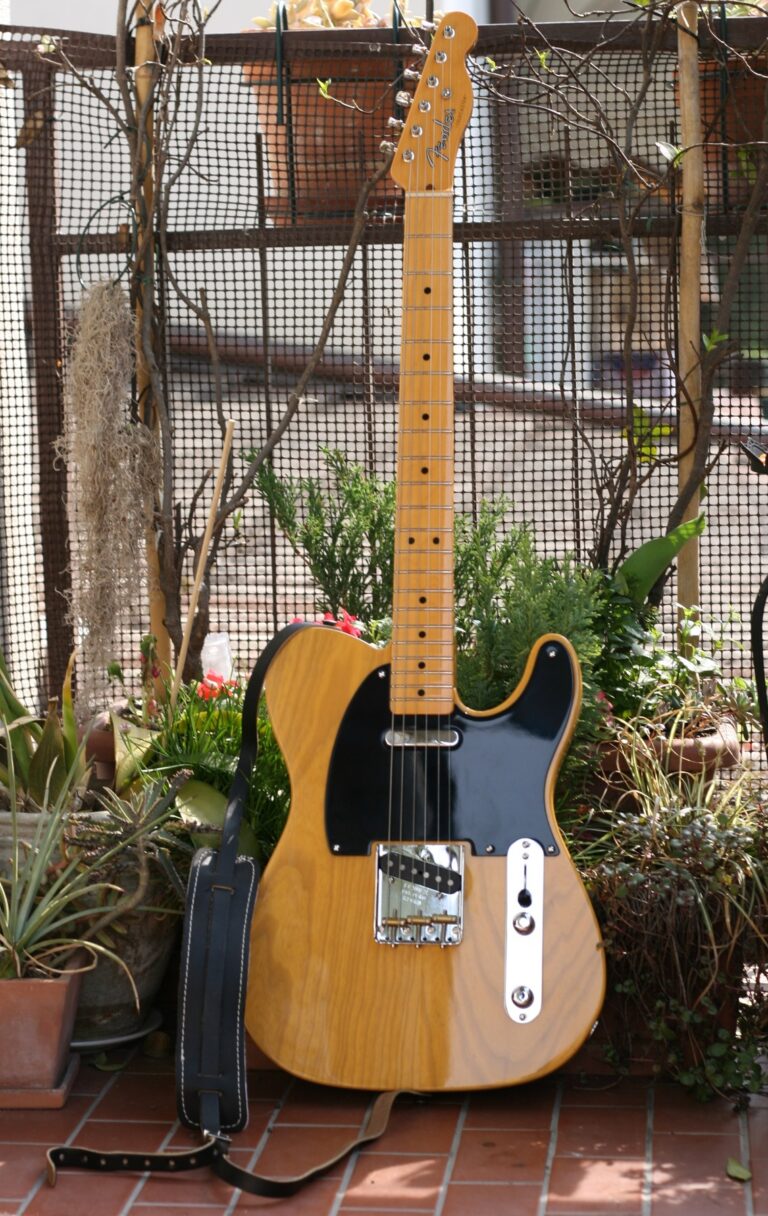
Fender Telecasters (Primary Career Instrument, Multiple Models): Bryant used several Broadcasters and Telecasters during the 1950s, and his relationship with these instruments is the central fact of his gear history. Deke Dickerson’s exhaustive research into Bryant’s Capitol recordings has confirmed that the Telecaster and the Fender Pro amp “appear on virtually all of his classic Capitol recordings.” Specific documented variants of his Telecaster collection include: a very early prototype model with the back hollowed out — Dickerson identifies this as “the origin of the hollow Telecaster Thinline produced in the ’60s”; a white pickguard model with a custom pickguard that had Bryant’s name emblazoned in rope lettering; and various production Telecasters through his endorsement relationship with Fender. His understanding of the Telecaster’s capabilities was deeper than anyone else’s at the time — he received the prototypes directly from Leo, gave feedback during development, and then spent the following decade demonstrating what the instrument could do at speeds and in harmonic territory that nobody had previously attempted on a solid-body electric.
Gibson Super 400 with Floating DeArmond Pickup (Early Hollywood Period): Before settling on the Telecaster as his primary instrument, Bryant was playing a sunburst Gibson Super 400 with a floating DeArmond pickup for his Hometown Jamboree work alongside a Fender Dual Professional amplifier. The Super 400 was Gibson’s largest and most prestigious archtop — a full 18-inch body, carved spruce top, the pinnacle of the archtop guitar tradition. With a floating DeArmond pickup (a clamp-on magnetic pickup that attached without permanent modification to the guitar), it produced the warm, full jazz archtop tone that was standard in country and western swing performance of the late 1940s. Bryant’s switch from the Super 400 to the Broadcaster prototype was a fundamental tonal shift — from warm archtop jazz to the bright, cutting solid-body character that defined his mature sound.
Stratosphere Twin Doubleneck (The “Stratosphere Boogie” Instrument): The most exotic instrument in Bryant’s documented collection is the Stratosphere Twin — a doubleneck guitar produced in Springfield, Missouri, that featured one standard six-string neck and one twelve-string neck strung in an entirely non-standard tuning: the strings tuned in thirds (minor and major) rather than the standard octave-doubling tuning of a conventional 12-string. This was specifically designed to allow a single guitarist to play twin-guitar harmonized lines — the kind of harmonized two-part melody that would normally require two separate guitar players. Bryant used the Stratosphere Twin on his 1954 recordings of “Stratosphere Boogie” and “Deep Water” — both on Capitol single F2964 — to achieve harmonized parallel lines that would have been physically impossible on a conventional guitar. The songs are extraordinary: the twin-neck’s third-interval tuning gives the harmony a specific intervallic quality different from anything a conventionally tuned 12-string could produce, and the speed and precision with which Bryant navigates the two necks simultaneously is still jaw-dropping to hear. He had long admired Les Paul’s multi-tracking approach to creating similar sounds on record; the Stratosphere Twin gave him the ability to produce them live and in a single take.
Rickenbacker Guitars (Post-Fender Period): After his Fender endorsement ended — reportedly acrimoniously, following the failure of the planned Jimmy Bryant Signature Stratocaster to materialize — Bryant moved through endorsements with several manufacturers. Rickenbacker guitars appear in his documented later-career gear, and he was reportedly the only guitarist ever to endorse Magnatone guitars. He also played an early Fender Jazzmaster for a period after leaving the Telecaster. The specific Rickenbacker models he used are not comprehensively documented, but the Rickenbacker semi-hollow archtop designs of the late 1950s and 1960s offered a different tonal character from the Telecaster — warmer, with more archtop resonance — that suited his later recording contexts.
Strat-Shaped Metallic-Blue Guitar (Imperial Label Period): For his debut on Imperial Records — Bryant’s Back in Town (1966) — Bryant and his Strat-shaped metallic-blue guitar were pictured on the cover. The specific manufacturer and model of this instrument have not been definitively identified in the literature, but its Stratocaster-influenced body shape suggests it was either a Fender product from this period or a similar solid-body from another manufacturer. The Imperial period saw Bryant experimenting with new sonic territory: he used a talk box on pedal-steel in “Shinbone,” fuzz on “Corn Ball,” and frequently recorded direct to the mixing board for specific jangly tonal effects.
Magnatone Guitar (Instructional Album Cover): Bryant appears with a Magnatone on the cover of his 1966 instructional album — one of the few documented appearances of this instrument in a professional context. Magnatone’s guitar line (separate from their amplifiers) was unusual and short-lived; Bryant was reportedly the only guitarist of note to endorse the brand. The Magnatone guitar’s specific tonal character is less documented than its amplifier line, but the endorsement reflects Bryant’s willingness to work with unusual and non-mainstream manufacturers after his disenchantment with Fender.
Amps
Fender Pro Amp with 15-Inch Field Coil Speaker (Primary Recording Amp, Capitol Era): The amplifier paired with Bryant’s Telecaster on virtually all of his classic Capitol recordings was a matching tweed Fender Pro amp — specifically a model fitted with a fifteen-inch field coil speaker. The field coil speaker (rather than a permanent-magnet speaker) was an older technology by the early 1950s, but produced a specific tonal character: slightly softer attack, different frequency response curve, and a warmth that complemented the Telecaster’s natural brightness. The Fender Pro’s larger 15-inch speaker gave more bass extension and fuller mid-range response than the smaller combos in the Fender line, suiting Bryant’s broad harmonic vocabulary and his tendency to play across the full range of the instrument. The amp appears on “Stratosphere Boogie,” on the West/Bryant duets, and on his own solo Capitol recordings.
Fender Dual Professional / Super (Early Hometown Jamboree Period): In the Hometown Jamboree period before the Broadcaster prototype arrived, Bryant used a Fender Dual Professional — a two-10-inch speaker combo with Jensen speakers — alongside his Gibson Super 400. This was one of Fender’s early two-speaker models, predating the standardized Fender amp line that would develop through the 1950s. The two 10-inch Jensens gave a different character from the Pro’s single 15-inch — brighter, more immediate, with the specific Jensen 10-inch character that defined early Fender combo sound.
Direct Console Recording: In his later career, Bryant frequently recorded his guitar direct into the mixing board — bypassing the amplifier entirely — to achieve specific “jangly” tonal characters that amplified guitar couldn’t produce in the same way. This approach, unusual for country guitarists of the era, reflects the same experimental attitude that led him to use the Stratosphere Twin doubleneck and to explore fuzz and talk-box effects in the 1960s — a musician always willing to push beyond the established tools of his genre.
Playing Style & Tone Philosophy
Jimmy Bryant’s playing was the first demonstration that jazz harmonic vocabulary could be executed at country music speed on a Telecaster. This synthesis — jazz thinking, country feel, Telecaster clarity — is his specific contribution to guitar history, and understanding it requires separating the three components.
The jazz vocabulary: Bryant’s melodic lines featured the chromatic passing tones, bebop-influenced note choices, and harmonic awareness of chord changes that characterized jazz improvisation. When he played through a 12-bar blues or a western swing chord progression, he wasn’t outlining the changes with pentatonic or diatonic scale patterns — he was constructing lines that referenced chord tones, passing tones, and approach notes in the manner of a jazz saxophonist or pianist. Premier Guitar’s assessment is precise: “Bryant’s improvising was a link between early jazz guitarists and country pickers.” He was, essentially, applying Charlie Christian’s harmonic language to country guitar contexts at speeds that Charlie Christian never attempted.
The country feel: despite the jazz harmonic content, Bryant’s phrasing had the forward momentum and the specific rhythmic drive of country and western swing rather than the more floating, suspended quality of jazz. The beat was there. The groove was there. The music swung in the country sense — kinetic, propulsive, foot-tapping — even when the notes he was playing belonged to a different tradition entirely. This is the combination that made his recordings with Speedy West so distinctive and so influential: jazz notes in a country-rhythmic body.
The Telecaster clarity: the Broadcaster/Telecaster’s specific tonal character — bright, cutting, with the bridge pickup’s nasal attack — was essential to Bryant’s sound rather than incidental to it. At the speeds he played, the individual notes needed to be distinctly audible; the Telecaster’s bright attack and clear note separation made his fastest runs legible in a way that a warmer-voiced instrument might not have. The fifteen-inch Fender Pro amp provided the low-frequency foundation and midrange warmth that balanced the Telecaster’s natural brightness without obscuring the speed.
His fiddle background contributed the same element it contributed to every guitarist who came from string-instrument tradition: melodic fluency, long-phrase thinking, and the specific physical speed that comes from years of executing fast passages on a bowed string instrument. The left-hand facility he developed on fiddle translated directly to guitar velocity.
How to Sound Like Jimmy Bryant
Guitar: A Fender Telecaster — specifically the bridge pickup — is the only authentic starting point. The Telecaster’s specific brightness and attack are not replicable by other instruments. The Fender American Original 50s Telecaster, the American Vintage II 1951 Nocaster, or any vintage-spec Telecaster with a brass bridge saddle and single-coil bridge pickup gets you into the correct tonal territory. For the Stratosphere Twin sound specifically: the effect can be approximated with a Telecaster running through an octave or harmony pedal set to a third interval, though the specific tuning of the Stratosphere’s 12-string neck produces a more complex harmonic result than any single-guitar approximation.
Amp: A tweed-era Fender combo with a 15-inch speaker is the authentic starting point — a Fender Pro reissue or a tweed Bassman (which uses four 10-inch speakers, a different tonal character but the same era’s circuit philosophy). The key is clean headroom with natural warmth: Bryant’s Telecaster recordings are not overdriven. They are bright, fast, and clean. The amp’s job is to amplify the Telecaster’s natural character with the warmth of the 15-inch speaker smoothing the high-frequency harshness.
Amp Settings (Tweed Fender / Clean Tube Combo):
| Control | Setting (0–10) | Notes |
|---|---|---|
| Volume | 4–6 | Clean — Bryant’s Capitol tone was pristine |
| Bass | 4–5 | Supported by the 15″ speaker — don’t boost further |
| Treble | 5–6 | Natural Tele brightness — not harsh, not rolled off |
| Reverb/Delay | 2–3 | Subtle — Bryant used reverb and delay but lightly |
The technique: The single most important element is the jazz harmonic vocabulary applied at speed. Study Bryant’s recordings for the chromatic passing tones and chord-tone targeting that characterize his lines. The speed will develop with practice; the harmonic thinking is the harder thing to internalize. His fiddle-player’s understanding of melodic line construction — long phrases that develop an idea rather than repeat a lick — is the musical intelligence behind the technical velocity.
Influence & Legacy
Jimmy Bryant’s influence runs through every player who discovered that the Telecaster was a lead instrument. Before Bryant, the solid-body electric guitar was primarily understood as a rhythm and support tool — cleaner than an archtop, louder than an acoustic, useful for certain effects but not the primary melodic voice in a band. Bryant’s use of the Broadcaster prototype as a virtuoso lead instrument — playing jazz-chromatic lines at unprecedented speeds — established the template for everything that followed.
James Burton — who played with Ricky Nelson and then with Elvis Presley through his final touring years, and who is the direct ancestor of the country-rock Telecaster tradition that runs through to Brad Paisley and Keith Urban — credited Bryant explicitly as the inaugural Telecaster virtuoso. The specific approach of using the Telecaster bridge pickup for expressive, fast lead work that Burton developed and that every subsequent country Telecaster player has inherited came from watching and absorbing what Bryant had done first.
Buck Owens — whose Bakersfield sound and whose partnership with Don Rich created one of the most important strands of country guitar — absorbed Bryant’s emphasis on precise, Telecaster-lead-guitar-forward country arrangements. The Bakersfield sound’s rejection of the Nashville Sound’s smooth production values in favor of raw Telecaster twang has a direct lineage to what Bryant demonstrated was possible.
Albert Lee — himself one of the most complete country-rock guitarists alive — specifically cited Bryant’s “incredible speed and definition” as a primary influence on his own fusion of country and rock. The Albert Lee → Jerry Reed → Johnny Hiland lineage of country guitar virtuosity runs partly through Bryant as a common ancestor.
Steve Howe — the Yes guitarist — has acknowledged the Bryant connection. This is a less-obvious but genuine lineage: Howe’s specific approach to fast, jazz-informed passage work on electric guitar in a rock context has antecedents in what Bryant was doing with similar material in a country context a decade earlier. Ritchie Blackmore is documented in the same acknowledgment. The idea of applying bebop-influenced harmonic thinking to an electric guitar at high speed in a non-jazz context: Bryant invented it first, and rock guitarists absorbed it through multiple chains of influence.
The Stratosphere Twin recordings — “Stratosphere Boogie” and “Deep Water” — deserve a final note as gear-history artifacts as much as musical documents. The Stratosphere Twin guitar, with its 12-string neck tuned in thirds, was genuinely invented for Bryant’s specific musical purpose: to produce parallel harmonized guitar lines that would require two separate players on conventional instruments. The concept — one guitar producing what sounds like two guitars in harmony — prefigures the multi-guitar arrangements that would become central to rock’s twin-guitar tradition. Scott Gorham and Brian Robertson’s Thin Lizzy harmonies, Dave Murray and Adrian Smith’s Iron Maiden twin leads — all of them are conceptually descended from what Bryant was demonstrating on the Stratosphere Twin in 1954. He was twenty years ahead of the tradition he helped create.
Related reading:
- Jerry Reed’s claw-style fingerpicking and country guitar mastery
- Read our guide to the Fender Telecaster
- Brad Paisley’s modern Telecaster country guitar lineage
- Scott Gorham’s twin-guitar approach, conceptually descended from Bryant’s Stratosphere Twin harmonies
Frequently Asked Questions: Jimmy Bryant Guitars & Gear
What guitar did Jimmy Bryant play?
Jimmy Bryant’s primary instrument was the Fender Telecaster — specifically, he was among the first professional guitarists to use a Fender Broadcaster prototype, received directly from Leo Fender around 1950. He used several Broadcasters and Telecasters during the 1950s, including a prototype with the back hollowed out (considered a precursor to the Telecaster Thinline) and a white pickguard model with his name in rope lettering. He also played a Gibson Super 400 with floating DeArmond pickup in his earliest Hollywood work, and the Stratosphere Twin doubleneck for the “Stratosphere Boogie” recordings. After his Fender endorsement ended, he played Rickenbacker guitars, Magnatone instruments, and various other models.
What amplifier did Jimmy Bryant use?
Bryant’s primary recording amplifier on his Capitol Records work was a tweed Fender Pro amp with a fifteen-inch field coil speaker — a model that appears on virtually all his classic Capitol recordings. In his earliest Hometown Jamboree period he used a Fender Dual Professional with two 10-inch Jensen speakers. He also recorded direct into the mixing console for specific tonal effects, bypassing amplification entirely. He paired his Telecaster with Magnatone amplifiers in certain later-career contexts and used reverb and delay lightly in his signal chain.
What is the Stratosphere Twin guitar and why is it important?
The Stratosphere Twin was a doubleneck guitar produced in Springfield, Missouri, featuring one standard six-string neck and one 12-string neck with a non-standard tuning: strings tuned in thirds (minor and major intervals) rather than the standard octave-doubling of a conventional 12-string. This allowed a single guitarist to play harmonized twin-guitar lines — the kind of parallel harmony that would normally require two separate players. Bryant used the Stratosphere Twin on his 1954 recordings “Stratosphere Boogie” and “Deep Water” to create the harmonized country-jazz sound that defines those recordings. It was the first doubleneck 12-string and 6-string electric guitar ever offered for sale.
Who is Jimmy Bryant’s most important legacy?
Bryant’s most important legacy is the demonstration that the Fender Telecaster was a virtuoso lead instrument rather than merely a rhythm guitar. Before Bryant, the solid-body electric was primarily used for rhythm and support roles. His jazz-chromatic lead work at high speed on the Broadcaster prototype established the Telecaster as a lead guitar, directly influencing James Burton, Buck Owens, Don Rich, and through them the entire tradition of country Telecaster playing. He also influenced rock guitarists including Albert Lee, Steve Howe, and Ritchie Blackmore through his demonstration of bebop-informed harmonic thinking applied at electric guitar speed.
Why did Jimmy Bryant fall out with Fender?
The exact details are not comprehensively documented, but Bryant became disillusioned with Fender after a planned Jimmy Bryant Signature Stratocaster fell through — the reasons for this failure remain unclear. After the endorsement ended, he moved through endorsements with Rickenbacker, Magnatone, and other manufacturers. He reportedly did not entirely stop using Fender instruments (photographs show him with a rosewood fingerboard Telecaster and an early Jazzmaster), but the close working relationship with Fender that characterized his early career did not continue into his later work.
What is “Stratosphere Boogie” and why is it historically significant?
“Stratosphere Boogie” (Capitol, 1954) is a recording by Jimmy Bryant and Speedy West in which Bryant plays the Stratosphere Twin doubleneck guitar, using its 12-string neck tuned in thirds to produce harmonized parallel lines that sound like two guitars simultaneously. The recording is historically significant as an early demonstration of parallel guitar harmonies as a compositional tool — a technique that would become central to the twin-guitar rock tradition of the 1970s. It is also a virtuosity showcase of the highest order, delivered at Bryant’s characteristically blistering speed.
Did Jimmy Bryant influence rock guitarists?
Yes, explicitly. Albert Lee, who is one of the most admired country-rock guitarists in the world, cited Bryant’s “incredible speed and definition” as a primary influence. Steve Howe (Yes) and Ritchie Blackmore (Deep Purple) have both acknowledged the Bryant connection. The conceptual lineage from Bryant’s jazz-harmonic speed picking on a solid-body electric to the rock guitar virtuoso tradition is direct: Bryant established that the approach was possible on a solid-body electric guitar in a non-jazz context, and rock guitarists absorbed this demonstration through multiple generations of influence.
Image credits
- Fender Telecaster: Massimo Barbieri, Wikimedia Commons, CC BY-SA 3.0.