

Remember the first time you heard the clean, shimmering intro to “Under the Bridge”? That tone that feels like sunshine and heartbreak all at once? Behind it stands John Frusciante — a quiet, almost fragile soul who joined his favorite band at nineteen, fell apart under fame, and somehow returned stronger than ever.
Frusciante didn’t walk into the Red Hot Chili Peppers as a polished rock star. He was a fan — a kid who had learned every riff by Hillel Slovak, the band’s original guitarist. When Slovak passed away, John stepped into his hero’s shoes, bringing both reverence and reinvention. His playing on Mother’s Milk and Blood Sugar Sex Magik didn’t scream for attention — it served the song.
That’s the magic of Frusciante: he never tries to dominate. His style is about breathing room — the way a single chord can make a room feel wider, or how a clean Strat line can cut through chaos without ever being loud. He once said he plays “for the spaces between,” and you can hear that philosophy in every note of Scar Tissue or Californication.
His influences are a cocktail of opposites — the wild expression of Jimi Hendrix, the precision of Eddie Van Halen, and the raw funk of Hillel Slovak. But the mix becomes something uniquely John. He uses soul where others use flash, emotion where others use speed.
The story wasn’t smooth. Fame hit hard. By the early ’90s, Frusciante quit the band, vanished into addiction, and nearly lost everything — his career, his health, even his home. But from the ashes came rebirth. When he rejoined the Chili Peppers in 1998, the result was Californication — a record that didn’t just revive the band, it redefined their sound.
This is the story of a guitarist who turned fragility into firepower, simplicity into poetry, and a handful of vintage Strats into the voice of an entire generation.
The Gear & Tone Philosophy – Less Tech, More Soul
John Frusciante’s tone isn’t about walls of gear or endless pedals — it’s about honesty. His setup looks almost humble compared to other arena players, but that’s exactly the point. He builds worlds with minimal tools, relying on touch, dynamics, and emotion rather than sheer volume or distortion.
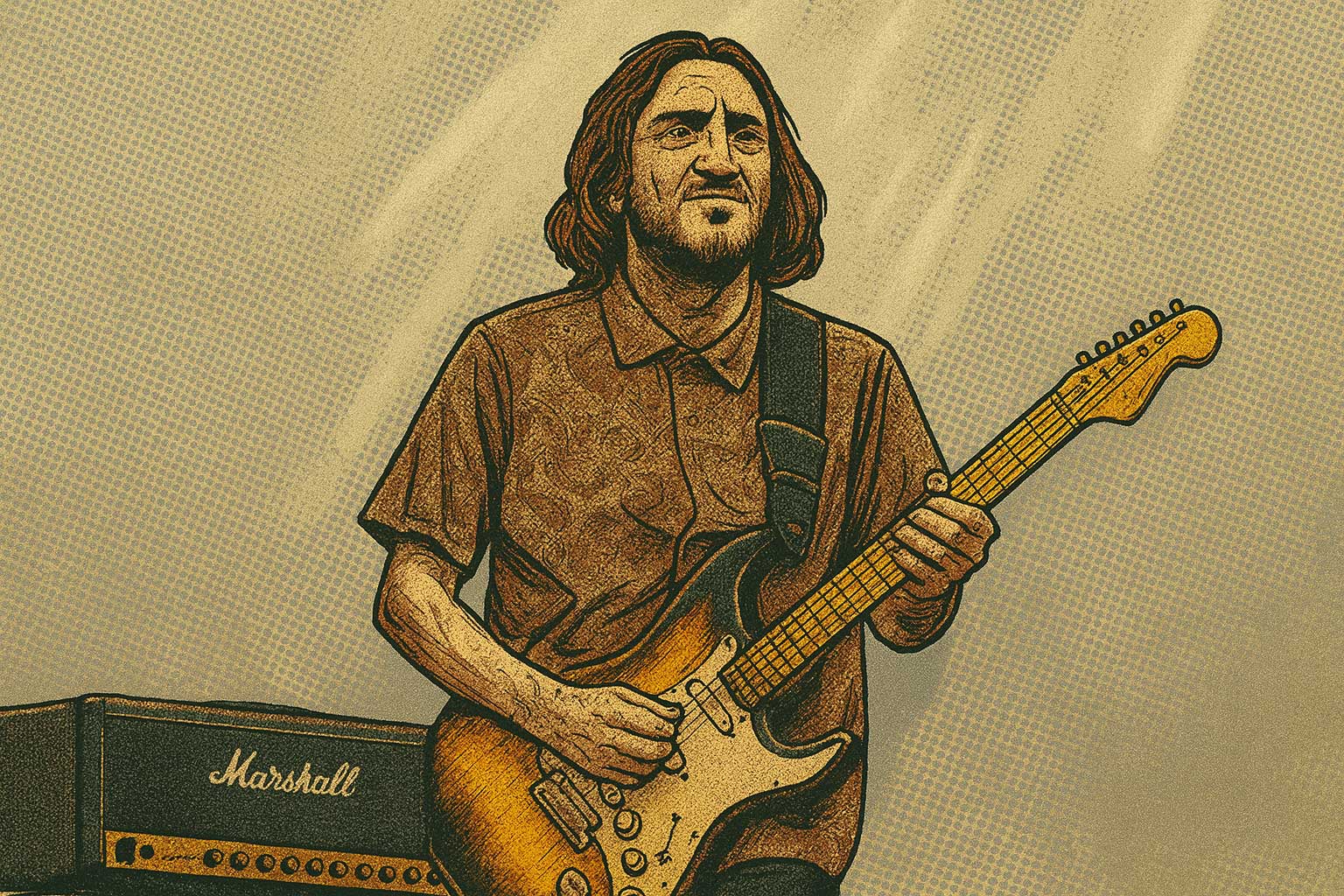
When John rejoined the Red Hot Chili Peppers for Californication, he stripped his sound back to basics: a few vintage Stratocasters, a Marshall stack, and the right hands. That’s it. He could’ve filled a warehouse with pedals, but instead he chose character over chaos. His signal path is pure — guitar to amp, maybe a chorus or fuzz pedal, and straight to heart.
The Heart of the Sound: Vintage Fenders
Frusciante’s main instruments are his early-’60s Fender Stratocasters — most notably a sunburst 1962 model that became his signature. The neck wear, the aged lacquer, even the cigarette burns are part of its identity. That guitar sings on songs like “Under the Bridge,” “Scar Tissue,” and “Dani California.”
He’s known for setting the pickup switch to the middle or neck positions, giving that glassy, bell-like tone. Combine that with light overdrive and a touch of reverb, and you get what fans call “that Frusciante sparkle” — a sound that somehow feels alive, like it’s breathing.
Amps: Raw Power, No Filters
For decades, his go-to setup has been a Marshall Major head or a Silver Jubilee, sometimes paired with a Fender Showman for extra clarity. He doesn’t stack gain or hide behind effects — the amp is turned up loud and clean, allowing every nuance of his playing to cut through.
John often says tone lives in the fingers, not the knobs. His right hand dynamics — soft strumming, sudden attacks, ghost notes — are what make each song sound human. It’s imperfect on purpose, and that’s why it feels real.
Pedals: Carefully Chosen Chaos
When he does use pedals, it’s never about showing off. Each one serves a purpose:
-
Boss DS-2 Turbo Distortion for raw, gritty drive.
-
Boss CE-1 Chorus Ensemble for that dreamy modulation you hear on “Under the Bridge.”
-
Electro-Harmonix Big Muff Pi and Fuzz Face for thick fuzz layers in live jams.
-
Moogerfooger Low-Pass Filter and Line 6 DL4 Delay Modeler for texture and ambience.
Even as his pedalboard grew in the 2020s, the philosophy stayed the same: effects should serve emotion, not replace it.
The Philosophy Behind the Tone
Frusciante’s tone isn’t just about equipment — it’s a mindset. He treats the guitar like a voice, using imperfections and volume swells the way a singer uses breath. He’ll dig into a string until it almost breaks, then let the next chord ring out clean and fragile.
For him, less has always meant more. It’s the same approach that made Californication shimmer and By the Way soar — restraint, space, and total commitment to feeling.
The Bands & Breakthroughs – A Career of Fire and Rebirth
John Frusciante’s story can’t be told without the bands that shaped him — and that he, in turn, reshaped. From the underground chaos of the early Chili Peppers to the stadium anthems of the 2000s, every chapter in his journey sounds different but feels connected by one thing: soul.
Red Hot Chili Peppers – The Birth of a Sound
When John joined the Red Hot Chili Peppers in 1988, he was barely out of his teens. The band had just lost founding guitarist Hillel Slovak, and their future looked uncertain. Then came Frusciante — a kid who could channel Hillel’s funk grit but add melody, harmony, and vulnerability.
On Mother’s Milk (1989), his youthful fire was everywhere — fuzzed-out riffs, fast funk lines, and solos that felt like controlled explosions. But it was Blood Sugar Sex Magik (1991) that turned everything to gold. Under Rick Rubin’s production, the band hit a perfect balance of groove and melody. John’s clean tone on “Under the Bridge” and his rhythmic bite on “Give It Away” helped push the album to multi-platinum status.
But the success was too much, too fast. The tours, the fame, the pressure — it all hit a 22-year-old who never wanted to be a celebrity. In 1992, John quit mid-tour and disappeared from the spotlight.
Solo Chaos and Resurrection
The years that followed were dark. Frusciante retreated to his home, where he painted, wrote, and recorded strange, lo-fi solo albums full of ghosts and tape hiss. Records like Niandra Lades and Usually Just a T-Shirt sounded raw, broken, and oddly beautiful — like the sound of a man talking to himself through a four-track machine.
But music saved him again. By 1998, he had cleaned up and rejoined the Chili Peppers. The reunion album Californication wasn’t just a comeback — it was a rebirth. John’s guitar lines glowed with clarity and hope. Songs like “Scar Tissue,” “Otherside,” and “Californication” reintroduced him as a player who could make simplicity hit harder than any shred solo ever could.
Then came By the Way (2002), a more melodic and layered record, where his harmonies and textures took center stage. By Stadium Arcadium (2006), Frusciante had evolved into a master of tone and arrangement — building twin-guitar symphonies that somehow still felt personal and human.
Beyond the Chili Peppers – Ataxia, The Mars Volta & The Night Shift
Even outside RHCP, Frusciante never stopped creating. His side project Ataxia, with Josh Klinghoffer and Joe Lally from Fugazi, explored experimental rock — long, hypnotic jams filled with looping bass and atmospheric guitar noise.
He also collaborated with The Mars Volta, contributing guitar and production touches that blended prog-rock ambition with psychedelic chaos.
And when the spotlight felt too bright again, he went solo — or rather, solo in the truest sense. Albums under his name and the alias Trickfinger dove deep into electronica and acid house, proving that Frusciante’s creativity doesn’t belong to one genre.
The Third Act – Return of the Magician
In 2019, Frusciante rejoined Red Hot Chili Peppers once again, sparking one of rock’s most celebrated reunions. The albums Unlimited Love (2022) and Return of the Dream Canteen saw him return with a new perspective — older, wiser, but still unpredictable. His tone was richer, his songwriting more patient, and his chemistry with Flea and Anthony Kiedis as alive as ever.
This latest chapter feels different. It’s not about proving anything — it’s about gratitude. Frusciante has nothing left to prove, yet everything he plays still sounds like discovery.
Signature Guitars & Gear Deep-Dive – The Tools of a Tone Poet
If you’ve ever heard that crystalline, emotional sparkle in John Frusciante’s playing, it’s not just technique — it’s his relationship with a few beautifully imperfect instruments. Every guitar he owns tells part of his story. They’re worn, scarred, sometimes barely holding together, but in his hands they become sacred tools.
The 1962 Fender Stratocaster – The Holy Grail
John’s main companion — and arguably one of the most famous Strats in rock history — is his 1962 Fender Stratocaster in three-tone sunburst. He bought it in the early ’90s, and it quickly became an extension of himself. The guitar’s aged rosewood neck, worn finish, and soulful resonance define classics like “Under the Bridge”, “Scar Tissue”, and “Dani California.”
He often plays it through the middle and neck pickups, letting that bell-like tone ring clear and wide. There’s nothing flashy about it — no hot-rodded pickups, no custom wiring. Just a vintage Fender breathing through a Marshall. It’s the definition of “less is more.”
The 1955 and 1961 Strats – The Backup Saints
Over the years, Frusciante has rotated other vintage Fenders into his live rig: a 1955 Stratocaster for its punchy single-coil snap, and a 1961 Stratocaster that delivers a slightly warmer response. Each one sounds unique but serves the same purpose — honesty through wood, wire, and touch.
He’s been known to say that he doesn’t “own” these guitars so much as “borrow their voices.” You can hear that philosophy in his clean rhythm work, where every chord blooms with personality.
Guitars Beyond the Strat
While Strats define his tone, John’s arsenal goes deeper:
-
Fender Telecaster Custom – Used on heavier or funkier tracks that needed bite.
-
Gretsch White Falcon – For shimmering clean passages on Stadium Arcadium.
-
Gibson ES-175 – Occasionally appears on his solo records for jazzier tones.
-
Martin Acoustic – For his stripped-down, emotional moments like “Road Trippin’.”
Each guitar earns its keep — there’s no collector’s vanity here, only purpose.
Signature Model – Fender Custom Shop John Frusciante Stratocaster
In 2023, Fender honored his legacy with the Limited Edition Masterbuilt John Frusciante Stratocaster, hand-built by Paul Waller at the Custom Shop. It’s a faithful recreation of his ’62 original — right down to the worn neck, clay dots, and custom-wound pickups by Abigail Ybarra.
Every detail screams authenticity: a nitrocellulose finish, aged hardware, and an Ilitch hum-canceling system that preserves vintage tone without the hum. It’s less a “signature” guitar and more a love letter to the sound that shaped an era.
Amps – The Roar Behind the Melody
Frusciante’s amplifier setup has stayed remarkably consistent through decades of evolution:
-
Marshall Major and Silver Jubilee heads for that crisp, open roar.
-
Fender Showman for added brightness and clean headroom.
-
Occasionally a Marshall JCM800 for extra warmth and breakup.
He runs his amps loud — almost painfully so — because he wants the tubes to sing. His tone isn’t pre-compressed or polished. It breathes, wobbles, and reacts to his touch like a living thing.
Pedalboard – Controlled Chaos
John’s pedalboard is iconic in its own right — a mixture of vintage simplicity and experimental curiosity. Some of his essentials include:
-
Boss DS-2 Turbo Distortion – His gritty overdrive of choice.
-
Boss CE-1 Chorus Ensemble – The lush swirl that defines “Under the Bridge.”
-
Electro-Harmonix Big Muff Pi – For his thick, fuzzed-out solos.
-
Moogerfooger Low-Pass Filter – For synth-like sweeps in live jams.
-
Line 6 DL4 Delay Modeler – A staple in his ambient textures.
-
MXR Phase 90 and Fuzz Face – Occasional guest stars.
His pedal philosophy is simple: use effects to extend expression, not replace it. Every sound he creates — from tape-delay loops to filtered fuzz shrieks — serves the song first
Strings & Setup
John Frusciante is a creature of habit when it comes to strings and setup — his tone depends on balance, feel, and control rather than fancy gear tweaks.
-
Strings: He typically uses D’Addario XL Nickel Wound .010–.046 on his Stratocasters and Telecasters. Occasionally, he switches to a lighter .009–.042 set during long tours to ease bending, but the .010s are his true comfort zone.
-
Tuning: Most songs are in standard E, though he sometimes drops a half-step to E♭ standard, especially for live performances of “Scar Tissue” and older RHCP material.
-
Action: Medium-to-high string action. Frusciante prefers a little fight from the strings — enough resistance to make dynamics matter.
-
Picks: Medium-gauge Fender 351 celluloid picks. He uses them loosely, often letting them scrape slightly across the strings for texture.
-
Setup Philosophy: His guitars aren’t hyper-polished or surgically intonated. He likes a lived-in feel — slightly imperfect, alive, and responsive to touch.
How to Sound Like John Frusciante
Want that shimmering, emotional tone that made Under the Bridge and Californication timeless? Here’s how to get close — not by copying, but by capturing the spirit of his sound.
Guitar
Start with a Fender Stratocaster or any Strat-style guitar with vintage single-coils. The neck and middle pickups are where the magic happens.
If you’re not rocking a vintage Fender, try:
-
Fender Vintera ‘60s Stratocaster
-
Player Plus Stratocaster
-
Squier Classic Vibe ‘60s Strat (budget-friendly and surprisingly accurate)
Keep your selector switch in position 4 (neck + middle) for those glassy, vocal-like cleans. Roll the tone knob down slightly to soften the attack.
Pickups & Electronics
Frusciante’s guitars are all about clarity and dynamics — low-output single coils do the trick.
-
Recommended: Fender Pure Vintage ‘65, Seymour Duncan SSL-1, or Lollar Blackface.
-
Keep volume around 7–8, tone rolled slightly back on the bridge pickup.
Amps
The amp is half the story. Frusciante’s rig is loud, clean, and brutally honest.
-
Marshall Silver Jubilee or Major for the authentic roar.
-
Fender Showman or Twin Reverb for sparkling headroom.
-
For smaller setups: Vox AC30, Boss Katana Artist, or Fender Blues Junior deliver great approximations.
Suggested EQ starting point:
-
Bass: 4
-
Mid: 7
-
Treble: 6
-
Presence: 5
-
Gain: Low
-
Volume: High — let the tubes breathe.
Pedals
Frusciante’s pedalboard is an exercise in discipline — every effect serves a feeling, not flash.
| Pedal | Setting / Use |
|---|---|
| Boss DS-2 Turbo Distortion | Gain 5 / Tone 6 / Level 6 — Turbo II on for solos. |
| Boss CE-1 Chorus Ensemble | Rate 3 / Depth 4 — for shimmering cleans like “Under the Bridge.” |
| Electro-Harmonix Big Muff Pi | Sustain 7 — thick fuzz for leads. |
| Line 6 DL4 Delay Modeler | 400–500 ms delay / Mix ~40 % / 3–4 repeats — ambient layering. |
| Moogerfooger Low-Pass Filter | For synth-like sweeps on By the Way tour tones. |
| MXR Phase 90 | Subtle swirl — used sparingly on atmospheric parts. |
Always keep the guitar volume control in play — Frusciante rides it constantly to shift from clean to breakup without touching pedals.
Playing Tips
-
Pick lightly and let dynamics do the work — play with the amp, not against it.
-
Keep rhythm tight but fluid — those muted strums between chords are essential.
-
Add gentle vibrato and slides rather than aggressive bends.
-
Don’t chase perfection. Frusciante’s tone breathes because it’s human.
Quick Starter Rig (Modern Equivalent)
If you want a modern, realistic setup that captures the essence of his sound:
-
Guitar: Fender Player Stratocaster (Alnico pickups)
-
Amp: Marshall DSL20 or Fender Hot Rod DeVille
-
Pedals: Boss DS-2, CE-2W, DL4 MkII
-
Strings: D’Addario .010–.046
-
Settings: Low gain, midrange emphasis, loud clean headroom
Play like you mean every note — that’s the secret.
Playing Style & Techniques – The Art of Emotion Over Perfection
John Frusciante’s playing isn’t about flawless execution — it’s about feeling. He can shift from delicate, melodic beauty to raw chaos in a heartbeat, yet it always sounds intentional. His guitar isn’t just an instrument; it’s a diary that sings, cries, and sometimes falls apart right in front of you.
Simplicity as a Superpower
Most great players chase complexity — John chases connection. He builds entire songs around minimal parts: a single melodic line, a few well-placed chords, a rhythm that lets the groove breathe. It’s restraint that makes his work powerful.
Listen to “Scar Tissue” — the solo isn’t flashy, it’s conversational. Every bend feels like a sigh. Or take “Californication” — just four chords, but the way he layers them with open voicings and clean dynamics turns them into something haunting. He often said that space between the notes is where the emotion hides, and his playing proves it.
The Magic of Clean Tone
Frusciante rarely hides behind distortion. His clean tone has become one of rock’s most recognizable voices — glassy, warm, and slightly vulnerable. He dials his amp hot but keeps the guitar volume rolled back just enough to let each note breathe. When he does crank the gain, it’s not to dominate the mix, it’s to serve the emotion.
His use of the Boss CE-1 Chorus and DS-2 Turbo Distortion pedals defines that blend of clarity and chaos — the perfect balance between church and fire. He lets the imperfections in the signal chain become part of the soul of the song.
Funk Roots, Rock Heart
John’s foundation sits somewhere between funk rhythm and classic rock melody. You can hear the ghost of Hillel Slovak in his percussive right-hand technique — those tight, syncopated scratches and muted ghost strums that give songs like “Can’t Stop” their groove. But you can also hear Hendrix in the chord voicings, and Eddie Van Halen in his fearless approach to effects and texture.
He’ll blend it all together: a Hendrix-style double-stop one second, a punky downstroke riff the next, and then a gospel-like arpeggio that opens the sky. It’s eclectic, but never random — every shift serves the song.
Improvisation & Live Energy
On stage, Frusciante plays with a mix of precision and wild instinct. No two solos are ever the same. He listens to Flea and Chad as if they’re having a conversation in real time — following the rhythm section rather than leading it. That’s why every Chili Peppers show feels alive.
Sometimes he’ll dive into chaos — feedback loops, whammy dives, or glitchy delay freakouts. Other nights he’ll hold one note for five seconds, eyes closed, as the whole arena goes silent. It’s not about showing off; it’s about honesty.
The Human Touch
What sets Frusciante apart isn’t just what he plays — it’s how he plays it. His hands never sound mechanical. He lets strings buzz, bends go slightly flat, and rhythms shift microseconds off the beat. Those human imperfections are what make his tone emotional.
He once said that music should feel like “a person trying to express their soul, not a machine proving its precision.” Every riff, solo, and accidental squeak proves he lives by that rule.
Notable Songs & Cultural Impact – Turning Emotion into Anthems
John Frusciante isn’t the kind of guitarist who hides behind speed or flash. His gift lies in creating parts that sound eternal — riffs and melodies that feel like they’ve always existed. His best songs don’t just show technical brilliance; they show heart, vulnerability, and an almost spiritual sense of melody.
“Under the Bridge” – The Song That Broke the World Open
Few songs define a guitarist’s career like “Under the Bridge.” Frusciante’s clean intro is a masterclass in tone, touch, and restraint. It’s built from simple chord shapes, yet every note shimmers with feeling. The way he lets the chords breathe between each phrase makes the entire piece sound human — fragile, reflective, and hopeful all at once.
That track turned Red Hot Chili Peppers from underground funk rebels into global icons. It also set a new standard for what emotional guitar playing could be in modern rock — expressive, melodic, and deeply personal.
“Scar Tissue” – The Wounded Melody
By the late ’90s, Frusciante had returned to the band with scars of his own — and “Scar Tissue” became his quiet confession. The slide guitar licks are simple, almost hesitant, but they carry a lifetime of pain and redemption. Every bend feels like it’s trying to heal.
It’s not just one of the most beautiful Chili Peppers songs — it’s one of the most honest guitar performances of the modern era.
“Californication” – Space and Restraint
The title track from Californication is a perfect example of how Frusciante uses space as an instrument. The arpeggiated chords ring out over Flea’s melodic bass line like waves rolling across the Pacific. He doesn’t crowd the arrangement; he lets silence do the talking.
That combination of melody and atmosphere turned a simple progression into one of the most recognizable intros in rock history.
“Can’t Stop” – The Groove Machine
Not every Frusciante part is quiet introspection. On “Can’t Stop,” his funky, precise downstrokes drive the song like an engine. It’s a masterclass in rhythm guitar — tight, syncopated, and dripping with personality. The way he locks in with Flea’s bass creates a groove that’s almost hypnotic.
It’s proof that John doesn’t just play with the rhythm section — he is part of it.
“Dani California” & “Snow (Hey Oh)” – The Modern Era
In the 2000s, Frusciante expanded his sound without losing its soul. “Dani California” shows his love for raw rock energy, while “Snow (Hey Oh)” is a study in technique and endurance. That rapid-fire picking pattern — clean, precise, and consistent — is one of his most recognizable riffs.
It’s a song every guitarist tries to learn at some point, not because it’s flashy, but because it’s hypnotic.
The Broader Influence
John Frusciante changed the way a generation thought about guitar tone. He reminded players that emotion, groove, and restraint matter as much as technical skill. His minimalist approach influenced everyone from indie rock bands to modern pop producers — artists who learned that space, melody, and texture can hit harder than distortion ever could.
Even today, you can hear echoes of his style in countless acts: the clean tones of Tame Impala, the phrasing of Arctic Monkeys, the vulnerability of John Mayer’s Continuum era — all trace part of their DNA back to Frusciante.
And beyond his sound, his story matters too: the rise, the fall, the comeback. He became proof that you can lose everything and still find your voice again — purer than before.
FAQs, Legacy & Why John Frusciante Still Matters
John Frusciante’s story is more than a guitar tale — it’s a story of transformation. He’s the rare artist who turned pain into poetry, proving that imperfection can sound divine when played with honesty. His legacy stretches far beyond the fretboard.
Frequently Asked Questions
What guitars does John Frusciante play?
His main weapon is a 1962 Fender Stratocaster — sunburst, aged, and full of soul. He also uses a 1955 and 1961 Strat, a Gretsch White Falcon, a Fender Telecaster Custom, and various acoustics.
What amps create his tone?
He’s most closely associated with the Marshall Major and Silver Jubilee heads, often paired with a Fender Showman. He runs them loud and clean, letting dynamics do the work instead of gain.
What pedals does he use?
The essentials include a Boss DS-2, Boss CE-1 Chorus Ensemble, Electro-Harmonix Big Muff Pi, Moogerfooger Low-Pass Filter, and Line 6 DL4. Every effect is there for emotion, not decoration.
How can I get John Frusciante’s tone?
Start with simplicity. A Strat-style guitar, a clean amp with plenty of headroom, and a light touch. Roll back your volume knob, focus on clarity and timing — and most importantly, play with feeling.
What are his most iconic songs?
“Under the Bridge,” “Scar Tissue,” “Californication,” “Can’t Stop,” “Snow (Hey Oh),” and “Dani California” showcase his full range — from tenderness to raw funk energy.
Did he really quit the band multiple times?
Yes. He left RHCP twice — first in 1992 at the height of fame, then again in 2009 — each time returning renewed and creatively reborn.
What’s his philosophy on music?
Frusciante believes music should sound human. He values vulnerability over perfection, emotion over precision, and creativity over conformity.
Legacy – The Human Side of Genius
John Frusciante redefined what it means to be a guitar hero. He never chased glory, endorsements, or technical mastery. Instead, he chased truth. His playing reminds us that a single note, played with intention, can carry more weight than a thousand empty ones.
Through every album, relapse, and resurrection, he’s remained authentic — a musician’s musician. His tone, phrasing, and humility inspired generations of players who learned that vulnerability can be louder than distortion.
Today, Frusciante’s influence runs deep in modern music — not just among guitarists, but producers, songwriters, and experimental artists who seek emotion first. He made the guitar feel personal again.
As long as there are players who believe that simplicity can move mountains, John Frusciante’s fingerprints will be all over the sound of the future.