Tom Morello – The Guitar Revolutionary Who Turned Noise Into Freedom
GuitarGangsters Editorial 16 min read Updated 21 October 2026
Tom Morello – The Guitar Revolutionary Who Turned Noise Into Freedom
You know that first scratchy, alien squeal on “Bulls on Parade”? The one that makes you wonder if it’s even a guitar? That’s Tom Morello — the guy who tore up every rulebook the rock world ever wrote and replaced it with one simple idea: imagination beats expensive gear every time.
Born in Harlem in 1964 and raised in the quiet suburbs of Libertyville, Illinois, Morello didn’t grow up surrounded by flashy guitars or rock star mentors. He grew up around ideas — his mother was a civil rights activist, and his father was a Kenyan revolutionary who once fought in the Mau Mau uprising. Maybe that explains why Tom never really separated rebellion from rhythm.
He didn’t start out planning to melt faces. He went to Harvard, studied political science, and came out with a degree — plus a mission: to make noise that meant something. But this wasn’t your average “college kid with a Strat” story. Morello soaked up everything — Led Zeppelin’s swagger, Black Sabbath’s heaviness, Run-D.M.C.’s punch, and The Clash’s revolution. Somewhere in the chaos, he found his sound — a mash-up of metal riffs, funk grooves, and turntable scratches, all shot through with a sharp political edge.
By the late ’80s, he was playing in a band called Lock Up, still hunting for that perfect fusion of power and purpose. He was broke, unknown, and barely holding onto his dream. Then, one afternoon in Los Angeles, everything changed.
He met a fiery poet named Zack de la Rocha, a bassist named Tim Commerford, and a drummer with thunder in his hands — Brad Wilk. Together they formed Rage Against the Machine, and rock music hasn’t been the same since.
Their mission wasn’t subtle. Rage didn’t just play songs — they declared war through distortion. When “Killing in the Name” dropped in 1992, it was like a bomb went off in every rehearsal room on the planet. The riffs were militant, the message was pure rebellion, and Tom Morello’s guitar didn’t sound like anyone else’s. Using a handful of pedals and a battered homemade guitar, he made sounds that felt like sirens, scratches, and explosions — like the whole system was collapsing through the amp.
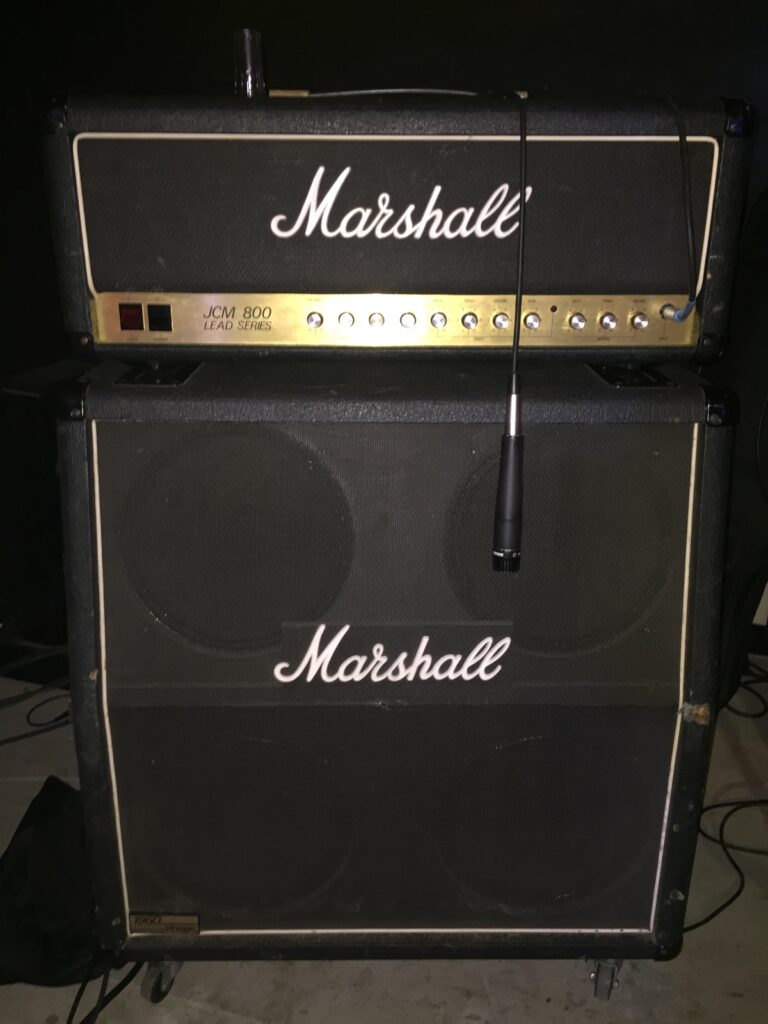
From there, Morello’s story became legend — not because he collected gear or chased endorsements, but because he built a sound from limits. He once said, “Gear matters zero percent.” And he meant it. His tone came from four things: a cheap Marshall head, a Peavey cabinet, a few beat-up pedals, and a brain full of revolutionary ideas.
In the next part, we’ll break down that setup — the Frankenstein guitars, the kill switches, the Whammy pedal magic — and how Tom Morello turned six strings into a weapon of mass inspiration.
The Gear of a Revolutionary – Inside Tom Morello’s Rig
Here’s the wild thing about Tom Morello’s setup: for a guy who sounds like a cyborg uprising wrapped in a revolution, his rig is shockingly simple. No boutique amps, no $5,000 pedals, no endless rack units. Just raw imagination strapped to a few stubbornly consistent pieces of gear he’s used since the late ’80s.
After his first rig got stolen, he walked into a local shop, grabbed a Marshall JCM800 2205 head and a Peavey 4×12 cab, and spent four straight hours twisting knobs until it screamed back the way he wanted. Then he marked the settings with tape — and never changed them again. That exact head and cab have been on every Rage and Audioslave record since.
Ask him what his secret weapon is, and he’ll shrug:
“Gear matters zero percent. Creativity matters 100 percent.”
But let’s be honest — the guy’s creativity thrives because his tools are weird, personal, and full of character.
“Arm the Homeless” – The Iconic Frankenstrat
If guitars had biographies, this one would be a punk-rock novel. Built in the mid-’80s by Performance Guitar USA, it’s a mash-up of parts Morello spent years swapping, breaking, and cursing at. The body? Alder. The neck? Graphite, after he ditched a chunky wooden one that felt like wrestling a baseball bat.
He loaded it with EMG 85/EMG H pickups, a Floyd Rose trem, and a custom kill switch wired from a three-way toggle. Across the blue body, in spray paint, are the words “Arm the Homeless” — scrawled by Morello himself one night before a gig, surrounded by four cartoon hippos that somehow became legendary mascots.
It’s the guitar that spat out “Killing in the Name”, “Bulls on Parade”, and “Freedom” — a Franken-creation that shouldn’t work, yet somehow channels pure chaos and clarity at once.
“Sendero Luminoso” – The Tele with a Rebel Soul
When the riffs drop to drop D, Morello reaches for a humble ’82 Fender Telecaster covered in stickers and scars. Its name — Sendero Luminoso (“Shining Path”) — says everything about his mindset: bright tone, militant message. It’s all stock except for a black pickguard and that handwritten sticker, but in his hands, it punches like a tank.
“Soul Power” – The Audioslave Era Strat
Fast-forward to the 2000s. Morello, now fronting Audioslave with Chris Cornell, wanted something sleeker. He modded a Japanese Fender Aerodyne Strat, adding a Seymour Duncan Hot Rails bridge pickup, Noiseless single coils, a Floyd Rose, and a chrome pickguard with — of course — another kill switch.
When “Like a Stone” hit radio, that shimmering solo came straight from this Strat. In 2020, Fender finally released the Tom Morello “ Soul Power ” Signature Stratocaster, a rare official collaboration that keeps every oddball detail intact — right down to the decal and the compound-radius fretboard.
The Pedalboard That Shook the System
If his guitars are characters, his pedals are accomplices. The lineup barely changes, but the way he abuses them does:
-
DigiTech Whammy WH-1 – his trademark two-octave dive-bombs and alien sirens.
-
DOD FX40B EQ – mid-boost for extra snarl.
-
Boss DD-2 Delay – short slap for percussive riffs.
-
Boss TR-2 Tremolo – that chopper-blade effect on “Guerrilla Radio”.
-
Dunlop Cry Baby Wah – essential for “Bulls on Parade”.
-
MXR Phase 90 and Ibanez DFL Flanger – for his sci-fi textures.
Sometimes he skips pedals altogether and just rubs a pencil or wrench across the strings, toggling the selector like a DJ cross-fader. It’s all about turning limitation into liberation.
Tone Philosophy – Turning Cheap Gear into Gold
Morello’s tone isn’t about warmth or perfection — it’s about identity. The amp’s set to roar, the EQ pedal pushes the mids, and the rest is pure human control. He’ll tell you: if your tone doesn’t sound like you, then no rig will save you.
In a world obsessed with boutique pedals and digital modelers, Tom Morello is the ultimate reminder that rebellion still lives in your fingertips.
The Bands That Defined an Era – Rage, Audioslave & Beyond
Tom Morello didn’t just join bands — he detonated movements. Each one carried a different message, but they all revolved around that same central spark: resistance.
Rage Against the Machine – The Sound of Uprising
When Rage hit the scene in 1992, they didn’t just release an album — they declared war on apathy. The debut record opened with “Bombtrack” and closed with “Freedom”, and every riff in between was a Molotov cocktail disguised as a groove.
Rage Against the Machine wasn’t just heavy; it was purposeful. With Zack de la Rocha spitting revolutionary poetry over Tom’s robotic scratches and siren screams, the band sounded like Public Enemy jamming with Black Sabbath inside a riot.
The hit “Killing in the Name” became an anthem of defiance, banned, censored, then resurrected by fans who made it the UK’s #1 Christmas song in 2009 — nearly two decades after its release. Evil Empire and The Battle of Los Angeles took that momentum global, topping charts and winning Grammys while still feeling underground.
Live, Rage was unstoppable. Every show felt like a political rally — amps blaring, fists raised, flags upside down. On Saturday Night Live in 1996, they hung American flags upside down during “Bulls on Parade” and got kicked off mid-song. That’s the point — Morello never wanted to entertain; he wanted to awaken.
Audioslave – Fire and Soul
When Rage split in 2000, Morello could’ve chased any project. Instead, he joined forces with Chris Cornell of Soundgarden — one of rock’s greatest voices — and created something completely new.
Audioslave fused 1970s rock power with Morello’s futuristic chaos. Cornell’s soulful voice met Morello’s robotic riffs, and somehow, it worked perfectly. Songs like “Cochise”, “Like a Stone”, and “Show Me How to Live” blended danger with beauty.
Their debut album went triple platinum, and “Like a Stone” — a haunting meditation on mortality — hit #1 on Billboard’s Mainstream Rock chart. It proved Morello could write songs that didn’t just punch — they lingered.
Follow-ups Out of Exile and Revelations hit #1 and #2 respectively, and for a few years, Audioslave ruled the airwaves. Behind the soaring choruses, Tom’s experimentation continued — whammy dives, glitchy kill-switch solos, tones that made guitarists worldwide scratch their heads and reach for their pedals.
When the band reunited for one night in 2017, it was pure magic. Cornell passed away just months later — a loss that hit Morello deeply. In interviews, he said that playing beside Chris felt like standing next to a volcano — unpredictable, powerful, unforgettable.
The Nightwatchman – When the Amp Goes Acoustic
Most guitar heroes crank up the gain to shout their message. Morello sometimes does the opposite. Under the name The Nightwatchman, he picks up a nylon-string guitar covered in slogans like “Whatever It Takes” and “Black Spartacus.”
Here, he trades distortion for storytelling — protest songs that nod to Woody Guthrie and Bob Dylan. His voice is rough, unpolished, but real. Songs like “One Man Revolution” and “The Fabled City” prove that you don’t need electricity to shock people awake.
Prophets of Rage – The Modern Resistance
In 2016, with Rage still on hiatus, Morello joined forces with Chuck D from Public Enemy and B-Real from Cypress Hill. The result? Prophets of Rage — a politically charged supergroup built to fight the chaos of modern times.
Armed with Marshall stacks and megaphones, they toured the world with slogans like “Make America Rage Again”. The message was clear: rock still had something to say — and Tom Morello was still saying it loud.
Legacy of the Machine
Across every lineup — Rage, Audioslave, The Nightwatchman, Prophets of Rage — one thing stays the same: Tom uses music as a weapon for change. Every riff is protest. Every solo is rebellion. Every lyric he backs is a call to question authority.
He once said,
“The electric guitar is the greatest instrument of protest ever invented.”
Looking back, it’s hard to argue.
Signature Guitars & the Gear Deep-Dive – When Hardware Becomes History
If there’s one thing Tom Morello proves, it’s that guitars aren’t just tools — they’re statements. Every one of his instruments carries a message, a scar, and a story. While other players chase endorsements, Morello builds legends out of plywood and persistence.
Arm the Homeless – The People’s Guitar
This one’s not a signature model… yet. But it’s more iconic than most that are.
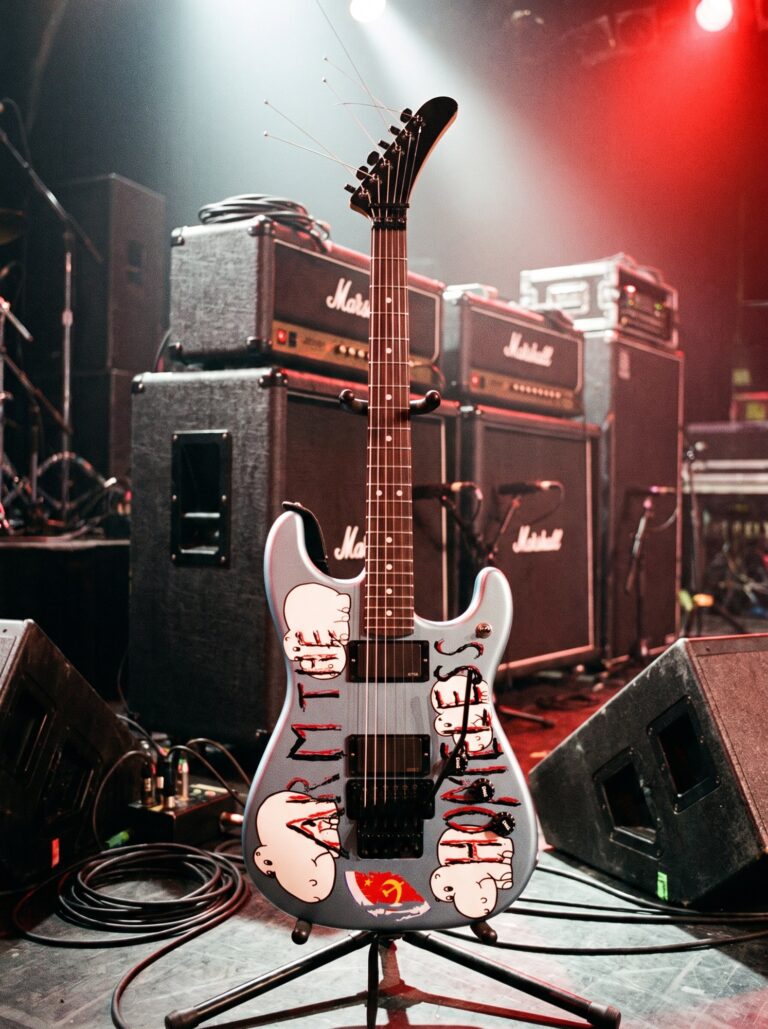
Back in the late ’80s, Tom walked into Performance Guitar USA and had them build what he thought would be his dream instrument. It wasn’t. He hated how it sounded. Over the next few years, he swapped everything — necks, pickups, tremolos — until only the alder body remained.
What emerged was the now-famous blue monster: “Arm the Homeless.”
Across the front, those three words spray-painted in white, flanked by four cartoon hippos. To most people it looks like a garage project gone wrong. To Tom, it’s the voice of revolution.
The final setup: a graphite neck with rosewood board, EMG 85 bridge and EMG H neck pickups, a Floyd Rose trem, and a toggle wired as a kill-switch. This guitar has been on every Rage Against the Machine album, and you can hear it tearing through “Killing in the Name,” “Bulls on Parade,” and “Freedom.”
There’s talk that Fender or another major brand might release an official version someday. But Morello’s clear — it has to stay ugly, awkward, and authentic. No polished reissue. Just truth in wood and wire.
The Soul Power Stratocaster – Chrome, Class, and Chaos
When Audioslave rose from the ashes of Rage, Morello needed something new. His weapon of choice became a Japanese Fender Aerodyne Stratocaster, modified beyond recognition.
He loaded it with a Seymour Duncan Hot Rails in the bridge, Noiseless single-coils, a Floyd Rose, and a chrome pickguard fitted with another kill-switch. On the body, one phrase screamed across the black finish: “Soul Power.”
That guitar gave birth to the soaring solo on “Like a Stone,” one of the most haunting mainstream rock hits of the 2000s.
Fender finally released an official Tom Morello “Soul Power” Signature Stratocaster in 2020, matching every odd detail — from the mirrored pickguard to the compound-radius neck. It’s a perfect blend of rebellion and precision.
Sendero Luminoso – Simplicity with Bite
Named after the Peruvian revolutionary movement Shining Path, this ’82 Telecaster is Morello’s go-to for drop-D chaos. It’s all stock — just a black pickguard, single coils, and that handmade sticker — but it’s proof that simplicity can still roar. You’ll hear it all over “Sleep Now in the Fire” and “Bulls on Parade.”
Acoustic Weapons – The Nightwatchman’s Tools
Even when he goes unplugged, Tom doesn’t drop the message. His Ibanez GA60SCE and Gibson J-45, both scrawled with protest slogans, are his folk-era guitars. They may look humble, but in his hands they’ve filled rallies and protest lines with the same fire as any Rage riff.
Signature Pedals – Bottled Revolution
Of course, someone eventually tried to put that fury into a stompbox.
-
MXR Tom Morello Power 50 Overdrive – designed to mimic his Marshall JCM800’s roar at any volume.
-
DigiTech Whammy “Tom Morello” Edition – limited run, same WH-1 circuit with special graphics.
-
Collaborations with Boss and boutique builders come and go, but Morello himself says it best:
“The effect isn’t in the pedal — it’s in the hands.”
Still, these pedals capture slices of his tone for those brave enough to try.
The Philosophy of Sound
For Morello, tone is about freedom, not fidelity. He doesn’t chase “vintage warmth” or boutique sparkle. He wants impact. The squeals, scratches, and helicopter chops aren’t accidents — they’re weapons. He turns limitation into liberation, proving that expression doesn’t live in price tags.
That’s why his gear lists are short, but his legacy is endless.
If you’re into gear revolutions and signature sounds, check out our deep-dives on James Hetfield’s Iron Cross Les Paul and Tony Iommi’s Monkey SG — two legends who, like Morello, forged tone from rebellion.
Playing Style, Techniques & the Art of Controlled Chaos
Try explaining Tom Morello’s playing style to someone who’s never heard him. You’ll probably end up saying something like: “It’s like a DJ got trapped inside a guitar amp — and decided to fight his way out.”
Morello’s approach is part science experiment, part revolution. He doesn’t play guitar on songs — he plays against them, twisting, scratching, and detuning until the instrument starts speaking its own language.
The Mechanics of Mayhem
At the core of his style are a few key weapons:
-
The Kill Switch – That three-way toggle wired to act as an on/off gate. He flicks it rhythmically to create those stuttering, helicopter-like bursts — you hear it all over “Bulls on Parade” and “Know Your Enemy.”
-
The Whammy Pedal – The DigiTech WH-1 isn’t just an effect — it’s an extension of his hand. It bends notes two octaves up or down, giving those alien squeals and soaring pitch jumps (“Killing in the Name”, “Like a Stone”).
-
The Wah & Tremolo Combo – On “Guerrilla Radio”, he uses the Boss TR-2 Tremolo to chop the signal into perfect rhythmic pulses, while the Cry Baby Wah filters the frequency, making the riff sound like it’s breathing.
-
Found Objects – Allen wrenches, pencils, coins — all fair game. Morello rubs them across the strings above the nut or near the pickups to mimic turntable scratching. It’s punk ingenuity with funk timing.
His left hand is all discipline; his right hand is all rebellion. Together, they create something no pedalboard can replicate — chaos under total control.
Tone as a Political Weapon
Tom often says his mission isn’t just to sound cool; it’s to sound like conflict. The metallic screams, machine-gun riffs, and robotic textures are metaphors — for surveillance, war, resistance, and revolution.
On stage, he doesn’t just solo — he broadcasts. Every squeal feels like a transmission from the front lines of a cultural battle. It’s theater, politics, and pure adrenaline rolled into six strings.
Notable Songs – Soundtracks of Rebellion
Each era of Morello’s career has its anthem — and every one is a masterclass in tone and intent.
🎸 “Killing in the Name” (1992)
A protest chant disguised as a metal riff. Those palm-muted E-string punches? Down-tuned rage. That ending? Pure catharsis. It’s one of the few songs where the silence between chords hits as hard as the distortion itself.
🎸 “Bulls on Parade” (1996)
The defining Morello moment. That “DJ solo” — created by rubbing his cable against the strings while manipulating the Whammy pedal — became a new guitar language overnight.
🎸 “Guerrilla Radio” (1999)
Political message, flawless groove. The choppy tremolo rhythm here is one of the most copied effects in modern rock.
🎸 “Like a Stone” (2003)
Audioslave’s emotional masterpiece. The solo feels like it’s crying through a broken radio — equal parts mechanical and human.
🎸 “Cochise” (2002)
Explosions, feedback, and percussive riffs that sound like artillery fire. One of the most aggressive openings in rock history.
🎸 “Sleep Now in the Fire” (1999)
A fierce satire of American greed. The solo sounds like chaos breaking loose — and yet, every sound is intentional.
Each song reinforces one truth: you can’t fake invention.
Beyond Technique – The Message in the Noise
Beneath the whammy madness and staccato shredding, there’s a storyteller. Every note feels like it’s punching through static to reach someone who needs to hear it.
That’s why Morello’s playing connects far beyond the guitar community. He doesn’t just shred — he says something. His sound reminds us that rebellion doesn’t always come with a slogan. Sometimes, it comes with distortion.
If you dig unique playing philosophies, check out our feature on John Frusciante’s raw Strat tones and Jack White’s DIY madness — both artists who, like Morello, made imperfection an art form.
FAQs, Legacy & Why Tom Morello Still Matters
He’s a Harvard grad with a Marshall stack, a protester with a pedalboard, and a tone scientist who can make a guitar sound like a helicopter, a siren, or a riot in motion. Three decades in, Tom Morello still stands alone — a reminder that rebellion and creativity can share the same power chord.
🔍 Frequently Asked (and Googled) Questions
What guitars does Tom Morello play?
His main weapons are the “Arm the Homeless” Frankenstrat, “Sendero Luminoso” Telecaster, and the “Soul Power” Stratocaster. He also uses acoustic protest guitars under his Nightwatchman alias, including a Gibson J-45 and Ibanez GA60SCE.
What amp does he use?
A single Marshall JCM800 2205 head paired with a Peavey 4×12 cabinet — the same rig he bought in 1988 and still uses today. He’s famously marked the knob settings with tape and refuses to change them.
Which pedals define his tone?
The DigiTech Whammy WH-1, DOD FX40B EQ, Boss TR-2 Tremolo, Boss DD-2 Delay, Dunlop Cry Baby, MXR Phase 90, and Ibanez DFL Flanger. Morello uses them like instruments, not effects — bending pitch, chopping rhythm, and creating textures no plugin can mimic.
How can I get Tom Morello’s tone?
Forget buying new gear — start with imagination. Use a mid-pushed Marshall-style amp, a Whammy pedal, and a toggle kill switch. Then experiment relentlessly. Tom’s philosophy: limitations create originality.
Is there an official “Arm the Homeless” signature guitar?
Not yet — but Morello has hinted that he’d approve one only if it stayed true to the DIY, imperfect original. The 2020 Fender “Soul Power” Stratocaster is the only official signature so far.
What are his most famous songs?
With Rage: “Killing in the Name,” “Bulls on Parade,” “Guerrilla Radio,” and “Sleep Now in the Fire.”
With Audioslave: “Like a Stone,” “Cochise,” “Show Me How to Live.”
All of them showcase different sides of his sound — militant, melodic, and unmistakably his.
What’s his tone philosophy in one sentence?
“The most important piece of gear is between your ears.”
⚡ The Legacy – Revolution Through Six Strings
Tom Morello changed what the electric guitar could be. He turned feedback into emotion, switches into speech, and solos into social commentary. While others chased tone perfection, he chased meaning.
Whether he’s headlining arenas with Rage, strumming protest songs as The Nightwatchman, or jamming with Bruce Springsteen, that rebellious spark never fades. Every squeal and stutter still feels like a reminder that music isn’t just sound — it’s power.
And that’s why Morello matters more than ever. In a world full of presets and algorithms, he remains gloriously unpredictable — the living proof that passion and purpose will always outplay perfection.
If you love artists who break the rules, dive into our pieces on James Hetfield – Downpicking King of Metallica and Tony Iommi – The Godfather of Heavy Metal. Both share Morello’s gift for turning rebellion into rhythm.––
Image credits
- Top image: Tom Morello – MuseBristol 050619-10, Wikimedia Commons, CC BY 2.0.
- Marshall JCM800: John2112, Wikimedia Commons, CC BY-SA 4.0.
- Tom Morello’s Arm the Homeless: GuitarGangsters AI-generated reference illustration, not a photograph.