Kirk Hammett – The Architect of Metal’s Dark Tone
GuitarGangsters Editorial 32 min read Updated 18 October 2026
There are guitarists who play metal — and then there’s Kirk Hammett, the man who turned fear, finesse, and feedback into one of the most recognizable guitar sounds on Earth.
Since joining Metallica in 1983, Kirk has been the sonic architect behind the band’s most iconic moments — from the molten scream of “Creeping Death” to the haunting cry of “The Unforgiven.”
But behind every note lies a labyrinth of gear, ghosts, and grit.
“Great tone isn’t luck — it’s architecture. You build it layer by layer, just like a song.”
— Kirk Hammett
Welcome to the complete GuitarGangsters deep dive into Kirk Hammett’s journey — his life, his rigs, his tone philosophy, and the horror-soaked guitar art that defines him. This isn’t just a story of a metal legend; it’s a blueprint for tone obsession that still rules arenas four decades later.
Background / The Artist’s Journey
From Bay Area Chaos to Global Metal Supremacy
Born in San Francisco in 1962, Kirk Lee Hammett was raised on the collision between surf rock, Sabbath riffs, and the violent birth of Bay Area thrash. Before Metallica ever called, Kirk was already grinding his teeth in Exodus, one of the original thrash outfits tearing up the Californian underground.
He wasn’t a prodigy — he was a tone scientist in a world before presets. Working a Burger King job just to afford his first Gibson Flying V, Kirk built his path one riff at a time. By the time Lars Ulrich dialed his number in 1983 to replace Dave Mustaine, Hammett’s life had already been tuned for destiny.
The first show with Metallica wasn’t glamorous. The amps hissed, the monitors bled, and the crowds were feral. But something happened when Kirk hit that first wah-saturated solo — a shriek that sliced through chaos. It wasn’t just distortion; it was identity.
The Thrash Years – Birth of Precision and Fear
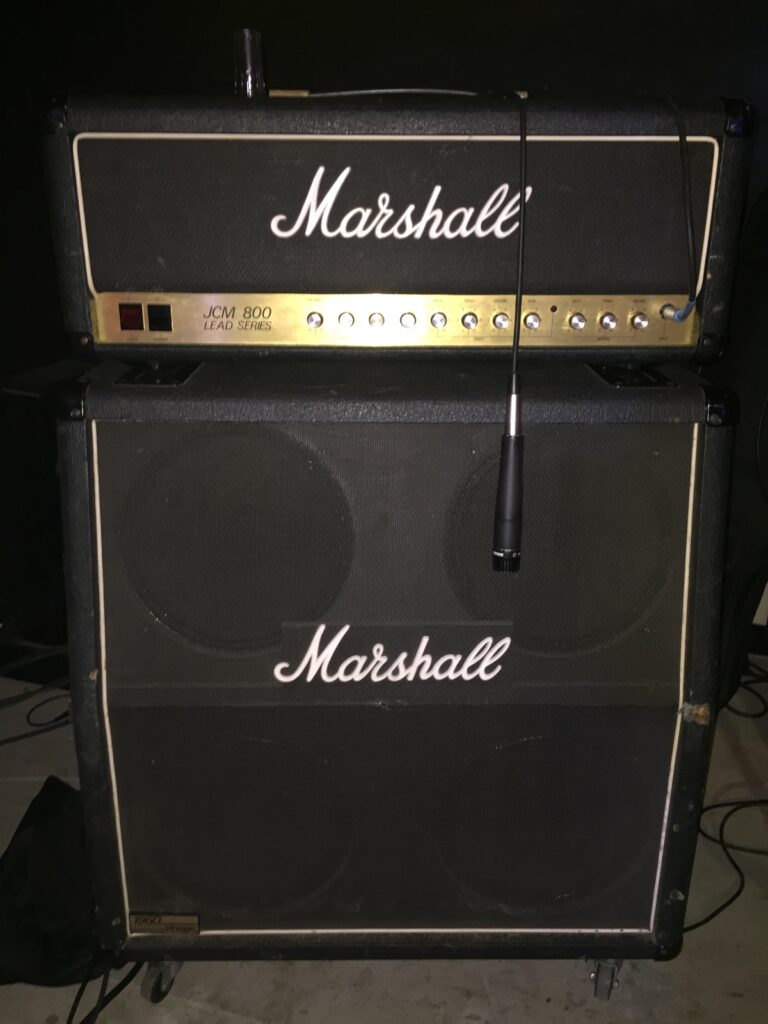
Kirk’s early years with Metallica were pure combustion. He stepped into a band running on caffeine and rage, armed with his battered 1979 Gibson Flying V and a Marshall JCM 800 that screamed like it was about to explode.
The result was Kill ’Em All — a raw, unfiltered statement of intent. You can hear a young guitarist clawing for control amid the storm, sculpting tone from the wreckage.
From there came Ride the Lightning (1984) and Master of Puppets (1986) — albums that redefined what “heavy” could sound like. The solos grew melodic, the tone tightened, and Kirk’s right hand became a metronome of menace. By the time …And Justice for All dropped in 1988, the world knew: Hammett wasn’t just Metallica’s lead guitarist — he was its pulse.
“I never cared about being the fastest. I cared about being the most expressive.” — Kirk Hammett
The Age of Refinement – From Mayhem to Mastery
The 1990s brought balance to the chaos. With The Black Album, Kirk and producer Bob Rock shaped a new form of sonic brutality — smoother, heavier, infinitely louder.
His solos on Enter Sandman and The Unforgiven weren’t technical exercises; they were emotional detonations. This was tone as storytelling — powered by Mesa Boogie Mark IV amps, EMG 81/60 pickups, and a meticulous understanding of how to make distortion breathe.
While Metallica flirted with reinvention during the Load and Reload years, Hammett evolved instead of retreating. He blended blues and hard-rock phrasing into the metal arsenal, pushing his sound toward something dirtier, groovier — still unmistakably his.
The Legacy Continues – Vintage Soul, Modern Muscle
Fast-forward to the present: Kirk Hammett, now in his sixties, still plays like a man possessed. His stage setup is an altar of metal heritage — Mesa Dual Rectifiers, Randall signature heads, and his beloved Greeny ’59 Les Paul, now singing beside the ESP monsters that made him a legend.
Every riff, every squeal still carries the DNA of that teenage kid soldering cables in his bedroom, chasing the perfect scream.
Today, as the metal world drowns in digital emulation, Hammett stands as proof that real tone still bleeds. His sound isn’t clean, and it’s never polite — it’s alive, breathing through wood, wire, and pure conviction.
The Rig / Gear
Kirk Hammett’s rig is a living, breathing monster — part science lab, part séance.
Every cable, every switch, every scratch on his guitars tells a story.
For Hammett, gear isn’t equipment. It’s identity.
Guitars — The Sonic Tarot of Kirk Hammett
If Metallica’s riffs are forged in steel, Hammett’s guitars are the weapons that swing it.
His collection isn’t just massive — it’s cinematic. Each instrument is a chapter in the mythology of metal: haunted symbols, cult references, and decades of battle scars baked into every fret.
Greeny – The Ghost That Won’t Die
Few guitars carry the kind of ghost stories that Greeny does.
A 1959 Gibson Les Paul Standard, born from the holy trinity of ownership: Peter Green, Gary Moore, and finally Kirk Hammett.
When Kirk bought it around 2009–2010, he didn’t just buy a guitar — he adopted a piece of rock history.
“Greeny” earned its nickname from Peter Green’s mod: an out-of-phase middle position caused by a reversed magnet in the neck pickup.
That mistake turned into magic — a tone that moaned instead of screamed, haunting instead of biting.
Hammett has called Greeny “alive.” It howls differently under every hand, sustaining like it’s haunted by every solo ever played on it.
Today, it’s more than an heirloom. It’s his spiritual compass.
“I play Greeny, and it’s like she knows what I’m about to do before I do it.” — Kirk Hammett
Hammett’s modern tone often begins and ends with Greeny — a vintage soul running through a Mesa-driven heart.
The ESP KH-2 ‘Caution’ – The Workhorse of Chaos
Long before signature deals were branding exercises, there was the KH-2 Caution.
Built in 1987, this was Kirk’s first true ESP custom, born in Japan’s Shibuya Custom Shop and instantly battle-ready.
Its yellow “CAUTION” sticker wasn’t decoration — it was warning tape for whatever stage he was about to destroy.
Specs:
- Body: Alder
- Neck: Maple bolt-on
- Fretboard: Rosewood, 24 extra-jumbo frets
- Pickups: EMG 81 (bridge) / EMG 60 (neck)
- Bridge: Floyd Rose Original
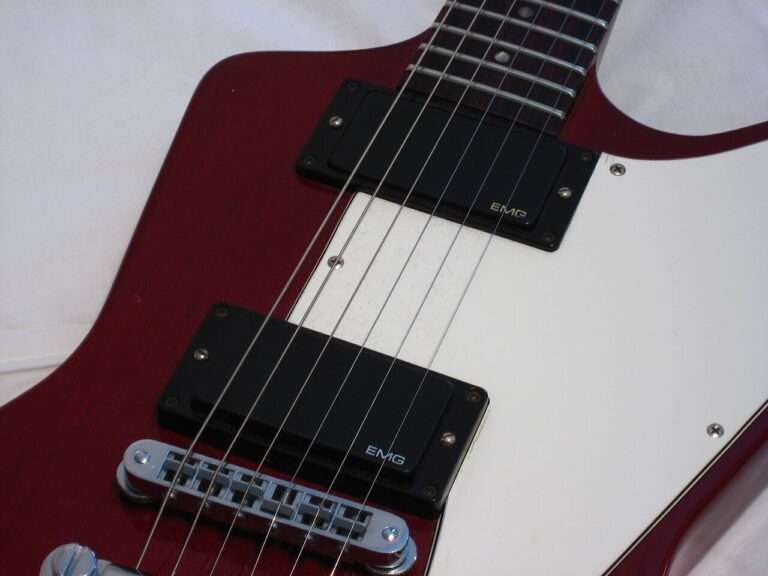
This was the tone of the late ’80s and early ’90s — compressed, articulate, fast.
From …And Justice for All to The Black Album, this guitar defined Hammett’s razor-cut lead sound.
It has lived through endless tours, sticker additions, sweat, beer, and blood.
The KH-2 became so iconic that ESP turned it into the backbone of Kirk’s entire signature line — every later ESP creation traces its DNA back to this one black, battle-scarred beast.
The Mummy – Horror Made Flesh (1992 Design, 1996 Debut)
No guitar screams “Kirk Hammett” louder than The Mummy.
Its body is draped in a print of the 1932 Boris Karloff movie poster, turning an ESP KH-2 into a horror-themed relic.
Originally crafted in 1992 but first unleashed live during the Load / Reload era (1996), the Mummy wasn’t just aesthetic — it was weaponized nostalgia.
Specs:
- Body: Alder
- Neck: Maple
- Fretboard: Rosewood, skull inlays
- Pickups: EMG 81/60
- Bridge: Floyd Rose
- Art: Custom transfer by ESP Japan under Kirk’s direction
Hammett has said that when he first played the Mummy, “it felt like an ancient spell got plugged into a wall socket.”
It’s darker, warmer than the KH-2, with an almost vocal midrange that cuts perfectly through Metallica’s twin-guitar mix.
The Mummy became such a cult icon that ESP later issued five distinct variations, each with subtle finish or graphic tweaks — and all of them instantly collectible.
“It’s a triple threat — it looks killer, plays killer, and sounds killer.” — Kirk Hammett
The Ouija – The Guitar That Talks Back
Some guitars sing. The Ouija whispers back.
Designed around 1990 after Kirk literally copied and faxed a Ouija board graphic to ESP Japan, this is his most infamous signature guitar.
When the first prototype arrived, it was as much an occult artifact as an instrument.
Fans thought it was a joke — until they heard it roar.
Specs:
- Body: Alder
- Neck: Maple bolt-on, thin U-profile
- Fretboard: Rosewood, 24 frets
- Pickups: EMG 81/60
- Bridge: Floyd Rose
- Finish: Black or natural wood with full Ouija board print (later purple and red sparkle editions)
The Ouija guitar became a cult relic. ESP released limited runs in 2010, 2015, and 2021, with prices soaring to the stratosphere.
Each finish feels like a séance on six strings.
Its tone? Pure, surgical aggression. The EMG 81 bridge pickup and thin U-neck give it blistering speed and tight control — perfect for Metallica’s rhythmic onslaught.
The Ouija isn’t just played; it’s invoked.
“It’s weird… sometimes it feels like the guitar is talking back to me.” — Kirk Hammett
The Nosferatu & White Zombie – The Undead Twins
When Kirk’s horror collection met his ESP partnership, monsters came to life again.
Nosferatu (limited to 13 pieces worldwide) is a blood-soaked tribute to the 1922 silent film. Its cracked-tomb finish and vintage red tone scheme give it the aura of an artifact unearthed from Dracula’s basement.
White Zombie, on the other hand, is vintage pulp horror glam — a 1932 Bela Lugosi poster splashed across an ESP KH-2 body.
Both carry EMG 81/60 pickups and Floyd systems, making them not just collectibles but stage-ready killers.
Together, they form Hammett’s ultimate statement: that guitars should tell stories — sometimes terrifying ones.
The 1979 Gibson Flying V – The First Blade
Before fame, before signature models, there was the black Gibson Flying V — Kirk’s first love and first weapon.
Bought with the sweat of a teenage day job, this guitar carried him from Exodus rehearsals to Metallica’s debut.
It wasn’t pristine. It was loud, raw, and full of attitude.
Fitted with stock humbuckers and run through a Marshall JCM 800, it produced the nasal snarl that defined Kill ’Em All.
Even today, it remains in his arsenal — a reminder of where it all began.
“That Flying V taught me everything about tone — mostly by fighting me the whole time.” — Kirk Hammett
Signature Guitars – When the Name Becomes the Axe
When a guitarist’s name is stamped on the headstock, something changes. It stops being just an instrument and starts being a declaration. For Kirk Hammett, signature models aren’t mere endorsements—they’re tone missions incarnate. Each one channels a piece of his story, his obsession, his legacy. Here are the models you can own (if you’ve got the guts).
🎸 Gibson / Epiphone – The Legacy Line
Gibson “Greeny” Les Paul Standard
The name sends chills: Greeny. A 1959 Les Paul Standard that lived three lifetimes—first in the hands of blues legend Peter Green, then rock outlaw Gary Moore, and finally Metallica’s tone warrior, Hammett. When he finally secured it around 2014–15, it felt like tone destiny clicking into place.
Inside: a secret weapon. The neck pickup magnet reversed polarity, giving a horrific out-of-phase middle position that wails like a tortured ghost. Plug it into a Mesa, fire up the wah, and you’ll hear the entire lineage breathe.
Gibson finally honoured it with a signature run: the Murphy Lab edition that lets you chase that haunted sustain. Epiphone followed with a more accessible iteration.
This is not a showpiece—it’s a spiritual conduit. Use it for slow leads, ballads, moments where the crowd holds its breath and the note hovers. Think “The Unforgiven”, “Nothing Else Matters”. This is legacy, bottled.
Epiphone “Greeny” Les Paul Standard
Want the myth without selling your car? Epiphone made it possible. Same concept, more reachable. Same reversed magnet trick, same soul-quake. Now you can channel that ghost without mortgaging your studio.
⚡ ESP / LTD – Workhorses & Horror Icons
ESP KH-2 “Caution” Signature Series
This is the machine. The black-skull beast Hammett used through the late ’80s and into the ’90s when Metallica broke the world. Alder body, extra-thin U-maple neck, 24 extra-jumbo frets, Floyd Rose, EMG 81/60 pickups.
The “Caution” moniker? That yellow sticker slapped on during the Black Album sessions. The records don’t just speak—they scream.
From “Enter Sandman” to “Sad But True”, the solos you’ve memorised rolled off this axe. It’s ruthless, reliable, unrelenting.
The signature-line KH-2 (and its vintage, NTB, etc variants) let you tap into the same DNA.
ESP LTD KH-602 / KH-202
Not enough budget for the high-end? The LTD versions deliver Hammett’s ethos at a price. The KH-602 duplicates neck & pickups, the KH-202 is the accessible gateway.
Same aggressive voice, same bald-faced swagger. Great for players chasing the Hammett sound without collector-wallet trauma.
ESP “Ouija” Signature Model
Where tone meets the paranormal. Early ’90s idea: Kirk faxed ESP Japan a photocopy of a Ouija board. They answered. The result: the Ouija-themed KH-2 variant.
Full graphic body wrap, skull inlays, planchette details. EMG 81/60, Floyd Rose, alder body.
Live, when the lights go dark and the solo kicks in (think “One”, “Creeping Death”), the Ouija doesn’t just play—it conjures.
The limited editions (Natural, Purple Sparkle, Red Sparkle) are collector holy-grails. But the tone? Gene-splicing of Hammett’s soul.
ESP “Mummy” Signature Model
Guitar meets monster-movie poster. The 1932 The Mummy wrap, the skull inlays, the dark midrange voice. Alder body, EMG 81/60, Floyd.
Used during the groove-heavy Load/Reload era when Kirk shifted his solo voice into something deeper, bluesier, more textured.
It’s the proof that Hammett can lean back and groove, not just shred.
ESP “Nosferatu” & “White Zombie”
Limited edition statements of identity. Blood-red cracked finish (Nosferatu), Bela Lugosi horror art (White Zombie). Same high-gain spec (EMG 81/60 + Floyd).
Rarely used live—when they are, you know something epic is happening. For gear fetishists. For tone cultists. For Hammett.
ESP LTD KH-V (Flying V Signature)
Yes—he’s got a V too. The KH-V is his V-shape signature model from ESP/LTD. 25.5″ scale, korina body, extra-thin U-neck, 24 frets, EMG Bone Breaker pickups.
Released March 2023 in three finishes (Black Sparkle, Red Sparkle, Metallic Gold).
Purpose? For players chasing Hammett’s tone in a V if you want shape and swagger.
This ensures his signature line spans shapes: Les Pauls, Super Strats, Vs. Choice is yours—but cruelty is guaranteed.
⚔️ Epiphone Kirk Hammett 1979 Flying V – The Return of the First Blade
Long before arenas, gold records, and million-dollar Les Pauls, there was a hungry kid in the Bay Area saving paychecks from a fast-food job to buy a black Gibson Flying V. That guitar became his first weapon of war — the one that screamed through Kill ’Em All and carved his name into thrash history.
Four decades later, Epiphone brought that weapon back from the dead.
Released in 2024, the Epiphone Kirk Hammett 1979 Flying V Ebony is a faithful resurrection of the original:
- Body: mahogany, sleek and sharp as a guillotine.
- Neck: one-piece mahogany with a smooth 1970s SlimTaper C profile that begs for speed.
- Fingerboard: Indian Laurel, 22 medium-jumbo frets, white dot inlays.
- Hardware: blacked-out Tone Pros Tune-O-Matic bridge and stopbar tailpiece for that stripped-down metal aesthetic.
- Pickups: Gibson USA T-Type humbuckers, voiced for vintage crunch with modern attack.
- Finish: deep Ebony gloss — a visual echo of the original axe that launched a legend.
Every detail bleeds nostalgia, from the mirror-polished headstock logo to the period-correct control layout. Even the case screams old-school road-ready menace.
“It’s like shaking hands with my past — only now it’s louder.” — Kirk Hammett
This model isn’t about luxury or museum reverence. It’s about energy. Plug it into a roaring amp and you’ll hear the young Kirk again — the rawness, the bite, the danger.
The release gave fans a chance to own not the myth of Hammett’s career, but its beginning. And Epiphone nailed the balance: real-deal feel, real-world price. It’s the people’s Flying V, forged for players who still believe guitar heroes should sweat, bleed, and play loud enough to rattle the rafters.
Why These Signature Models Matter to You
- They lock in the tone architecture Hammett built: pickup combo, neck profile, trem system, woods.
- They span price tiers so players on any budget can chase the voice.
- They carry narrative: guitar as myth, guitar as identity.
- For affiliate linking: highlight the accessible models (Epiphone Greeny, ESP LTD KH-602/KH-V) so your readers can buy into the legend.
Amps & Cabinets – Sculpting Thunder
If his guitars are the blades, his amps are the anvils.
Hammett’s amplifier evolution is a textbook in modern metal tone design.
He began with Marshall JCM 800s, pushing them until the tubes begged for mercy.
But by Master of Puppets, the game changed — he discovered Mesa Boogie’s Mark IIC+, the amp that birthed his signature scooped-mid punch.
By the Black Album, Kirk was stacking heads like artillery: Mesa Mark IVs, modded Marshalls, and Fender cleans blended in the studio for that massive stereo width.
The result? Solos that didn’t just cut through the mix — they owned it.
Since the 2000s, Hammett has run a dual-head system, blending Mesa Dual Rectifiers with his Randall RM100KH signature heads.
On modern tours, you’ll also spot prototype Fortin heads and rack-mounted Mesa systems chained to digital controllers.
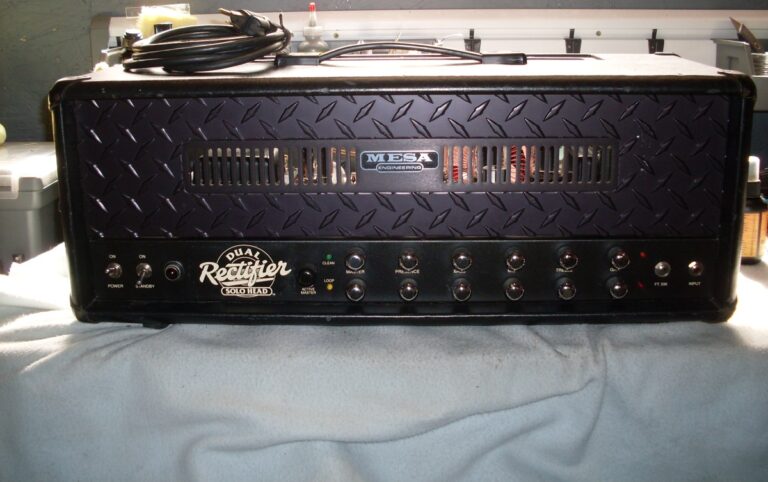
Mesa = muscle. Randall = precision. Together, they’re thunder and scalpel in one.
Pedals & Signal Chain – Controlled Chaos
Kirk’s pedalboard might look modest, but every stomp is a command.
Core Chain (Live):Guitar → DBX Gate → Ibanez TS9 → Dunlop KH95 Wah → Mesa / Randall Heads → TC Electronic G-Major → Mesa 4x12s
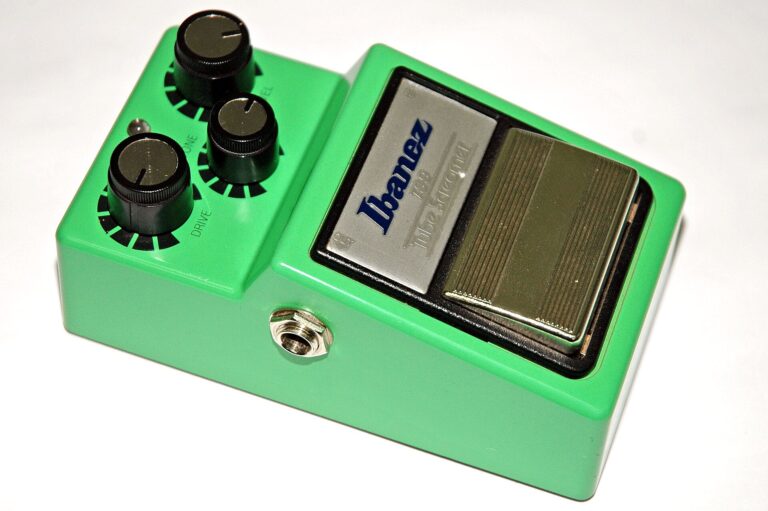
- Ibanez TS9 Tubescreamer: Used as a boost, not a distortion — just enough to tighten low-end.
- Dunlop KH95 Wah: His signature wah; frequency sweep 350–4500Hz. It never rests still during a solo.
- DBX Quad Gate: Keeps the high-gain rig quiet between notes.
- TC Electronic G-Major: Handles his ambient delay and reverb — never overused.
Studio sessions often introduce subtle digital delay (≈250 ms, mix 15 %) and hall reverb (≈2 s decay) for sustain.
Hammett doesn’t drown in effects; he weaponizes them.
Where others hide behind pedals, he uses them like punctuation — exclamation marks in distortion.
Strings, Picks & Setup
- Strings: Ernie Ball 10-52 (occasionally 10-48)
- Tuning: E Standard, Eb, Drop D depending on setlist
- Picks: Dunlop Jazz III KH Signature 1.38 mm Tortex
- Setup: Medium-high action; Floyd Rose tremolos; necks adjusted for maximum resonance
He doesn’t chase comfort — he chases response.
Every setup fights back just enough to make him dig deeper.
Tunings & Tone Philosophy
Kirk’s philosophy is simple: tone is the intersection of chaos and control.
He scoops his mids (400 Hz–2 kHz) just enough to clear space for Hetfield’s rhythm wall, then boosts upper mids (~5 kHz) to make his leads scream.
The EMG 81 in the bridge delivers that tight, percussive low-end while staying articulate under extreme gain.
“I want every note to have teeth — even the quiet ones.” — Kirk Hammett
Playing Style & Tone Philosophy
There’s a reason Kirk Hammett’s solos still light up stadiums after four decades: they aren’t just fast — they’re alive.
His style is a cocktail of fear, feeling, and finesse. One part thrash precision, one part blues phrasing, and one part wah-fueled hysteria.
He doesn’t play for perfection — he plays for emotion.
“Every solo should tell a story. If it doesn’t say something, it’s just notes.” — Kirk Hammett
The Language of the Left Hand — Emotion Through Bending
Kirk’s bends aren’t about technique. They’re about tension.
He’ll grab a string and wrench it a full step and a half, milking every molecule of resistance. The result is pure vocal intensity — the guitar literally sings.
His left hand channels players like Gary Moore, Michael Schenker, and Thin Lizzy’s Scott Gorham, but with a darker metallic edge.
Wide vibrato, sustained phrasing, and pre-bent intervals (minor/major thirds) define his melodic DNA.
On songs like “Fade to Black” and “The Unforgiven,” his vibrato feels like heartbreak caught in steel — wide, slow, and trembling with control.
“I learned early that one bend in the right place can hit harder than fifty notes.” — Kirk Hammett
The Right Hand — Precision Through Chaos
If his left hand sings, his right hand punches.
Hammett’s rhythm precision often flies under the radar because James Hetfield’s downstroke power gets the spotlight — but Kirk’s picking hand is a disciplined machine.
He mixes tight alternate picking for lead passages with percussive palm muting, always staying locked to Hetfield’s tempo wall.
When he wants intensity, he doesn’t reach for more gain — he hits harder.
That’s why his notes bark through any mix.
His use of Jazz III picks isn’t coincidence. The small tip gives him surgical control and lets him dig deep without flub. Combined with 10–52 gauge strings, his attack becomes a controlled explosion — responsive but not forgiving.
The Wah – Kirk’s Other Voice
If there’s one piece of gear that’s become synonymous with Hammett, it’s the wah pedal.
He doesn’t use it sparingly — he lives in it.
For most players, wah is an effect. For Kirk, it’s articulation. He rocks it rhythmically, breathing phrases in and out like a vocalist shaping syllables.
That’s why his leads on “Enter Sandman”, “Sad But True”, or “One” feel like they’re talking — every sweep a new emotion.
The original Dunlop Crybaby he used in the ’80s evolved into the KH95 Signature Wah, tuned to his exact frequency sweep (350–4500 Hz).
Even when he’s shredding at Mach speed, you can hear the wah dance in perfect sync with the band’s pulse.
“The wah is my language translator. It makes the guitar speak the way I feel.” — Kirk Hammett
The Scales of Fear — Kirk’s Musical DNA
Underneath all that fire and fury lies deep theoretical discipline.
Kirk’s leads are rooted in Minor Pentatonic and Aeolian (Natural Minor) scales, often peppered with chromatic runs for tension.
When he wants exotic flavor, he’ll switch to Harmonic Minor — that haunting, Middle Eastern edge you hear in songs like “Creeping Death” or “The Day That Never Comes.”
He rarely overplays. Instead, he builds tension like a horror film soundtrack — melody first, chaos second.
That cinematic phrasing is deliberate; Kirk’s lifelong love for classic horror movies bleeds into every lick he writes.
Tone Philosophy — Building Emotion from Frequency
Hammett’s tone philosophy is one of contrast and construction.
He once said, “You build tone layer by layer.” That idea is carved into every album he’s ever made.
His foundation is high-gain clarity, sculpted around the frequency valley that defines the Metallica sound:
- Mid scoop: 400 Hz to 2 kHz reduced by 3–4 dB
- Treble boost: +2 to +3 dB at 5 kHz
- Tight low-end: controlled below 100 Hz
That combination leaves space for Hetfield’s rhythm guitar while giving Kirk’s leads a laser-focused voice.
His EMG 81/60 pickups compress his attack without sterilizing it, while Mesa Boogie amps deliver the punch.
He doesn’t chase vintage breakup or boutique warmth — he chases clarity under chaos.
“My tone needs to sound dangerous — like it could fall apart any second.” — Kirk Hammett
Dynamics – The Secret Ingredient
Hammett’s genius lies not in his notes, but in his dynamics.
He’ll play with whisper-level touch one bar and full aggression the next, letting the amps breathe.
That’s why even under stadium-sized gain, his tone still feels alive.
During “Nothing Else Matters”, you can hear his sensitivity — each bend breathes like a confession.
Then on “Battery”, it’s a chainsaw.
That’s not an accident — it’s decades of learning when to fight and when to let go.
The Improviser – Controlled Anarchy
In the studio, Kirk writes solos like stories. Roughly 80% is composed; the rest is chaos.
That improvisational sliver — the unpredictable scream, the accidental harmonic — is where his humanity lives.
He’ll often record multiple takes, then splice together the most emotional moments.
Live, he’s even freer. No two versions of “Fade to Black” or “One” are identical.
He thrives on the edge between precision and panic — the zone where magic happens.
The Sound of Fear and Faith
At its core, Hammett’s playing is spiritual.
Every technique — from the precise bend to the wah-inflected cry — serves one mission: communication.
He doesn’t want to impress. He wants to connect.
That’s why his solos hit harder than cleaner, “better” players. They mean something.
He once said, “I’m not playing for speed. I’m playing for the ghost in the machine.”
And that’s why even with modern gear, digital presets, and walls of sound, Kirk Hammett still feels human.
His imperfections are his fingerprint. His gear is his voice. His tone — his truth.
How to Sound Like Kirk Hammett
You can’t clone Kirk Hammett’s soul — but you can chase his scream.
His tone isn’t voodoo; it’s engineering and emotion welded together.
Below, we break down how to build that sound: from the Mesa Boogie snarl of Master of Puppets to the wide, wah-drenched lead tone that haunted the Black Album era and beyond.
“Great tone isn’t found. It’s built. Layer by layer.” — Kirk Hammett
🎸 Step 1: Start with the Foundation – The Guitar
Kirk’s tone lives in the handshake between his fingers and his pickups.
He’s used dozens of guitars over the years, but his tonal core stays constant: high-output active pickups, tight setup, and medium-high action that forces the player to dig in.
If you want that Hammett response:
- Budget Option: ESP LTD KH-202 or KH-602 — both have EMG pickups and Floyd Rose systems.
- Mid-Range: ESP KH-602 (EMG 81/60, alder body).
- Pro-Level: ESP KH-2 or KH-2 Vintage with real Floyd Rose and EMG 81/60 set.
- Vintage Fanatics: Gibson Les Paul “Greeny” reissue (Murphy Lab or Custom Shop).
Strings: 10–52 gauge.
Tuning: E Standard, Eb, or Drop D depending on the song.
Picks: Dunlop Jazz III KH Signature (lime green, 1.38 mm).
Tone note: “If your guitar isn’t fighting back, it’s not giving you the sound.” — Kirk Hammett
⚙️ Step 2: Amp Settings – Sculpting the Storm
Kirk’s amps are where science meets sorcery.
His signature tone comes from Mesa Boogie Mark IIC+, Mark IV, and later Dual Rectifiers blended with Randall RM100KH heads for extra saturation.
Here’s your roadmap:
Mesa Boogie Core Tone (Lead Channel)
| Control | Setting | Description |
|---|---|---|
| Gain | 6.5 | Saturated, articulate high-gain |
| Bass | 6.5 | Tight but full low-end |
| Mid | 3.0 | Classic “scoop” in midrange |
| Treble | 7.5 | Adds vocal bite and brightness |
| Presence | 5.5 | Balances top-end sparkle |
| Master | 8.0 | Loud is tone; always push tubes |
Randall RM100KH (or Fortin Equivalent)
| Control | Setting | Description |
|---|---|---|
| Gain | 7.0 | Adds saturation and sustain |
| Bass | 6.0 | Maintains weight |
| Mid | 5.0 | Evens out Mesa’s scoop |
| Treble | 7.0 | Keeps clarity high |
| Master | 5.0 | Blend for texture, not volume |
EQ Philosophy:
- Scoop mids around 400 Hz by ~3–4 dB.
- Boost 5 kHz by +3 dB for lead clarity.
- Roll off below 40 Hz for tight bass.
- Light compression, if any — Kirk’s dynamics come from his picking.
“If it’s too polite, you’re doing it wrong.” — Kirk Hammett
🧩 Step 3: The Pedalboard Blueprint
Kirk’s pedalboard isn’t cluttered — it’s precise.
Every stomp has a job, and each job has to survive 120 dB of sonic war.
Typical Signal Chain:
Guitar → DBX Gate → Ibanez TS9 → Dunlop KH95 Wah → Mesa/Randall Heads → TC Electronic G-Major → Mesa 4x12 Cab
Breakdown:
- DBX Quad Gate: Noise management between massive gain stages.
- Ibanez TS9 Tubescreamer: Set gain to 4, tone 5, level 6. Tightens the low end and adds edge.
- Dunlop KH95 Wah: Always active in solos. Sweep range 350–4500 Hz.
- TC Electronic G-Major: Adds delay (250 ms, 15% mix) and hall reverb (2.0s decay, 8% mix).
Hammett’s philosophy? Effects should breathe, not bury. You hear them only when they leave.
“The pedalboard’s job is to enhance emotion, not hide mistakes.” — Kirk Hammett
🔊 Step 4: The Cabinet & Mic Setup
Cabinet: Mesa Boogie 4×12 loaded with Celestion Vintage 30s.
Mic Placement: SM57, 1–3 inches from the grill, slightly off-axis.
Recording Tip: Blend a second mic (e.g., Royer 121) for warmth if using DAW setups.
Live Mix: Keep room mic minimal — Kirk’s tone lives in the close capture.
IR/Impulse Option (Modelers): Mesa 4×12 STL “Urban” or OwnHammer V30 library.
💻 Step 5: Digital Modeler Setup (Helix / Kemper / Axe-Fx)
For players in the modern age, Hammett’s rig translates beautifully to digital gear.
“Kirk Hammett – Metallica Lead Tone” Preset Chain
| Block | Type | Setting Summary |
|---|---|---|
| Input Gate | Noise Gate | Threshold -35 dB, hold 100 ms |
| Overdrive | TS9 Model | Drive 4.0, Tone 5.0, Level 6.0 |
| Wah | KH95 or Crybaby Model | 350 Hz – 4.5 kHz sweep |
| Amp 1 | Mesa Mark IIC+ Model | Gain 6.5, Mid 3.0, Treble 7.5 |
| Amp 2 | Randall RM100KH Model | Gain 7.0, Mid 5.0, Treble 7.0 |
| Cab | 4×12 V30 IR | Mic: SM57 close, mix 100% |
| Delay | Digital Delay | 250 ms, Feedback 25%, Mix 15% |
| Reverb | Hall | Decay 2.0 s, Mix 8% |
Tone Character:
High-gain, percussive, and singing. Tight bass, smooth treble, endless sustain.
💀 Step 6: Budget Rigs – Metal for Every Wallet
Whether you’re a weekend warrior or studio vet, you can still channel Hammett’s tone spirit.
$500 Budget Build
- Guitar: ESP LTD KH-202
- Amp: Boss Katana 50 MkII (Lead channel, Gain 6, Bass 6, Mid 3, Treble 7)
- Pedal: Dunlop Crybaby GCB-95
- Strings: 10–52 Ernie Ball Slinky
$1,000 Budget Build
- Guitar: ESP LTD KH-602 (EMG 81/60)
- Amp: EVH 5150 Iconic or Orange Rockerverb 50
- Pedal: Ibanez TS9 + KH95 Wah
- Cab: 1×12 Celestion V30
$3,000+ Professional Setup
- Guitar: ESP KH-2 or Gibson “Greeny”
- Amp Stack: Mesa Mark IIC+ + Randall RM100KH
- Pedalboard: KH95 Wah, TS9, TC G-Major rack
- Cab: Mesa 4×12 Vintage 30
Each tier respects the same tonal geometry: tight low-end, sculpted mids, upper presence, and active-pickup clarity.
🧠 Step 7: Playing Techniques – Hands First, Gear Second
Even with the perfect rig, you won’t sound like Kirk until your hands do.
Focus on:
- Wide, slow vibrato — every note should sing, not flutter.
- Pre-bends — bend before you strike.
- Rhythmic wah motion — don’t stomp, breathe through the pedal.
- Minor pentatonic phrasing — melody over mechanics.
Practice Ritual:
Play “The Unforgiven” solo at half speed. Feel each note resonate. Then hit “Creeping Death” and match his right-hand stamina — your tone will follow your effort.
🎧 Bonus: Recording Tips
If you’re tracking at home:
- Double-track rhythms with slightly varied EQ to mimic Metallica’s stereo field.
- Record leads with both Mesa and Randall models blended 60/40.
- Pan one track wide left, the other wide right.
- Keep solo in the center with 1.5 dB boost at 5 kHz.
Result: that unmistakable Black Album spread — massive yet precise.
Influence & Legacy
Kirk Hammett didn’t just shred — he shifted the way the world thought about heavy guitar.
Before him, lead guitar in metal was a race for speed. After him, it became a search for feeling.
His influence isn’t measured in BPMs or fretboard acrobatics; it’s measured in goosebumps.
Every time a guitarist hits a wah pedal and lets it cry, every time a solo breaks through a wall of distortion and actually sings — that’s Hammett’s DNA echoing through the strings.
“He brought the blues to metal and made it scream.” — Guitar World (1991 retrospective)
The Revival of Emotion in Metal
In the early ’80s, thrash was a war zone. Every guitarist was out to be louder, faster, heavier.
But when Kirk joined Metallica in 1983, he injected something few others had — melody.
His solos weren’t just technical displays; they were emotional detonations wrapped in distortion.
Listen to “Fade to Black.”
That opening lead isn’t just a solo — it’s a eulogy, a slow burn that turns heartbreak into anthem.
Then listen to “One.” It starts as despair, builds into anger, and ends in apocalypse — all told through Hammett’s phrasing.
He reminded the metal world that feeling hits harder than flash.
The Wah Legacy – Talk to Me
Kirk’s wah obsession became a language all its own.
What Jimi Hendrix invented, Hammett perfected for metal.
The wah became his trademark — a vocal expression that transformed solos into dialogue.
In a genre obsessed with brutality, he made the guitar speak.
From “Enter Sandman” to “The Memory Remains,” that signature vowel-scream is instantly recognizable.
It’s not just a pedal sound — it’s a punctuation mark in the language of metal.
And he’s not ashamed of it, either. While some players mock overuse, Hammett wears it like a badge of identity.
He once laughed, “Yeah, I use the wah too much. But that’s my voice — and I’m not done talking.”
A Bridge Between Worlds – Blues and Thrash
Kirk Hammett is a rare breed: a shredder with a blues soul.
He channels the emotional phrasing of Gary Moore, Peter Green, and B.B. King, then runs it through the brutality of Bay Area thrash.
That’s why his solos still feel human amid Metallica’s mechanical precision.
Even during the most aggressive riffs, he finds melody.
You can trace his phrasing roots to the blues masters — wide bends, dynamic swells, minor-major interplay — but his attack is pure metal.
He’s the missing link between emotion and aggression, between vintage tone and modern fire.
“Kirk is the reason blues survived inside metal.” — Joe Bonamassa
The Influence Across Generations
From the ’80s to now, Kirk’s fingerprints are everywhere.
You can hear his phrasing in players like John Frusciante, Gary Clark Jr., Synyster Gates, and Matt Heafy — all of whom cite him as a gateway artist.
Without Hammett, there might not have been a John Mayer playing blues-inspired solos on pop stages, or a Kenny Wayne Shepherd blending clean sustain with aggression.
Even heavyweights like Zakk Wylde and Slash borrowed from his precision-under-pressure approach — the idea that clarity in distortion is what separates professionals from amateurs.
Hammett didn’t just inspire guitarists — he redefined how guitar sounded on records.
He proved that a clean, articulate high-gain tone could still breathe, still swing, still bleed.
The Cultural Legacy – Metal, Horror, and Heart
Beyond riffs, Kirk is a cultural archetype: the metal mystic.
A collector of horror memorabilia, an art curator, a vintage gear historian — he embodies the fusion of art and darkness.
His horror-themed guitars (like The Mummy, Nosferatu, and White Zombie) aren’t gimmicks.
They’re autobiographical. Each one tells a story about who he is: a kid who grew up on monster movies and turned that obsession into sound.
He even turned his personal collection into a traveling museum, It’s Alive!, showcasing horror posters, props, and the mythology that shaped his aesthetic.
For Hammett, horror and music are the same language — both use tension, release, and silence to scare and move the audience.
The Eternal Flame – Four Decades of Fire
Kirk Hammett’s impact spans generations, genres, and continents.
He’s sold out arenas, topped charts, and influenced millions — but none of that defines him.
What defines him is that, forty years later, he still plays like he has something to prove.
Every night, when the lights go down and the crowd starts chanting, Hammett steps forward, hits that first note, and the world listens.
The tone is still sharp, still dangerous, still emotional.
“I don’t play perfect — I play honest.” — Kirk Hammett
That’s the essence of his legacy. Honesty through noise. Humanity through distortion.
A New Generation of Tone Chasers
Today, guitarists around the world are still trying to decode the “Hammett formula.”
They’re learning that it’s not just gear or scales — it’s philosophy.
- Build tone like architecture.
- Let emotion guide the mix.
- Make every note mean something.
Whether you’re chasing his Black Album lead tone or building your own wah-fueled chaos, the path Hammett paved still leads forward.
Read our guide to the ESP E-II M-II for more on the guitar shape behind Hammett’s KH-2 instruments.
FAQ – Everything You Wanted to Know About Kirk Hammett’s Gear, Tone & Legacy
This is where we clear up myths, settle debates, and decode the details.
We’ve compiled the most common questions fans and players ask — and answered them GuitarGangsters-style: with facts, attitude, and just enough grease under the fingernails.
Q1. What pickups does Kirk Hammett use?
Kirk’s signature sound has been powered by EMG active pickups since the mid-’80s.
His main configuration:
- Bridge: EMG 81
- Neck: EMG 60
More recently, he’s worked with EMG to refine the formula into the EMG Bone Breaker set — designed for smoother mids and slightly more dynamic headroom.
They preserve his surgical high-gain clarity but add a warmer attack, perfect for blending vintage tones from Greeny with the precision of his ESPs.
“Active pickups gave me the punch I wanted without the noise I didn’t.” — Kirk Hammett
Q2. Why does Kirk use so much wah?
Because for him, the wah isn’t an effect — it’s a voice.
He grew up worshipping Jimi Hendrix and Michael Schenker, both of whom used wah like punctuation.
Kirk took that idea and made it his signature sound.
His Dunlop KH95 Cry Baby Wah is custom-tuned with a 350–4500 Hz sweep, voiced to maintain tight bass while accentuating mid-vowel articulation.
That’s why it sounds “talky” instead of “quacky.”
And yeah — he knows the jokes. He doesn’t care.
“If people say I use the wah too much, they’re probably not using it enough.” — Kirk Hammett
Q3. What’s special about Greeny, and how did Kirk get it?
“Greeny” is no ordinary Les Paul.
It’s the 1959 Gibson once owned by Peter Green of Fleetwood Mac, then Gary Moore — both legends of expressive phrasing.
Kirk bought it around 2009–2010, and it quickly became his most personal guitar.
Its tone magic comes from an accident: one pickup magnet was installed backward, creating an out-of-phase middle position that gives that haunting, nasal sustain.
Today, Gibson and Kirk have teamed up to reissue Greeny Les Paul Standards through the Murphy Lab.
But the real one? It still travels with Kirk, stage to studio.
Q4. What amps does Kirk Hammett use live today?
Kirk’s modern touring rig blends classic and contemporary muscle:
- Mesa Boogie Dual Rectifiers for core rhythm and sustain
- Randall RM100KH Signature Heads for extra saturation and bite
- Fortin prototypes occasionally tested for added aggression
For clean and studio work, he still keeps a Mesa Mark IIC+ — the amp responsible for Master of Puppets and …And Justice for All.
Each head feeds into Mesa 4×12 cabs loaded with Celestion Vintage 30s.
Q5. What are his go-to effects besides wah?
Kirk keeps it minimal. His live pedalboard is small but deadly:
- Ibanez TS9 Tube Screamer: gain 4, tone 5, level 6 — used as a clean boost.
- DBX Quad Gate: noise control between amps.
- TC Electronic G-Major: delay (250 ms), reverb (2.0 s), and slight modulation.
- Boss Chromatic Tuner: the only “normal” pedal in sight.
He hates clutter. Everything must serve tone, not distract from it.
Q6. How does Kirk get that singing sustain in his solos?
It’s the perfect storm:
- Active pickups compressing dynamics just enough.
- Tube saturation from Mesa amps running hot.
- Light digital delay (250 ms, low mix) creating a cushion behind the note.
- And, most importantly — his touch.
Kirk doesn’t rely on feedback loops or endless gain.
He lets the note bloom naturally, milking sustain through control and patience.
“You don’t make a note sustain — you let it breathe.” — Kirk Hammett
Q7. Does Kirk still use the same gear in the studio and on stage?
Mostly, yes — but with studio layering.
On stage, his rig is streamlined for reliability. In the studio, he stacks tones: Mesa for body, Randall for grit, sometimes even Fender or Diezel for texture.
He’s also embraced digital modeling for fly rigs, often using Helix or Axe-Fx profiles of his real amps.
In 2025, he confirmed his Helix preset mirrors his touring rig 1:1 — down to EQ curves and wah response.
Q8. What are Kirk’s tunings?
Kirk mainly plays in:
- E Standard (Black Album, Master of Puppets)
- Eb Standard (Load, Reload, live shows)
- Drop D (Sad But True, Dirty Window)
He occasionally experiments with Drop C for heavier tracks, but prefers traditional tunings — he believes real tone comes from tension, not tuning down.
Q9. What’s Kirk’s favorite guitar of all time?
He’s said it dozens of times: Greeny.
It’s not his flashiest, or even his most practical — but it’s his most spiritual.
Every show, he makes sure Greeny sees at least one song.
Second place? His original ESP KH-2 Caution, the guitar that carried him through …And Justice for All and The Black Album.
Q10. Can I sound like Kirk Hammett without expensive gear?
Yes — if you understand his formula:
- Heavy strings (.010–.052)
- Tight picking technique
- Mid-scooped amp tone (cut 400 Hz, boost 5 kHz)
- Touch-sensitive wah motion
- Confidence
Tone is 70% hands, 20% EQ, and 10% everything else.
Hammett’s sound isn’t about price — it’s about conviction.
“It’s not the gear. It’s what you make the gear say.” — Kirk Hammett
Q11. What’s next for Kirk Hammett?
As of 2025, Kirk continues to evolve.
He’s balancing Metallica’s new era, film scoring projects, and horror exhibitions.
He’s also pushing digital tone innovation — working with amp modelers and Gibson’s Custom Shop on a new line of hybrid Les Paul/ESP crossover prototypes.
Hammett’s goal isn’t nostalgia — it’s longevity.
He wants the next generation to chase tone the same way he did: by earning it.
When the lights go down and the first notes of “Creeping Death” echo through a stadium, something ancient wakes up inside Kirk Hammett’s tone.
It’s the same raw spirit that pushed a teenage kid from San Francisco to solder his first guitar cable, the same haunted pulse that hums through Greeny’s maple top, the same ghost that whispers through every wah pedal he’s ever stepped on.
Kirk Hammett isn’t just Metallica’s lead guitarist — he’s the soul engineer of metal’s emotional frequency.
Every scream of feedback, every bent note, every snarling solo is an open wound turned into melody.
He taught an entire generation that speed means nothing without soul, and distortion means nothing without danger.
“I don’t play perfect. I play honest.” — Kirk Hammett
In a world of plugins and presets, Kirk remains beautifully analog — flawed, fiery, and utterly human.
His tone bleeds, his solos breathe, and his guitars tell stories written in electricity.
From the Flying V that started it all to the haunted elegance of Greeny and the horror-soaked ESPs that followed, his journey is a reminder that great music isn’t built in a lab.
It’s born in the dark — one bend, one scream, one risk at a time.
And that’s why four decades later, Kirk Hammett still matters.
Because long after the amps cool down and the echoes fade, his sound still lives in every guitarist who ever tried to make their guitar speak.
Image credits
- Marshall JCM800: John2112, Wikimedia Commons, CC BY-SA 4.0.
- Mesa/Boogie Dual Rectifier: Roadside Guitars, Flickr, CC BY-SA 2.0.
- Ibanez TS9 Tube Screamer: Mataresephotos, Wikimedia Commons, CC BY 3.0 US.
- EMG 81 pickups: ZngZng, Wikimedia Commons, CC BY-SA 4.0.