Michael Poulsen – The Unpolished Genius Behind Volbeat’s SG GT Fury
GuitarGangsters Editorial 14 min read Updated 20 October 2026
You know that feeling when a riff doesn’t just hit your ears but rattles your ribcage? The kind that feels like a ’70s muscle car idling just before the light turns green. That’s what happens the first time you hear Michael Poulsen fire up his black Gibson SG GT through a screaming Marshall. It’s raw, tight, and somehow still melodic – the sound of a man who never cared about being perfect, only about being real.
Poulsen isn’t your typical modern metal guitarist with a wall of pedals and an endorsement spreadsheet. He’s the kind of player who learned by ear, by mistake, and by sheer stubbornness. His right hand is a weapon – sharp upstrokes, snappy rhythm, and a groove that swings as much as it crushes. There’s a reason Volbeat sounds like no other band on the planet: it’s Sabbath heaviness colliding with Elvis swagger.
He once said he’d never take guitar lessons because they’d “ruin what I’ve got.” That pretty much sums him up. Everything about his tone – from the vintage Marshall growl to the snarl of his SG GT – feels homemade, imperfect, and absolutely unstoppable. He’s built a career on playing the riffs nobody else dared to write: too heavy for rockabilly, too catchy for thrash, and too fun to fit any label.
Before we dive into the gear that makes that happen – the SG GTs, the Marshalls, the Kemper profiles, the secret sauce behind that punchy, articulate distortion – we have to understand where it all began: a Danish kid who fell in love with Elvis and discovered Black Sabbath… and decided the world needed both in the same riff.
From Elvis to Sabbath – The Roots of a Hybrid Sound
Michael Poulsen’s story isn’t your average metalhead origin tale. He didn’t grow up worshipping shredders or obsessing over scales. Instead, he was spinning Elvis Presley, Johnny Cash, and Little Richard records long before he even picked up a guitar. Those old 45s taught him the power of rhythm — the snap of a backbeat, the swagger of a simple three-chord groove. That DNA still runs through every Volbeat song.
Then came the twist: Black Sabbath. The first time Poulsen heard Tony Iommi’s monstrous tone, everything changed. The swagger met the darkness. He’s said more than once that Sabbath was the reason he started playing guitar — and it shows. Volbeat’s riffs may swing like rockabilly, but they hit like heavy metal thunder.
By the time he started his first bands in Copenhagen, Poulsen had already figured out what kind of player he wanted to be: one who ignored the rulebook. No fancy scales, no overthinking, no following trends. Just tone, feel, and attitude. That mindset would eventually shape both his playing and his gear choices.
Early on, he flirted with B.C. Rich and ESP guitars — sharp-looking beasts that fit the metal image. But when he got his hands on a Gibson SG, it was over. The balance, the bite, the simplicity — it felt like home. Poulsen later fell in love with the SG GT, a short-lived hot-rod version of the classic model. Chrome hardware, racing stripe, coil-taps, and a built-in high-pass filter gave it just the right mix of grit and clarity.
It’s no surprise that his SG GT became a permanent extension of his body. Whether he’s hammering through “Still Counting” or digging into “Lola Montez,” that guitar delivers the same thing every time — a wall of vintage-flavored crunch with just enough attitude to start a bar fight.
Next, we’ll crack open that rig: the SG GT, the Marshalls, and the unholy marriage of classic rock warmth and modern metal aggression that defines the Volbeat tone.
The Rig – Built for Bite, Not Perfection
If you strip away the lights, the smoke, and the festival chaos, Michael Poulsen’s setup is shockingly simple. It’s not about chasing trends or modeling plug-ins — it’s about feel. His rig is designed to respond like a living thing: punchy, unpredictable, and a little bit dangerous.
Guitars
At the center of it all is the Gibson SG GT — Poulsen’s weapon of choice since the mid-2000s. It’s not a collector’s piece; it’s a workhorse with a hot-rod soul. The chrome hardware, dual humbuckers, and that unmistakable racing stripe give it attitude before you even plug it in. The built-in high-pass filter keeps his tone razor-sharp even at high volume, while coil-taps let him flip from fat Sabbath growl to bright rockabilly snap in seconds.
He keeps a fleet of them in rotation — usually black or candy orange — all tuned a half-step down for that extra punch. When he wants a different flavor, he grabs his Gibson Firebird Custom, which has a slightly glassier midrange but the same snarling top end. Poulsen doesn’t hoard guitars; he plays them until they’re road-scarred and sweat-stained, then keeps going.
Pickups, Strings & Picks
Poulsen sticks with Seymour Duncan JB in the bridge and ’59 Model in the neck — the classic rock-metal combo. His strings are Ernie Ball Regular Slinkys (10-46), sometimes with a heavier low E when Volbeat drops tuning. Picks? Dunlop Tortex 0.88 mm — stiff enough for precision, flexible enough for that signature upstroke snap.
Amps
Here’s where the magic really happens. For years, Poulsen’s heartbeat has been a Marshall JCM800, dimed within an inch of its life. No boutique clones, no modded heads — just raw British crunch. He dials in gain through volume rather than pedals, pushing the amp so the tubes do the heavy lifting. It’s the same school of tone that gave birth to Iommi, AC/DC, and Motörhead.
But touring the world every year takes a toll on vintage gear. Enter the Kemper Profiler. Poulsen’s tech, Tue Bayer, captured the exact profile of his favorite JCM800 so he can recreate that sound consistently night after night. It’s not about convenience — it’s about reliability. The irony? Even through digital gear, his tone still sounds 100 percent analog, because the human part of the signal chain hasn’t changed.
Pedals & Signal Chain
Poulsen’s pedalboard could fit in a backpack:
-
Boss TU-3 Tuner
-
MXR Micro Boost for solos
-
MXR Carbon Copy Delay for a quick slapback echo
-
Straight into the amp or Kemper
That’s it. No overdrive, no reverb, no fancy modeling. The tone lives in the right hand — in that relentless upstroke rhythm and the way he digs into the strings like he’s trying to start a fight with them.
Philosophy of Tone
Ask Poulsen about his sound and he’ll tell you it’s not about “accuracy.” It’s about character. He doesn’t chase pristine frequencies or surgical EQs. He wants strings that bite, amps that breathe, and imperfections that make every riff human. “Perfection,” he once said, “is a terrible word made up by a terrible human being.”
How to Get Michael Poulsen’s Tone
Here’s the thing about chasing Poulsen’s sound: you can buy the same gear, copy every setting, and it still won’t sound right unless you play like him. His tone isn’t just the sum of wood, tubes, and strings — it’s the product of his attack, timing, and swagger. Still, if you want to get close, here’s how to build that wall of crunch and swing.
Amp Settings – Start with the Crunch, Not the Gain
Forget the modern high-gain approach. Poulsen’s tone lives in the sweet spot between saturation and bite. On a Marshall JCM800, start with these ballpark settings:
-
Gain: 6–7 (enough to growl, not fizz)
-
Bass: 5
-
Middle: 7
-
Treble: 6
-
Presence: 6
-
Master Volume: loud enough that it scares your neighbors
The key is to push the tubes. Poulsen’s rhythm parts have that slightly compressed snap that only comes from volume-driven distortion, not pedals. If you’re using a Kemper or modeler, pick a JCM800 profile and tweak the EQ until the chords hit like a hammer but never blur together.
The Upstroke Revolution
Michael Poulsen’s picking hand is his secret weapon. While most players attack downwards, he favors aggressive upstrokes, which add a percussive whip to his tone. It also keeps the rhythm bouncing — a leftover from his rockabilly obsession. Practice slow, locked-in upstrokes with muted power chords until you can make them groove instead of chug.
If you’re used to palm-muting every riff, loosen up. Poulsen lets the low strings breathe. His riffs often have a mix of tight chugs and open rings, giving Volbeat songs that swinging motion between metal and rock’n’roll.
Pedals and Effects
Keep it minimal. If you can’t play the riff clean, distortion won’t save it. The MXR Carbon Copy is only there for a quick slapback echo — about 120–150 ms of delay with low repeats — to give leads a vintage vibe. The Micro Boost just pushes the amp a little harder for solos, not to change the tone.
Playing Feel and Attitude
Poulsen’s playing is equal parts rhythm and confidence. He’s not chasing shred-level precision; he’s chasing impact. Every note is hit with intent. His right hand stays loose, his timing leans slightly ahead of the beat, and his chords ring out with controlled chaos.
When you’re trying to emulate him, think less about technique and more about storytelling. His riffs sound like motion — motorcycles, bar fights, and Elvis hips all rolled into one. That’s what separates “Still Counting” from a thousand faceless hard-rock songs.
What to Avoid
-
Don’t drown your tone in gain — it kills the dynamic swing.
-
Don’t rely on pedals — Poulsen’s tone lives in the amp and the hands.
-
Don’t aim for clinical perfection — the magic’s in the rough edges.
If your rig feels too polite, loosen it up. Detune half a step, dig in harder, and remember that rock’n’roll should sound like it might fall apart at any second. That’s the entire spirit of Poulsen’s sound — controlled chaos with a grin.
Next, we’ll look at how that sound translates on stage — how Volbeat’s live setup turns that raw SG GT growl into an arena-filling storm night after night.
Live Tone – The Controlled Chaos of Volbeat on Stage
Watching Michael Poulsen live is like watching a drag race. There’s smoke, heat, danger — and underneath it all, absolute control. Every night, his rig walks the tightrope between vintage unpredictability and modern reliability.
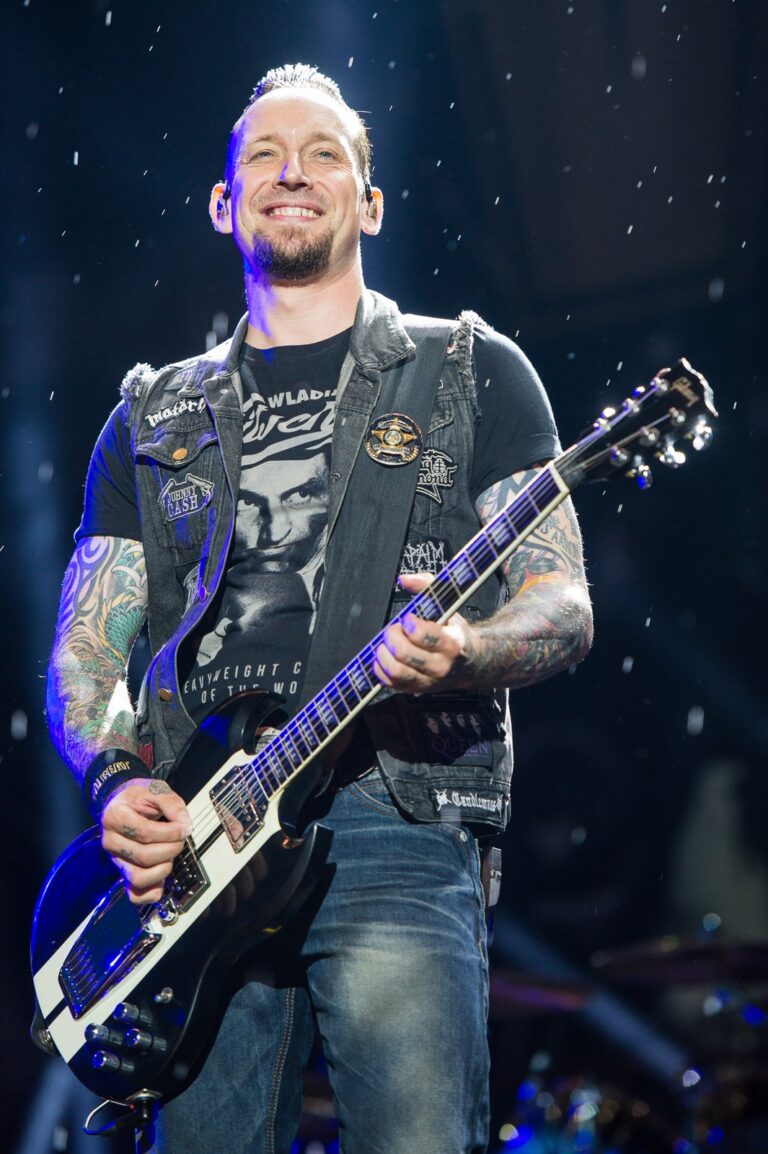
Consistency Without Sterility
Volbeat plays hundreds of shows across continents, and Poulsen can’t risk blowing tubes halfway through “Still Counting.” That’s why his Kemper Profiler has become essential. It’s not about convenience — it’s a digital snapshot of his favorite Marshall JCM800, captured by his tech, Tue Bayer. That means Poulsen gets his amp, his tone, his response — every single night, no matter if he’s in a sweaty club or a European stadium.
But here’s the kicker: he still treats it like a tube amp. The volume knob on his SG GT is always part of the performance. He rides it constantly — rolling it back for verses, cranking it for choruses. That dynamic touch keeps the digital rig breathing like a living, snarling amp.
The Stage Mix
Poulsen’s live tone is bone-dry. No reverb, barely any delay. Just the natural reverb of the venue and the chaos of the crowd. His monitors are tuned to feel like a real amp pushing air — the kind that kicks you in the gut when you hit an open E chord. The FOH engineers know better than to polish it; the grit is the point.
Every piece of his signal chain is built for punch and speed. Guitar techs say his signal path from pick to speaker is “the shortest possible route.” No wireless lag, no racks of effects — just SG → tuner → boost → delay → amp. That’s it.
How It Sounds in the Room
In person, Poulsen’s tone isn’t pretty — it’s alive. You hear the pick scrape, the string buzz, the little imperfections that give the riffs their muscle. It’s why Volbeat’s sound feels human even at arena volume. You can tell he’s fighting the guitar, not polishing it.
When the lights hit and the first riff of “A Warrior’s Call” explodes through the PA, that SG GT tone slices through everything — fat, percussive, and unmistakably Michael Poulsen.
What Makes It Work
-
Dynamic control – His volume knob and picking hand do more than any pedal ever could.
-
Midrange power – His tone sits right between the bass and drums, giving Volbeat that wall-of-sound groove.
-
Confidence – Poulsen plays like the guitar owes him money. That aggression is the final ingredient.
There’s no secret recipe, no hidden plugin, no fancy preset. It’s just a guy with a guitar that feels right in his hands, an amp that roars when he pushes it, and a lifetime spent turning rhythm into rebellion.
Next up: we’ll break down Michael Poulsen’s legacy and influence — how a Danish kid with an Elvis record and a Black Sabbath obsession ended up reshaping modern rock guitar.
Legacy – The Rebel Who Bridged Rockabilly and Metal
Michael Poulsen doesn’t fit neatly into any genre box — and that’s exactly why he matters. In an era where guitar music keeps getting sliced into subgenres, Poulsen built a sound that laughs in the face of labels. He took the swagger of early rock ’n’ roll, the heaviness of metal, and the melody of pop hooks, then welded them together with sheer attitude.
You can hear it in how he writes riffs. They don’t just crunch — they move. There’s swing in his rhythm, a pulse that nods back to Elvis even while the distortion screams Sabbath. It’s a sound that shouldn’t work… but it does, because it’s completely his.
The Self-Taught Edge
Poulsen is living proof that personality beats perfection. He never took lessons, never studied theory, and never cared about technique for technique’s sake. His approach is pure instinct — built on groove, attitude, and storytelling. When he says he doesn’t want to learn “the right way” because it might ruin his sound, it’s not arrogance. It’s artistic self-preservation.
That instinctive, working-class ethos is what gives Volbeat its charm. Their songs are cinematic but gritty, polished but real. Poulsen’s tone has become part of that identity — a tone that sounds like sweat, dust, and denim.
Influence on Modern Players
Ask ten modern hard-rock bands who they listen to, and at least half will name Volbeat. Not because Poulsen reinvented the guitar, but because he reminded everyone that feel still matters. His upstroke rhythm and hybrid tone have inspired a new wave of players who want groove and grit instead of digital perfection.
You can hear echoes of his style in everything from Scandinavian metal to American hard rock. Younger players cite him not for his speed or complexity, but for his confidence. That’s the secret sauce: he plays like he believes every note could start a riot.
The SG GT Icon
Thanks to Poulsen, a short-lived Gibson model that most players ignored — the SG GT — became a cult favorite. Its hot-rod aesthetic, chrome trim, and snarling tone are now inseparable from Volbeat’s identity. Fans still beg Gibson to release a Michael Poulsen Signature SG, and it’s only a matter of time before that happens. When it does, it’ll be less about specs and more about spirit — a guitar that celebrates imperfection, groove, and the joy of turning it up too loud.
The Bigger Picture
In a world of amp sims, presets, and polished production, Poulsen stands for something rare: authenticity. His gear may evolve, but his philosophy never will. Play hard. Play honest. Don’t be afraid of the noise.
Because at the end of the day, Michael Poulsen isn’t just a guitarist — he’s a reminder that rock ’n’ roll still belongs to the misfits who never learned the rules in the first place.
FAQ — Michael Poulsen’s Gear, Style & Tone
Q: What guitar does Michael Poulsen play?
A: His main guitar is the Gibson SG GT, a short-run hot-rod version of the classic SG built between 2006 and 2008. It features chrome hardware, a racing stripe, coil-tap switches, and a built-in high-pass filter that keeps his tone sharp and articulate. He also uses a Gibson Firebird Custom as a backup on tour.
Q: What pickups and strings does he use?
A: Poulsen sticks with a tried-and-true combo — a Seymour Duncan JB in the bridge and a ’59 Model in the neck. Strings are usually Ernie Ball Regular Slinkys (10-46), sometimes with a heavier low E for drop-tuned songs.
Q: What amps create his signature sound?
A: His signature growl comes from a Marshall JCM800, driven hard for natural tube distortion. Live, his tech Tue Bayer runs a Kemper Profiler loaded with Poulsen’s own JCM800 profile, giving him identical tone every night with zero risk of tube failure.
Q: What pedals does he rely on?
A: Almost none. A Boss TU-3 tuner, MXR Micro Boost for solos, and MXR Carbon Copy Delay for quick slapback echo. That’s it. His tone lives in the amp — and his hands.
Q: How does he achieve that unique rhythm feel?
A: Poulsen’s secret weapon is his upstroke technique. Instead of the usual down-picking, he drives his riffs upward, giving them a percussive snap and a subtle swing — a nod to his early rockabilly influences.
Q: What tuning does Volbeat use live?
A: Most songs are played in E♭ Standard, occasionally Drop D in E♭, adding just enough weight without losing clarity.
Q: Is his live sound different from the studio?
A: Not much — just louder and meaner. The Kemper replicates his studio Marshalls almost perfectly, and he controls dynamics with his guitar’s volume knob rather than extra effects.
Q: Will Gibson ever release a Michael Poulsen signature model?
A: Fans have been begging for it for years. No official word yet, but given the cult following of the SG GT, it’s probably only a matter of time before a Poulsen signature hits the market.
Read our guide to the Kemper Profiler Head for a closer look at the profiling approach discussed here.
Image credits
- Michael Poulsen: Stefan Brending (2eight), Wikimedia Commons, CC BY-SA 3.0.