Schecter PT Fastback: The Guitar That Carries Pete Townshend’s Blueprint
The Schecter PT Fastback traces its shape to guitars Pete Townshend played with the Who. Full specs, tone guide, and buying advice on this T-style rocker.
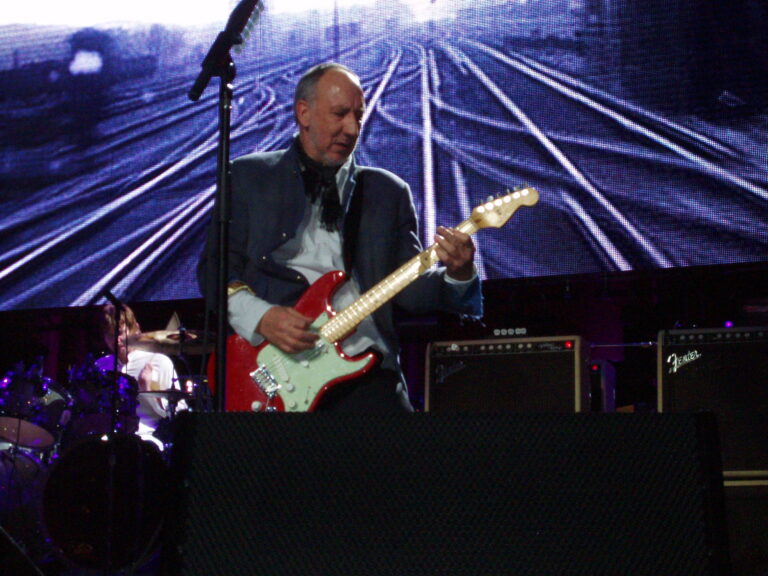
Most “PT” model names on a guitar spec sheet mean nothing more than a factory code. Schecter’s PT line is the exception, and it’s one of the more genuinely surprising origin stories in the company’s catalog. The letters stand for Pete Townshend, and the guitar traces its lineage directly back to a real instrument the Who’s guitarist played onstage from 1979 through 1988 — not a tribute built decades later by a marketing team chasing nostalgia, but a shape born from an actual working relationship between Townshend and the young parts-replacement company that would become Schecter Guitar Research.
The Fastback variant takes that historic PT shape and dresses it in a set of features — coil-splittable humbuckers, a slightly reworked control layout, premium tonewood pairing — aimed at players who want the DNA of that late-’70s rock history filtered through a genuinely modern, affordable instrument.
The Real History Behind the “PT”
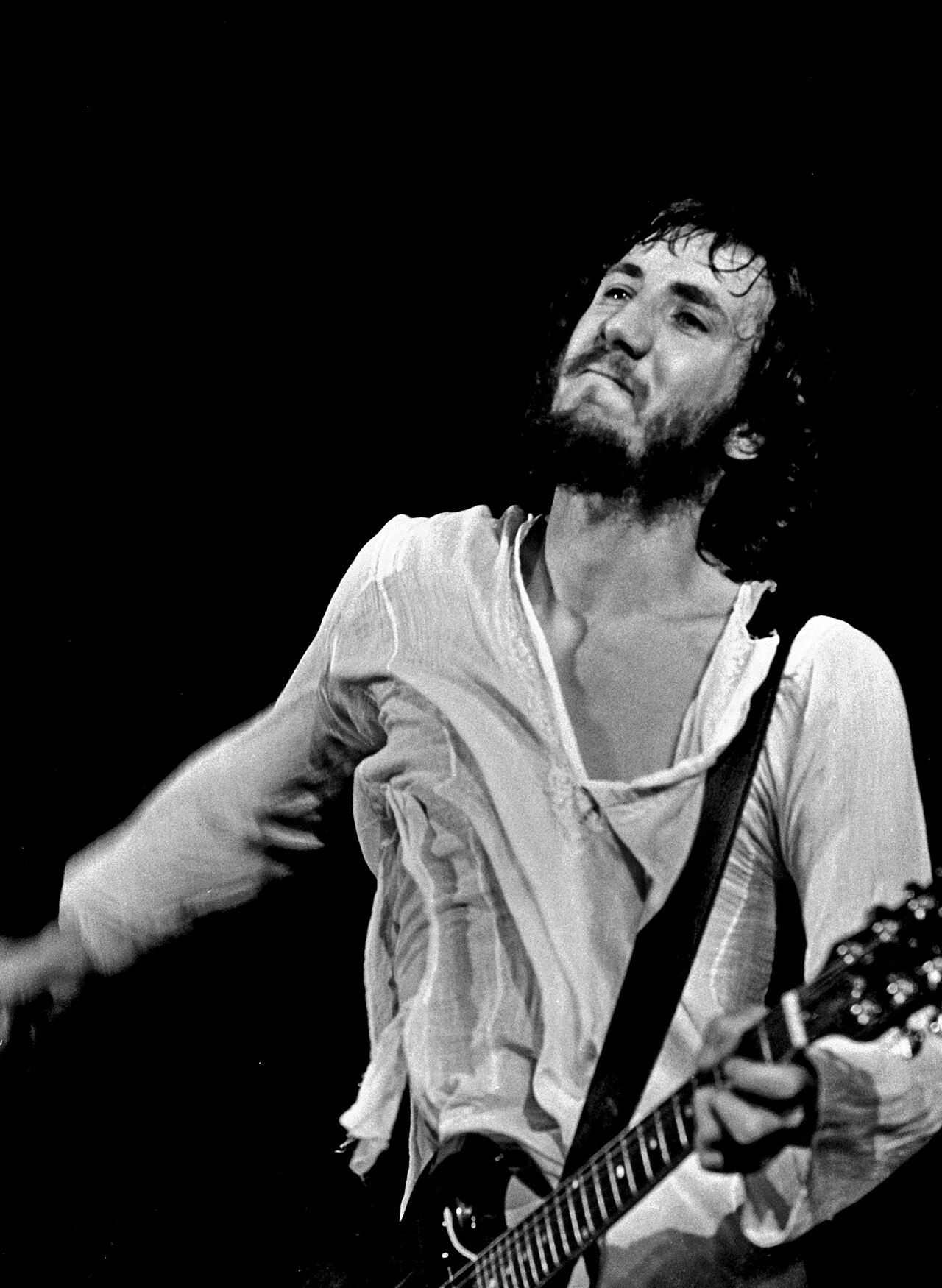
The story starts in the late 1970s, while Eddie Van Halen was busy reshaping what a Fender Stratocaster or Gibson ES-335 could do in the hands of a rock guitarist. Schecter Guitar Research, founded a few years earlier as a Southern California parts-replacement operation, had built up enough capability to start assembling complete instruments from its own components rather than just selling individual parts to repair shops. In 1979, one of those assembled guitars found its way into the hands of Pete Townshend, who was in the process of retiring the numbered Gibson Les Paul Deluxes he’d relied on for years. His guitar tech, Alan Rogan, tracked one down at Manny’s Music in New York, and Townshend was reportedly won over immediately.
What followed was a genuine collaborative relationship. Townshend had UK luthier Roger Giffin, and later Schecter directly, build him further examples to his specification: a Telecaster-style body loaded with a pair of high-output humbuckers rather than the single-coil configuration a T-style guitar would traditionally carry. Townshend played these Schecter-built guitars onstage with the Who from 1979 through 1988 — nearly a decade at the height of the band’s stadium-rock era. That’s a documented, primary-source-level connection: it comes directly from guitar-press retrospectives on the model’s origin, cross-referenced against Townshend’s own well-documented gear history during that period.
From Custom Build to Catalog Model
Schecter eventually formalized that shape into a standing catalog offering, and the PT badge has stuck around in various forms ever since — the plain PT Standard, the PT Special, and the Fastback covered here, which adds a distinct body contour and a more contemporary pickup and control configuration on top of the historic silhouette. The name “Fastback” borrows automotive language, evoking the sloped, aerodynamic roofline of muscle-car-era Detroit iron — a fitting reference for a guitar whose shape has one foot in the same late-’70s rock era that produced Townshend’s original Schecters.
It’s worth noting that Schecter’s relationship to that era runs slightly deeper than a single artist story. During the same late-1970s and 1980s window, the company’s parts-and-custom-build business quietly touched several other notable names — the brand’s own retrospectives mention Mark Knopfler and Prince among artists who used Schecter parts or instruments at various points, though none of those connections carry the same documented, sustained depth as Townshend’s near-decade-long run with the PT-shaped guitars onstage.
Schecter PT Fastback: Full Specifications
The dual-volume, dual-tone control layout is a deliberate nod to the vintage Telecaster Deluxe/Custom formula the original Townshend guitars echoed, giving players independent control over each pickup’s output rather than the single master volume most modern T-style guitars default to. Reviewers have consistently pointed to that control scheme as one of the Fastback’s most rewarding features in practice — blending a tapped pickup at partial volume against the other at full creates tonal textures a simpler one-volume guitar can’t easily reach.
Famous Players: A Genuine, Verified Connection
This is the rare Schecter model where the honest Famous Players story is about surfacing a connection that’s arguably under-told relative to how significant it actually is.
The real story here is Pete Townshend, and it’s a stronger connection than most “famous player” sections in this guide can claim, precisely because it predates the modern endorsement-deal model of artist relationships entirely. Townshend wasn’t paid to carry a Schecter — he sought one out, fell for it, and had the company custom-build him more, at a point when Schecter itself was barely established as a guitar maker rather than a parts supplier. Pete Townshend’s nine-year run with these guitars, spanning some of the Who’s biggest stadium tours, is as close to a foundational artist relationship as this brand has.
It’s worth being precise about what that means for the modern PT Fastback specifically, though: Townshend played the original, hand-built custom instruments Schecter made for him directly — not this catalog-production Fastback variant, which arrived years later as Schecter’s way of making that shape and spirit available at a production price point. The historical connection is to the platform’s origin story and silhouette, not a claim that Townshend has personally played this exact production model.
Tone Recipes
Classic-rock rhythm, Townshend-adjacent power chords: Both humbuckers engaged (middle switch position), amp pushed into light breakup, full volume on both pickups for maximum output — the SuperRock Custom Alnico pickups are voiced with enough midrange push to cut through a full band mix on big, ringing open chords.
Vintage-leaning clean and jangle: Neck pickup, tone rolled back slightly, coil split engaged via the push-pull tone control for a thinner, more single-coil-adjacent character that leans closer to a traditional Telecaster’s chime.
Blended textures: Middle switch position with the neck pickup’s volume rolled to about 60% against a full-volume bridge pickup — this is the control-layout trick reviewers consistently highlight, producing tonal shades a single-volume guitar simply can’t replicate.
How It Stacks Up: Competitor Comparisons
Against a Fender Telecaster, the PT Fastback’s humbucker-loaded configuration and independent dual-volume control give it a fundamentally different tonal palette — fuller, warmer, and less twangy than a traditional Tele, while retaining the same body silhouette and scale length that make the platform feel familiar to Telecaster players.
Against Schecter’s own Reaper-6, the two guitars represent opposite ends of the brand’s identity: the Reaper-6 is built for modern high-gain sustain and metal, while the PT Fastback is rooted in vintage-inspired rock tones and classic control-layout versatility.
Against a Gretsch-style single-cut with Bigsby (relevant for the PT Fastback II B variant), the Schecter’s alder body and higher-output humbuckers give it noticeably more midrange punch than the airier, more hollow-adjacent character typical of Gretsch’s semi-hollow lineup.
Buying Guide: Which PT Fastback Variant
- PT Fastback (standard): Fixed bridge, the most straightforward and best-value entry point into the platform.
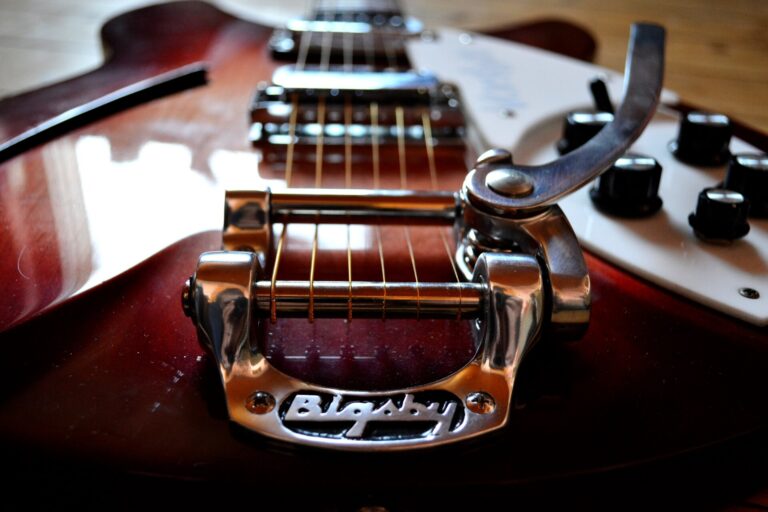
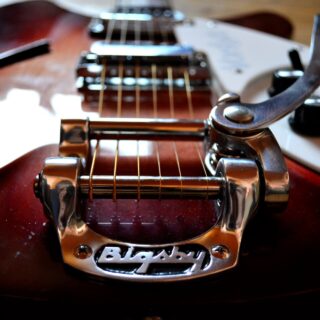
- PT Fastback II B: Adds a Bigsby Flat Top B50 vibrato with a roller Tune-o-matic bridge, aimed at players who want vintage-style tremolo shimmer without sacrificing tuning stability.
- PT Fastback Custom: Upgraded pickups and premium finish options for players wanting to stay within the Fastback body but step up the electronics package.
Why This Guitar Still Matters in a Crowded T-Style Market
The T-style market is one of the most saturated corners of the electric guitar world — nearly every manufacturer at every price point offers some version of the shape, most of them chasing either strict vintage authenticity or maximalist metal-spec modernization. The PT Fastback carves out a third lane that’s harder to find: a guitar that keeps the historic silhouette and control-layout thinking intact while updating the pickups and hardware just enough to feel current, without erasing what made the original guitars distinctive in the first place. That’s a narrower design brief than it sounds, and it’s part of why the model has stayed in Schecter’s catalog in various forms for well over a decade rather than being replaced by newer T-style entries.
It also benefits from carrying genuine, verifiable history rather than a manufactured origin story. Plenty of guitar shapes borrow vintage design language purely for aesthetic appeal; the PT Fastback’s connection to an actual working guitarist’s actual stage instrument gives it a layer of substance that’s difficult for a purely design-led alternative to replicate.
Practical Ownership Notes
Premier Guitar’s review of the PT Fastback II B was notably glowing, explicitly calling out the construction, playability, and attention-to-detail as competitive with instruments costing significantly more — a strong signal given the publication’s generally measured tone toward budget-tier import guitars. That said, feedback across owner forums and retailer reviews does surface a few recurring notes: some players find the stock SuperRock Custom pickups better suited to high-gain rock and blues than to cleaner, more articulate genres, and a subset of owners eventually swap them for boutique alternatives once they’ve settled into the guitar. On II B units, a handful of reviews mention the stock Bigsby spring needing an aftermarket replacement (players commonly recommend a Reverend “Soft Touch” spring) to smooth out its action. None of this undermines the platform’s fundamental value proposition — it’s consistently described as punching well above its price point.
FAQ
Did Pete Townshend actually play the Schecter PT Fastback?
Townshend played the original hand-built Schecter guitars that inspired the PT platform’s shape and spirit during his time with the Who from 1979 to 1988. The modern production Fastback is Schecter’s way of bringing that shape to a wider audience at an accessible price, not a claim that Townshend has played this specific catalog model.
What does “PT” stand for on Schecter guitars?
Pete Townshend — the PT shape traces directly back to the custom Schecter guitars built for him in the late 1970s and early 1980s.
Is the PT Fastback closer to a Telecaster or a different body style entirely?
It’s clearly T-style-inspired in silhouette, but the dual-humbucker configuration and vintage Wide Range-style pickup voicing give it a notably different tonal identity from a standard single-coil Telecaster.
Should I get the standard PT Fastback or the II B with a Bigsby?
If you want maximum tuning stability and simplicity, the standard fixed-bridge version is the safer choice. If vintage-style vibrato shimmer matters more to your playing style than rock-solid tuning under heavy bends, the II B is worth the tradeoff.
Image credits
- Pete Townshend: Heinrich Klaffs, Wikimedia Commons, CC BY-SA 2.0.
Latest News
Related

On This Day
Monday 9 November
From this week: