One Knob to Rule Them All: The Boss OS-2 OverDrive/Distortion’s Long Game
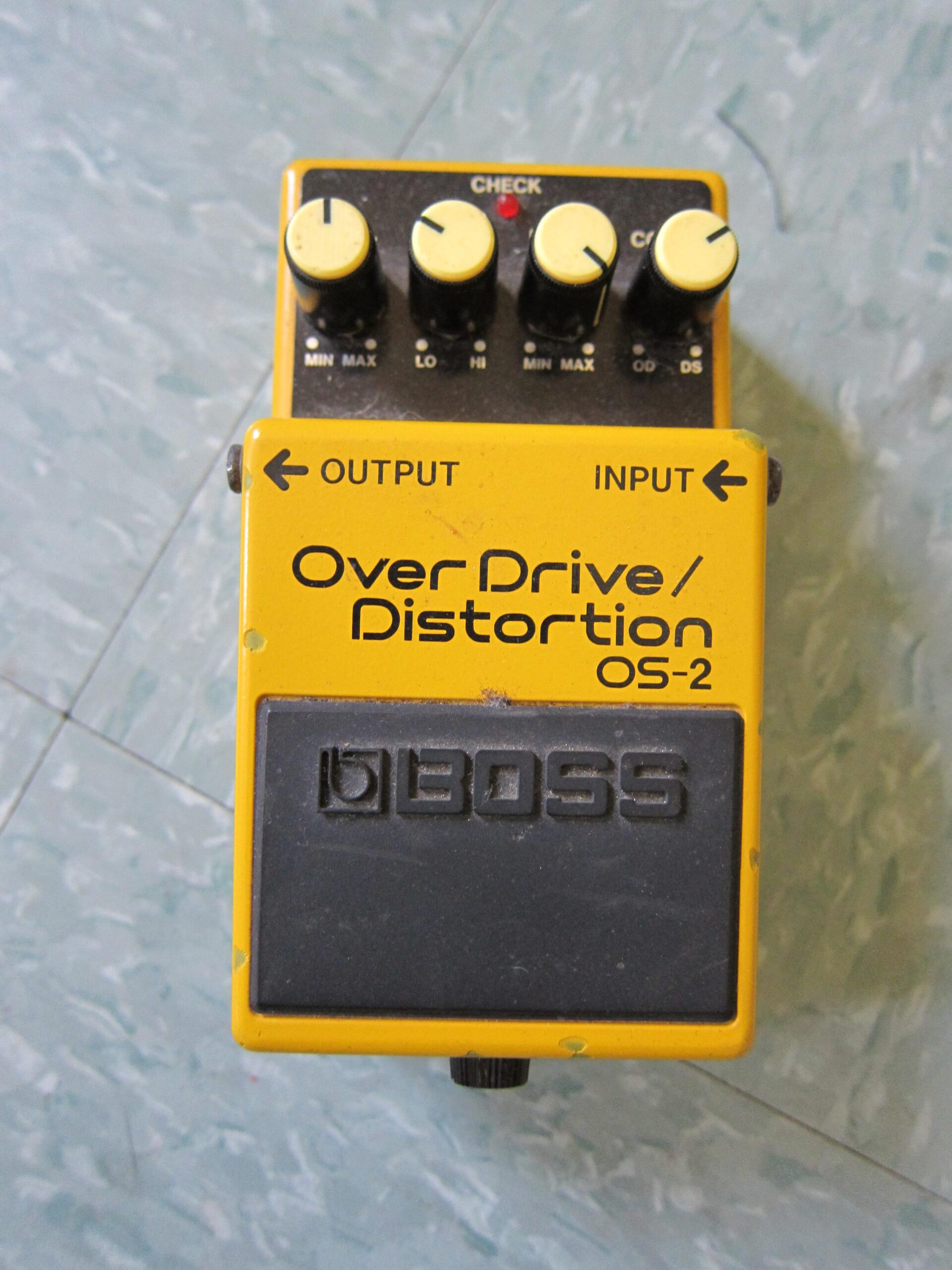
Boss OS-2 OverDrive/Distortion, photographed 11 October 2011. Photo: Oldangelmidnight. CC BY-SA 2.0 (https://creativecommons.org/licenses/by-sa/2.0/). Full source frame retained; resized web versions: CC BY-SA 2.0. No crop or retouching. Source: https://commons.wikimedia.org/wiki/File:BOSS_OS-2_OverDrive_Distortion.jpg
The Boss OS-2 blends overdrive and distortion with one Color knob. Specs, tone recipes, famous players, buying guide, and honest comparisons — all here.
In 1990, Boss dropped a pedal that should have started arguments but mostly ended them. The OS-2 OverDrive/Distortion put two fundamentally different gain circuits into a single compact enclosure and handed players a Color knob to blend between them. Not a multi-effects unit. Not a menu-diving digital patch bay. Just a single yellow knob that sweeps from warm overdrive on the left to hard-clipping distortion on the right, with every combination in between available at any point along the way. It was an audacious design decision for its era, and over three decades later, Boss still builds it the same way.
The OS-2 is not the most talked-about pedal in the Boss catalog. It doesn’t carry the mystique of the DS-1’s raw rock heritage or the prestige of the MT-2’s heavy metal icon status. It exists in a quiet middle ground where usefulness matters more than mythology. That’s the place where working musicians live — and it’s why the OS-2 has stayed in production since the year Germany reunified.
The Logic of 1990: Why Boss Built a Hybrid
By 1990, Boss had already established two clear sonic poles in their compact pedal lineup. On one end sat the overdrive territory: the OD-1 (1977) had pioneered asymmetrical soft clipping that mimicked the natural saturation of pushed tube amplifiers. The SD-1 (1981) carried that lineage forward with added mid-frequency emphasis. On the other end stood the distortion realm: the DS-1 (1978) delivered hard-clipping, wall-of-gain distortion that didn’t pretend to be a tube amplifier at all — it was something new, something electric, something designed for stages where volume control was a secondary concern.
Most players owned pedals from both camps, swapping between them mid-set or running them in parallel with an A/B switcher. Boss’s engineering team looked at this situation and asked a reasonable question: what if the blend itself was the pedal? The OS-2 was the answer. It put both circuits in a single chassis with independent internal signal paths, then routed both through a single passive mix stage controlled by the Color knob. Turn Color fully counterclockwise: pure overdrive, rooted in OD-1 lineage. Turn it fully clockwise: pure distortion, drawing from DS-1-style hard clipping. Park it in the middle: both circuits active simultaneously, their characters layered rather than one replacing the other.
The circuit architecture makes the OS-2 fundamentally different from a single-circuit pedal with a wide gain range. The overdrive side uses asymmetrical clipping — the same principle that gives tube amplifiers their characteristic even-harmonic saturation and dynamic responsiveness. The distortion side uses symmetrical hard clipping — a different family of saturation that’s more aggressive, more compressed, with a different harmonic texture. When you blend the two via the Color knob, you’re not adjusting a single parameter within one circuit. You’re mixing two genuinely different sonic personalities, and their interaction produces combinations that neither circuit alone can achieve.
This distinction matters when you’re trying to understand why the OS-2 sounds the way it does at any given Color setting. A Color knob at nine o’clock isn’t just “a little less harsh than noon” — it’s a different ratio of two separate harmonic contents. The overdrive component preserves more of the guitar’s natural pick attack and dynamic variation. The distortion component adds density, sustain, and compression. In the blended region, you get attack from the overdrive side and sustain from the distortion side simultaneously. That’s a combination that’s genuinely useful for lead playing in particular: front-of-the-note clarity with long, even sustain on the tail.
Controls: Four Knobs, No Mysteries
The OS-2 keeps its interface direct. Level sets output volume. Drive controls the gain amount applied across both active circuits simultaneously. Tone shapes the frequency character for both circuits at once — a single sweep from dark to bright that applies globally regardless of the Color knob position. Color is the defining control: the left (CCW) extreme is overdrive-only, the right (CW) extreme is distortion-only, and anywhere in between delivers a proportional blend of both.
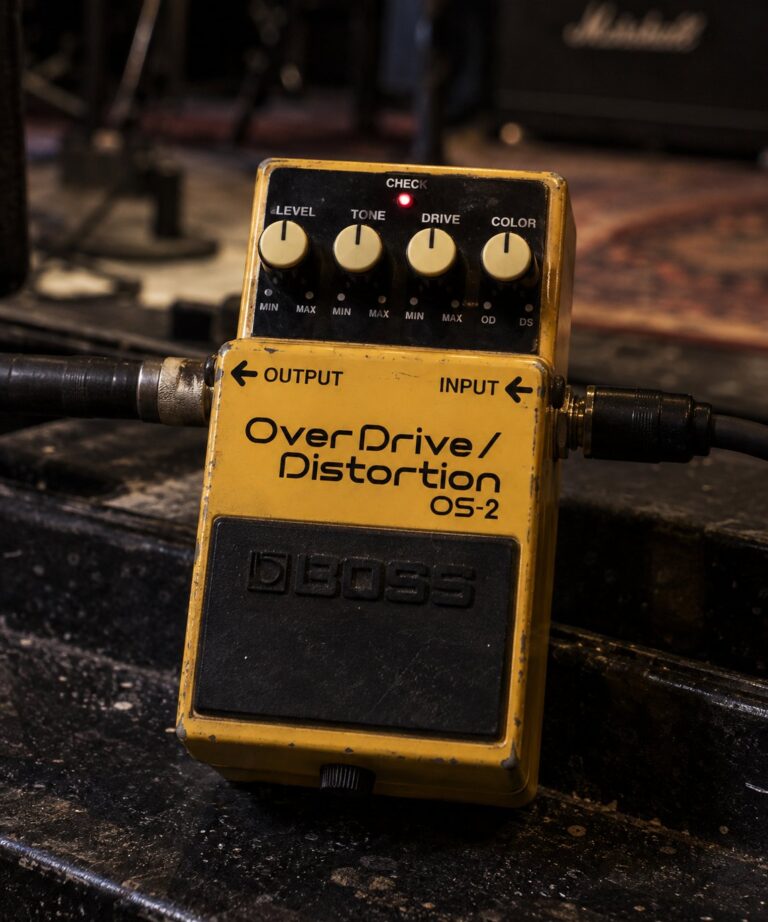
The Tone knob behavior is worth understanding. Because it applies to the combined signal rather than to each circuit independently, its effect changes character depending on the Color position. At full CCW (pure overdrive), rolling Tone back produces a warm, slightly dark edge-of-breakup sound that recalls vintage pushed-amp tones. At full CW (pure distortion), Tone rolled back creates a thicker, heavier wall of gain without the fizz that high Tone settings can produce on the distortion side. In the blended center region, Tone affects both circuits simultaneously, which can require slightly more Tone to maintain clarity than you’d expect if you were only running the overdrive side.
The Drive knob interacts with the Color setting in ways that reward experimentation. At low Drive with Color in the overdrive zone, the OS-2 behaves as a relatively transparent light overdrive, adding harmonic content without dramatically altering the guitar’s character. Push Drive up in the same Color position and the overdrive circuit thickens into classic rock crunch. Shift Color toward the distortion zone while keeping Drive moderate and you access a range of tones that genuinely compete with dedicated distortion pedals in terms of gain density — but with the overdrive component’s dynamic characteristics still present underneath.
Specifications
| Specification | Boss OS-2 | Ibanez TS9 Tube Screamer | Boss DS-1 Distortion |
|---|---|---|---|
| Release Year | 1990 (still in production) | 1982 (reissued 1993) | 1978 (still in production) |
| Circuit Type | Hybrid: OD-1-lineage overdrive + DS-1-style distortion (parallel blend) | Op-amp soft clipping, mid-focused | Op-amp hard clipping |
| Bypass Type | FET buffered bypass | True bypass (reissue) | FET buffered bypass |
| Controls | Level, Tone, Drive, Color | Level, Tone, Drive | Level, Tone, Dist |
| Current Draw | 12 mA | ~6 mA | ~8 mA |
| Power | 9V DC or 9V battery | 9V DC or 9V battery | 9V DC or 9V battery |
| Dimensions | 73mm W × 129mm D × 59mm H | 70mm W × 129mm D × 54mm H | 70mm W × 129mm D × 54mm H |
| Weight | 420g (15 oz) | ~390g | ~390g |
| Price (new) | ~$79–$99 USD | ~$99–$109 USD | ~$49–$59 USD |
| Price (used) | ~$35–$60 USD | ~$55–$80 USD | ~$25–$40 USD |
Famous Players: Honest Connections
The OS-2’s player roster is smaller than Boss’s most iconic single-circuit pedals — it never had a Cobain moment or a Hendrix association. But the documented users represent a genuinely interesting cross-section of players who valued the pedal’s specific hybrid character.
The most thoroughly documented connection belongs to Chris Wolstenholme, bassist for Muse. During the Showbiz era (1999–2001), Wolstenholme used the OS-2 as his primary source of overdriven bass tone, alongside occasional use of the Electro-Harmonix Green Russian Big Muff Pi. His OS-2 tone is documented across most tracks on the Showbiz album and in live recordings from the era. The MuseWiki — the comprehensive documentation resource for Muse’s equipment history — notes that Wolstenholme likely kept the Color knob primarily toward the CCW (overdrive) position, producing the dense, midrange-forward, overdriven bass character that defined the album’s heavier moments without crossing into full distortion territory. This is a textbook use of the Color knob’s sweet spot: overdrive-dominant blend with just enough distortion component for sustain and density. It also demonstrates something rarely discussed about the OS-2 — the circuit’s usefulness for bass, where the overdrive side’s preserved low-frequency content and the distortion side’s compressed sustain combine particularly well. His Showbiz-era tone remains one of the most concrete examples of a professional building an album’s sonic foundation around this pedal.
Johnny Marr is the OS-2’s most notable confirmed guitar connection. Marr — former Smiths guitarist and one of the most influential lead players in British rock history — is documented as an OS-2 user via the official Boss artists page and confirmed equipment sources. Johnny Marr’s relationship with Boss compact pedals spans his career; his approach to layering clean, effected, and lightly overdriven tones across a single guitar part made the OS-2’s blend capability directly applicable to his working method. Marr has spoken in interviews about using a yellow overdrive unit with multiple controls at his feet during his active playing years, with documentation pointing to the OS-2. His use reinforces the OS-2’s position as a player’s pedal — a tool chosen because it delivers specific functionality, not because it’s fashionable.
Contemporary indie and R&B circles have brought the OS-2 back into view through Mk.gee (Michael Todd Gordon), whose textured, effects-heavy guitar work on his 2024 debut album Two Star & the Dream Police attracted significant gear-watching attention. The Boss OS-2 is documented as present on his pedalboard via Equipboard community analysis of pedalboard photographs, positioned alongside a Boss DD-20 Giga Delay, Boss CE-2W Chorus, Chase Bliss MOOD MKI, and Rainger FX Reverb-X. His OS-2 inclusion is noteworthy precisely because his aesthetic — layered, cassette-saturated, lo-fi in texture — finds specific utility in the overdrive side of the Color range, where the OS-2’s OD-1-lineage circuit adds harmonic density without the brightness or hardness that would clash with his production approach. The OS-2’s affordability also aligns with his documented preference for humble, unglamorous working tools alongside boutique effects.
The OS-2’s honest position is that it lacks the kind of canonized celebrity endorsement that defines the DS-1 or TS9 narratives. No single iconic recording defines its sound the way “Smells Like Teen Spirit” defines the DS-1 or “Pride and Joy” defines the modified germanium Fuzz Face. Its reputation is built on functional breadth and longevity — the qualities that make professional working musicians return to it across three decades rather than the qualities that generate magazine cover stories. That’s a different kind of credibility, and for many players, a more useful one.
Tone Recipes and Settings
Overdrive-Forward Lead (Marr Territory)
Color at seven or eight o’clock (full CCW or close to it). Drive at eleven o’clock. Tone at noon. Level set to unity or slightly above. Into a lightly pushed clean amp — a Fender Deluxe Reverb with volume at five or six — and a guitar with single-coil pickups. This setting produces the OS-2’s most refined, dynamically responsive character: overdrive-dominant with the Tone control’s noon position keeping the frequency response balanced rather than scooped or nasal. Pick attack translates directly into saturation variation. Back off the guitar volume and the OS-2 cleans up to a glassy, light-crunch tone. Push into the string hard and the overdrive thickens but retains definition. This is the setting for players who need overdrive as an expressive tool rather than a wall of gain.
Blended Mid-Gain Crunch (The OS-2’s Best Argument)
Color at eleven o’clock (slightly overdrive-dominant but with distortion component active). Drive at one o’clock. Tone at eleven o’clock (slightly backed off). Level at unity. This setting showcases what the hybrid design actually accomplishes that no single-circuit pedal can match: the attack comes from the overdrive side with natural dynamic variation, while the sustain tail is filled in by the distortion component’s denser harmonic content. The result is a mid-gain crunch tone with more depth and sustain than a pure overdrive would deliver at similar Drive settings, but more pick responsiveness than a pure distortion. Into a Gibson Les Paul Standard, this setting produces a rhythm crunch that sits well in a mix without pushing into lead-guitar saturation levels.
Overdriven Bass (Wolstenholme Approach)
Color at seven or eight o’clock (overdrive-dominant). Drive at ten to eleven o’clock. Tone at noon or one o’clock. Level adjusted for stage volume balance. This replicates the Showbiz-era approach: Color biased toward overdrive preserves low-frequency content that the distortion side would compress and thin out, while the Drive setting is kept moderate enough to maintain note definition in a bass context. The slight Tone-up position prevents the OS-2 from sounding muddy through bass amp speakers. If you have active pickups on a bass, keep the instrument’s preamp level conservative to avoid overloading the OS-2’s input stage.
Dense Rhythm Distortion (Distortion-Dominant)
Color at three o’clock (distortion-dominant, small overdrive component). Drive at noon. Tone at one to two o’clock. Level slightly above unity for definition. Into a British-voiced amp — a Fender Stratocaster with the pickup selector on the bridge — this setting delivers dense rhythm distortion with more note definition than a fully committed DS-1 at similar Drive settings. The small overdrive component in the Color blend adds just enough harmonic texture to prevent the distortion from sounding sterile. This is the OS-2 as a dedicated rhythm tool for players who need a single pedal to cover gain duties from edge-of-breakup to full crunch.
Full Distortion with Clarity (Maximum Breadth Setting)
Color fully clockwise (pure distortion). Drive at nine o’clock (moderate, not cranked). Tone at eleven o’clock. Level set for unity. At this Color position with a moderate Drive setting, the OS-2’s distortion circuit operates at a gain level where note-to-note definition remains intact — more so than the same circuit would produce with Drive pushed higher. This setting reveals that the DS-1-lineage distortion in the OS-2, when used conservatively, has more character and less fizz than a stock DS-1 at comparable gain levels. Useful for players who primarily want distortion but find the DS-1 too bright or too fizzy for their particular guitar-amp combination.
Comparisons
OS-2 vs. Ibanez TS9 Tube Screamer
The Ibanez TS9 is a highly specific tool: its mid-forward character, soft clipping behavior, and tight low-end response all push toward a defined tonal target that works brilliantly in certain contexts (particularly into an already-driven amp) but fails in others (it’s not designed for high-gain tones and its midrange emphasis doesn’t work for every style). The OS-2 is a different philosophy entirely. It’s not particularly mid-forward in its default sound; the overdrive side has a more open frequency response, and the distortion side has a harder character that owes nothing to Tube Screamer topology. The OS-2 offers far more tonal range than the TS9 but less of the TS9’s specific magic in the contexts where that magic is called for. If you need an SRV-style bluesy boost into a cranked amp, the TS9 wins definitively. If you need to cover overdrive, distortion, and blended territory without carrying two pedals, the OS-2 wins with equal clarity.
OS-2 vs. Boss BD-2 Blues Driver
The BD-2 Blues Driver is built around a JFET-based circuit with a distinctive snappy, slightly bright bite that particularly suits single-coil guitars at moderate gain levels. Its character is immediately identifiable — there’s a touch of edge and clarity to its saturation that makes it excellent for blues and light rock applications. The OS-2 in pure overdrive mode (Color fully CCW) is warmer and less distinctive than the BD-2; it blends into the guitar’s natural character more neutrally. The BD-2 has more personality in that register. But the OS-2’s range beyond the pure overdrive position — the blended and distortion zones — is territory the BD-2 doesn’t enter at all. These are complementary tools rather than competitors.
OS-2 vs. Boss DS-1 Distortion
The Boss DS-1 is the benchmark Boss distortion pedal, and its distortion circuit is closely related to the OS-2’s distortion side. The critical difference: the OS-2’s distortion circuit is tuned with somewhat less high-end emphasis than the DS-1, making it slightly warmer and less prone to fizz at high Drive settings. When the OS-2’s Color knob is fully clockwise, you’re running a distortion that sounds related to but not identical to a DS-1 — and the DS-1 comparison actually disadvantages the DS-1 slightly in terms of high-gain smoothness. The DS-1 costs significantly less and its single-circuit focus gives it a cleaner, more predictable signal path. The OS-2 costs more but does more. If you already own a DS-1 and are happy with pure distortion, the OS-2’s upgrade case rests entirely on whether you want the overdrive side and blending capability. If you’re choosing for the first time, the OS-2 represents substantially more value per dollar despite the higher price.
OS-2 vs. Boss OD-3 OverDrive
The Boss OD-3 — released in 1997, seven years after the OS-2 — represents Boss’s refinement of the OD-1 heritage into a dedicated dual-stage overdrive pedal. Its overdrive circuit is more sophisticated than what the OS-2 offers in pure overdrive mode: the OD-3’s dual-stage topology provides a wider gain range, fuller low-frequency response, and more even overdrive character. If pure, versatile overdrive is the goal, the OD-3 wins against the OS-2’s overdrive channel in direct comparison. But the OS-2 offers something the OD-3 cannot: the Color knob’s ability to introduce distortion character alongside the overdrive. For players who only need overdrive, the OD-3 is the better tool. For players who want overdrive, distortion, and every blend between them in a single pedal, the OS-2 has no competition within the Boss lineup.
OS-2 vs. Multi-Effect Processor
A common modern alternative to the OS-2’s range-via-single-pedal approach is to use a multi-effect unit with separate overdrive and distortion patches. The multi-effect wins on parameter depth: independent EQ, gain, and level controls for each circuit, switchable without touching the Color knob. The OS-2 wins on simplicity, analog character, and the specific quality of having both circuits genuinely running simultaneously when blended — not a digital crossfade between two patches but actual analog parallel signal paths producing a hybrid character that blending can’t fully replicate. For rehearsal spaces, practice rigs, and situations where pedalboard real estate is severely constrained, the OS-2’s proposition is hard to dismiss.
Buying Guide
The OS-2 retails new for approximately $79–99 USD depending on the retailer, making it one of the more affordable compact pedals in Boss’s current catalog given its dual-circuit design. It has been manufactured continuously since 1990, meaning the used market is well-supplied: excellent-condition examples commonly appear between $35 and $60 USD. There are no meaningful version differences or upgrade cycles to navigate — Boss has not issued MkII or MkIIS variants. Early production units from 1990–1995 may have slightly different internal component specifications due to standard parts evolution, but no documented sonic difference significant enough to pay a premium for vintage examples.
The OS-2 is not battery-hungry — 12mA draws at 9V are easily managed by any standard power supply. It runs on center-negative 9V DC or a standard 9V battery. The enclosure is standard Boss compact, which is somewhat taller and deeper than the very smallest available compact enclosures, so account for that in pedalboard planning. The FET buffered bypass is always active; if you use germanium fuzz pedals that are sensitive to input impedance (Fuzz Face variants, vintage-style germanium designs), place them before the OS-2 in the signal chain. The OS-2’s buffer actually benefits the downstream signal chain on most rigs — particularly rigs with long cable runs between the pedalboard and the amplifier.
For players considering the OS-2 as a single-pedal gain solution for a simple practice or rehearsal rig, it delivers exceptional value: one pedal, one power connection, one board space, covering tone territory that would otherwise require at minimum two separate pedals and a switching solution. For players with dedicated overdrive and distortion pedals already on their boards, the OS-2 is a harder sell — its individual circuits don’t outperform purpose-built competitors like the OD-3 on overdrive or the DS-1 on distortion. The OS-2’s case is strongest when its blend capability is the specific feature you need, not when you’re benchmarking its individual circuits against specialist alternatives.
Ownership Notes
The Color knob rewards slow exploration across its full range. Many players settle on a fixed position early and stop experimenting; resist this tendency. The interactions between Color, Drive, and Tone across the full knob range produce genuinely different-sounding tones that are easy to overlook if you set the pedal once and stop. In particular, the nine-to-noon region of the Color knob — overdrive-dominant but with increasing distortion component — contains the most unique OS-2 sounds that can’t be replicated by switching between separate pedals.
The Tone control’s dark end (seven to nine o’clock) is underused. Most players push Tone to noon or above by instinct. Rolling Tone back on the OS-2 produces a woolly, warm saturation — particularly in pure overdrive mode — that works well for rhythm playing in dense mixes where the guitar needs harmonic weight without frequency-range competition with other instruments. This is a valuable setting that takes some deliberate experimentation to find.
Drive interacts with the Color setting in ways that aren’t fully intuitive. In the pure distortion zone, moderate Drive settings often produce more usable tones than cranked Drive settings; the distortion circuit can become harsh and fizzy at high Drive, particularly through bright amplifiers. Backing the Drive to nine or ten o’clock while keeping Color in the distortion range often produces better lead tones than a fully cranked Drive setting.
Finally: the OS-2 stacks well with other drive pedals despite being a hybrid. Placed after a moderate overdrive (a Boss SD-1 or TS9) with Color in the overdrive zone, the OS-2 adds harmonic thickness and gain without dramatically changing the first pedal’s character. Placed before an amp’s natural breakup channel, even the pure overdrive Color setting pushes the front end enough to produce tube saturation that sounds different from either the OS-2’s circuits or the amp’s natural overdrive alone. The hybrid design means it interacts differently with different parts of the signal chain depending on Color position, which requires some experimentation but yields a range of useful combinations.
Frequently Asked Questions
What does the Color knob on the Boss OS-2 actually do?
The Color knob blends between the OS-2’s two independent internal circuits. Turned fully counterclockwise, you hear only the overdrive circuit (rooted in OD-1 lineage, asymmetrical soft clipping). Turned fully clockwise, you hear only the distortion circuit (hard-clipping DS-1-style topology). Anywhere in between, both circuits are active simultaneously — their signals mixed proportionally. This is a genuine parallel analog blend, not a digital crossfade. The result is that mid-range Color positions produce tones with qualities from both circuits: the overdrive side’s dynamic responsiveness with the distortion side’s sustain and density.
Is the Boss OS-2 the same as a DS-1 plus an SD-1 in one box?
Closely related, but not identical. The OS-2’s distortion circuit is tuned differently from a stock DS-1 — it’s generally described as warmer and slightly less bright at high gain settings. The overdrive circuit draws from OD-1 lineage rather than the SD-1’s mid-forward character. Additionally, the OS-2’s blend architecture means both circuits are active simultaneously in the Color mid-range, which is a qualitatively different result from switching between two separate pedals. If you want an OD-1 and DS-1 in parallel with a blend control, the OS-2 is close. It’s not an exact component-level clone of either specific model.
Does the OS-2 work well for bass guitar?
Yes, particularly in the overdrive-dominant Color range. Chris Wolstenholme’s use on the Muse Showbiz album is the most well-documented example: Color kept mostly CCW (overdrive), Drive set moderately, Tone slightly open to avoid muddiness. The key is keeping the Color knob toward the overdrive side — the distortion circuit’s hard clipping tends to thin out low-frequency content more aggressively, which is problematic for bass unless that thinned character is specifically desired. At moderate Drive levels with overdrive-dominant Color, the OS-2 produces a dense, midrange-forward overdriven bass tone with usable note-to-note definition.
Is the OS-2 better than using a dedicated overdrive and distortion pedal separately?
Depends on what you need. Two separate pedals give you independent control over each circuit’s level, tone, and gain — and the ability to switch between them instantly without touching a knob. The OS-2’s advantage is footprint, cost, and the specific quality of having both circuits genuinely blended simultaneously (which you can’t do with an A/B switcher between two pedals — you’d need a parallel signal path or a Y-split with both pedals on simultaneously). If you regularly need overdrive tones, distortion tones, and blended tones in the same set, the OS-2’s Color knob is a more elegant solution than managing two footswitches and a switching network.
Should I use the OS-2 before or after other overdrive pedals in my chain?
In most cases, before. Running the OS-2 earlier in the chain lets it respond to the guitar’s direct signal with maximum dynamic range, which the overdrive side particularly benefits from. Placed after other gain stages, the OS-2 receives an already-compressed, already-clipping signal that can cause distortion-side tones to become compressed and fizzy. However, there are specific applications where placing the OS-2 after a light overdrive is useful: a low-gain TS9 or SD-1 before the OS-2 in overdrive-dominant Color mode adds thickness to the foundation without stacking gain in a way that collapses. Experimentation is warranted in both positions.
What’s the best Color knob position for single-coil guitars?
Generally the overdrive-dominant range: Color between fully CCW and about ten o’clock. Single-coil pickups have a more aggressive top end than humbuckers, and the distortion circuit’s hard clipping — particularly at higher Tone settings — can produce a bright, slightly harsh result with single-coils. The overdrive side’s asymmetrical soft clipping responds better to single-coil dynamics and preserves the natural brightness of the pickups without adding more high-end hardness on top. If you want some distortion component with a Stratocaster or Telecaster, push Color to nine o’clock rather than noon; this adds distortion density while keeping the overdrive component’s softening influence prominent.
Is the Boss OS-2 discontinued?
No. As of 2026, Boss still manufactures and sells the OS-2 OverDrive/Distortion. It has been in continuous production since its 1990 introduction — over 35 years — which makes it one of the longest-running compact pedals in Boss’s catalog. You can buy a new unit from any authorized Boss dealer. The used market also has consistent supply given the production run’s length, and prices are generally modest.
Can I power the Boss OS-2 with an 18V supply for more headroom?
No. The OS-2 is designed for 9V operation only. Unlike some Boss pedals that accept a broader voltage range, or boutique designs that specifically support 18V for increased headroom, the OS-2 spec sheet specifies 9V DC. Running it at higher voltages risks damaging the circuit. The 12mA current draw at 9V is modest and compatible with any standard pedalboard power supply, including budget options, so power supply choice is not a significant variable with this pedal.
Image credits
- Top image: Boss OS-2 OverDrive/Distortion, photographed 11 October 2011. Photo: Oldangelmidnight. Source photograph · CC BY-SA 2.0. Full source frame retained; resized web versions are licensed under CC BY-SA 2.0. No crop or retouching.
- Boss OS-2 OverDrive/Distortion: GuitarGangsters AI-generated reference illustration, not a photograph.
Latest News
Related
On This Day
Thursday 12 November
From this week: