The Orange Box That Ate the World: Inside the Boss DS-1 Distortion
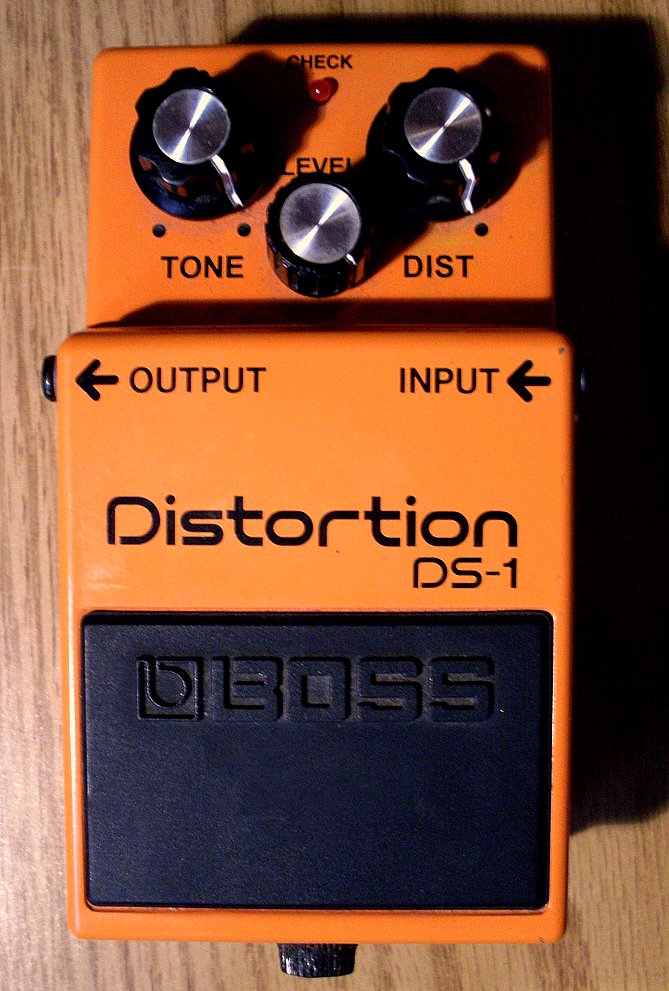
Boss DS-1 Distortion with silver-topped knobs. Photo: “Boss DS-1” by Roadside Guitars, CC BY-SA 2.0 (https://creativecommons.org/licenses/by-sa/2.0/). Source image unchanged. Source: https://www.flickr.com/photos/roadsideguitars/3103588475/
The Boss DS-1 Distortion has driven rock since 1978. Learn the circuit versions and how Kurt Cobain, Joe Satriani, and Steve Vai used the orange icon.
There are pedals that are famous. And then there is the Boss DS-1 Distortion — the orange stompbox that has been on more pedalboards, in more bedrooms, on more stadium stages, and on more legendary recordings than any distortion circuit in history. Since 1978, that squat orange enclosure with its three knobs has been the default answer to the question “how do I make my guitar sound like a monster?” It has fueled grunge, shred, jazz fusion, pop rock, indie, and everything in between. It is, by any reasonable measure, the best-selling distortion pedal ever built — over 1.5 million units of the DS-1 alone, part of more than 17 million Boss compact pedals sold globally as of 2022.
And yet, despite its ubiquity, the DS-1 is persistently misunderstood. Players dismiss it as a beginner pedal the moment they can afford something boutique, only to rediscover it a decade later and realize they’ve been chasing something the orange box already had. George Lynch has been reaching for it since the ’80s. Joe Satriani built his solo career on it. Kurt Cobain used one on the record that launched grunge. Mike Stern put it on every jazz album he made. The DS-1 is not a stepping stone — it is a destination. This is its full story.
Before the Orange: Boss in 1977
The Boss compact pedal series launched in 1977 with three models: the OD-1 Overdrive (yellow), the PH-1 Phaser (green), and the SP-1 Spectrum (red). They were called the “traffic light” trio, and they introduced the world to Boss’s now-iconic enclosure format — the rugged die-cast casing, the rubber-capped footswitch, the 9V battery compartment, the clean industrial design that would outlast every trend in the guitar world for the next five decades.
The OD-1 was a revelation. Its asymmetrical clipping circuit produced smooth, warm breakup that mimicked a cranked tube amp at manageable volumes — the dawn of a new pedal category called “overdrive.” But the Boss engineers immediately recognized that the market needed something harder. Something that went further into aggressive, high-gain territory than the OD-1 was designed to reach. Something that would make your guitar sound like it was plugged directly into a wall of controlled fury.
In 1978, that something arrived. The DS-1 Distortion joined the Boss lineup — the first distortion pedal the company ever made, and the first to carry the Boss name. Its enclosure was painted a distinctive burnt orange, partly to stand out visually and partly because it was simply the color that was left. In hindsight, that orange has become one of the most recognizable aesthetic choices in guitar history. JHS Pedals founder Josh Scott summed it up precisely: “When you say distortion pedal, an orange box pops up in my head. It’s a cultural pop icon to me.”
The Circuit That Changed Everything
What the Boss engineers built in 1978 was genuinely novel. Most drive pedals of the era were fuzzes — spitty, brash, germanium-and-silicon circuits that became harsh and muddy at higher gain settings. The OD-1 had improved on this with its smooth asymmetrical clipping, but it was optimized for warm breakup, not aggressive distortion.
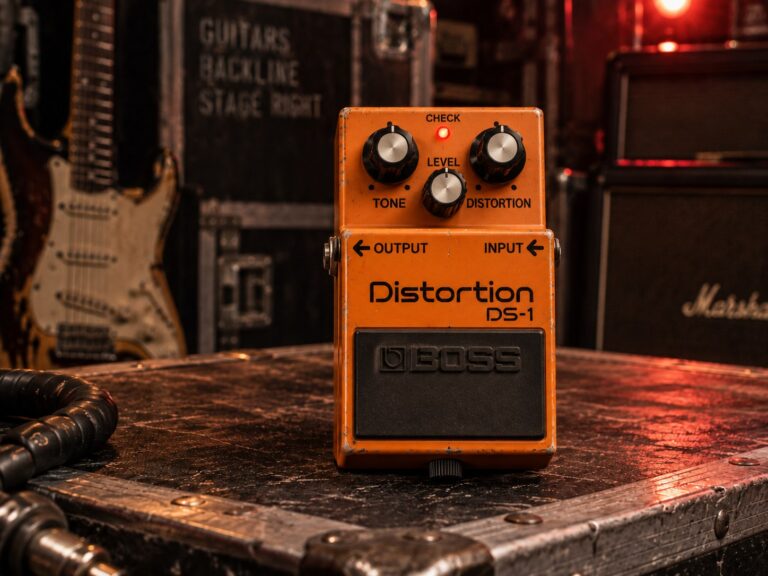
For the DS-1, Boss took a different approach. The engineers combined two common circuit architectures — a transistor gain stage and an op-amp gain stage — into a single hard-clipping design. The result was something the guitar world hadn’t quite heard before: distortion that was simultaneously tight and harmonically rich, aggressive but controlled, capable of searing high-gain sustain without dissolving into fizzy noise at the bottom end.
The three-control layout has never changed: Level (output volume), Distortion (gain), and Tone. That Tone control is worth understanding properly, because it works differently from the tone controls on most pedals. Rather than simply cutting high frequencies as you turn it down, the DS-1’s Tone knob functions as a “tilt” EQ — rotating counterclockwise simultaneously boosts lows and cuts highs, while clockwise simultaneously boosts highs and cuts lows. This gives the DS-1 a much wider tonal palette from a single knob than it might appear on paper. At the center position the response is roughly flat. Fully clockwise produces a razor-bright, cutting high-end. Fully counterclockwise produces a thick, dark wall of low-mid distortion.
One technical characteristic worth knowing: the DS-1 has a slight dip in the lower midrange by design. This makes it pair exceptionally well with amps that have a strong midrange presence — classic Marshalls, vintage Fender tweeds, and mid-forward British designs all benefit. If you’re using a mid-scooped amp like a blackface or silverface Fender, you may need to compensate with your amp’s EQ or by keeping the Tone knob in a warmer position.
Forty-Eight Years of Versions: The DS-1 Family Tree
The DS-1 has been in continuous production since 1978 — longer than any other distortion pedal in history. Over those decades, its circuit has evolved significantly, and the differences between versions are real enough to matter to serious players.
The original 1978 Made-in-Japan (MIJ) version used a Toshiba TA7136AP preamplifier IC, which gave it a distinctive warm character with glints of grittiness. These are identified by the “Made in Japan” back label and a visible metal screw on the battery compartment. They are the most sought-after version on the vintage market and command a premium accordingly. The MIJ era continued until roughly 1988–1990, when Boss relocated production to Taiwan to reduce costs in the face of competition from DOD and Peavey.
The 1994 redesign (DS-1A) was the most significant engineering change in the pedal’s history. With the Toshiba TA7136AP chip reaching end-of-life, Boss completely rewrote the circuit topology and adopted the Rohm BA728N dual op-amp. The new design cascaded two internal op-amps in non-inverting configuration — a fundamentally different architecture from the original preamp IC design. The December 1994 Boss service manual formally designated this version “DS-1A.”
The 2000 revision swapped the BA728N for a Mitsubishi M5223AL, widely considered the weakest version of the DS-1. Players documented a “fizzy” character and increased noise at high Drive/Level settings, and a peculiar volume boost when rotating the Tone knob. The modification community exploded during this era, with op-amp swaps (to RC4558, OPA2134, and others) becoming popular upgrades.
By 2006, Boss had moved to a New Japan Radio NJM2904 op-amp, and by 2016, the DS-1 moved production to Malaysia with a shift from through-hole to surface-mount (SMT) components. The SMT change largely ended the modification scene for current-production pedals, since most DS-1 mods require access to easily-replaced through-hole components.
To celebrate the DS-1’s 40th anniversary in 2018, Boss released the DS-1-4A — a limited run with a sleek black enclosure, gold-capped knobs, and a vintage silver screw. Made in Japan with through-hole components (most examples), it also used the NJM3404AL op-amp, an enhanced version of the NJM2904 with improved slew rate and reduced crossover distortion.
The most significant recent development is the 2022 DS-1W Waza Craft — Boss’s premium analog series, handbuilt in Japan with discrete components. The DS-1W adds a slider switch for two modes: Standard (the classic DS-1 circuit) and Custom (a revised circuit with a fatter, richer midrange, retuned Tone control, and increased input sensitivity and output gain). The DS-1W bridges the gap between the beloved vintage character and modern dynamic demands.
Specifications
| Feature | Specification |
|---|---|
| Controls | Level, Tone, Distortion |
| Signal type | Analog hard-clipping, transistor + op-amp stages |
| Bypass | Electronic buffered bypass |
| Input impedance | 1 MΩ |
| Output impedance | 1 kΩ |
| Power | 9V DC (PSA-series adapter or 9V battery) |
| Current draw | 5 mA |
| Dimensions | 73 × 129 × 59 mm / 2-7/8 × 5-1/16 × 2-3/8″ |
| Weight | 395 g / 13 oz (with battery) |
| Price (current, 2026) | ~$59.99 USD |
| DS-1W Waza Craft | ~$149.99 USD |
| Made in | Malaysia (current production); Japan (DS-1W, DS-1-4A) |
Famous Players
Kurt Cobain — Nirvana
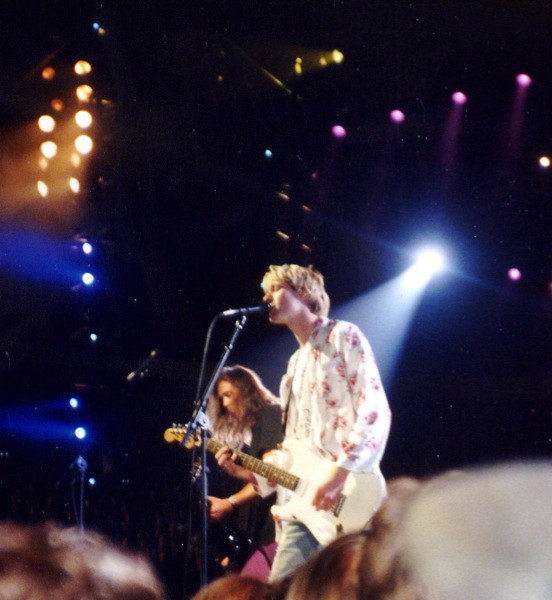
The DS-1’s defining cultural moment may be its role in the birth of grunge. When Nirvana recorded Bleach at Reciprocal Recording in Seattle in 1989, the signal chain was almost laughably simple: Cobain’s guitar into a DS-1, out into Jack Endino’s clean Fender Twin Reverb. Endino, the super-producer who defined the Seattle sound, confirmed the setup directly in an interview with Guitar World: “I can tell you Kurt was using a BOSS DS-1, the orange pedal with three knobs. That was his sound in 1989.” The DS-1 was reportedly set near maximum gain — creating the raw, abrasive wall-of-noise character that would define Nirvana’s early sound and, by extension, the first wave of grunge. Cobain later transitioned to the DS-2 Turbo Distortion for his Nevermind and In Utero work, but the DS-1 owns the DNA of where it all began.
Joe Satriani
Before Joe Satriani became the most commercially successful solo instrumental guitarist in history, he was a guitar teacher in the San Francisco Bay Area who had just released a breakout album that surprised everyone — including him. When Surfing with the Alien (1987) became a hit, Satriani was suddenly expected to perform it live, with no touring infrastructure and no budget for vintage Marshalls. His solution was the DS-1. In a 2022 interview with the Music Gear Network YouTube channel, he described the decision plainly: “I thought the only way to do this would be to get the sound in a little box, which was the DS-1, and figure out one amp that I could play to take a little bit of the buzz off and just add a bit more punch to the sound.” The DS-1 made his signature articulate, singing lead tone achievable on a practical touring rig, and he continued using it as a cornerstone of his live setup for years afterward.
Steve Vai
Steve Vai is often associated with elaborate, customized signal chains and signature gear, but for a decade-plus stretch of his career, the DS-1 was his main distortion pedal. Thomas Nordegg, Vai’s longtime guitar technician, confirmed the timeline in an interview with BOSS Users Group: “From ’99 on up, yeah, he used the DS-1. That was his main pedal. Forever he had the DS-1, always.” Vai has since transitioned to a (now-discontinued) dual-distortion signature pedal where one side is directly influenced by the DS-1 circuit, which tells you everything about how fundamental it was to his working sound. The DS-1’s combination of brightness, sustain, and dynamic response mapped well onto Vai’s precise, articulate picking technique.
John Frusciante — Red Hot Chili Peppers
John Frusciante is closely associated with both the DS-1 and its sibling, the DS-2 Turbo Distortion. In a wide-ranging MusicRadar interview in 2006, both pedals were listed as key components of his recording gear for Stadium Arcadium — the Red Hot Chili Peppers double album that swept the Grammys that year. Frusciante’s approach to the DS-1 reflects his broader philosophy: he favors a relatively natural, reactive distortion character that responds dynamically to picking intensity rather than producing a static saturated wall. The DS-1’s relatively open gain structure (compared to heavier distortion pedals) allows pick attack to translate through, giving his playing its characteristic physicality and expressiveness even at high gain settings.
George Lynch — Dokken
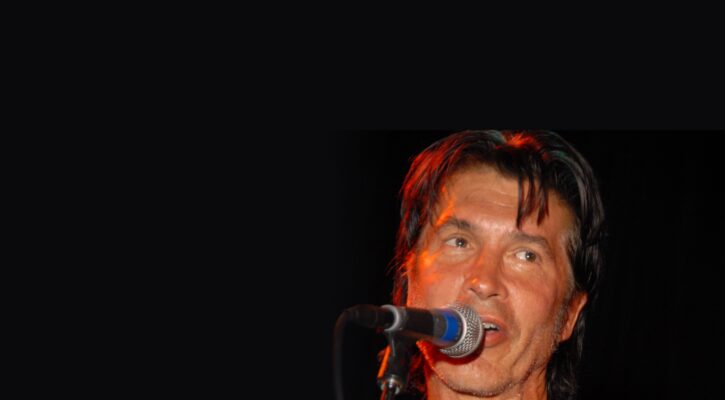
George Lynch is one of the great champions of the DS-1, and he comes to that position with full credibility as a gear obsessive. In a 2004 BOSS Users Group interview, he made his position plain: “The box I’ve used consistently since the ’80s is the DS-1. That pedal, for me, has always been my default overdrive/distortion pedal no matter what else I have access to, which is basically everything.” And then, delivering perhaps the strongest testimonial the DS-1 has ever received: “I’m a pedal freak. I mean, I’m on eBay, I’m talking to collectors, I’m picking up every old retro pedal that Hendrix, Beck, or Page ever used. But I swear the DS-1 beats 95 percent of everything that’s current or ever made. You can’t go wrong with it.” Lynch’s shred-rock style — percussive picking, wide bends, singing sustained leads — is ideally matched to the DS-1’s tight, harmonically rich character.
Mike Stern
The DS-1’s reach extends well beyond rock and metal — one of its most devoted users is jazz guitarist Mike Stern, a player known for his work with Miles Davis and decades of respected solo output. In a 2006 BOSS Users Group interview, Stern was emphatic: “I’ve been using BOSS pedals for about 15 years, maybe closer to 20 years, and I dig ’em a lot. I’ve used the distortion, the DS-1, on every one of my own records, and on a lot of other peoples’ records too. I use it all the time. It just works for me, and it’s got a real nice sound to it, so I’ve been using it forever.” For Stern, the DS-1 provides the edge that cuts through a jazz mix without overwhelming the harmonic complexity of the material — a testament to the pedal’s unexpected versatility across genres.
Mark Speer — Khruangbin
Mark Speer of Houston psychedelic groove trio Khruangbin runs one of the most minimal rigs of any professional guitarist today, and the DS-1 sits at its core. In a 2018 Premier Guitar Rig Rundown interview, Speer described his baseline setup: “My preferred setup is my guitar into a Cry Baby wah that I never turn off. And then it goes from there into a BOSS DS-1.” After mentioning a few modern additions he’d made, Speer admitted with a laugh, “I wish I could go back to the wah and DS-1, and that’s it.” For a band whose sound is built on slow-burning, deeply melodic guitar lines over Afrobeat-influenced grooves, the DS-1 provides exactly the right amount of color — warm, smooth sustain without destroying the note’s identity.
Tone Recipes and Settings
Recipe 1: Kurt Cobain Bleach Grunge — Maximum Aggression
This is the setting that defined Bleach: Distortion at 9–10 o’clock (high gain), Tone at 11 o’clock (slight warmth to tame harshness), Level to taste. Feed it into a clean Fender Twin Reverb or similar high-headroom clean amp. The key is that the DS-1 is doing all the work — the amp stays clean and the pedal’s hard-clipping character is fully exposed. The slightly rounded Tone position prevents the brittle fizz you’d get from pushing Tone too far clockwise, while the high Distortion setting creates the saturated wall of the early Nirvana sound.
Recipe 2: Joe Satriani Instrumental Shred — Articulate Lead
Distortion at 12 o’clock (medium-high gain), Tone at 1 o’clock (bright for clarity), Level set to push the amp slightly. The goal is articulation: you need to hear each note individually even at high gain, with enough sustain to carry through bends and legato runs. The medium-high Distortion setting leaves some dynamic response in the signal — picking harder produces a slightly brighter, more saturated attack, which is essential for expressive lead playing. Run this into a moderately driven amp (not clean, not fully saturated) for the best interaction.
Recipe 3: George Lynch ’80s Hard Rock — Rhythm Crunch
Distortion at 7 o’clock (moderate gain), Tone at 12 o’clock (flat/balanced), Level at 1–2 o’clock (louder than unity for boost). This setting uses the DS-1 more as a refined crunch than a full distortion — the moderate gain produces chunky, percussive rhythms with tight low-end and clear note definition. Pushed into a moderately driven Marshall-style amp, it delivers the classic ’80s hard rock palette: defined palm mutes, crackling chords, dynamic variation between quiet and loud picking.
Recipe 4: Mike Stern Jazz Fusion — Warm Edge
Distortion at 8 o’clock (low-moderate gain), Tone at 9–10 o’clock (warm/dark), Level at 12 o’clock. The goal is to add edge and sustain to a jazz-clean tone without drowning out harmonic complexity. The lower Distortion setting means chord extensions and chromatic lines remain clear; the darker Tone setting prevents brightness from cutting into the jazz character of the amp. Works beautifully in front of a warm, mid-forward amp like a vintage Fender with the bright switch off.
Recipe 5: Mark Speer Psychedelic Groove — Smooth Sustain
Distortion at 10 o’clock, Tone at 11 o’clock, Level at 12 o’clock. Combine with a Dunlop Cry Baby wah in front (set to a fixed mid-wah “parked” position if desired). This setting is about texture — a thick, slightly fuzzy sustain under melodic lines, with enough Tone warmth to give the notes a rounded, almost vocal quality. Roll off your guitar’s tone knob slightly for additional warmth. The DS-1 in this context functions as a color rather than a character — adding just enough edge to make single-note lines sing over a groove.
The DS-1 Family: Siblings and Successors
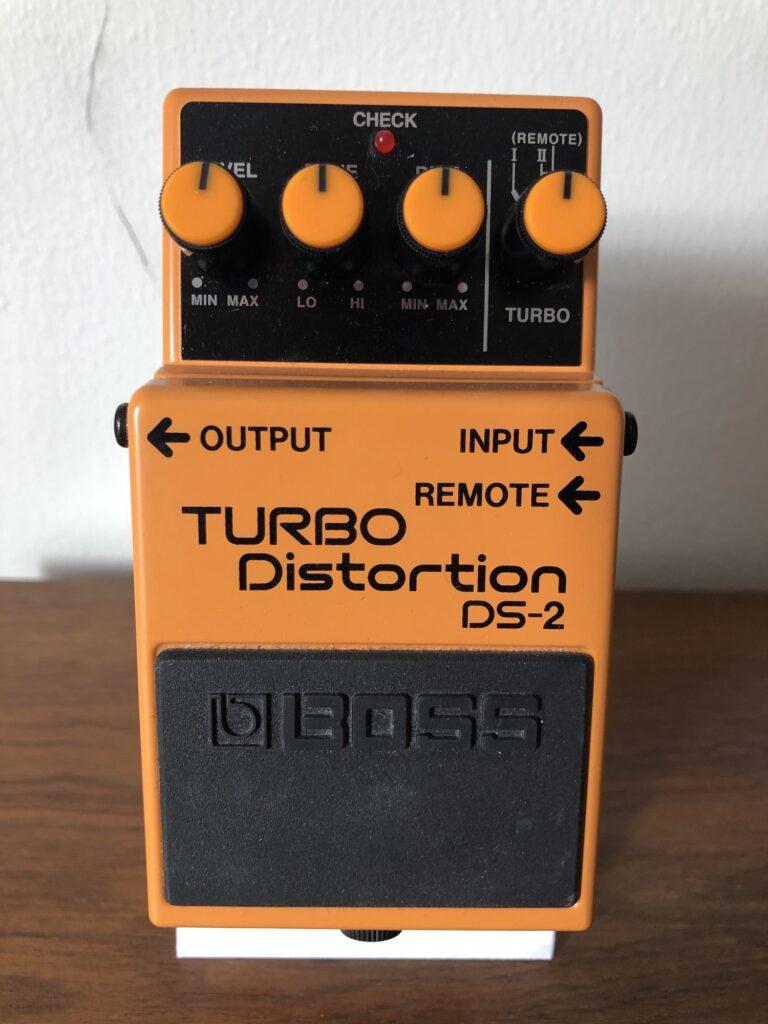
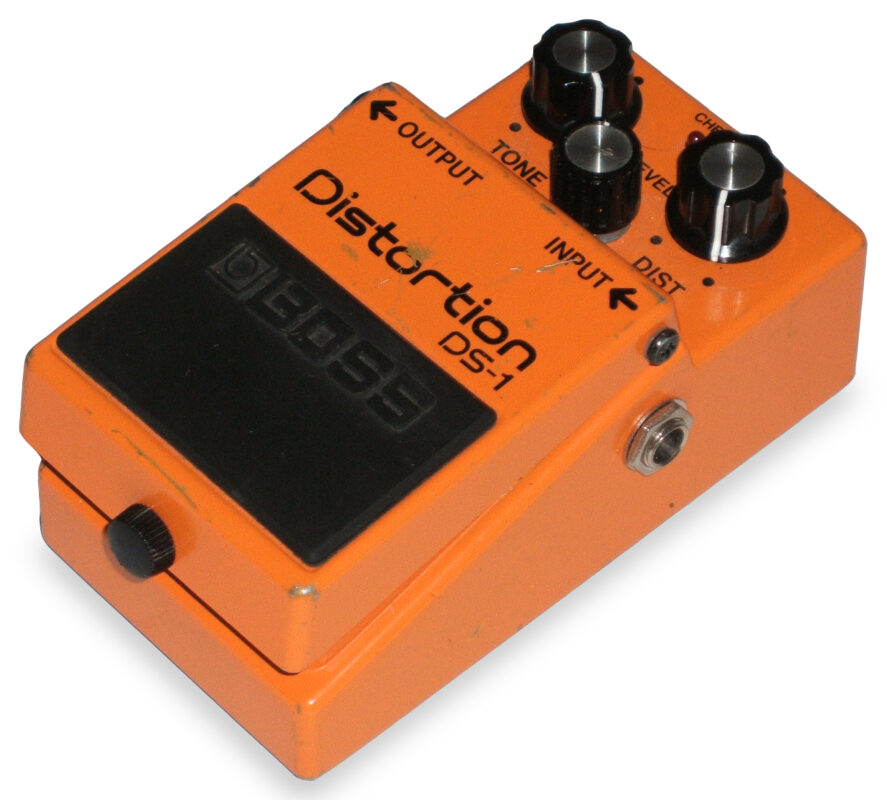
The DS-1 has spawned several important relatives within the Boss lineup. The DS-2 Turbo Distortion arrived in 1987 and has remained in production since. Turbo I mode mimics the DS-1 character with a slightly softer attack and flatter frequency response; Turbo II adds an additional gain stage and a mid boost designed for sustained lead playing. Kurt Cobain famously transitioned from the DS-1 to the DS-2 for his Nevermind and In Utero recordings, and John Frusciante used both simultaneously, often stacking them.
The DS-1X Distortion (2014) took the concept into the digital domain, using Boss’s Multi-Dimensional Processing (MDP) technology to analyze the input signal in real time and produce distortion with improved dynamic response and note separation at high gain settings. It’s a more sophisticated tool, but lacks the raw, simple honesty of the original.
The DS-1W Waza Craft (2022) is the premium evolution — made in Japan, discrete components, two modes (Standard = original DS-1 circuit; Custom = fatter, richer midrange). At roughly $149.99 USD, it’s the version for players who want the DS-1 DNA with premium build and enhanced tone options.
Outside the Boss family, the most direct competitor historically has been the Pro Co RAT 2 — a hard-clipping distortion with a similar three-knob layout (though its controls are named Volume, Distortion, and Filter). The RAT tends toward a more aggressive, compressed character with a stronger midrange emphasis; the DS-1 is slightly brighter and more open-sounding. Both have been used on countless classic recordings and occupy similar price points on the used market. The choice between them is genuinely stylistic rather than one being objectively superior.
The other natural comparison is the Ibanez TS9 Tube Screamer — though the two pedals serve different sonic functions. The TS9 is an overdrive: symmetrical soft clipping, a pronounced mid-hump centered around 700Hz, lower maximum gain. It’s designed to push a tube amp into natural breakup. The DS-1 is a distortion: hard-clipping, higher gain ceiling, wider Tone range, intended to stand on its own as the primary gain source. Players who want to boost an already-driven amp reach for the TS9; players who want the pedal to provide the distortion character reach for the DS-1. They can coexist beautifully — many players run both, using the TS9 as a light boost before the DS-1 for leads.
Buying Guide
The current-production Boss DS-1 sells for approximately $59.99 USD — making it one of the least expensive name-brand distortion pedals on the market. At that price, there is essentially no argument for avoiding it if you need a distortion pedal. Even if you later decide it’s not your sound, you’ll lose almost nothing reselling it.
For players interested in vintage versions, the hierarchy is: 1978–1988 MIJ (Toshiba TA7136AP chip, warmest character, Made in Japan label) → 1988–1994 MIT (Taiwan production, same TA7136AP through ~1994, still very close to the original) → 1994–2000 DS-1A (Rohm BA728N, different but valid character) → 2006 NJM2904 (well-regarded improvement over the M5223AL era). The 2000–2006 M5223AL era is generally considered the weakest vintage version and is the one most commonly targeted by modders. On Reverb, expect to pay $60–$120 for a clean vintage MIJ or MIT example; exceptional early-screw 1978 originals can reach $200+.
The DS-1-4A 40th Anniversary (2018) is worth tracking down on the used market ($80–$130) — it’s Made in Japan with through-hole components and the improved NJM3404AL chip. The DS-1W Waza Craft ($149.99 new) is worth the upgrade for players who want the full DS-1 experience with better build quality and the Custom mode’s additional richness.
Ownership Notes and Signal Chain Tips
The DS-1 uses electronic buffered bypass, not true bypass. When you kick the pedal on, it activates; when you kick it off, your signal passes through a buffer stage rather than being physically bypassed. This has implications in a long signal chain: the buffer adds a slight low-impedance output that can interact with wah pedals and vintage fuzz circuits differently than a high-impedance passive bypass would. For most rigs, this is not a problem — the Boss buffer is actually quite good — but if you’re combining the DS-1 with a vintage Fuzz Face or other impedance-sensitive fuzz, put the DS-1 after the fuzz rather than before.
The DS-1 has very low current draw at 5mA, so it’s compatible with virtually any 9V pedalboard power supply. Do not use an 18V supply — the circuit is designed for 9V.
For the Tone knob: start at 12 o’clock and adjust from there. Many players assume the “best” position is fully clockwise (maximum brightness), but the tilt EQ character of the DS-1 means that 12 o’clock is actually a more neutral, usable starting point in most rigs.
The DS-1 takes pedals extremely well on both sides. Stacking a light overdrive (like a Boss SD-1 or similar) in front of it produces a smooth, compressed lead tone. Placing a clean boost after it (like a Boss GE-7 set as a mid-boost) can transform its character significantly. Fuzz pedals placed after the DS-1 can produce unexpected and interesting sounds, particularly with the DS-1’s Distortion set low and the fuzz handling most of the gain.
For recording direct without an amp, the DS-1 benefits from an IR loader or speaker simulator placed after it — its raw direct output sounds thin and fizzy without some form of cabinet coloration. Paired with a good IR (even one of the stock options in a Torpedo, Fractal, or similar device), it can sound excellent in a recording context.
FAQ
Is the Boss DS-1 good for beginners?
It is the default recommendation for a reason. At ~$60, it is bombproof, genuinely versatile, and used professionally by world-class players. Starting on a DS-1 does not mean you’re settling — you’re using the same pedal Kurt Cobain, Joe Satriani, and George Lynch used. There is no shame in starting (or ending) there.
What is the difference between the DS-1 and the DS-2 Turbo Distortion?
The DS-2 adds a second mode (Turbo II) that provides more gain and a mid boost. Turbo I is a slight variation on the DS-1 character with a softer attack and flatter response. The DS-2 is more versatile; the DS-1 is more focused. Kurt Cobain used both at different career stages — DS-1 on Bleach, DS-2 later. John Frusciante used both simultaneously.
Which version of the DS-1 is the best?
The 1978–1988 MIJ version with the Toshiba TA7136AP chip is most prized by collectors and tone purists for its warm, slightly gritty character. For modern production, the DS-1W Waza Craft is the premium option with the best build quality and tonal range. The current-production DS-1 at $60 is excellent value for working players who don’t need vintage authenticity.
Did Kurt Cobain use a DS-1 or DS-2?
Both, at different times. Producer Jack Endino confirmed Cobain used a DS-1 for the Bleach recording sessions in 1989. He later transitioned to the DS-2 Turbo Distortion for Nevermind and subsequent work. The DS-1 owns the raw, abrasive grunge sound of Bleach; the DS-2 owns the more refined distortion of the peak Nirvana era.
Can the DS-1 do metal?
Yes — with caveats. The DS-1 can deliver convincing hard rock and classic metal tones (George Lynch is living proof), but it was not designed for modern extreme metal. Its gain ceiling is high but not at the level of a Mesa Boogie-style high-gain distortion. For drop-tuned chug and modern metal, a pedal like the Boss MT-2 Metal Zone or an actual high-gain amp is more appropriate. For classic and hard rock distortion, the DS-1 is more than capable.
Is the current Malaysia-made DS-1 as good as the vintage Japan models?
Sonically close but not identical. The current Malaysian SMT version uses the NJM2904 op-amp and sounds good by any objective standard. It lacks the specific character of the original Toshiba IC versions, and the SMT construction makes modification difficult. For most players in most contexts, the difference is subtle. For tone obsessives, the vintage MIJ versions and the DS-1W offer noticeably different characters.
What amp does the DS-1 pair best with?
The DS-1 was designed by Boss to pair well with a clean or lightly driven amp — the pedal provides the distortion character, and the amp provides volume and frequency shaping. It works particularly well with amps that have prominent midrange (Marshall-style British voiced amps, vintage Fender tweeds), since the DS-1’s slight lower-mid scoop is complemented by those amps’ mid presence. With mid-scooped blackface or silverface Fenders, compensate by pushing the Tone knob toward 9–10 o’clock.
Should I get the DS-1W Waza Craft or the standard DS-1?
If budget allows, the DS-1W is worth the premium for the improved build quality, the MIJ discrete components, and the Custom mode’s additional richness and output. But the standard DS-1 at $60 is not a compromise — it’s the same iconic circuit that appears on decades of classic records. Buy the standard DS-1 if you want the real thing at minimal investment; buy the DS-1W if you want to commit to the DS-1 sound long-term with premium construction.
Image credits
- Top image: Boss DS-1 by Roadside Guitars. CC BY-SA 2.0. Source image unchanged.
- Boss DS-1 Distortion: photo by Matt Eason, via Wikimedia Commons, CC BY 2.5.
- George Lynch: Glenn Francis, Wikimedia Commons, CC BY-SA 3.0.
- Kurt Cobain: P.B. Rage, Wikimedia Commons, CC BY-SA 2.0.
- Boss DS-1 Distortion: GuitarGangsters AI-generated reference illustration, not a photograph.
Latest News
Related
On This Day
Monday 9 November
From this week: