
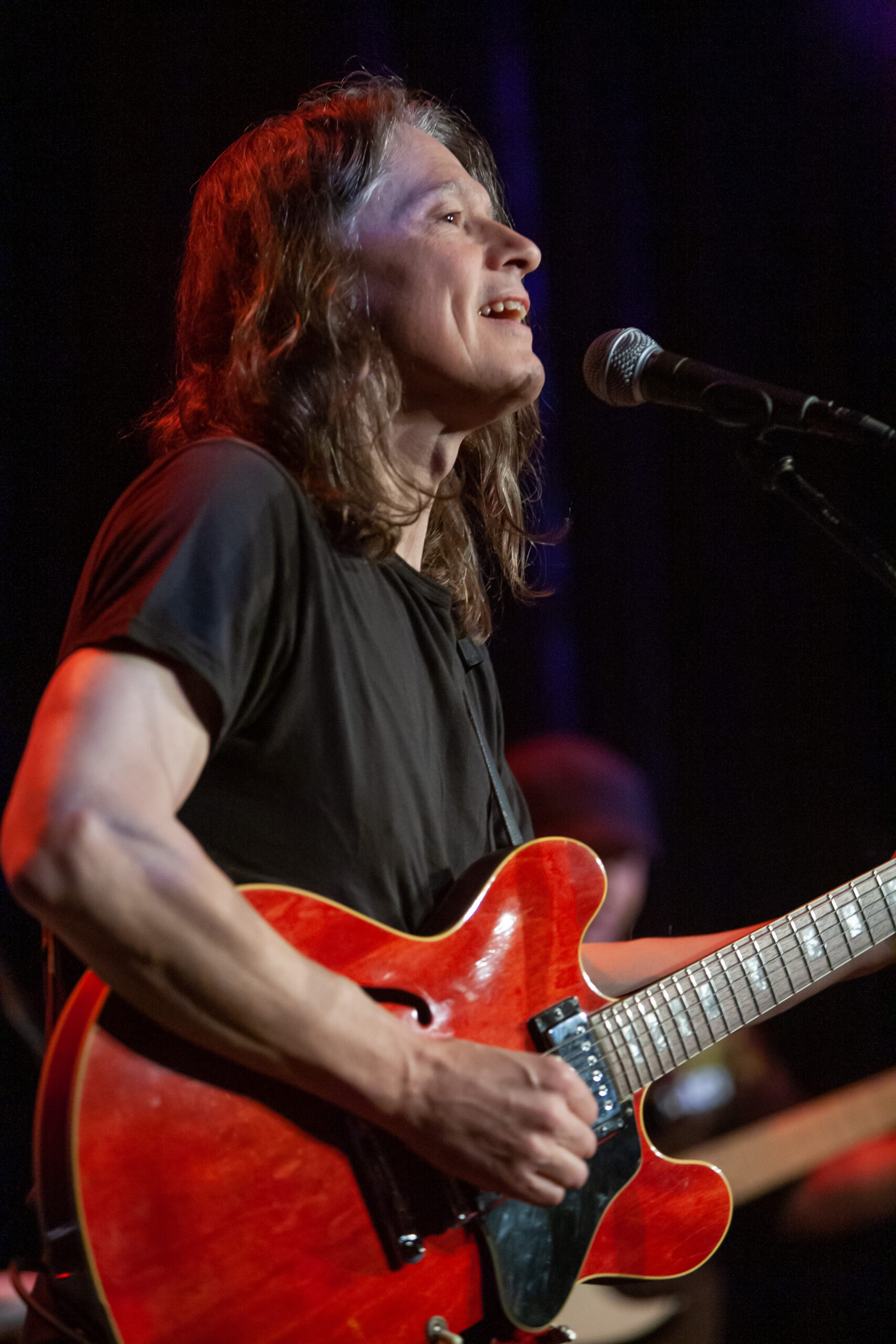
Gear Timeline
In 1983, Alexander Dumble — the reclusive amplifier builder whose instruments are now among the most valuable and sought-after in the world — made a specific amplifier for Robben Ford. It is a Dumble Overdrive Special. It is serial number 002. Serial number 001 belongs to Dumble himself, his personal amplifier. Serial number 002 belongs to Robben Ford, and has been his main amp since the year it was built, more than forty years ago. He runs it through a Dumble 2×12 cabinet loaded with Celestion G12-65 speakers. He plugs it into a variable voltage regulator to protect it. He describes it as “may be the most valuable guitar amp out there.” He has made essentially every significant recording of his career since Talk to Your Daughter in 1988 with this amplifier. “I’ve literally done every record I’ve ever made since Talk to Your Daughter with the same Dumble Overdrive Special and cabinet.” The amplifier does not tour — it is too valuable and too irreplaceable. His tech travels with it, treats it with extreme care, and runs it through the variable voltage regulator to protect the tubes from power supply variations that could shorten their lives. Serial number 002. Made for Robben Ford in 1983. Still in service.
Robben Lee Ford was born on December 16, 1951, in Woodlake, California, and raised in Ukiah, in Northern California. He began playing saxophone at age ten and guitar at fourteen — a dual instrument identity that continues to shape his musical thinking, the horn player’s approach to melody and phrasing audible throughout his guitar work. He has played with Miles Davis, Joni Mitchell, George Harrison, Bob Dylan, Larry Carlton, and dozens of other major artists. He founded the Yellowjackets, one of the defining contemporary jazz fusion groups of the 1980s. He has been nominated for five Grammy Awards. Musician magazine named him one of the 100 Greatest Guitarists of the 20th Century. And the specific synthesis he has developed across fifty years of professional playing — the combination of Chicago blues vocabulary with jazz harmonic sophistication — remains his most distinctive and most influential contribution: what Guitar World described as “the heart and soul of a bluesman and the brain and fingers of a jazzer.”
His tone philosophy is as clear as his guitar work: “Tone has always been number one to me. It needs to sound good first — otherwise, who cares what the notes are?” This is the bluesman’s assessment of priority — the notes emerge from the tone, and if the tone is wrong, the notes are irrelevant. The Dumble Overdrive Special serial number 002 is the primary expression of this priority: one of the finest amplifiers ever built, obtained when Ford was one of the first musicians Dumble trusted with his work, maintained for forty-plus years because nothing available has yet replaced its specific tonal character for his specific musical requirements.
Background: From Ukiah to Joni Mitchell to Miles Davis
Robben Ford’s musical biography is a series of significant associations across an extraordinary range of musical contexts, each one adding a new dimension to the blues foundation he established in his teens. The Aretha Franklin, Otis Redding, Mike Bloomfield, Eric Clapton, and B.B. King he absorbed growing up. The Charlie Musselwhite touring band at age eighteen, his first professional engagement. The Jimmy Witherspoon years — where he began blending jazz elements with Chicago blues in ways that were, per Vintage Guitar magazine, “as impressive and convincing as it was virtually unprecedented.” The L.A. Express and Joni Mitchell — touring and recording on Court and Spark (1974) and The Hissing of Summer Lawns (1975), suddenly operating in a jazz fusion and sophisticated pop context far from the Chicago blues where he had started. The Miles Davis connection. George Harrison hiring him at twenty-three for the Harrison and Friends North American Tour. The Yellowjackets.
The musical transition from Charlie Musselwhite’s Chicago blues to the L.A. Express’s jazz fusion to Miles Davis is a musical biography that covers more harmonic and stylistic ground than most guitarists traverse in their entire careers — and Ford did it all before the age of thirty. This breadth — the willingness to enter genuinely different musical environments and succeed in each of them — reflects both his technical preparation and his fundamental understanding that music is music, regardless of genre label. “It’s not really like changing hats for me; I’m a musician, and I’m comfortable in a variety of situations mainly because I’m not changing hats. It’s the same guy who shows up, no matter what the gig.” This is the statement of a musician who has internalized multiple vocabularies so deeply that moving between them is natural rather than effortful — the way a truly bilingual speaker moves between languages without the translation step that less fluent speakers require.
The L.A. Express period was particularly significant because it deposited Ford in the company of some of the finest session musicians in Los Angeles at the precise moment when California jazz fusion was at its most creative and commercially viable. Tom Scott’s band was playing with Joni Mitchell — arguably the most harmonically sophisticated singer-songwriter of her generation — and the guitar work required was not blues but a sophisticated jazz-folk-pop synthesis that Ford had to grow into rapidly. He did. “Tone has always been number one to me” is a statement about a developed aesthetic sensibility, not a beginner’s preference — and the aesthetic development that L.A. Express and the Mitchell tours accelerated gave him the tonal sophistication that his subsequent career has been built upon.
The Miles Davis connection deserves its own paragraph, because playing with Miles Davis is one of the most specific testaments available to a guitarist’s musical intelligence. Davis was famously and productively intolerant of musicians who didn’t bring their full creative engagement to every performance. He hired Robben Ford. The specific musical qualities Davis recognized in Ford — the harmonic sophistication that could operate in Davis’s modal and post-bop frameworks, the rhythmic sensitivity that could respond to Davis’s specific approach to time, the willingness to play what the music required rather than what guitar conventions suggested — are exactly the qualities that Ford’s career has demonstrated across fifty years. When Miles Davis decides your guitar playing is worth having in his band, something specific has been identified correctly.
His own solo career — Talk to Your Daughter (1988), the Grammy-nominated Robben Ford and the Blue Line records of the 1990s, the subsequent Concord and Mascot releases — has been the most fully realized expression of his specific musical vision: the blues-jazz synthesis that he describes not as “changing hats” but as “the same guy who shows up, no matter what the gig.” His description of his playing as “finger painting” captures something specific about his approach: “An analogy that I came up with for the way I play is that it’s like finger painting. It stays in one place and just explores it.” The palette is contained; the exploration within it is deep.
The Rig: Robben Ford’s Guitars, Amps, and Effects
Guitars
Robben Ford’s primary guitar is a 1960 Fender Telecaster in blonde finish with a rosewood fretboard. “But the Tele has also become very important. It’s a 1960.” This guitar — a vintage instrument from the year that Fender’s transition from maple to rosewood fretboards was well established — provides the specific clear, articulate, single-coil character that suits Ford’s melodic, singing lead lines better than humbucker-equipped instruments. The 1960 Telecaster’s rosewood board adds warmth to the standard Tele’s characteristic brightness, and the specific resonance of the alder or ash body (1960 Telecasters used both) with the original vintage pickups gives it the organic, responsive quality that vintage instruments provide and that modern production guitars approximate. The guitar was Joe Glaser-serviced for the A Day in Nashville tour, with Glaser removing the original Bigsby tremolo from the accompanying Epiphone Riviera and doing setup work on both instruments.
The second guitar Ford currently travels with is a 1966 Epiphone Riviera — a semi-hollow thinline instrument with twin mini-humbucker pickups, similar in construction concept to the Gibson ES-335 but with Epiphone’s specific New York-era character. Joe Glaser modified it by removing the original Bigsby vibrato tremolo and replacing it with a stop tailpiece — a modification that improves sustain and tuning stability at the cost of the vibrato’s expressive range. The Riviera’s semi-hollow body and mini-humbucker pickups provide a warmer, fuller tonal character than the Telecaster’s single-coils while maintaining the clarity and articulation that Ford’s playing requires. Currently, he travels with just these two vintage beauties: the 1966 Epiphone Riviera and the 1960 Fender Telecaster with rosewood fretboard.
While playing in the Yellowjackets in the late 1970s to early 1980s, as well as before and after this time period, Robben played a sunburst 1959 dot-neck Gibson ES-335. He also used a later period sunburst block-neck ES-335 occasionally. The ES-335’s semi-hollow construction — a solid center block with hollow “wings” — provides warmth and sustain while resisting feedback at moderate performance volumes, the specific balance that suits his blues-jazz fusion style better than either a fully hollow archtop or a solid-body instrument.
The 1952 Fender Telecaster — the original production year for what was then still called the “Broadcaster” or “Nocaster” before the Telecaster name was officially adopted — appeared in earlier Ford touring configurations. The 1952 Tele’s specific character: a lighter, more resonant body, the original single-coil pickups before Fender modified the design, and the vintage construction quality of the earliest production models.
A 1964 Gibson ES-335 in sunburst appeared in Ford’s documented gear — the block-inlay version that followed the dot-neck production years, with the specific tonal character of that era’s PAF-adjacent pickups.
A 1964 Gibson SG also appears in Ford’s documented collection — the thin-bodied mahogany dual-cutaway with the specific bright, aggressive character of the SG in its original production form, different from the ES-335’s warm semi-hollow character and suited to specific musical applications within his range.
Assorted Paul Reed Smith guitars appear in Ford’s documented equipment across different periods of his career. PRS’s specific combination of ergonomic design, quality construction, and tonal versatility suited specific touring and recording requirements when his vintage instruments needed rest or repair.
Ford uses D’Addario .010-.046 gauge strings across his electric guitars — a standard light-medium gauge that provides the balance between bending accessibility and tonal body that blues-influenced guitar playing requires. D’Addario heavy picks match the string gauge: heavier picks with medium-heavy strings produce the consistent, defined attack that his melodic single-note lines require.
Amps
Since 1983, Ford’s main amp has been a Dumble Overdrive Special, serial number 002, which Alexander Dumble made for him that year. Serial 001 is Dumble’s personal amp. Ford keeps this amp safe by plugging it into a variable voltage regulator. He runs this Overdrive Special through a Dumble 2×12 cabinet that was actually made for his second Dumble head. The cabinet houses a pair of Celestion G12-65 8-ohm speakers. This is not hyperbole: the Dumble Overdrive Special is, in many informed opinions, the finest amplifier ever made for electric guitar. Alexander Howard Dumble is a reclusive California amplifier builder who has made perhaps 300 amplifiers over fifty years, each one handmade, each one voiced specifically for the musician who commissioned it, and each one reflecting Dumble’s specific understanding of what a guitar amplifier should do.
The specific character of the Overdrive Special: it was developed from a Fender Bassman head that Dumble modified and refined — “According to Rick Wheeler, ‘the output section of Robben’s Dumble is EXACTLY like a Fender Bassman.'” Dumble got the idea from listening to Ford play a Fender Bassman head in the San Francisco days of his career. The Overdrive Special’s clean channel provides extraordinary warmth and transparency; the overdrive channel provides a natural, musical overdrive that responds dynamically to picking force in ways that no other amplifier fully replicates. The specific quality that makes Dumbles irreplaceable for the players who own them: they sound like a great tube amplifier should sound — warm, present, dynamically responsive, never harsh or compressed — but at a level of quality that production amplifiers don’t achieve. Ford has paid this amplifier the ultimate practical compliment: he has used it, and only it, for every significant recording since 1988.
For a 2021 recording project (Pure), Ford’s primary studio amp was the Little Walter “59” — a 50-watt head through a single 12-inch cabinet. “I had it hooked to my TS310 cabinet which had a trio of Eminence Legend 1028 10-inch 35-watt 8-ohm speakers. It was obvious that Robben was very pleased with the tone of the ’59 and he especially liked the characteristics of the TS310 cabinet.” For the main Dumble sessions on the same album, he plugged into his trusty Dumble Overdrive Special but used a Matchless 1×12 cabinet instead of his usual 2×12 setup. This flexibility — using the same fundamental amplifier in different cabinet configurations — reflects a pragmatic approach to tone that values the right acoustic environment for the sound as much as the amplifier itself.
Effects
Ford’s pedalboard is built around a Vertex Effects I/O Interface — a passive input interface at the front of the signal chain that maintains the guitar signal’s impedance and tone before hitting any active electronics. “Interface (passive input), TC Electronic Polytune Mini, OD (prototype shown, however Zendrive is in its place now), Vertex Boost, Strymon Timeline, TC Electronic Hall of Fame Reverb Mini, Interface (buffer/splitter out to two amps).” The two I/O interfaces — one at the input, one at the output — bracket all the effects between them, managing signal impedance and providing clean routing.
The Hermida Audio Zendrive is Ford’s primary overdrive pedal — a boutique overdrive designed to approximate the specific character of Dumble-style amplifier overdrive in a pedal format. “The Hermida Audio Zendrive immediately appealed to me. The Zendrive has found a way to reduce the compression I hear in a lot of other pedals, creating a more natural sound. I use the Zendrive for overdrive, a TC Electronic Hall of Fame reverb pedal, the Strymon TimeLine delay, and the Vertex Boost.” The Zendrive’s specific circuit — a JFET-based design that produces a natural, asymmetric clipping characteristic — produces an overdrive character that is warmer and less obviously “pedal-like” than most commercial overdrives. Its transparency allows the guitar’s natural voice to come through the overdrive rather than being replaced by the pedal’s own tonal character.
The Vertex Boost provides the clean signal enhancement that pushes the Dumble’s input stage for additional harmonic complexity without adding obvious distortion. Running into the front of the Dumble, the Vertex Boost raises the guitar’s signal level into the amp’s sweet spot, producing the specific dynamic response that the Dumble is famous for at lower overall volume levels.
The Strymon TimeLine — a high-quality digital delay with analog character and extensive tape/modulation/multi-head delay emulation — is controlled by a Roland EV-5 Expression Pedal for real-time delay time modulation. The TimeLine’s quality provides the echo depth that Ford’s solos and clean passages benefit from without the harsh digital artifacts of lower-quality digital delays.
The TC Electronic Hall of Fame Reverb provides the ambient spatial depth that Ford’s clean guitar passages require. The Hall of Fame’s broad range of reverb characters — hall, spring, room, plate — gives him access to appropriate reverb for different musical contexts within the same pedal.
The TC Electronic PolyTune Mini provides polyphonic tuning — the ability to check all strings’ tuning simultaneously with a single strum — in a compact format. Between songs, a single strum confirms tuning status across all six strings without requiring individual string checking.
The Dumble amplifier’s own footswitch — controlling the pre-EQ boost and overdrive channel switching of the Overdrive Special — completes the signal management infrastructure. The Dumble’s footswitch is a specific piece of hardware designed by Dumble for his amplifiers, providing the channel and boost switching that allows Ford to move between the amp’s clean and overdrive channels without adjusting any controls.
Playing Style & Tone Philosophy
Robben Ford’s playing style is one of the most clearly articulated in contemporary guitar — both in his music and in his extensive instructional work, which has given him the vocabulary to describe his own approach with unusual precision. The blues foundation is non-negotiable and always present: his pentatonic vocabulary, his bending approach, his vibrato, his rhythmic feel all derive from the Chicago blues tradition he absorbed in his teens. The jazz overlay — the chord extensions, the modal thinking, the harmonic sophistication he developed from Mickey Baker’s jazz guitar method and from years of playing with jazz musicians — gives the blues vocabulary a harmonic richness that most blues guitarists don’t access.
The “finger painting” analogy he has used — “It stays in one place and just explores it” — is one of the more accurate descriptions of how improvisation works at its most developed level. An improviser who has fully absorbed a tradition’s vocabulary doesn’t move through the tradition’s territory rapidly, checking off different corners of a harmonic map; they find a specific place in the tradition, explore it thoroughly, and let the exploration reveal the music that lives there. Ford’s solos explore specific harmonic territories with the thoroughness of someone who knows exactly where they are and has the time to investigate rather than the anxiety of someone trying to prove how much territory they can cover.
His tone philosophy, stated in his own words: “Tone has always been number one to me. It needs to sound good first — otherwise, who cares what the notes are?” This is not the statement of someone who neglects technical development; it is the statement of someone who has learned, through decades of professional experience, that technical accomplishment without tonal beauty is impressiveness without beauty — a performance of ability rather than an expression of music. The Dumble Overdrive Special serial number 002 is the physical expression of this priority: an amplifier chosen because it sounds better than anything else available, maintained for forty years because nothing has yet surpassed it, and used on every significant recording because the tone is the foundation on which the notes rest.
His recent evolution toward “less is more” — noted by Blues Guitar Insider: “Lately he is more economical in his playing and really is starting to epitomize the ‘less is more’ thinking” — reflects the maturation of a player who has achieved the level of technical mastery where restraint is a choice rather than a limitation. Young guitarists play a lot of notes because they can; mature guitarists choose specific notes because those specific notes say what needs to be said. Ford’s current approach is in the second category.
The evolution Ford describes in his playing — more economical, less is more, staying in one place and exploring it — is the maturation pattern of the most developed musicians. Young musicians play everything they know because demonstrating everything they know is how they establish their credentials. Developed musicians play what the music needs because they understand that the music’s needs are the only relevant criterion. This evolution is not a decline in technical capacity but an expansion of musical wisdom: the knowledge that the note you don’t play defines the note you do play, and that the space between notes is where the music breathes.
How to Sound Like Robben Ford
Getting genuinely close to Robben Ford’s tone is the most expensive undertaking in this series after a 1959 Les Paul, because Dumble Overdrive Specials are not available at accessible price points — they sell for six-figure sums when they appear on the market at all. The alternative is to understand what the Dumble does and find the closest accessible equivalent.
Guitar: A vintage Telecaster (for the single-coil character) or an ES-335-type semi-hollow (for the humbucker warmth) — Ford’s current touring pair captures both ends of his tonal spectrum. Vintage quality if available; quality modern equivalent if not. D’Addario .010-.046.
Amp: A Dumble Overdrive Special is the authentic choice and is not a practical suggestion. For accessible alternatives: Two-Rock Studio Signature (explicitly designed to emulate Dumble’s dynamic response), Carr Slant 6V, or any quality clean-to-overdrive tube amplifier with a warm, touch-sensitive clean channel and a natural overdrive channel that responds to picking dynamics. The Two-Rock Studio Signature is the recommendation that appears most frequently in discussions of Ford’s tone for players who can’t access a Dumble.
Amp Settings (Dumble-inspired or clean/warm tube amp):
| Control | Setting (0–10) | Notes |
|---|---|---|
| Clean Volume | 5–7 | Working — warm and present but not breaking up |
| Bass | 5–6 | Full — warm, not boomy |
| Mid | 6–7 | Forward — the Dumble’s signature warmth lives in the mids |
| Treble | 5–6 | Moderate — warmth over brightness |
| Reverb | 2–3 | Light spring or plate — presence without wash |
Overdrive: Hermida Audio Zendrive is the authentic choice. Comparable alternatives: Bogner Ecstasy pedal, Lovepedal Eternity, or any JFET-based overdrive designed for natural, non-compressed overdrive character. The key is transparency — the overdrive should make the guitar sound more like itself, warmer and more sustained, rather than imposing its own tonal character on top of the guitar’s natural voice.
Influence & Legacy
Robben Ford’s influence on guitar playing is most clearly visible in the community of blues-jazz fusion guitarists who have absorbed his specific synthesis and developed their own voices from it. The combination of deep blues vocabulary with jazz harmonic sophistication — the approach he pioneered alongside Larry Carlton and Scott Henderson — has become the defining aesthetic of contemporary American guitar playing in the blues-jazz space. Every guitarist who can play a blues solo that incorporates the harmonic language of bebop while maintaining the feel of Chicago blues is working in a tradition that Ford helped establish.
His instructional work — guitar clinics, online lessons through TrueFire, instructional books, and the vocabulary of his playing made accessible through his extensive teaching — has been as important as his recordings in spreading his approach. Players who have studied his technique describe specific revelations: the way he approaches chord extensions, the specific vibrato development he teaches, the understanding of how jazz harmony can be applied to blues contexts without losing the blues feel. This pedagogical contribution — the translation of his musical intelligence into learnable vocabulary — is as significant as the music itself for guitarists who want to develop in his direction.
For context on where Ford fits in the blues-jazz guitar synthesis tradition, the comparison with Larry Carlton’s approach to blues-jazz fusion guitar — his peer and frequent touring companion in the LA studio scene — illuminates how two players from the same musical environment arrived at related but distinct personal voices. Both work in the blues-jazz synthesis space; Carlton’s is more studio-polished, Ford’s is more raw and blues-direct. Both are essential to understanding what contemporary American guitar sounds like at its most sophisticated.
The comparison with B.B. King’s approach to blues guitar as expressive voice at #11 shows the deepest root: Ford absorbed King’s specific understanding of the blues — the bent note as the primary expressive vehicle, the rest between notes as important as the notes themselves, the vibrato as the guitar’s equivalent of the human voice’s inflection — and carried it forward into a more harmonically sophisticated context. The tradition is continuous. The voice that expresses it changes with each guitarist who absorbs it genuinely.
And the comparison with John Mayer’s approach to blues-rock guitar at #49 illuminates the generational transmission: Mayer has specifically cited Ford as one of his primary influences, the specific combination of blues feel and jazz harmonic sophistication that Ford demonstrated being exactly the direction Mayer pursued in his own career. The Dumble Overdrive Special’s influence is in Mayer’s gear choices as well — the Two-Rock amps that Mayer favors are in the Dumble family of inspiration. The influence runs through the amplifier as much as through the playing.
Robben Ford is seventy-four years old in 2026. The Dumble Overdrive Special serial number 002 is still in service, still protected by the variable voltage regulator, still producing the specific tonal character that Ford described as “the most valuable guitar amp out there.” The 1960 Telecaster and the 1966 Epiphone Riviera are in the cases. The Zendrive is on the board. The approach — tone first, then notes; blues always, jazz when it helps; less than you think is necessary, more than enough — remains intact. “Tone has always been number one to me. It needs to sound good first — otherwise, who cares what the notes are?” It sounds good. It has sounded good for fifty years. It will sound good for as long as serial number 002 keeps running.
Ford’s specific approach to tone development over the course of his career is worth examining. The Dumble has been his primary amplification since 1983. The vintage Telecasters and ES-335s have been his primary instruments for decades. The core pedalboard — clean boost, natural overdrive, delay, reverb — has evolved in specific components but not in basic philosophy. Where many guitarists engage in continuous gear experimentation, chasing the next tonal refinement, Ford has found his equipment and committed to it. This is not stagnation; it is the discipline of having found what works and refusing to be distracted from it by the next available option. The Dumble sounds the way he wants it to sound. The 1960 Telecaster feels the way he wants it to feel. The Zendrive does what it needs to do without imposing its own character. Everything works. The tone is right. “It needs to sound good first — otherwise, who cares what the notes are?” It sounds good. The notes follow from that, session after session, tour after tour, album after album.
The instructional dimension of his career is also significant. Ford has taught extensively — clinics, workshops, TrueFire online lessons, instructional books that break down his specific approach to blues scales, chord voicings, and improvisational vocabulary. “This book begins with basic blues concepts such as the pentatonic, mixolydian and blues scales and builds on them, progressively incorporating more sophisticated scales and chord voicings.” The generosity of this teaching — making his specific technical and musical insights available to guitarists at all levels — has extended his influence beyond what recordings alone could achieve. Players who have never seen him live but who have worked through his instructional materials understand something specific about how blues and jazz vocabulary can be integrated at the level of actual playing rather than mere theoretical combination.
His Grammy nominations — five total, most recently for Best Contemporary Blues Album for Bringing It Back Home in 2013 — document the formal industry recognition of a career that has operated across multiple Grammy categories. Blues nominations, jazz nominations, the Grammy as a measure of peer and industry respect rather than commercial success: Ford’s nominations reflect his specific position in American music as a guitarist whose work is taken seriously across genre boundaries. He has not won. This is not a statement about the quality of his work — the Grammy process has its own complex politics — but simply the factual record of a career that has been formally acknowledged as worthy of consideration at the highest level of formal music industry recognition, repeatedly, across multiple decades.
Robben Ford is seventy-four years old in 2026. The Dumble Overdrive Special serial number 002 is still in service, still protected by the variable voltage regulator, still producing the specific tonal character that Ford described as “the most valuable guitar amp out there.” The 1960 Telecaster and the 1966 Epiphone Riviera are in the cases. The Zendrive is on the board. The approach — tone first, then notes; blues always, jazz when it helps; less than you think is necessary, more than enough — remains intact. “Tone has always been number one to me. It needs to sound good first — otherwise, who cares what the notes are?” It sounds good. It has sounded good for fifty years. It will sound good for as long as serial number 002 keeps running. And when the Dumble finally needs servicing — when even the most carefully maintained, most reverently operated amplifier requires attention — there is presumably a craftsperson somewhere who knows what to do, because Robben Ford will have found one. The tone is too important to not have a plan.
Frequently Asked Questions: Robben Ford Guitars & Gear
What guitar does Robben Ford play?
Robben Ford’s current primary touring setup uses just two vintage guitars: a 1960 Fender Telecaster in blonde with a rosewood fretboard, and a 1966 Epiphone Riviera semi-hollow (with the original Bigsby trem removed and replaced with a stop tailpiece by luthier Joe Glaser). During the Yellowjackets era (late 1970s to early 1980s), his primary guitar was a sunburst 1959 dot-neck Gibson ES-335. His documented collection also includes a 1952 Fender Telecaster, a 1964 Gibson ES-335, a 1964 Gibson SG, and various PRS guitars used in different periods. All guitars are strung with D’Addario .010-.046, and he uses D’Addario heavy picks.
What amplifier does Robben Ford use?
Since 1983, Robben Ford’s main amp has been a Dumble Overdrive Special, serial number 002 — the second amplifier Alexander Dumble ever made (serial 001 is Dumble’s own personal amp). Ford runs this amp through a Dumble 2×12 cabinet loaded with Celestion G12-65 speakers. He plugs it into a variable voltage regulator to protect its tubes and components. He has made every significant recording since Talk to Your Daughter (1988) with this single amplifier. He has described it as “may be the most valuable guitar amp out there.” For recent studio work, he has also used the Little Walter “59” 50-watt head and has used a Matchless 1×12 cabinet with the Dumble instead of his standard 2×12.
What is the Dumble Overdrive Special?
The Dumble Overdrive Special is a handmade guitar amplifier built by Alexander Howard Dumble, a reclusive California amplifier builder who has produced perhaps 300 amplifiers over fifty years, each one voiced specifically for the musician who commissioned it. Dumble amps are considered by many guitar players and amplifier enthusiasts to be the finest guitar amplifiers ever made, valued for their extraordinary warmth, dynamic response, and musical harmonic content. They are extremely rare and sell for $50,000 to $150,000 or more when they appear on the market. According to Robben Ford’s tech Rick Wheeler, “the output section of Robben’s Dumble is EXACTLY like a Fender Bassman” — Dumble developed the design from a modified Fender Bassman head after hearing Ford play one in the San Francisco period of his career.
What effects does Robben Ford use?
Robben Ford’s pedalboard (in signal-flow order): Vertex I/O Interface (passive input), TC Electronic PolyTune Mini (tuner), Hermida Audio Zendrive (primary overdrive), Vertex Boost (clean boost), Strymon TimeLine (delay, controlled by Roland EV-5 Expression Pedal), TC Electronic Hall of Fame Reverb, and Vertex I/O Interface (buffer/splitter out to two amps). The Dumble footswitch (separate from the pedalboard) controls pre-EQ boost and overdrive switching on the amplifier itself. Ford has specifically praised the Zendrive: “The Hermida Audio Zendrive immediately appealed to me. The Zendrive has found a way to reduce the compression I hear in a lot of other pedals, creating a more natural sound.”
What musicians has Robben Ford played with?
Robben Ford has an extraordinarily broad résumé of major artist collaborations. He toured and recorded with Joni Mitchell through the L.A. Express (Court and Spark, 1974; Miles of Aisles and The Hissing of Summer Lawns, 1975). He played for Miles Davis. George Harrison hired him for the George Harrison and Friends North American Tour in 1974, when Ford was twenty-three. He has played with Bob Dylan, Little Feat, Larry Carlton, Michael McDonald, Bonnie Raitt, Rick Springfield, and many others. He co-founded the Yellowjackets, a defining contemporary jazz fusion band. He played with blues veterans Jimmy Witherspoon and Charlie Musselwhite early in his career. This résumé — spanning blues, jazz, rock, and fusion contexts — reflects his specific reputation as one of the most musically adaptable guitarists in the industry.
How did Robben Ford develop his blues-jazz fusion style?
Robben Ford developed his blues-jazz synthesis from two primary sources absorbed simultaneously. The blues foundation came from his teens — listening to Aretha Franklin, Otis Redding, Mike Bloomfield, Eric Clapton, and B.B. King. He then built formal jazz vocabulary from Mickey Baker’s Complete Course in Jazz Guitar, starting with the first book of basic jazz chords before adding advanced and modern concepts. These were then developed practically through his working years with Jimmy Witherspoon, Charlie Musselwhite, the L.A. Express, and later with Miles Davis and George Harrison. “I’m a musician, and I’m comfortable in a variety of situations mainly because I’m not changing hats. It’s the same guy who shows up, no matter what the gig.”
Is Robben Ford in the Rock and Roll Hall of Fame?
Robben Ford has not been inducted into the Rock and Roll Hall of Fame as of 2026. He has received recognition through Grammy nominations (five nominations, most recently for Best Contemporary Blues Album for “Bringing It Back Home” in 2013) and Musician magazine’s listing as one of the 100 Greatest Guitarists of the 20th Century. His influence on contemporary blues-jazz guitar is widely acknowledged within the guitar community, and his collaborations with Miles Davis, Joni Mitchell, and George Harrison represent some of the most historically significant guitar work of the 1970s-80s. His primary recognition has come from the guitar community specifically rather than from the broader Rock and Roll Hall of Fame’s constituency.
Related stories

Yngwie Malmsteen Guitars & Gear: The Complete Guide to the Shred Master’s Rig
Yngwie Malmsteen's guitars, amps, and effects — the complete guide. The Duck Stratocaster, scalloped fretboard, Marshall wall, DiMarzio HS3, and how to nail that neoclassical metal tone.
Sylvain Sylvain Guitars & Gear: The Complete Guide to the New York Dolls’ Gretsch, Les Paul Junior & Automatic Guitar Proto-Punk Rig
Sylvain Sylvain guitars & gear: New York Dolls guitarist. Les Paul Junior 'automatics', Gretsch Golden Anniversary, white Les Paul Custom stolen by Steve Jones — proto-punk tone.
Ted Nugent Guitars & Gear: The Complete Guide to the Motor City Madman’s Byrdland Rig
Ted Nugent guitars & gear: the Motor City Madman's Byrdland rig. 12 vintage Gibson Byrdlands, Fender Twin Reverbs, Peavey 6505, zero effects, and the Stranglehold tone.