
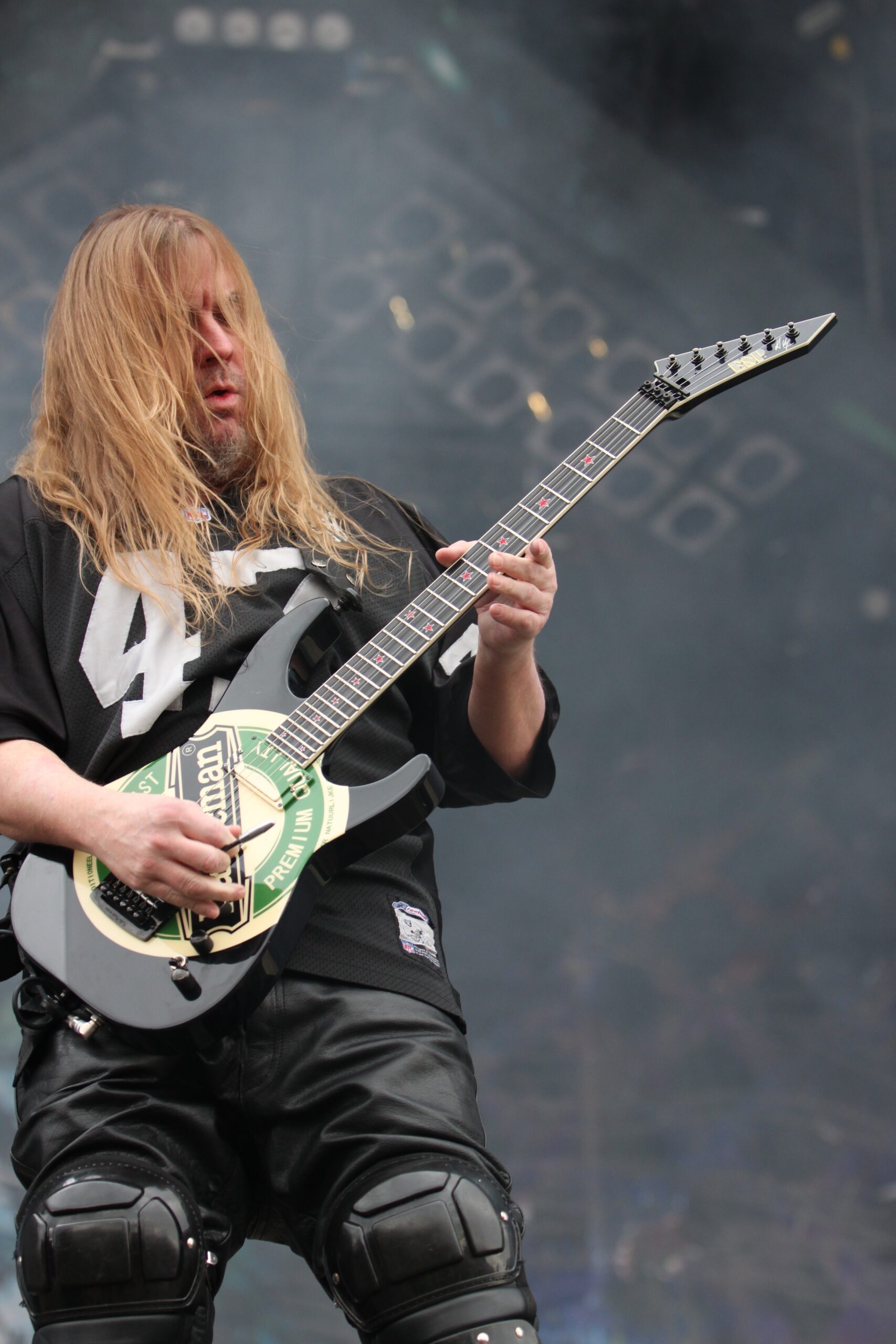
“I put a Seymour Duncan pickup in the bridge position — I can’t remember which one but it may have been a Distortion. I had a Kahler tremolo put on her, too. Actually, the guy who put it in for me was the first guitarist in Megadeth, Chris Poland. I think he did it for 50 bucks! To do the paint job I taped up the pickups, dipped a stick in some red paint and just splashed it on there. I think I screwed some chains on her for a while, too.” Jeff Hanneman said this to Guitar World about his first significant guitar — the Gibson Les Paul that he transformed from a conventional instrument into something recognizably his own with 50 dollars of work from the future Megadeth guitarist, a paint stick, and some chains. This is the Guitar World quote about the guitar that appears in countless early Slayer photographs: the red paint-splattered Les Paul with chains. He is describing the process with the same casual directness that he brought to everything about Slayer — the no-frills, what-works-is-what-we-use approach to equipment that produced some of the most violent and most influential guitar music in thrash metal history. For Reign in Blood (1986), he used the B.C. Rich Bich that Kerry King gave him — fitted with DiMarzio Super Distortion pickups and a Kahler Pro locking tremolo, covered in stickers from thrash bands and vodka companies. The Marshall JCM 800 2203 with Groove Tube 6550 power tubes into Marshall 1960 cabinets was the amp. E-Flat tuning, six guitars on tour for the different tunings used across different albums. The ESP Hanneman Signature with his name over a Heineken logo became the most recognizable guitar of his later years. He was the primary songwriter behind “Angel of Death,” “Raining Blood,” “South of Heaven,” and “Seasons in the Abyss” — the defining songs of Slayer’s commercial and artistic peak. He was “The Riff Fuhrer.” He died on May 2, 2013. He was forty-nine years old. The riffs remain.
Jeffrey John Hanneman was born on January 31, 1964, in Huntington Park, California. He grew up in Los Angeles, learning guitar as a teenager and forming Slayer with Kerry King, Tom Araya, and Dave Lombardo in Huntington Park in 1981. Slayer’s breakthrough came with Reign in Blood (1986, produced by Rick Rubin on Def Jam Records) — an album whose speed, aggression, and lyrical darkness established the standard for thrash metal at its most extreme. Subsequent albums — South of Heaven (1988), Seasons in the Abyss (1990), Divine Intervention (1994), Christ Illusion (2006), World Painted Blood (2009) — maintained Slayer’s position at the forefront of extreme metal. Hanneman was the band’s primary lyricist and the composer of most of their most celebrated songs. He suffered a life-threatening spider bite in 2011 that led to necrotizing fasciitis, a bacterial infection that severely damaged his left arm and removed him from touring. He returned to limited playing before his death from liver failure on May 2, 2013, at age forty-nine. The spider bite’s specific medical severity, and the subsequent surgical and rehabilitation process, limited his final years of active playing.
Background: Huntington Park California, Slayer 1981 with Kerry King, Reign in Blood Rick Rubin 1986, “Angel of Death” “Raining Blood” Primary Songwriter, Spider Bite 2011, Died May 2013
Hanneman’s specific songwriting contribution to Slayer is the most often underappreciated biographical fact of his career. Kerry King receives much of the public attention as Slayer’s most visually dominant guitarist (the beard, the tribal tattoos, the BC Rich Wartribe/Warlock guitars) — but Hanneman wrote the most celebrated songs in the Slayer catalog. “Angel of Death” — the opening track of Reign in Blood — was Hanneman’s composition. “Raining Blood” — the closing track — was Hanneman’s composition. “South of Heaven” was Hanneman’s composition. The songs that non-metal-fans know as “Slayer songs” are primarily Hanneman’s songs. This specific credit dispute is not contentious but simply underappreciated: King’s visual dominance does not reflect the compositional reality of the partnership.
His relationship with Kerry King is the foundational creative relationship of his career: King approached Hanneman with a proposition to start a band after seeing him play guitar in 1981. Slayer was born from that encounter. The two-guitarist approach they developed — both playing simultaneously with the fast, aggressive, non-conventional rhythm/lead separation of thrash metal — produced the specific overwhelming guitar wall of the Slayer sound. Hanneman’s contribution was primarily compositional (he wrote the songs) while King’s was more improvisational (he developed his distinctive whammy bar lead style); both guitarists played the full range of rhythm and lead parts in live contexts.
The spider bite incident of 2011 is the most specifically tragic biographical event of his final years. While touring, Hanneman contracted a spider bite that led to necrotizing fasciitis — a bacterial infection that destroys soft tissue — severely damaging his left arm. The medical treatment required surgery and extensive rehabilitation, and while he made some recovery and continued participating in limited recording, he was unable to return to full touring with Slayer before his death from liver failure in 2013.
The Rig: Jeff Hanneman’s Guitars, Amps, and Effects
Guitars
Jeff Hanneman’s first significant guitar was a Gibson Les Paul — modified extensively in the early Slayer period. Ground Guitar captures his own Guitar World description: “I put a Seymour Duncan pickup in the bridge position — I can’t remember which one but it may have been a Distortion. I had a Kahler tremolo put on her, too. Actually, the guy who put it in for me was the first guitarist in Megadeth, Chris Poland. I think he did it for 50 bucks!” The specific cast of characters in this modification — Hanneman, Chris Poland (who went on to record Killing Is My Business… with Megadeth), and a $50 modification fee — places this guitar in the specific creative community of Los Angeles’s emerging extreme metal scene of the early 1980s, where the musicians who would form the leading bands of the genre (Metallica, Megadeth, Slayer, Anthrax) were already interconnected. The paint job: “I taped up the pickups, dipped a stick in some red paint and just splashed it on there. I think I screwed some chains on her for a while, too.” The red paint-splattered Les Paul with chains is visible in early Slayer photographs and represents Hanneman’s early approach to guitar aesthetics: making the instrument recognizable and personalized through simple, direct modification.
The most historically significant guitar in Hanneman’s career is the B.C. Rich Bich used for Reign in Blood (1986) — one of the most important albums in thrash metal history. The Mixdown Magazine documentation: “The late Jeff Hanneman… tended to favour a B.C. Rich Bich guitar around the time Slayer recorded the album, which he attained from co-guitarist Kerry King. Fitted with two DiMarzio Super Distortion pickups and a Kahler Pro locking tremolo, Hanneman’s B.C. Rich Bich also featured an assortment of Slayer-esque stickers on the body, ranging from fellow thrash acts to vodka companies.” The B.C. Rich Bich’s specific character: an angular, pointed-headstock, through-neck design with the aggressive aesthetic of 1980s metal — not a prestige instrument but one with a specific visual and sonic identity suited to Slayer’s specific extreme character. The DiMarzio Super Distortion — ceramic-magnet, high-output, the same pickup used by Greg Ginn and Trey Azagthoth — provides the specific aggressive, compressed character of the Reign in Blood guitar tone. The Kahler Pro locking tremolo provides the tuning stability for the aggressive, sometimes dive-bombing tremolo use of Slayer’s solos.
The Full in Bloom documentation: “Perhaps the best remembered guitar from Hanneman’s later years was the ESP Hanneman Signature model emblazoned with his name over a Heineken logo.” The ESP Hanneman Signature — endorsed by ESP Guitars and featuring his distinctive Heineken beer logo (reflecting his well-documented love of Heineken beer) — became the most recognizable guitar of his later career. The signature model typically featured EMG 81/85 active humbucker pickups (the same EMG combination that Devin Townsend uses) and the specific body shape and neck profile of the ESP superstrat design.
Equipboard: “In the YouTube video ‘SLAYER ‘Seasons In The Abyss’ Live on The John Stewart Show,’ Jeff Hanneman can be seen playing a Jackson Soloist. This custom shop model features distinctive stickers, a Kahler tremolo, and EMG 81/85 pickups. It served as a prototype for his ESP signature guitars.” The Jackson Soloist Custom Shop — the high-performance superstrat built by Jackson before Hanneman’s formal ESP endorsement — with EMG 81/85 and Kahler tremolo represents the transitional instrument between the B.C. Rich Bich period and the ESP signature era.
Full in Bloom: “Nearly all of the photos of Jeff Hanneman playing during Slayer’s first few years show him playing his black Les Paul, though there are a few showing him with a red Flying V guitar.” The red Flying V — appearing in a limited number of early Slayer photographs — documents the pre-B.C. Rich period of his guitar history.
Full in Bloom: “Hanneman used E-Flat tuning on most of Slayer’s albums, though a few such as ‘Christ Illusions’ and ‘Diabolus In Musica’ utilized alternate tuning. ‘Show No Mercy’ was recorded in standard tuning, though most live performances of the album’s songs featured E-Flat tuning.” And: “While on tour, Hanneman typically carried six guitars with him, due to the various tunings he used on different albums.” E-Flat tuning (all six strings tuned down a half-step) provides the specific slightly darker, slightly heavier character of a guitar at reduced string tension — the same tuning used by Jimi Hendrix, who tuned to E-Flat for similar tension and tonal reasons. Six guitars on tour for the different tuning requirements reflects the professional reality of playing songs from albums recorded in different tunings without retuning between songs.
Full in Bloom: “He also used a custom slide shaped in the form of an upside down cross in the early days.” An inverted cross guitar slide is the most specifically Slayer-aesthetic gear item in this guide — an instrument modification that is simultaneously functional (a glass or metal slide for slide guitar technique) and visually provocative (an inverted cross). This is Hanneman in miniature: practical musical tool applied with maximum aesthetic commitment to the Slayer visual identity.
Amps
Jeff Hanneman’s primary amplifier is the Marshall JCM 800 2203 — a 100-watt, single-channel, non-master-volume Marshall head that is the most celebrated tube amplifier in classic 1980s metal and thrash. The Oreate blog documentation: “He favored the Marshall JCM-800 2203 equipped with Groove Tube 6550 power tubes. Pairing these amps with modded Marshall cabinets loaded with Celestion G12T-75 speakers gave him unparalleled clarity while maintaining bone-crushing heaviness during live performances.” The standard JCM 800 2203 uses EL34 power tubes; Hanneman’s modification to Groove Tube 6550 power tubes (a different tube type that provides a slightly different character — tighter bass response, more extended high-frequency detail) is the specific technical modification that contributes to the Slayer tone’s particular clarity at high gain and high volume. The Celestion G12T-75 speakers (the standard UK-made Celestion found in Marshall cabinets from the 1980s) provide the specific British speaker character that converts the amplifier’s signal into the specific Slayer live sound.
Equipboard: “We are honored to have for sale Jeff Hanneman’s Marshall Artist 3203 Head and Marshall 4×10 Cabinet.” The Marshall Artist 3203 — a less common Marshall model than the JCM 800 — appears in his documented equipment as an additional Marshall head alongside the primary JCM 800 2203.
Full in Bloom: “Jeff’s preference for amplification, just like hundreds of other metal guitarists, was Marshall stacks.” And the zZounds documentation of the Reign in Blood rig: “King’s rig on Reign In Blood was reportedly a Marshall JCM 800 head with Marshall 1960 4×12 cabinets” — this applies equivalently to Hanneman, both guitarists using the same fundamental Marshall JCM 800 rig for the band’s most celebrated album.
Effects
The zZounds documentation: “King and Hanneman’s guitar rigs from this era were fairly straightforward, mostly relying on volume and power rather than intricate gear choices to achieve their sound.” Hanneman’s approach to rhythm guitar was the direct approach: guitar into Marshall JCM 800, no effects in the signal chain for the rhythm parts. The Marshall’s natural high-gain character at high volume provided the specific aggressive, slightly compressed tone of the Slayer rhythm guitar without requiring additional pedal processing.
Hanneman’s primary expressive tool in live performance was not a pedal but the Kahler tremolo system on his B.C. Rich and subsequent guitars. The Kahler Pro locking tremolo allows extreme pitch manipulation — dive bombs (lowering pitch dramatically), pitch rises, and the specific chaotic pitch manipulation that characterizes Slayer’s most extreme solo passages. Both Hanneman and King’s live solos used the whammy bar extensively for the atonal, abstract, chaos-oriented lead approach that distinguishes Slayer’s solo playing from conventional melodic metal solos.
The zZounds documentation confirms the Boss 10-Band EQ in the Reign in Blood era rig — with the sliders set in an upside-down “V” shape, boosting the mids. The EQ box provides additional frequency shaping before the Marshall’s input, boosting the specific midrange frequencies that give the Marshall’s saturation its particular aggressive presence in the mix.
The Oreate documentation notes “the Eventide H3000S Harmonizer which brought depth to tracks like ‘Disciple'” — the same Eventide H3000 processor documented for Azagthoth, Mould, and Frisell appearing in the Hanneman studio setup for specific pitch-shifting and harmonic depth effects.
The Oreate documentation lists “an MXR Smart Gate for noise reduction during high-gain passages.” At the extreme gain levels of the Marshall JCM 800 with the aggressive playing of Slayer’s thrash metal, a noise gate is essential for controlling the amplifier’s background noise during pauses between riffs.
Playing Style & Tone Philosophy
Jeff Hanneman’s playing style is the most songwriting-focused in the extreme metal context — the approach of a guitarist whose primary creative contribution was compositional rather than technical display. Unlike the soloists (Azagthoth’s Temple of Ostx improvisation, Townsend’s open-C compositional explorations), Hanneman’s guitar identity is in the riffs: the opening of “Angel of Death,” the main riff of “Raining Blood,” the melodic counterpoint of “South of Heaven.” These are compositions that have defined a genre across forty years of thrash metal influence.
His tone philosophy was the Marshall philosophy — the JCM 800 2203 at high gain with the Groove Tube 6550 power tubes, the Celestion speakers, and the DiMarzio Super Distortion or EMG pickups providing the necessary output to push the amp into its natural saturation zone. Volume and power rather than intricate gear choices. The same fundamental approach that Greg Ginn brought to his solid-state Peaveys — just use enough power, the right guitar, and let the amp produce the tone — applied to the specific character of the Marshall JCM 800’s specific tube saturation.
His legacy is the riffs: four decades of Slayer fans recognizing the specific guitar motifs of his compositions, subsequent thrash metal and death metal bands adopting his riff-writing approach as a template, and the cultural position of Reign in Blood — the album his B.C. Rich Bich helped create — as one of the most influential metal recordings in history.
How to Sound Like Jeff Hanneman
Guitar: B.C. Rich Bich (with DiMarzio Super Distortion pickups and Kahler Pro locking tremolo) for the Reign in Blood character. ESP Hanneman Signature (EMG 81/85) for the later career character. Jackson Soloist Custom Shop (EMG 81/85, Kahler) for the transitional period. E-Flat tuning: tune all six strings down a half-step from standard (Eb-Ab-Db-Gb-Bb-Eb).
Amp: Marshall JCM 800 2203 (100W, single channel) — with Groove Tube 6550 power tubes for the specific Hanneman character (tighter bass, more extended highs than standard EL34). Marshall 1960 4×12 cabinets with Celestion G12T-75 speakers.
Amp Settings (Marshall JCM 800 — Slayer Thrash Metal Tone):
| Control | Setting (0–10) | Notes |
|---|---|---|
| Preamp Gain | 8–10 | Maximum — the JCM 800’s preamp saturation is the foundation |
| Bass | 4–6 | Moderate — the 6550 power tubes tighten the low end |
| Mid | 7–8 | Forward — boosted by Boss EQ for the specific Slayer “cut” |
| Treble | 6–7 | Bright — attack definition for fast riff articulation |
| Presence | 7 | High — projects through the dense Slayer drum and bass texture |
Effects chain (minimal): Boss 10-Band EQ (upside-down V curve — boost mids rather than scoop) → MXR Smart Gate (noise control for high-gain rhythm playing) → Marshall JCM 800 input. No additional effects for rhythm. Kahler tremolo on the guitar for solo dive bombs and pitch manipulation. Studio: Eventide H3000S for depth on specific tracks.
Influence & Legacy
Jeff Hanneman’s influence on thrash metal and extreme metal guitar is the most specifically compositional in this section — the influence of a guitarist who wrote the riffs that defined the genre’s musical vocabulary at its most extreme. “Angel of Death,” “Raining Blood,” “South of Heaven,” “Seasons in the Abyss” — these songs are the standard against which thrash metal songwriting is measured. The specific combination of extreme speed, extreme dissonance, extreme aggression, and the occasional melodic passage that provides contrast (the opening clean guitars of “South of Heaven”) established a template for sophisticated songwriting within extreme metal that subsequent bands have drawn from across four decades.
His connection to Trey Azagthoth as a fellow foundational death/thrash metal guitarist of the same generational moment — both Morbid Angel and Slayer formed in the early 1980s in the American South/West, both defined their respective subgenres — reflects the shared historical position as genre-founders. His connection to Devin Townsend as a fellow guitarist whose approach to amplification (Marshall JCM 800 and the Peavey 5150 successor both provide the specific tight, aggressive high-gain character of 1980s-1990s extreme metal) reflects the shared amplifier tradition of the genre. His connection to Greg Ginn as a fellow guitarist who built genre-defining music from straightforward, volume-and-power-based amplification without intricate gear complexity reflects the shared pragmatism of extreme musicians who trust the amp and the playing rather than effects chains.
Frequently Asked Questions: Jeff Hanneman Slayer Guitars & Gear
What guitar did Jeff Hanneman use on Reign in Blood?
For Reign in Blood (1986), Hanneman primarily used the B.C. Rich Bich — a guitar he received from Kerry King, fitted with two DiMarzio Super Distortion pickups and a Kahler Pro locking tremolo, and covered with stickers from thrash acts and vodka companies. Guitar.com: “The late Jeff Hanneman… tended to favour a B.C. Rich Bich guitar around the time Slayer recorded the album, which he attained from co-guitarist Kerry King.”
What is the story of Hanneman’s modified Gibson Les Paul?
His early Slayer guitar was a Gibson Les Paul that he modified extensively: “I put a Seymour Duncan pickup in the bridge position… I had a Kahler tremolo put on her, too. Actually, the guy who put it in for me was the first guitarist in Megadeth, Chris Poland. I think he did it for 50 bucks! To do the paint job I taped up the pickups, dipped a stick in some red paint and just splashed it on there. I think I screwed some chains on her for a while, too.” This red paint-splattered, chain-decorated Les Paul appears in many early Slayer photographs.
What amplifier did Jeff Hanneman use?
Hanneman’s primary amplifier was the Marshall JCM 800 2203 — 100 watts, single channel, non-master-volume — equipped with Groove Tube 6550 power tubes (replacing the standard EL34s for a tighter bass response and more extended high-frequency character) and matched to Marshall 1960 cabinets loaded with Celestion G12T-75 speakers. The Marshall Artist 3203 also appears in his documented equipment.
What tuning did Jeff Hanneman use?
“Hanneman used E-Flat tuning on most of Slayer’s albums, though a few such as ‘Christ Illusions’ and ‘Diabolus In Musica’ utilized alternate tuning. ‘Show No Mercy’ was recorded in standard tuning, though most live performances of the album’s songs featured E-Flat tuning.” He typically carried six guitars on tour to accommodate the different tunings used across different albums.
Who wrote “Raining Blood” and “Angel of Death”?
Both “Raining Blood” and “Angel of Death” — the two most celebrated Slayer songs — were written primarily by Jeff Hanneman. He was the primary songwriter behind most of Slayer’s most celebrated material, including “South of Heaven” and “Seasons in the Abyss.” Despite Kerry King’s greater visual prominence, Hanneman was the band’s most prolific and most significant songwriter.
How did Jeff Hanneman die?
Jeff Hanneman died on May 2, 2013, of liver failure. He was forty-nine years old. In 2011, he had contracted a spider bite that led to necrotizing fasciitis — a bacterial infection that severely damaged his left arm. Though he made some recovery, his final years of active playing were limited by the physical damage from this illness. He had been working on material with Slayer before his death.
What is the ESP Hanneman Signature guitar?
The ESP Hanneman Signature was his primary guitar during his later career — “Perhaps the best remembered guitar from Hanneman’s later years was the ESP Hanneman Signature model emblazoned with his name over a Heineken logo.” The guitar featured his name integrated with the Heineken beer logo (reflecting his well-documented love of the brand), EMG 81/85 active pickups, and the specific body shape and neck profile of the ESP superstrat design. The Jackson Soloist Custom Shop with EMG 81/85 and Kahler tremolo preceded the ESP signature as a prototype for the same design direction.
Related stories
Tosin Abasi Guitars & Gear: The Complete Guide to Animals as Leaders’ Guitar Innovator’s Rig
Tosin Abasi's guitars, amps, and effects — the complete guide. Abasi Concepts Larada 8, Fractal Axe-FX, Fishman Fluence, thumping technique, and how to nail that Animals as Leaders progressive metal tone.
Vernon Reid Guitars & Gear: The Complete Guide to Living Colour’s Guitar Genius’s Rig
Vernon Reid's guitars, amps, and effects — the complete guide. Parker MaxxFly, PRS Vela VR, Mesa Dual Rectifiers, Roland VG-99, Eventide H9, Living Colour gear guide.
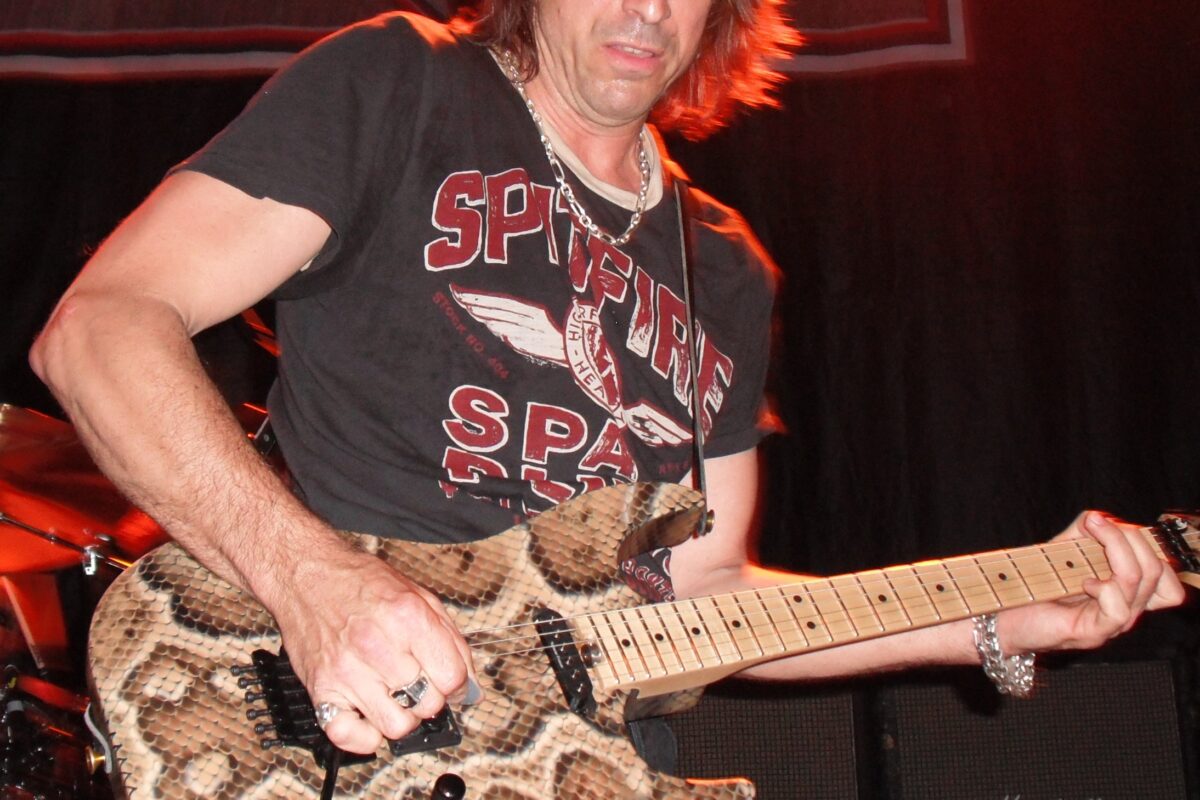
Warren DeMartini Guitars & Gear: The Complete Guide to Ratt’s Torch Guitarist’s Rig
Warren DeMartini guitars & gear: Ratt's Torch guitarist. Charvel Bomber, snakeskin, Jose-modded Plexi, Fender Super Champ, RTM pickup, slapback echo — the complete rig.