
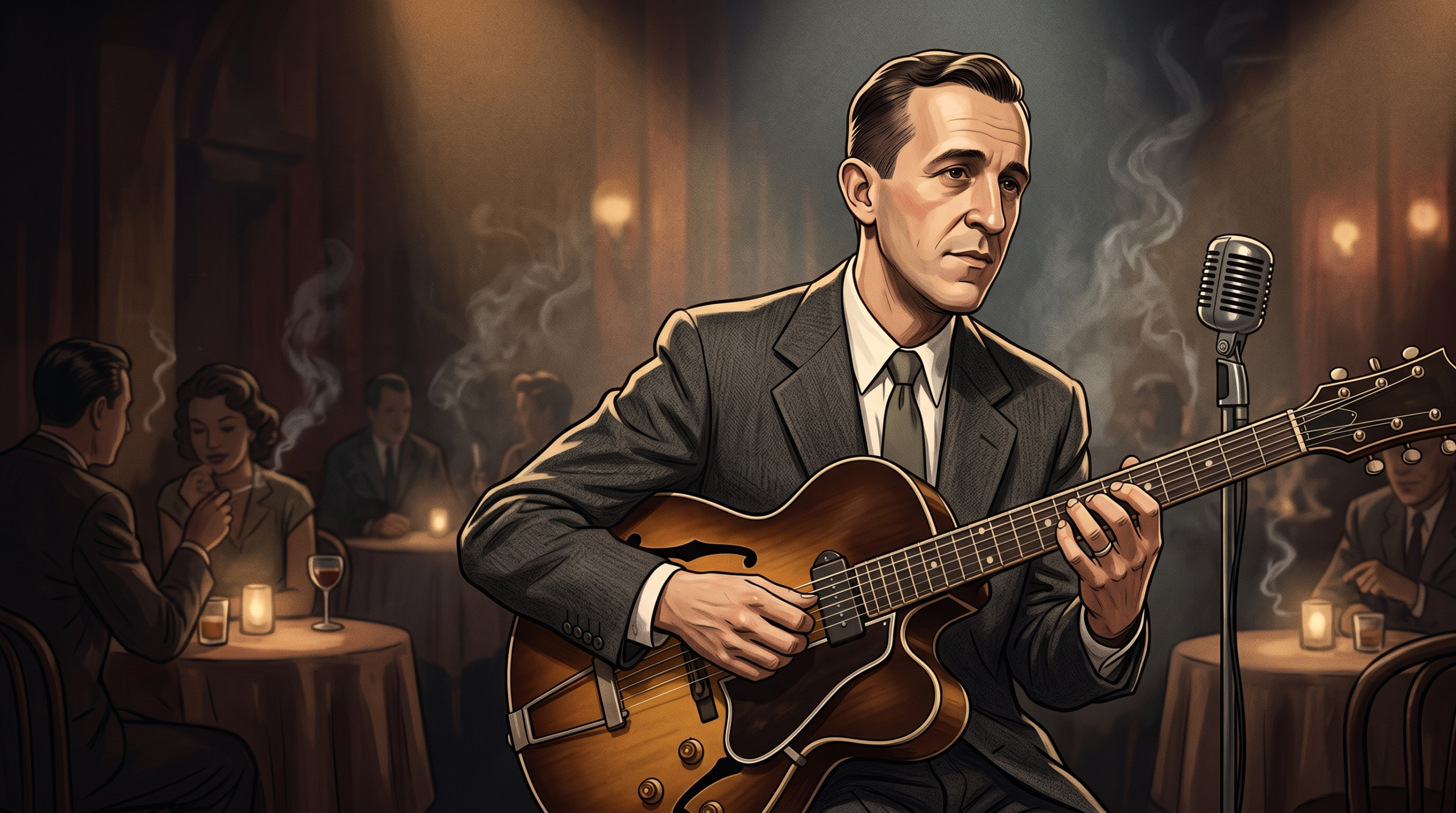
Jimmy Raney guitars gear is the subject of this series’ examination of one of jazz guitar’s most significant bebop-era voices — the equipment and approach of a guitarist whose work, particularly his collaboration with pianist Stan Getz in the early 1950s and his subsequent associations with various jazz luminaries across a sustained career, established him as a central figure in the “cool jazz” guitar tradition: bringing bebop’s harmonic and melodic vocabulary to guitar with a lyrical, singing quality that influenced subsequent jazz guitarists substantially, even as his individual name recognition remained somewhat less prominent than the musicians he collaborated with and the musical tradition he helped establish.
His specific position — a bebop-era jazz guitarist whose individual approach brought specific qualities (lyrical phrasing, sophisticated harmonic awareness, genuine melodic invention) to a tradition being established in real time during jazz guitar’s early formative decades — offers a view of bebop jazz guitar at its historical developmental moment, distinct from the more contemporary jazz guitar voices of Breau and Diorio: Raney as a foundational figure rather than a later revisionist or synthesiser, representing jazz guitar’s bebop vocabulary at the tradition’s high-water mark. This is the complete breakdown of Jimmy Raney guitars gear, technique, and tonal philosophy.
Background
Jimmy Raney was born on August 20, 1927, in Louisville, Kentucky, United States, with his early musical development occurring in a Southern American city (Kentucky’s largest) before his subsequent move into jazz’s primary professional environment — New York City — where the bebop revolution was being shaped during his formative years as a professional jazz musician.
His association with Stan Getz — the tenor saxophonist who was among bebop’s and subsequently cool jazz’s most significant individual voices — produced recordings that many jazz critics consider landmarks: Raney’s guitar work with Getz demonstrated that guitar could function as a full harmonic and melodic peer within high-level bebop jazz context rather than primarily as a rhythm section instrument, establishing a precedent for jazz guitar’s subsequent development as a genuine front-line improvisational voice alongside horns and piano.
His associations with other significant jazz musicians — including pianist Al Haig, drummer Terry Gibbs, and various other bebop-era musicians whose specific associations with Raney this article can note without attempting to catalogue exhaustively — placed him within jazz’s primary professional and creative environment during bebop’s formative development, giving him access to the intensive musical exchange (playing with the best musicians, learning from direct professional engagement) that jazz’s informal apprenticeship system provided at its most intense.
His later career — including a return to professional activity following a period of reduced public musical presence, and subsequently a collaboration with his son Doug Raney (also a jazz guitarist) that represented a specific father-son musical partnership — gave Raney’s career a shape including both high creative peaks (the Getz recordings in particular) and subsequent quieter periods, before his death in 1995.
Jimmy Raney Guitars Gear: The Complete Rig
Guitars
Jimmy Raney’s primary guitar association is with the Gibson ES-175 — the hollow-body electric archtop, here in its most directly jazz-appropriate application: the ES-175’s warm, rounded tonal character, produced by its single-cutaway hollow body and its original single-coil DeArmond pickup (later models received humbucker pickups, with both versions maintaining the instrument’s characteristic warmth), suited bebop jazz guitar’s specific tonal requirements as well as any instrument of its era. The ES-175’s association with jazz guitar specifically, across its production history since its 1949 introduction, connects directly to its use by Raney and various other jazz guitarists who found its specific warm-and-rounded character appropriate to jazz’s tonal aesthetic.
The ES-175’s specific construction — thinline hollow body (thinner than fully hollow archtops like the L-5, but retaining hollow construction’s resonance characteristics), pointed lower cutaway for upper-register access, laminate maple top/back/sides construction (rather than solid tonewoods, a practical construction choice that contributed to the instrument’s affordability while providing adequate tonal quality for professional use) — produced a specific tonal character: warm, somewhat midrange-forward, with a slightly compressed and rounded quality that suited chord-melody and single-note improvisation in clean jazz contexts. This specific ES-175 character — warm and midrange-forward rather than bright — connects directly to why this specific instrument became so closely associated with jazz guitar specifically rather than with other electric guitar genres that often favour brighter, more cutting tonal characters.
Amps
Jazz amplification appropriate to the early 1950s professional jazz context — clean, warm, designed to reproduce the ES-175’s natural tonal character at appropriate volume for small ensemble jazz performance contexts (clubs, recording studios) rather than large-scale concert or rock/pop performance contexts — would represent Raney’s foundational amplification approach. The specific amplifiers associated with professional jazz guitar in the early 1950s included various models from manufacturers like Gibson (who produced combo amplifiers alongside their guitars, marketed specifically to jazz guitarists), Epiphone, and others, all sharing the general “clean, warm, professional” character that suited jazz guitar’s tonal requirements.
Effects
The early 1950s jazz guitar context predates most of the effects technologies of later decades — the various pedals and processing devices that subsequent decades brought to electric guitar weren’t yet available or weren’t yet in common professional use. Raney’s context represents jazz guitar’s pre-effects era, where guitar tone was shaped entirely by the instrument (ES-175) and amplifier combination without additional processing, making the instrument/amplifier combination’s natural character entirely responsible for the overall tonal result.
Playing Style & Tone Philosophy
Jimmy Raney represents bebop jazz guitar at its formative historical moment, since Raney wasn’t working against or extending an already-established jazz guitar bebop tradition (as a post-bop or contemporary musician might) but was participating in the active establishment of this tradition during its developmental period in the late 1940s and early 1950s.
Bebop’s specific demands on guitar — when jazz’s harmonic and melodic language shifted from swing’s more simple harmonic structures to bebop’s complex chord substitutions, chromatic passing tones, and rapid tempo single-note improvisation — represented genuine new challenges for the instrument. Swing-era jazz guitar (represented by figures like Freddie Green’s essential but primarily rhythmic contribution to Count Basie’s orchestra, or Eddie Lang’s and Django Reinhardt’s earlier melodic guitar work within the swing tradition) had developed a specific vocabulary that didn’t immediately transfer to bebop’s demands: the harmonic complexity, faster tempos, and chromatic melodic language of bebop required guitarists to develop new technical and harmonic approaches, since the physical instrument’s characteristics (fretted intervals, available chord voicings) didn’t automatically accommodate bebop vocabulary in the way that piano’s layout or saxophone’s physical technique could more directly serve bebop’s specific demands.
Raney’s specific contribution — developing a bebop guitar vocabulary that genuinely matched bebop’s harmonic and melodic sophistication while maintaining a lyrical, singing quality that distinguished his approach from more mechanical or technically-displayed bebop playing — represents the specific achievement that subsequent musicians and critics have consistently cited as his most significant individual contribution. The “lyrical quality” this article’s introduction mentioned deserves specific examination: many bebop musicians (across various instruments) could execute bebop’s technical demands while maintaining a somewhat mechanical or note-running quality where the music feels like technical display rather than genuine melodic invention and emotional expression. Raney’s specific gift was executing bebop’s technical demands while maintaining genuine melodic singing quality — lines that felt invented and felt musical rather than merely executed, which (whatever the specific harmonic and technical means involved) represents the distinction between good bebop playing and truly significant bebop playing.
The Stan Getz collaboration’s specific significance — producing recordings considered landmarks within both jazz guitar’s history and cool jazz’s history more broadly — deserves examination regarding what specifically these recordings demonstrated. Guitar appearing as genuine front-line improvising voice alongside a significant saxophone voice (rather than primarily as rhythm-section instrument, as guitar had more commonly functioned in large-ensemble swing contexts, or as solo voice without horn peers, as various solo jazz guitar recordings represent) showed the jazz world that guitar could function as a genuine peer within high-level bebop improvisation, not merely as accompaniment or as a special-case instrument for solo showpieces. This demonstration — guitar as fully capable bebop front-line voice alongside horn — helped establish the context within which subsequent jazz guitarists could pursue similar front-line roles, contributing to jazz guitar’s development as a consistently valued front-line jazz instrument across subsequent decades.
Louisville, Kentucky as formative origin places Raney within American jazz’s mid-century geographic distribution: Louisville represented a Southern American city with its own regional music culture (including blues and country influences from the broader Kentucky/Tennessee region), while jazz’s primary development was occurring in Chicago, New York, and various other primarily-Northern and coastal cities. For Raney, the subsequent move to New York represented the essential geographic transition that connected his Southern origins to jazz’s primary professional and creative environment.
Tonally, Jimmy Raney guitars gear philosophy was built on the Gibson ES-175’s warm, rounded, midrange-forward character through clean era-appropriate jazz amplification without effects — equipment serving a bebop jazz guitar vocabulary combining technical harmonic sophistication with genuine melodic invention and lyrical quality, within the specific historical moment of jazz guitar’s bebop development rather than against an already-established tradition.
The Gibson ES-175’s specific construction history — introduced in 1949, making it virtually contemporary with Raney’s professional jazz career’s beginning — represents an interesting historical alignment: Raney and the ES-175 essentially grew into their respective jazz identities together, with neither representing an established tradition the other inherited but rather both coming into being within jazz’s bebop development period simultaneously. This historical contemporaneity — guitarist and instrument both coming into their primary professional identities during roughly the same period of jazz’s development — produces a different relationship between musician and instrument than cases where a guitarist chooses an already-established “classic jazz guitar” (like the Gibson L-5, which had been available since the 1920s and had already accumulated decades of jazz guitar association by the time Raney was developing professionally). For Raney, the ES-175 was a relatively new instrument in a relatively new jazz style, with neither having yet accumulated the historical associations they would subsequently develop — making his relationship to this instrument and this musical style more genuinely exploratory (both musician and instrument finding their identity through use) than if either had represented an already-established and already-defined tradition. This “explorer rather than inheritor” dynamic connects to this article’s broader framing of Raney as a foundational figure rather than a later revisionist or synthesiser — he was, in a genuine sense, helping to define what jazz guitar and specifically what this specific instrument within jazz guitar would be, rather than working within a definition already established by predecessors.
The cool jazz distinction this article has touched on — noting Raney’s association with this specific mid-century jazz development through his Getz collaboration — deserves brief clarification regarding what specifically distinguishes cool jazz from bebop. Bebop (developing primarily in the early-to-mid 1940s) represented jazz’s first movement toward highly complex harmonic structures, chromatic melodic language, fast tempos, and small-ensemble contexts — a deliberate departure from swing’s commercial accessibility toward a more musically demanding approach. Cool jazz (emerging in the late 1940s and early 1950s, with Miles Davis’s Birth of the Cool sessions often cited as a landmark early statement) retained bebop’s harmonic sophistication while moving toward somewhat more relaxed tempos, more lyrical melodic approaches, and a generally less intense overall affect — a different character rather than a fundamentally different harmonic language. For jazz guitar specifically, the cool jazz context (more relaxed, more lyrical, more space for the melodic qualities of individual notes rather than primarily the velocity of note production that bebop’s fastest tempos demand) arguably suited guitar’s specific physical characteristics somewhat better than bebop’s absolute fastest tempos: a guitarist can produce lyrical, sustained, harmonically sophisticated lines at the tempos cool jazz favoured very effectively, while the absolute upper-limit bebop tempos create specific challenges for guitar’s physical technique that saxophone or piano’s different physical mechanisms can navigate somewhat differently. Raney’s specific excellence — lyrical quality within bebop and cool jazz’s harmonic framework — thus reflects not only his individual musical gifts but also some genuine alignment between guitar’s physical characteristics and cool jazz’s specific musical character.
How to Sound Like Jimmy Raney
Guitar Approach
A Gibson ES-175 (or comparable warm-toned hollow-body jazz archtop with similar midrange-forward character) represents the foundational Jimmy Raney guitars gear instrument.
The musical approach: developing bebop jazz guitar vocabulary requires engagement with bebop’s specific harmonic and melodic language — the chord substitutions, chromatic passing tones, characteristic rhythmic placement (bebop’s specific emphasis on “and” beats, the characteristic Charleston and other rhythmic patterns that give bebop its specific rhythmic character), and approach to playing over complex chord changes that bebop improvisation’s full development requires. For the specific lyrical quality that distinguishes Raney’s bebop from more mechanical approaches, this ultimately comes from musical intelligence and genuine melodic invention rather than from any technical system alone — developing enough harmonic knowledge to improvise fluently over bebop changes, and then developing the musical sensibility to make those improvisations genuinely melodic and genuinely inventive rather than merely technically correct, represents the full developmental challenge Raney’s example poses.
Amp Approach
Clean, warm jazz amplification appropriate to the instrument and the musical context — era-appropriate vintage amplification (or contemporary equivalents) preserving the ES-175’s natural warm character at appropriate jazz performance volumes.
| Setting | Value | Notes |
|---|---|---|
| Volume | Moderate (clean, jazz club appropriate) | Small ensemble jazz performance levels |
| Treble | 3–4 (warm, rolled off) | ES-175 warmth emphasised rather than brightness |
| Middle | 6 (midrange forward) | ES-175’s characteristic midrange character |
| Bass | 5 (warm but controlled) | Harmonic fullness without low-end muddiness |
| Effects | None | Pre-effects era — pure instrument/amp character |
| Core tone character | Warm, rounded, midrange-forward | Classic 1950s jazz guitar sound |
Gibson ES-175 through clean vintage jazz amplification, no effects. The defining elements are the ES-175’s specific warm, midrange-forward character (historically significant as the instrument that helped define jazz guitar’s bebop-era tonal standard), clean amplification preserving this natural character, and bebop jazz guitar vocabulary combining harmonic sophistication with genuine lyrical melodic invention — the latter being the most demanding developmental target and the quality most directly representing Raney’s specific individual contribution.
Influence & Legacy
Jimmy Raney’s influence operates through multiple mechanisms: his recordings with Stan Getz and others remain available as demonstrations of what jazz guitar’s bebop vocabulary could sound like at its highest lyrical development; his subsequent guitarists who heard these recordings and absorbed his specific approach to bebop phrasing developed their own approaches partly in relation to his example; and his broader demonstration that guitar could function as a full front-line bebop voice helped establish the context within which all subsequent front-line jazz guitar improvising has occurred.
His broader significance — representing bebop jazz guitar at its formative historical moment, making the specific case for guitar as a genuine bebop instrument rather than primarily as a rhythm-section or special-case instrument — represents a historical contribution that subsequent developments have built on, often without fully acknowledging the foundational work Raney and a small number of contemporaries did to establish the very possibility of what those subsequent developments represent.
The comparison with Joe Diorio — whose own contribution, documented in the previous article, represented a post-bop extension of jazz guitar’s harmonic and melodic vocabulary beyond the bebop mainstream — provides the most direct chronological-and-conceptual comparison within this series’ jazz guitar sequence: Raney representing bebop jazz guitar’s highest individual development within the tradition’s foundational period; Diorio representing a subsequent generation’s extension of this tradition toward different harmonic and melodic territory. The contrast between “establishing a tradition’s highest expression” (Raney) and “extending a tradition beyond its established vocabulary” (Diorio) represents a recurring developmental dynamic across music history, where later musicians’ extensions are often only possible because earlier figures established the tradition’s foundational forms at sufficient quality to provide something worth extending. The parallel with Herb Ellis — another jazz guitarist this series will document shortly, whose own specific approach within jazz guitar’s swing and bebop traditions represents another point within the comparative landscape this series’ jazz guitar sequence is building — extends this series’ comparative jazz guitar documentation, with Ellis’s specific approach providing another data point for understanding the full diversity of how individual jazz guitarists developed genuinely distinct voices within broadly shared traditional territory. And the connection to Lenny Breau — whose own jazz guitar innovations, documented two articles ago, represented a later synthesis drawing on traditions including jazz’s bebop heritage that figures like Raney helped establish — places Raney’s foundational work in direct relationship to Breau’s synthesis: Breau’s jazz vocabulary, however distinctive and synthesised with other traditions, was built partly on the foundation of bebop jazz guitar that Raney’s generation established.
Frequently Asked Questions: Jimmy Raney Guitars & Gear
What guitar did Jimmy Raney play?
Jimmy Raney’s primary instrument was the Gibson ES-175 — a single-cutaway hollow-body electric archtop introduced in 1949 that became one of jazz guitar’s most historically significant instruments. The ES-175’s warm, rounded, midrange-forward tonal character suited bebop jazz guitar’s tonal requirements as well as any instrument of its era, contributing to its widespread adoption among jazz guitarists across the bebop period and beyond.
What was Jimmy Raney’s collaboration with Stan Getz?
Raney’s recordings with tenor saxophonist Stan Getz — particularly in the early 1950s — are considered landmark jazz documents, demonstrating that guitar could function as a full front-line improvisational voice alongside a significant saxophone voice in high-level bebop jazz contexts. These recordings helped establish guitar’s legitimacy as a genuine bebop front-line instrument rather than primarily a rhythm-section or special-case instrument.
What specifically distinguishes Raney’s bebop playing?
Raney is consistently cited for combining bebop’s technical harmonic and melodic demands with a genuine lyrical, singing quality that distinguishes his playing from more mechanically-executed bebop. This “lyrical quality” — executing bebop’s technical requirements while maintaining genuine melodic invention and emotional expression rather than mere technical display — represents the specific quality critics and musicians have most consistently identified as his primary individual contribution.
What is the Gibson ES-175 and why is it significant in jazz guitar history?
The Gibson ES-175 is a single-cutaway hollow-body electric archtop introduced in 1949, featuring laminate construction (rather than solid tonewoods) that made it more affordable than Gibson’s premium archtops while providing adequate tonal quality for professional jazz use. Its warm, rounded, midrange-forward tonal character suited jazz guitar’s tonal requirements particularly well, leading to its widespread adoption among jazz guitarists including Raney — eventually making it one of jazz guitar’s most historically associated and recognisable instruments.
Why is bebop’s historical development important for understanding jazz guitar?
Bebop’s emergence in the 1940s represented a fundamental change in jazz’s harmonic and melodic language — from swing’s relatively simple harmonic structures to bebop’s complex chord substitutions, chromatic passing tones, and rapid-tempo single-note improvisation. This shift created new challenges for guitar specifically, since the instrument’s physical characteristics didn’t automatically accommodate bebop’s demands. Raney and contemporaries who developed genuine bebop guitar vocabularies did foundational work that established guitar’s viability as a bebop instrument and created the tradition within which all subsequent jazz guitar improvisation operates.
What was the relationship between Raney and the cool jazz movement?
Cool jazz — emerging in the late 1940s and early 1950s as a somewhat more relaxed, lyrical, and harmonically sophisticated alternative to bebop’s intense and rapid-fire approach — found particular expression in certain musicians’ work, with Getz’s tenor saxophone representing one of cool jazz’s central voices. Raney’s guitar work, particularly with Getz, similarly embodied cool jazz’s characteristic combination of bebop harmonic sophistication with a more lyrical and less intense overall character — making him a significant voice within this specific mid-century jazz development.
How does Raney’s generational position relate to the other jazz guitarists?
Raney (born 1927) represents the bebop generation’s oldest member among the jazz guitarists named here — the foundational period rather than subsequent developments. Breau (born 1941) and Diorio (born 1936) represent the next generation who built on foundations Raney and contemporaries established. Ellis, Roberts, and Byrd span various points within similar generational landscapes, collectively demonstrating jazz guitar’s development across several decades of the tradition’s establishment and subsequent extension.
The father-son musical partnership — Raney’s collaboration with his son Doug Raney (also a jazz guitarist) in later career — represents a specific and relatively unusual form of musical collaboration: direct family-lineage musical partnership, where musical tradition and musical relationship are simultaneously familial and professional. Various significant jazz musicians have had children who became musicians (creating second-generation jazz families where musical knowledge and approach are transmitted partly through the family relationship alongside whatever formal and informal musical education applies), but father-son guitar duets or collaborations represent a specifically intimate form of this pattern, where both parties’ individual guitar voices exist in direct conversation within a musical context. For the Raney case, the specific musical relationship — what Doug Raney’s guitar approach shared with or diverged from Jimmy Raney’s — represents detail this article doesn’t have access to in sufficient specificity, beyond noting that the collaboration existed and represents one of the later-career developments that adds texture to the full picture of Jimmy Raney’s musical life beyond the early-1950s Getz recordings that represent his most widely cited career moment.
The swing era’s jazz guitar tradition that bebop built on and transformed — briefly mentioned in this article’s playing-style discussion through references to Freddie Green, Eddie Lang, and Django Reinhardt — represents a predecessor context worth briefly examining to clarify what specifically bebop changed about jazz guitar’s role. Swing-era jazz guitar typically functioned in one of a few specific roles: as rhythm guitar within large ensemble contexts (Freddie Green’s function in Count Basie’s orchestra — playing four-to-the-bar comping chords, providing rhythmic definition and harmonic foundation without asserting melodic independence), as single-note melodic voice within smaller combo contexts (Django Reinhardt’s most direct contribution, establishing guitar as a viable melodic voice within jazz ensemble contexts, though within swing’s harmonic language rather than bebop’s), or as solo acoustic guitar in context-specific settings. Bebop’s small-group (combo) format — typically piano, bass, drums, and one or two horns — provided a different context from both large ensemble swing and from special-case solo guitar: a small ensemble where guitar might appear as an additional voice (as with Raney playing alongside Getz’s saxophone and accompanying rhythm section), where guitar needed to function as a genuine improvising front-line voice rather than primarily as rhythm section or special-case solo instrument. This small-ensemble context — where guitar appears alongside horn as co-equal improvising voice — is precisely the context that Raney and contemporaries navigated in developing bebop jazz guitar vocabulary, representing a genuinely new role for the instrument (not quite what swing rhythm guitar was, not quite what Django’s more solo-style melodic work represented) that required new approaches rather than simply applying prior roles’ techniques within bebop’s different harmonic context.
Louisville, Kentucky as jazz origin connects to a broader geography of jazz’s mid-century American landscape that included significant jazz activity in various cities beyond the most commonly cited primary centres. Louisville represented a border-state city with connections to both the Deep South’s blues and country traditions and the Midwest’s more urban musical culture, with various jazz musicians having Louisville connections (though Louisville isn’t primarily associated with jazz in the same direct way as New Orleans, Chicago, or New York). For Raney, whatever specific local musical environment Louisville provided during his formative years represents the starting point from which his subsequent jazz development proceeded — with the subsequent New York involvement representing the critical step from regional origin to primary jazz professional environment. This Louisville-to-New-York trajectory represents a specific instance of the broader geographic mobility pattern that characterised bebop’s formation: musicians from varied American geographic origins converging on New York’s specific professional and creative environment, bringing diverse regional influences and backgrounds into contact with each other and with bebop’s specific New York-centred development, with the resulting cultural mixture contributing to bebop’s own richness rather than representing a single geographic community’s self-contained development.
In summary, Jimmy Raney guitars gear represents the Gibson ES-175 through clean, warm, vintage jazz amplification without effects — equipment serving a bebop jazz guitar vocabulary that combined harmonic sophistication (bebop’s complex chord substitutions and chromatic language) with genuine lyrical melodic quality, within the specific historical context of jazz guitar’s bebop development where Raney and contemporaries were establishing guitar’s viability as a front-line bebop instrument rather than working within an already-established tradition. For jazz guitarists interested in bebop guitar’s foundational vocabulary at its lyrical best, Raney’s recordings represent essential listening and essential study.
For listeners wanting to engage with Raney’s specific contribution directly, the Getz-Raney recordings from the early 1950s represent the most direct entry point to what his approach specifically sounded like within its primary context — listening with particular attention to how Raney’s guitar lines function alongside (rather than beneath) Getz’s saxophone, maintaining genuine melodic independence and harmonic sophistication while also serving the ensemble’s overall musical needs. This “simultaneous independence and service” — the guitar contributing its own melodic perspective while also shaping the overall musical dialogue with the other instruments — represents the front-line jazz guitar ideal that these recordings helped establish, and provides direct sonic illustration of what this article has described analytically.
A closing thought about what makes bebop’s foundational figures specifically hard to fully appreciate in retrospect: when something has been thoroughly established as a tradition, the work of establishing it becomes harder to perceive as the genuinely innovative work it was. We now hear bebop jazz guitar vocabulary as “jazz guitar” — as a naturalised tradition whose specific qualities (the characteristic harmonic language, the melodic approach, the instrument’s specific tonal character) feel like simply “what jazz guitar is” rather than as the specific creative achievement of specific musicians who had to figure out how to make these things work in real time. Raney represents this founding-achievement problem: what he accomplished — making bebop guitar vocabulary genuinely lyrical and genuinely musical rather than merely technically correct — was a genuine creative achievement that subsequent jazz guitarists have built on sufficiently thoroughly that the achievement now feels like inherited tradition rather than original creation. This retrospective naturalisation of genuine creative achievement represents one of the more interesting challenges in documenting foundational figures: giving their work appropriate credit for what it was (genuinely creative, genuinely difficult, genuinely original in its moment) rather than undervaluing it by treating it as simply “the way things have always been done.”
Related stories
Vernon Reid Guitars & Gear: The Complete Guide to Living Colour’s Guitar Genius’s Rig
Vernon Reid's guitars, amps, and effects — the complete guide. Parker MaxxFly, PRS Vela VR, Mesa Dual Rectifiers, Roland VG-99, Eventide H9, Living Colour gear guide.
Warren DeMartini Guitars & Gear: The Complete Guide to Ratt’s Torch Guitarist’s Rig
Warren DeMartini guitars & gear: Ratt's Torch guitarist. Charvel Bomber, snakeskin, Jose-modded Plexi, Fender Super Champ, RTM pickup, slapback echo — the complete rig.
Warren Haynes Guitars & Gear: The Complete Guide to Gov’t Mule’s Guitar Master’s Rig
Warren Haynes' guitars, amps, and effects — the complete guide. Gibson Les Paul Chester, Soldano SLO-100 modified, Klon Centaur, Emma Discombobulator, and how to nail that Gov't Mule blues-rock tone.