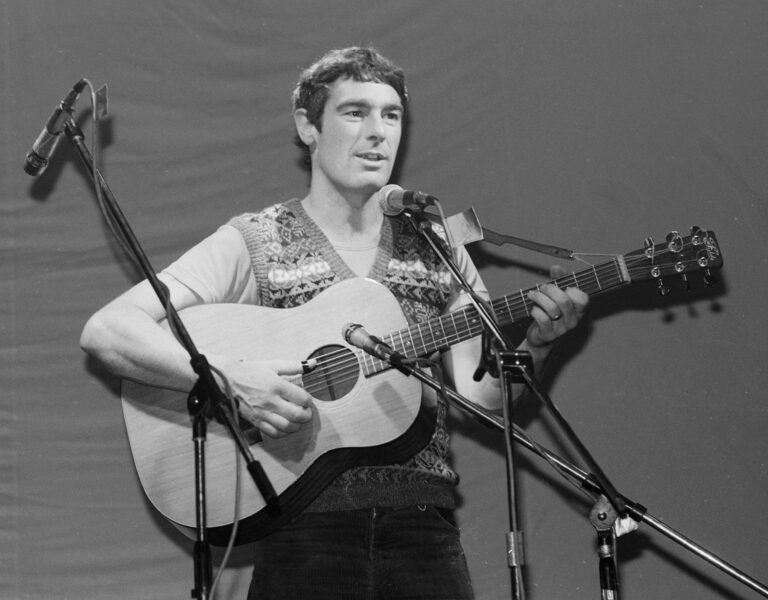
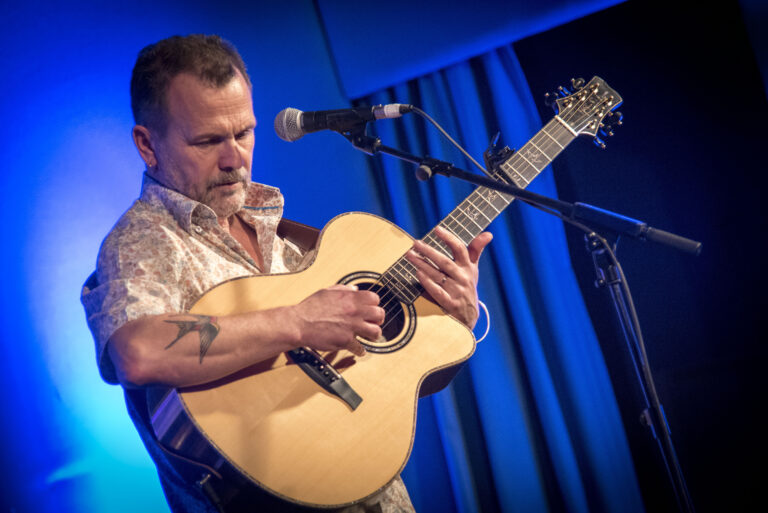
Robin Williamson Guitars & Gear: The Incredible String Band Visionary’s Complete Rig
Robin Williamson guitars gear — Martin acoustic and DADGAD tuning deep-dive for the Incredible String Band Celtic folk visionary's complete multi-instrumental rig.
Explore Robin Williamson guitars gear and you enter one of the most eclectic and genuinely multi-instrumental worlds in British folk music — a Scottish musician who co-founded the Incredible String Band with Mike Heron in 1966 and went on to play guitar, sitar, gimbri, oud, whistle, violin, cello, harpsichord, and assorted percussion across a series of albums that defined psychedelic folk and influenced everyone from Led Zeppelin to Kate Bush to R.E.M. Williamson was never primarily a guitarist in the technical virtuoso sense — his relationship with the guitar was one of several in an extraordinarily wide instrumental palette — but his acoustic guitar playing, particularly on the early ISB recordings, has a specific character and emotional depth that rewards the same close attention as more technically spectacular playing.
The Journey
This guide covers Williamson’s guitar equipment and approach: the acoustic and occasional electric instruments he used across his career, his approach to the guitar as one voice in a larger multi-instrumental conception, the specific acoustic guitar character that appears across the ISB recordings and his subsequent solo work, and the playing philosophy of a musician who understood the guitar as a medium for storytelling and emotional communication rather than for technical demonstration. Understanding Robin Williamson’s gear is understanding how a minimal technical approach can coexist with deep musical intelligence and genuine artistic vision.
Background
Robin Williamson was born on November 24, 1943, in Edinburgh, Scotland. His early musical influences were eclectic from the beginning — he absorbed the Celtic folk tradition of Scotland and Ireland through direct cultural immersion, the American folk and blues tradition through records, and the broader world music traditions that were becoming accessible through ethnomusicological recordings in the late 1950s and early 1960s. He came to music as a natural participant in traditional culture rather than as a formal student of it, which gave his playing the organic quality of someone for whom music was a cultural practice rather than an academic subject.
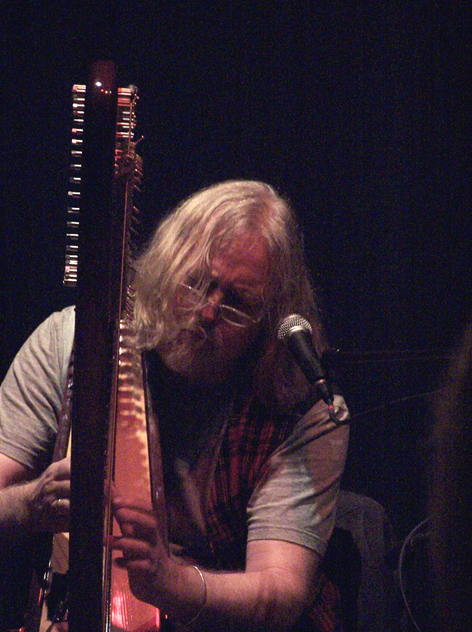
He began his professional career busking in Edinburgh before moving to Glasgow and eventually London, where he met Mike Heron and formed the duo that would become the Incredible String Band. The ISB’s debut album (1966) and its follow-up The 5000 Spirits or the Layers of the Onion (1967) established the band as one of the most original voices in British folk music — synthesising Celtic and Eastern folk traditions, American country blues, psychedelic rock, and a distinctly surreal lyrical sensibility into something that had no clear precedent.
The band’s most celebrated period — roughly 1966 to 1970, encompassing The Hangman’s Beautiful Daughter (1968), Wee Tam and the Big Huge (1968), Changing Horses (1969), and I Looked Up (1970) — produced recordings of extraordinary range and genuine originality. Williamson’s multi-instrumental contributions to these albums — playing different instruments on different tracks and occasionally combining multiple instruments within a single arrangement — gave the music its specific character of folk music from a culture that had absorbed the whole world’s musical traditions simultaneously.
The ISB dissolved in 1974, and Williamson subsequently pursued a solo career that has continued into the 2020s, combining traditional Celtic storytelling, original composition, and the multi-instrumental approach that characterised his ISB work. He has also worked extensively as a teacher of traditional music and as a collector and transmitter of the Celtic oral tradition, making his contribution to British cultural life considerably broader than his commercial profile might suggest.
Robin Williamson Guitars Gear: The Complete Rig
Guitars
Robin Williamson’s guitar playing sits within a multi-instrumental context that is essential to understanding his equipment choices. Unlike guitarists for whom the guitar is the primary instrument around which all other choices are organised, Williamson’s guitar is one of many instruments — sometimes the primary voice, sometimes a supporting voice, sometimes absent entirely — and his guitar choices reflect this context.
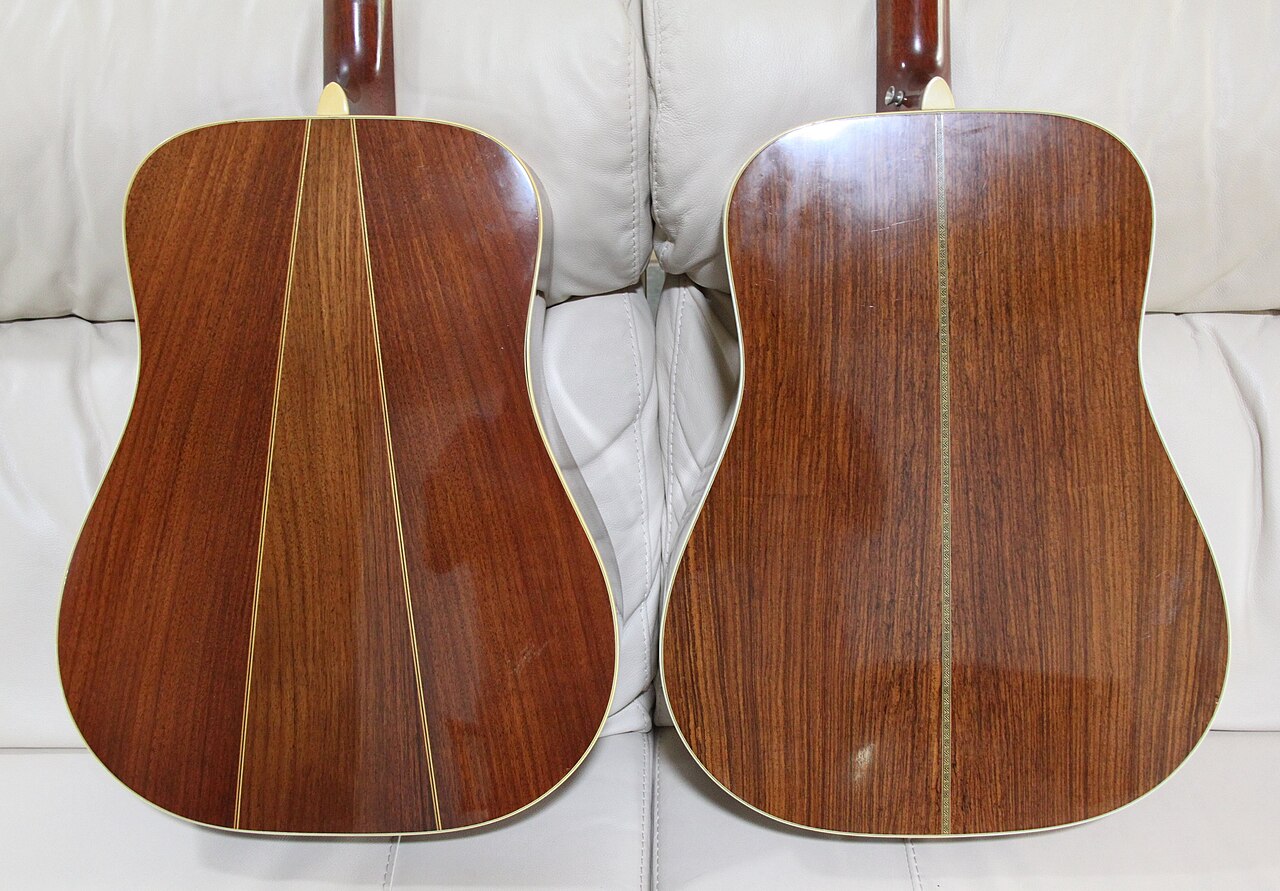
His primary acoustic guitar through the ISB period was a Martin acoustic guitar — the American manufacturer whose instruments have been central to the folk and country traditions that influenced Williamson’s playing. Specific model documentation from the early ISB period is somewhat sparse, but the Martin 000-series instruments — the Orchestra Model body that combines sufficient projection with comfortable playability — are consistent with the tonal character audible on the recordings. The Martin 000-28 or similar variants with spruce tops and rosewood back and sides produce the specific combination of clarity, warmth, and projection that suits folk fingerpicking and accompaniment to vocals.
He used the guitar primarily for open tunings — following the tradition of Celtic and American folk players who retune the instrument to specific chord configurations that enable drone strings and specific harmonic voicings not available in standard tuning. DADGAD tuning (D-A-D-G-A-D), which Davy Graham had introduced to British folk in the late 1950s and which the ISB absorbed through the folk scene, appeared regularly in Williamson’s playing, giving his guitar work the characteristic drone quality of Celtic music and enabling the specific chord voicings that suited the traditional and original material he played.
Other open tunings — open G (D-G-D-G-B-D), open D (D-A-D-F#-A-D), and various modal variants — also appeared across different songs and albums, giving the ISB’s acoustic guitar work its tonal variety. Each tuning produces a different set of available chord voicings and drone combinations, and Williamson’s facility across multiple tunings reflected both his wide musical knowledge and his pragmatic approach to the guitar as a tool for achieving specific sounds.
He also played sitar on various ISB recordings — the Indian classical instrument that was culturally ubiquitous in the late-1960s psychedelic folk scene. The sitar’s drone strings, sympathetic resonator strings, and characteristic melodic character gave the ISB recordings some of their most distinctive Eastern-influenced colour, and Williamson’s facility on the instrument — developed through self-study and cultural absorption rather than formal training — was sufficient to produce musically convincing results even if it fell short of the technical standards of trained Indian classical players.
A gimbri — the Moroccan three-stringed lute associated with the Gnawa musical tradition — appeared on several ISB recordings, adding a distinctly African tonality to the band’s already cosmopolitan palette. The gimbri’s low-tension strings and characteristic percussive bass quality gave it a specific rhythmic and harmonic role quite different from the guitar or sitar, and Williamson’s use of it reflects the ISB’s genuine engagement with world musical traditions rather than superficial exoticism.
String gauges on his acoustic guitar work were typically light to medium — appropriate for the fingerpicking technique that dominated his guitar playing and for the various open tunings that required different string tensions from standard tuning for correct instrument response. The light strings also facilitated the Celtic ornaments — grace notes, slides, and trills — that characterised his melodic playing on the guitar.
Amps and Amplification
Robin Williamson’s acoustic guitar work was, for much of the ISB period, performed without amplification — the intimate folk club and small venue context that defined the band’s early career didn’t require electronic amplification, and the acoustic guitar’s natural projection was sufficient for the performance spaces involved. When larger venues and festival performances required amplification, the approach was acoustic amplification — pickup systems and small acoustic amplifiers rather than the high-gain electric guitar amplification of the rock world.
The specific pickup systems and amplifiers used for ISB performances are less well-documented than the instruments themselves, reflecting both the period (acoustic guitar amplification was less systematised in the late 1960s than it became subsequently) and the ISB’s general indifference to technical specifications in favour of musical spontaneity. Magnetic soundhole pickups — simple devices that picked up string vibration through a magnetic field similar to an electric guitar pickup, mounted in the soundhole of the acoustic guitar — were the most common acoustic guitar amplification technology of the era, and it is likely that Williamson used these for larger venue performances.
The acoustic amplifiers of the period — small solid-state or valve combos designed for acoustic instrument amplification — were considerably less sophisticated than contemporary acoustic amplification technology. The Vox AC30, originally designed for electric guitar but widely used for acoustic guitar amplification in the 1960s British scene, appeared in various folk performance contexts and may have been part of the ISB’s live setup at various points. Its relatively flat frequency response at clean settings and its onboard reverb made it a reasonable acoustic guitar amplification solution for the period.
Effects
Robin Williamson’s effects use was minimal in the conventional sense — the ISB’s approach to sound was acoustic and organic rather than electronic and processed. Effects in the rock guitar sense played essentially no role in his guitar work. The “effects” that gave ISB recordings their distinctive sound were primarily the unusual instruments themselves, the open tunings that produced specific drone and harmonic effects, and the recording approaches that captured multiple acoustic instruments in a specific spatial relationship.
Natural reverb — the acoustic response of the recording space — was the primary spatial effect on ISB recordings. Producer Joe Boyd’s approach to recording the band (at Sound Techniques in London and other facilities) emphasised natural acoustic ambience over electronic reverb processing, and the specific character of the spaces where the recordings were made is part of their sonic identity. The warmth and dimensional quality of the acoustic instruments in appropriately sized rooms gave the recordings their characteristic intimacy and naturalness.
For his post-ISB solo work — particularly from the 1980s onwards as he performed in larger venues and with different expectations — Williamson incorporated more sophisticated acoustic amplification including more recent pickup technology and small acoustic amplifiers. But the fundamental approach remained the same: minimal signal processing, natural acoustic quality, music that communicated through the direct relationship between the player’s hands and the acoustic instrument’s voice rather than through electronic enhancement.
Playing Style & Tone Philosophy
Robin Williamson’s guitar playing is best understood not as a discrete technical practice but as one expression of a broader musical and cultural orientation — the orientation of a traditional musician who uses the guitar as a vehicle for the transmission of stories, emotions, and cultural memory rather than as a vehicle for technical demonstration. This orientation, which he shares with the great traditional folk players of Celtic, Appalachian, and blues traditions, gives his playing a specific quality of purpose and directness that technically more sophisticated playing doesn’t always achieve.
His fingerstyle technique — using the thumb and fingers rather than a flat pick — reflects the acoustic fingerpicking tradition shared by Celtic folk, Appalachian folk, and American country blues. The thumb typically handles the bass strings, providing rhythmic and harmonic foundation, while the fingers handle the treble strings, playing melody and harmonic fills. In the open tuning contexts that Williamson frequently used, this approach allowed simultaneous drone strings, rhythmic bass patterns, and melodic fills that gave the guitar playing a full, self-sufficient character even without accompanying instruments.
His melodic approach draws directly from the Celtic musical tradition — the specific ornaments, scales, and melodic contours of Scottish and Irish traditional music are audible in his guitar playing, giving it a character quite different from the American folk and blues influences that dominated British folk guitar in the 1960s. The specific modal quality of Celtic melody — the use of Dorian, Mixolydian, and other modal scales that differ from the major/minor framework of Western classical music — gives his melodic lines a slightly archaic, otherworldly quality that is one of the defining characteristics of ISB music.
His approach to chord voicings in open tunings was pragmatic and exploratory — finding voicings that suited the specific emotional and harmonic requirements of each song rather than following a systematic theory of open tuning harmony. This pragmatic approach, combined with his broad knowledge of Celtic and world folk traditions, produced chord voicings of unusual character: not the standard open position chords of most folk guitarists, but specific voicings chosen for their sonic character within the specific tuning context of each piece.
Tonally, Williamson’s philosophy was the folk musician’s philosophy: the instrument should sound like itself, the playing should reflect the musical tradition, and any amplification or processing should be as transparent as possible. He was not seeking a distinctive “tone” in the sense that rock guitarists pursue tone — he was seeking the natural acoustic sound of the instrument in the service of the music.
How to Sound Like Robin Williamson
Guitar Approach
A quality steel-string acoustic guitar — Martin 000-28 or similar spruce-top, rosewood-back-and-sides instrument — is the starting point. Light to medium strings (.011–.052 or similar) provide the appropriate tension for fingerpicking and for the various open tunings he employed. Learn DADGAD tuning specifically — the most important single tuning for Celtic folk guitar — and spend time finding chord voicings and melodic passages within it before exploring other tunings. The Celtic melodic ornaments — the gracenote before a note, the roll (a rapid ornamental figure using the note above, the note itself, and the note below), the cut (a brief silencing of the string before re-sounding the note) — are part of the musical language and require specific study of the Celtic tradition to execute authentically.
The most important element is the musical context: Williamson’s guitar playing is inseparable from the songs, stories, and cultural traditions it serves. Study the Celtic folk tradition — listen to traditional Scottish and Irish music, study the oral tradition of the Gaelic world, understand the stories that the songs tell. Guitar technique in service of this tradition means something very different from guitar technique in service of jazz harmony or rock energy.
Amp Approach
For performance contexts requiring amplification, a modern acoustic pickup system — L.R. Baggs or similar — into a small acoustic amplifier (AER Compact or similar) represents the best contemporary approximation of the natural acoustic sound that Williamson’s playing requires. Keep the signal as clean and transparent as possible: no reverb beyond what the room naturally provides, no EQ colouration that adds character not present in the instrument itself. The goal is to make the amplified guitar sound indistinguishable from the natural acoustic guitar at close range.
| Element | Setting | Notes |
|---|---|---|
| Pickup (LR Baggs type) | Unity gain | No boost — match natural acoustic level |
| Acoustic amp — Volume | Natural listening level | As loud as the room requires, no louder |
| Acoustic amp — Bass | Flat | Preserve natural acoustic warmth |
| Acoustic amp — Treble | Flat or slight boost | Compensate for pickup high-frequency loss |
| Reverb | None or very slight | Let the room do the reverb work |
| Tuning | DADGAD or open tuning | Essential for Celtic drone character |
Influence & Legacy
Robin Williamson’s legacy operates through multiple channels simultaneously. The most direct is his contribution to the Incredible String Band — which influenced an extraordinary range of subsequent musicians. Led Zeppelin, R.E.M., Kate Bush, Fairport Convention, Van Morrison, and countless other artists have cited the ISB as a formative influence, and the specific elements of the ISB sound — the multi-instrumental eclecticism, the open tuning guitar work, the Celtic melodic sensibility, the psychedelic folk synthesis — are traceable through British and American folk and rock music for decades after the band’s dissolution.
His contribution to the revitalisation of Celtic storytelling traditions — the spoken word performances of traditional Scots and Irish tales that he has developed through his solo career — represents a dimension of his cultural legacy that goes beyond music specifically. The oral tradition he has helped preserve and transmit is a form of cultural heritage that the live performance and recording work of individual artists like Williamson plays a genuine role in sustaining.
Within the acoustic guitar world specifically, the ISB recordings remain touchstone examples of how the guitar can function within a multi-instrumental folk context — how open tunings, drone strings, and Celtic melodic ornaments can expand the instrument’s vocabulary beyond the major-chord accompaniment that dominated folk guitar before the ISB generation. Players who have engaged seriously with these recordings have found in them a set of guitar approaches that remain musically productive and that point in directions that the mainstream folk guitar tradition doesn’t explore.
For players exploring the British acoustic folk tradition that Williamson helped define, the rigs and approaches of Gordon Giltrap — whose development of British acoustic guitar vocabulary followed from the same folk roots in a more progressive direction — and Davy Graham, whose foundational role in the DADGAD tradition that Williamson absorbed provides the essential predecessor context, offer illuminating comparison. The Celtic dimension of Williamson’s musical world connects to Ralph Towner‘s acoustic guitar work, which shows how similar traditions of acoustic guitar purity and world music synthesis developed in the American context.
The Incredible String Band Sound: What the Recordings Actually Document
The ISB recordings — particularly the classic quartet of albums from 1967 to 1968 — are worth examining in detail as documents of what specific acoustic instruments actually sounded like when recorded with care in appropriate spaces in the late 1960s. The production approach used by Joe Boyd at Sound Techniques studio in Chelsea was oriented toward capturing the natural acoustic character of the instruments with minimal electronic processing, and the result — audible throughout the ISB catalogue — is some of the finest acoustic music recording of the era.
The guitar on these recordings sounds like a guitar being played in a room — not like a guitar signal processed through electronics and reproduced through speakers. The specific combination of microphone placement, room acoustic, and the natural resonance of the Martin acoustic instruments Williamson used gives the recordings a three-dimensional quality that the best modern digital recording often struggles to replicate, partly because the original recordings preserved the complex acoustic relationship between the instrument, the player, and the room in ways that close-miked, heavily processed modern recording doesn’t.
The specific character of Williamson’s guitar sound on these recordings — warm in the bass, clear in the midrange, with a natural brightness in the upper register — reflects both the quality of the instruments and the recording approach. The open tuning voicings produce specific low-string drones that resonate through the mix in ways that conventional chord voicings don’t, giving the music its characteristic earthen warmth. The Martin’s Sitka spruce top responds to the fingerpicking technique with a particular clarity of note onset and a natural sustain in the lower register that suited the ISB’s unhurried, meditative approach to folk melody.
The sitar on The 5000 Spirits and The Hangman’s Beautiful Daughter deserves specific attention as an example of cultural synthesis in acoustic recording. The sitar’s sympathetic strings — additional strings that vibrate in resonance with the melody strings, producing a characteristic halo of overtones around each played note — give it a unique harmonic richness that no Western instrument replicates. Williamson’s facility on the sitar was self-taught and therefore somewhat different from the classical Indian approach, but his musical intelligence and his understanding of what the instrument could contribute to the ISB’s specific sonic world gave his sitar playing a musical validity that pure technical accomplishment without musical purpose wouldn’t have achieved.
The ISB’s recording approach also documented instruments rarely heard on Western popular music recordings of the era — the gimbri’s earthy Moroccan bass quality, the whistle’s bright Celtic melody, the violin’s bowing techniques applied to folk rather than classical contexts. Each of these instruments, recorded with the same natural acoustic care as the guitar and sitar, contributed to the specific character of the ISB sound without any of them being artificially enhanced or processed into a “bigger” sound than the instruments naturally produced. The recordings document musical instruments as they actually sound when played well in appropriate spaces — a deceptively simple achievement that requires specific production philosophy and the musical authority to resist the temptation to improve what is already right.
The Oral Tradition and the Guitar’s Role Within It
One of the most distinctive aspects of Robin Williamson’s relationship with the guitar is that he came to it as a traditional musician — a practitioner of the Celtic oral tradition who uses the guitar as one of several instrumental vehicles for the transmission of stories, songs, and cultural memory. This orientation places him in a different relationship with the instrument from most guitarists who approach it primarily as a vehicle for personal expression or technical development.
In the Celtic oral tradition, the instrument is understood as serving the story or song rather than as the primary creative vehicle. The guitar’s role is to support the voice, to maintain rhythmic continuity, to provide harmonic context, and to carry the emotional weight of the musical setting — but always in service of the content being transmitted rather than as an independent artistic statement. This service orientation gives Williamson’s guitar playing its specific quality of appropriateness: every note and every chord voicing is chosen for how it serves the song, not for how it demonstrates the player’s ability or expresses the player’s personality independently of the material.
The specific techniques of Celtic folk accompaniment that Williamson absorbed — the drone strings that represent the continuity of tradition beneath the changing melody, the open tuning voicings that sound like they emerged from the landscape rather than from a music theory textbook, the rhythmic patterns that support rather than drive the vocal — are not merely techniques but expressions of a cultural relationship with music that is quite different from the Western art music tradition and from the rock tradition. Understanding this cultural context is as important as understanding the specific technical details of his guitar setup for appreciating what he was doing and why.
His subsequent career as a storyteller — performing traditional Scots and Irish tales in the oral tradition with musical accompaniment — extends this service orientation into the most direct possible form. The guitar in a storytelling performance is even more clearly in service of something larger than itself: the story, the tradition, the cultural memory being transmitted. The specific quality of Williamson’s guitar in this context — supportive, unobtrusive, atmospherically appropriate — reflects decades of practice in using the instrument to serve rather than to lead.
ISB Influence on British Music: The Ripple Effect
The Incredible String Band’s influence on subsequent British music is one of the most thoroughly documented cases of a small cult following generating an extraordinarily broad subsequent cultural impact. The band sold relatively few records by the standards of the major commercial artists of their era — they were never pop stars and never sought to be — but the musicians who did encounter their recordings reacted with sufficient intensity that the ISB’s influence permeated British and American music for decades after the band’s dissolution.
Led Zeppelin’s Jimmy Page has cited the ISB as an important influence on his approach to acoustic guitar and to the integration of folk elements into rock music — an influence audible in the acoustic passages on Led Zeppelin albums and in Page’s use of open tunings and Celtic-influenced melodic material. The acoustic folk dimension of early Led Zeppelin is inconceivable without the ISB precedent, even if the eventual directions diverged dramatically. Robert Plant’s interest in Celtic and world folk traditions, which runs throughout his solo career as well as his Led Zeppelin work, similarly reflects the ISB’s influence on the generation of British musicians who came of age listening to them.
Kate Bush — whose debut album appeared in 1978 and whose subsequent work showed a consistent interest in folk, world, and eclectic cultural synthesis — has cited the ISB as a significant influence. The specific quality of her music’s cultural eclecticism, its willingness to draw on Celtic, Middle Eastern, and world folk traditions within a pop context, and its approach to the voice as a vehicle for storytelling rather than mere melody, all reflect the ISB’s precedent even through the very different production values of Bush’s commercial recordings.
R.E.M.’s Peter Buck has acknowledged the ISB as an influence on his early acoustic guitar playing, and the specific open-tuning, drone-based acoustic approach audible in R.E.M.’s quieter moments reflects this influence. The broader American alternative folk movement that emerged in the 1980s and 1990s — drawing on Celtic, Appalachian, and world folk traditions in a rock context — owed something to the ISB’s demonstration that this synthesis was possible and musically productive.
The guitar equipment and approach that Williamson used — the Martin acoustic in open tunings, the natural acoustic recording approach, the multi-instrumental context — were central to making this influence possible. The specific sonic character of the ISB recordings, rooted in the natural acoustic qualities of real instruments recorded with care, gave them a timeless quality that purely electronic or heavily produced recordings often lack. The recordings sound right because the instruments were right, the recording approach was right, and the musical vision guiding both was right. In Robin Williamson’s case, as in all the best cases of equipment serving music, the gear story is ultimately inseparable from the cultural and musical story that gives it meaning.
The Multi-Instrumental Approach: What It Means for Guitar Playing
Robin Williamson’s multi-instrumental approach — his facility on guitar, sitar, gimbri, oud, violin, whistle, and other instruments — shapes his guitar playing in specific ways that are worth examining in detail. When a musician plays multiple instruments seriously rather than treating one instrument as primary and others as occasional additions, the cross-pollination between instruments affects how each individual instrument is played.
His violin playing, for example — developed in the Celtic fiddle tradition — gave him a specific understanding of melody and ornamentation that carried into his guitar work. The Celtic fiddle’s specific ornaments — the cuts, rolls, and grace notes that are characteristic of traditional Irish and Scottish fiddle style — are idiomatic to the bowed string instrument but transfer productively to fingerstyle guitar, where similar articulation effects can be achieved through left-hand technique. Williamson’s guitar melodic lines often have the flowing, ornamented quality of Celtic fiddle playing, not because he is imitating the fiddle on the guitar but because the two instruments share a melodic tradition that he has absorbed comprehensively.
His sitar playing influenced his approach to drone and sustained notes on the guitar — the sitar’s sympathetic strings create a constant harmonic halo around each note that the guitar (without open tuning drone strings) doesn’t naturally produce. Williamson’s use of open tunings on the guitar was partly motivated by the desire to achieve something of the sitar’s characteristic drone quality through the guitar’s own acoustic properties, creating an acoustic environment on the guitar that approximated the sitar’s characteristic resonance through different means.
The gimbri’s approach to rhythm and bass — the specific percussive bass quality of the Moroccan instrument, its use as both a rhythmic and harmonic foundation in Gnawa music — influenced how Williamson used the bass strings of the guitar in fingerpicking contexts. The thumb’s bass note function in Celtic fingerpicking is made more deliberately percussive in some of his playing, reflecting the gimbri’s influence on how he thought about the bass strings’ rhythmic role.
This cross-instrumental influence — the way each instrument in a multi-instrumentalist’s arsenal affects the others — is one of the less-discussed aspects of the multi-instrumental approach, and it is one of the things that gives Williamson’s guitar playing its specific character. He is not merely a guitarist who occasionally plays other instruments; he is a musician for whom all the instruments he plays are genuine aspects of his musical personality, and the guitar bears the marks of all of them. The Martin acoustic in DADGAD tuning, played by a musician who also plays Celtic fiddle, sitar, gimbri, and oud, sounds different from the same guitar played by a musician who has encountered only the guitar tradition — not technically different, but musically different in the ways that count. The equipment is the same; the musical intelligence that uses it is broader and deeper, and that breadth and depth is audible in every note.
Robin Williamson’s legacy is the legacy of a cultural custodian as much as a musician — someone who has not merely played music but who has helped preserve, transmit, and develop the cultural traditions that music serves. His guitar playing, within that larger context, is exactly what it needs to be: an appropriate, intelligent, emotionally direct vehicle for the stories and songs that his musical and cultural tradition has entrusted to him. The equipment that serves this purpose is the right equipment, and the music that emerges from it is the right music. In the end, that is all that matters.
The Joe Boyd production approach that captured the ISB’s acoustic instruments so faithfully is worth examining from a technical perspective, because the methods he used — which were standard professional practice of the era rather than anything exotic or experimental — produced results that many more technically sophisticated modern recording approaches struggle to replicate. Boyd’s approach at Sound Techniques was essentially simple: high-quality condenser microphones (Neumann U47s and U67s were standard equipment at the studio) placed at thoughtful distances from the acoustic instruments in a room with appropriate acoustic treatment — neither too live (which produces excessive room reverberation that blurs note definition) nor too dead (which produces a flat, characterless sound that lacks dimension). The microphone placement was calibrated by ear rather than by formula — the engineer and producer listened to the specific instrument in the specific room and moved the microphone until the sound in the headphones matched the sound the instrument was actually making. This ear-calibrated approach, which requires musical judgment as well as technical knowledge, produced recordings with a naturalness that formula-based placement approaches often don’t achieve. For Williamson’s guitar specifically, the microphone was positioned to capture both the instrument’s direct output from the soundhole and the contribution of the body’s resonance to the overall sound — a balance between directness and warmth that gave the guitar recordings their specific character. This production approach was the essential final element in the chain that began with Williamson’s acoustic instruments, extended through his tuning and playing technique, and concluded in the recorded sound that listeners have been drawn to for more than fifty years. The equipment was right at every stage of the chain, from the player’s hands through the instrument to the microphone and the magnetic tape — and the result is recordings that sound as alive and as natural now as they did when they were made.
The specific string gauges that Williamson used on his acoustic guitars deserve mention as a practical consideration that affected the tonal character of his playing in specific ways. Light to medium gauge strings — .011 to .053 or similar — were appropriate for the Celtic fingerpicking tradition in which sustained note clarity is as important as tonal mass. Heavier strings produce more volume and more fundamental tone, but they require more left-hand force for fretting and bending and make the specific Celtic ornaments — grace notes, rolls, cuts — more physically demanding. The light gauge strings that suited Celtic ornamentation also suited the open tuning work: the lower tension of light strings in standard tuning becomes appropriate medium tension when tuned down to DADGAD, where the lower overall pitch of the strings compensates for the lighter gauge in terms of feel and tone production. This practical calibration of string gauge to both playing technique and tuning system reflects the accumulated wisdom of a traditional musician who has spent decades learning what works in practice rather than what sounds theoretically correct. The equipment serves the tradition; the tradition shapes the equipment choices; and the result is a coherent, self-consistent musical approach that sounds as natural as it does because every element has been chosen to serve the same musical vision.
Frequently Asked Questions: Robin Williamson Guitars & Gear
What guitar does Robin Williamson play?
Robin Williamson’s primary guitar has been a Martin acoustic — likely 000-series instruments with spruce tops and rosewood back and sides — used in various open tunings including DADGAD and other Celtic-appropriate configurations. The guitar is one of many instruments in his musical arsenal, which also includes sitar, gimbri, oud, whistle, violin, and various other instruments. His guitar playing reflects his approach to all these instruments: in service of the music and the cultural traditions it represents.
What is DADGAD tuning and why is it important to Williamson’s playing?
DADGAD is an open tuning for acoustic guitar (strings tuned D-A-D-G-A-D from low to high) that was developed by Davy Graham in the late 1950s and became central to British folk guitar through the 1960s. The tuning produces a suspended fourth chord when strummed openly, with the open D strings providing a drone that suits Celtic and Eastern musical traditions. Robin Williamson used DADGAD and related open tunings extensively in ISB recordings and his subsequent solo work, enabling the specific drone quality and chord voicings that give Celtic folk guitar its characteristic sound.
What other instruments did Robin Williamson play in the ISB?
Williamson played an extraordinary range of instruments with the Incredible String Band — including sitar, gimbri (Moroccan three-stringed lute), oud, whistle, violin, cello, harpsichord, and various percussion instruments alongside his primary role as guitarist and vocalist. This multi-instrumental breadth was central to the ISB’s musical identity, giving their recordings a quality of world folk music synthesised from multiple traditions simultaneously.
Who was in the Incredible String Band?
The Incredible String Band was formed in Edinburgh in 1966 by Robin Williamson and Mike Heron, initially with Clive Palmer as a third member. Palmer departed early, leaving Williamson and Heron as the core duo whose partnership produced the band’s most celebrated recordings. Various additional musicians appeared on recordings and tours, and partners Rose Simpson and Licorice McKechnie joined as performing members in the later period. The band was known for the multi-instrumental complexity of their recordings and the eclectic synthesis of folk traditions from around the world.
What influenced Robin Williamson’s guitar style?
Williamson’s guitar style reflects multiple influences absorbed simultaneously: the Celtic folk tradition of Scotland and Ireland, American country blues (particularly the fingerpicking tradition of players like Big Bill Broonzy and Leadbelly), the DADGAD open tuning tradition pioneered by Davy Graham, and the broader world music traditions he encountered through ethnomusicological recordings and cultural study. The synthesis of these influences — neither purely Celtic, nor purely American, nor purely traditional — produces the specific character of his playing.
What are the Incredible String Band’s most important recordings?
The Hangman’s Beautiful Daughter (1968) is generally considered their masterpiece — a double album of extraordinary range and invention that represents the ISB at their most fully realised. The 5000 Spirits or the Layers of the Onion (1967) is equally celebrated and more focused in its approach. Wee Tam and the Big Huge (1968), released simultaneously as two separate records that formed a single artistic statement, shows the band at maximum ambition. All three are essential listening for understanding both the ISB and the broader tradition of British psychedelic folk.
What is Robin Williamson’s solo career about?
Williamson’s solo career since the ISB’s dissolution in 1974 has combined traditional Celtic storytelling — performances of traditional Scots and Irish tales in the oral tradition — with original songs, instrumental music on multiple instruments, and collaborative projects with other folk musicians. He has continued to record and perform into the 2020s, maintaining the multi-instrumental approach and the engagement with Celtic cultural tradition that defined his ISB work. His solo recordings span a wide range from intimate fingerstyle guitar to full ensemble arrangements.
Genre:
Celtic Folk / Psychedelic Folk
Decades:
1960s | 1970s | 1980s | 1990s | 2000s | 2010s | 2020s
Image credits
- The backs of two Martin acoustic guitars: Tony 1212, Wikimedia Commons, CC BY 4.0.
- Robin Williamson: Sam Saunders, Wikimedia Commons, CC BY-SA 2.0.