
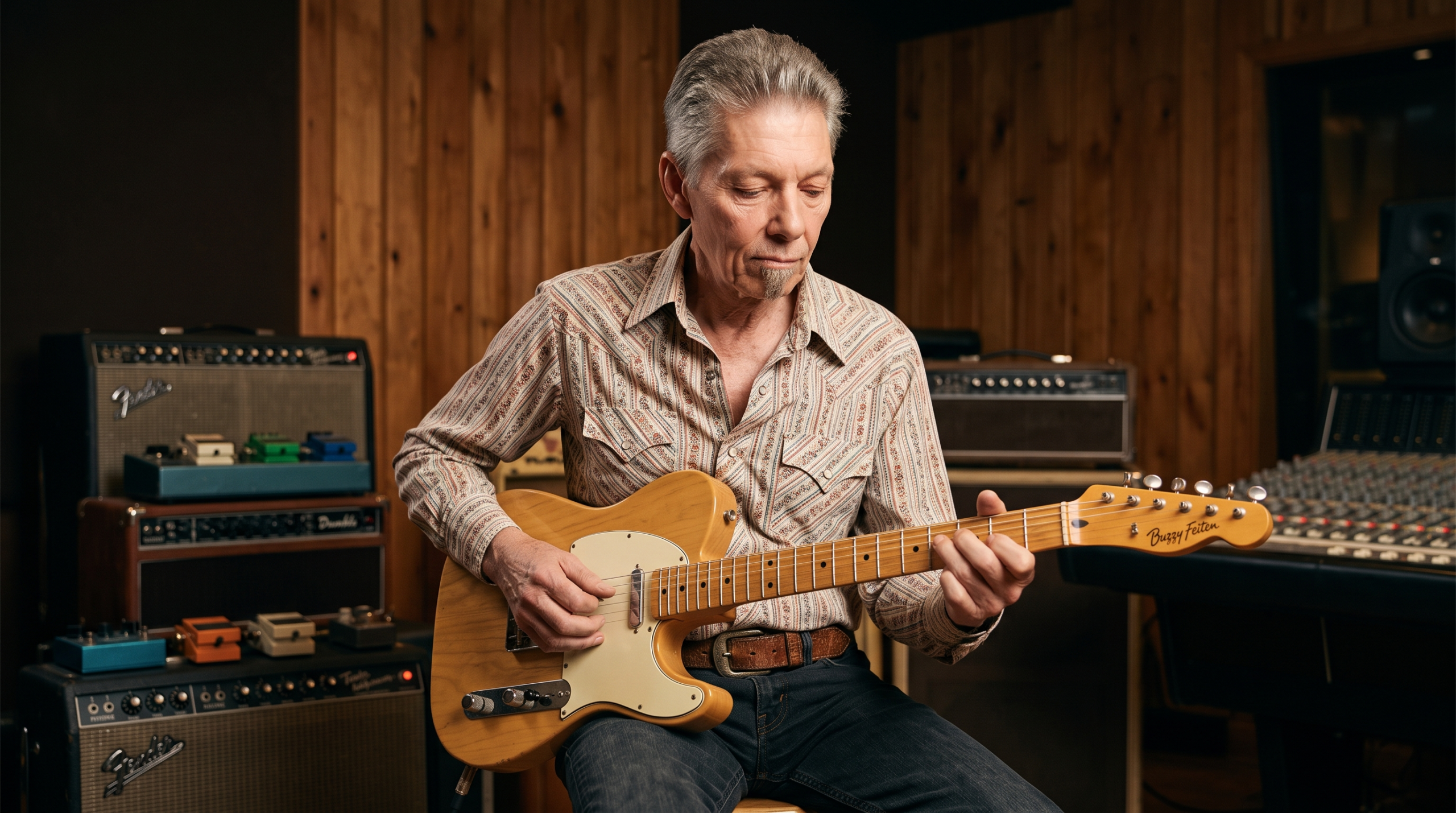
Explore Buzzy Feiten guitars gear and you find one of American music’s most quietly influential figures — a New York guitarist whose professional career has stretched from the late 1960s Rascals to Bob Dylan sessions to the Larsen-Feiten Band to a solo career, and who late in that career made a contribution to guitar technology that may outlast all of it: the Buzz Feiten Tuning System, a compensated nut and saddle arrangement that addresses the inherent intonation limitations of the equal-tempered guitar. Feiten is the guitarist whose credits span virtually every genre of American popular music, whose session work touched hundreds of recordings, and who ultimately cared enough about the guitar’s intonation to build a better solution to a problem most guitarists had simply accepted as unavoidable.
This guide covers Feiten’s complete equipment picture: the guitars he developed through his career and the specific modifications that led to the tuning system, the amplification that gave him his warm, versatile tone across radically different musical contexts, the effects chain he adapted to each situation, and the playing philosophy of a musician who brought jazz harmonic sophistication to rock and soul contexts with consistent musical intelligence. Understanding Buzzy Feiten’s gear is understanding how a professional musician’s relationship with his instruments can drive innovation that benefits the entire guitar community.
Background
Howard “Buzzy” Feiten was born on November 7, 1948, in New York City. His early musical development unfolded in New York’s extraordinarily rich musical environment of the 1960s — a city where jazz, R&B, rock, soul, and pop coexisted in a density of musical activity that shaped a generation of musicians who absorbed multiple traditions simultaneously. He came to the guitar through the R&B and rock influences that were transforming American popular music in the early 1960s, and his development included both formal training that gave him access to jazz theory and the informal education of playing in the real-world musical contexts that New York provided.
His professional career began in earnest when he joined the Young Rascals — the New Jersey-based blue-eyed soul and rock group — replacing Eddie Brigati’s brother David as guitarist. The Rascals were, by 1969, already one of the most successful acts in American pop music, with a string of Top 10 hits including “Good Lovin’,” “Groovin’,” and “People Got to Be Free.” Feiten’s contribution to their final period — appearing on the album See (1969) — gave him his first major commercial exposure and established his presence in the professional recording world.
The subsequent session career that Feiten built through the 1970s and 1980s was extraordinary in its breadth and quality. His credits include recordings with Bob Dylan, Paul Simon, Carly Simon, Bette Midler, Steely Dan, Joni Mitchell, Garth Brooks, and dozens of others — a range that demonstrates both the musical flexibility and the professional reliability that sustained session careers require. The specific demands of these diverse sessions — from Dylan’s folk-rock to Steely Dan’s jazz-influenced pop to Garth Brooks’ country — required Feiten to adapt his approach, his equipment, and his playing style to each context while maintaining the consistent quality that kept him in demand.
The Larsen-Feiten Band — formed with bassist Neil Larsen in the mid-1970s — gave him a context for his own compositional and playing voice, producing two albums that showed his jazz fusion approach in a commercial pop/rock context. The collaboration with Larsen, a keyboard player of exceptional range and musical intelligence, produced music that sat at the intersection of jazz, R&B, and rock in ways that the mainstream session context didn’t always allow.
The development of the Buzz Feiten Tuning System — initiated by his long-standing frustration with the guitar’s inherent intonation limitations — became one of the most significant contributions to guitar technology of the late twentieth century. The system, now licensed to many major guitar manufacturers and offered as an aftermarket modification, addresses the systematic intonation errors that result from the equal-tempered guitar’s design, producing instruments that play more consistently in tune across all positions of the neck. Feiten’s willingness to pursue this technical problem to a practical solution — and to make the solution available to the broader guitar community — reflects the same musical seriousness that has characterised every aspect of his career.
Buzzy Feiten Guitars Gear: The Complete Rig
Guitars
Buzzy Feiten’s guitar collection reflects the demands of a career that required genuine versatility — instruments chosen for specific tonal purposes across a range of musical contexts that included folk-rock, jazz fusion, R&B, country, and commercial pop. His instrument choices evolved alongside his career, and his relationship with specific guitars deepened through the technical understanding that the tuning system development provided.
His primary electric guitar through much of his career has been the Fender Stratocaster — an instrument whose versatility, reliability, and the specific range of tonal characters its three-pickup configuration provides made it ideal for the session contexts that dominated his professional life. The Stratocaster’s five-way pickup switching gives access to five distinct tonal characters — from the bright, cutting bridge pickup through the out-of-phase intermediate positions to the warm, full neck pickup — that cover the range of sounds required across different musical contexts without changing instruments.
His specific Stratocasters have been vintage late-1960s and early-1970s examples, chosen for the specific tonal character of the CBS-era instruments he prefers. The pickups in his Stratocasters — Alnico V single-coils measuring approximately 5.8k to 6.5k ohms DC resistance — have the specific combination of output and frequency response that suits the versatile session context: not so hot that they saturate the amplifier on clean passages, not so light that they lack authority in driven contexts. The Stratocaster’s alder body and maple neck contribute the specific combination of brightness and warmth that makes it effective across such a wide range of amplifier and gain settings.
All of his guitars have been modified with the Buzz Feiten Tuning System — the compensated nut and saddle arrangement that corrects the systematic intonation errors inherent in the standard guitar design. The standard guitar is built around a compromise: equal temperament requires all semitones to be equal in size, but the physics of string vibration — the way strings go slightly sharp when pressed to the fret — means that the notes in the first few positions of the neck are systematically sharp relative to the notes higher up the neck. Standard tuning procedure (tune open strings to a reference pitch, set intonation at the 12th fret) cannot correct this because the error occurs differently at each fret position. The BFTS compensates by modifying the nut position (pushing the nut slightly toward the bridge) and by using specific saddle compensation for each string, producing an instrument that plays more consistently in tune across all positions.
He has also used Gibson ES-335 semi-hollow guitars extensively — the warm, resonant character of the ES-335’s semi-hollow construction providing a different tonal dimension from the Stratocaster’s solid-body brightness. The ES-335 with PAF-spec humbuckers (7.5k to 8.5k ohms, Alnico II or Alnico V) suits the jazz and R&B contexts in his session work where a warmer, more sustained tone is more appropriate than the Stratocaster’s single-coil clarity. His ES-335 instruments have also been fitted with the BFTS, giving them the same intonation advantages as his Stratocasters.
A Gibson Les Paul appeared in his session arsenal for specific contexts requiring the warmth and sustain of mahogany construction and humbucker pickups. The Les Paul’s longer sustain and denser midrange character suited rock and R&B contexts where the ES-335’s semi-hollow warmth was appropriate but where additional sustain and body were required. The Les Paul’s PAF-style humbuckers, in both vintage and reproduction configurations, provided the specific warm, dynamic tone that blues and rock-influenced sessions required.
String gauges for Feiten run medium — typically .010–.046 on the Stratocaster and similar on the Gibson instruments — appropriate for the range of playing styles his session work requires. The string gauge interacts specifically with the BFTS modification: the compensation values in the system were calibrated for specific string gauges, and changing string gauge requires corresponding adjustment of the nut and saddle positions.
Amps
Buzzy Feiten’s amplification philosophy reflects the session musician’s fundamental priority: clean, warm, transparent amplification that can serve multiple musical contexts without imposing a specific tonal character that conflicts with the production requirements of different sessions. His amplifier choices have been consistently oriented toward American designs that provide clean headroom and natural warmth rather than the more character-specific British designs that suit specific tonal goals.
His primary amplifier has been the Fender Twin Reverb — the 85-watt, 2×12 combo running two 6L6 output valves, with the clean headroom and warm American character that served his session work consistently across multiple decades. The Twin’s ability to remain clean at high stage volumes — a practical necessity in session recording where the guitar signal needs to be clear and uncoloured — was a core professional requirement, and the Twin’s specific 6L6 character provided the warmth and low-end clarity that suited his versatile playing approach.
He has also used the Fender Deluxe Reverb — the smaller, 22-watt 6V6 combo — for specific studio and intimate performance applications where the Twin’s higher power was unnecessary or impractical. The Deluxe’s 6V6 character provides a slightly earlier saturation and a different quality of warmth from the Twin’s 6L6 — more compressed, with a rounder midrange — that suited specific session contexts where the Twin’s cleaner character was too pristine.
For specific jazz and fusion contexts where the warm, compressed character of all-tube clean amplification was appropriate, Feiten used Polytone amplifiers — the solid-state designs specifically engineered for jazz guitar amplification. The Polytone’s flat frequency response and clean, neutral character suited the jazz session context where the guitar’s natural acoustic character needed to be preserved rather than coloured by the amplifier’s own personality.
His rock and higher-gain session work employed Marshall JMP or JCM800 amplifiers — the standard British hard rock amplification that the EL34 output valve character and natural preamp gain provided. For sessions requiring the specific Marshall character — the midrange emphasis, the natural drive at working volumes, the specific quality of EL34 saturation — the Marshall remained the correct tool even for a player whose primary identity was in cleaner, more American-character amplification.
Effects
Feiten’s effects chain was adapted to each musical context rather than maintained as a fixed personal rig. Session musicians who work across wildly different musical styles necessarily approach effects as a variable rather than a constant — the effects appropriate for a Dylan folk-rock session are completely different from those appropriate for a Steely Dan jazz-pop session, and the discipline to recognise this difference and adapt accordingly is a professional skill as much as a musical one.
A wah pedal — the Dunlop Cry Baby in its standard configuration — was a consistent element of his rock and R&B session work, used for both conventional swept lead effects and as a fixed filter for tonal colouring. The Cry Baby’s inductor-based circuit produces the characteristic vocal vowel quality that his R&B and soul-influenced session work frequently required.
A Boss CE-2 Chorus Ensemble provided the dimensional quality for clean chord work — a particularly useful tool in the pop and R&B session contexts where a clean, full chord sound with some dimensional interest is frequently required. The CE-2’s bucket-brigade circuit produces a warmer, more organic chorus than digital alternatives.
An Ibanez Tube Screamer (TS-808 or TS-9) appeared in his chain for mild overdrive applications — the Tube Screamer’s JRC4558 op-amp circuit producing a smooth, mid-forward overdrive that complemented both the Stratocaster and the ES-335 in specific session contexts. For rock sessions requiring edge without heavy distortion, the Tube Screamer into a clean Fender amplifier produced exactly the right tonal character.
A delay pedal — the Boss DD series in later years, tape echo in the earlier period — provided spatial dimension for specific session applications. His delay use was subtle rather than prominent — a tool for adding depth and dimension rather than for creating obvious rhythmic echo effects.
A volume pedal allowed real-time dynamic control in session contexts where the production required precise management of guitar level relative to other instruments and the overall mix. For acoustic or semi-acoustic session work especially, the ability to fine-tune the guitar’s contribution to the overall sound without changing amplifier settings was practically essential.
Playing Style & Tone Philosophy
Buzzy Feiten’s playing is defined by the session musician’s virtues taken to their highest level: harmonic sophistication, tonal versatility, rhythmic precision, and the musical intelligence to identify what each specific musical context requires and deliver exactly that. These qualities are not glamorous in the way that a virtuoso soloist’s technical fireworks are glamorous, but they are as musically demanding and considerably rarer among musicians who genuinely possess them at the professional level.
His jazz training is the foundation of his harmonic vocabulary — the specific chord-scale relationships, the extended voicings, the chromatic approach notes and passing tones of the bebop and post-bop tradition that give his playing its harmonic interest regardless of the musical context. This jazz vocabulary, deployed in folk-rock, R&B, country, and commercial pop contexts, adds a harmonic sophistication that elevates the musical result above what players without jazz training would produce in the same contexts. The listener who doesn’t know jazz theory may not be able to articulate what makes Feiten’s playing more harmonically interesting than other session guitarists, but the musical effect is audible.
His rhythm playing — which constitutes the majority of his session work — is characterised by the specific quality of groove that distinguishes players who genuinely feel the music from those who merely execute it correctly. His chord voicings are chosen for both harmonic accuracy and rhythmic character: the specific voicing that produces the right rhythmic articulation for a specific musical passage is not always the simplest or most conventional choice, and Feiten’s ability to identify and execute the harmonically and rhythmically optimal voicing is central to the quality of his session contributions.
Tonally, his philosophy is the session musician’s philosophy: the right tone for the specific session, chosen with genuine musical judgment rather than applied from a fixed personal preference. The Stratocaster’s brightness for folk-rock and country; the ES-335’s warmth for jazz and R&B; the Les Paul’s sustain for rock; the specific amplifier and effects combination that serves each specific production. This contextual sensitivity — the ability to ask “what does this music need?” rather than “what is my tone?” — is the fundamental professional virtue that his career demonstrates.
The Buzz Feiten Tuning System: A Technical Revolution
The Buzz Feiten Tuning System deserves specific attention in any account of Feiten’s career because it represents a contribution to guitar technology that may ultimately be more lasting and more widely felt than his musical recordings. The system addresses a genuine acoustic problem that has existed since the guitar’s design was fixed in the nineteenth century, and its development reflects the same musical seriousness that characterises his playing career.
The problem the system addresses is this: the standard guitar is built so that the open strings, when correctly tuned to pitch, play sharp when fretted — because pressing the string to the fret increases its tension slightly, raising its pitch above the theoretical equal-tempered value. The standard compensation approach — setting the saddles to make the 12th-fret harmonic and the 12th-fret fretted note identical — corrects the intonation at the 12th fret while leaving significant intonation errors in the lower positions of the neck. This means that chords in the first five frets — where most guitar playing occurs — are systematically out of tune in ways that equal-tempered instruments other than the guitar don’t produce.
Feiten’s solution, developed in collaboration with luthiers over many years of experimentation, involves two modifications: a slightly different nut position (the nut is placed fractionally closer to the first fret than in standard guitar construction) and a specific saddle compensation for each string that is different from standard intonation procedure. The combination of these two adjustments produces an instrument that plays more consistently in tune across all positions of the neck, reducing the systematic intonation errors of standard guitar design without requiring any change in the player’s tuning approach or playing technique.
The BFTS is now licensed to numerous guitar manufacturers — Ibanez, Peavey, and others have incorporated it into production models — and is available as an aftermarket modification from various luthiers. Its adoption by a significant portion of the guitar manufacturing industry is the clearest possible acknowledgment of its musical validity, and it represents a contribution to the guitar community that goes well beyond Feiten’s personal career. A player who cared enough about intonation to spend years developing a better solution and then made that solution available to the wider community is performing a form of musical generosity that most players never consider.
How to Sound Like Buzzy Feiten
Guitar Approach
A Fender Stratocaster — preferably with the Buzz Feiten Tuning System installed — is the primary starting point. Medium strings (.010–.046) provide the appropriate balance of warmth and articulation for his versatile approach. Develop your chord vocabulary specifically from the jazz tradition: the extended voicings, the inversions, the specific chord types (major 7th, minor 7th, dominant 7th with extensions) that give his playing its harmonic sophistication. The BFTS modification on your guitar will immediately make your chord work more harmonically satisfying by correcting the systematic intonation errors of the standard guitar design.
The most important element is musical adaptability — the ability to identify what each specific musical context requires and to deliver that. This requires both broad musical knowledge (understand folk, rock, R&B, jazz, and country well enough to play in each) and the musical judgment to know which approach each specific piece of music needs. This adaptability is a form of musical intelligence that develops through wide listening and varied playing experience rather than through technical practice alone.
Amp Approach
A Fender Twin Reverb — or Deluxe Reverb for smaller applications — provides the clean, warm American amplification foundation. Run it clean: the Twin’s headroom and the Stratocaster’s single-coil output are balanced to produce warmth without distortion at normal session levels. Add the Tube Screamer for mild overdrive when the musical context requires edge, and the CE-2 chorus for dimensional quality in clean chord passages. Adapt the amplifier choice to the musical context: the Twin for folk and jazz, Marshall for rock, Polytone for pure jazz session work.
| Control | Setting | Notes |
|---|---|---|
| Volume | 4–6 | Clean headroom — Twin stays undistorted at moderate volumes |
| Treble | 5–6 | Moderate — Stratocaster single-coils are inherently bright |
| Middle | 5–6 | Moderate mids for chord voicing presence |
| Bass | 4–5 | Controlled bass for chord clarity |
| Reverb | 2–3 | Light spring reverb for spatial dimension |
| CE-2 Chorus | Light depth, medium speed | Subtle dimensional quality for chord work |
| Tube Screamer (optional) | Low gain, full tone | Mild overdrive for R&B and rock contexts |
Influence & Legacy
Buzzy Feiten’s legacy operates on two distinct levels that rarely intersect. His musical legacy — the recordings, the sessions, the playing across five decades of professional work — is substantial but largely invisible to casual listeners, as session musicians’ contributions typically are. His technological legacy — the Buzz Feiten Tuning System — is potentially more lasting and more widely distributed, affecting the intonation of guitars played by players who have never heard his recordings.
As a session guitarist, his work contributed to recordings that reached hundreds of millions of listeners without his name being attached to those contributions in any way that the average listener would recognise. This is the session musician’s fundamental condition: the music reaches people, but the credit does not. Within the professional musical community, however, his reputation has always reflected the genuine quality of his work — consistently called upon by major artists across multiple genres is a form of professional recognition that is more honestly earned than many forms of public fame.
The BFTS’s adoption by guitar manufacturers is the most visible and durable form of recognition his career has generated. When a guitarist plays a production guitar with BFTS intonation and finds that their first-position chords ring more in tune than they did on their previous guitar, they are benefiting from Feiten’s decades of work on the problem — whether or not they know the system’s name or its originator’s history. This invisible but genuine contribution to the quality of guitar playing broadly conceived is a form of legacy that few musicians achieve.
For players exploring the American session guitar tradition that Feiten represents at its highest level, the rigs of Waddy Wachtel — whose parallel session career in Los Angeles covered similar musical breadth with comparable quality — and Andy Fairweather Low, whose British session career shows a parallel development of musical versatility and professional excellence, provide essential comparison. The jazz foundation of his playing connects to Steve Khan‘s more explicitly jazz-oriented approach, showing how similar harmonic foundations can produce very different musical personalities in different professional contexts.
Session Life: What the Credits Don’t Tell You
The session musician’s life — the specific daily reality of Buzzy Feiten’s professional existence for much of his career — is worth examining in detail, because it shapes equipment choices, playing approach, and musical values in ways that the external view of the “studio guitarist” role often misses. A session is not simply a recording engagement; it is a complex social and musical situation that requires specific kinds of knowledge and specific kinds of discipline that most musicians never develop, because most musicians never need to.
The call comes, typically, the day before or the morning of the session. The guitarist is told the artist, the musical style, approximately what the material sounds like, and what equipment to bring. The preparation time is limited to whatever hours remain before the session begins. In this time, the session player reviews whatever information is available about the artist’s existing recordings and the specific character of the material being recorded, makes equipment decisions based on this review, and then arrives at the studio ready to contribute from the first take.
Feiten’s equipment choices for any specific session reflected this preparation process. The guitar was chosen based on what the musical style required: Stratocaster for the bright, articulate character of folk-rock and country; ES-335 for the warmer, more sustained character of jazz and R&B; Les Paul for the heavier, more sustained tone of rock. The amplifier was chosen based on the same analysis: Twin Reverb for American-character clean work; Marshall for British-character rock; Polytone for pure jazz. The effects chain was assembled from the elements that the specific musical context required and left out whatever wasn’t needed.
This preparation was not perfunctory — it reflected genuine musical knowledge and genuine musical judgment. Feiten’s ability to identify, in advance of the session, what equipment and approach a specific musical context required, was a skill developed through years of experience with a wide range of musical situations. A guitarist without this breadth of musical knowledge would have to guess, or would apply their personal default setup regardless of context — and the result would be less appropriate to the music than the correctly adapted approach.
The actual session then required the application of a different set of skills: the ability to read a chord chart accurately at sight, the ability to understand the producer’s direction and execute it immediately, the ability to listen to the rest of the musicians and integrate one’s playing with theirs rather than imposing a personal vision, and the physical consistency to play the same part correctly take after take until the producer had what was needed. These skills — real-time musical execution under specific professional requirements — are different from the skills of the bandleader or the solo artist, and they require specific development alongside the more visible musical skills of technique and harmonic knowledge.
Feiten’s decades of consistent employment as a session guitarist — being called back by major artists again and again — reflects the combination of all these skills at the professional level. The equipment was right; the playing was right; the musical judgment was right; the professional execution was right. The session musician’s version of success is this consistent re-employment, and by that measure, Feiten’s session career was one of the most successful in the history of American popular music recording.
The Dylan Connection: Folk-Rock and Beyond
Buzzy Feiten’s association with Bob Dylan — appearing on Dylan recordings in the 1970s — places him at one of the most historically significant intersections of American popular music, and his specific equipment choices for this context illuminate how a session musician’s approach adapts to a specific artist’s musical world.
Dylan’s recording approach in the 1970s was characterised by a specific combination of spontaneity and musical sophistication — sessions that sometimes captured first or second takes of arrangements that had been barely discussed in advance, with musicians drawing on their experience to create appropriate parts on the spot. For a session guitarist in this environment, the ability to make harmonically and stylistically appropriate choices immediately — without the extended arrangement discussions that more structured recording sessions allow — was essential.
The Stratocaster that Feiten brought to Dylan sessions was the right instrument for the musical context: Dylan’s folk-rock aesthetic was rooted in the American tradition that the Stratocaster’s tone and character suited perfectly. The clean Fender Twin amplification, warm but clear, complemented the acoustic and semi-acoustic character of the Dylan recordings without imposing a heavier or more processed character that would have been inappropriate. The specific chord voicings and rhythmic approaches Feiten used — drawing on his jazz harmonic knowledge while applying it in a specifically American rock and folk context — contributed to the recordings without calling attention to themselves.
The Dylan sessions also required a specific quality of musical responsiveness — the ability to follow Dylan’s spontaneous choices in real time, adapting to chord changes that might vary from take to take and responding to the specific emotional content of a given performance rather than simply executing a pre-determined part. This responsiveness — the jazz musician’s improvisational quality applied to a rock and folk context — was one of the specific things that Feiten’s jazz training provided and that his equipment setup had to support. A guitarist whose equipment required specific settings for specific gain levels couldn’t adapt as quickly to a spontaneous musical environment; Feiten’s clean, tonally neutral Twin Reverb setup gave him the flexibility to respond to any musical direction without equipment limitations constraining his choices.
The Intonation Problem: A Technical Deep Dive
The specific acoustic physics behind the problem that the Buzz Feiten Tuning System addresses deserves a more detailed examination than the brief overview in the Background section, because understanding the physics illuminates why the standard solution is inadequate and why Feiten’s solution works in ways that might not be immediately obvious.
When a guitarist frets a note, the string is pressed from its resting position down to the fretboard, increasing its tension and therefore its pitch above the theoretical equal-tempered value. The amount of pitch increase depends on the string’s gauge, the action height, and the specific fret position — in general, the first few frets produce more pitch increase than higher frets because the string has to travel further to reach the fret. This means that open-position chords — the first-position major and minor chords that constitute the foundation of most guitar playing — are systematically sharp relative to both the open strings and the notes played higher on the neck.
The standard intonation procedure — setting the saddle position so that the 12th-fret harmonic and the 12th-fret fretted note are identical — corrects for the average pitch increase across the full range of the neck, but it cannot correct the position-specific errors that occur at different fret positions. The BFTS’s solution is to modify the nut position so that the string’s starting position at the open end is slightly adjusted, changing the effective scale length in a way that compensates for the specific pitch increase at the lower fret positions. The saddle compensation values are then calibrated to produce consistent intonation across the full neck, given this modified nut position.
The result is not perfect intonation — no guitar playing system based on equal temperament can produce the just-intoned intervals that would be ideal for every chord in every key — but it produces significantly better intonation across the full range of guitar playing than the standard design allows. The improvement is most audible in first-position chord work, where the standard guitar’s systematic sharpness creates harmonic beating against other equal-tempered instruments; with the BFTS, these chords ring with more clarity and harmonic purity.
For Feiten as a session musician whose harmonic sophistication made him particularly sensitive to intonation quality, the BFTS was not merely a technical nicety but a genuine musical improvement that affected the quality of his harmonic contributions to every recording. The development of the system, and his decision to make it available to the wider guitar community, represents the application of a serious musician’s sensitivity to a genuine acoustic problem — and the result is a contribution to guitar playing that affects every player who uses an instrument with the system installed, whether or not they understand the physics behind it.
The interaction between the BFTS and the specific Stratocaster that Feiten uses is particularly interesting because the Stratocaster’s design — its specific scale length, its tremolo system’s influence on string tension, and the specific voicing of its single-coil pickups — creates specific intonation challenges that the BFTS addresses with greater practical benefit than it would on some other guitar designs. The Stratocaster’s 25.5-inch scale length produces slightly higher string tension than a Gibson’s 24.75-inch scale length at the same pitch and string gauge, which affects how much the string sharpens when fretted — a subtly different calibration of the BFTS values is required for the Stratocaster compared to shorter-scale instruments. Feiten’s decades of experience with Stratocasters, combined with his sensitivity to intonation as both a player and as the developer of the tuning system, gave him the specific knowledge to calibrate the system optimally for the instrument he used most. The BFTS as installed on a Stratocaster reflects not just the general acoustic principles of the system but the specific characteristics of this particular instrument — a calibration that could only be achieved by someone who knew both the physics and the specific instrument in the intimate, hands-on way that decades of professional playing provide. This specificity — the adaptation of a general principle to a particular instrument — is itself a form of musical and technical intelligence, and it is one more illustration of how Feiten’s career has been characterised by the application of genuine understanding rather than the acceptance of conventional practice.
Buzzy Feiten’s career is ultimately a case study in how genuine musical values — harmonic intelligence, professional discipline, technical curiosity, and the willingness to pursue a better solution to a real problem — can sustain a career of extraordinary range and consistent quality across six decades of professional work. The equipment he used to pursue these values: the BFTS-modified Stratocasters, the clean Fender amplification, the contextually adapted effects chain — was always chosen to serve specific musical requirements rather than to project a personal brand or to follow fashion. The recordings his name appears on, the sessions his guitar contributed to, and the tuning system that bears his name are all expressions of the same underlying values. In the Buzzy Feiten story, the gear and the music are inseparable, and both reflect a musician who has spent his career in genuine service to the highest musical standards he was capable of maintaining.
Frequently Asked Questions: Buzzy Feiten Guitars & Gear
What guitars does Buzzy Feiten play?
Buzzy Feiten’s primary electric guitar is the Fender Stratocaster — typically vintage late-1960s or early-1970s examples with Alnico V single-coil pickups. He also plays Gibson ES-335 semi-hollow guitars and Gibson Les Pauls for specific contexts requiring their different tonal characters. All his guitars are modified with the Buzz Feiten Tuning System — the compensated nut and saddle arrangement he developed to correct the guitar’s inherent intonation limitations.
What is the Buzz Feiten Tuning System?
The Buzz Feiten Tuning System is a guitar intonation modification developed by Feiten over many years of experimentation. It involves repositioning the nut slightly toward the first fret and using specific saddle compensation values for each string — different from standard intonation procedure — to correct the systematic intonation errors inherent in standard guitar design. The result is a guitar that plays more consistently in tune across all positions of the neck, particularly in the first five frets where standard guitar design produces systematic sharpness. The system is now licensed to numerous guitar manufacturers and available as an aftermarket modification.
What amp does Buzzy Feiten use?
His primary amplifier for most session and live work is the Fender Twin Reverb — the 85-watt, 2×12 combo with 6L6 output valves and Jensen speakers, providing clean, warm American-character amplification. He also uses the smaller Fender Deluxe Reverb for specific applications, Polytone amplifiers for jazz session work, and Marshall JMP or JCM800 heads for rock session contexts requiring British EL34 character.
What sessions is Buzzy Feiten known for?
Feiten’s session credits span an extraordinary range: Bob Dylan, Paul Simon, Carly Simon, Bette Midler, Steely Dan, Joni Mitchell, Garth Brooks, and many others. He was also part of the Young Rascals for their final period (appearing on the 1969 album See). The breadth of his session discography — spanning folk-rock, jazz-pop, R&B, country, and commercial pop — reflects the genuine musical versatility and professional reliability that sustained a decades-long session career.
What effects does Buzzy Feiten use?
His effects chain is adapted to each musical context. Consistent elements include a Dunlop Cry Baby wah pedal (for R&B and rock contexts), a Boss CE-2 Chorus Ensemble (for clean chord dimensional quality), an Ibanez Tube Screamer (TS-808 or TS-9, for mild overdrive), a Boss DD delay (for spatial dimension), and a volume pedal (for dynamic control in session work). His effects use is musical and context-specific rather than fixed.
What was the Larsen-Feiten Band?
The Larsen-Feiten Band was a jazz fusion and pop duo formed by Feiten with bassist and keyboard player Neil Larsen in the mid-1970s. The band recorded two albums that showed their specific fusion of jazz harmony, R&B groove, and commercial pop accessibility in a context that allowed more personal musical expression than their individual session work permitted. The collaboration with Larsen — whose keyboard sophistication complemented Feiten’s guitar harmonic intelligence — produced music of genuine quality that demonstrated the full extent of both players’ abilities.
Why should guitarists care about intonation beyond standard tuning?
The standard guitar’s intonation, even when correctly set by conventional methods, produces systematic sharpness in the first-position chords that most guitar playing relies on. This systematic error is subtle enough that individual players often habituate to it — their ear adjusts to the guitar’s specific intonation profile — but it creates genuine harmonic beating against other equal-tempered instruments and voices, reducing the overall intonation quality of ensemble performance. The Buzz Feiten Tuning System addresses this fundamental limitation, producing an instrument that sounds more harmonically pure in ensemble contexts. For any guitarist who cares about the quality of their harmonic contribution to music — which should be all of them — understanding and addressing this intonation issue is musically important.
Genre:
Session / Rock / Jazz Fusion
Decades:
1960s | 1970s | 1980s | 1990s | 2000s | 2010s
Related stories
Sylvain Sylvain Guitars & Gear: The Complete Guide to the New York Dolls’ Gretsch, Les Paul Junior & Automatic Guitar Proto-Punk Rig
Sylvain Sylvain guitars & gear: New York Dolls guitarist. Les Paul Junior 'automatics', Gretsch Golden Anniversary, white Les Paul Custom stolen by Steve Jones — proto-punk tone.

Ted Nugent Guitars & Gear: The Complete Guide to the Motor City Madman’s Byrdland Rig
Ted Nugent guitars & gear: the Motor City Madman's Byrdland rig. 12 vintage Gibson Byrdlands, Fender Twin Reverbs, Peavey 6505, zero effects, and the Stranglehold tone.
Ted Turner Guitars & Gear: The Complete Guide to Wishbone Ash’s Twin Guitar Pioneer’s Rig
Ted Turner guitars & gear: Wishbone Ash's twin-lead pioneer. Stratocasters, Firebird, Orange amps, and the Argus-era tone fully explained.