
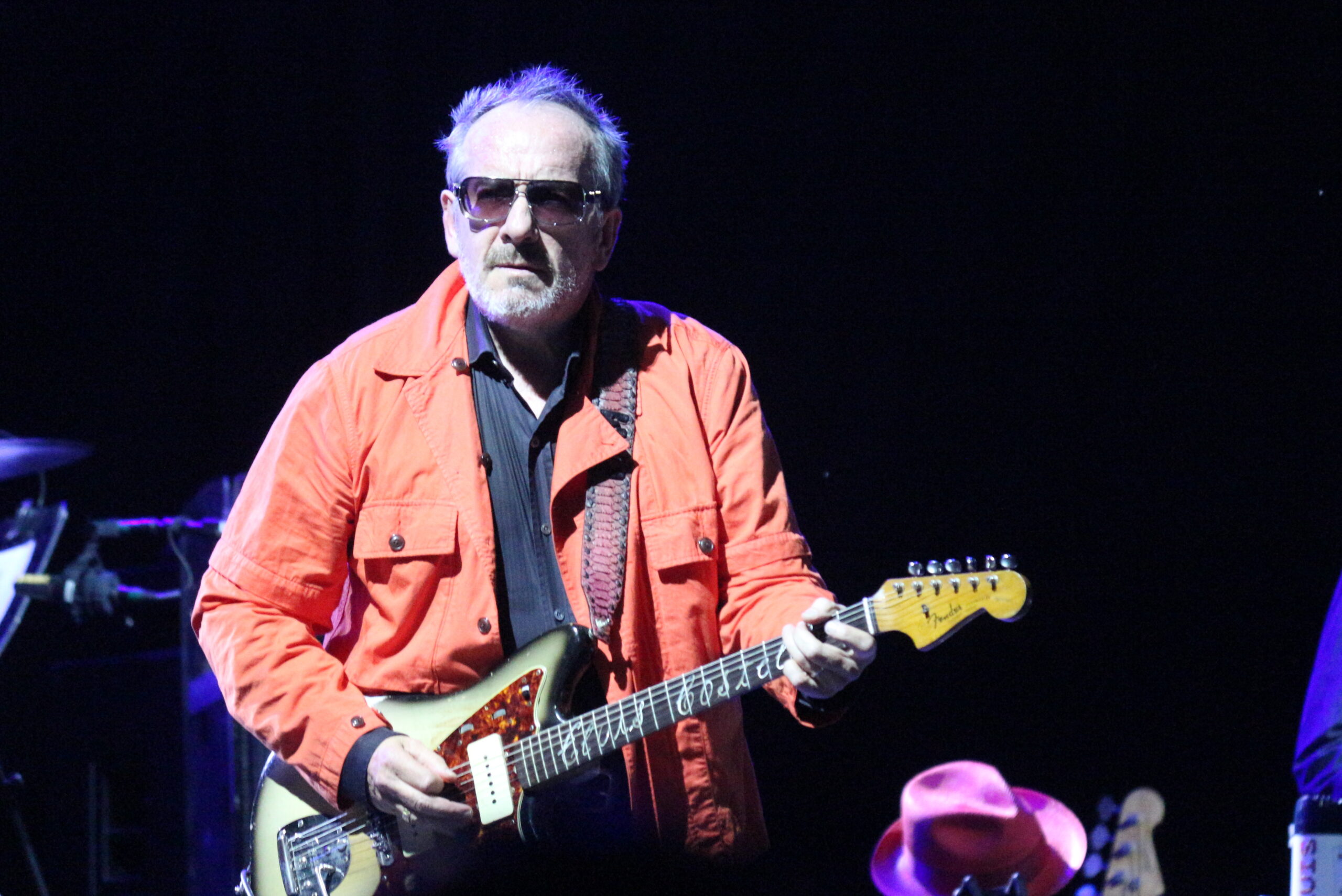
Examine Elvis Costello guitars gear and you enter the equipment world of one of British rock’s most intellectually restless and most stylistically adventurous musicians — a Liverpool-raised singer-songwriter who emerged from the punk and new wave moment of 1977 with a voice, a guitar, and an intelligence that could not be contained by any single genre, and who has since moved through punk, new wave, pop, country, classical, jazz, chamber pop, and everything in between with the facility of a musician for whom style is a language rather than a limitation. Costello’s guitar playing has never been the primary focus of discussion about his career — the songs, the voice, and the intelligence that inhabits both have always commanded more attention — but his guitar work across fifty years of recording has been consistently intelligent, sometimes brilliant, and always exactly right for whatever music he was making at any specific moment.
This guide covers Costello’s complete equipment picture: the Jazzmaster and other guitars that defined his visual and tonal identity, the amplification he used across wildly different musical contexts, his approach to effects, and the playing philosophy of a musician who has always understood that the guitar’s role is to serve the song’s vision rather than to demonstrate the guitarist’s ability. Understanding Elvis Costello’s gear is understanding how stylistic range is enabled by genuine musical knowledge rather than by abandoning one’s identity.
Background
Declan Patrick MacManus was born on August 25, 1954, in London, England, to parents who were themselves involved in music — his father Ross MacManus was a professional musician who played trumpet in the Joe Loss Orchestra. Growing up in London and Liverpool gave him exposure to the full range of British musical culture of the 1960s and early 1970s, and the musical intelligence he developed reflected both his direct cultural formation and the broader musical education that a musician’s household provides.
He adopted the stage name Elvis Costello — partly in homage to Elvis Presley and partly as a deliberate provocation — when he signed to Stiff Records in 1977. The debut album My Aim Is True (1977) was recorded with American country rock band Clover rather than with Costello’s own band, giving it a different character from the more punk-adjacent sound of the subsequent Attractions recordings. The Attractions — keyboardist Steve Nieve, bassist Bruce Thomas, and drummer Pete Thomas — became the primary vehicle for his musical personality through the late 1970s and 1980s, and the specific interplay between Costello’s guitar and Nieve’s keyboard was a defining element of the band’s sound.
The first three Attractions albums — This Year’s Model (1978), Armed Forces (1979), and Get Happy!! (1980) — established Costello as one of the most musically sophisticated and most lyrically inventive artists to emerge from the new wave moment. Each album showed a different facet of his musical range while maintaining the essential character of his musical personality: the wordplay, the emotional intelligence, the harmonic sophistication, and the physical energy of a performer who understood that intelligence and urgency were not opposites. Subsequent albums showed his range more fully: the country explorations of Almost Blue (1981), the baroque pop of Imperial Bedroom (1982), the string-quartet collaborations, the orchestral recordings, and the jazz and Burt Bacharach projects all showed a musician for whom stylistic boundaries were invitations rather than limits.
Elvis Costello Guitars Gear: The Complete Rig
Guitars
Elvis Costello’s guitar identity is more visually than tonally distinctive — the specific image of him with a Jazzmaster or a hollow-body guitar has been as central to his visual identity as any tonal characteristic, and his guitar choices have always reflected a combination of practical musical requirements and the specific desire for instruments that looked appropriate for the musical character he was projecting.
His most iconic instrument is the Fender Jazzmaster — the offset-waist solidbody that Fender introduced in 1958 and that has maintained a specific cultural association with the surf rock and then the indie and alternative rock traditions that Costello’s early visual identity connected to. The Jazzmaster’s specific construction — the offset body, the floating tremolo and lock-out system, the dual-circuit pickup configuration — gives it a tonal and mechanical character quite different from both the Stratocaster and the Telecaster. Its rhythm circuit (a separate switch-activated pickup and tone configuration for chord work) and lead circuit (the conventional pickup selector for lead playing) gave a wider tonal range than either of the other Fender solidbody designs.
The Jazzmaster pickups — single-coil units wider and flatter than the standard Stratocaster or Telecaster designs, measuring approximately 8k ohms DC resistance with Alnico V magnets — produce a specific sound: warmer than a Stratocaster but less warm than a Telecaster neck pickup, with a specific smooth, rounded quality that distinguished them from the more cutting character of narrower single-coil designs. This specific character — not quite the Stratocaster’s quack, not quite the Telecaster’s twang, but something smoother and warmer — suited Costello’s approach to guitar playing, which was less aggressive and more texturally varied than either of those instruments’ primary associations.
His early career use of a Fender Mustang — the shorter-scale-length student guitar that Fender introduced in 1964 — reflected both practical (it was affordable when he was starting out) and aesthetic considerations (its specific visual character suited the deliberately provocative image he was cultivating). The Mustang’s 24-inch scale length produced a different string tension from the standard 25.5-inch Fender scale, giving the instrument a slightly different playing feel and a somewhat different tonal character from the Jazzmaster.
He has used Gibson ES-335 and other Gibson semi-hollow instruments for material requiring the warmth and acoustic resonance that solid-body Fender designs don’t provide. The harmonic sophistication of albums like Imperial Bedroom and the jazz and chamber music recordings required an instrument with more acoustic dimension and warmth than the Jazzmaster’s solid body could generate.
Various acoustic guitars — both steel-string and classical — appeared across the folk, country, and singer-songwriter material in his catalogue, with specific instruments chosen for their acoustic character relative to the specific recording’s requirements.
String gauges ran light — typically .010–.046 or lighter — appropriate for the rhythm-focused guitar work that dominated his Attractions-period playing, and for the chord-based approach that served the songs without competing with Nieve’s keyboards for the harmonic foreground.
Amps
Costello’s amplification has been as varied as his musical approach — different amplifiers for different musical contexts, with no single consistent choice that served the full range of his stylistic explorations.
His primary amplifier during the Attractions period was a Vox AC30 Top Boost — the EL84-driven combo whose chimey, compressed character suited both the new wave energy of the early records and the more melodically oriented playing of the later Attractions work. The AC30’s natural compression gave sustained chords their specific bloom, and its upper-midrange emphasis gave the Jazzmaster’s warmer single-coils some additional definition and presence that suited Costello’s chord-heavy rhythm guitar approach.
He has also used Fender amplifiers — particularly the Twin Reverb and the Deluxe Reverb — for cleaner, more American-character work. The country explorations of Almost Blue and the later Americana-influenced material required the warm, clean American character of Fender 6L6 amplification rather than the chimey British character of the AC30.
For the harder-rocking material in his catalogue, Marshall amplifiers provided the more aggressive British EL34 character that the energetic early new wave recordings sometimes required.
Effects
Costello’s effects use has been characteristically restrained — consistent with a musician whose primary musical tools were always the voice and the song rather than sonic complexity generated by elaborate signal chain processing.
A Boss CE-2 Chorus Ensemble appeared in his early period for the dimensional shimmer that added texture to chord playing — the chorus’s specific bucket-brigade character complementing the Jazzmaster’s smooth pickup character to produce a specific atmospheric quality that suited the more melodically oriented material in the Attractions catalogue.
Various overdrive pedals — the Ibanez Tube Screamer and similar units — provided smooth front-end boost for passages requiring more drive than the clean Vox or Fender amplification naturally provided. His use of overdrive was selective and musical rather than constant — the clean amplifier character was the primary tonal identity for most material, with drive added when the musical context specifically required it.
A delay pedal for atmospheric depth on specific passages, and the Vox AC30’s onboard tremolo (which the specific Top Boost models provided through a separate circuit) for specific material where tremolo added appropriate rhythmic dimension. His effects use in all cases was purposeful rather than habitual.
Playing Style & Tone Philosophy
Elvis Costello’s guitar playing is defined by the songwriter’s priorities — every technical choice, every tonal decision, and every equipment selection is evaluated by its contribution to the song’s specific requirements rather than by its intrinsic interest as guitar playing. This orientation, which he has maintained consistently across fifty years of stylistic exploration, gives his guitar work a specific quality of appropriateness that distinguishes it from guitar playing that pursues its own technical or tonal logic independently of the song’s needs.
His rhythm playing with the Attractions showed a player whose primary concern was harmonic support and rhythmic energy rather than individual technical display. The specific voicings he used — informed by his harmonic knowledge and his understanding of the relationship between guitar and keyboard in the Attractions’ dual-chord context — complemented Nieve’s keyboard harmonies without duplicating them. This complementary relationship required genuine harmonic intelligence: knowing what Nieve was playing and choosing guitar voicings that added harmonic dimension rather than cluttering the frequency space the keyboard already occupied.
His chord voicings across the range of his musical explorations showed the breadth of his harmonic knowledge — from the simple power chord energy of the most punk-adjacent material through the sophisticated jazz and classical voicings of the chamber music recordings. Each harmonic vocabulary was genuinely absorbed rather than superficially borrowed, reflecting the deep musical intelligence that has always been the foundation of his work.
Tonally, his philosophy has been consistent despite the apparent chaos of his stylistic explorations: the right instrument for the right song, amplified appropriately for the musical character being pursued, with effects added only when they contribute something specific and musically necessary. The Jazzmaster for new wave visual and sonic identity, the Gibson for jazz and chamber warmth, the acoustic for folk and country material, the AC30 for British chimey character, the Fender for American clean warmth. The equipment followed the music; the music followed the vision; and the vision was always clear even when the specific stylistic territory was unfamiliar.
How to Sound Like Elvis Costello
Guitar Approach
A Fender Jazzmaster — vintage or current production — is the most appropriate starting point for the early Attractions-period material that most people associate with Costello’s guitar identity. Light strings (.010–.046 or lighter) for the rhythm-focused chord work that dominated his Attractions playing. The rhythm circuit is a specific element of the Jazzmaster that many players ignore — experiment with it for the warmer, more muted character that Costello sometimes used for chord work.
The most important element is the harmonic vocabulary — the specific chord voicings and the understanding of how guitar harmonies interact with keyboard harmonies in a dual-chord context. Study the Attractions recordings closely for the specific chord choices and the specific way those choices complemented rather than competed with Nieve’s keyboard work.
Amp Approach
A Vox AC30 Top Boost is the most authentic amplifier for the Attractions-period material. The EL84 natural compression and chimey upper-midrange give the Jazzmaster its specific character in that context. For country and Americana material, switch to a clean Fender Twin or Deluxe. The effects chain is minimal — the CE-2 chorus for atmospheric shimmer on chord passages, selective overdrive when the musical context requires it.
| Control | Setting | Notes |
|---|---|---|
| Volume (Top Boost) | 5–6 | Natural EL84 compression — the core of the Attractions guitar tone |
| Treble | 7 | High — Jazzmaster’s warm pickups need treble presence |
| Bass | 3–4 | Controlled — the keyboard occupies the low midrange territory |
| Tone Cut | 5 | Neutral — don’t cut the treble that makes the Jazzmaster sing |
| CE-2 Chorus | Light, slow sweep | Subtle shimmer for chord passages |
| Tremolo (AC30 onboard) | Moderate depth, medium rate | For specific material drawing on surf and early rock references |
Influence & Legacy
Elvis Costello’s influence on British and American popular music is so pervasive and so varied that it defies single-sentence summary. In the new wave tradition specifically, his combination of lyrical intelligence, musical sophistication, and physical energy established a model for what new wave could be beyond the three-chord nihilism of punk’s most reduced manifestation. The Attractions recordings — particularly This Year’s Model, Armed Forces, and Imperial Bedroom — showed a standard of musical and lyrical craft that influenced the entire subsequent generation of British songwriters who came of age in the 1980s.
His Jazzmaster — more than any other single piece of equipment — became one of the defining visual icons of the new wave era, and its subsequent adoption by indie and alternative rock musicians through the 1980s and 1990s (Sonic Youth’s Thurston Moore and Lee Ranaldo, Kurt Cobain, J Mascis of Dinosaur Jr.) reflects in part the cultural weight that Costello’s association with the instrument gave it. The Jazzmaster’s current status as one of the most sought-after alternative rock guitars is not entirely traceable to Costello’s influence, but his early prominent use of it contributed to the cultural associations that made it attractive to subsequent generations of musicians seeking to connect with the new wave aesthetic he helped define.
His influence on country music — through Almost Blue and subsequent explorations of the Americana tradition — introduced his aesthetic to audiences who might not have encountered his work through the new wave mainstream, and his collaborations with country artists showed the tradition’s own musicians that crossover from the rock world could serve the music rather than exploit it. His respect for the country tradition — evidenced by his evident knowledge of and love for the music — gave his country explorations an authenticity that purely commercial crossover attempts couldn’t achieve.
For players exploring the British new wave and post-punk tradition that Costello helped define, the rigs of Dave Edmunds — whose Rockpile work overlapped with Costello’s early career and shared the same broad musical reference points from a slightly different stylistic angle — and James Honeyman-Scott, whose Pretenders work showed how similar influences produced different but equally sophisticated musical personalities, provide illuminating comparison. The country dimension of his work connects to Junior Brown‘s approach, which shows how authentic country guitar playing requires the same depth of cultural knowledge that Costello brought to his country explorations.
This Year’s Model: Guitar in a Keyboard-Led Band
This Year’s Model (1978) — the first Attractions album and arguably Costello’s most energetically compelling record — is particularly instructive for understanding how his guitar approach was shaped by the specific presence of Steve Nieve’s keyboards in the band. The Attractions were not a typical rock band where guitar and keyboard played complementary but separate roles; they were an ensemble where the keyboard was as harmonically central as the guitar, and where the guitar’s role was specifically defined in relation to that keyboard centrality.
Nieve’s keyboard approach — drawing on classical training and an extraordinary facility with complex harmony — occupied much of the harmonic space that guitar would normally fill in a less keyboard-centric band. His chord voicings were dense and sophisticated; his melodic contributions were prominent; his harmonic authority was substantial. In this context, Costello’s guitar had to find a role that added something to the musical picture rather than duplicating what Nieve was already providing.
The solution was to use the guitar primarily as a rhythmic and textural instrument rather than as a primary harmonic voice — to provide rhythmic drive, physical energy, and specific tonal colour that the keyboard’s inherent character didn’t produce, rather than to provide additional harmonic content that Nieve’s playing already covered comprehensively. This required both genuine harmonic knowledge (to know what Nieve was playing and to choose guitar voicings that complemented rather than duplicated it) and the specific discipline to resist the temptation to fill every available harmonic space with guitar.
The Jazzmaster’s specific character suited this role — the instrument’s warm, slightly rounded single-coil tone provided rhythmic drive without the aggressive cutting character that would have competed with Nieve’s keyboard in the upper midrange. The AC30’s natural compression gave chords their specific bloom and sustain without the amplifier dominating the overall sound. The guitar’s role on This Year’s Model — propulsive, energetic, rhythmically central, harmonically supportive rather than harmonically leading — was achieved through the specific combination of Jazzmaster, AC30, and the playing approach that understood the specific musical role that combination needed to serve.
Almost Blue: Country Crossover and Equipment Adaptation
Almost Blue (1981) — the album of country covers produced by Billy Sherrill in Nashville — is perhaps the most striking single document of Costello’s willingness to subordinate his established musical identity to the requirements of a completely different tradition. The album was recorded in Nashville with Nashville session musicians, using Nashville studio approaches, and the guitar work it required was nothing like the Jazzmaster-and-AC30 approach of the Attractions recordings.
For the Nashville sessions, Costello adapted his equipment and approach to the requirements of the country tradition rather than imposing his existing approach on a different musical context. The Telecaster’s country credentials — the instrument most closely associated with the Nashville studio sound through its use by players like James Burton and Don Rich — made it more appropriate than the Jazzmaster for the country material. Fender amplification rather than the Vox provided the American clean character that Nashville country production required. The playing technique shifted from the rhythmic, chord-heavy Attractions approach toward the specific flatpicking and chicken-picking techniques of country lead and rhythm guitar.
This adaptation — changing specific equipment and technique to serve the musical tradition being explored — reflected the same intelligence that characterised all of Costello’s stylistic explorations: genuine engagement with the tradition rather than superficial stylistic borrowing. The country recordings worked not because Costello imposed his new wave identity onto country music but because he genuinely engaged with country’s specific requirements, learning what the tradition required and attempting to deliver it with authentic understanding.
Billy Sherrill’s production approach — the lush, orchestrated Nashville sound that was Sherrill’s specific signature — was itself a new technical and aesthetic context for Costello, and his willingness to work within it (rather than insisting on the more sparse, guitar-forward approach of his own recordings) showed the artistic humility that allowed the project to succeed on its own terms rather than merely as a curiosity. The equipment he used in this context was a visible expression of this humility: not the Jazzmaster that announced his own identity but the Telecaster that announced his engagement with the tradition he was entering.
Imperial Bedroom: Harmonic Sophistication and Guitar’s Changing Role
Imperial Bedroom (1982) — widely considered Costello’s artistic peak and one of the most harmonically sophisticated British pop records of the 1980s — presented a very different challenge for the guitar than either the new wave energy of This Year’s Model or the country authenticity of Almost Blue. The album’s complex, layered arrangements — produced by Geoff Emerick, who had worked with the Beatles — incorporated orchestral elements, intricate keyboard work, and specific guitar textures that served the harmonic ambition without dominating it.
The guitar on Imperial Bedroom was frequently processed and layered in ways that the more direct Attractions recordings didn’t employ — the complexity of the arrangements permitted and required a more compositionally sophisticated approach to guitar texture rather than the rhythmically assertive, harmonically supportive approach of the live Attractions sound. The specific guitar tones on the record — sometimes clean, sometimes lightly processed, sometimes heavily layered — served the specific harmonic and atmospheric requirements of individual tracks rather than maintaining a consistent guitar identity across the album.
The Gibson ES-335 or similar semi-hollow instruments that appeared on specific tracks provided the acoustic warmth and resonance that the complex harmonic arrangements required — the hollow body’s acoustic dimension adding a quality of natural warmth to chord work and sustained notes that solid-body instruments don’t produce. For the more orchestrally conceived passages on the album, this warmth and acoustic resonance allowed the guitar to blend into the overall texture rather than standing in front of it.
Understanding Imperial Bedroom‘s guitar approach requires understanding that Costello and Emerick’s production was prioritising the overall harmonic and emotional experience rather than any individual instrument’s prominence or character. The guitar served this priority by being present where it added something and absent (or very much in the background) where it didn’t. This compositional discipline — knowing when to contribute and when to step aside — required the same genuine harmonic intelligence that made the overall record so musically distinguished.
The Jazzmaster’s Appeal: Visual and Acoustic
The Fender Jazzmaster’s specific visual character — the offset body, the floating tremolo, the specific control layout with its rhythm circuit switch and disc-shaped tone and volume knobs — was as much part of its appeal for Costello as its acoustic properties. In the photograph-heavy world of early new wave promotion, where the visual character of a musician’s equipment was part of their overall artistic statement, the Jazzmaster’s slightly eccentric, slightly vintage appearance suited the image Costello was cultivating: intelligent, musically literate, slightly ironic in the choice of an instrument associated with surf rock rather than the British rock that was his actual cultural context.
The Jazzmaster’s acoustic properties — the specific warmth of its wide, flat single-coil pickups, the floating tremolo’s distinctive feel (different from both the hard-tail stop tailpiece of the Telecaster and the spring-loaded vibrato of the Stratocaster), and the dual-circuit configuration’s specific tonal versatility — added specific musical values alongside the visual character. The warmth of the Jazzmaster pickup suited Costello’s chord-focused rhythm playing by providing a rounder, less cutting character than the Telecaster’s bridge single-coil would have produced. The floating tremolo’s feel under the right hand — slightly springier and more variable in response than the hard-tail Telecaster — gave the instrument a specific playing character that affected how chords were strummed and how single notes were articulated.
The Jazzmaster’s association with Costello has been one of the most consequential instrument-musician associations in the history of alternative rock — not because Costello was the first or the most influential Jazzmaster player (Leo Fender’s original surf rock design intent was quite different from anything Costello did with the instrument) but because his early-career prominence at the specific cultural moment when new wave was establishing its visual identity gave the instrument a specific alternative rock associations that it has maintained for the decades since. Every indie rock guitarist who has adopted the Jazzmaster as their primary instrument has, at some level, been responding to the cultural weight that Costello’s use of it created — which is ultimately a testament to the specific power of the image he projected in those early career photographs, and to the specific fit between his musical identity and the instrument’s visual character.
The Steve Nieve dimension of Costello’s guitar approach — how the presence of an extraordinarily gifted keyboard player shaped what the guitar was and wasn’t allowed to do in the Attractions context — is one of the more interesting case studies in how band configuration shapes individual instrument roles. Nieve’s technical facility and harmonic sophistication were such that his keyboard often occupied the harmonic and melodic foreground that guitar would typically claim in a more conventional rock band context. This created a specific challenge for Costello’s guitar: how to remain musically present and essential while ceding the harmonic and melodic foreground to the keyboard.
The solution — rhythmic and textural guitar playing that supported and energised the overall ensemble without competing for the harmonic foreground — required specific playing choices and specific equipment choices. The Jazzmaster’s warm, rounded character allowed it to provide rhythmic drive without the cutting brightness that would have competed with Nieve’s keyboard in the upper midrange. The AC30’s natural compression gave chord work a specific energy and presence that complemented rather than duplicated the keyboard’s sustain. The playing approach — focused on rhythmic conviction and textural variety rather than on harmonic elaboration — filled the specific musical role the Attractions context required.
The broader lesson in this specific dynamic is that the best guitar playing in an ensemble context is always defined by the specific musical role the ensemble creates for the guitar rather than by an abstract standard of what guitar playing should be. A guitar part that would be ordinary in isolation can be musically essential in the right ensemble context; a guitar part that would be impressive in isolation can be musically redundant in a context where another instrument is already providing what it offers. Costello’s understanding of this principle — evident in the specific choices he made with the Jazzmaster in the Attractions context, with the Telecaster in the country context, with the semi-hollow in the orchestral context — is one of the most consistent expressions of genuine musical intelligence in his fifty-year career. The gear followed the music; the music followed the vision; and the vision was always clear about what role the guitar was supposed to play.
Elvis Costello’s continuing creative vitality — his capacity for genuine musical surprise after five decades of professional work — reflects a musician whose relationship with the guitar and with music-making generally has remained genuinely alive rather than becoming merely habitual. The Jazzmaster through the AC30 that defined his visual and tonal identity at the beginning of his career is still part of his equipment toolkit, but it has been joined over the decades by a range of instruments and amplifiers that reflect the expanding musical territory he has continued to explore. The equipment serves the music; the music serves the vision; and the vision continues to seek new territory without abandoning the musical intelligence and the genuine craft that have always been its foundation. That combination — restless exploration and genuine craft — is ultimately the defining characteristic of Elvis Costello’s career, and his guitar playing and equipment choices have expressed it consistently across every musical territory he has explored.
The Fender Mustang that Costello used in his earliest professional appearances — before the Jazzmaster became his primary instrument — is worth noting as an example of how practical constraints can produce aesthetically appropriate choices. The Mustang, with its 24-inch short scale length, was significantly cheaper than either the Jazzmaster or the Stratocaster on the used market of the mid-1970s, which made it accessible to a musician who was not yet commercially successful. But the practical constraint of cost led to an instrument whose specific character — the shorter scale’s different string tension, the Mustang’s specific pickup character, its compact physical size — suited the developing Costello image in specific ways. The Mustang’s compact, slightly toy-like appearance contrasted with the physical imposingness of the instrument he was playing it through (typically a Marshall or similar powerful amplifier), creating a visual tension that suited the intellectual-provocateur image he was cultivating. The budget instrument played through professional amplification, delivering music of genuine sophistication — the combination was visually and conceptually appropriate for an artist who was deliberately challenging expectations at every level. The Mustang was eventually replaced by the Jazzmaster as his career and income developed, but the trajectory from Mustang to Jazzmaster — practical constraint producing aesthetic appropriateness, then deliberate aesthetic choice producing consistent identity — is characteristic of how musicians’ equipment histories develop in general rather than being merely an accident of Costello’s specific biography.
The Stiff Records context of Costello’s initial commercial emergence is worth noting as a musical and business environment that shaped the specific equipment approach he brought to the first recordings. Stiff Records in 1977 was a deliberately low-budget, high-energy operation — the label that had also launched Ian Dury, Nick Lowe, and other artists whose specific approach to British popular music valued directness and wit over polish and production value. The recording approaches at Stiff — quick sessions, limited production resources, the specific priority of capturing energy rather than achieving sonic perfection — shaped the guitar sounds on My Aim Is True and the subsequent early recordings in specific ways. The Jazzmaster through a Vox AC30, recorded direct or through basic studio miking in the shortest practical time, produced sounds that reflected this approach: present, direct, characterized by the instrument’s and amplifier’s natural acoustic properties rather than by elaborate production enhancement. This directness — the guitar sounding like a guitar played by a person rather than like a processed studio artifact — was consistent with the Stiff Records aesthetic and with the specific cultural moment of new wave’s emergence from punk’s rejection of over-produced 1970s rock. The equipment was right for the cultural moment as much as for the music itself, and understanding both dimensions of Costello’s equipment choices gives a more complete picture of why they were made and why they worked.
The Jazzmaster’s dual-circuit electrical system — the rhythm circuit and lead circuit configured separately through the switch on the upper bout — deserves specific technical examination because it was a genuine engineering innovation that most players have never fully explored, and because Costello’s use of both circuits at different times reflects a more sophisticated engagement with the instrument than the typical player who uses only the lead circuit. The rhythm circuit’s separate volume and tone controls can be set independently of the lead circuit’s controls, allowing a pre-configured “rhythm tone” that can be accessed instantly by throwing the slide switch. For Costello’s chord-focused rhythm playing — where a specific warm, slightly rolled-off character suited the rhythmic strumming approach he used behind Nieve’s keyboard — the rhythm circuit’s pre-set warm character was directly available without any mid-song control adjustments. The lead circuit, with its standard three-way pickup selector and full-range tone and volume controls, provided the more flexible range required for lead passages and for the specific tonal adjustments that different musical moments within a single song might require. The ability to switch instantly between two pre-configured tonal characters — warm rhythm tone and full-range lead tone — gave the Jazzmaster a specific performance flexibility in a live context that neither the Telecaster’s two-pickup simplicity nor the Stratocaster’s five-position selector could exactly replicate. Costello’s use of this specific feature — engaged with the instrument’s actual design rather than ignoring the features that most players overlook — reflected the genuine intelligence with which he approached every aspect of his equipment and his music.
The legacy of Elvis Costello’s guitar choices is ultimately the legacy of intellectual and artistic curiosity applied to the physical reality of what specific guitars and amplifiers actually sound like in specific musical contexts. The Jazzmaster’s warmth through the AC30’s compression for new wave rhythm guitar; the Telecaster’s twang through Fender clean for Nashville country; the semi-hollow’s acoustic resonance for orchestral pop arrangements — these were not random choices or fashionable selections but genuinely musically appropriate decisions made by a musician who understood what each specific combination of instrument and amplifier contributed to different specific musical situations. That understanding — grounded in genuine musical knowledge and expressed through fifty years of consistently intelligent equipment choices — is ultimately the most important thing that Elvis Costello’s gear story teaches any musician who pays attention to it.
Frequently Asked Questions: Elvis Costello Guitars & Gear
What guitar does Elvis Costello play?
Elvis Costello’s most iconic guitar is the Fender Jazzmaster — the offset-waist solid body with dual-circuit pickup configuration that has been his primary visual and tonal identity since his early career. He has also used Fender Mustangs (particularly in his early period), Gibson ES-335 and other semi-hollow instruments for warmer material, and various acoustic guitars for folk, country, and singer-songwriter recordings. His guitar choices have been as stylistically varied as his musical explorations.
What amp does Elvis Costello use?
His primary amplifier during the Attractions period was a Vox AC30 Top Boost — the EL84-driven British combo whose chimey, compressed character suited both the new wave energy and the more melodic material of that period. He has also used Fender amplifiers (Twin Reverb and Deluxe Reverb) for cleaner, more American-character material, and Marshall amplifiers for harder-rocking passages. His amplifier choice adapts to the stylistic territory of each specific recording and performance context.
What is Elvis Costello’s most important album?
Imperial Bedroom (1982) is frequently cited as his artistic masterpiece — a record of extraordinary harmonic sophistication and emotional depth that represents the fullest expression of his musical intelligence to that point in his career. This Year’s Model (1978) is equally essential for understanding his new wave period, and Armed Forces (1979) showed the full scope of the Attractions’ musical range. His entire output from 1977 to 1986 — the classic Attractions period — is one of the most consistently excellent bodies of work in British rock of the era.
Why is the Fender Jazzmaster associated with Elvis Costello?
Costello adopted the Jazzmaster in his early career partly for practical reasons (it was accessible and distinctive) and partly for the specific visual character it projected — slightly eccentric, slightly vintage, fitting the intellectual-provocateur image he was cultivating. His prominent use of the instrument during the highly photographed early Attractions period gave the Jazzmaster a specific cultural association with new wave and post-punk that contributed to its subsequent adoption by indie and alternative rock musicians. The guitar’s specific tonal character — warmer than a Stratocaster, with the dual-circuit configuration’s specific versatility — also suited his rhythm-focused playing approach.
What effects does Elvis Costello use?
His effects chain is minimal and contextual: a Boss CE-2 Chorus Ensemble for atmospheric shimmer on chord passages in the Attractions period, various overdrive pedals (Tube Screamer type) for selective drive when the musical context requires it, and occasional delay for atmospheric passages. The Vox AC30’s onboard tremolo appeared for specific material. His effects philosophy consistently prioritises the song’s requirements over elaborate sonic processing.
How did Elvis Costello develop such a wide stylistic range?
Costello’s stylistic range reflects genuine musical curiosity and genuine knowledge across multiple traditions — he hasn’t superficially borrowed from different styles but has actually absorbed them at the level of genuine understanding. His father’s professional musical background gave him early exposure to jazz and popular music traditions; his own intensive listening and study extended that exposure across country, classical, and various other traditions. The equipment he has used across these explorations — different guitars, different amplifiers, different effects configurations for different musical territories — reflected this genuine knowledge rather than merely stylistic appropriation.
What is the Jazzmaster’s dual-circuit system?
The Fender Jazzmaster has two separate electrical circuits: a rhythm circuit (activated by a slide switch near the upper bout) that provides a separate, pre-set volume and tone configuration intended for chord playing, and a lead circuit (the standard pickup selector and controls) for single-note lead work. The rhythm circuit’s pre-set controls can be dialled in for a specific chord-playing tone — typically warmer and slightly rolled-off — while the lead circuit provides the full range of pickup selection and tonal adjustment. Most players today either ignore the rhythm circuit or use it as Costello did, as an additional tonal option rather than for its originally intended purpose.
Genre:
New Wave / Rock / Country
Decades:
1970s | 1980s | 1990s | 2000s | 2010s | 2020s
Related stories
The Edge Guitars & Gear: The Complete Guide to U2’s Guitar Genius’s Rig
The Edge's guitars, amps, and effects — the complete guide. Gibson Explorer, Vox AC30, dotted eighth-note delay, Korg SDD-3000, and how to nail that massive U2 tone.

Tim Henson Guitars & Gear: The Complete Guide to Polyphia’s Guitar Innovator’s Rig
Tim Henson's guitars, amps, and effects — the complete guide. Ibanez TOD10, TOD10N nylon, Fractal Axe-FX, Neural DSP Archetype, hybrid picking, and how to nail that Polyphia clean-crunch tone.
Tom DeLonge Guitars & Gear: The Complete Guide to Blink-182’s Single-Pickup Strat, Mesa Triple Rectifier & Invader Tone
Tom DeLonge guitars & gear: Blink-182 guitarist. Custom Shop Strat single Seymour Duncan Invader, Mesa Boogie Triple Rectifier, MXR EVH Flanger — Enema of the State tone guide.