Gibson Firebird: The Reverse-Body Rebel That Broke Every Gibson Rule
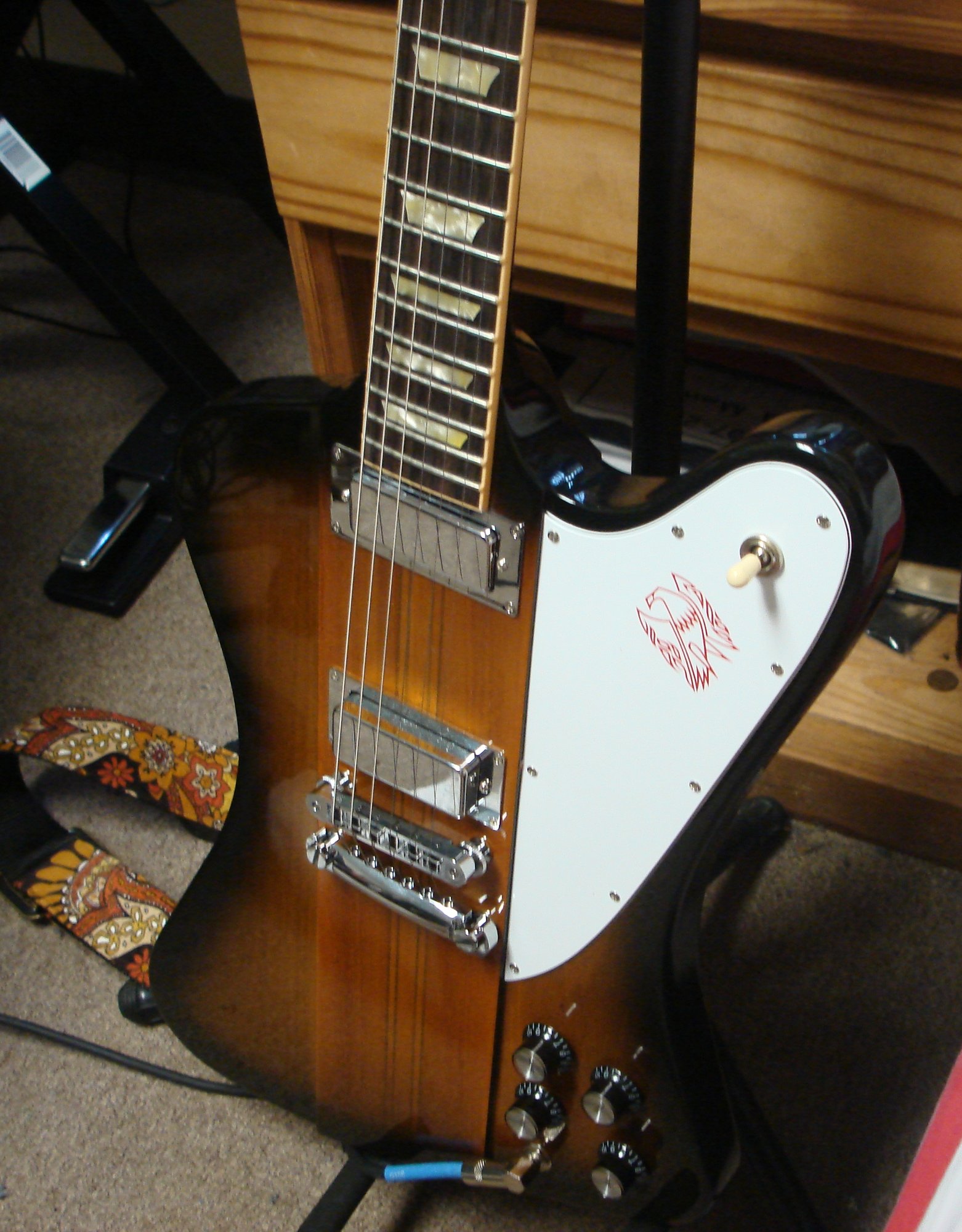
Body detail of a Gibson Firebird V, showing its covered pickups, bridge, controls and Firebird pickguard. Photo: Firebirdv2008.jpg by Jones629, via Wikimedia Commons, public domain (released by the photographer). Proportionally resized and JPEG re-encoded; image framing may be cropped by the article layout. Source: https://commons.wikimedia.org/wiki/File:Firebirdv2008.jpg License: https://commons.wikimedia.org/wiki/Template:PD-user-en
The Gibson Firebird broke every rule in 1963. Explore its neck-through build, mini-humbucker bite, and the players like Johnny Winter who made it fly. (150 characters)
Most Gibson electric guitars look like they belong in a mahogany-paneled den, all curves and tradition and quiet dignity. Then there’s the Firebird — a guitar that looks like it was designed by someone who’d just walked out of a 1963 auto show and decided a guitar should have tailfins. It has a headstock pointing the wrong way, tuners mounted where no tuners had been mounted before, and a body shape so asymmetrical it seems to be leaning into a turn even sitting still on a stand. It is, by any reasonable Gibson standard, a strange guitar. And that strangeness is exactly why it’s still flying more than sixty years after its rocky, unlikely debut.
A Detroit Detour: How a Car Designer Built a Guitar
Gibson introduced the Firebird and its Thunderbird bass counterpart in the spring of 1963 as an effort to compete with Fender’s offset-body instruments like the Jazzmaster and Jaguar, and for that job, Gibson president Ted McCarty made an unusual hire. He brought in Raymond Dietrich, a designer famed for his automotive work with Chrysler, Packard, and Lincoln, to shape four new guitars: the Firebird I, III, V, and VII. The results were unmistakably a car designer’s instrument — an asymmetrical body of two mahogany wings attached to a long mahogany neck running straight through the center, with a resemblance to vintage automobile fins that remains striking to this day.
That neck-through spine wasn’t just for looks. The Firebird became the first Gibson solidbody to use neck-through construction, with the neck itself built from five plies of mahogany interspersed with four narrow strips of walnut for added strength. Combine that with a reverse headstock carrying rear-mounted banjo-style tuners on planetary gears, and Gibson had built something that felt genuinely alien next to a Fender Stratocaster or a Gibson Les Paul Standard.
The “reverse” name comes from that backward-looking body: the right-hand treble horn of the body is longer than the bass horn, the opposite of nearly every other double-cutaway guitar, which is why the original Firebirds became known unofficially as “reverse” models. Gibson’s pitch was aggressive and specific: this was the anti-Fender, an instrument that could out-sculpt the competition while still carrying Gibson’s tonal DNA underneath the sheet metal.
A Short, Rocky Flight: 1963-1965
The reverse Firebird’s original run was brief and troubled. Gibson had originally hoped for great things from the design, but the construction proved difficult for their factories to maintain, and customers complained about balance issues and a headstock that was prone to breaking in transit. There was also outside pressure: Fender itself objected, claiming the Firebird’s headstock mirrored the Stratocaster’s and that the body infringed on Fender’s design patents, threatening a lawsuit. By mid-1965, just eighteen months after the Firebird hit shops in October or November 1963, Gibson discontinued the original reverse design.
In its place, Gibson unveiled a redesigned “non-reverse” Firebird at the June 1965 NAMM show — a flatter, solid body with the belly contour flipped, a separate glued-in neck instead of the through-body construction, and conventional inline tuners. It solved the balance and breakage problems, but it also stripped away much of what had made the original so distinctive, and it never captured the same collector reverence. Only about 3,000 original reverse Firebirds were built across every variation and custom color before the switch — a tiny production run that, decades later, turned surviving examples into five-figure vintage instruments.
Gibson kept circling back to the reverse design over the following decades, bringing it back for a Bicentennial edition in the mid-1970s, reissuing it again in the following years, and eventually settling the reverse body as the standard modern spec. The guitar’s habit of being discontinued and resurrected, again and again, earned it the Phoenix-inspired name it still carries — appropriate for an instrument whose logo, fittingly, depicts a bird rising from ashes.
The Custom Colors: Gibson’s Answer to Fender’s Palette
Alongside the radical shape, Gibson launched the Firebird with something equally unusual for the company at the time: a full range of automotive-inspired custom colors, a direct answer to Fender’s reputation for offering guitars in eye-catching Duco finishes. The 1963 catalog offered ten options beyond standard sunburst — Polaris White, Frost Blue, Ember Red, Inverness Green Poly, Silver Mist Poly, Kerry Green, Gold Mist Poly, Pelham Blue Poly, Heather, and Cardinal Red — for an extra fifteen dollars over the standard finish. Shipping records show these custom-color examples went out in far smaller numbers than the standard sunburst finish, which is exactly why a well-preserved custom-color reverse Firebird today commands a serious premium over an equivalent sunburst example. Phil Manzanera’s cardinal red Firebird VII is arguably the most famous surviving example of that custom-color run still in regular use by its original longtime owner.

The Firebird line was also structured differently than Gibson’s other guitars of the era. Rather than using names like “Junior,” “Standard,” or “Custom” the way the Les Paul and SG families did, Gibson designated the Firebirds by Roman numeral — I, III, V, and VII — with the number roughly tracking price and appointment level. The Firebird I was the stripped-down economy model with a single pickup and unbound neck; the Firebird VII sat at the top of the range with three pickups, gold-plated hardware, bound ebony fingerboard with block inlays, and a Maestro Vibrola vibrato, selling for $445 at launch against the Firebird I’s $189.50. It’s the same tiered-naming logic Gibson would later apply to its ES series, just expressed through numerals instead of adjectives.
The Thunderbird’s Quieter Sibling Success
It’s worth noting that the Firebird didn’t launch alone. Gibson introduced it alongside the Thunderbird bass, sharing the same neck-through construction, reverse body silhouette, and general design language — though scaled up to bass proportions and fitted with a new humbucker design adapted from Gibson’s earlier lap-steel pickups. Where the Firebird’s fortunes have always been tied to a specific list of guitarists, the Thunderbird built its own separate legacy among bass players, eventually counting Kim Gordon, Adam Clayton, Tom Hamilton, and Tom Petersson among its notable users. The two instruments have always been closely linked in Gibson’s history and often show up together in period photographs and catalogs, two “reverse” oddities from the same design brief, aimed at the same slice of the market that wasn’t quite buying what Gibson expected.
Full Specifications: Gibson Firebird (Original Collection, current production)
The specifics have shifted slightly across decades and reissues — the 2019 relaunch under Gibson’s Original Collection brought a new nut and refreshed finish options while keeping the mahogany body, nine-ply mahogany/walnut neck, bound rosewood fretboard, and Firebird Mini-Humbuckers intact — but the bones have stayed remarkably consistent since 1963.
The Pickup That Isn’t Quite a Mini-Humbucker
Here’s a detail that trips up even experienced players: the Firebird’s pickups are not mini-humbuckers in the way the term is usually used. Firebird pickups are a uniquely designed pickup Gibson introduced in 1963 specifically for these guitars, with an immediately distinguishable sound some players describe as a “ticked off Tele” or a “Strat on steroids” — a description that tells you everything about why the Firebird sounds nothing like a Les Paul plugged into the same amp.
Compared with a genuine mini-humbucker, the Firebird pickup is designed to sound closer to a fat single coil — brighter overall, with a bass response that stays tight and defined for noticeably longer, trading some snarl for more spank. Under the hood, the construction differs from a standard humbucker or mini-humbucker in that there’s no external bar magnet; instead each bobbin has its own internal magnet, and vintage-correct examples run around 6.5k DCR on the neck with the bridge sometimes reaching 7k.
The upshot for players: a Firebird plugged into an amp doesn’t sound like a lightweight Les Paul. It sounds like its own instrument — brighter, more immediate, faster to respond to pick attack, with a low end that stays articulate under gain rather than turning to mud. That’s precisely why the players who’ve reached for a Firebird tend to be the ones chasing a specific cutting edge that a PAF-loaded Les Paul or a Strat’s single coils can’t quite deliver.
Famous Firebird Players
Johnny Winter — The Undisputed Firebird Champion
Texas blues-rock guitarist Johnny Winter became the undisputed Firebird champion of his generation, converting his instrument to a stop-tail configuration and playing it throughout his career. His well-worn, heavily modified Firebird V became as much a part of his visual identity as his slide technique, and Gibson has since built tribute replicas modeled directly on his battered stage instrument, right down to the weathering. For a player known for blistering slide runs and searing lead tone, the Firebird’s bright, cutting pickups were a perfect match — and a big part of why the guitar carries such deep blues-rock credibility today. See more on Johnny Winter’s gear.

Allen Collins — The Guitar Behind “Free Bird”
Every bar band in America has heard someone shout for it. Lynyrd Skynyrd guitarist Allen Collins recorded the iconic “Free Bird” solo on an original reverse-body Firebird, and used it on much of the band’s catalog before an Explorer joined it in his later rig. It’s hard to overstate how much cultural weight that single association carries — a guitar this unconventional, tied forever to one of Southern rock’s most quoted solos. Learn more about Allen Collins’ rig.
Phil Manzanera — Roxy Music’s Sonic Sculptor
Few Firebird stories are as well-documented as Phil Manzanera’s. He found his cardinal red 1964 Firebird VII through a private ad in the back pages of Melody Maker in 1973, bought it for £120, and it’s featured on practically every record he’s played on since, including all fourteen of his solo albums. He’s counted, alongside Allen Collins, Eric Clapton, Clarence “Gatemouth” Brown, Gary Moore, Brian Jones, Dave Grohl, Warren Haynes, and Johnny Winter, among the guitar’s blue-ribbon roster of players. Manzanera’s Firebird VII wasn’t just a stage prop, either — it lent its name to his 2008 solo album, “Firebird V11,” a direct nod to the guitar that had defined his career. Explore Phil Manzanera’s gear.

Warren Haynes — The Les Paul Devotee Who Also Flies
Better known as a Les Paul player, Warren Haynes has also frequently reached for both reverse- and non-reverse-body Firebirds in his work with Gov’t Mule and the Allman Brothers Band, proving the guitar can sound “delectably thick and creamy” as easily as it can cut. More recently he’s favored non-reverse Firebirds onstage with Gov’t Mule specifically — a reminder that even the less-loved second-generation body style has its committed advocates. See Warren Haynes’ gear.
Tone Recipes
Blues-Rock Slide (Johnny Winter Territory)
Bridge pickup, tone rolled back just slightly to tame the top end, straight into a cranked tube amp with minimal pedal interference — a Fender Deluxe Reverb pushed hard gets you most of the way there. The Firebird’s inherent brightness does the cutting work; you just need the amp to break up naturally underneath it.
Southern Rock Lead (“Free Bird” Voicing)
Neck pickup for the sustained, singing lead tones, switching to the bridge for the harmony runs. A moderate overdrive — an Ibanez TS9 Tube Screamer set with gain around a third of the way up — tightens the low end further and adds sustain without smothering the Firebird’s natural clarity.
Art-Rock Texture (Manzanera Approach)
Both pickups blended via the middle switch position, clean-to-edge-of-breakup amp tone, and modulation or delay layered on top. The Firebird’s clarity means chorus and delay effects stay articulate rather than turning to mush — ideal for shimmering, textural rhythm parts.
How It Compares
Against a Gibson Les Paul Standard, the Firebird is lighter, brighter, and considerably more polarizing to look at — where the Les Paul disappears into the background of a stage, the Firebird demands attention. Tonally, the Les Paul’s full-size humbuckers deliver more midrange weight and a thicker, more compressed overdrive; the Firebird stays leaner and snappier, closer in character to a hot single coil than to a PAF.
Against a Fender Telecaster, the comparison is more apt than it first appears — both guitars are known for cutting through a mix with clarity and bite. But the Firebird’s neck-through construction and heavier body give it more sustain and a rounder low end than a bolt-on Tele, at the cost of the Tele’s lightweight resonance and twang.
Against a Fender Stratocaster, the Firebird trades tremolo flexibility and single-coil sparkle for humbucker-adjacent output with single-coil-adjacent articulation — a genuinely different tonal lane that neither Fender model quite occupies.
Buying Guide
New: Current USA-made Original Collection Firebirds run roughly $2,200-$2,500, giving you the modern neck-through construction, Firebird Mini Humbuckers, and Grover Mini Rotomatic tuners with full factory support and a case.
Used/Vintage: This is where things get serious. Clean original reverse examples from 1963-1965 now sell for $8,000 to $15,000 and up, reflecting both their rarity and their historical significance as the “pure” version of the design. Non-reverse models from 1965-1969 are considerably more affordable and remain, per collectors, an underrated way into vintage Firebird ownership without the reverse-model price tag.
What to check: Headstock repairs are extremely common on vintage reverse-body examples due to the design’s inherent fragility — budget accordingly and always ask for repair history. On the neck-through construction, look closely at the finish where the mahogany wings meet the center neck-through spine for signs of separation or repair.
Practical Ownership Notes
The Firebird’s neck-through design and headstock geometry create two well-known quirks. First, neck dive is real and often significant — the guitar wants to rotate the headstock toward the floor when strapped on, and most players solve this with a wide suede strap or by relocating the strap button. Second, the larger body and reverse silhouette mean it won’t fit a standard guitar stand or gig bag; plan for a dedicated case. On the upside, players consistently note the neck-through build transmits noticeably more resonance and sustain through the body when playing chords than a bolt-on or set-neck design typically offers.
FAQ
What’s the difference between reverse and non-reverse Firebirds?
Reverse models (1963-65, and reissues since) have the original offset body with the longer horn on the treble side, neck-through construction, and banjo-style tuners. Non-reverse models (1965-69) have a conventional glued-in neck, a flipped body contour, and standard inline tuners — generally considered less collectible but more affordable.
Are Firebird pickups the same as mini-humbuckers?
No. They look similar but are a distinct Gibson design, built to sound brighter and more single-coil-like than a true mini-humbucker while retaining humbucker-style noise cancellation.
Why does the Firebird have such bad neck dive?
The body shape places most of the guitar’s mass toward the lower bout while the through-neck extends a long distance to a heavy headstock — a wide strap or relocated strap button largely solves it.
Is the Firebird good for beginners?
It’s playable and comfortable once you adjust to the balance, but the price point and distinctive tone make it more of a second or third guitar for players who already know they want that specific bright, cutting sound.
Why the Firebird Still Matters
The Firebird’s commercial story reads, on paper, like a cautionary tale — a guitar that sold poorly enough to be redesigned within two years and discontinued entirely within its first decade. But that’s precisely what makes its long survival so remarkable. Unlike guitars that succeeded because they fit neatly into what players already expected, the Firebird succeeded slowly, over decades, because it refused to sound or look like anything else in Gibson’s catalog. Every player who’s picked one up — from a teenage Texas blues prodigy to a London art-rock guitarist buying a guitar sight-unseen from a classified ad — has done so because they wanted precisely what the Firebird offers and nothing else could substitute: that reverse-body attitude, that through-neck sustain, and pickups that split the difference between a Telecaster’s bite and a humbucker’s power. Six decades on, it remains one of the few genuinely oddball designs in electric guitar history to have earned permanent residency in a major manufacturer’s core lineup, rising, appropriately enough, from its own ashes more times than any guitar has a right to.
Image credits
- Phil Manzanera: Eva Rinaldi, Wikimedia Commons, CC BY-SA 2.0.
- Top image: Gibson Firebird V, body detail. Photo: Jones629. Source photograph · Public domain, released by the photographer. Proportionally resized and JPEG re-encoded; complete source frame retained. The original photograph shows the body and part of the neck; no production year is claimed.
- Johnny Winter: Pelerin, Wikimedia Commons, CC BY-SA 4.0.
- Phil Manzanera: Raph_PH, Flickr, CC BY 2.0.
Latest News
Related
On This Day
Tuesday 10 November
From this week: