
In this guide
If the Gibson ES-175 was built to be affordable and practical, the L-5 CES was built to be neither. Where the 175 got its name from a $175 price tag, the L-5 has never needed a bargain story — it’s been Gibson’s flagship archtop since before the electric guitar existed as a concept. When Gibson finally wired one for amplification in 1951, they weren’t inventing a new instrument so much as bolting electronics onto an object that already carried three decades of prestige. The result is still, by most serious measures, the guitar every other carved archtop gets compared to.
Origin Story: Thirty Years of Reputation Before It Ever Got Plugged In
The L-5’s story starts in 1922, under the direction of Gibson’s legendary acoustic engineer Lloyd Loar, as the company’s first guitar built with f-holes rather than a round soundhole — a design borrowed directly from violin-family instruments and intended to maximize projection and tonal complexity. It quickly became the instrument of choice for big-band rhythm guitarists who needed to cut through a horn section without amplification, and by the 1940s it had cemented itself as the standard-bearer of American archtop design.
Electrification came comparatively late and deliberately. Gibson’s engineers had already built the laminated, all-electric ES-5 as “the supreme electronic version of the L-5” in 1949, but serious L-5 players wanted the real thing — a genuinely electrified version of the carved acoustic flagship, not a laminated stand-in. In 1951, Gibson answered with the L-5 CES (Cutaway Electric Spanish), fitting the L-5’s carved spruce top and carved maple back and sides with a pair of P-90 pickups and a rosewood bridge. Only 31 examples shipped from the Kalamazoo plant that first year — a guitar this labor-intensive was never going to be a high-volume product, and it never has been.
The most significant spec change came in 1958, when Gibson swapped the P-90s for the newly developed PAF humbucker, designed by Seth Lover to cancel mains hum while adding warmth and output — the same transition that reshaped the ES-175 the year before. Only 21 humbucker-equipped L-5 CES guitars shipped in that first year, but that combination — carved solid-wood construction, humbucking pickups, ornate Gibson appointments — became the specification that’s defined the model, largely unchanged, for the six-plus decades since. The cutaway shape shifted too: the original rounded “Venetian” cutaway gave way to a sharper “Florentine” cutaway through most of the 1960s before later returning to the rounded profile that Gibson’s Custom Shop still uses today.
Full Specifications: Gibson L-5 CES (Modern Custom Shop Build)
Deep Dive: What Justifies the Price and the Prestige
Carved, Not Laminated — The Core Distinction
The single biggest difference between the L-5 CES and its more affordable stablemate, the ES-175, comes down to construction method. The ES-175 uses laminated maple for cost-efficiency and feedback resistance; the L-5 CES uses hand-carved solid spruce for the top and carved solid maple for the back and rims — the same labor-intensive process used on premium violins and cellos. Carved solid wood offers a richer, more complex, more acoustically alive tone than laminate, but it comes with real tradeoffs: higher cost, more susceptibility to feedback at volume, and a construction process that simply can’t be rushed or automated the way laminate pressing can.
Built for a Studio Mic As Much As an Amp
Even after electrification, the L-5 CES never fully abandoned its acoustic roots. Unplugged, it remains a genuinely loud, resonant instrument — closer to a true acoustic archtop than most electric guitars will ever be. This dual identity is part of why the model became such a favorite among session players and studio guitarists who needed an instrument that could be captured beautifully by a microphone as easily as it could be plugged into an amplifier, offering genuine versatility across acoustic-leaning folk and country sessions as much as amplified jazz and rock work.
Ornate by Design, Not by Accident
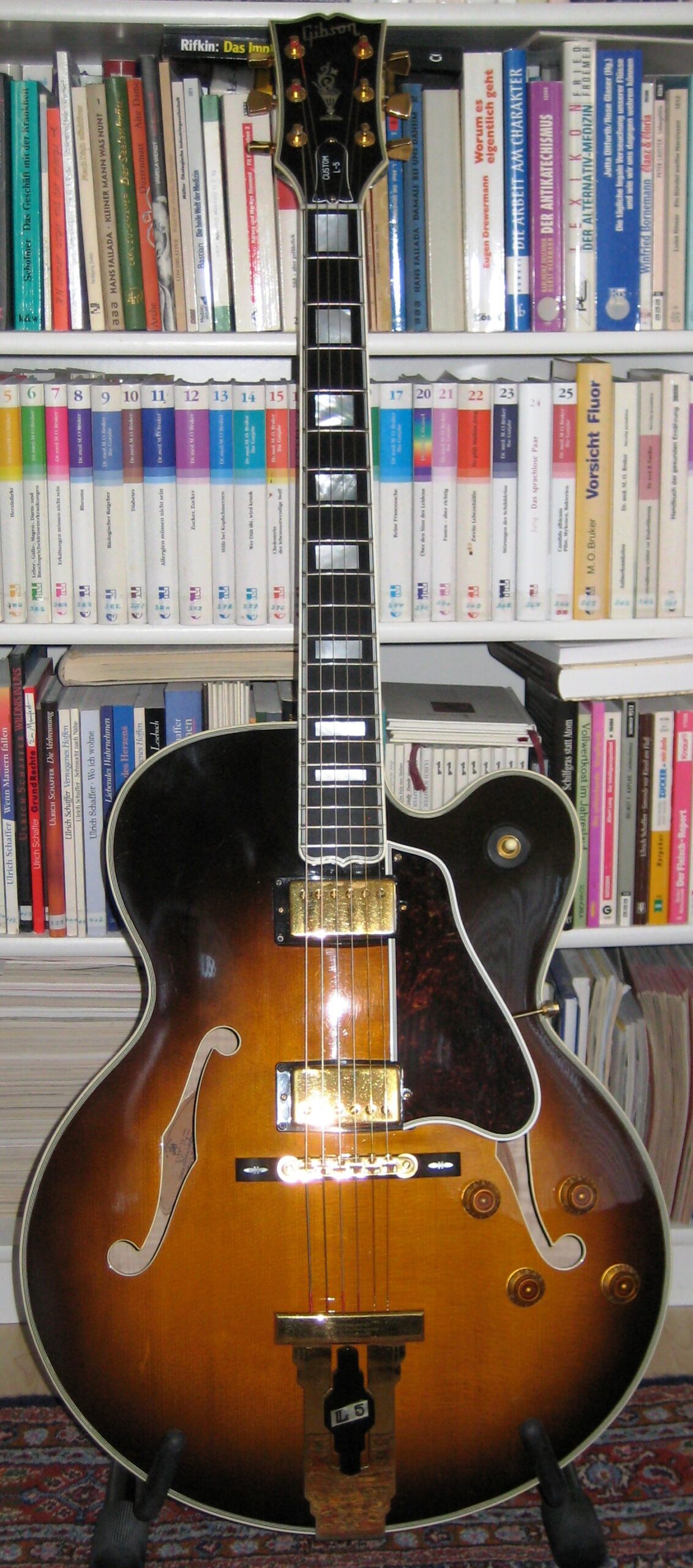
The L-5 CES’s appointments — the mother-of-pearl “Flowerpot” headstock inlay, the pearl block fingerboard markers, the multi-ply binding throughout — aren’t incidental decoration. They’re a direct continuation of Gibson’s original 1922 design language, signaling the model’s status at the very top of the company’s hierarchy since Lloyd Loar’s era. Every L-5 CES that’s left the factory has carried forward that same visual statement: this is Gibson’s flagship, not merely another electric guitar in the catalog.
A Neck and Scale Built for a Different Playing Style
At 25.5 inches, the L-5 CES uses a longer scale length than the 24.75-inch standard found on most Gibson electrics, including the Les Paul and ES-175. Combined with its wider 1 11/16-inch nut, the guitar rewards a more deliberate, chord-melody-oriented playing style — the kind of technique jazz guitarists spend years developing — over the fast, bend-heavy lead playing more associated with shorter-scale solidbodies.
Sound and Feel: What Carved Wood Actually Buys You
The difference between playing a carved-top archtop and a laminated one isn’t subtle, and it’s the first thing most players notice within seconds of picking up an L-5 CES. Strum it unplugged and the sound fills a room in a way that laminated hollowbodies simply can’t match — there’s a complexity to the overtones, a shimmer and depth to the sustain, that comes directly from allowing solid wood to vibrate freely rather than constraining it within pressed layers. It’s the same principle that separates a hand-carved violin from a factory-produced student instrument, applied to a guitar body.
Plugged in, that acoustic complexity carries through into the amplified tone in a way that’s genuinely difficult to describe without hearing it directly. Notes bloom with more harmonic richness, sustain trails off more naturally rather than simply decaying, and the overall voice has a three-dimensional quality that solidbody and even semi-hollow instruments can approximate but never quite replicate. This is precisely why studio engineers and session players have prized the L-5 CES for so many decades — it’s an instrument that rewards close-miking and careful signal chains, giving back detail and nuance that a lesser guitar simply doesn’t have to offer.
The tradeoff, as with any carved-top archtop, is control. That same freely vibrating top that produces such rich acoustic tone also makes the guitar considerably more prone to feedback as volume and gain increase — a genuine limitation for players chasing high-gain rock tones, but a non-issue for the jazz, studio, and roots-music contexts the L-5 CES was built to excel in. Players who understand and work within that limitation tend to find the guitar endlessly rewarding; players expecting solidbody behavior from a fundamentally acoustic-hearted instrument tend to be disappointed. Knowing which category you fall into before buying one is the single most important piece of advice any experienced owner will offer.
Famous Players: A Guitar That Crosses Every Genre Line
Wes Montgomery — The Definitive L-5 Player
No name is more closely tied to the L-5 than Wes Montgomery, who played a Florentine-cutaway L-5 he simply called his “axe,” fitted with a single pickup installed later in the neck position. His thumb-picking technique and octave-driven melodic lines, captured on that instrument, defined what jazz guitar was supposed to sound like for an entire generation of players — a legacy so strong that Gibson eventually built an official Wes Montgomery signature model based directly on his personal specifications.
Mother Maybelle Carter — Country’s Most Important Guitar
Mother Maybelle Carter of the Carter Family played her 1928 L-5 for the majority of her career, using its distinctive carter-scratch picking technique to help define the sound of American country music at its foundation. Guitar historian George Gruhn has called it “the most important single guitar in the entire history of country music” — and it now resides permanently in the Country Music Hall of Fame in Nashville, a testament to how far beyond jazz this model’s influence reaches.
Eric Clapton — An Unexpected Archtop Detour
Eric Clapton has been documented playing an L-5 CES across various sessions and performances throughout his career, a reminder that even guitarists whose signature sound is built around Stratocasters and blues-rock crunch occasionally reach for the warmth and complexity only a genuine carved archtop can deliver.
Keith Richards — The Rolling Stone’s Jazz Box
Keith Richards has used the L-5 CES on select recordings and sessions, applying its rich, woody tonal character to textures well outside the Rolling Stones’ more familiar Telecaster-driven sound.
Mark Knopfler — Roots Music Warmth
Mark Knopfler played an L-5 CES on the Notting Hillbillies’ 1990 album Missing… Presumed Having a Good Time, documented in photographs from the group’s early live performances — a fitting choice for a project built around warm, roots-inflected acoustic textures rather than the electric fireworks of his Dire Straits work.
Pat Martino — The Black L-5
Pat Martino famously played a custom ebony-finished L-5 CES for many years, using its dark, distinctive look as a visual signature to match his blazing-fast, harmonically sophisticated improvisational lines — one of the most recognizable player-and-instrument pairings in modern jazz guitar.
Tone Recipes
Chord-Melody Jazz (Montgomery/Martino Mode)
- Neck pickup, tone rolled back to around 3–4 for maximum warmth
- Clean amp platform with minimal coloration, such as the Fender Deluxe Reverb
- Flatwound strings and a light touch for the smoothest, roundest tone
Roots and Americana Warmth (Knopfler/Carter Mode)
- Both pickups blended, or neck pickup alone for fingerpicked passages
- Amp set clean with generous headroom, played more for acoustic-adjacent warmth than volume
- Minimal effects — this is a tone that thrives on the guitar’s natural resonance rather than pedal coloration
Rock and Blues Detour (Clapton/Richards Mode)
- Bridge or middle pickup position, tone opened up more than traditional jazz settings
- Light, transparent overdrive such as the Ibanez TS9 Tube Screamer for extra sustain without burying the guitar’s natural woody character
- Careful volume management to avoid pushing this full hollowbody into unwanted feedback
How It Compares
Against its own stablemate, the Gibson Les Paul Standard, the L-5 CES occupies an entirely different world — solidbody sustain and rock-ready output versus carved-archtop resonance and acoustic complexity. Against a Fender Telecaster or Fender Stratocaster, the contrast is just as stark: single-coil snap and bright, articulate attack versus dark, woody warmth built for a completely different musical vocabulary. Within Gibson’s own hollowbody lineup, the L-5 CES sits meaningfully above the laminated ES-175 in both cost and acoustic complexity — the 175 was built to be the practical, affordable jazz box; the L-5 CES was built to be the one nobody had to apologize for.
Buying Guide: Who Actually Needs One
The L-5 CES is not, and has never tried to be, a guitar for everyone. Its price point alone — new Custom Shop examples running $9,000 to $12,000, with desirable vintage originals often well beyond that — puts it firmly in professional and serious-collector territory. It makes the most sense for working jazz guitarists who play regularly in acoustic-adjacent or studio settings where the instrument’s natural resonance genuinely matters, collectors drawn to its historical significance and craftsmanship, and players who’ve already spent years on laminated archtops like the ES-175 and are ready for the meaningfully different experience a carved instrument provides.
For players drawn to the L-5’s reputation but not ready for its price tag, the ES-175 remains the more practical entry point into carved-adjacent archtop tone, while Gibson’s own ES-5 and various Epiphone archtop models have historically offered laminated alternatives that borrow visual cues from the L-5 without its carved-top cost. Vintage L-5 CES buyers should pay particularly close attention to top condition — carved spruce tops are more prone to cracking with age and humidity fluctuation than laminated tops, and repairs on an instrument this labor-intensive to build are correspondingly expensive.
Practical Ownership Notes
- Humidity control is non-negotiable: carved solid-wood archtops are significantly more sensitive to humidity swings than laminated instruments — invest in proper case humidification, especially through dry winter months.
- Feedback management: as a full hollowbody with a carved top, the L-5 CES is highly resonant and correspondingly prone to feedback at stage volume — this is fundamentally a studio and small-venue instrument rather than an arena-rock tool.
- Weight and balance: despite its large body, the L-5 CES tends to balance comfortably thanks to its build, though its size makes a proper strap and careful seated posture worthwhile for long sessions.
- Insurance: given the price point of both new and vintage examples, dedicated instrument insurance is worth strongly considering rather than relying on standard homeowner’s or renter’s coverage.
- Setup: the floating-style bridge setup benefits from a specialist archtop luthier rather than a general repair shop — intonation and bridge placement are more nuanced on carved-top instruments than on flat-top electrics.
Frequently Asked Questions
What does “CES” stand for on the Gibson L-5 CES?
CES stands for “Cutaway Electric Spanish,” describing the electrified, cutaway version of the original acoustic L-5 that Gibson introduced in 1951.
What’s the real difference between the L-5 CES and the ES-175?
The core difference is construction: the L-5 CES uses hand-carved solid spruce and maple, while the ES-175 uses laminated maple throughout. The L-5 CES offers richer acoustic complexity and greater prestige at a significantly higher price and with more feedback sensitivity; the ES-175 offers a more practical, feedback-resistant, and affordable alternative with its own distinct tonal character.
Is the L-5 CES a good first archtop guitar?
Given its price point and the specialized care carved-top instruments require, most guitarists are better served starting with a more affordable laminated archtop like the ES-175 before working up to an L-5 CES once they’ve developed a clear sense of what they want from the format.
Can the L-5 CES handle rock or blues playing?
Yes, as documented use by Eric Clapton and Keith Richards demonstrates, though its full hollowbody construction makes it more feedback-prone at high gain and volume than a solidbody or semi-hollow instrument, making it better suited to studio and lower-volume live settings than high-gain arena rock.
How much does a Gibson L-5 CES cost?
New Custom Shop examples typically run $9,000–$12,000. Vintage originals from the 1950s and ’60s generally range from $10,000 to $20,000 or more depending on year, condition, and finish, with rare early examples commanding significantly higher prices among serious collectors.