The Vox AC4HW1 Hand-Wired: Four Watts of Hand-Soldered British Chime That Could Be Your Best Recording Amp Ever
The Vox AC4HW1 Hand-Wired is a 4-watt, hand-wired tube combo with a Celestion Greenback. Our guide covers specs, players, tone recipes, and how it compares.
There is a particular kind of courage involved in spending over a thousand dollars on a four-watt amplifier. At first glance, the math seems brutally wrong: a wattage figure that barely registers, a price tag that competes with far beefier rigs, and a power output you could theoretically drown out with an acoustic guitar in a medium-sized room. And yet, the Vox AC4HW1 Hand-Wired has been making a compelling counter-argument since its debut in 2012, one turret-board solder joint at a time.
This is not a budget practice amp with a heritage badge slapped on the grille. It is a hand-wired, birch-ply, Celestion Greenback-loaded statement about what tone actually means at manageable volumes — and about how the most significant audio decisions are sometimes made in the quietest rooms. If you have been chasing that elusive Class A Vox chime without waking the neighbors, blowing your studio budget on a 30-watt combo you can never push, or compromising with a digital model that sounds fine until it doesn’t, the AC4HW1 is the amplifier worth understanding properly.
From the AC2 to the AC4HW1: Sixty Years of Compact Vox DNA
The story of the Vox AC4 begins not in 2012 but in 1958, when Vox — then operating as Jennings Musical Instruments (JMI) out of Dartford, Kent — produced a compact low-wattage valve amplifier called the AC2. The circuit was refined over the following years into the AC6, and by 1962 it had coalesced into the model we know as the AC4: a single EL84 power tube, a pair of ECC83/12AX7 preamps, a compact cabinet, and a straightforward Top Boost-derived tone circuit.
The original JMI AC4 of 1962 was a genuinely different animal from the modern AC4HW1. It used a passive tone-cut approach rather than the full active Top Boost EQ, included built-in tremolo on some variants, and was built to the exacting standards — and cost-cutting realities — of early 1960s British manufacturing. But its fundamental character was established from the first: a single-ended Class A circuit producing those asymmetric, even-order harmonics that make a fully-cranked four-watt EL84 sound like something considerably larger and considerably more beautiful than its wattage rating suggests.
The JMI AC4 was available through the mid-1960s before being discontinued as the industry moved toward larger, louder rigs. It spent roughly forty years as a curiosity — a footnote in the AC30 story, beloved by studio engineers who understood what a cranked single-ended amp could do in a recording chain. Then, in 2012, Vox revisited the concept not as a direct reissue but as a modern interpretation: the AC4HW1 Hand-Wired.
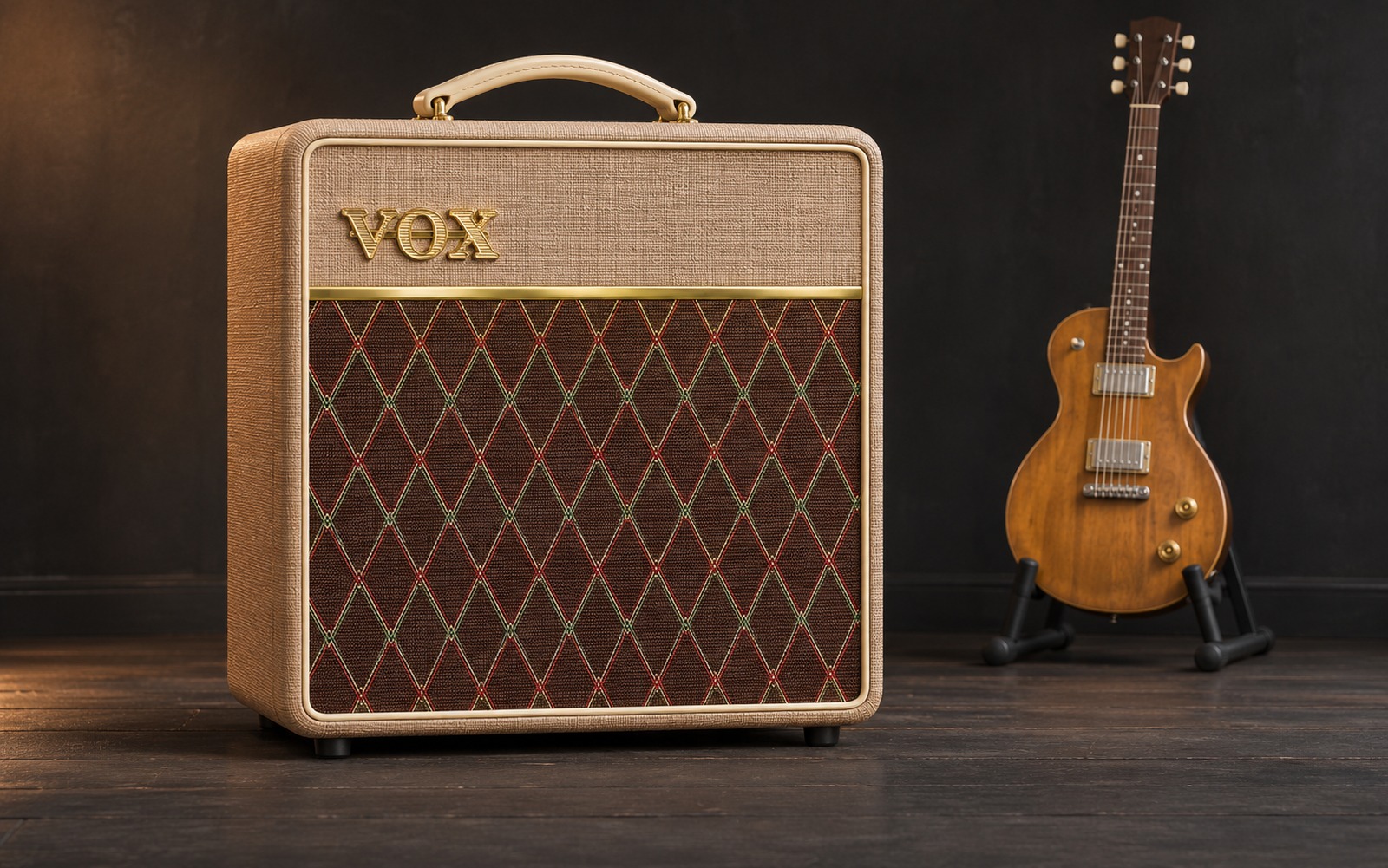
Where earlier modern Vox small-wattage amps — including the AC4C1 series — used printed circuit board construction and cost-optimized components, the AC4HW1 was built to a different specification entirely. Point-to-point turret board hand-wiring. Birch plywood cabinet. Celestion G12M Greenback speaker. A Cool/Hot mode toggle with real tonal consequences. At £778/$1,100 at launch, it sat at roughly double the price of its PCB-based sibling, and it was unambiguous about why.
Specifications
What the Controls Actually Do
The AC4HW1’s rear-facing control panel — a design quirk inherited from the original JMI era, when it was assumed guitarists would sit alongside their combo rather than standing with it behind them — presents a deceptively simple layout. Volume, Bass, Treble, and Gain handle the fundamental tone shaping, with a Master Volume governing overall output level. But the most interesting control is the small Cool/Hot mini-toggle, and understanding it is the key to understanding the amp.
In Cool mode, the AC4HW1 operates as a conventional Top Boost Vox: all tone controls active, full signal path from input to speaker. This is where the classic Vox chime lives — the shimmer and articulate high-end clarity that made EL84-powered British amps the sound of the early 1960s, and the sound that indie, country, and Americana players keep returning to sixty-plus years later.
Flip the toggle to Hot mode, and the tone pots are bypassed entirely. The signal travels a shorter, more direct route through the circuit — thicker, louder (about 2–3dB perceived increase), and heavier in the lower midrange. It is a modification approach that Vox’s own engineers noted is similar to the way Brian May has had his AC30s modified over the years: stripping out the tone stack to create an unfettered, pure signal path that sacrifices some tonal flexibility for maximum harmonic density and raw volume. In the AC4HW1’s context, Hot mode transforms the amp from a refined top-end sparkle machine into something with genuine riff authority — a different amplifier hiding inside the same chassis.
The Hi and Lo inputs offer a further variable. The Hi input feeds directly into the first gain stage; the Lo input attenuates the signal before the first stage, effectively dropping sensitivity and giving you more clean headroom before the circuit begins to compress. Using the Lo input with the Gain and Volume pushed is a different proposition from using the Hi input at moderate settings, even if both produce a similar perceived volume — the way the tube stages interact with the signal changes the harmonic texture of what comes out of that Greenback.
The Celestion G12M Greenback Question
One of the most significant decisions Vox made with the AC4HW1 was to load it with a Celestion G12M Greenback rather than the cost-optimized Celestion VX12 used in the Vox AC4C1-12. This is not a minor detail. The Greenback is one of the most historically significant guitar speakers ever produced — used in countless Marshall and Vox combinations from the mid-1960s onward, responsible for the characteristic warm, woody midrange and the controlled, slightly compressed high-end that defines a huge portion of recorded classic rock and British pop.
In the context of a four-watt single-ended amp, the Greenback’s voice and power handling characteristics interact with the circuit in a specific way. The G12M handles 25 watts; running a four-watt SE amp through it means the cone is operating well within its power envelope, which produces a faster, more detailed response to transient dynamics than a speaker working near its limits. You get the full frequency character of the Greenback — the slight warmth in the upper bass, the smooth midrange density, the Vox-characteristic “bloom” on sustained notes — without the compression artifacts of an overloaded cone.
This also means the AC4HW1 has a notably different sonic character than the AC4C1-12, even given the same wattage and similar circuit topology. The MusicRadar review (Neville Marten, September 2012) noted that the 12-inch Greenback “bring[s] greater breadth and openness to the HW’s output” compared to smaller-speaker AC4 variants, and the turret-board wiring was credited alongside the speaker as responsible for a more expansive sound. Both observations hold up: hand-wired point-to-point circuits are measurably different from equivalent PCB designs in ways that affect the parasitic capacitances and resistances in the signal path, producing subtle but real differences in tone and feel that experienced players can identify through a blindfold.
Famous Players: What the Evidence Actually Shows
The AC4HW1 occupies an interesting position in the famous-player landscape: it is an amplifier historically associated with the Vox brand’s most celebrated names, but almost none of those names can be documented using this specific model. The distinctions matter, and this article will be straight about them.
George Harrison — George Harrison passed away in November 2001. The Vox AC4HW1 was introduced in 2012, eleven years later. The connection is a calendar impossibility. Harrison was a significant Vox AC30 user during the Beatles era and retained affection for the brand throughout his life, but he could not have used the AC4HW1. George Harrison’s gear is documented extensively — this amp is not part of it.
Rory Gallagher — Rory Gallagher passed away in June 1995. The AC4HW1 arrived seventeen years later. Same issue: genuine Vox family member, genuine guitar legend, documented AC30 and various vintage Vox user, but the AC4HW1 is chronologically impossible. Rory Gallagher’s gear belongs firmly to the JMI and original-era Vox story, not the 2012 hand-wired revival.
Brian May — May is one of the most documented Vox AC30 users in history, using them through the Normal channel with a Rangemaster treble booster for Queen’s layered guitar orchestra recordings. His actual Vox signature product is the MV50-BM NuTube head, not the AC4HW1. That said, the Hot mode on the AC4HW1 operates on a principle directly analogous to May’s AC30 modification — bypassing the tone stack for a direct, unfettered signal path — and Brian May is worth understanding in the context of what the AC4HW1’s Hot circuit is trying to achieve. No primary source documents him using the AC4HW1 specifically.
The Edge — The Edge’s documented Vox usage centers on heavily modified AC30TBs and customized AC30 combos built to specific touring specifications. No documented connection to the AC4HW1 exists. The Edge’s gear at the AC4HW1’s wattage range does not feature in known Rig Rundowns or interviews.

Tom Petty — Petty, who passed away in October 2017, had a documented fondness for vintage AC30 combos (famously his “old brown AC30”). The AC4HW1’s production window of 2012–2019 technically overlaps with the last five years of his life, but no primary source — Rig Rundown, interview, or photo documentation — places him with the AC4HW1. His Vox association is with vintage AC30s, not the modern hand-wired small-wattage series.
Hunter Hayes — The one verifiably documented professional user of the AC4HW1. Equipboard lists Hayes as a confirmed user, and he has specifically praised the hand-wired series: “The AC4 and AC15 have been two of my favorite go-to amps for studio and stage.” That quote is important context for understanding where this amp actually lives: for Hayes, as for many professionals who have discovered it, the AC4HW1 is primarily a studio and home-recording tool rather than a main-stage amp. Hayes’ 2013 Premier Guitar Rig Rundown documented his live rig as two modified vintage Fender Deluxe heads driving Ladner 2×12 cabinets — significantly more headroom for a large-venue country touring context. The Vox was doing different work: recording, writing sessions, the quieter end of the creative process. This is precisely the use case the AC4HW1 is built for. His endorsement is the most credible, specific player connection the AC4HW1 can claim.
Tone Recipes and Settings
Recipe 1: Classic British Jangle
Mode: Cool. Gain at 9 o’clock, Volume at 12, Bass at 10 o’clock, Treble at 12 o’clock, Master at 12 o’clock. Use the Hi input. Pair with a Rickenbacker 360/12 or Epiphone Casino. The AC4HW1 in Cool mode with a semi-hollow or thinline gives you the essential 1964–1966 British sound — articulate, chimey, with the Greenback adding warmth and body that the stock VX12 in the AC4C1-12 cannot match. Play at the edge of picking dynamics; this circuit rewards a light touch with shimmer and responds to harder playing with natural compression.
Recipe 2: Edge-of-Breakup Country and Americana
Mode: Cool. Gain at 10 o’clock, Volume at 1 o’clock, Bass at 11 o’clock, Treble at 11 o’clock, Master at 9 o’clock (for studio; push higher for rehearsal). Use the Lo input. Pair with a Fender Telecaster. A bridge-pickup Tele into the AC4HW1’s Lo input in Cool mode gives you the “edge of breakup” sound that Nashville session players have increasingly discovered in small-wattage hand-wired amps over the past decade: not clean, not distorted, but responsive — where your picking attack determines whether the note is crystal or slightly furry. This is Hunter Hayes territory: the recording sound for modern country-pop with authentic tube character.
Recipe 3: Hot Mode Raw Blues
Mode: Hot (toggle flipped). Volume at 1 o’clock, Master at 12 o’clock. Use the Hi input. Plug in a single-coil — Stratocaster neck or middle pickup works beautifully here. Hot mode’s tone stack bypass delivers a rounder, fatter character with noticeably more lower-midrange authority. This is where the Greenback’s warmth comes into its own, and where adding a Fulltone OCD or a transparent overdrive pushes into genuine blues-rock breakup that punches well above the amp’s wattage. MusicRadar’s Neville Marten noted in the original review: “Jumping on a Fulltone OCD pedal highlights the Marshall-y edge already present courtesy of the Greenback” — the G12M’s heritage is dual-brand, and it shows in Hot mode.
Recipe 4: Studio Maximalism
Mode: Hot. Gain at 11 o’clock, Volume at 2 o’clock, Master at 10 o’clock (low — let the power stage cook while keeping speaker volume manageable). Add a good reverb at the desk or via a pedal in the signal chain. Use delay via a send/return through a mixer — since the amp has no effects loop, time-based effects work best in parallel rather than series when pushing the amp hard. This is the approach that makes the AC4HW1 a genuine recording amp rather than a demo tool: small enough to position close-mic’d in a live room without bleeding into other sources, loud enough to get genuine power-stage saturation without needing a power attenuator, and tonally complex enough to sit in a dense mix without fighting for space. A Electro-Harmonix Deluxe Memory Man before the amp (Cool mode) adds depth without muddying the circuit’s natural response.
Recipe 5: Fuzz Platform
Mode: Cool. Gain at 9 o’clock, Volume at 10 o’clock, Bass at 12, Treble at 12, Master at 11 o’clock. Run a Electro-Harmonix Big Muff Pi or a Ge-transistor fuzz into the Hi input. The AC4HW1 in Cool mode with relatively clean amp settings becomes an extremely neutral, high-fidelity platform for fuzz pedals — the Top Boost circuit’s midrange character complements Big Muff-style fuzz without the interaction problems some amps create. Vox EL84 amps and Big Muff variants have a documented tonal synergy going back to the shoegaze era, and the hand-wired construction maintains the transparency of that pedal interaction.
How It Compares: AC4HW1 in the Vox and Competitor Landscape
The most direct comparison is with the Vox AC4C1-12, which shares the same wattage, basic circuit topology, and 12-inch speaker format but differs in almost every construction detail that matters: PCB vs. turret board, MDF vs. birch ply, Celestion VX12 vs. G12M Greenback, and no Cool/Hot mode vs. a genuine tonal switching capability. The AC4C1-12 is a very competent amplifier for the money; the AC4HW1 is a different level of instrument. Whether that difference justifies the price gap is the question each player has to answer for themselves, but the material and construction differences are real and audible.
Against the Fender Blues Junior — the default competitor in the small-wattage tube combo space — the AC4HW1 offers a fundamentally different tonal character. The Blues Junior’s EL84-based circuit (in its original version) produces a more American-voiced midrange, fuller low end in its larger cabinet, and built-in reverb. The AC4HW1 is brighter, more harmonically complex in the mid-treble range, and significantly more characterful in the way it responds to playing dynamics. If you want reverb and slightly more clean headroom at moderate volumes, the Blues Junior is the more practical choice. If you want the specific Vox Class A character and are happy to source reverb from a pedal, the AC4HW1 wins on pure tone quality for its specific voice.
The Fender ’65 Princeton Reverb is a more direct competitor in the single-ended tube combo space — also SE Class A topology (6V6 power tube rather than EL84), similar wattage range, built-in spring reverb that the AC4HW1 lacks. The Princeton has more clean headroom and a warmer, rounder American voice; the AC4HW1 has the specific Vox EL84 bite and chime, and the Cool/Hot mode gives it a range the Princeton can’t match without pedals. At similar price points on the used market, this is the most interesting comparison for a recording guitarist choosing between American and British Class A tones.
Elsewhere in the Vox hand-wired family, the Vox AC30HW2 Hand-Wired is the flagship: point-to-point wiring, 30 watts, two EL84 pairs, and a price that reflects the full commitment to vintage-accurate construction. The AC4HW1 shares the same wiring philosophy at roughly a third of the output and cost. For players who don’t need 30 watts but do need the hand-wired construction quality and Greenback character, the AC4HW1 is the more practical entry point into the hand-wired Vox world.
The AC4HWR1: The 2024 Successor
In 2024, Vox introduced the AC4HWR1 — a revised and significantly enhanced successor to the original AC4HW1, launched as part of a new hand-wired series alongside updated AC15 and AC30 variants. The AC4HWR1 retains the same core circuit (1× EL84 power, 2× ECC83 preamp, Celestion G12M Greenback, 9mm birch ply cabinet) but adds features the original conspicuously lacked: a FET-buffered spring reverb with dedicated footswitch, a transparent FET effects loop (bypassable), a phase inverter stage added specifically to generate push-pull-style harmonics even at single-ended power levels, a custom-wound output transformer developed from measurements of an original 1962 AC4, and slight negative feedback borrowed from the 1959 AC6 design for improved clarity at low volumes.
Guitar World reviewed the new hand-wired series in July 2025 (Martin Smith, five stars), stating: “Every bit of that legendary sound is ready and waiting to be coaxed out of these amps, and the actual playing experience will surely have you grinning, ear to ear.” The AC4HWR1 prices at $1,099/£929 — roughly in line with the original AC4HW1’s 2012 launch price adjusted for inflation, and a meaningful upgrade in features while maintaining the core hand-wired construction standard. If you are buying new, the AC4HWR1 is the current product; the AC4HW1 is now the used-market proposition, available from around $650–750 on Reverb.
Buying Guide: AC4HW1 on the Used Market
The AC4HW1 was produced from 2012 to approximately 2019, and examples turn up regularly on Reverb and eBay in the $650–800 range depending on condition. Here is what to look for.

Tubes first. The EL84 power tube runs hot in a single-ended Class A circuit — it conducts full plate current continuously rather than alternating with a partner tube as in push-pull designs. On original tubes that have been run hard for a decade or more, you may find inconsistent bias or a worn tube. Asking for a retube history or budgeting for a quality replacement EL84 (JJ, Mullard reissue, or Tung-Sol are all appropriate) and a pair of 12AX7s is reasonable for any used example. A full retube costs $40–60 at most.
The back panel access situation. MusicRadar’s original review flagged this as the amp’s only real practical drawback, and it remains true: the back panel requires removing an extraordinary number of screws to access the tube complement. If you need to swap a tube during a session without an electric screwdriver, plan for a significant time investment. This is a known characteristic of the design, not a fault to look for, but it affects the urgency of buying pre-retubed.
Cabinet and speaker. The birch ply cabinet is more durable than MDF but not indestructible — check for delamination around the corners and speaker baffle, which are the vulnerable points in older combo amps. The Celestion Greenback is a robust speaker, but check that it has not been pushed beyond its 25-watt handling with an extension cabinet. A four-watt source through a single Greenback is entirely within specification; an external 100-watt head through the extension speaker output (16Ω only) absolutely is not.
The Cool/Hot toggle. Verify that the toggle operates cleanly in both positions and that switching between modes does not produce crackling or intermittent behavior. A dirty or oxidized toggle switch can be cleaned easily, but confirm the mode switching works before purchasing.
Footswitch. The original footswitch for Cool/Hot switching is a simple single-button FS-1, and many used examples come without it. It is not expensive to replace, but confirm whether it is included if you specifically need remote Cool/Hot switching.
Ownership Notes
The AC4HW1 in regular use has a few behavioral characteristics worth knowing. The EL84 runs genuinely hot — single-ended Class A operation means the tube is always conducting, never resting, and adequate ventilation matters. Do not run the amp in an enclosed space or with the speaker fabric bunched up against the rear panel. The amp runs best with some breathing room.
For recording, close-miking the Greenback with a Shure SM57 positioned at the edge of the dust cap — approximately 1–2 cm from the grille — captures the amp’s full frequency character without the proximity effect artifacts of a dead-center mic position. The Greenback’s characteristic slight mid-presence rise sits at approximately 1–2kHz, and the SM57’s own character complements this rather than competing with it. A Royer R-121 ribbon mic as a room mic at three to five feet adds air and depth without requiring a reverb plug-in. This is the recording approach that makes the AC4HW1 genuinely competitive with amplifiers costing three to four times as much.
The absence of an effects loop means that time-based effects (delay, reverb, chorus) work best in one of two configurations: placed before the amp input in the guitar signal chain (acceptable for modest drive levels), or added at the desk in parallel via an auxiliary send/return arrangement (superior for maintaining the amp’s natural dynamic response). If your studio or rehearsal setup does not have a mixer with aux sends, a dedicated parallel effects loop device (such as the Boss ES-8 or a simple A/B/Y arrangement with a reverb unit) can solve this elegantly without fighting the circuit.
Frequently Asked Questions
Is the Vox AC4HW1 really hand-wired?
Yes — the AC4HW1 uses point-to-point turret board construction rather than a printed circuit board. This means individual components are soldered directly to turret posts on a phenolic board, with hand-run wiring between stages. This is the construction method used in vintage amplifiers from the 1950s and 1960s, and it genuinely affects tone and repairability compared to PCB designs. The term “hand-wired” is used accurately here, not as marketing shorthand for “PCB with manual assembly.”
Can the Vox AC4HW1 handle small gigs?
Yes, with caveats. At four watts through a 12-inch Greenback, the AC4HW1 produces more perceived volume than its wattage rating suggests — the Greenback’s efficiency rating contributes meaningful on-paper SPL. For intimate settings (wine bar, coffee shop, home rehearsal), the amp works well without PA support. For anything larger — club stages, rehearsal with a drummer — a DI output or a microphone into the PA is necessary unless the drummer plays very quietly. The amp was designed primarily as a studio and small-venue tool, and it excels in that role.
What is the difference between Cool and Hot mode?
Cool mode operates the full Top Boost circuit: Volume, Gain, Bass, and Treble all active, giving you the standard Vox chime and tonal flexibility. Hot mode bypasses the passive tone network entirely, sending the signal through a more direct path that is louder (approximately 2–3dB), thicker in the midrange, and less adjustable tonally. Hot mode is closer to what some boutique amp builders call “cathode bypass” or “straight wire” operation — maximum harmonic content, reduced tonal shaping, and a more raw, direct character.
Does the Vox AC4HW1 work with humbuckers?
Yes, and it can work very well. MusicRadar’s review noted “The Les Paul was tight and punchy, and with cranked Gain and the Master about halfway, sweet lead tones abounded.” The key adjustment when using humbuckers is the Lo input rather than Hi — the higher output of a humbucker into the Hi input can push the preamp into breakup at lower Gain settings than you might want. Using Lo gives you the additional headroom to find the clean-to-crunch transition at a more controlled point in the circuit. In Hot mode, humbuckers push the amp toward a surprisingly muscular mid-gain character for a four-watt amp.
Why does the AC4HW1 cost so much more than the AC4C1-12?
Three primary factors: the Celestion G12M Greenback speaker (significantly more expensive than the Celestion VX12 in the AC4C1-12), the birch plywood cabinet (more expensive than MDF), and the point-to-point turret board hand-wiring (significantly more labor-intensive than automated PCB population). All three of these differences affect both tone and longevity. The Greenback is a better speaker in most measurable ways for this application; birch ply resonates differently and is more durable than MDF; and hand-wired circuits are generally easier to service and repair decades later. Whether the tone improvement justifies the price premium is a matter for individual judgment, but the cost difference is substantive, not superficial.
Can I run a 4×12 extension cabinet from the AC4HW1?
The AC4HW1 has a 16-ohm extension speaker output. You can connect an external 16-ohm cabinet — including many 4×12 configurations wired to 16Ω — and the amp will drive it at full four-watt output. What you will not get is more volume proportional to cabinet size; the amplifier is still producing four watts regardless of how many cones it is moving. What you do gain is the different tonal character of the external cabinet’s speakers (Vintage 30s have a different character from the Greenback, for example) and the spatial distribution of a larger enclosure. It is a surprisingly effective combination in a studio context: the familiar AC4 tone through an unexpected front-end.
Is the AC4HWR1 worth buying instead of a used AC4HW1?
Probably yes, if you want a new amp. The AC4HWR1 adds genuine, functional improvements over the original AC4HW1: a real spring reverb (absent from the original), a bypassable FET effects loop (absent from the original), a phase inverter stage for improved harmonic complexity, and a custom-wound transformer designed from measurements of a 1962 original. These are not cosmetic updates. At $1,099/£929 new versus $650–750 for a used AC4HW1, the delta is real but not enormous given what you are gaining. If you specifically want the original’s simplicity, Cool/Hot toggle character, and the satisfaction of a vintage-adjacent purchase, the used AC4HW1 remains a compelling option. If you want the most capable hand-wired Vox four-watter available, the AC4HWR1 is clearly the current answer.
Does the AC4HW1 need regular biasing?
The AC4HW1 uses cathode biasing for its EL84 power tube rather than fixed bias — this means the circuit self-adjusts bias automatically as the tube ages, within limits. You do not need to periodically rebias the amp as you would a fixed-bias design. What you do need to do is monitor the tube for signs of failure: significantly reduced volume or unusual noise typically indicate an EL84 approaching the end of its service life. At that point, a replacement EL84 can be simply dropped in — no biasing procedure required.
Image credits
- Top image: GuitarGangsters AI-generated reference illustration, not a photograph.
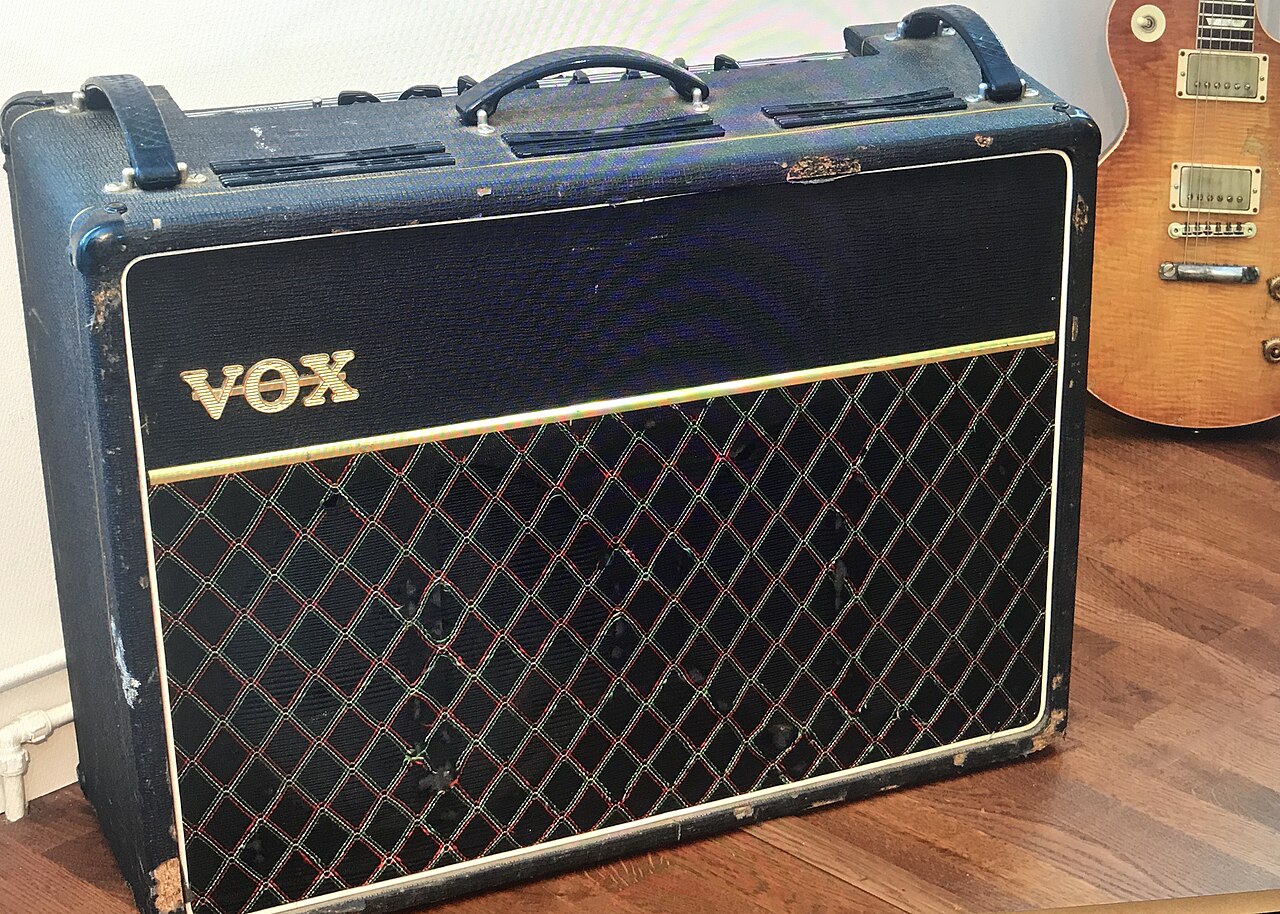
- The front of a Vox AC30 amplifier: Johnsamps, Wikimedia Commons, CC BY-SA 4.0.
- Rory Gallagher: Heinrich Klaffs, Wikimedia Commons, CC BY-SA 2.0.
- The Edge: iinchicore, Wikimedia Commons, CC BY-SA 4.0.
Latest News
Related

On This Day
Monday 9 November
From this week: