Elmore James Guitars & Gear: The Complete Guide to the King of Slide Guitar’s Kay K-6000, DeArmond Pickups & Dust My Broom Tone
Elmore James guitars & gear: King of Slide Guitar. Kay K-6000 flat-top with DeArmond Rhythm Chief 1000, modified amp, open D tuning — Dust My Broom complete slide blues guide.
The most influential slide guitar sound in the history of the electric blues was produced by a budget flat-top acoustic from the Kay Guitar Company of Chicago, fitted with two DeArmond pickups in a configuration that no one had previously attempted and that Elmore James assembled himself with the radio repairman’s knowledge of what electronics could do when applied creatively to a problem that existing commercial solutions hadn’t solved. The Kay K-6000 “Western Rhythm” had a DeArmond RHC-B pickup mounted in the soundhole — backwards, the sunken pole piece incorrectly positioned under the A string rather than the B — and a DeArmond Rhythm Chief 1000 archtop pickup mounted on the top of the guitar between the soundhole and the bridge, with the control box screwed to the treble side of the bridge and hanging down. The initials “EJ” were set in rhinestones on the bass-side upper bout, because Elmore James knew who he was and wanted the guitar to confirm it. He plugged this specific improvised instrument into whatever amplifier the specific session or stage provided — the Harmony H440 at Robinson’s New York studio for the Fire sessions (Ry Cooder’s specific identification), the Magnatone he appears with in photographs, the Gibson GA-53 that his cousin Homesick James stated he used. He modified the amplifiers himself, with the radio repairman’s skill, producing “raw, distorted sounds that wouldn’t resurface until the advent of heavy rock amplification in the late ’60s.” He tuned the Kay to open D — D A D F# A D — and put the glass slide (an old bottleneck, worn on the pinky finger) across the strings, and played the specific riff that Robert Johnson had recorded in 1936 as “I Believe I’ll Dust My Broom” — electrified, amplified, distorted, made louder and rawer and more aggressive than Johnson or anyone else had previously played it. “Dust My Broom” was released in 1951 on the Trumpet label. It became a national R&B hit. The sound was unlike anything anyone had heard from a guitar, because no one had previously taken a budget flat-top acoustic and fitted two DeArmond pickups in the specific improvised configuration that James had assembled with the radio repairman’s knowledge and the Delta bluesman’s feeling. The Kay K-6000. The DeArmond Rhythm Chief 1000. The initials in rhinestones. The open D. The glass slide on the pinky. The amp modified to distort. The most influential slide guitar sound in the history of the electric blues.
Elmore James was born Elmore Brooks on January 27, 1918, in Richland, Mississippi, near Canton in the Mississippi Delta. He died on May 24, 1963, in Chicago, of a heart attack, at the age of forty-five — three days before he was scheduled to inaugurate the new Copa Cabana Club in Chicago, within weeks of the British Invasion’s first American chart appearances, and within a year of the specific moment when the Rolling Stones, the Animals, the Yardbirds, and Fleetwood Mac would make the Elmore James catalogue the foundational text of British blues-rock. “In less than a year a bunch of white English boys were going to arrive in the country to help the general public rediscover one of the greats of the blues.” He didn’t live to see it. He had been the King of the Slide Guitar. He was forty-five years old. The British boys were already rehearsing his riffs in suburban London. He died three days before the gig. The Copa Cabana Club opened without him. The British Invasion arrived without him. The blues revival that gave Muddy Waters and Howlin’ Wolf the international recognition they had been denied became one of the great historical what-ifs of Elmore James’s biography: what would the blues revival have given to the guitarist who had done more than anyone to electrify the Delta slide tradition if he had lived another five years? The question has no answer. The Kay K-6000 with the rhinestone initials provides the closest available approximation.
The first instrument Elmore James ever played was a diddley bow — the one-string wire stretched between two nails on a wall that appears in this series in James “Blood” Ulmer’s entry as the conceptual ancestor of the harmolodic unison tuning. In the Elmore James context, the diddley bow is the specific foundational instrument of the Delta blues guitar tradition: the simplest available string instrument, the instrument that every child in the Mississippi Delta who couldn’t afford a guitar could make from a piece of wire and two nails, producing the single-string blues that was the precursor to the full guitar approach. “By the age of 12, Elmore was experimenting with a ‘diddly bow’… By his teens, he was performing at local clubs and dances under the name Cleanhead.” The nickname “Cleanhead” — from the shaved head — is the specific physical document of the young Elmore Brooks’s emerging musical identity. Some time after the diddley bow, he constructed a multi-stringed instrument consisting of broom wire stretched over an old lard tin — the homemade guitar, the next stage in the instrument progression. The diddley bow, the lard-tin guitar, the guitar from Sonny Boy Williamson. Each stage bringing him closer to the Kay K-6000 with the rhinestone initials and the two DeArmond pickups and the radio-repairman-modified amp on eleven.
Robert Johnson is the specific individual who changed the trajectory of the Elmore James career: “It was Johnson who inspired James to specialise in bottleneck, or slide, blues.” The meeting with Robert Johnson in the Mississippi Delta in the 1930s — before Johnson’s death in 1938, before the mythology had fully calcified around him — introduced the young James to the specific physical technique of the metal sleeve on the finger moving across the fretted strings, producing the sustained, bending, vocal-adjacent notes that the Delta slide tradition had developed from the earliest acoustic guitar approaches. Johnson showed him the technique. Johnson’s 1936 recording of “I Believe I’ll Dust My Broom” provided the specific riff that Elmore James electrified in 1951 and made the most recognizable slide riff in the history of the electric blues. The student outlived the teacher by twenty-five years and made the teacher’s riff the defining statement of the postwar electric slide guitar. This is the specific chain of transmission: Johnson’s riff, taught to James in the Delta, electrified by James through the DeArmond pickups and the modified amplifier, then transmitted to Brian Jones and Jeremy Spencer and Eric Clapton and Stevie Ray Vaughan and every subsequent slide guitarist who has ever put a bottleneck on a finger and opened a string to D.
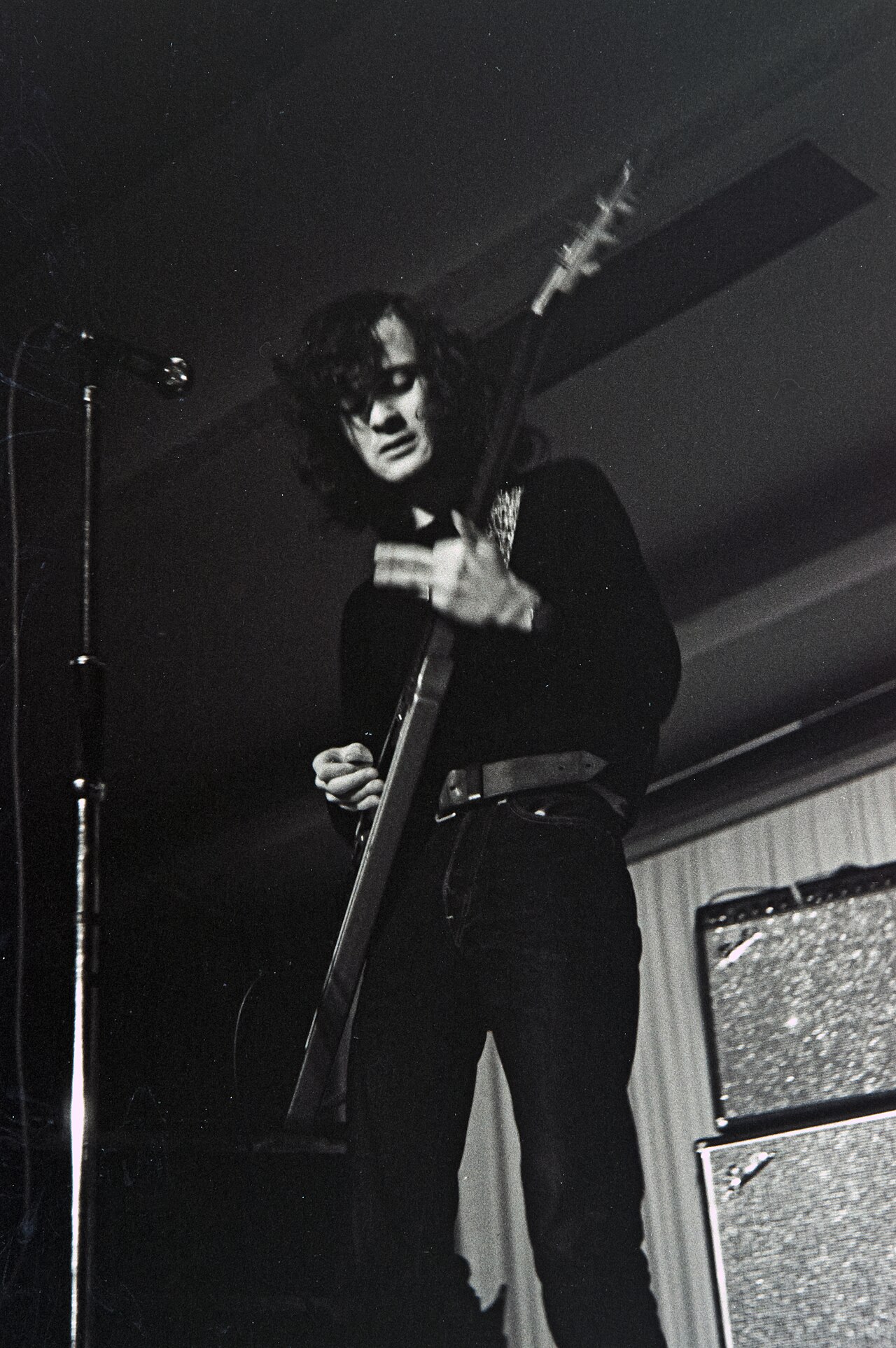
Background: The Delta Diddley Bow, Robert Johnson’s Riff, the Navy, and the Radio Repairman Who Turned His Amp to Eleven
The radio repairman background is the specific technical education that gave Elmore James the capability to do what no other blues guitarist of his era was doing with amplification. James worked at Holston’s radio repair shop in Canton, Mississippi — his adopted brother Robert Holston’s business — learning the specific electronics knowledge that the radio repair trade required. This knowledge, applied to guitar amplifiers, produced the specific distortion and echo effects that James began experimenting with before the commercial guitar amplifier industry had developed the specific high-gain, overdriving character that would eventually become the standard rock guitar amplifier approach. “A radio repairman by trade, he experimented with various amplifier hookups, making his guitar not only louder but also capable of tonal distortion and echo effects.” The tonal distortion and echo effects: the specific sonic qualities that would not reappear in mainstream rock guitar amplification until the British Invasion bands and the subsequent heavy rock era of the late 1960s. James had them in the early 1950s because the radio repairman understood the electronics that produced them and the Delta bluesman understood the specific emotional impact they added to the slide guitar’s already expressively extreme character. The radio repair shop was the technical education. The Delta blues was the musical motivation. The Kay K-6000 with the modified amp was the result.
Sonny Boy Williamson II — the harmonica player Aleck Miller, born near Belzoni, Mississippi, who became one of the most celebrated blues harmonica players of the postwar period — is the specific professional partner who shaped the early Elmore James career. James played on radio shows with Williamson in Belzoni and Helena, Arkansas; Williamson played harmonica on “Dust My Broom” at the first James recording session for the Trumpet label in 1951; and the professional relationship between the two remained significant through the early portion of James’s recording career. Williamson’s specific blues harmonica approach — the bending, the rhythmic drive, the emotional directness — was the natural complement to the James slide guitar approach in the small-ensemble blues format.
Ike Turner’s role in the Elmore James career is the specific commercial chapter that followed the Trumpet Records breakthrough: Turner, working as a scout for the Flair Records label (and not yet famous as the Ike of Ike and Tina), signed James for Flair after the success of “Dust My Broom.” It was with Flair and later Chess and Fire Records that James recorded the most iconic songs of the middle career: “It Hurts Me Too,” “The Sky Is Crying,” “Look on Yonder Wall,” “Done Somebody Wrong,” and “Shake Your Moneymaker.” Each of these songs became, in the subsequent decade, one of the most covered blues songs in the British rock tradition — the specific Elmore James catalogue that the Rolling Stones and the Yardbirds and Fleetwood Mac and the other British blues-rock bands used as the foundational text of their own approach.
The WWII Navy service — 1943 to 1945, as a coxswain during the invasion of Guam — placed James in one of the most violent and historically significant military engagements of the Pacific theatre, returning as a decorated veteran to the Mississippi Delta blues scene. The war interrupted the developing career; the return as a veteran with the specific technical confidence of a man who had survived the Guam invasion accelerated the radio repairman’s experimentation with amplifier modification. The specific connection between the WWII experience, the Navy’s electronics training that complemented the radio repair shop knowledge, and the development of the distorted amplifier approach is not documented in detail but is implicitly present in the specific technical sophistication of what James was doing with amplification in the late 1940s and early 1950s.
The Rig: Elmore James’s Guitars, Amps, and Effects
Guitars
Elmore James’s primary and most historically significant guitar was the Kay K-6000 “Western Rhythm” — a budget flat-top acoustic guitar from the Kay Guitar Company of Chicago, distinguished from its factory specification by the specific improvised pickup installation that James had fitted himself. The Kay K-6000 featured crude X-bracing of the top that contributed to the specific acoustic resonance character of the instrument — the combination of the X-bracing’s acoustic character with the two DeArmond pickups’ specific electromagnetic capture of the string vibration producing the specific hybrid acoustic-electric tone that distinguished James from the purely electric archtop players who used conventional magnetic pickup guitars for their electric blues. The guitar also had a trapeze tailpiece attached to it, used to hold the strings instead of the original bridge — another improvised modification that altered the string tension and the acoustic character of the instrument. He had his initials “EJ” set in rhinestones on the bass-side upper bout. This was not a signature model made for Elmore — it was simply a guitar that he owned and happened to use frequently and personalized with the rhinestone initials that announced whose guitar it was. The Kay K-6000 with the rhinestone EJ: the most recognizable specific guitar associated with any blues musician of the postwar electric era, because every photograph of James on stage or in the recording studio shows the same specific flat-top with the rhinestone initials and the unusual pickup installation.
The first of the two DeArmond pickups on the Kay K-6000 was a DeArmond RHC-B soundhole pickup — mounted in the soundhole of the flat-top acoustic, but incorrectly: “the sunken pole piece should be under the B string not the A string,” as the S. Nathaniel Adams research documents. The backwards mounting — whether intentional or accidental — is part of the specific character of the Elmore James improvised pickup installation: the radio repairman’s experimental approach to mounting a pickup that was designed for archtop f-hole use in the soundhole of a flat-top, in the configuration that produced the specific tonal character of the “Dust My Broom” recordings. The DeArmond RHC-B’s specific character mounted in the soundhole position captured the acoustic resonance of the flat-top body along with the string vibration, contributing the acoustic warmth and body resonance to the pickup signal that a standard bridge pickup would not capture.
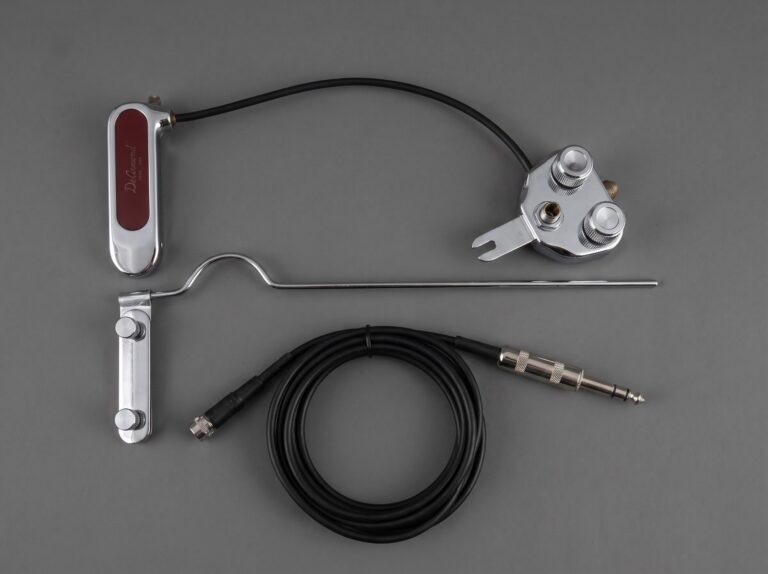
The second and primary DeArmond pickup — the one most directly responsible for the specific recorded Elmore James tone — was the DeArmond Rhythm Chief 1000, mounted on the top of the guitar between the soundhole and the bridge, with the control box (volume, tone, and “Rhythm Switch”) screwed down onto the treble side of the bridge and hanging down from it. The Rhythm Chief 1000 was introduced in 1948 and was intended for archtop f-hole acoustics — designed to clip onto the f-hole and convert an acoustic archtop to electric use. James mounted it onto the top of his flat-top Kay in a position that no standard installation would have suggested, placing the pickup in the specific location between the soundhole and the bridge that captured the string vibration at the point where the flat-top’s acoustic resonance was most pronounced. The combination of this position with the flat-top Kay’s crude X-bracing produced the specific “unique and iconic sound” that the Equipboard documentation identifies. The Rhythm Chief 1000’s specific character at this position: “if you play at too loud a volume, or too much gain on the amp, the tone gets thin and spiky/screachy” — which is exactly the specific “screaming” quality of the extreme distortion that James’s modified amplifier could produce at its highest volumes. The control of the amp gain was essential to maintaining the specific Elmore James tone at its most effective range.
In some photographs, James appears with a Silvertone 1361 — one of the Sears, Roebuck-sold budget electric guitars of the 1950s, in the Kay/Harmony production tradition. The Silvertone’s more conventional electric guitar design provided a different tonal character from the Kay K-6000’s improvised acoustic-electric hybrid, suggesting that James was not exclusively committed to the specific Kay K-6000 configuration for all performance contexts.
Amps
Ry Cooder — the slide guitar master who has studied the Elmore James approach as thoroughly as any subsequent musician — believes James used a Valco-made Harmony H440 for the Fire sessions at Robinson’s New York studio “because it was a house amp at Robinson’s.” The Harmony H440 is a small valve (tube) amplifier from the Valco manufacturer — the Chicago-based amplifier and guitar company that built instruments and amplifiers for Harmony, National, Supro, and other budget brands during the 1950s. The Valco-made H440’s specific character: a small tube combo amplifier with the specific warm, compressed quality of the smaller Valco tube designs, capable of producing the specific natural overdrive and compression at relatively modest volume levels that the Kay K-6000’s DeArmond pickup output combined with James’s modified circuit to produce the “raw, distorted sounds” that the EBSCO historical documentation describes.
James is photographed with a Magnatone amplifier — possibly the Model 280. The Magnatone amplifier line — known for its specific vibrato circuit and its warm, chimey tube character — would have provided a different tonal character from the Valco/Harmony H440, with the Magnatone’s specific warm tube amplification and vibrato option adding additional expressive tools to the James live performance context. The Magnatone’s vibrato applied to the slide guitar’s already trembling, bending notes would have added the specific pitch modulation of the amplifier’s vibrato to the pitch modulation of the slide’s physical movement across the strings — tremolo on tremolo, vibrato on vibrato, the specific over-expressiveness that the King of the Slide Guitar’s “loud amplification and distant tone” (as the historical description identifies) required.
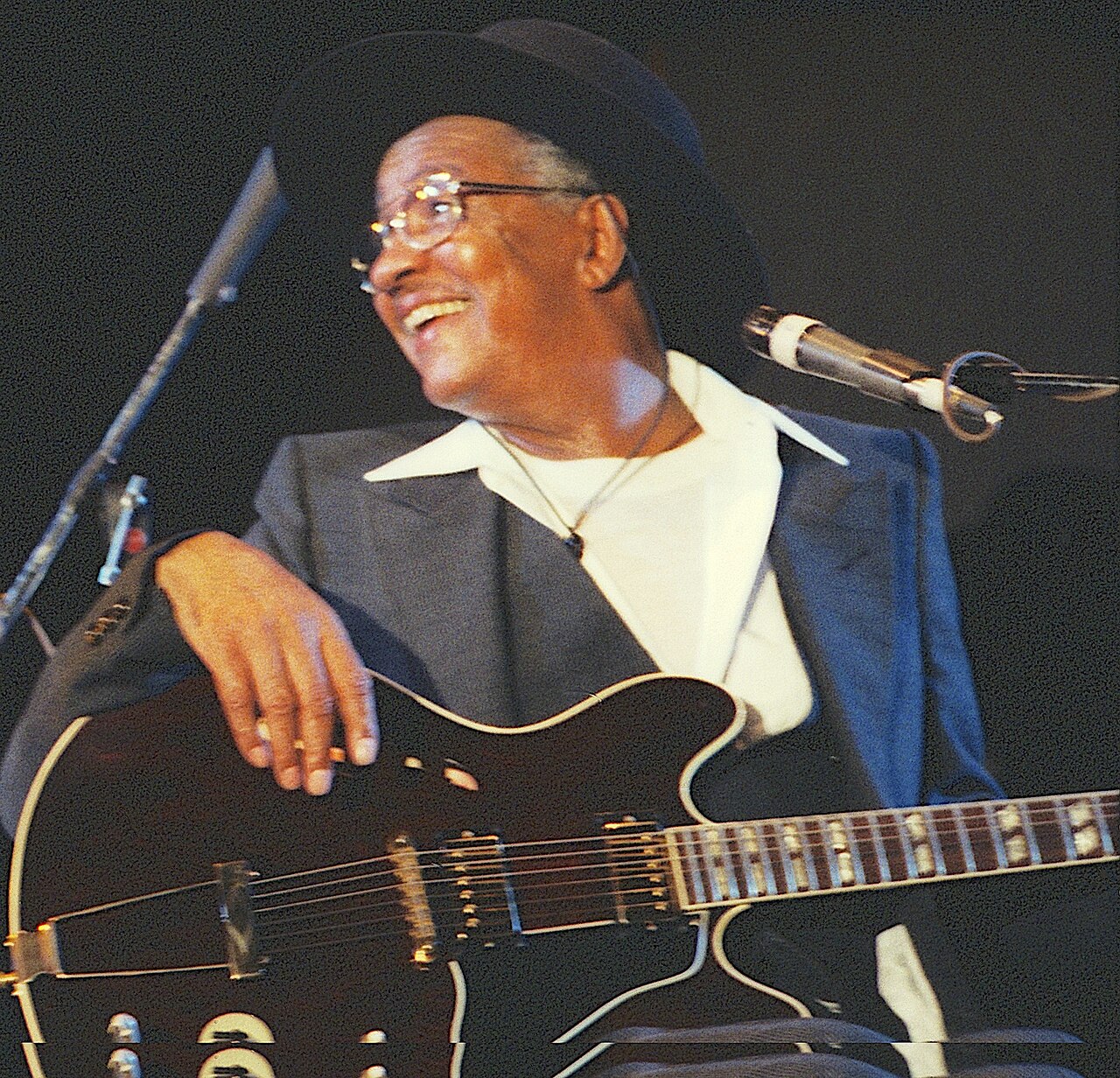
Homesick James — Elmore’s cousin, who backed him on rhythm guitar or bass throughout the career — stated that James used a Gibson GA-53 amplifier. The Gibson GA-53 is a tube combo amplifier from the Gibson tube amplifier line, providing the warm, mid-focused quality of Gibson’s tube amplification designs. Additionally, the Gibson TwoTone GA-30 has been speculated as another amplifier in the James collection. The range of documented amplifiers — the Harmony H440, the Magnatone, the Gibson GA-53, and the Gibson GA-30 — confirms the pattern of a working musician who used available amplification in the specific recording and performance contexts encountered rather than maintaining exclusive commitment to a single amplifier model.
The specific amplification approach that distinguishes Elmore James from every other electric blues guitarist of his era is the radio repairman’s modification of the amplifiers he used — the specific technical knowledge that allowed him to “experiment with various amplifier hookups, making his guitar not only louder but also capable of tonal distortion and echo effects.” These modifications produced “raw, distorted sounds that wouldn’t resurface until the advent of heavy rock amplification in the late ’60s.” The radio repair trade provided the technical education; the Delta blues provided the musical motivation; and the specific combination produced distorted electric guitar amplification approximately fifteen to twenty years before the commercial guitar amplifier industry had developed the high-gain amplifiers that made similar distortion commercially available. The amp modification is not documented in circuit-level detail — what specific modifications James made to the specific amplifiers he used remains incompletely known — but the specific tonal result is documented on every Elmore James recording from “Dust My Broom” onward: the raw, distorted, aggressively amplified slide guitar sound that defined the postwar electric blues and that Brian Jones and Jeremy Spencer and Eric Clapton and Stevie Ray Vaughan heard as the fundamental sound they wanted their guitars to make.
Effects and Technique
Open D Tuning (D-A-D-F#-A-D — Primary Slide Tuning)
Elmore James employed open D tuning (D A D F# A D) as his primary tuning — the specific open tuning that produces a complete D major chord from all open strings, enabling the slide to produce a full major chord at any position on the neck by pressing across all six strings at the same fret. Open D is one of the two most common open tunings for slide guitar (the other being open G, which Hooker used for “Crawlin’ Kingsnake” in the previous entry), and its specific character — the D as the root note providing the full warmth of the D major chord across the full frequency range of the guitar’s six strings — produces the specific resonant, full-chord harmonic foundation beneath the slide’s melodic movement. The “Dust My Broom” riff — the most recognizable slide riff in the history of the electric blues — is played in open D, the slide moving from the open strings up through the specific positions that produce the characteristic ascending riff pattern.
Glass Slide / Bottleneck (Worn on Pinky Finger)
James used a glass slide — typically an old bottleneck, following the Delta blues tradition of using the neck of a broken bottle as the slide — worn on the pinky finger of the fretting hand. The pinky-finger position is the specific physical choice that allows the remaining four fingers to fret the strings independently when the slide is not in use, providing the ability to play non-slide fretting simultaneously with slide playing — switching between the slide’s characteristic gliding, bending, sustaining character and the fretted notes’ precise, stopped character within the same musical phrase. “James used a glass slide, often an old bottleneck, to achieve a warm yet biting tone that cut through band mixes. His slide technique emphasized aggressive attacks and wide bends, frequently wearing the slide on his pinky finger to allow fretting and picking with the other fingers, enhancing rhythmic drive and melodic phrasing.” The aggressive attacks: the specific physical energy of the slide application that distinguishes the James approach from the smoother, more controlled slide technique of Robert Nighthawk or Earl Hooker. “Others may have had more technique — Robert Nighthawk and Earl Hooker immediately come to mind — but Elmore had the sound and all the feeling.”
The Signature Riff (The Most Recognizable Slide Lick in Blues)
The Elmore James signature riff — the electric updating of Robert Johnson’s “I Believe I’ll Dust My Broom” — is the specific combination of the open D tuning’s harmonic foundation, the glass slide’s specific gliding character on the Kay K-6000’s acoustic-influenced string response, and the DeArmond Rhythm Chief 1000’s specific tonal character that produced “one of the most recognizable sounds in blues history.” The riff has been played in “infinite variations from day one to his last session” — James returned to the specific riff pattern across his entire recorded career because it was not a lick he had learned but a statement he had made, a declaration of the specific slide guitar identity that no other variation fully captured. “No one attempting to play slide guitar can do it without being compared to Elmore James.” This is the most specific available statement of the riff’s centrality to the entire subsequent slide guitar tradition: the comparison is inescapable because the riff is the foundational statement, the first fully realized electric slide expression of the Delta blues tradition.
Playing Style & Tone Philosophy
Elmore James plays guitar with the specific combination of maximum emotional intensity and technical improvisation that the radio repairman’s knowledge of electronics and the Delta bluesman’s knowledge of feeling produces. “As a guitarist, he is notable for loud amplification and a distant tone” — the “distant tone” being the specific quality of the acoustic-electric hybrid approach, the flat-top Kay’s acoustic resonance through the DeArmond pickups producing a tonal character that is neither purely acoustic nor purely electric but something in between: present enough to cut through a band mix, acoustically warm enough to retain the Delta blues’ natural resonance, raw enough from the modified amp’s distortion to convey the “violent expressiveness” that the Allmusic description identifies as James’s most distinctive quality.
“James was not a subtle player — his approach to the guitar was direct, forceful and filled with violent expressiveness.” The violent expressiveness is the specific quality of the wide bends, the aggressive slide attacks, the amp-at-eleven approach that the radio repairman’s modifications enabled, all applied to the open D tuning’s resonant harmonic foundation through the DeArmond pickups’ specific tonal character. The subtlety of Jim Hall or Kenny Burrell or Charlie Byrd — the various jazz guitarists who appear earlier in this list — is the complete opposite of the Elmore James approach. James’s philosophy was the maximum available expression: the loudest available amplification, the most aggressive available slide attacks, the widest available string bends, the most distorted available amp tone. And yet within the maximum expression, the feeling — “Others may have had more technique, but Elmore had the sound and all the feeling.” The feeling is not the violence; the feeling is what the violence is in service of. Every aggressive attack is in service of the specific emotional content of the blues that Robert Johnson showed him and that Will Moore’s Mississippi church community had provided the foundational emotional framework for. The violence expresses the feeling. The feeling is the blues.

The single-string work that distinguishes the later Elmore James recordings — “his seldom-heard single-string work had an equally profound effect on B.B. King and Chuck Berry” — is the less celebrated dimension of the James guitar identity, the bebop-adjacent single-note melodic approach that the open D tuning and the slide enabled alongside the full-chord riff work. B.B. King’s specific single-string expressive approach, which would become the foundational reference for the subsequent generation of rock lead guitarists, traces a specific lineage to the James single-string work that preceded it. Chuck Berry’s specific single-note riff approach, which defined the rock and roll guitar vocabulary, similarly acknowledges the James influence. The King of the Slide Guitar was also, in the single-string dimension, an influence on the two guitarists who most directly shaped the rock guitar’s melodic vocabulary.
How to Sound Like Elmore James
The Elmore James tone requires: a budget flat-top acoustic (Kay K-6000 if you can find one, or any equivalent budget 1950s acoustic); a DeArmond Rhythm Chief 1000 pickup mounted between the soundhole and the bridge on the top of the guitar (not in the soundhole), with the control box at the bridge; open D tuning (D A D F# A D); a glass slide (old bottleneck, worn on the pinky finger); a small tube amplifier (Valco-built Harmony or equivalent) modified for natural overdrive and distortion; and the specific aggressive attack and wide bends of the Delta slide tradition filtered through the radio repairman’s understanding of how to make an amplifier do more than the manufacturer intended. The emotion is not in the equipment list. The equipment is in service of the emotion.
| Control | Setting (0–10) | Notes |
|---|---|---|
| Small Tube Amp — Modified (Harmony H440 / Valco / Magnatone) | Volume: 8–10; pushed hard into natural overdrive | “A radio repairman by trade, he experimented with various amplifier hookups, making his guitar not only louder but also capable of tonal distortion and echo effects.” Push the small tube amp hard — the natural distortion of the tube output stage pushed beyond its clean range is the Elmore James distortion, not a pedal but the amplifier itself. The radio repairman modified the circuit; you can approximate it by running the small amp loud. The distortion should be raw, not smooth. |
| Open D Tuning (D A D F# A D) | Full open D chord from all open strings | The primary Elmore James tuning. All six strings in open D: the full D major chord from the open position, the slide producing a full major chord at every fret position. The “Dust My Broom” riff lives in this tuning — the open strings ringing, the slide moving up to the specific positions of the riff pattern. Open D is the foundation of everything. |
| DeArmond Rhythm Chief 1000 (Mounted on Top of Acoustic) | Between soundhole and bridge; control box at treble side of bridge | The specific improvised pickup installation: the Rhythm Chief 1000 mounted on the top of the flat-top acoustic, not in the soundhole. The position between soundhole and bridge captures the string vibration and the acoustic resonance simultaneously. At controlled amp volumes, the tone is warm and biting; at high volumes, it “gets thin and spiky/screachy” — the specific screaming extreme of the James distorted sound. |
| Glass Slide on Pinky (Aggressive Attack) | Wide bends; aggressive contact; pinky position | Old bottleneck glass slide on the pinky finger of the fretting hand. The other three fingers remain available for fretted notes. “His slide technique emphasized aggressive attacks and wide bends.” Attack the string aggressively with the slide — not the gentle caress of the Hawaiian slide tradition but the violent, hard contact of the Delta blues approach. The wide bends produce the “screaming” quality. The aggressive attack produces the cutting, present tone that “cut through band mixes.” |
| The Dust My Broom Riff (Primary Statement) | Open D; ascending; slide from open to fifth to seventh | The signature riff — an electric updating of Johnson’s 1936 original. In open D tuning, the riff moves from the open position through the specific fret positions that produce the characteristic ascending pattern. “No one attempting to play slide guitar can do it without being compared to Elmore James.” Learn this riff first. Then vary it. Then vary it again. James played it in “infinite variations from day one to his last session.” The riff is not a cliché to be avoided; it is the foundational statement to be internalized and then developed. |
| Violent Expressiveness (Emotional Philosophy) | Maximum feeling; not subtle; all the way | “James was not a subtle player — his approach to the guitar was direct, forceful and filled with violent expressiveness.” Others may have had more technique. Elmore had the sound and all the feeling. The sound IS the feeling. The distorted amp, the aggressive slide, the wide bends: all of these are not technical choices but emotional statements. The violence in service of the feeling. The feeling IS the blues. Play it like you mean it. Mean it completely. |

Influence & Legacy
Elmore James’s influence on the electric guitar is the influence of the specific individual who completed the journey from the diddley bow to the electrified Delta blues — who took the single string of the wire stretched between two nails on a wall, the homemade lard-tin guitar, the acoustic riffs of Robert Johnson and Tampa Red, and the Delta slide tradition, and electrified them through the improvised pickup installation on the Kay K-6000 and the radio repairman’s modified amplifier into the sound that every subsequent electric slide guitarist has been measured against. “No two ways about it, the most influential slide guitarist of the postwar period was Elmore James, hands down… in just about every guitar player who puts a slide on their finger and wails the blues.” This is not hyperbole. It is the statement of the specific technical reality: the electric slide guitar vocabulary — the open tuning, the glass slide, the aggressive attack, the wide bends, the amp pushed past clean, the acoustic-electric hybrid pickup approach — was assembled by Elmore James in the early 1950s from the available materials (the Kay K-6000, the DeArmond pickups, the Harmony H440, and the radio repairman’s knowledge), and every subsequent slide guitarist’s approach exists in direct relationship to what James assembled.
Brian Jones of the Rolling Stones, Jeremy Spencer of Fleetwood Mac, and Alan Wilson of Canned Heat “all credit Elmore with helping create their guitar sounds” — the three most specifically James-identified British rock slide guitarists, each of whom heard the Kay K-6000 recordings and understood them as the template for everything they wanted the slide guitar to do. Eric Clapton covered “It Hurts Me Too.” Stevie Ray Vaughan covered “The Sky Is Crying” and “Done Somebody Wrong.” George Thorogood’s entire career is an extended homage to the Elmore James approach. Hound Dog Taylor, J.B. Hutto, and John Littlejohn are the direct blues successors. B.B. King and Chuck Berry absorbed the single-string dimension. The rolling influence through the subsequent seventy years of popular music is incalculable.
He died three days before the gig. He was forty-five years old. The British boys arrived less than a year later and covered his songs and brought him to an international audience that he never lived to receive. The Rock and Roll Hall of Fame inductees list includes his name. The Rolling Stones covered his riff. The Doors covered Hooker who acknowledged James. The most recognizable slide riff in the history of the electric blues is the riff Robert Johnson recorded in 1936 that Elmore James electrified in 1951 through the Kay K-6000 with the rhinestone EJ initials and the two DeArmond pickups and the radio-repairman-modified amp. This is where the guitar tradition — as documented in this series of one hundred articles from Scott Gorham to Elmore James — connects back to its beginning: the broom wire on the lard tin, the diddley bow on the wall, the Delta blues at the source. One hundred guitarists. A hundred ways to play the same six strings. The King of the Slide Guitar was making his guitar from broom wire when he was twelve. He was electrifying Robert Johnson’s riff at thirty-three. He was dead at forty-five. The series ends here — at the beginning. For the British Invasion that picked up the Elmore James tradition and carried it into the 1960s, see the rock guitarists who open this series — the Scott Gorhams and Brian Robertsons and Paul Kossoffs at entries one through ten, all of whom trace their foundational electric guitar identity through the British blues revival to the Delta slide tradition that Elmore James brought into the electric era. The line runs from the diddley bow to the Thin Lizzy twin-lead at #1. Everything in between is in this series. For the Delta blues roots tradition that produced the John Lee Hooker at #99 and the James Blood Ulmer at #98, both of whom cite the same Mississippi musical culture as their foundational formation, the series has now completed the complete arc from the Delta source to the contemporary avant-garde. Every entry connects. John Lee Hooker at #99 got his first electric from T-Bone Walker in Detroit — and T-Bone Walker’s single-string Texas blues tradition connects back to the same Delta source that shaped Elmore James. The diddley bow. The broom wire. The lard tin. The rhinestone EJ on the Kay K-6000. The glass slide on the pinky. Open D. The riff. Dust My Broom. This is where it ends. This is where it started.
Frequently Asked Questions: Elmore James Guitars & Gear
What guitar did Elmore James use?
Elmore James’s primary and most historically significant guitar was a Kay K-6000 “Western Rhythm” flat-top acoustic, fitted with two DeArmond pickups that he installed himself using his radio repairman’s knowledge: a DeArmond RHC-B soundhole pickup (mounted backwards in the soundhole) and a DeArmond Rhythm Chief 1000 archtop pickup mounted on the top of the guitar between the soundhole and the bridge, with its control box screwed to the treble side of the bridge. He had his initials “EJ” set in rhinestones on the bass-side upper bout. He was also photographed with a Silvertone 1361. The Kay K-6000 with the improvised pickup installation is the most iconic guitar associated with any postwar electric blues musician.
What amplifier did Elmore James use?
Elmore James used several amplifiers. For the Fire Records sessions at Robinson’s New York studio, Ry Cooder believes he used a Valco-made Harmony H440 (the house amp at the studio). He is also photographed with a Magnatone amplifier (possibly a Model 280). His cousin Homesick James stated that he used a Gibson GA-53. A Gibson TwoTone GA-30 has also been speculated. As a radio repairman by trade, James modified his amplifiers to produce distortion and echo effects that “wouldn’t resurface until the advent of heavy rock amplification in the late ’60s” — the technical modification of the amplifier circuitry being as important as the specific model chosen.
What is the Elmore James tuning?
Elmore James’s primary tuning was open D (D-A-D-F#-A-D) — all six strings tuned to produce a complete D major chord from the open position. Open D allows the slide to produce a full major chord at any position on the neck by pressing across all six strings at the same fret. The “Dust My Broom” riff and most of his slide vocabulary are built in open D, with the characteristic ascending riff pattern moving from the open strings through the specific positions of the signature lick.
Why is “Dust My Broom” so significant?
“Dust My Broom” (recorded 1951, released 1952 on Trumpet Records) is Elmore James’s most celebrated recording and the most influential slide guitar recording in the history of the electric blues. The song is an electrified updating of Robert Johnson’s 1936 recording “I Believe I’ll Dust My Broom” — Johnson himself had shown James the bottleneck/slide technique. James’s electric version featured the Kay K-6000 with the DeArmond Rhythm Chief 1000 through a modified tube amplifier pushed into distortion, producing a sound that was “louder, sharper, and more aggressive than anything heard before.” The opening slide riff became “one of the most recognizable sounds in blues history” and the foundational slide guitar statement that every subsequent player has been measured against.
Who influenced Elmore James?
Elmore James’s primary guitar influence was Robert Johnson, who personally showed him the bottleneck/slide technique and whose 1936 recording of “I Believe I’ll Dust My Broom” became the template for James’s defining statement. Sonny Boy Williamson II (Aleck Miller) was his primary professional partner and harmonica influence. Tampa Red was an additional influence on developing the slide sound. The broader Delta blues tradition — absorbed from local gatherings, juke joints, and the oral traditions of the rural South — provided the foundational emotional context.
Who did Elmore James influence?
Elmore James’s influence extends across the full range of blues and rock guitar: Brian Jones (Rolling Stones), Jeremy Spencer (Fleetwood Mac), and Alan Wilson (Canned Heat) all specifically credit James. Eric Clapton covered “It Hurts Me Too.” Stevie Ray Vaughan covered “The Sky Is Crying” and “Done Somebody Wrong.” George Thorogood has built his career around the James approach. His slide guitar influenced Hound Dog Taylor, J.B. Hutto, John Littlejohn, and his cousin Homesick James. His single-string work “had an equally profound effect on B.B. King and Chuck Berry.” He is “the most influential slide guitarist of the postwar period — hands down.”
How and when did Elmore James die?
Elmore James died on May 24, 1963, in Chicago, from a heart attack at the age of forty-five. He was scheduled to inaugurate the new Copa Cabana Club in Chicago three days later. He died before the British blues revival — the Rolling Stones, the Yardbirds, Fleetwood Mac — made the Elmore James catalogue internationally famous in 1964 and after. His contemporaries Muddy Waters and Howlin’ Wolf lived to see and benefit from the blues revival; James did not. He was inducted into the Rock and Roll Hall of Fame posthumously. “Although his early demise from heart failure kept him from enjoying the fruits of the ’60s blues revival… James left a wide influential trail behind him.”
Image credits
- Eric Clapton: MerleEllaPatsy, Wikimedia Commons, CC0 1.0.
- Jeremy Spencer: Herbert Weber, Hildesheim, Wikimedia Commons, CC BY-SA 4.0.
- Ry Cooder: Steve Proctor, Wikimedia Commons, CC BY-SA 4.0.
- Homesick James: Eatonland, Wikimedia Commons, CC BY-SA 4.0.
- DeArmond Rhythm Chief 1000: GuitarGangsters AI-generated reference illustration, not a photograph.