Gibson ES-335: The Complete Guide to the World’s Most Versatile Electric Guitar
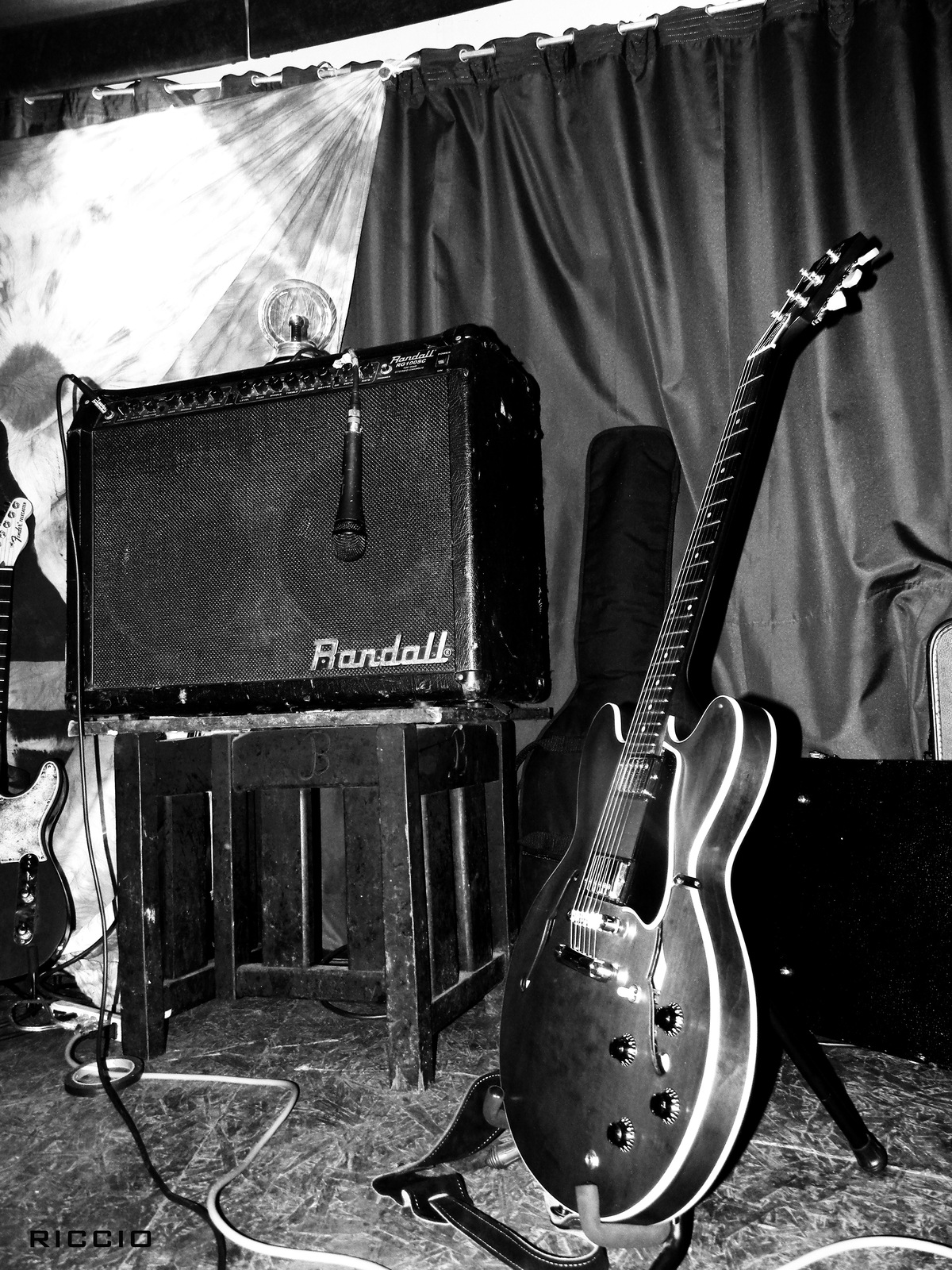
Gibson ES-335 beside a Randall amplifier. Photo: Gibson es-335 by Riccio L (Riccio Leon), CC BY 2.0 (https://creativecommons.org/licenses/by/2.0/). Full frame resized and JPEG re-encoded; original photographer watermark retained. Source: https://www.flickr.com/photos/riccioleon/6020105123/
Gibson ES-335 — the complete deep-dive into the semi-hollow that does everything. History, tone secrets, legendary players, settings, buying guide, and why it's the most versatile guitar ever.
There’s a moment every guitarist has — standing in front of an amp, flipping through sounds, trying to find the one guitar that can do everything. The Stratocaster sparkles but can’t get dark enough. The Les Paul roars but won’t clean up completely. The jazz box sounds gorgeous but feeds back the second you push the volume past noon. And then you pick up a Gibson ES-335, and the argument is over.
Since 1958, the ES-335 has been the great compromise that isn’t a compromise at all. It is the guitar that Chuck Berry used to invent rock and roll. The guitar that Larry Carlton turned into a jazz institution on “Kid Charlemagne.” The guitar that Eric Clapton wielded through Cream’s Goodbye album. The guitar that B.B. King named Lucille (well, almost — his was a custom ES-355, but the DNA is identical). The guitar that Dave Grohl straps on when the Foo Fighters need to sound bigger than physics should allow.
The ES-335 is not the best guitar for any single thing. It is the best guitar for everything.
Origin Story: The Best of Both Worlds
By 1957, Gibson president Ted McCarty had a problem. His solid-body guitars — the Les Paul, the SG predecessor, the Junior and Special — were brilliant at high-volume rock and blues but lacked the warmth and acoustic resonance of the company’s archtop hollowbodies. Meanwhile, those gorgeous hollowbodies — the L-5 CES, the ES-175, the ES-350 — sounded incredible at jazz volumes but screamed with feedback the moment a player cranked the amp.
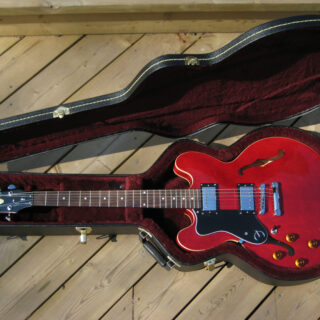
McCarty’s solution was elegantly simple. Take a thinline, double-cutaway hollowbody and run a solid block of maple through the center of the body, directly underneath the strings and pickups. The solid center block would suppress feedback and provide sustain comparable to a solid-body. The hollow “wings” on either side would vibrate freely, adding warmth, resonance, and a woody airiness that solid-bodies couldn’t achieve. Two f-holes in the laminated maple top allowed the hollow chambers to breathe acoustically.
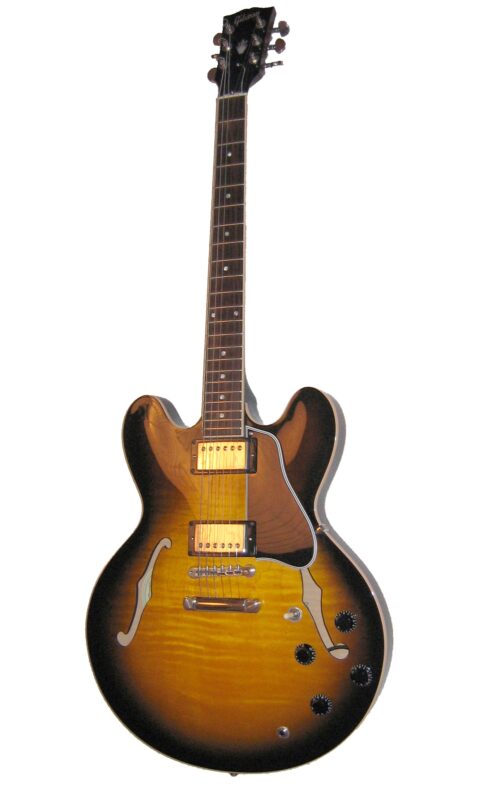
The result, introduced at the 1958 NAMM show and officially designated the ES-335TD (Electric Spanish, Thinline, Double-pickup), was nothing short of revolutionary. It created an entirely new category of instrument — the semi-hollow body — and guitarists have been arguing about whether it’s the most versatile electric guitar ever made for every year since.
Initially priced at $267.50, the ES-335 was positioned between Gibson’s budget solid-bodies and their premium archtops. Gibson expected jazz players to adopt it first. Instead, it was blues and rock players — Chuck Berry, Freddie King, B.B. King — who immediately recognized what the semi-hollow design offered: a guitar warm enough for expressive blues, loud enough for rock, and feedback-resistant enough to survive a cranked amplifier.
The Sound: Where Hollow Meets Solid
The ES-335’s tonal signature is defined by the interaction between its solid center block and hollow wings. This creates a sound that’s rounder and warmer than a Les Paul but tighter and more focused than a full hollowbody. The notes “bloom” — they start with a defined attack and then open up, spreading into a resonant warmth that seems to fill the space around the guitar. It’s often described as “woody,” “organic,” or “three-dimensional,” and it’s this quality that makes the ES-335 feel alive under your fingers in a way that solid-body guitars can’t quite match.
The Body
A laminated maple top, back, and sides (three-ply on early models, later increased to five-ply) with a solid maple center block running from the neck joint to the tail block. The body is 16 inches wide and 1¾ inches deep — substantially thinner than a traditional archtop but thicker than a solid-body. Double Venetian cutaways provide easy access to the upper frets, with the neck joining the body at the 19th fret. The laminated construction is sometimes dismissed by tonewood purists, but it’s actually a feature: laminated maple is more resistant to feedback and environmental changes than solid wood, contributing to the ES-335’s legendary reliability.
The Pickups
Two PAF-style humbuckers (the specific model varying by era and production series), each with independent volume and tone controls and a three-way toggle switch. The pickup voicing through the semi-hollow body is distinctly different from the same pickups in a Les Paul — warmer, with more harmonic complexity and a slightly compressed midrange that makes the ES-335 sing in a way that’s particularly suited to expressive lead work.
Bridge Pickup: Brighter and more cutting than the neck, but with a roundness and warmth that a solid-body bridge humbucker can’t match. This is the tone of Alvin Lee’s blistering “Going Home” solo at Woodstock — aggressive but never harsh.
Middle Position (Both): Rich, full, and complex. The combination of both pickups through the semi-hollow body produces a wide-frequency tone that works beautifully for rhythm playing across virtually any genre. Many ES-335 players live in this position.
Neck Pickup: Deep, warm, and velvety. This is where the ES-335 approaches jazz territory — roll the tone back slightly and you get a round, woody sound that sits perfectly in a jazz combo mix. Larry Carlton’s legendary tone on Steely Dan recordings comes primarily from the neck pickup of his ES-335, and it’s one of the most beautiful guitar sounds ever committed to tape.
The F-Holes
The violin-style f-holes aren’t just decorative. They allow the hollow wing chambers to resonate acoustically, which contributes to the ES-335’s characteristic warmth and “air.” Played unplugged, the ES-335 produces more volume and acoustic projection than a solid-body — useful for practicing and for adding natural dynamics to your amplified sound.
The Legends: ES-335 Players Across Every Genre
Chuck Berry — The Architect of Rock and Roll
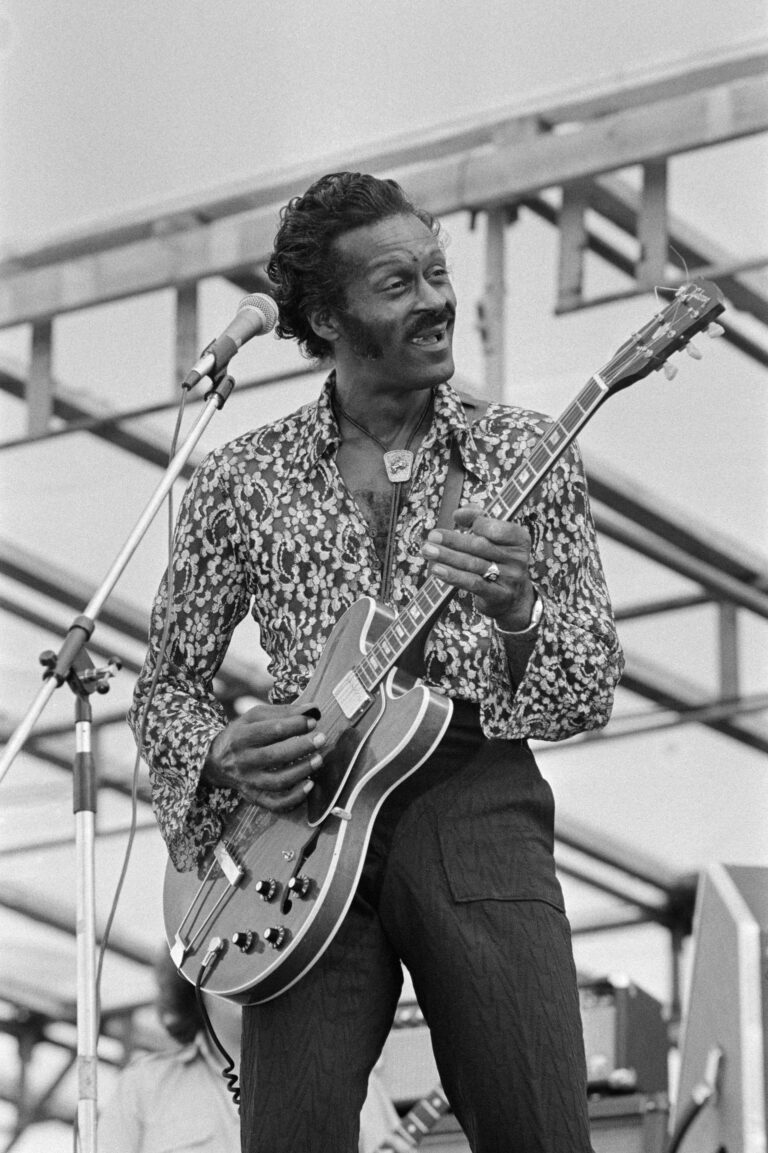
Chuck Berry didn’t just play the ES-335 — he defined rock and roll guitar with it. His rhythmic, doubled-note lead style, showcased on “Johnny B. Goode,” “Roll Over Beethoven,” and “Maybellene,” established the vocabulary that every rock guitarist since has drawn from. Berry’s cherry-red ES-335 (and later ES-355) became as iconic as his duck walk, and its warm-yet-cutting tone proved that the semi-hollow could rock as hard as any solid-body.
Larry Carlton — Mr. 335
No guitarist is more identified with the ES-335 than Larry Carlton, who literally earned the nickname “Mr. 335.” His work as a session guitarist for Steely Dan — particularly the legendary solo on “Kid Charlemagne” — demonstrated the ES-335’s capacity for sophisticated jazz-rock fusion. Carlton’s warm, singing neck-pickup tone through a Fender Deluxe Reverb or Marshall combo became one of the most imitated sounds in 1970s guitar.

B.B. King — Lucille’s Cousin
B.B. King‘s guitar was technically an ES-355 (the upscale sibling with fancier appointments), but the core design is identical to the 335. King’s expressive vibrato, precise string bending, and economical note choice — always the right note, never a wasted one — made “Lucille” the most recognizable guitar in blues history. His tone — the neck humbucker through a Lab Series solid-state amp — was warm, clean, and impossibly vocal.
Eric Clapton — The Cream Years
Eric Clapton used a cherry ES-335 during his time with Cream, and it appears on the Goodbye Cream album. Before fully committing to the Stratocaster, Clapton explored the ES-335’s unique ability to handle both blues expressiveness and rock aggression — making it an important transitional instrument in his evolution from Gibson man to Fender devotee.
Alvin Lee — The Fastest Guitar in the West
Alvin Lee’s red ES-335, covered with stickers and nicknamed “Big Red,” produced one of Woodstock’s most electrifying moments during Ten Years After’s performance of “Going Home.” Lee played with astonishing speed and aggression, pushing the semi-hollow into heavy rock territory and proving that the ES-335 could shred as convincingly as any solid-body.
Dave Grohl — The Modern Rock Champion
Dave Grohl’s adoption of the Gibson Trini Lopez Standard (an ES-335 variant with diamond-shaped f-holes and a six-in-line headstock) for Foo Fighters brought the semi-hollow design back into mainstream rock consciousness. Grohl’s use proves what ES-335 devotees have always known: the semi-hollow can handle volume, distortion, and arena-scale dynamics without breaking a sweat.

The Jazz Masters
John Scofield’s angular, harmonically complex jazz-funk owes much of its tone to his ES-335. Lee Ritenour used one throughout his fusion career. Emily Remler championed the 335 in 1980s jazz. And Noel Gallagher brought the ES-335 into Britpop, using its jangly warmth on Oasis’ later work. The breadth of players — from avant-garde jazz to Britpop — is the ultimate proof of the ES-335’s versatility.
The Eras: A Production Timeline
Dot Neck Era (1958–1962)
The most sought-after ES-335s. Named for the simple dot inlays on the rosewood fingerboard (a marker Gibson typically reserved for budget models, making the 335’s dot necks an anomaly). PAF humbuckers, long-tenon neck joint, Brazilian rosewood fingerboard, and the “Mickey Mouse ear” rounded cutaways that define the early silhouette. Cherry red finish was added in 1959. Dot-neck 335s in good condition command $15,000 to $60,000+ depending on year and specification.
Block Neck Era (1962–1965)
In mid-1962, Gibson upgraded the dot markers to large block inlays for a more upscale appearance. PAF humbuckers gave way to patent-number pickups (sonically similar but with slightly different construction). These are excellent instruments and substantially more affordable than dot-necks — the sweet spot for vintage ES-335 buyers who want pre-CBS quality at manageable prices.
The Transition and CBS/Norlin Era (1965–1985)
Gibson (under Norlin ownership from 1969) made various changes: the neck joint shortened from long-tenon to short-tenon, a walnut center block replaced maple in some years, and construction quality varied. The pointed “Mickey Mouse” cutaways became sharper in the late 1960s. Despite the inconsistency, certain Norlin-era 335s — particularly early examples with good wood — are excellent players at vintage prices that remain accessible.
Modern Era (1985–Present)
Gibson’s Nashville and Memphis facilities have produced consistently excellent ES-335s since the mid-1980s. The Memphis factory (2000–2019) became particularly renowned for semi-hollow production. Today’s Gibson ES-335 lineup includes the Vintage and Original collections with period-correct specifications, and the Modern collection with contemporary features like coil-splitting and asymmetrical neck profiles. The ES-339, introduced in 2007, offers ES-335 tone in a smaller, Les Paul-sized body for players who find the full-size 335 unwieldy.
Popular Settings and Tone Recipes
The Jazz Standard
Pickup: Neck | Volume: 6–8 | Tone: 3–5
Amp: Fender Deluxe Reverb or Fender Twin, completely clean
Pedals: None
Roll the tone knob back to remove treble shimmer, producing a round, warm, woody tone perfect for chord-melody jazz. The semi-hollow body adds natural depth and resonance that solid-bodies can’t replicate. This is the sound of Joe Pass, Barney Kessel, and countless jazz guitarists who’ve adopted the ES-335 as their primary instrument.
The Carlton Fusion
Pickup: Neck or Middle | Volume: Full | Tone: 7–8
Amp: Fender Deluxe Reverb or Marshall combo, just touching breakup
Pedals: Light overdrive — Tube Screamer or Blues Driver with gain low
Larry Carlton’s signature sound: warm, singing sustain with just enough grit to give notes body and presence. The ES-335’s natural compression adds sustain without requiring high gain, producing a tone that sings and sustains while remaining articulate and defined.
The B.B. King Blues
Pickup: Neck | Volume: Full | Tone: 6–8
Amp: Clean solid-state or Fender Twin with moderate volume
Pedals: None
B.B. King‘s approach was deceptively simple: guitar straight into a clean amp, let the fingers do all the work. The ES-335/355’s neck pickup produces a warm, round tone that responds to every nuance of vibrato and bending — which is why King could say more with one perfectly placed note than most guitarists say with a hundred.
The Rock Crunch
Pickup: Bridge | Volume: Full | Tone: Full
Amp: Marshall JCM800 or Vox AC30, pushed hard
Pedals: Tube Screamer as boost
The ES-335’s bridge humbucker through a cranked amp produces a slightly different crunch than a Les Paul — warmer, more open, with a “woody” quality that adds dimension to power chords. Dave Grohl and Noel Gallagher both exploit this quality. The semi-hollow body adds natural resonance that makes big chords sound bigger.
The Indie Shimmer
Pickup: Middle position (both) | Volume: 7–8 | Tone: Full
Amp: Vox AC30, clean to edge-of-breakup
Pedals: Reverb + delay + light chorus
Both pickups combined through a Vox produces a shimmering, complex tone with natural depth and dimension. The ES-335’s resonant body adds a three-dimensional quality to ambient and effects-heavy playing that solid-bodies can’t achieve. This is dreampop and shoegaze territory, explored by bands who’ve discovered that a semi-hollow through effects is an utterly different experience from a solid-body through the same chain.
Perfect Pairings: Gear That Complements the ES-335
Amps
The ES-335’s warmth pairs beautifully with clean Fender amps. A Deluxe Reverb is the classic combination for blues and jazz — its natural breakup complements the semi-hollow’s warmth without ever getting harsh. The Fender Twin provides pristine cleans that let the ES-335’s acoustic resonance shine through. For crunch, a Vox AC30 adds chimey British character, while a Marshall JCM800 pushes the 335 into rock territory with surprising authority. The one caveat: fully hollow guitars feed back at high volumes, but the ES-335’s center block means it can handle surprisingly aggressive levels before feedback becomes an issue.
Pedals
The ES-335 tends to need fewer pedals than a single-coil guitar. Its humbuckers and semi-hollow resonance provide natural warmth and sustain that a Stratocaster needs pedals to achieve. A quality overdrive — Tube Screamer or Blues Driver — is useful for blues and rock lead work. A good reverb pedal exploits the ES-335’s natural resonance beautifully. And a compressor can tighten up the slightly loose low end that some players notice with semi-hollow designs at high volumes.
The ES-335 Family: Related Models
The ES-335 spawned an entire family of semi-hollow instruments, each with its own character:
ES-345: The mid-tier sibling, adding stereo wiring and a six-position Varitone switch for additional tonal options. Modern reissues are mono without Varitone.
ES-355: The luxury version — ebony fretboard, multi-ply binding, gold hardware, and the same Varitone/stereo electronics as the 345. B.B. King‘s “Lucille” is an ES-355 variant.
ES-339: A modern Gibson design that shrinks the ES-335 body to Les Paul dimensions while retaining the semi-hollow construction and center block. Ideal for players who love the 335 tone but find the full-size body too large.
ES-330: Visually similar to the ES-335 but fully hollow with no center block and P-90 pickups instead of humbuckers. A completely different instrument with its own wonderful voice, more suited to jazz and low-volume playing.
Epiphone Dot / Sheraton: Epiphone’s affordable ES-335 equivalents, offering genuine semi-hollow tone at a fraction of the Gibson price.
Buying Guide: Which ES-335 Is Right for You?
Budget Tier ($400–$700)
The Epiphone ES-335 (formerly the “Dot”) delivers authentic semi-hollow tone with ProBucker humbuckers, a laminated maple body with center block, and set mahogany neck. An astonishing value.
Mid-Range ($2,500–$3,500)
The Gibson ES-335 Sixties Cherry and Vintage Sunburst models from the current production line feature MHS (Memphis Historic Spec) or Calibrated T-Type humbuckers, ABR-1 bridge, period-correct appointments, and Gibson’s Nashville craftsmanship.
Smaller Body Alternative ($2,500–$3,000)
The Gibson ES-339 puts ES-335 tone into a more compact body. Same center block construction, same pickup configuration, significantly easier to handle on a long gig.
Custom Shop ($4,000–$10,000+)
Gibson Custom Shop produces historically accurate ’59 and ’63 ES-335 reissues with period-correct PAF-style pickups, Brazilian or Indian rosewood fingerboards, hide-glue construction, and Murphy Lab aging. These are the closest production instruments to vintage dot-neck 335s.
Tips, Mods, and Setup
Feedback management: The ES-335 handles volume well, but at extreme gain levels, the hollow wings can start to resonate uncontrollably. Stuffing a cloth or foam piece through the f-holes into the wing cavities can reduce feedback without significantly affecting tone. Some players use purpose-built feedback suppressors.
String gauge: The ES-335’s 24.75″ scale length and warm voicing respond well to medium-light strings (.010–.046). Heavier gauges can overwhelm the semi-hollow body’s natural resonance; lighter strings may sound thin. Flatwound strings for jazz playing are a natural match with the 335’s warm character.
Pickup height: Because the ES-335’s pickups sit in the solid center block (not the hollow wings), pickup height adjustment follows the same principles as a Les Paul. The neck pickup benefits from being set slightly lower than the bridge to maintain balance between positions.
The “50s wiring” mod: As with the Les Paul, rewiring the tone capacitors in ’50s style allows independent tone and volume operation — rolling off treble without losing output. This mod is particularly useful on the ES-335, where the tone controls see heavy use across genres.
FAQ
What is the difference between an ES-335 and a Les Paul?
The Les Paul is a solid-body guitar — denser, heavier, with more sustain and a tighter, more compressed tone. The ES-335 is semi-hollow — lighter, more resonant, with a warmer, more “open” sound that includes acoustic-like qualities. Both use humbuckers and set necks, but they sound and feel distinctly different.
Is the Gibson ES-335 good for jazz?
The ES-335 is one of the most popular jazz guitars ever made. Its semi-hollow warmth, humbucker smoothness, and acoustic resonance produce the warm, round, woody tone that defines the jazz guitar sound. Larry Carlton, John Scofield, Lee Ritenour, and Emily Remler all used ES-335s as primary jazz instruments.
Does the ES-335 feed back?
Less than a fully hollow guitar, more than a solid-body. The solid maple center block suppresses most feedback at normal playing volumes. At extreme gain levels, the hollow wing chambers can resonate, but for most practical applications — including loud rock performance — the ES-335 handles volume well.
What is a dot-neck ES-335?
ES-335s produced between 1958 and mid-1962 feature simple dot position markers on the fingerboard instead of the block inlays used from mid-1962 onward. Dot-neck 335s are the most collectible and valuable vintage examples, prized for their PAF humbuckers, long-tenon neck joints, and the tonal characteristics associated with early production.
Is the ES-335 too big?
The ES-335’s 16-inch body is larger than a Les Paul or Stratocaster, which some players find unwieldy. The Gibson ES-339 offers the same semi-hollow construction and tone in a smaller body (14¼ inches). Try both before deciding — many players find the full-size 335 comfortable once they adjust to its dimensions.
What’s the difference between an ES-335 and an ES-330?
Despite their similar appearance, these are fundamentally different instruments. The ES-335 has a solid maple center block (semi-hollow), humbucking pickups, and the neck joins at the 19th fret. The ES-330 is fully hollow (no center block), uses P-90 single-coil pickups, and the neck joins at the 16th fret. The ES-330 is more acoustic-sounding and feedback-prone; the ES-335 is more versatile and practical at higher volumes.
Can you play rock on an ES-335?
Absolutely. Chuck Berry literally invented rock and roll guitar riffs on an ES-335. Alvin Lee, Dave Grohl, Noel Gallagher, and Eric Clapton (during his Cream era) have all used ES-335 variants for rock. The semi-hollow design adds warmth and dimension to rock tones while the center block ensures it can handle high volume and gain.
The Verdict
Ted McCarty set out to build a guitar that combined the best of hollow and solid. He succeeded so completely that the Gibson ES-335 has been in continuous production since 1958 — one of the longest unbroken production runs of any electric guitar model. It has been used to play blues, jazz, rock, soul, country, funk, indie, and fusion, and it has been equally at home in all of them.
The ES-335 doesn’t shout. It doesn’t show off. It doesn’t have the aggressive visual presence of a Flying V or the space-age glamour of a Stratocaster. What it has is a warmth, a resonance, and a musical intelligence that rewards any style and flatters any player. It is the guitar that serious musicians reach for when the music demands nuance, dynamics, and an instrument that responds to every shade of touch.
If you can only own one electric guitar — and you play more than one genre — there is no more logical choice than the Gibson ES-335. It is the great equalizer. The do-everything machine. And after nearly seventy years, it is still the most versatile electric guitar on the planet.
Image credits
- Top image: Gibson ES-335 beside a Randall amplifier. Photo: Gibson es-335 by Riccio L (Riccio Leon), CC BY 2.0. Full frame resized and JPEG re-encoded; original photographer watermark retained.
- Gibson ES-335: photo by Federico.Gallerani, via Wikimedia Commons, CC BY-SA 3.0.
- Chuck Berry: V. K. Hietanen, Wikimedia Commons, CC BY 4.0.
- Larry Carlton: Kenneth C, Wikimedia Commons, CC BY-SA 3.0.
- Dave Grohl: EJ Hersom / DoD News Features, Wikimedia Commons, CC BY 2.0.
Latest News
Related
On This Day
Tuesday 10 November
From this week: