Roland JC-120 Jazz Chorus: The Amp That Refused To Break Up
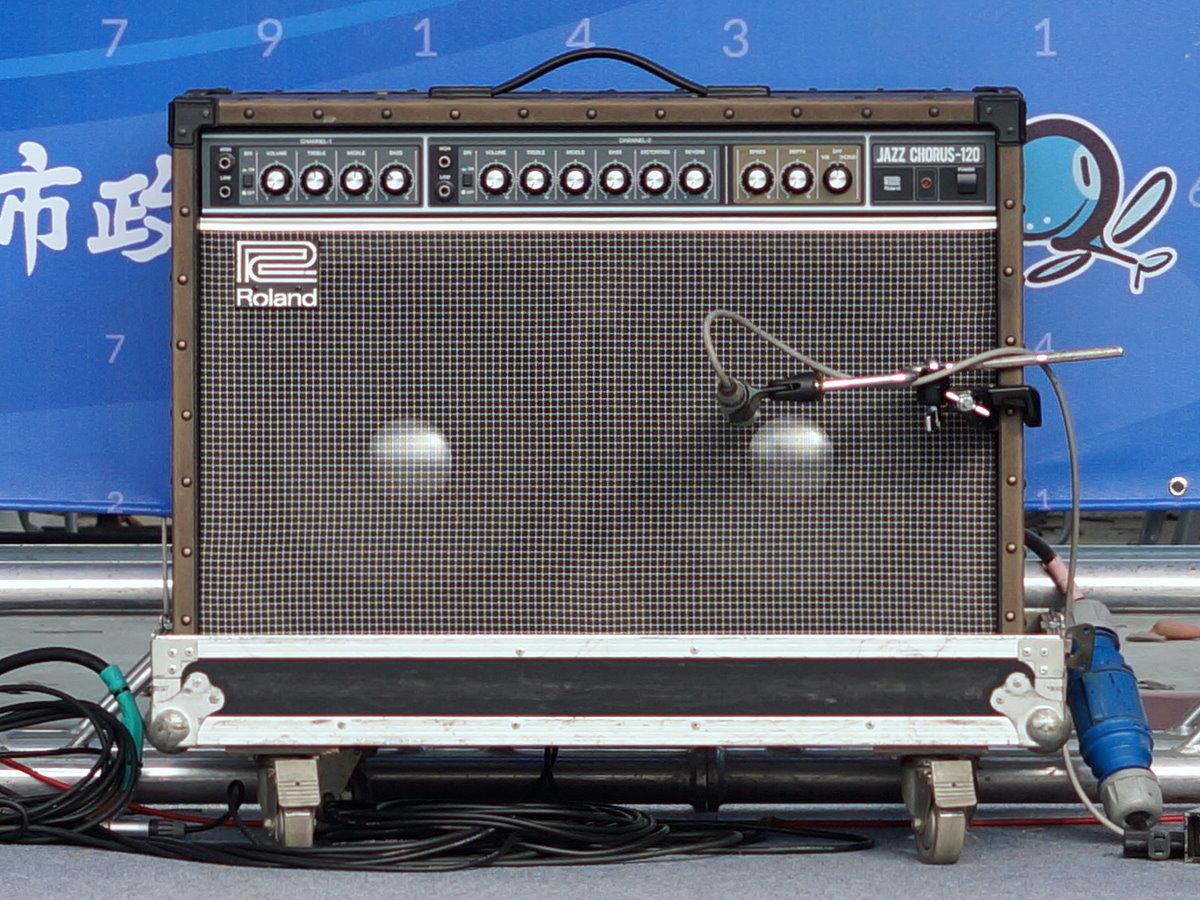
Roland Jazz Chorus-120 on stage, 6 November 2021. Photo: Solomon203. CC BY-SA 4.0 (https://creativecommons.org/licenses/by-sa/4.0/). Source image unchanged; automatically resized web versions: CC BY-SA 4.0. Source: https://commons.wikimedia.org/wiki/File:Roland_Jazz_Chorus-120_on_the_stage_20211106.jpg
Inside the Roland JC-120 Jazz Chorus: true-stereo design, the Dimensional Space Chorus, verified players, tone recipes and a 2026 buying guide.
Every legend in this genre is a story about distortion. Somebody turned something up until it cracked, and a genre fell out of the crack. The Roland JC-120 Jazz Chorus is the exception that got famous for going the other way — an amplifier designed, from the first sketch, to be physically incapable of the thing everybody else was chasing.
In 1975 that was close to heresy. The prestige gear of the moment was a stack you had to hurt to make sing. Transistor amps were the punchline of the backline, the thing you bought because you could not afford valves, and they were widely regarded as brittle, unreliable and lifeless. Roland’s response was not to build a better imitation of a valve amp. It was to build the cleanest amplifier on earth, put a studio effect inside it that nobody had ever seen in a combo, and let the market work out what to do with it.
Fifty-one years later it is still in the catalogue, essentially unchanged, and it is on the rider of half the touring bands you can name across four genres that have nothing else in common. Roland’s own marketing calls it “the king of clean.” That is unusually restrained for marketing copy. The JC-120 is not the best clean amp in some categories. It is the reference against which everybody else’s clean is described.
Osaka, 1972: A Company In A Hurry
Ikutaro Kakehashi founded Roland on 18 April 1972 in Osaka, Japan. It was not his first company. He had established Ace Electronic Industries — Ace Tone — in 1960, building electronic organs, drum machines, instrument amplifiers and effects, and had lost control of it when Sumitomo Chemical acquired the business in March 1972. Roland was the second run at the same idea, with the lessons attached.
What followed was one of the more absurd creative streaks in the history of musical instruments. The RE-201 Space Echo arrived in 1974 — a tape delay so definitive that BOSS is still selling emulations of it half a century later, in the RE-2 and RE-202. One year after that, in 1975, Roland released its first guitar amplifier. Not a starter combo, not a cautious toe in the water: a 120-watt, two-by-twelve, stereo, effects-loaded flagship. Production began in 1975 and exports to the United States started in 1976.
The naming was the thesis statement. JC stood for Jazz Chorus. Not “Rock.” Not “Lead.” Roland was pointing the amp squarely at the jazz-fusion players who wanted enormous headroom and a pedalboard’s worth of colour on top of it — a scene that was expanding fast in the mid-1970s and being served badly by amplifiers designed to sound best when abused. The JC-120 shipped alongside a one-by-twelve sibling, the JC-60, presumably out of mercy for anyone who had to carry the big one up a fire escape.
The Design Decision Everyone Else Got Backwards
Here is the part that gets missed when people call the JC-120 “just a clean amp.” It was not designed to sound like a valve amp with the gain down. It was designed to have no opinion at all.
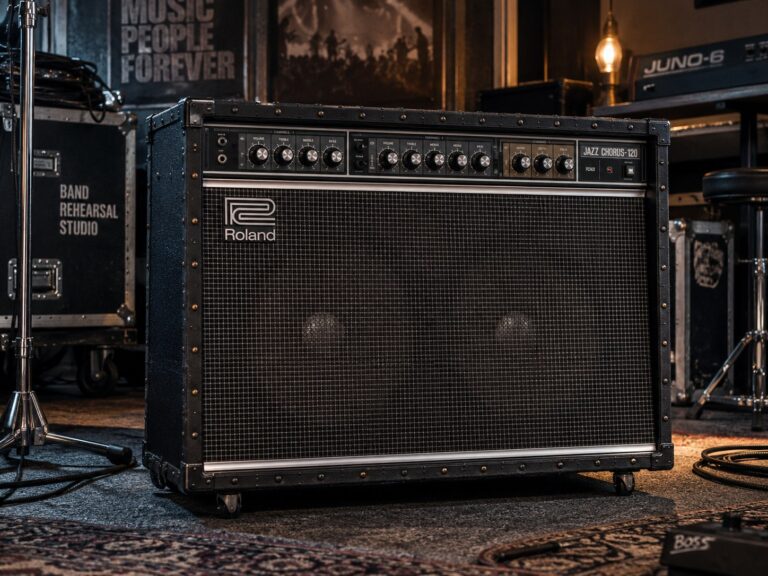
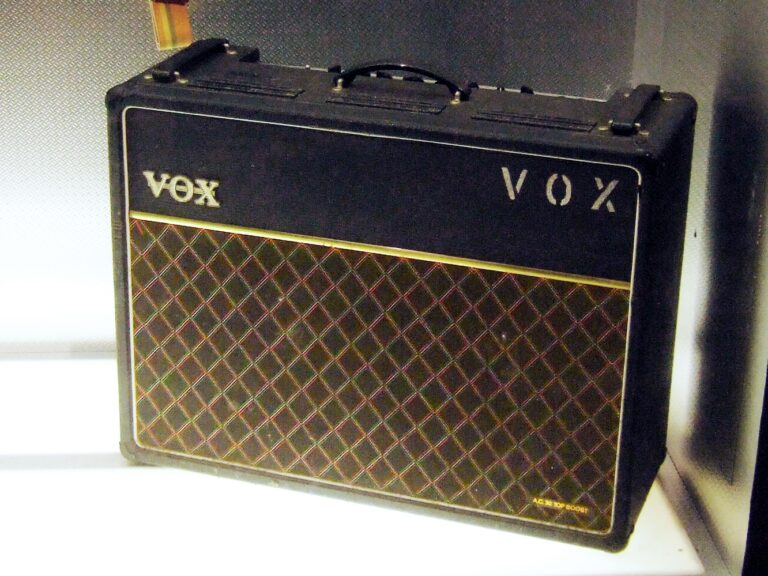
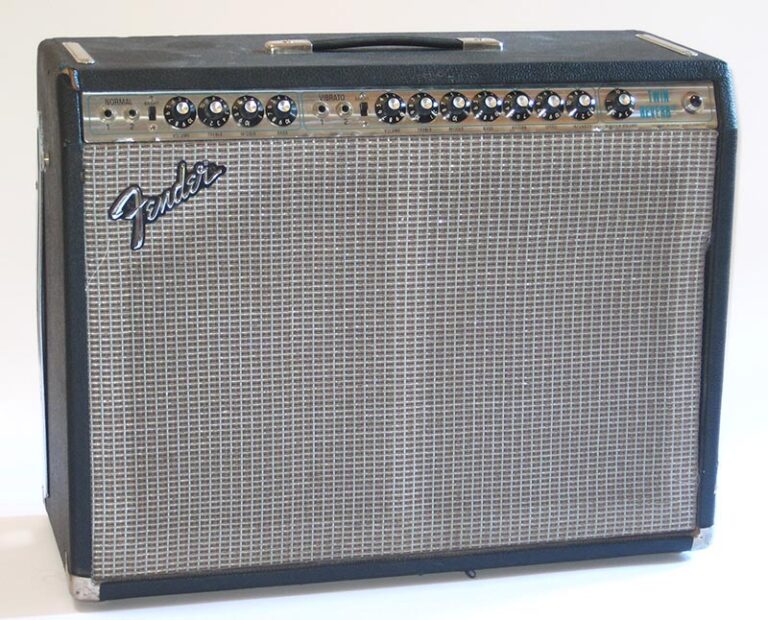
Almost every clean tone in the classic canon is a coloured clean. A Fender Twin Reverb is clean with a scooped midrange and a top-end sparkle you can identify blindfolded. A Vox AC30 Top Boost is clean right up to the point where the cathode-biased EL84s start blooming, and its whole identity lives in that transition. A Fender Deluxe Reverb is barely clean at all above 5 on the dial. All three are magnificent, and all three are tone-shaping devices whether you asked them to be or not.
The JC-120 does not do that. Its job is to take what you give it, make it much louder, and hand it back with the fingerprints still legible. Roland’s product copy for the current model says it plainly: “The rich JC clean tone preserves the character of your basic guitar sound, perfect for hearing the sound created by your devices.” That sentence, written for a 2020s pedal-platform market, is a perfectly accurate description of a design brief from 1975.
This is why the amp survived the arrival of digital modelling instead of being killed by it. A modeller plugged into a Twin is being coloured twice. A modeller plugged into a JC-120 is being amplified. The same argument applies to the current generation of floor units — a Line 6 Helix, a Neural DSP Quad Cortex or a Kemper Profiler into the JC’s return is one of the most common serious rigs on the road in 2026, and it works because the JC-120 is the closest thing to a full-range monitor that still sounds like a guitar amp.
Two Amplifiers In One Box: The Stereo Architecture
The JC-120’s headline number is 120 watts. The important number is 60.
Inside the cabinet there are two entirely separate 60-watt power amplifiers, each feeding one specially designed 12-inch loudspeaker. This is not a bridged output or a marketing split. It is a genuine two-channel stereo power section, and it is the single design decision from which everything the JC-120 is famous for follows.
Real chorus is a stereo phenomenon. As Guitarist‘s amp specialist Nick Guppy laid out for Guitar World in February 2023, the effect works by taking one signal path, modulating its pitch cyclically up and down and delaying it by roughly 10 milliseconds, then mixing it against the dry, unmodulated path — with the crucial detail that the mixing is supposed to happen in the air, between the listener’s ears, not inside the amplifier. A mono chorus pedal has to blend wet and dry electrically before the speaker. The JC-120 does not blend them at all.
In chorus mode, one speaker gets the pitch-modulated signal and the other stays dry. The two never meet until they are already in the room. That is what produces the three-dimensional, wraparound, faintly seasick shimmer that no pedal into a single speaker has ever fully reproduced, and it is why the amp’s own literature calls it Dimensional Space Chorus rather than just “chorus.”
Flip to vibrato mode and both speakers are pitch-modulated, which collapses the spatial effect and gives you a genuine pitch-warble instead. And here is the specification detail that catches out more JC owners than any other, worth writing on the back of your hand:
The Speed and Depth controls operate in Vibrato mode only. In Chorus mode the rate and depth are fixed and cannot be altered. Turning those knobs with the switch in Chorus does precisely nothing. This is not a fault, it is not a broken pot, and it is not your amp needing a service. The JC chorus is a preset, and the fact that it is a preset — one setting, chosen by Roland in 1975, that everybody from Andy Summers to James Hetfield simply accepted — is a large part of why the sound is so instantly identifiable. There is only one of it.
The Chip At The Centre Of It
The analogue chorus was generated by the MN3002 dual bucket-brigade delay chip, now long obsolete. A BBD passes the audio signal down a chain of capacitor stages like a fire brigade passing buckets, clocked by an oscillator; vary the clock speed and you vary the delay time, which varies the pitch. It is a beautifully crude way to build a time-based effect and it sounds warm and slightly lossy in a way that digital emulations spend enormous effort trying to earn back.
Roland understood immediately what it had. In 1976 the company’s guitar-effects division, BOSS, repackaged the JC-120’s chorus and vibrato circuit into a floor pedal: the CE-1 Chorus Ensemble. That pedal was, simultaneously, the first BOSS pedal ever made and the first mass-produced chorus pedal in the world. Every chorus you have ever stepped on is downstream of an amplifier feature. The line runs directly from the JC-120 through the CE-1 to the CE-2, the CE-2W, the CH-1 Super Chorus and the DC-2W Dimension C, and sideways into everything from the MXR Analog Chorus to Walrus Audio’s Julia.
What Else Is In There
The JC-120 is often described as a one-trick amp, which is odd given how much is crammed into it. Channel 1 is the clean channel: Bright switch, Volume, and a three-band Treble/Middle/Bass stack. Channel 2 has all of that plus the entire effects section — Distortion, Reverb, Speed, Depth and the Chorus/Vibrato switch.
The reverb is a real spring tank, not a digital simulation. On earlier units it came from OC Electronics of Milton, Wisconsin, whose tanks carried the now-notorious sticker declaring they were “Manufactured by beautiful girls in Milton, Wisconsin” — a phrase that has aged approximately as well as you would expect, and which vintage dealers now cheerfully use as a dating tell.
The onboard distortion is the amp’s least-loved feature and always has been. It is a preamp-stage clipping circuit, it is fizzy, and the overwhelming majority of JC-120 owners have never switched it on twice. This is not really a criticism of the amp so much as an observation about what it is for: an amplifier engineered to add nothing was never going to be the place to get your gain from. Use an Ibanez TS9, a BD-2, a DS-1 or a Walrus Iron Horse and let the JC do the job it is actually world-class at.
Specifications
| Specification | Roland JC-120 (current production) |
|---|---|
| Rated power output | 120 W (2 x 60 W stereo) |
| Configuration | Two independent power amps, true stereo |
| Speakers | 2 x 30 cm (12 in) Roland “silver cone” |
| Nominal input level | INPUT jack: -30 dBu (680 k ohm) |
| Channel 1 controls | Bright switch, Volume, Treble, Middle, Bass |
| Channel 2 controls | Bright switch, Volume, Treble, Middle, Bass, Distortion, Reverb, Speed, Depth, Vib/Chorus switch |
| Inputs | High and Low 1/4-inch jacks per channel |
| Effects loop | Channel 2 only: mono Send; L/Mono + R Return; Series/Parallel switch; +4 dBu / -20 dBu level switch |
| Line out | L/Mono and R, 1/4-inch |
| Footswitch jacks | Chorus/Vibrato, Reverb, Distortion (BOSS FS-5L, FS-6, FS-7; sold separately) |
| Reverb | Spring tank |
| Power consumption | 130 W |
| Width | 760 mm / 29-15/16 in |
| Depth | 280 mm / 11-1/16 in |
| Height | 622 mm / 24-1/2 in (incl. casters) |
| Weight | 28.7 kg / 63 lb 5 oz |
| Supplied | Owner’s manual, power cord |
Two things to notice. First, the effects loop is on Channel 2 only — a limitation that shapes rig design and that a surprising number of buyers discover after they get the amp home. Second, the amp weighs over 63 pounds and comes on casters as standard, which tells you everything about how Roland expected it to be moved. Nobody carries a JC-120. You roll it.
The Family Tree
The JC-120 has never been alone, though it has outlived most of its relatives. The line launched in 1975 with the 1×12 JC-60 alongside it, and over the decades expanded into a sprawl of models — the JC-55, JC-77, JC-90, JC-160 and others — most of which are now vintage-market curiosities. Three remain in current production.
| Model | Power | Speakers | Notes |
|---|---|---|---|
| JC-120 | 120 W (2 x 60 W) | 2 x 12″ | The flagship. Continuous production since 1975 — Roland’s longest-running product. |
| JC-40 | 40 W stereo | 2 x 10″ | Mid-size gigging version; adds a stereo input; the practical compromise for anyone without a road crew. |
| JC-22 | 30 W stereo | 2 x 6.5″ | Ultra-compact. Genuine JC chorus in a bedroom-and-small-stage box. |
| JC-120-50A | 120 W (2 x 60 W) | 2 x 12″ | Roland 50th Anniversary Limited Edition. 350 units worldwide, cherry wood veneer in open-pore burgundy, dark grey grille cloth, hand-engraved numbered badge. Electronically the standard amp. |
| JC-60 (historic) | 60 W | 1 x 12″ | Launched simultaneously with the JC-120 in 1975. Mono — no true stereo chorus. |
| JC-160 (historic) | Higher-powered 4×10 variant | 4 x 10″ | The one Robert Smith actually used live. See below. |
A note on the smaller models that matters more than the wattage: the magic of the JC chorus is the physical separation of the wet and dry speakers. The JC-40 and JC-22 are both genuinely stereo and both do the trick, but the further apart the two drivers sit, the wider the effect. Billy Duffy of The Cult worked through the alternatives and came back, telling Roland that he “just surrendered to the idea that the JC-120 with the 2×12 speaker setup — the way the phase works on the speakers — it’s a magical sound.” That is not brand loyalty talking. It is speaker spacing.
What Actually Changed Over Fifty Years
Roland has been careful with this one, and the changes are the kind of quiet running revisions that only matter if you are shopping used. Per Guitarist‘s Nick Guppy:
- The internal layout has been reorganised across generations.
- The Chorus/Vibrato switch changed from a toggle to a rotary control. This is the fastest visual dating tell on the front panel.
- The overdrive/distortion circuit has been modified several times. If you are one of the rare players who likes the onboard distortion, be aware that “the JC-120 distortion” is not one sound across five decades.
- The effects loop arrived around 1986 — a mono send with a stereo return. Pre-1986 amps do not have one, which is a serious rig-planning consideration if you were counting on running time-based effects post-preamp.
- The speakers have stayed essentially the same throughout. Guppy’s line is worth repeating verbatim: “While speaker substitution has always been a hot topic, most users are happy with the JC-120 in standard configuration; as with most classics, if it isn’t broken, don’t try fixing it.”
Compare that list to the running-change chronology of any vintage Marshall Super Lead or blackface Fender and the JC-120 looks almost static. Roland has resisted the temptation to improve it, which in a fifty-one-year production run counts as a genuine act of corporate discipline.
Famous Players — Verified, Corrected And Qualified
The JC-120 has a player list that reads like somebody shuffled four different genres together and dealt at random, and unusually for this series, most of it holds up under checking. Roland has published direct quotes from several of these players, which is a stronger class of evidence than the usual aggregator sludge. But there is one significant correction to make, and one name that needs its scope narrowed.
Andy Summers — Verified, And The Defining Association
Andy Summers is the JC-120’s headline player and the association is documented in his own words. Speaking to Roland: “The Roland JC-120 has been a staple in my collection of amplifiers for as long as I can remember — probably from the day it came out!” On what the amp unlocked: “Suddenly, chorus was this fantastic new sound for the guitar, and everybody had to get it. In stereo, you could get this huge, shimmering sound coming out of a big PA system — pretty impressive.”

The reference recording is “Every Breath You Take” (1983), a US number one built on a clean, spidery, add9 arpeggio figure that has become the single most-copied clean guitar sound of the decade. Summers also told Guitar Player in 1986 that the amp took his guitar synthesizers unusually well — which, given the JC-120’s design brief of adding nothing, is exactly what you would predict. A guitar synth needs a transparent amplifier for the same reason a modeller does.
Johnny Marr — Verified, With An Important Caveat About The Rig
Johnny Marr‘s jangle in The Smiths is routinely attributed to a Rickenbacker into a JC-120, and the JC half of that is confirmed by Marr himself. On why he chose it: “It came out at a time when there were a lot of no-nos in guitar culture. To use a Roland amp was very unusual and exciting.” On its role in his sound: “That was a big part of my sound, you know, that clean, chorus-y sound. It’s not really a surprise that your gear dictates the way you play, and so I was fortunate.”
The caveat that gets dropped from the shorthand version: Marr was running it alongside a Fender Twin, not instead of one. His own account is explicit — “I had a Fender Twin, but the next thing I got was a JC-120, and those two amps fired together were really quite amazing.” Anyone trying to reverse-engineer the Meat Is Murder or The Queen Is Dead guitar sound from a single JC-120 is chasing half a rig. The Twin supplies a midrange thickness and a slightly softer top that the JC deliberately does not have; the JC supplies the width and the chime. Together they cover each other’s gaps, which is precisely why the combination sounded like nothing else at the time.
Marr’s own postscript on the amp’s staying power, given to Roland: “The interesting thing is that now — many, many, many years later — kids still ask me about playing the JC-120. They like that sound.”
Robert Smith — HARD CORRECTION
Every list of JC-120 players includes Robert Smith, and it is very nearly right, but not quite. Smith’s live amplifier through the early Cure years was the JC-160, not the JC-120 — a fact that Sweetwater’s own history of the amp concedes with a shrug (“not a JC-120, but we’ll let it slide this time, Robert”). Contemporary accounts and video from the period put a JC-120 in the studio and a JC-160 in the live backline, visible in the stage rigs of the early 1980s.
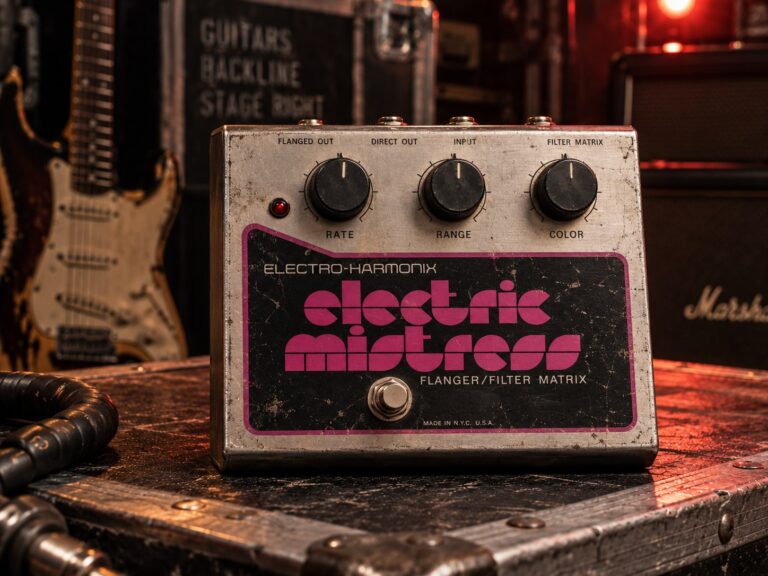
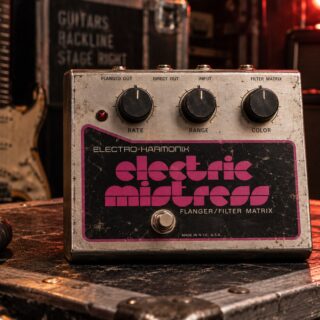
And the correction goes further than the model number. From the mid-1980s onward, Smith’s primary workhorse amplifier was a Peavey Musician Mark III, not a Roland at all. The Jazz Chorus family was foundational to the Seventeen Seconds / Faith / Pornography era; it was not the whole career. Add to that the fact that a great deal of what people hear as “Robert Smith’s chorus” is actually his Electro-Harmonix Electric Mistress flanger, and the honest summary is: the Roland was one ingredient in an era, not the source of the sound. If you want that specific swirl, an Electric Mistress is doing more of the work than the amp is.
This is a textbook instance of a pattern this series keeps running into: a family name gets flattened into its most famous model. “Jazz Chorus” becomes “JC-120” in the retelling, the same way “AC30” becomes “AC30 Top Boost” and “Deluxe Reverb” becomes “blackface.” Check the model number, not the family.
James Hetfield — Verified, And Genuinely Surprising
A pristine solid-state jazz amp inside the most-imitated metal rig on earth sounds like a mistake. It is not. James Hetfield has called the JC-120 “my go-to forever”, and it is documented as the source of the clean passages on “Welcome Home (Sanitarium)” and “One”, with the amp in the rig from the Master of Puppets sessions onward and still in it decades later.
The logic is sound once you think about it in terms of contrast. When the rest of your record is a wall of gain from a Mesa Mark IIC+ and a JCM800, a merely “clean-ish” tone in the intro does not read as clean. It reads as quiet. Metal needs its cleans to be extreme cleans — glassy, cold, wide, with no valve warmth softening the edges — because the drop back into distortion has to land like a trapdoor. The JC-120 is the most extreme clean available, so that is what got used.
Kirk Hammett — Verified But Narrower Than The Claim
Kirk Hammett is frequently listed alongside Hetfield, and the JC-120 does appear in his rig, but the scope needs stating honestly: it is the clean-tone source inside a rig whose identity is Mesa/Boogie and, more recently, Diezel and Fractal. On stage his cabinets are driven by Mesa 2:Ninety power amps and function largely as monitoring and feedback generators while the Fractal unit goes direct to front of house. Calling Hammett “a JC-120 player” in the way Andy Summers is a JC-120 player overstates it considerably. He is a Mesa player with a Roland for the clean channel — which is, to be fair, exactly how most metal guitarists have used this amp for forty years.
Adrian Belew and Robert Fripp — Verified, And The Best Origin Story
Adrian Belew heard the amp at a casual get-together in 1977 and converted on the spot: “The sound mesmerized me. I had never heard an amp sound so pristine and beautiful. There was a shimmering clarity to every note.” He has since put it on an implausible run of records — Frank Zappa’s Sheik Yerbouti, David Bowie’s Lodger, Talking Heads’ Remain in Light, and King Crimson’s Discipline, where both Belew and Robert Fripp used it extensively for the interlocking guitar work that defines the record.
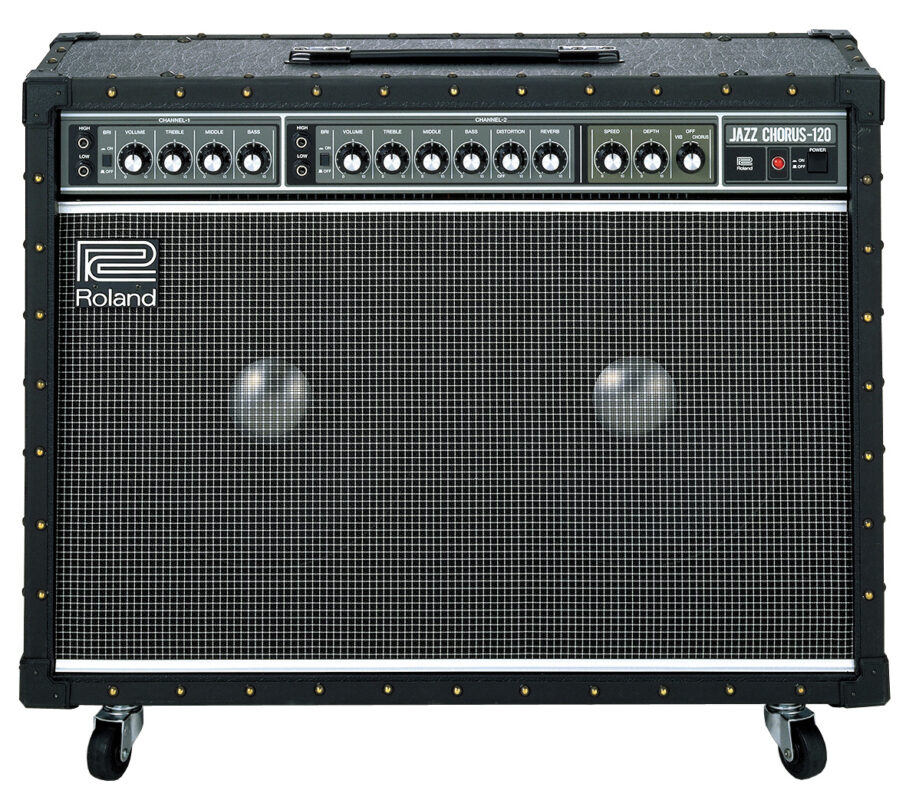
Belew’s verdict is the strongest single endorsement any solid-state amplifier has ever received from a player of that calibre: “The Roland Jazz Chorus JC-120 has made a huge mark on the music of the last four decades and continues to do so today. There is simply nothing else like it. In my opinion, it has to be considered in the pantheon of the top three amplifiers of all time.”
Billy Duffy — Verified, And The Most Useful Technical Testimony
Billy Duffy of The Cult relied on the JC-120 as a primary colour on Love and Sonic Temple, and his description of how he used it is the most practically useful quote in the whole file: “I use the JC-120 for my clean sound, and I’ve always used it in combination with a valve amp. The chorus itself is really sweet.”
That combination — JC-120 for clean, valve amp for dirt, both live, blended — is the classic professional deployment of this amplifier and it is worth understanding as a rig template rather than a personal quirk. Marr did it with a Twin. Hetfield does it with Mesas. Duffy did it with valve heads. Nobody at the top end uses a JC-120 as their only amplifier, because it was never designed to be one.
Others, Verified And Documented
Roland’s own artist listing for the amp names Pat Metheny and Jeff Baxter alongside Summers, Marr, Belew and Duffy. Albert King is cited by Roland at the historical end of the range and Wes Borland of Limp Bizkit at the modern one. Jeff Buckley is widely documented on the amp. Producers Steve Levine (Culture Club, The Vapors) and Gil Norton are both named by Roland as reaching for it in the studio, with Levine’s pitch being the commercial one: “If you want to add that expensive quality to a recording, the JC-120, with its lush chorus sound, is the way to go.”
And then there is shoegaze, where the JC-120 is close to compulsory. Roland’s own history flatly states that “shoegaze purists regard the JC-120 as the quintessential amp for achieving the swirling sound of the genre, exemplified by bands like Slowdive” — which brings Neil Halstead into the conversation, and by extension the whole vocabulary of enormous, pitch-smeared, reverb-drowned clean guitar that Kevin Shields was building in parallel. Newer converts named by Roland include The Vaccines’ Freddie Cowan and Jeremy Freedman of The Neighbourhood, plus Guns N’ Roses’ Richard Fortus, who has discussed his Roland and BOSS gear with the company directly.
Seven Tone Recipes
1. The Every Breath You Take
Channel 2. Volume 4-5, Treble 1 o’clock, Middle 12, Bass 11, Bright ON, Chorus engaged, Reverb 2-3. Bridge-and-middle position on a Strat or a hollowbody with the tone rolled back slightly. Play the add9 shapes with a light pick and let the chorus do the vibrato you are not adding with your hand. The trick is restraint: no compression, no drive, nothing between guitar and amp.
2. Smiths Jangle (The Honest Version)
Channel 2. Volume 5, Treble 2 o’clock, Middle 11, Bass 10, Bright ON, Chorus engaged, Reverb 3. Then — and this is the part the shorthand leaves out — run a second amp. A Deluxe Reverb or Twin in parallel at roughly equal volume, EQ’d fatter (Treble 11, Middle 1 o’clock). A Rickenbacker 330 or 360-12 in the middle position. Capo where the song needs it.
3. Metal Clean Interlude
Channel 2. Volume 6, Treble 1 o’clock, Middle 10, Bass 1 o’clock, Bright ON, Chorus engaged, Reverb 4-5. Neck pickup, humbucker, played with the pick close to the neck. Scoop the mids harder than feels right — the point is maximum contrast with the distorted sections, so this tone should sound almost hollow in isolation and enormous in sequence.
4. Jazz Comping (The Original Brief)
Channel 1. Volume 4, Treble 10, Middle 1 o’clock, Bass 1 o’clock, Bright OFF. No chorus, no reverb, nothing. An archtop or an ES-335 on the neck pickup with the tone at 6. This is what the amp was named for and it is the setting fewest owners ever try. It is also the fastest way to hear how flat the JC-120’s EQ actually is.
5. Shoegaze Wall
Channel 2. Volume 6-7, Treble 12, Middle 12, Bass 12, Bright OFF, Chorus engaged, Reverb 6+. In front: fuzz into a Deluxe Memory Man or a Strymon TimeLine set to long modulated repeats, plus a big reverb such as BigSky or Walrus Fathom in the loop. Play chords, not notes. Let the stereo field do the work — this recipe is meaningless in mono.
6. Pedal Platform, Zero Colour
Channel 1. Everything at 12, Bright OFF, no chorus, no reverb. Volume to taste. Then build the entire tone in front: overdrive stack, modulation, delay, whatever you like. This is the setting for anyone using the JC-120 as what it fundamentally is — a very loud, very honest, very reliable power section with speakers attached. Start every pedalboard session here.
7. Modeller / Guitar Synth Front End
Channel 2 effects return, or Channel 1 input with the modeller’s cab sim disengaged if you prefer. Amp EQ flat, no onboard effects. Roland has been making this argument since Andy Summers made it in 1986 about guitar synths and it applies identically to a HX Stomp, a Fractal FM9 or a Strymon Iridium: if the box in front is doing the tone-shaping, you want an amplifier with no opinions, and this is the one.
All settings are clock positions. The JC-120’s EQ is powerful and, unusually, genuinely flat at noon — this is one of the few amps where “everything at 12” is a real starting point rather than a joke.
How It Compares
vs. Fender Twin Reverb
The two canonical loud clean amps, and they are clean in completely different ways. The Twin is valve-clean: scooped mids, a specific chime, some compression and bloom in the way it responds to attack, and a breakup point that exists even if it is louder than a drummer. The JC is transistor-clean: no breakup point at all, a flatter and more extended frequency response, and a top end that stays glassy where the Twin’s rounds off. The Twin is 64 lb, the JC is 63 lb, so weight is a wash. The real decision is whether you want an amplifier with a personality (Twin) or a magnifying glass (JC). Marr’s answer was both, at once.
vs. Vox AC30 Top Boost
Almost a perfect inverse. The AC30 is cathode-biased, mid-forward, compresses early and is defined by its transition into distortion. The JC-120 is solid-state, flat, uncompressed and has no transition to be defined by. For jangle they overlap in the results and share nothing in the method — the AC30 jangles because of harmonic content generated by the amp; the JC jangles because it is faithfully reproducing a Rickenbacker with a chorus on it. If you want the amp to contribute, buy the Vox. If you want it to get out of the way, buy the Roland.
vs. Roland Blues Cube Artist
Roland’s other serious solid-state design, and its opposite number philosophically. The Blues Cube Artist uses Roland’s Tube Logic approach to model the behaviour of a valve amp, including the breakup. The JC-120 refuses to. Both are excellent; they answer different questions. Anyone who wants “a JC-120 that can crunch” is describing the Blues Cube and should buy that instead of modifying this.
vs. BOSS Katana
The modern volume-seller from the same corporate family. A Katana 100 gives you many amp voices, onboard effects, power scaling and app editing for a fraction of the price and the weight. It does not give you the JC’s stereo speaker separation, and it does not give you the specific analogue chorus. The honest framing: the Katana is the better amp for most players in most rooms in 2026, and the JC-120 is the better amp for the specific job of being a huge transparent stereo clean platform. Those are not competing claims.
vs. A Chorus Pedal Into Any Amp
The comparison everybody makes and the one where the JC has the strongest case. A CE-2, a CE-2W or an M234 into a single-speaker amp mixes wet and dry electrically and pushes the result out of one driver. The JC never mixes them at all. In a room, on a stage, in front of an audience, the difference is not subtle — and it is completely invisible on a single close mic, which is why so many recordings of JC-120s sound disappointing compared to standing in front of one.
vs. Quilter and Modern Solid-State
The current class of high-end transistor amps — a Quilter Aviator Cub, a Superblock — mostly aim at valve-like feel and weight savings. The JC-120 is not in that competition and never entered it. It is heavier than all of them and sounds like none of them. Its argument is a fifty-one-year production run and the fact that a rental company in any city on earth can put one on your stage tonight.
Buying Guide
New
As of mid-2026 the standard JC-120 sits around $1,100-$1,250 street in the US, with $1,241.99 as a typical major-retailer listing and roughly $1,099.99 achievable across the market. The JC-40 is around $770 and the JC-22 lands well below that. The JC-120-50A 50th Anniversary is a different market entirely — a 350-unit run listed from around $3,100 in the US, and quoted at £1,689 in the UK at launch, roughly £400 over a standard JC-120.
Note the size of that anniversary premium. You are paying roughly double for a cherry veneer, a grille cloth and a numbered badge on an electronically identical amplifier. That is a collector’s proposition, not a tone proposition, and it should be evaluated as one. Roland released it somewhat ahead of the model’s own 1975 anniversary, since it celebrates the company’s fiftieth rather than the amp’s.
Which size to buy comes down to one question: how far apart do you need the speakers? If the stereo chorus is the reason you are buying a Jazz Chorus — and it usually is — the 2×12 is meaningfully wider than the 2×10 and dramatically wider than the 2×6.5. If you are buying it as a clean pedal platform for club stages and the chorus is a bonus, the JC-40 is the sane purchase and your spine will write you a thank-you note.
Used
Used JC-120s are plentiful, cheap relative to vintage valve amps, and mostly fine, because there is no set of output valves to have been abused. Run this checklist:
- Establish the generation. Toggle Chorus/Vibrato switch = earlier; rotary = later. Check for the rear-panel effects loop: if there is no loop, the amp predates roughly 1986, and that is a hard rig-design constraint, not a cosmetic difference.
- Test both speakers independently. This is the single most important check on this specific amp and the one most buyers skip. Engage Chorus and stand directly in front of each driver in turn. A JC-120 with one dead power amp or one blown speaker will still make noise, still sound loud, and will have lost the entire reason it exists. Also verify the effect actually swirls in the room rather than just warbling.
- Turn Speed and Depth in Chorus mode and expect nothing to happen. Then flip to Vibrato and confirm they work. A seller who tells you the knobs are “broken in chorus” is describing normal operation; a seller whose knobs do nothing in Vibrato either has a fault or a modified amp.
- Check the spring tank. Tip the amp gently and listen for the crash. Silence means a disconnected or dead tank — cheap to fix, but negotiate.
- Check the casters and the cabinet corners. A 63 lb amp that has been rolled around venues for thirty years takes its damage at floor level. Seized casters are common and are the difference between an amp you gig and an amp you resent.
- Ignore speaker swaps as a selling point. Non-original speakers in a JC-120 are a value reduction, not an upgrade. The stock drivers are part of the design.
- Don’t over-pay for “vintage.” Unlike a blackface Fender or a JMI Vox, an early JC-120 is not worth a large premium over a late one, because the circuit has changed so little. Buy the cleanest, most functional example you can find rather than the oldest.
Living With One
Some practical realities that the spec sheet does not convey.
It is heavy and it does not want to be lifted. Sixty-three pounds, no meaningful handle geometry for a two-person carry, and casters that assume flat ground. Venues with stairs are the JC-120’s natural enemy.
Recording it properly requires two microphones. One close mic on a JC-120 in chorus mode captures either the wet signal or the dry signal, not the effect. You need a mic on each speaker, panned. This trips up first-timers constantly and produces the common complaint that “the JC sounded amazing in the room and terrible on the track.”
The distortion channel is not the reason you bought it. Skip it. Every serious user does.
The effects loop is Channel 2 only, mono send, stereo return. Plan your signal chain around that before you buy pedals, not after. If you want stereo time-based effects, you are feeding the loop return, and Channel 1 is not part of that conversation.
Reliability is genuinely excellent, and this was a design goal, not a happy accident. Guppy’s framing is right: in an era when transistor amps were prone to failure, the JC-120 proved transistors could be reliable. There are no output valves to replace, no bias to set, no cathode resistors to drift. Fifty-year-old examples routinely still work. Electrolytic capacitors do age and a very old unit may benefit from a service, but the maintenance burden is a fraction of any comparable valve amp.
Solid-state amps do not like being run into the wrong load or having their speaker leads shorted. Unlike a valve amp, a JC-120 has no output transformer, so the classic valve-amp failure mode does not apply — but do not treat the internal speaker connections as a place to experiment.
Frequently Asked Questions
Why don’t the Speed and Depth knobs do anything?
Because you are in Chorus mode. Speed and Depth operate in Vibrato mode only. The chorus rate and depth are fixed by Roland and cannot be adjusted. This is normal, correct, original behaviour on every JC-120 ever built, and it is the most frequently reported non-fault in the amp’s history.
Is the JC-120 really stereo, or is that marketing?
Genuinely stereo. Two separate 60-watt power amplifiers, each driving one 12-inch speaker. In chorus mode one speaker carries the modulated signal and the other carries the dry signal, and they combine acoustically in the room rather than electrically in the amp. That is the whole trick.
Can I get the JC chorus sound from a pedal?
Partly. The BOSS CE-1 was a direct port of the JC-120’s chorus/vibrato circuit in 1976, and the CE-2W includes a faithful modern recreation of it. What no pedal can give you into a single amp is the physical separation of wet and dry across two speakers. Run a stereo chorus into two amps and you get close; run any chorus into one amp and you are hearing a different effect that shares a name.
Did Robert Smith use a JC-120?
In the studio, yes — but his live amp through the early Cure years was the JC-160, a different model in the same family, and from the mid-1980s his main amplifier was a Peavey Musician Mark III. Much of the swirl attributed to the amp is actually his Electro-Harmonix Electric Mistress flanger. The JC family was foundational to the early records; the JC-120 specifically was not his live workhorse.
Why do metal bands use a jazz amp?
Contrast. When the distorted sections are a wall of compressed gain, a clean tone with any valve warmth in it reads as “quiet” rather than “clean.” The JC-120 produces the coldest, glassiest, widest clean available, so the drop back into distortion hits harder. James Hetfield used it for “Welcome Home (Sanitarium)” and “One” and has called it his go-to forever.
Is the onboard distortion any good?
No, and it has been revised several times over the years so there is not even one consistent answer. Use pedals. The amp’s transparency makes it an exceptionally good platform for overdrive and distortion boxes, which is the reverse of the same coin.
How much does a JC-120 cost in 2026?
Roughly $1,100-$1,250 new in the US for the standard model. The JC-40 is around $770. The 50th Anniversary JC-120-50A, limited to 350 units worldwide, lists from around $3,100 in the US and was quoted at £1,689 in the UK. Used standard JC-120s are widely available and represent excellent value, since there are no valves to have been worn out.
Which JC should I buy — 120, 40 or 22?
Decide on the basis of speaker spacing, not wattage. The wider the drivers sit apart, the bigger the stereo chorus. The JC-120’s 2×12 layout is the reference and Billy Duffy explicitly went back to it after trying the alternatives. If the chorus is a bonus rather than the point, the JC-40 is the practical gigging choice at half the price and a fraction of the weight.
Does it work as a modeller or guitar-synth platform?
It is one of the best available. The design brief was to add nothing to the signal, which is exactly what you want when the tone is being generated upstream. Andy Summers made this argument about guitar synths to Guitar Player in 1986 and it holds identically for a Helix, a Quad Cortex, a Kemper or an Iridium in 2026.
Image credits
- Top image: Roland Jazz Chorus-120 on stage, 6 November 2021. Photo: Solomon203. Source photograph · CC BY-SA 4.0. Source image unchanged; automatically resized web versions are licensed under CC BY-SA 4.0.
- JC-120: photo by Roland Musikvertrieb Deutschland, via Wikimedia Commons, CC BY-SA 3.0.
- Andy Summers: Andy Summers Atlanta 1, Wikimedia Commons, CC BY-SA 4.0.
- Fender Twin Reverb: Micahmedia, Wikimedia Commons, CC BY 3.0.
- Vox AC30 Top Boost: wetwebwork; existing crop and contrast/color adjustments: Clusternote, Wikimedia Commons, CC BY-SA 2.0.
- Roland JC-120 Jazz Chorus: GuitarGangsters AI-generated reference illustration, not a photograph.
Latest News
Related
On This Day
Monday 9 November
From this week: