Gibson SJ-200 Standard: King of the Flat-Tops
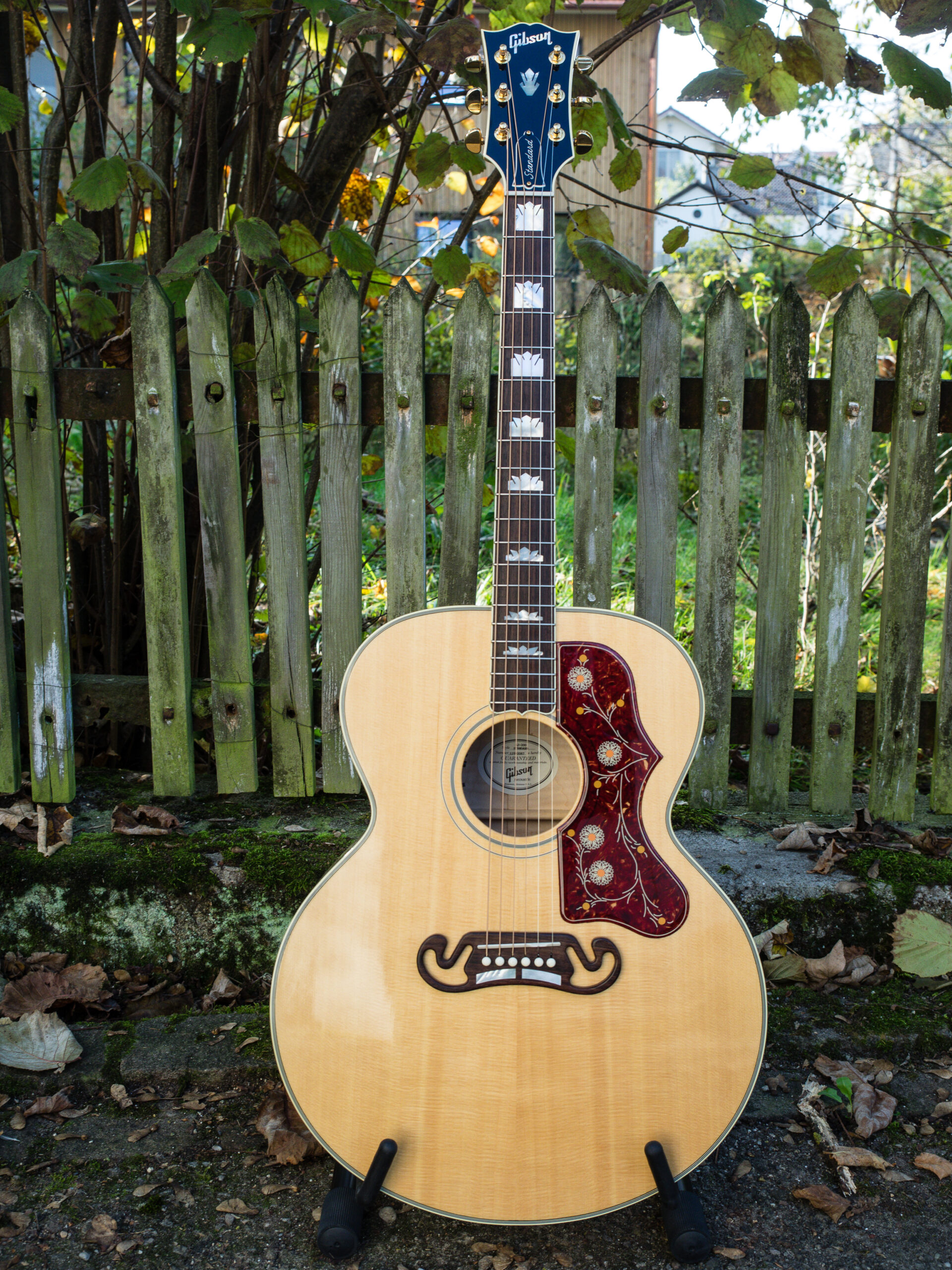
Gibson SJ-200. Photo: Gibb Stutz, CC BY 3.0. Source: https://commons.wikimedia.org/wiki/File:Gibson_SJ200.jpg
The Gibson SJ-200 is the King of the Flat-Tops for good reason. Full history, tonewoods, setup guide, famous players and buying advice.
There is a photograph of Elvis Presley — and there are thousands of photographs of Elvis Presley, but this particular one matters — in which he stands holding a Gibson acoustic guitar so large it almost seems proportionate to the mythology surrounding the man. The guitar has a wide body that curves inward dramatically at the waist, a pickguard decorated with a vine-and-flower engraving, a moustache-shaped bridge that nobody in the history of instrument-making has ever improved upon for sheer visual bravado, and a flame maple back that catches the light in a way that suggests the guitar itself is performing. This is the Gibson SJ-200. Gibson called it “The King of the Flat-Tops.” They were not being modest. They were being accurate.
The SJ-200 is Gibson’s largest, most expensive, most visually imposing acoustic guitar — and it has been since 1937, when the first one was built to the specifications of a Hollywood singing cowboy who wanted a flat-top with the presence and authority of Gibson’s grand archtop. In the nearly ninety years since, that original proposition has been refined but never essentially changed. The SJ-200 today looks like the SJ-200 of 1947 in all the ways that matter. And it sounds like what it has always sounded like: an enormous acoustic guitar that fills rooms without effort, that supports singers the way a full orchestra supports a soloist, that makes everything played on it sound like a statement rather than a suggestion.
Elvis used one. Bob Dylan posed with one on the cover of Nashville Skyline. Pete Townshend bought one at Manny’s Music in New York in 1968 and played the opening of “Pinball Wizard” on it — one of the most recognisable acoustic intros in rock history. George Harrison used one from the White Album sessions forward, and composed much of All Things Must Pass on it. Jimmy Page borrowed one to track the acoustic guitar parts on the first Led Zeppelin album. These are not marginal associations with a boutique instrument. The SJ-200 is woven through the fabric of popular music in a way that very few guitars from any manufacturer can claim.

Origins: Hollywood, 1937
The SJ-200’s origin story is more specific and more colourful than most acoustic guitar histories. In 1937, Ray Whitley — a singing cowboy who appeared in Hollywood westerns and was a genuine fixture of the era’s entertainment landscape — attended a rodeo performance at Madison Square Garden in New York and got talking with Guy Hart from Gibson. Whitley had a very clear vision of what he wanted: a flat-top acoustic guitar built to the scale and visual presence of Gibson’s flagship 17-inch L-5 archtop, which was the finest acoustic guitar money could buy in 1937, but in the practical body of a flat-top that would work for stage performance and recording.
Gibson built the prototype — what they called the Super Jumbo — and presented it to Whitley. The guitar was subsequently ordered by other western performers: Roy Rogers, Gene Autry, and the performing cowboys who populated the films and radio shows that were the dominant popular entertainment of the era. These were musicians who performed on stages and in film productions where a guitar needed to be seen as well as heard, and the Super Jumbo delivered on both counts. The body was enormous — a 16 7/8-inch lower bout, wider than any dreadnought Martin had built — with a narrow waist that made the body’s width even more dramatic in contrast. The construction combined a double-braced red spruce top with rosewood back and sides, and the decorative appointments — the engraved pickguard, the moustache bridge, the crown-shaped mother-of-pearl fingerboard inlays — announced that this was not a workman’s guitar. This was a showman’s guitar.
Gibson formalised the model in 1939, rechristening it the Super Jumbo 200 — with the 200 referring to the retail price of $200, which at the time was an extraordinary amount of money for an acoustic guitar, roughly equivalent to several thousand dollars today. Production was limited by the economics of wartime America, and relatively few pre-war SJ-200s were made. Then the war ended, and Gibson returned to the instrument with a crucial change.
In 1947, Gibson switched the SJ-200’s back and sides from rosewood to figured maple. The decision was driven partly by material supply and partly by sonic preference — maple’s brighter, more percussive character complemented the Sitka spruce top’s own brightness in a way that rosewood, with its warmer and more complex response, did not. The maple SJ-200 was clearer, more articulate, and more immediately loud than the rosewood original. It became, in this form, the definitive version of the instrument — the guitar that the next seven decades of players would associate with the SJ-200 name. Gibson dropped the “S” in 1955, calling the model the J-200 for several decades before eventually restoring the SJ-200 designation for modern production. Today, both names are used interchangeably.
Tonewoods: Why the SJ-200 Sounds Like Nothing Else
The SJ-200 Standard’s tonal character is the product of a combination of elements that, taken together, produce a sound distinctly its own: a sound that is immediately recognisable as the SJ-200 the moment you hear it, whether in a recording studio, on a concert stage, or in a guitar shop. Understanding the individual contributions of each element reveals why the combination works so well — and why no other acoustic guitar sounds quite like this one.
AAA Figured Maple: Brightness, Clarity, and Visual Drama
The SJ-200 Standard’s back and sides are crafted from AAA figured maple — the highest grade of flamed or curly maple, selected for both its acoustic properties and its visual appearance. The “AAA” designation refers to the intensity and regularity of the figure: the three-dimensional chatoyance of highly figured maple, in which the wood appears to shift and shimmer as the viewing angle changes, is one of the most dramatic visual effects in lutherie. On the SJ-200, that figured maple back — visible when the guitar is played or displayed, catching light across its rippled surface — is as much a part of the instrument’s identity as the moustache bridge or the engraved pickguard.
Tonally, maple is a very different material from the mahogany that backs the J-45 and the Hummingbird. Where mahogany absorbs and colours the sound with warmth and midrange emphasis, maple reflects — it is a more acoustically neutral material that allows the spruce top’s natural character to come through with minimal modification. Maple back and sides produce a sound with prominent highs and a strong mid-scoop: the frequencies between roughly 400Hz and 2kHz are less emphasised than they would be on a mahogany instrument, leaving the bass and treble more pronounced. This quality — sometimes called the “scooped midrange” — is what makes the SJ-200 work so well behind a singer. The guitar does not compete with the vocal in the midrange; it underlies and frames it, adding low-end warmth and top-end sparkle without crowding the frequency space where the voice lives.
Maple also produces a more percussive, more articulate attack than mahogany. Notes speak quickly and clearly on a maple-backed guitar; individual notes within a strummed chord retain their identity rather than blending into a warm wash. This articulation — combined with the SJ-200’s enormous body — gives the guitar an unusual quality: it is simultaneously large and complex in its sound, with the bass extension and volume that only a super jumbo body can produce, and precise and clear in its note separation, with the articulation that only maple can provide.
Sitka Spruce: The Top That Drives Everything
The SJ-200 Standard’s top is solid AAA Sitka spruce — the same top wood used on the J-45 and Hummingbird, but on a body platform that is significantly larger, with more vibrating surface area and more internal air volume. The consequences are direct: more volume, more bass extension, and a larger sound in every dimension. The SJ-200’s top is braced with Gibson’s traditional hand-scalloped X-bracing, which allows the top to vibrate freely across its large surface and contributes the openness and sustain that the instrument is known for.
The 25.5-inch scale length on the SJ-200 Standard — longer than the 24.75-inch scale used on all other Gibson acoustic models — increases string tension and changes the feel of the instrument. Strings feel slightly tighter than on a J-45 or Hummingbird; the bass strings in particular have more punch and definition. This additional string tension contributes to the SJ-200’s clear, articulate character — loose strings bloom and sustain, while tighter strings speak with more immediacy and precision.
The Moustache Bridge: Function and Visual Identity
The SJ-200’s signature “moustache” bridge — a two-bar rosewood construction with curved outer extensions that give it the distinctive shape from which the nickname derives — is one of the most recognisable acoustic guitar hardware designs in the world. It is also, according to players and luthiers who have examined the instrument closely, a functional choice: the bridge’s mass and shape affect how string vibration transfers to the top, contributing to the SJ-200’s characteristic sustain and low-end weight. Replace the moustache bridge with a standard acoustic saddle and you have, by all accounts, a guitar that sounds notably less like itself. The bridge is part of the voice.
The Legends and Their SJ-200s
The list of significant musicians who have played the SJ-200 across its nearly ninety-year history is long enough to fill a chapter of acoustic guitar history. Here are the associations that have most defined the instrument’s cultural identity.
Elvis Presley
Elvis’s relationship with the SJ-200 was long and personal. He owned several, the most famous of which was customised with his name inlaid on the fingerboard and a tooled leather cover made by his friend Charles Underwood. That guitar is now part of the permanent collection at Graceland. Elvis continued to play J-200s into the early 1970s, and the visual image of the King holding this enormous, ornate acoustic guitar — made even more spectacular by his stage costumes — is one of the defining images of American popular music. For many players, the SJ-200 is Elvis’s guitar before it is anyone else’s.
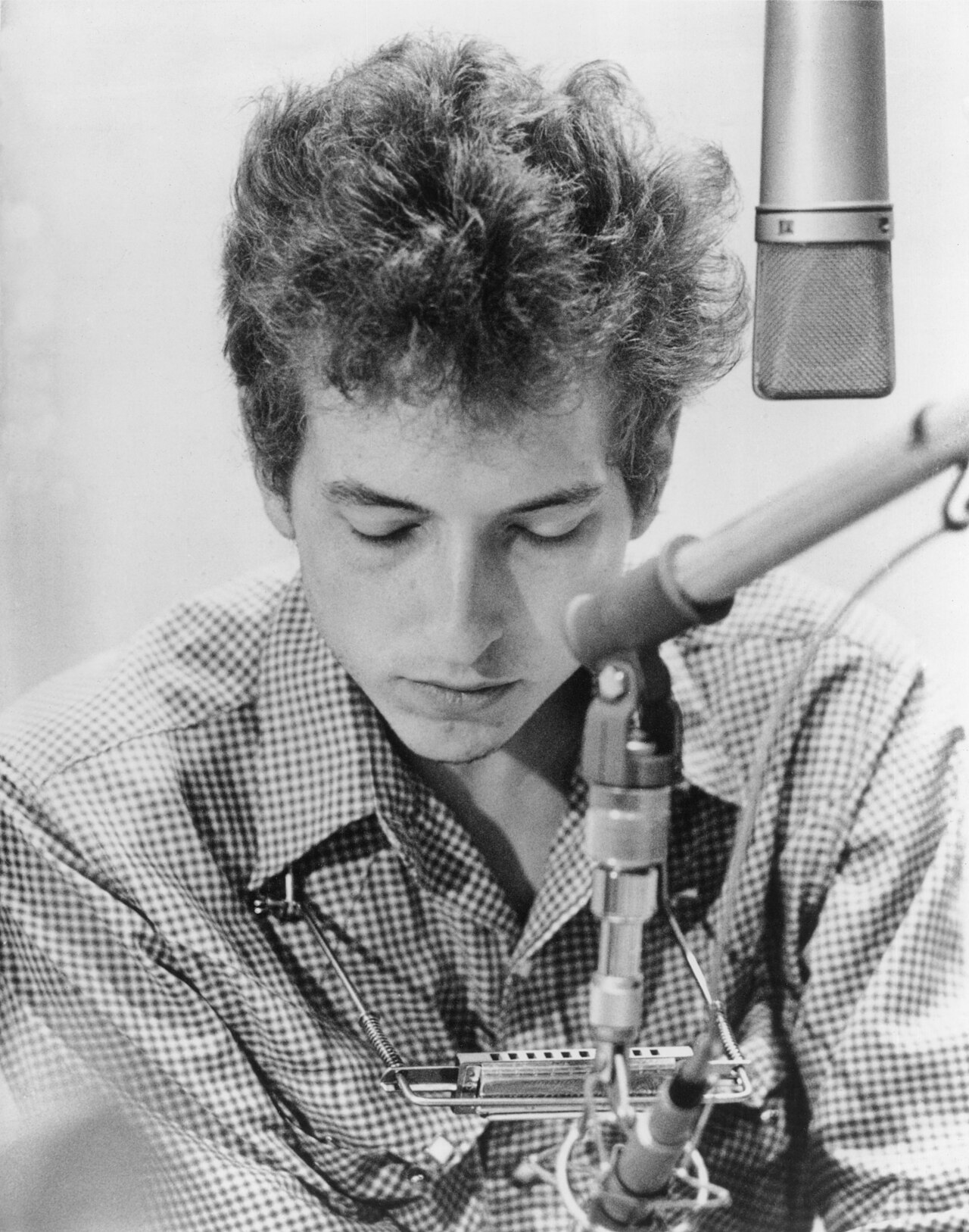
Bob Dylan
Dylan poses with a J-200 on the cover of Nashville Skyline (1969), and the guitar was a significant tool during the Rolling Thunder Revue era. Notably, the J-200 Dylan played was reportedly given to him by George Harrison — a guitar that had itself been part of Beatles history. In 2015, Gibson released the Bob Dylan SJ-200 Player’s Edition with custom specifications reflecting Dylan’s preferences. For Dylan, the SJ-200 represented a departure from the more intimate, vocal-forward character of the J-45 he had played through the folk era — a move toward a bigger, bolder acoustic presence that matched the musical evolution documented on Nashville Skyline and subsequent records.
Pete Townshend
Pete Townshend of The Who bought his first J-200 at Manny’s Music on 48th Street in New York in 1968 — and has been playing them ever since. “Pinball Wizard” is the most famous acoustic guitar intro in rock music, and it was played on a J-200 with a characteristic Townshend windmill strum: an enormous arc of the right arm that crashes into the first chord with the force of a full band. Only a guitar with the SJ-200’s projection and sustain can survive that treatment and still sound musical.
Townshend’s description of the guitar captures its essential quality as well as anything: “It had a crisp sound and an easy neck. It was only later I found how well the J-200 records when you play it hard. Like the Everly acoustic, it has a rather dead soundboard and that allows you to really dig in when strumming. They are hard to bring to life with piezo pickups because the sound is so distinctive in real air.” That last observation — that the SJ-200 sounds best in real air, captured with microphones rather than pickups — is a recurring theme among the guitar’s most devoted players, and a useful guide for anyone approaching the instrument for recording.
George Harrison
George Harrison switched to the J-200 from his Epiphone Casino for The Beatles’ White Album sessions in 1968, and the guitar appears on some of the most celebrated tracks in the band’s catalog. “While My Guitar Gently Weeps,” “Here Comes the Sun,” “Long, Long, Long,” and “Piggies” all feature a J-200. After The Beatles, Harrison used the guitar extensively in composing the songs for All Things Must Pass — the triple album that many consider the finest solo record to emerge from any former Beatle — and the J-200’s broad, full-frequency response provided the sonic foundation for the dense, orchestrated arrangements that characterise that record.
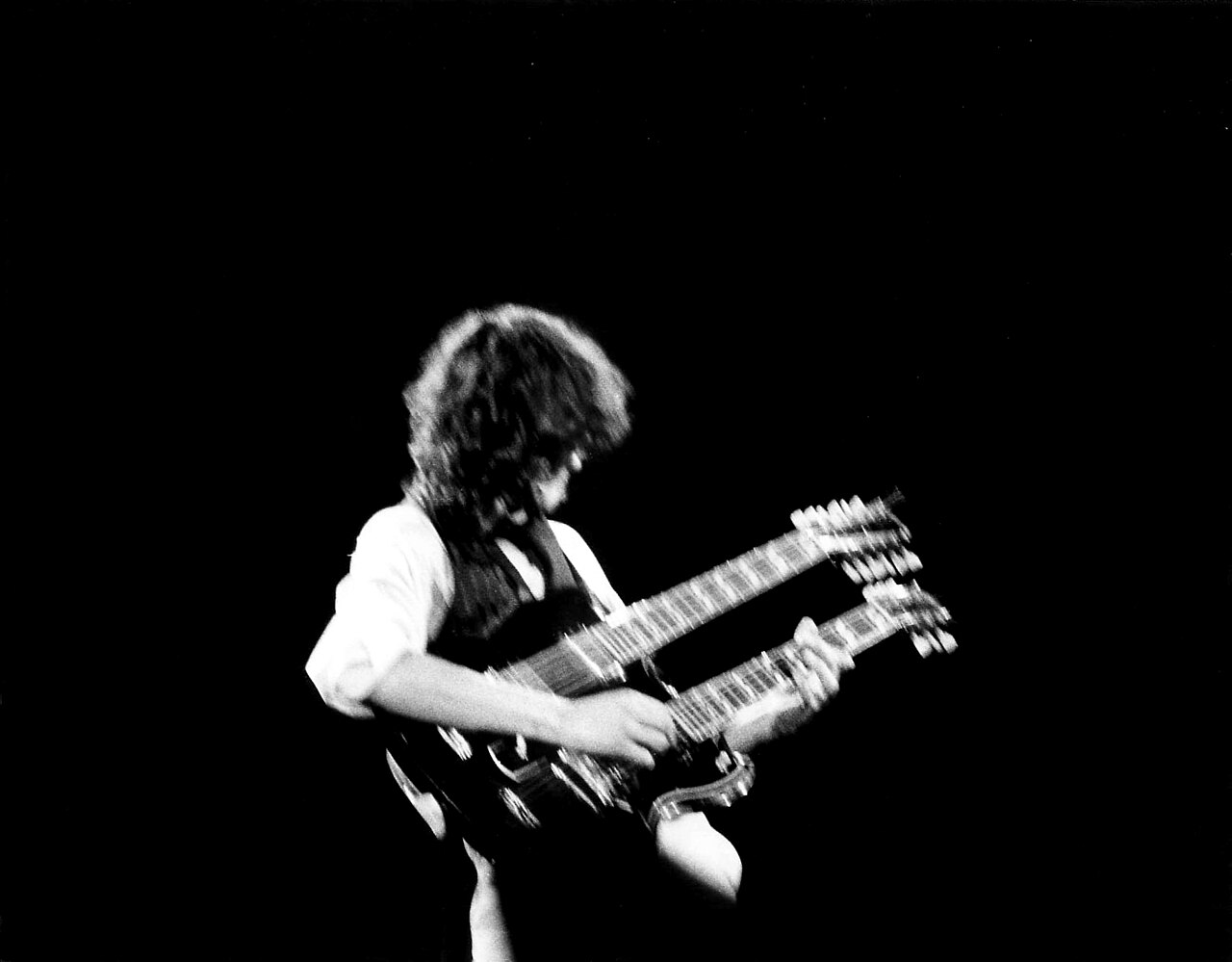
Jimmy Page
Jimmy Page borrowed a J-200 from fellow session musician Jim Sullivan to record the acoustic tracks on Led Zeppelin’s debut album. “Your Time Is Gonna Come,” “Babe I’m Gonna Leave You,” and “Black Mountain Side” are all on a J-200, and Page’s description of the experience is one of the most evocative testimonials to the instrument’s quality: “I’ve never found a guitar of that quality anywhere since. It had heavy gauge strings on it, but it just didn’t seem to feel like it. I could play so easily on it, get a really thick sound.” The “really thick sound” is the SJ-200 at its most characterful — the figured maple body producing bass depth and clarity simultaneously, the enormous top vibrating freely beneath a light touch.
Setup and Playability: Getting the Best from the SJ-200
The SJ-200 is a physically large guitar, and first-time players sometimes find the body dimensions challenging — the width at the lower bout and the depth of the body can make the instrument awkward for players with smaller frames or shorter arms. These are real considerations, but they can be managed, and the sonic reward for adapting to the SJ-200’s physical demands is substantial.
Body Size and Playing Position
The SJ-200’s 16 7/8-inch lower bout is significantly wider than a standard dreadnought (typically 15.5–15.75 inches). This extra width means the right arm must extend slightly further to reach the strings comfortably when seated. Many SJ-200 players find that sitting with the guitar in the classical position — body resting on the left thigh, guitar tilted slightly toward the player — is more comfortable than the standard country/folk position. Standing with a strap is often easier than seated playing for longer sessions. Players with smaller frames should try the J-185 (a slightly narrower Gibson Super Jumbo at 16 inches) or the Everly Brothers J-180 as alternatives before dismissing the SJ-200 format entirely.
String Gauge and Selection
The SJ-200’s 25.5-inch scale length — longer than all other Gibson acoustics — means that medium gauge strings (.013–.056) feel approximately like light gauge strings (.012–.054) on a 24.75-inch scale guitar. This is actually an advantage: you get the volume and projection benefits of medium gauge tension with a feel that is somewhat lighter than the numbers suggest.
- Medium gauge phosphor bronze (.013–.056): The definitive SJ-200 string. Full bass, clear treble, excellent projection. The guitar sounds like itself with these strings. The longer scale manages the tension well; the result is punchy and articulate without feeling stiff.
- Light gauge phosphor bronze (.012–.054): Slightly easier to play, with a more refined and delicate character. The SJ-200 can sound beautiful with lights, particularly for fingerpicking and recording work where you want the guitar’s natural character without its full acoustic force.
- Heavy gauge phosphor bronze (.014–.058): Pete Townshend territory. More volume, more sustain, more physical demand on the left hand. For aggressive strumming and large-venue performance without amplification, this is the choice. Not recommended for extended playing sessions without appropriate hand conditioning.
The LR Baggs Anthem System
The SJ-200 Standard ships with the LR Baggs Anthem — a step up from the VTC system used on the J-45 and Hummingbird. The Anthem combines an undersaddle piezo pickup with an internal microphone, blending the two signals for a more natural amplified sound than a piezo alone can provide. The soundhole-mounted controls include volume, a mix control that adjusts the balance between the mic and the piezo, a phase inversion switch for feedback management, and a battery indicator. This is one of the most sophisticated factory pickup systems available on a production acoustic guitar at any price point.
Townshend’s observation that the SJ-200 is “hard to bring to life with piezo pickups because the sound is so distinctive in real air” remains true even with the Anthem system. For studio recording, microphones remain the superior option. For live performance, the Anthem system is genuinely excellent — but the mix control that blends between the internal microphone and the undersaddle piezo is worth spending time with, as the optimal balance varies with venue size, stage volume, and the type of music being played.
Tone Recipes: The SJ-200 in Different Contexts
Stage Presence — The Acoustic Rock Statement
The SJ-200 is at its most impressive large and loud. This is Pete Townshend’s application: the acoustic guitar as a statement instrument that holds its own on a rock stage.
- Strings: Medium or heavy gauge phosphor bronze
- Technique: Strum with authority — the SJ-200 rewards players who commit to the attack. A light touch produces a beautiful sound; a decisive strum produces something genuinely powerful.
- Live amplification: LR Baggs Anthem to DI. Set the mic/piezo blend toward the microphone (60/40 mic/piezo) for the most natural amplified sound. Cut slightly at 200–300Hz in loud venues to control the low-end before it overwhelms the PA.
- Pro tip: Open tunings unlock something special in the SJ-200. The guitar’s wide frequency response and maple clarity make open chord voicings sound dimensional and complex. Try open D (D-A-D-F#-A-D) for maximum low-end drama.
Studio Recording — Capturing the King
The SJ-200 is notoriously difficult to record badly. Its clarity and projection mean that even an average microphone placement produces a usable result. The challenge is capturing the full scope of the instrument’s character.
- Primary mic: Large-diaphragm condenser at 24–30 inches from the guitar, aimed between the 12th fret and the edge of the soundhole. The SJ-200 projects aggressively; a microphone too close will overload the capsule on hard strums.
- Room mic: The SJ-200 fills a room with resonance; a room mic at 6–8 feet captures this natural ambience and adds a studio-recorded quality that is immediately distinctive. Blend with the close mic to taste.
- EQ: The maple back’s scooped midrange means the SJ-200 needs less mid-cut than mahogany acoustics in a mix. A gentle high-pass at 80Hz to control sub-bass rumble and a slight presence boost at 4kHz often improves definition without disrupting the instrument’s natural balance.
- Pro tip: Record the SJ-200 with its own natural dynamics; do not compress heavily. The dynamic range of this guitar — from whisper to roar — is part of what makes it compelling in a recording.
Singer-Songwriter Accompaniment — Supporting the Voice
The SJ-200’s scooped midrange is its greatest asset in a vocal context. The guitar occupies different frequency space from the voice, creating a natural separation that requires minimal EQ.
- Strings: Light gauge phosphor bronze (.012–.054) for a warmer, less aggressive character
- Technique: Fingerpicking or light strumming with a medium pick. Roll the instrument’s dynamics back from its full-force character; let the voice lead.
- Mic placement for recording: Small-diaphragm condenser at the 12th fret, 20 inches away. This position captures the guitar’s midrange presence while minimising the bass extension that could crowd the vocal.
- Pro tip: Try Nashville tuning — replacing the bottom four strings with strings tuned an octave higher — for a distinctive, chiming accompaniment texture. The SJ-200’s clarity makes Nashville-tuned playing extraordinarily vivid.
Fingerpicking and Celtic/Folk Work
The SJ-200 rewards patient fingerpicking work. Page’s acoustic Led Zeppelin recordings are the reference: delicate, precisely voiced, with the maple clarity allowing each note to speak distinctly even in complex fingerstyle arrangements.
- Strings: Light gauge phosphor bronze
- Technique: Thumb and fingers; classical-position seating for maximum control of the large body
- Tuning: Celtic DADGAD tuning produces extraordinary results on the SJ-200 — the guitar’s bass extension and maple clarity make the open-string drones ring with unusual richness
- Pro tip: The SJ-200 fingerpicks most beautifully when the right hand is positioned toward the soundhole rather than the bridge. This position captures the warmth of the maple body rather than the brightness of the string close to its termination point.
Current Models: The SJ-200 Family in 2026
Gibson produces several SJ-200 variants, each with distinct tonal and visual character.
SJ-200 Standard (Maple)
The definitive version — the guitar this article is about. AAA figured maple back and sides, solid AAA Sitka spruce top, hand-scalloped X-bracing, two-piece maple neck with walnut stringer, 25.5-inch scale, rosewood fingerboard with graduated crown mother-of-pearl inlays, moustache rosewood bridge, TUSQ nut and saddle, gold Grover Rotomatic tuners, LR Baggs Anthem pickup system, gloss nitrocellulose lacquer finish. Available in a range of finishes including Antique Natural, Vintage Sunburst, and various burst options. Hardshell case included. Built in Bozeman, Montana.
SJ-200 Standard Rosewood
A significant departure from the maple standard: rosewood back and sides bring the original 1937–1946 tonewood choice back to the modern production line. Rosewood produces a warmer, more complex character than maple — less scooped in the midrange, with more overtone complexity and a fuller low-end. The rosewood SJ-200 sounds closer to a mahogany guitar (though larger) than the maple version; it is less percussive, more sustained, and somewhat warmer in the vocal range. An excellent choice for players who want the SJ-200’s body size and visual presence but prefer a warmer tonal character than maple provides. Pairs with an LR Baggs Anthem pickup system and Grover Imperial tuners.
SJ-200 Original / Vintage
Higher-spec variants with thermally aged tops, vintage-style hardware, and construction choices closer to the golden-era instruments. These are premium instruments at premium prices, built for players and collectors who want the closest approximation to the original Kalamazoo-made SJ-200s in a new guitar. Thermally aged tops behave acoustically more like aged wood, with the crystallised wood sugars that make vintage guitars sound more open and complex than new instruments. No factory electronics; if you perform live, plan to add a pickup or use external microphones.
Vintage SJ-200s (1937–1969)
Pre-war rosewood models (1937–1942) are among the most valuable acoustic guitars in existence — condition-dependent values of $90,000 to $120,000 have been documented. Post-war maple models from the late 1940s through early 1960s command significantly less but still represent serious collector territory. The early maple models — from the period before significant bracing changes in the early 1960s — are the most sought-after for tonal quality. As with all vintage acoustics, condition and originality are paramount: look for uncracked tops, original finish, matching-era tuners, and an original moustache bridge saddle. Have any significant vintage acquisition authenticated by a specialist before purchasing.
The SJ-200 vs. the Competition
The SJ-200’s internal competitors within Gibson’s lineup are the J-45 and the Hummingbird. Both use mahogany back and sides and the 24.75-inch scale; both are warmer, more midrange-focused instruments. The SJ-200’s maple body, longer scale, and larger body produce a fundamentally different character — brighter, louder, more percussive, with the scooped midrange that makes it such a natural vocal guitar. The J-45 is the intimate companion; the Hummingbird is the assertive statement; the SJ-200 is the showpiece.
Against the Martin D-28, the comparison is instructive: both are large acoustic guitars with spruce tops, but the Martin’s rosewood back and sides produce a warmer, more complex sound than the SJ-200’s maple, and the Martin dreadnought body is significantly smaller than the Super Jumbo. The D-28 is more compact and somewhat more versatile across styles; the SJ-200 is louder, more visually dramatic, and more tonally distinctive.
There is genuinely no acoustic guitar that sounds like the SJ-200 from any manufacturer. The combination of the super jumbo body, the maple back and sides, the longer scale, and the moustache bridge produces a character that is entirely its own — bright but warm, loud but articulate, enormous but precise. You either want that sound or you do not. If you do, there is only one guitar.
Who Should Play the Gibson SJ-200 Standard?
The SJ-200 is for players who want the maximum acoustic guitar experience — the loudest, the most projecting, the most visually spectacular instrument Gibson makes. It rewards musicians who play for rooms rather than for headphones, who strum with authority and want the guitar to respond with authority, who understand that an acoustic guitar can make a visual statement as powerful as any electric.
It is the natural choice for performers who sing while they play and want a guitar that frames their voice without competing with it — the maple-backed scooped midrange is genuinely the most singer-friendly tonal character of any acoustic guitar design. The frequency separation between guitar and voice is almost automatic.
And it is, simply, the guitar for players who want the best. Not the most refined or the most technically precise or the most studio-optimised — the J-45 and the Hummingbird can make those claims in their respective domains. The SJ-200 is the best at being the SJ-200: the most imposing, most theatrical, most physically commanding acoustic guitar in the world, the guitar that has attracted the most famous musicians across the most genres over the longest time, the guitar that Gibson called King of the Flat-Tops and has spent nearly ninety years proving they were right to do so.
Buying Guide Summary
$3,500–$4,500 — SJ-200 Standard (Maple): The core instrument and the one that defines the model. AAA figured maple, LR Baggs Anthem electronics, Bozeman construction. Try multiple examples; the flame figure varies significantly between units and some are more visually spectacular than others. The tonal character is more consistent. A professional setup post-purchase is recommended for optimal action at the 25.5-inch scale length.
$4,500–$6,000 — SJ-200 Standard Rosewood: For players who want the SJ-200’s body and visual presence with a warmer, more complex tonal character. Closer to the 1937 original tonewood specification. An excellent option for singer-songwriters who find the maple standard too bright or too percussive.
$5,000–$8,000 — SJ-200 Original / Vintage: Thermally aged tops, vintage hardware, no factory electronics. The premium choice for players who want the closest approximation to a historic SJ-200 in a new instrument.
Vintage ($8,000+): Post-war maple models from the late 1940s through early 1960s. Pre-war rosewood models from 1937–1942 command exponentially higher prices and are genuine collector’s items. Authentication and specialist inspection are essential before any vintage SJ-200 purchase.
Frequently Asked Questions
What is the difference between the SJ-200 and the J-200?
They are the same guitar. Gibson introduced the instrument in 1937 as the Super Jumbo, changed the name to Super Jumbo 200 (SJ-200) in 1939, dropped the “S” prefix in 1955 (J-200), and has since used both designations at various points. The current production model is marketed as the SJ-200, though many players and retailers still use J-200. The instruments are identical — the naming history is simply a product of Gibson’s evolving marketing decisions over nine decades.
Why does the SJ-200 use maple instead of rosewood or mahogany?
The original 1937–1942 SJ-200 used rosewood back and sides. In 1947, Gibson switched to figured maple — a change driven partly by materials availability and partly by the sonic preference of players at the time. Maple’s brighter, more percussive character and its scooped midrange turned out to suit the SJ-200’s intended use case — vocal accompaniment and stage performance — particularly well. The maple SJ-200 quickly became the definitive version of the instrument, and the current Standard maintains that maple tradition. Gibson has periodically offered rosewood variants for players who prefer that warmer character.
Is the SJ-200 difficult to play because of its size?
The SJ-200 is physically larger than most acoustic guitars — its 16 7/8-inch lower bout is wider than a dreadnought, and the deep body requires a somewhat different playing posture. Many players find the guitar perfectly comfortable after an adjustment period; others find the size a persistent challenge. The 25.5-inch scale length (longer than Gibson’s other acoustics) means strings feel slightly tighter at comparable gauges, though many players find medium gauge strings (.013–.056) on the SJ-200 feel similar to light gauge on a shorter-scale guitar. If the standard SJ-200 feels too large, the Gibson J-185 (a slightly narrower 16-inch version of the same concept) offers a more manageable alternative with similar tonal character.
What recordings feature the SJ-200 most prominently?
The acoustic tracks on Led Zeppelin’s debut album — “Babe I’m Gonna Leave You,” “Your Time Is Gonna Come,” and “Black Mountain Side” — were recorded on a J-200 borrowed by Jimmy Page. Pete Townshend’s intro to “Pinball Wizard” is one of the most recognised SJ-200 moments in rock. George Harrison’s work on the Beatles’ White Album and Let It Be, and his compositions on All Things Must Pass, were developed on a J-200. Bob Dylan’s Nashville Skyline era features the guitar prominently. The Everly Brothers, whose J-180 (a slightly smaller cousin of the SJ-200) is named after them, shaped the sound of early rock and roll acoustic guitar work on related Gibson super jumbo instruments.
How does the SJ-200 record compared to other acoustic guitars?
The SJ-200 is one of the most distinctive-sounding acoustic guitars to record — immediately recognisable for its bright, slightly scooped midrange character and its wide dynamic range. It requires somewhat more microphone distance than smaller acoustics (24–30 inches rather than 12–18) because of its aggressive projection. The maple back and sides mean less low-end buildup than mahogany instruments, which actually makes the SJ-200 somewhat easier to EQ in a mix — the scooped midrange creates natural space for vocals, and the bright treble response sits clearly above bass and rhythm instruments. The guitar can sound overwhelming if recorded too close or with too much low-end emphasis; captured well, it produces a sound that is immediately arresting.
Does the SJ-200 work for fingerpicking?
Absolutely, and it excels at it. Jimmy Page’s acoustic Led Zeppelin work is the definitive evidence: the guitar’s clarity and note separation make complex fingerstyle arrangements speak clearly, with each note retaining its individual character rather than blending into a warm mass. Light gauge strings and a position of the right hand toward the soundhole (rather than the bridge) brings out the SJ-200’s warmth and reduces the maple brightness that can make the guitar feel too crisp in a delicate fingerstyle context. The guitar is most associated with strumming and projecting performance, but it is genuinely versatile.
What is the best way to amplify the SJ-200 live?
The LR Baggs Anthem system included with the Standard is the best factory pickup option Gibson has ever fitted to a production acoustic. It combines an undersaddle piezo with an internal microphone, and the blend between them is the key to getting a good amplified sound. A microphone-heavy blend (60–70% mic) sounds more natural; a piezo-heavy blend is more feedback-resistant. For most live situations, start at an even 50/50 blend and adjust based on the stage volume and monitor level. For large stages with high monitor levels, favour the piezo to reduce feedback risk. For intimate performances where fidelity matters most, favour the internal microphone. Townshend’s observation about the difficulty of amplifying the SJ-200 remains valid — the guitar’s real voice is in real air — but the Anthem system gets closer to that natural sound than any previous factory solution.
Image credits
- Bob Dylan: Don Hunstein, Wikimedia Commons, Public domain.
- Jimmy Page: Andrew Smith, Wikimedia Commons, CC BY-SA 4.0.
- Pete Townshend: Kubacheck, Wikimedia Commons, CC BY 2.0.
- Top image: Gibson SJ-200 Standard in Antique Natural finish, photographed 1 November 2014. Photo: Gibb Stutz. Source photograph · CC BY 3.0. Full source frame resized for web display; no crop or retouching.
Latest News
Related
On This Day
Tuesday 10 November
From this week: